
Head of AI Transformation | Scaling AI from Pilot to Production | Driving Measurable Business Outcomes
Joined March 2025
- Tweets 125
- Following 125
- Followers 22
- Likes 39
7 Photos and videos


Pinned Tweet

13 Jun 2025
After months of writing, stats, caffeine, and existential dread... my dissertation has officially landed on ProQuest!
I studied how AI code generation affects developer productivity so you don’t have to.
proquest.com/docview/3217383…
#DeveloperProductivity #AI
1
3
173
May 21
Why Human-in-the-Loop Isn’t Optional
There’s a common idea in AI:
“The goal is full automation.”
In practice, that’s rarely how successful systems work.
Most real AI systems rely on:
👉 human-in-the-loop design
Not as a fallback.
As a core part of the system.
Here’s why:
1. Trust doesn’t exist by default
Users need to see, validate, and understand outputs before relying on them
2. Edge cases are everywhere
No model handles every scenario cleanly
3. Context still matters
Humans bring situational awareness that systems don’t fully capture
4. It enables learning
Human feedback improves the system over time
Where companies go wrong:
They design AI as:
Fully automated from day one
Or completely manual with no leverage
The reality is in between.
Good systems:
Use AI to accelerate decisions
Keep humans where judgment matters
Gradually increase automation over time
Human-in-the-loop isn’t a weakness.
It’s how systems actually scale.
If you’re building or deploying AI right now, this is one of the most important design decisions you’ll make.
I’ll go deeper into this in future posts.
If you want a structured way to approach system design, I’ve outlined it here:
👉 drscottmorgan.com
3
May 20
Decision Support vs Automation
Most companies are trying to use AI to automate everything.
That’s the wrong starting point.
Not every decision should be automated.
The real question is:
👉 Should this be decision support… or full automation?
Here’s how I think about it:
Decision Support
High cost of being wrong
Requires human judgment
AI provides recommendations, not final decisions
Automation
High frequency
Low variability
Low cost of failure (or well-controlled)
Clear inputs and outputs
Where companies go wrong:
They try to automate decisions that:
Are ambiguous
Carry high risk
Require context the model doesn’t have
And when it fails, trust is lost immediately.
A better approach:
Start with decision support
Build confidence
Then selectively automate
AI isn’t about replacing humans everywhere.
It’s about placing the system at the right point in the decision flow.
That’s where the real leverage is.
If you’re working through this tradeoff, I’d be interested to hear how you’re approaching it.
And if you want a structured way to think about these decisions, I’ve outlined my approach here:
👉 drscottmorgan.com
5
May 19
Why Most AI Use Cases Are Wrong
Most AI use cases sound good.
That’s the problem.
They’re framed as:
“Let’s use AI to improve X”
“Let’s build a chatbot for Y”
“Let’s automate this process”
But they’re missing one thing:
A decision.
AI is not about features.
It’s about decisions.
If your use case doesn’t clearly answer:
👉 What decision is being made differently?
…it’s probably wrong.
Strong AI systems:
Support or automate decisions
Reduce cycle time
Improve consistency
Change outcomes
Weak ones:
Add another tool
Sit outside the workflow
Depend on user choice
Don’t impact real metrics
This is why so many AI initiatives stall.
They’re not tied to how the business actually runs.
They’re layered on top of it.
The shift is simple, but critical:
From:
“Where can we use AI?”
To:
“Where are decisions being made at scale?”
That’s where the real leverage is.
That’s where AI works.
I’ll break this down further in future posts.
If this is something you’re thinking through, I’ve put a structured approach together here:
👉 drscottmorgan.com
3
May 13
Most AI projects don’t fail; they stall. This is often more detrimental because a stalled AI initiative can appear to be making progress. There may be a pilot, the model may “work,” and there could be demos and updates, yet nothing changes in the business. There is no real adoption, no workflow integration, and no measurable impact.
I've observed a recurring pattern with stalled initiatives:
1. The use case was never strong enough - It sounded interesting but lacked real operational leverage.
2. No one actually owned the outcome - There may be an “AI team,” but there is no accountable operator.
3. It lives outside the workflow - Users must choose to use it, and often they don’t.
4. It’s not tied to financial results - Consequently, it never becomes a priority.
At this stage, the initiative doesn’t fail; it simply sits there. I refer to this as pilot purgatory, and many companies find themselves in it.
Scaling AI isn’t just about improving the model; it’s about addressing:
- Ownership
- Integration
- Measurement
This distinction is crucial between a working demo and a functioning business system. I will break down how to avoid this in upcoming posts. If this resonates with you, you are not alone. For those looking to move beyond pilots into something tangible, I’ve outlined my approach here:
👉 drscottmorgan.com
6
May 12
AI doesn’t fail because the models don’t work; it fails because organizations don’t know how to scale it. Over the past year, I’ve been immersed in enterprise AI delivery, focusing on real systems, workflows, and financial outcomes.
Here’s what I’ve observed:
Most companies aren’t struggling with AI capability; they’re struggling with AI implementation. They build:
- Impressive pilots
- Smart models
- Interesting demos
…but they often fail to translate that into:
- Workflow integration
- Adoption
- Measurable business impact
As a result, initiatives stall—not because the AI failed, but because the supporting system never existed.
After witnessing this pattern repeatedly, I started structuring the problem to connect:
- Use-case selection
- System design
- Workflow integration
- Governance
- Financial outcomes
I call it the AI Scale Framework (AISF). This framework helps move AI from experimentation to production and ultimately to EBITDA impact.
In the coming months, I will break this down in detail, discussing what works, what doesn’t, and what actually scales in real organizations. If you’re navigating AI in your company, I’d like to hear where you’re facing challenges.
For those interested in a deeper dive, I’ve compiled the full framework here: drscottmorgan.com
6
30 Sep 2025
How easy is it to create a lesson plan in Plansora? Find out here - youtube.com/watch?v=ixwWppOg…
1
86
18 Sep 2025
AI data preparation is transforming analytics workflows. By automating data cleansing and integration, organizations can save up to 80% of the time spent on these tasks, allowing data scientists to focus on higher-value initiatives. #AIinData
27
17 Sep 2025
In exploring AI code generation, a recent study reveals that developer productivity can increase by up to 50% when incorporating intelligent tools. This shift highlights the evolving role of developers as they transition from writing to refining code. #devproductivity
47
17 Sep 2025
Retrieval Augmented Generation (RAG) is enhancing the capabilities of language models by integrating external knowledge sources. This development promises more accurate and contextually relevant outputs, which is crucial for applications in enterprise. #RAG
12
16 Sep 2025
Retrieval Augmented Generation is enhancing natural language processing by combining retrieval techniques with generative AI. This hybrid approach promises improved context and accuracy in generated outputs, reflecting a significant shift in AI capabilities. #RAG
10


10 Sep 2025
Every classroom is different.
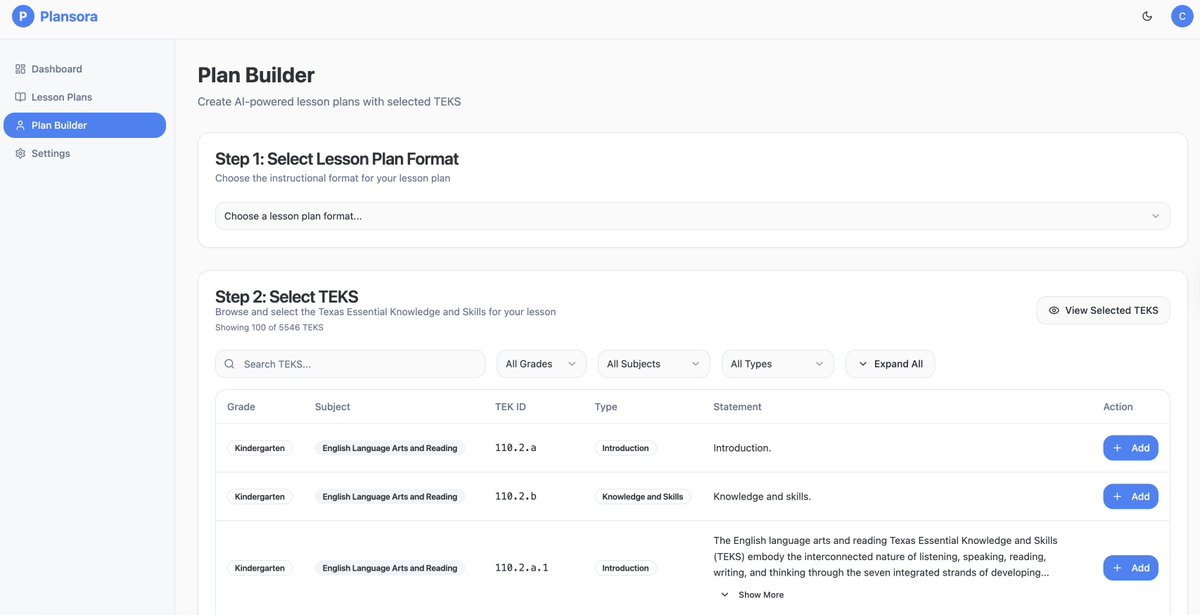
That’s why Plansora lets you choose your lesson plan format and instantly generate plans powered by TEKS standards. 📝✨ plansora.com
Customizable. Aligned. Ready in minutes.
#TeacherTwitter #EdTech #AIart
73
10 Sep 2025
Teachers in Texas know the importance of TEKS. 📚
With Plansora, you can browse TEKS standards and build AI-powered lesson plans aligned to exactly what your students need. plansora.com
Save time. Stay aligned. Teach with confidence.
#EdTech #TEKS #AIinEducation
1
13
Dr. Scott Morgan retweeted
8 Sep 2025
🚀 Excited to share what I’ve been building: Plansora.
An AI-powered lesson plan generator designed to save teachers hours of prep time.
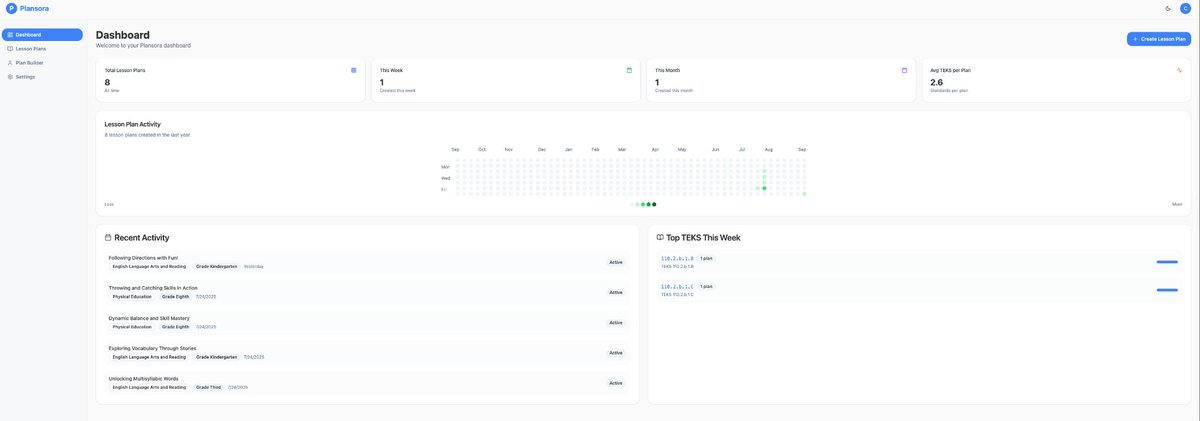
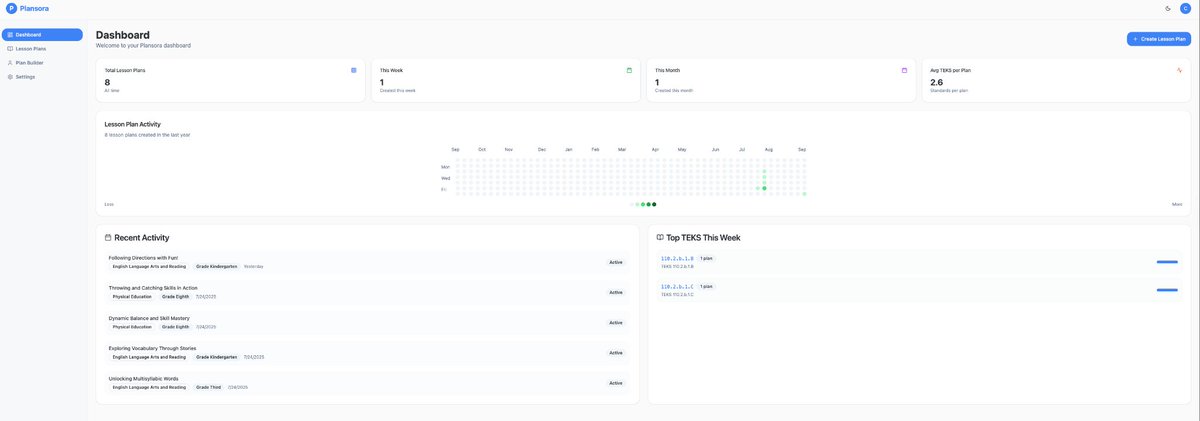
Imagine creating standards-aligned lesson plans in minutes instead of hours. plansora.com
Early preview 👇
#EdTech #AI
1
25
Dr. Scott Morgan retweeted
8 Sep 2025
If ChatGPT can help write essays…
…why not lesson plans?
That’s exactly what I’m building with Plansora.
AI-generated, TEKS-aligned plans to save teachers time. plansora.com
Want early access? Follow along 👇
#EdTech
1
19
8 Sep 2025
AI-driven Data Preparation is reshaping how organizations handle their datasets. These tools streamline the cleansing and transformation processes, ultimately enabling more accurate analytics and informed decision-making. A game changer for data-driven strategies. #DataPreparation
6
8 Sep 2025
Teachers spend countless hours planning lessons.
📚 What if AI could cut that down to minutes?
That’s the mission of Plansora — an AI tool that builds TEKS-aligned lesson plans fast.
plansora.com
More to come soon. Stay tuned!
#EdTech #TeacherLife
10