
cofounder cto @boldmetrics / oss @smallharness / early @ sonos / eng @ carnegie mellon / at home in the forest 🌲
Joined January 2009
- Tweets 71,066
- Following 807
- Followers 38,552
- Likes 77,477
7,841 Photos and videos









Pinned Tweet

Jun 13
I was honored when Nick asked if I wanted to be on the pod, this was a lot of fun.
If you’ve ever wanted to learn more about me, my journey, and why I’m so damn excited all the time, give this a listen.
Jun 13

Banger of an interview with @morganlinton! Heart for humanity, curiosity for ai, and drive to build. A man for the moment!
podcasts.apple.com/us/podcas…
2
10
2,316
Okay, Fable is coming back, and we have Strawberry man to thank 🍓

fable is coming back and i played a small part.
i feel good once more.
1
11
1,403
Must read for anyone who uses the Codex mobile app.
I thought I knew this app pretty well, realized I’m still just scratching the surface.
Wayyyyy better than using Termius on your phone and squinting to navigate a CLI on a tiny screen 🧐

3
24
6,101
Okay, I've been really in a groove with @smallharness today, so decided to finally cut the feature I felt like I need for a true v1.0 release.
And this is, model routing...but kinda model routing Morgan-style I guess, because I've been testing out different approaches lately, and found something pretty interesting.
At a high level, I've been thinking that it doesn't make sense to have one model to orchestrate, one to write code, and one to review, and I've been playing around with different configurations.
What I've determined, at least for me, lately, is that I actually want a different model to orchestrate simple tasks vs. complex tasks, and I also want different agents to do coding tasks, based on how much thinking depth/tool calling I need, etc.
Also in some cases, I might want the same model but at different effort levels, like I learned with Fable where I could do a lot more with low than I expected, but there were some tasks I wanted medium for, and of course, crazy complex architecture stuff that I wanted high or even max for.
Same for code review. For MVPs and stuff I'm playing with, I just want fast and cheap, simple code review. But for production code, then I want way more in-depth code review, a better, more expensive model that goes much deeper.
I've come up with a series of roles, and this is all now built into Small Harness. Finally got my idea, into code, and into a harness that can help you write code, using this methodology.
Here's the high-level on it.
The Roles
-----------
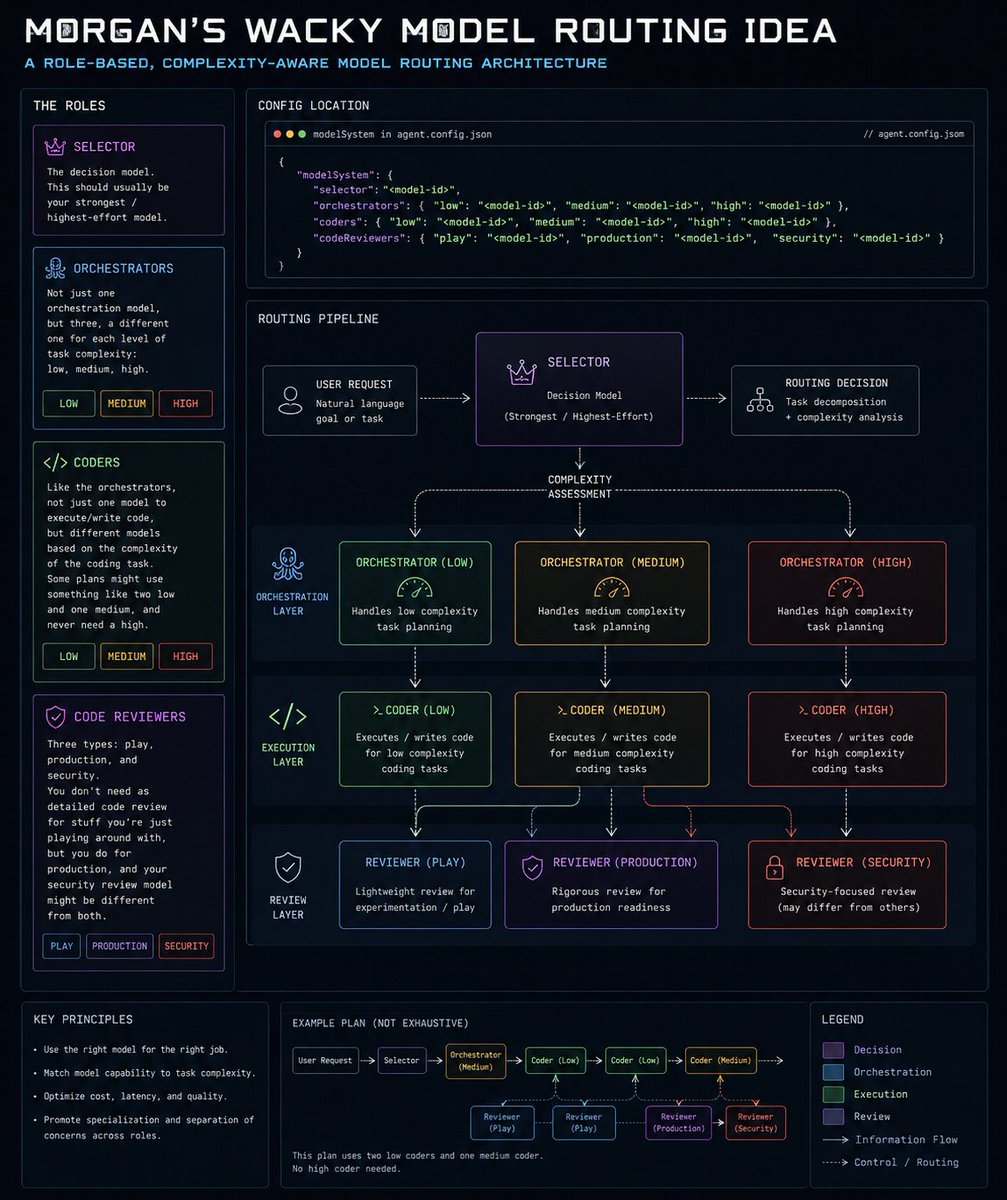
The config lives under modelSystem in agent.config.json:
👑 Selector: the decision model. This should usually be your strongest/highest-effort model.
🐙 Orchestrators: not just one orchestration model, but three, a different one for each level of task complexity: low, medium, high.
🧑💻 Coders: like the orchestrators, not just one model to execute/write code, but different models based on the complexity of the coding task. Some plans might use something like two low and one medium, and never need a high.
✅ Code reviewers: three types, play, production, and security. You don't need as detailed code review for stuff you're just playing around with, but you do for production, and your security review model might be different from both.
And I made a chart, aptly titled, Morgan's Wacky Model Routing Idea. That you can look at if you want to do a little deeper dive into what I'm thinking here.
Now live on Github, free and open source, link to the rep in first comment below.
6
10
2,438
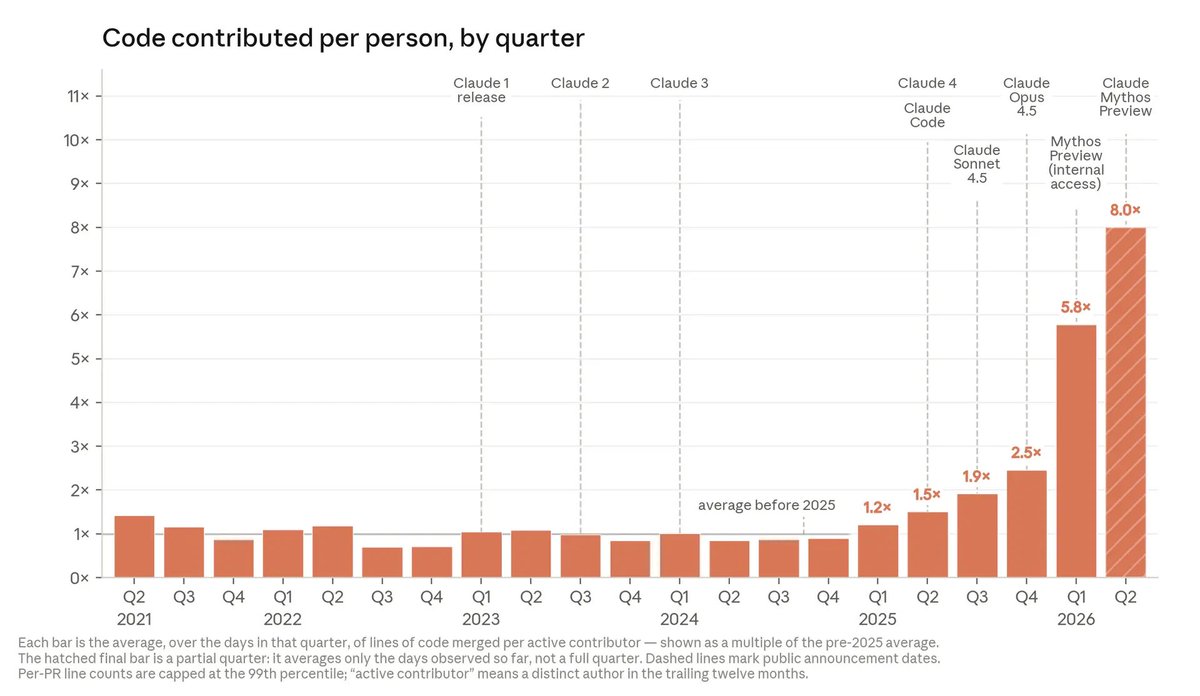
Recently Anthropic put out an article with a chart showing how many more lines of code their engineers are writing now, thanks to Mythos.
But the best engineers I know, like @ThePrimeagen, brag about how many lines of code they are getting rid of.
We need better metrics to track engineering progress. Lines of code go up, doesn’t work.

6
3
24
2,629
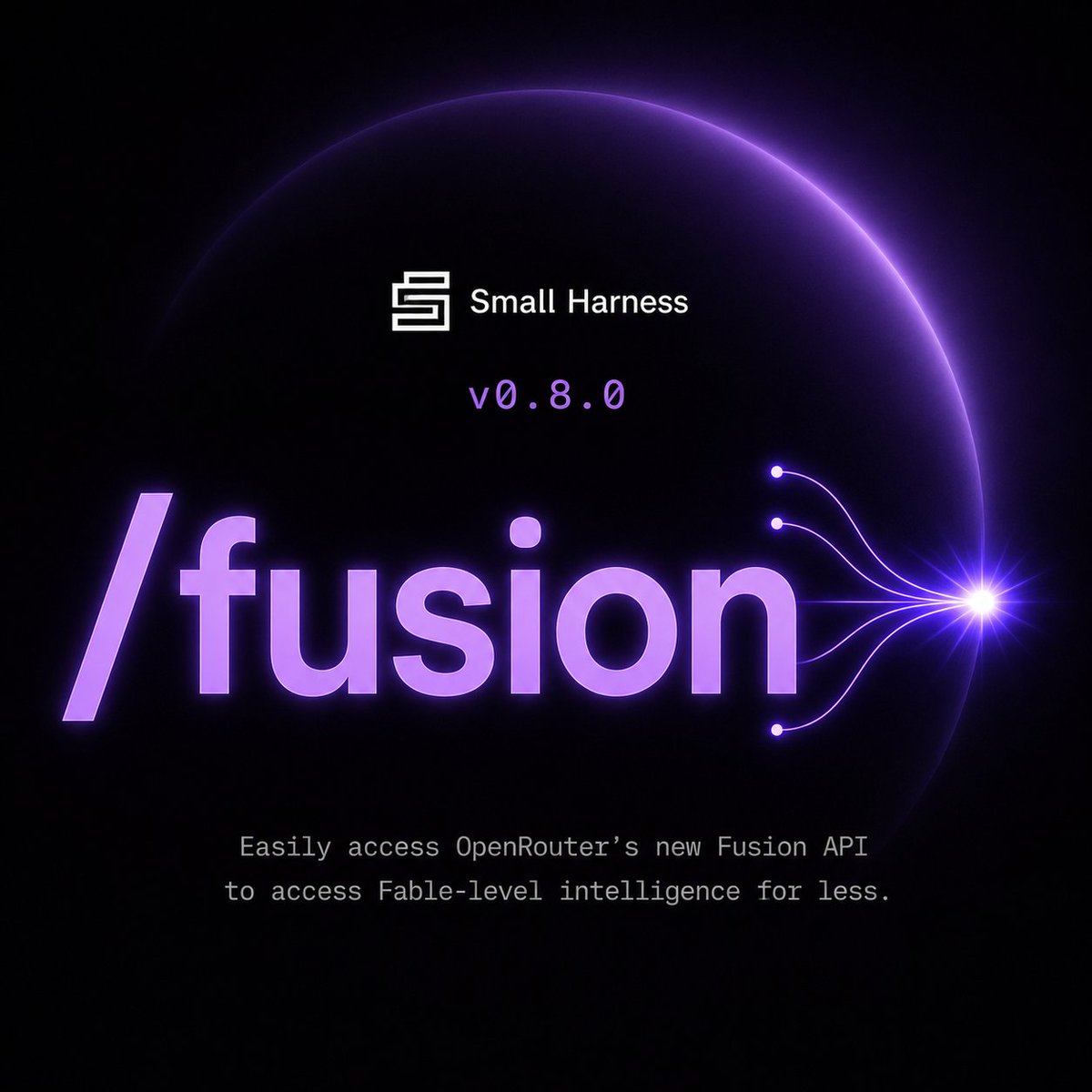
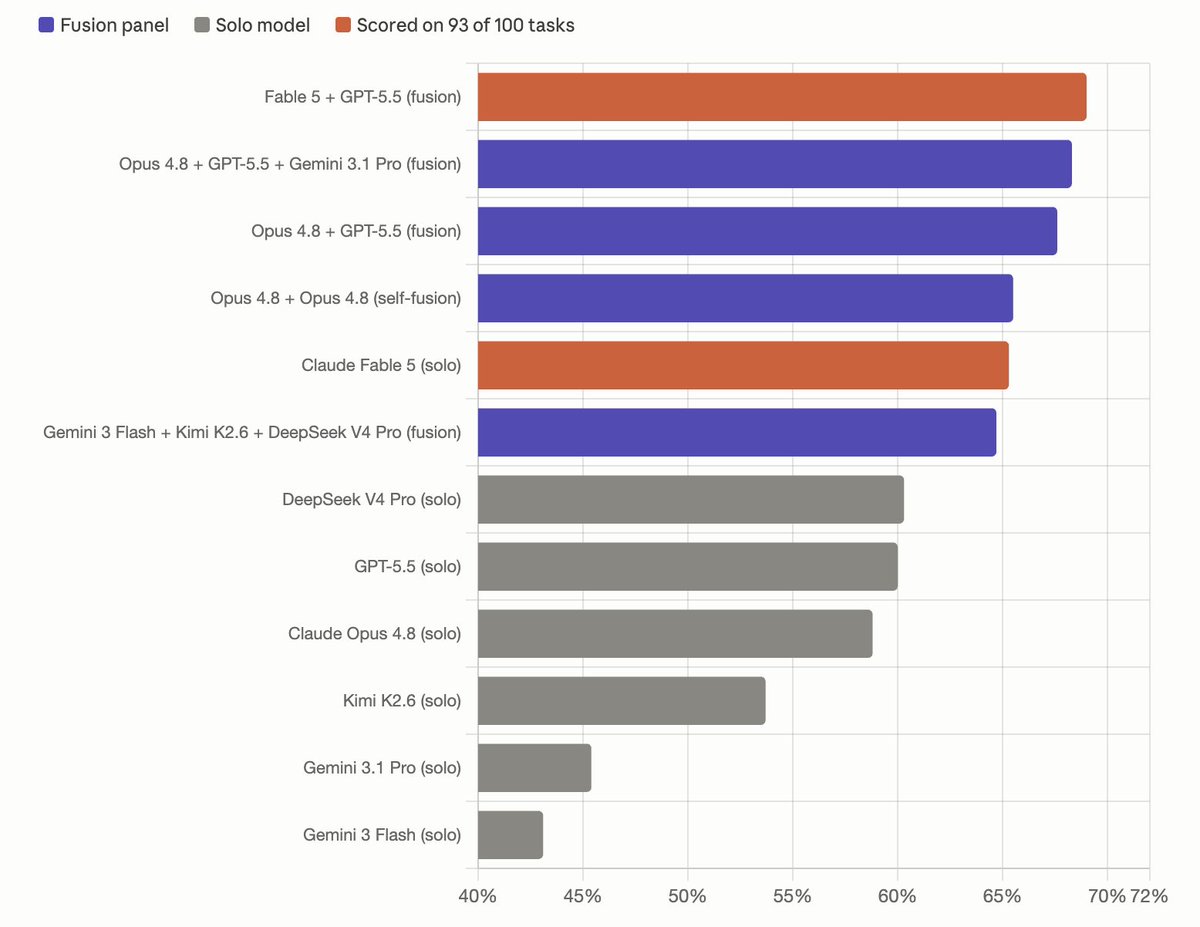
Okay, officially too excited about Fusion from OpenRouter not to add a dedicated command for it directly to Small Harness.
Don't wait for Anthropic to make Fable 5 available, get the same level of intelligence for half the cost.
Now built-into Small Harness.
Small harness is free and open source, so use it out of the box, or fork it and make it your own.
Link to gh repo in first comment below.
Jun 13

Introducing the Fusion API, the smartest compound model in the market.
Fusion achieves Fable-level intelligence at half the price.
How it works 👇
13
7
141
21,692
Great interview, and despite what Matt says, I think he’s an awesome engineer.

"I'm not an engineer but somehow I'm able to ship things of value, which is crazy and weird and still blowing my mind."
Here's my new episode with @mvanhorn, a non-technical founder who has contributed to 100 open source projects and reached 44K GitHub stars despite not knowing how to code.
We cover:
→ How he uses Compound Engineering to build without reading code or plans
→ How you can use Printing Press to give your agent access to almost any website or app
→ How he contributed to Python, Go, OpenClaw, and other top repos
Some quotes from Matt:
"My favorite tool for building anything is Compound Engineering. The killer skills are CE plan and CE work."
"What if anyone could print their own CLI? Google Flights and Kayak don't have an official API, but Printing Press lets you find all the secret APIs that exist."
"Just build, just launch. It's okay even if you build something for yourself. Even if I had no users of Agent Cookie, I get value out of it."
📌 Watch now: youtu.be/BxEf3RqIHkw
Thanks to our sponsor:
@RiversidedotFM: All-in-one AI studio for podcasts and video creators.riverside.com/Peter…
@wisprflow: 4x faster than typing with your voice ref.wisprflow.ai/peteryang
3
13
2,729
Very excited about this update, it solves a problem I constantly find myself running into with coding agents.
Try it out.

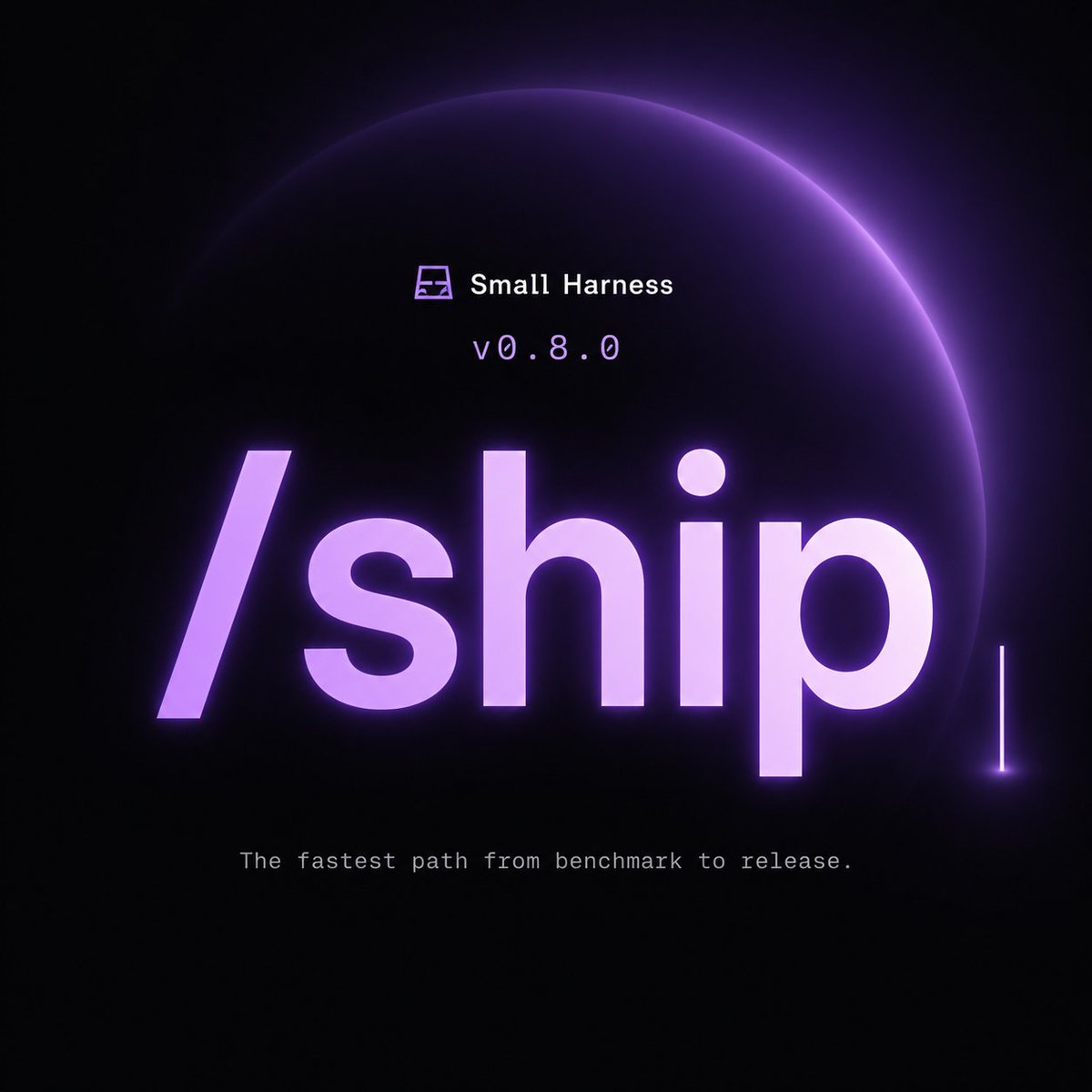
Small Harness v0.8.0 is here, now live on Github.
This update adds /ship, a last-mile workflow for coding agents.
It checks readiness, drafts the commit, creates guarded commits, pushes, opens a GitHub PR, and reports PR/CI status from the terminal.
With most coding harnesses, you finish a change, then still have to ask:
Did I run the right tests?
Is my branch behind?
Are there unstaged or untracked files?
What should the commit message be?
Did I accidentally include local junk?
Did the push work?
Is the PR open?
Are CI checks green?
/ship turns that last-mile checklist into one guided flow inside the same coding harness.
4
1
20
4,797
21h
Congratulations to the New York Knicks, amazing team effort, well deserved, now to fly back home as champions! 🏆 🗽

1
3
1,096
Jun 13
Greg’s right, it’s time to go local.
Jun 13

Fable is banned. Long live local AI.
Full episode breaking down exactly how to get good at local models. the runtime, the hardware, quantization, connecting it to Hermes agent and local AI startup ideas (25 minutes)
4
24
4,965


Jun 13
This is pretty incredible, very much aligned to how my brain has been rewired lately.
Jun 13
Introducing the Fusion API, the smartest compound model in the market.
Fusion achieves Fable-level intelligence at half the price.
How it works 👇
6
1
20
2,038
Jun 13
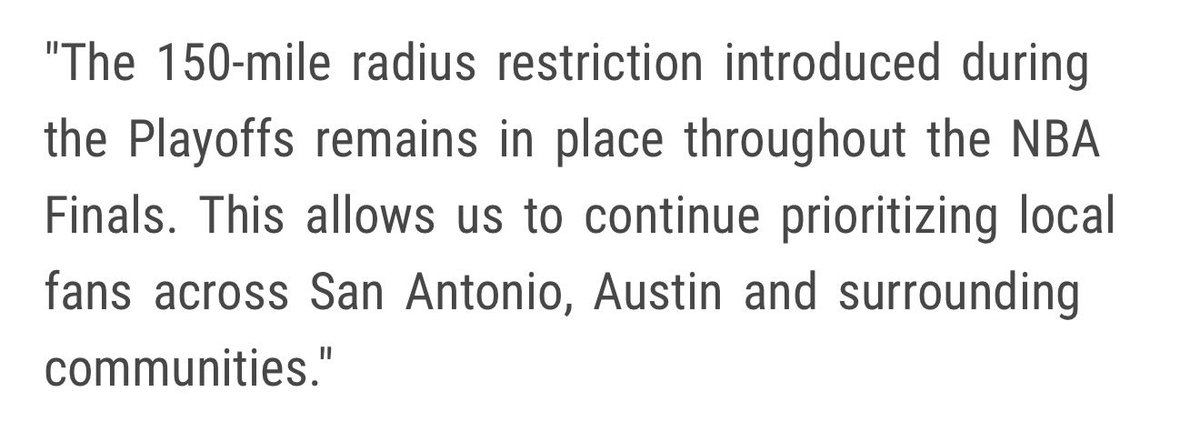
It looks like the media is trying to make a story around something that isn’t actually new.
The Spurs introduced a 150-mile restriction during the playoffs. This has been in place since the playoffs started, and was in effect for the first two finals game.
This is nothing new, and as we already know, the rules don’t apply to celebrities.
Ben and Timothy will be there.
But great story to run to get lots of eyeballs today.
2
2
1,199
Jun 13
My theory on the Fable 5 suspension 🙋♂️
Amazon somehow can generator more revenue, and thus benefits their shareholders, if Anthropic gets hurt.
I’m not sure if they want OpenAI to do better, haven’t gone very deep yet, but they clearly want Anthropic to struggle.
Over the coming weeks, we’ll see what horse Amazon is betting on, and this will all make more sense.
But this has nothing to do with model security, this is a business move, made by a big business, to impact shareholder value.
As simple as that.
My guess is, if you have Amazon stock, you will find out over the next few weeks, why this move by Amazon, to hobble Anthropic, makes the stock price go brrrrr.
More to come, I obviously have no inside information, but that’s my theory, and next week we’re going to learn a lot more.
And I’m probably going to buy some Amazon stock on Monday, full transparency, because I think they know what they’re doing, and if other ppl are going to make money off of it, why not me?
I have no horses in this race.
15
1
21
7,928
Jun 13
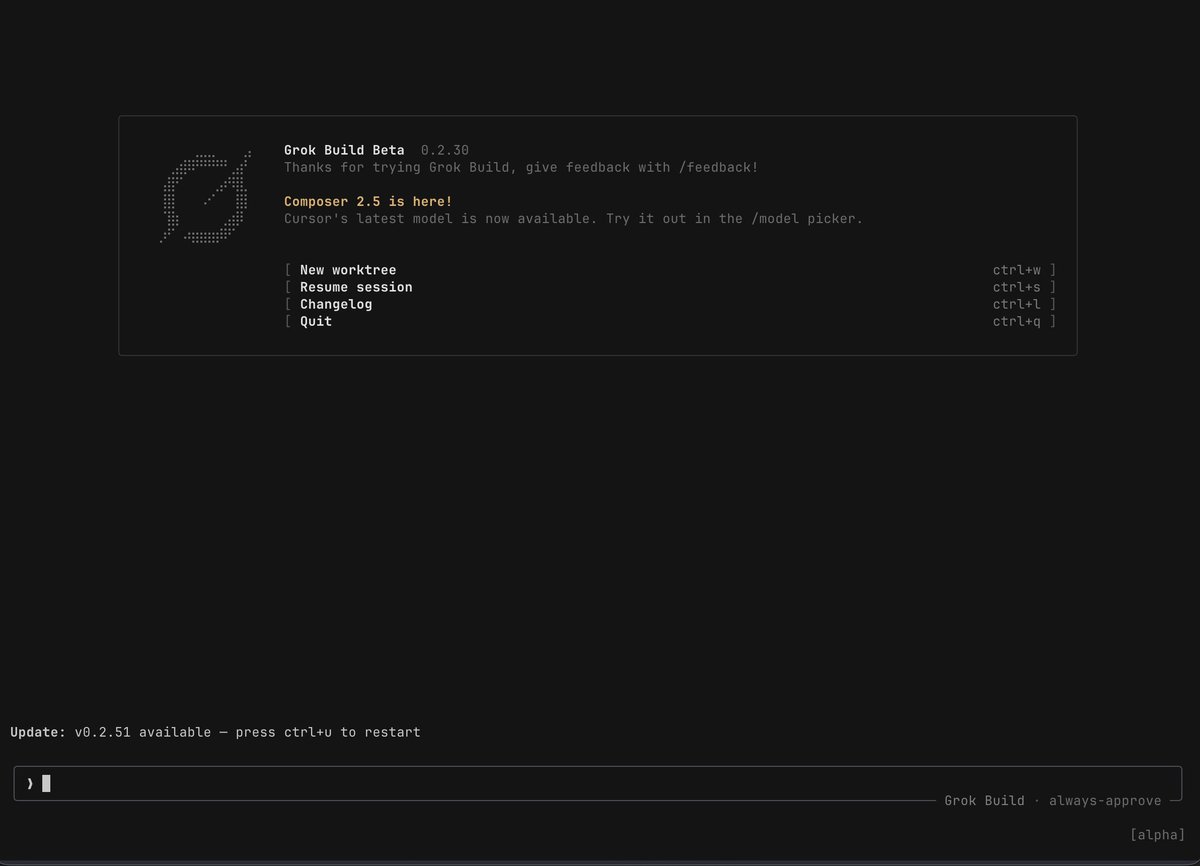
If you haven't tried Grok Build in a few weeks, I can honestly say, then you haven't really tried it.
The team has shipped so many updates, and they don't seem to be slowing down.
Two thing I'd recommend everyone try this weekend if you haven't yet:
1. Worktrees - if you don't know what these are, you are missing out, ask Grok to teach you
2. Composer 2.5 in Grok Build, it's a very good, and fast model
You might just find you don't miss Fable 5 at all.
18
4
53
4,166