Joined November 2025
- Tweets 194
- Following 20
- Followers 70
- Likes 9
6 Photos and videos

Pinned Tweet

Jun 2
Your AI agent does the work in a black box. You get the answer — never the thinking.
Flowtrace turns the work into a map you watch build, step by step, and steer while it runs.
Open source. Works with Claude Code, Codex & Cursor.
⭐ github.com/AIScientists-Dev/…
7
2
51
319,525
Jun 8
Don't let your AI agent guess on tabular data.
TorchKM gives it a classifier it can call — and verify: exact solution, calibrated probabilities, GPU-native. Full train tune in seconds, not hours.
Open source 👉 github.com/YikaiZhang95/torc…
1
2
3
1,479
Jun 8
Agents and pipelines need a real probability to act on — block at 0.9, escalate at 0.5. TorchKM returns calibrated probabilities AND the exact, reproducible solution.
And it's fast: one fit() call trains tunes (CV over the whole grid) in tens of seconds where scikit-learn takes hours. sklearn-style API.
MIT licensed, coauthored by @MorphMind__AI team.
⭐ github.com/YikaiZhang95/torc…
2
3
377
Jun 2
Skills are the moves. Workflows are the order.
Traces are the missing layer: the composition — how a kind of task actually gets done — as a graph you can see, reuse, and improve.
MIT-licensed. Built in Rust.
1
1
393
Jun 2
What people already run as traces:
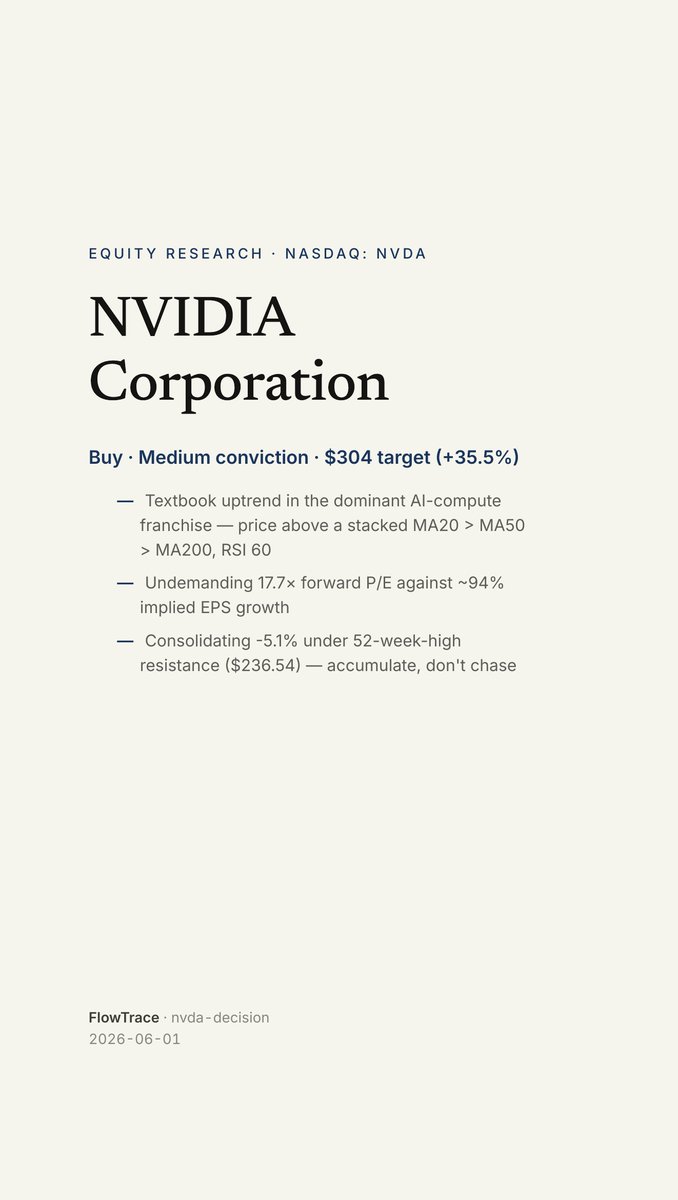
"Should I buy NVDA?" → a fixed-format research-note PDF
• Single-cell RNA-seq analysis
• A 24-step statistical pipeline on a dataset
• A resume tailored to one job post
One graph each. Watch them build.
1
1
234
Jun 2
Stop reading 300-word plans to find the one wrong assumption.
See it in 100ms. Point at it. Change it.
Try Flowtrace → github.com/AIScientists-Dev/…
1
114
Jun 2
Your AI agent does the work in a black box. You get the answer — never the thinking.
Flowtrace turns the work into a map you watch build, step by step, and steer while it runs.
Open source. Works with Claude Code, Codex & Cursor.
⭐ github.com/AIScientists-Dev/…
7
2
51
319,525
Jun 1
Big week for 'observability' becoming enterprise vocabulary. Here's what that looks like in practice: watch every step as it runs, steer mid-task, verify outputs against sources — before anyone signs off. We built that. morphmind.ai microsoft.com/en-us/microsof…
1
63
Jun 1
Microsoft just made 'observe, govern, and secure every agent' a GA product. The EU AI Act clock hits in August. Controllable AI is no longer a design preference — it's the compliance floor. morphmind.ai futurumgroup.com/insights/mi…
1
66
Jun 1
The headline on Codex isn't 'AI takes over your PC.' It's that you can steer it mid-run from your phone. That's the product bet worth noticing — and it's exactly what MorphMind is built around. morphmind.ai opentools.ai/news/openai-cod…
67
Jun 1
The hallucination research is clear: the blocker isn't the model anymore, it's the missing verification layer. At MorphMind, every run shows its sources inline — so your team doesn't review AI outputs on faith. You trace them. morphmind.ai iternal.ai/ai-hallucination-…
41
Jun 1
93% of frontline workers don't fully trust the AI they use every single day. That's not a change-management problem — that's the product telling you something. Trust is a UI feature, and most teams haven't shipped it yet. morphmind.ai cxtoday.com/contact-center/a…
30
Jun 1
When AI quietly updates your CRM, deploys code, and triggers workflows mid-run — 'trust but verify' isn't a policy, it's an architecture. morphmind.ai is built for exactly that moment. dev.to/composiodev/4-best-ai…
33
Jun 1
CMU's AgentCompany benchmark: top models complete 24% of complex tasks autonomously. Failure rates hit 70-90% as complexity rises — often silently. MorphMind shows you every step as it runs, so you catch the drift before it cascades. morphmind.ai galileo.ai/blog/best-ai-agen…
36
Jun 1
A persistent agent that's 'always there' sounds like a dream until it's mid-task on something that matters. That's exactly when you want to pause it, check its reasoning, and course-correct — not just read a summary after the fact. Try it: morphmind.ai codersera.com/blog/gemini-3-…
27
May 31
The trust gap isn't about AI saying the wrong thing anymore. It's about AI doing the wrong thing — mid-run, autonomously, without a pause button. That's exactly the problem MorphMind was built to close. morphmind.ai
mckinsey.com/capabilities/te…
39
May 31
AI now scores above average on creativity tests. But the test rewards variation, not judgment. It doesn't ask: is this idea defensible? Useful? True? A score is not a signature. That gap is exactly where humans still need to stay in the loop. sciencedaily.com/releases/20…
28
May 31
46% of Gen Z workers think AI is degrading their own judgment. That's not anti-AI sentiment — it's a signal. When you can't see what the AI actually did or verify its reasoning, you stop thinking for yourself. Observability isn't a feature. It's the point. readaboutai.com/may-25-2026/
34