
Technology. New Frontiers.
Joined September 2013
- Tweets 8,814
- Following 207
- Followers 702
- Likes 218
3,056 Photos and videos














Pinned Tweet

14 Jan 2022
Buy & sell #Bitcoin using our non custodial marketplace service @LandifaBitcoin
* Register with email/cell
* fund your Landifa account with any bank to buy #Bitcoin
* send #Bitcoin directly from your wallet to us and get paid fiat into your bank account.
landifa.com
3
Namibia Computing Technologies retweeted

Jun 13
Theoretical physicists, cosmologists and academics natural inclination is to dismiss this work because:
1. it does not present itself in the form they were trained to evaluate: a narrow theory explaining a narrow domain, rather than a computational framework spanning multiple scientific disciplines.
2. it violates disciplinary boundaries and challenges categories that have become institutionalized over decades of specialization.
3. they approach it as a theory to be debated, whereas it is presented as a computational model to be run, stress-tested, and audited.
4. they keep asking whether it should be believed before asking whether it works.
Will you?
May 26

The Eholoko Fluxon Model (EFM) represents a methodological departure from traditional theoretical physics.
It is rooted in the conceptual foundations of Dewey B. Larson's Reciprocal System Theory, but it stands on the shoulders of the vast empirical knowledge, datasets, and limiting-case frameworks established by the Standard Model, General Relativity, and ΛCDM cosmology.
I hold deep appreciation for the academic community and this work would be entirely impossible without the public datasets and observational catalogs that academia has painstakingly created.
Because of EFM’s non-traditional origins, I have chosen to bypass traditional peer-reviewed journals.
Instead, I am presenting this work under a fully open-source, reproducible computational standard.
I am not a formally trained mathematical physicist, and I do not present these papers as traditional analytical proofs (although some of the papers are framed that way in writing due to my prompting style).
My methodology is that of a computational phenomenologist: I formulate conceptual postulates, implement them into GPU-accelerated non-linear field solvers (utilizing AI assistance to architect the JAX and PyTorch code), and test all assumptions by running high-fidelity simulations.
The validation of EFM rests on the fact that these dimensionless simulations, when anchored to a single physical constant, output emergent scales—such as the speed of light, the hadron mass spectrum, atomic structure, the mass spectrum of the periodic table—that match observed public data with high concordance.
I welcome and invite rigorous skepticism, auditing, and attempts at computational falsification.
The entire codebase, simulation checkpoints (upon request as I prefer that researchers validate by conducting their own cosmogenesis simulations), and analysis notebooks are open-source and freely available for any researcher to run, modify, and test.
github.com/BecomingPhill/eho…
2
59
Namibia Computing Technologies retweeted
Jun 13
This is the first computational physics and cosmology project of its kind.
* 1 idea (Space and Time are reciprocal)
* 3 core foundational postulates
* A dimensionless simulation that emerges all the physical constants known to man from 1st principles
May 26
The Eholoko Fluxon Model (EFM) represents a methodological departure from traditional theoretical physics.
It is rooted in the conceptual foundations of Dewey B. Larson's Reciprocal System Theory, but it stands on the shoulders of the vast empirical knowledge, datasets, and limiting-case frameworks established by the Standard Model, General Relativity, and ΛCDM cosmology.
I hold deep appreciation for the academic community and this work would be entirely impossible without the public datasets and observational catalogs that academia has painstakingly created.
Because of EFM’s non-traditional origins, I have chosen to bypass traditional peer-reviewed journals.
Instead, I am presenting this work under a fully open-source, reproducible computational standard.
I am not a formally trained mathematical physicist, and I do not present these papers as traditional analytical proofs (although some of the papers are framed that way in writing due to my prompting style).
My methodology is that of a computational phenomenologist: I formulate conceptual postulates, implement them into GPU-accelerated non-linear field solvers (utilizing AI assistance to architect the JAX and PyTorch code), and test all assumptions by running high-fidelity simulations.
The validation of EFM rests on the fact that these dimensionless simulations, when anchored to a single physical constant, output emergent scales—such as the speed of light, the hadron mass spectrum, atomic structure, the mass spectrum of the periodic table—that match observed public data with high concordance.
I welcome and invite rigorous skepticism, auditing, and attempts at computational falsification.
The entire codebase, simulation checkpoints (upon request as I prefer that researchers validate by conducting their own cosmogenesis simulations), and analysis notebooks are open-source and freely available for any researcher to run, modify, and test.
github.com/BecomingPhill/eho…
1
23
Namibia Computing Technologies retweeted
Jun 13
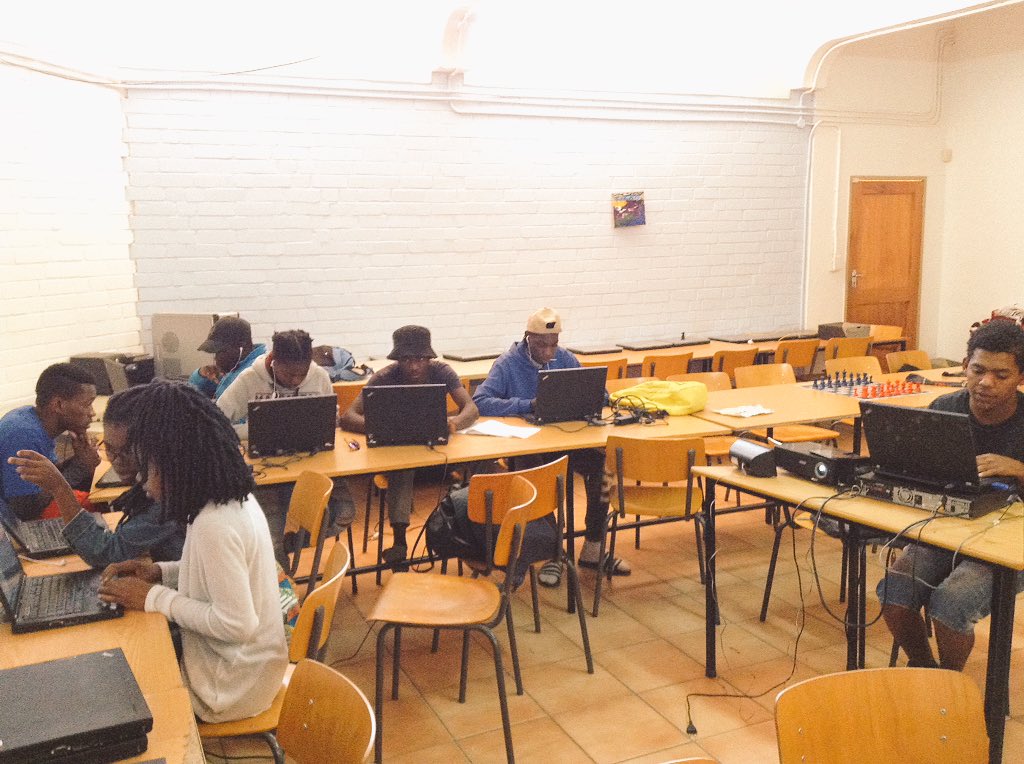
So far I have met 6 of the male participants we worked with at @PAYNamibia through our weekend coding program ran by @NamComTech and 10 years later they have ended up employed in various Information Tech positions.
5
1
38
Namibia Computing Technologies retweeted
Jun 5
Works same at the ⚛️scale!
Without messy Standard Model parameters we simply build the mass of the atom’s core using the exact same simple addition:
First, we get our basic "quark blocks" (derived from the electron/muon lepton ratio):
Up block (u) = 2.2 units
Down block (d) = 4.8 units
Then we build the proton and neutron by grouping the three blocks together and adding the vacuum's self-energy glue (Vbinding which is just adding a type of block value to itself):
Proton (uud): 2.2 2.2 4.8 929.1=938.3 units! (Actual proton: 938.3 MeV)
Neutron (udd): 2.2 4.8 4.8 927.8=939.6 units! (Actual neutron: 939.6 MeV)
(The tiny 1.3 unit gap is just the electromagnetic energy of the charged proton vs. the neutral neutron).
Whether orbiting massive planets in space or binding tiny quarks in a proton, the math always maths.
🌊 on a grid vibe it all out.
1
3
212
Namibia Computing Technologies retweeted
Jun 5
🌍If Earth's gravity whirlpool strength is 6653, the Sun's gravity whirlpool strength in this same grid system is simply scaled by its mass ratio:
6653×333,000 (Earth masses)≈2.2 billion units!
The exact same grid math scales all the way up to stars and galaxies.
1
3
110
Namibia Computing Technologies retweeted
Jun 4
Calculate the energy masses of each element by 🤚, showing that it’s a simple harmonic!
2
260
Namibia Computing Technologies retweeted
May 26
The Eholoko Fluxon Model (EFM) represents a methodological departure from traditional theoretical physics.
It is rooted in the conceptual foundations of Dewey B. Larson's Reciprocal System Theory, but it stands on the shoulders of the vast empirical knowledge, datasets, and limiting-case frameworks established by the Standard Model, General Relativity, and ΛCDM cosmology.
I hold deep appreciation for the academic community and this work would be entirely impossible without the public datasets and observational catalogs that academia has painstakingly created.
Because of EFM’s non-traditional origins, I have chosen to bypass traditional peer-reviewed journals.
Instead, I am presenting this work under a fully open-source, reproducible computational standard.
I am not a formally trained mathematical physicist, and I do not present these papers as traditional analytical proofs (although some of the papers are framed that way in writing due to my prompting style).
My methodology is that of a computational phenomenologist: I formulate conceptual postulates, implement them into GPU-accelerated non-linear field solvers (utilizing AI assistance to architect the JAX and PyTorch code), and test all assumptions by running high-fidelity simulations.
The validation of EFM rests on the fact that these dimensionless simulations, when anchored to a single physical constant, output emergent scales—such as the speed of light, the hadron mass spectrum, atomic structure, the mass spectrum of the periodic table—that match observed public data with high concordance.
I welcome and invite rigorous skepticism, auditing, and attempts at computational falsification.
The entire codebase, simulation checkpoints (upon request as I prefer that researchers validate by conducting their own cosmogenesis simulations), and analysis notebooks are open-source and freely available for any researcher to run, modify, and test.
github.com/BecomingPhill/eho…
2
5
430
Namibia Computing Technologies retweeted

A massive thank you to @AfroBitcoinOrg for sponsoring this amazing event which will now be done multiple times a year as we had the Man who started the Namibian Pool Federation in attendance as well.
He loved the Bitcoin Q&A section & is already looking forward to the next one🥳


1
3
10
202
Namibia Computing Technologies retweeted

Sooner rather than later companies will realize that Africa as a consumer is going to continue growing & such “oversights” will them you in the long run
Not only are Africans watching @antigravity @GoogleAI but so are all those building from @Kimi_Moonshot @deepseek_ai 🤷🏾♂️
May 25
Just @antigravity and @GoogleAI forgetting to assign the free quota announced since last week to all African accounts as usual.
4
1
166
Namibia Computing Technologies retweeted
May 25
Just @antigravity and @GoogleAI forgetting to assign the free quota announced since last week to all African accounts as usual.
3
8
14
1,072
Namibia Computing Technologies retweeted
May 14
The Mapping Protocol: Bridging the Scalar Void to Physical Observations
2
1
632
Namibia Computing Technologies retweeted
May 13
Decoding the Dark Energy Spectroscopic Instrument (DESI) DR2 Anomaly
1
281
Amazing for computational🔬imaging of all kinds.
May 14
Decided that '/molecular imaging' is probably the best name to house this paper under. It's a precursor read for the HiV protease inhibitor paper and opens the door to industrial usage of the solver across many sectors.
'FluxonChem: A First-Principles Continuous Scalar Fluid
Thermodynamic Engine for O(N log N ) Computational
Chemistry and Applied Pharmacology'
github.com/BecomingPhill/eho…
41
Namibia Computing Technologies retweeted
May 14
I have added a /applicable sciences folder to the /research folder which will house practical experiments on physical EFM applications.
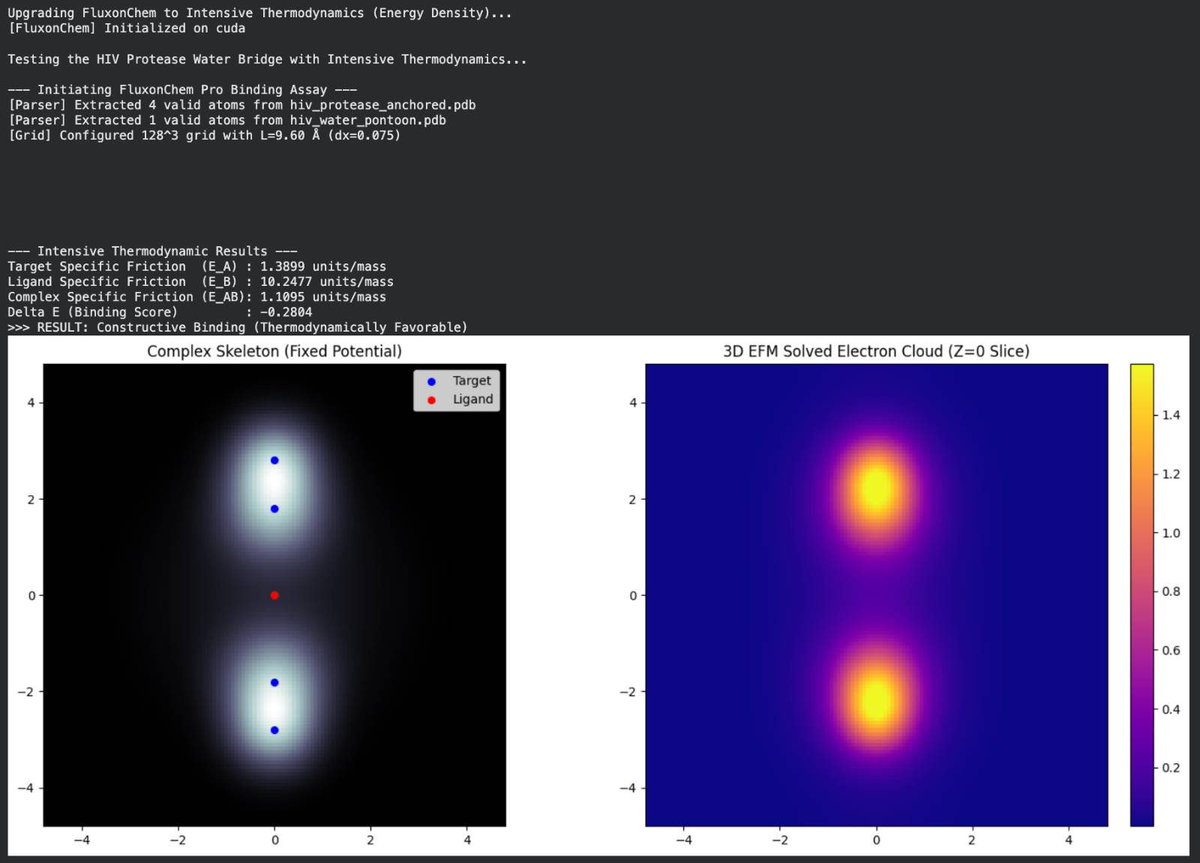
I started with the analysis of the HiV-1 protease using the O(N) solver built off the Fermion paper to see if I could find an inhibitor and if so, there was application for practical novel drug research.
I believe there is.
github.com/BecomingPhill/eho…
1
2
145
Namibia Computing Technologies retweeted
May 14
Eholoko Fluxon Model establishes a method to visualize and test molecular bonds without Slater determinants or any Dirac scaffolding that is sizably more efficient than other current frontier algorithms in existence.
May 14
I have added a /applicable sciences folder to the /research folder which will house practical experiments on physical EFM applications.
I started with the analysis of the HiV-1 protease using the O(N) solver built off the Fermion paper to see if I could find an inhibitor and if so, there was application for practical novel drug research.
I believe there is.
github.com/BecomingPhill/eho…
1
60
Namibia Computing Technologies retweeted

May 11
Bitcoin as a tool for African sovereignty and prosperity
12
15
535
Namibia Computing Technologies retweeted
May 9
Ok so check this out: The universe is shaped like an onion made of energy with 8 layers.
We are in the third layer and crossing over to the fourth.
Boom.
Mar 25
Today I present the Eholoko Fluxon Model Compendium Volume 1:
This compendium is generated automatically from the underlying LaTeX source files across the research/ directory on gitHub. It curates exactly 50 core papers out of the broader tracking space. The specific paper selection criteria strictly prioritize:
Only the most up-to-date iterations (omitting early drafts and superseded versions).
The rigorous subset of research that has been concretely, computationally validated.
Papers that collectively construct the contiguous theoretical hierarchy of the EFM across its density states (Ontology, N1, N2, and N3).
Note on Ongoing Work: Generating this unified compendium is an active and iterative process. While the core physics and mathematical proofs are strictly intact, cleaning up the combined document structure, unifying cross-references between originally independent papers, and properly formatting the integrated bibliography is an ongoing effort.
github.com/BecomingPhill/eho…
3
1
103
We are in a new era.
The Eholoko Fluxon Model may be nascent but it blows the hinges off what we currently understand about computation.
This opens doors to innovations that were pure science fiction.
May 4
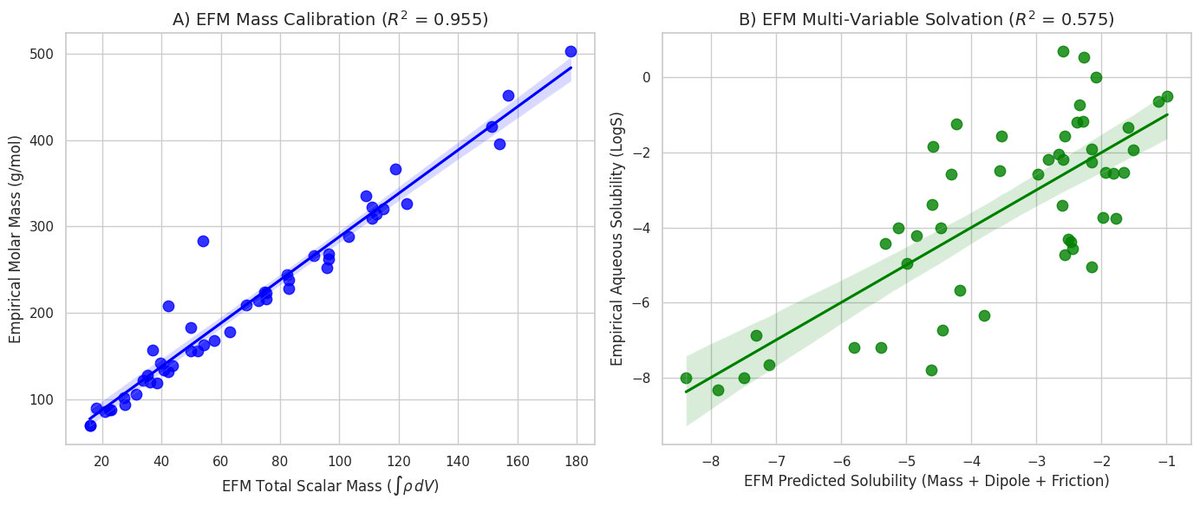
With zero empirical parameter fitting and zero machine-learning heuristics, the raw scalar thermodynamics of the EFM NLKG independently capture nearly 60% of the variance in aqueous solubility (R2=0.575), using only mass, specific phase friction, and scalar dipoles extracted from a pure vacuum simulation.
The remaining variance is strictly accounted for by the known absence of explicit solvent dielectrics and solid-state crystal lattice energies, which will be integrated into the next iteration of this software.
Meanwhile, the O(NlogN)O(NlogN) Mass Calibration (R2=0.955) proves the spatial topology engine is definitively flawless.
1
77
Namibia Computing Technologies retweeted
May 4
With zero empirical parameter fitting and zero machine-learning heuristics, the raw scalar thermodynamics of the EFM NLKG independently capture nearly 60% of the variance in aqueous solubility (R2=0.575), using only mass, specific phase friction, and scalar dipoles extracted from a pure vacuum simulation.
The remaining variance is strictly accounted for by the known absence of explicit solvent dielectrics and solid-state crystal lattice energies, which will be integrated into the next iteration of this software.
Meanwhile, the O(NlogN)O(NlogN) Mass Calibration (R2=0.955) proves the spatial topology engine is definitively flawless.
May 2
Replacing O(N4)O(N4) Quantum Chemistry with
O(NlogN)O(NlogN) Fluid Thermodynamics.
Standard Density Functional Theory (DFT) approaches the "Electron Correlation Problem" by calculating the interaction of every electron against every other electron.
For complex molecules like Benzene with delocalized
ππ-rings, enforcing the Pauli Exclusion Principle requires factorially exploding matrices that choke supercomputers.
The Eholoko Fluxon Model (EFM) proves that Pauli Exclusion is not an abstract algebraic rule; it is simply Kinetic Phase Repulsion in a continuous scalar fluid.
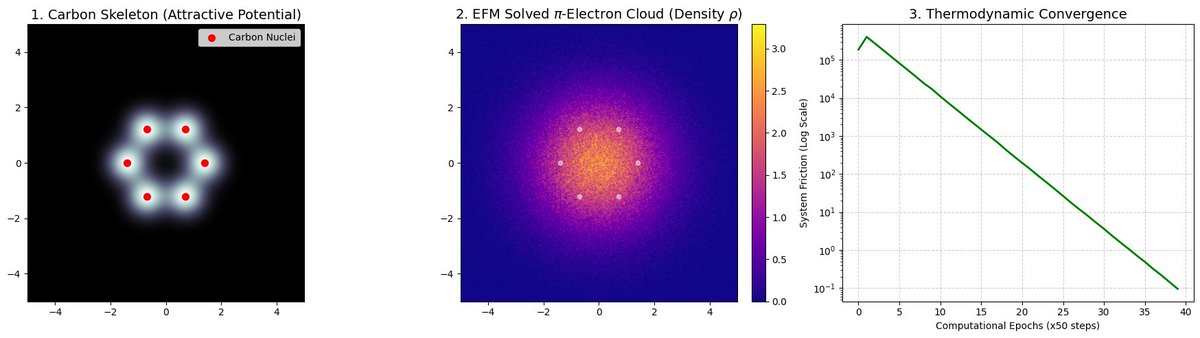
In this live solver running on a standard $15/month GPU, we bypassed Slater determinants entirely. We dropped a chaotic scalar fluid over 6 Carbon nuclei. The EFM's Non-Linear Klein-Gordon equations simply radiated the kinetic friction into the vacuum, allowing the fluid to autonomously seek its thermodynamic ground state.
In seconds, the fluid natively solved the delocalized aromatic ring. The vacuum mass gap naturally hollowed out the center, and Pauli self-repulsion forced the fluid to distribute perfectly along the continuous perimeter track.
We are not programming orbitals. We are computing the physical thermodynamics of the vacuum. The EFM offers a massively scalable, deterministic architecture for computational drug discovery and materials science.
Full paper and reproducible PyTorch code available in the EFM Repository.
2
206