
398 Photos and videos

Pinned Tweet

10 Jul 2025
Hahaha, this is too cool.
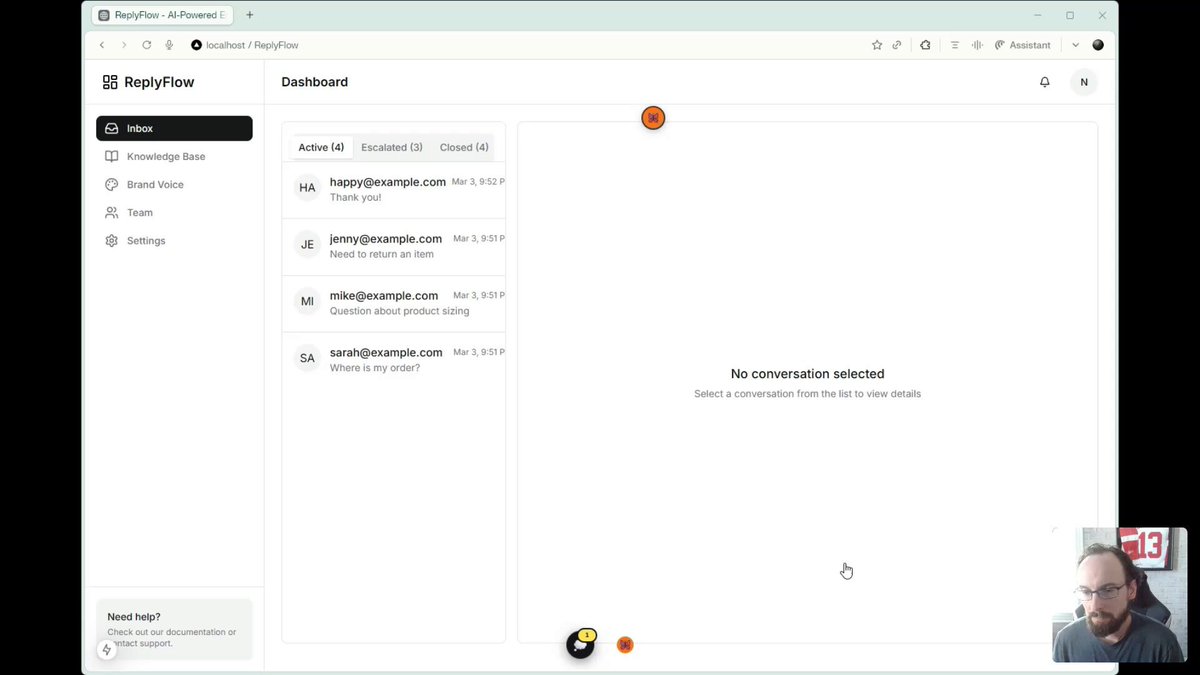
Comet, an agentic app, using the UI of another agentic app.
I had Comet use @RaleonHQ - our app that automates d2c email marketing with agents.
They did EVERYTHING.
Planned the campaigns, generated the copy, and then designed emails.
9
7
95
16,994
May 4
The context layer is going to be the system of record of this tech cycle.
1
1
92
Apr 26
If you've vibed an app or prototype, then you've undoubtedly ran into the frustration of wishing you could leave comments on it.
I've fixed that now with an open-source tool that brings agent-enabled, figma-style comments to your vibe coded work.
I call it Holler.
It's super simple to install: You have Claude Code run one line for you, setup a free supabase account, and you're ready to roll.
The whole setup takes a one time setup <5 minutes. Then you can run it on any number of projects.
I decided to release Holler publicly after quite a few product managers in my group at Intuit Mailchimp started to use it, along with a handful of friends.
Here's a few example use cases:
- Humans can easily leave figma-style comments on a prototype/vibed app
- Use it on your own work as a faster way of making notes on what needs to change for claude code
- Agents can use the built-in CLI to read the comments, make code updates, add new comments, and resolve comments they've fixed.
Start hollerin': nsnell.github.io/holler/
Happy building!
1
3
203
Apr 17
Yup.
This was part of the magic we delivered in Raleon.
We had a context layer that self-updated across multiple channels (along with dynamic data). It’s part of how we had crazy results.
The system of record used to be the sticky thing.
Now it’s the context layer.
Apr 16

Someone is going to build a worldclass “Brain” for enterprises & make a stupid amount of money.
Why? As @da_fant said, “coding w ai is solved bc all context is in the git repo. knowledge work is difficult bc context is spread out. an ai system that creates a git repo w all context for a knowledge worker will be able to 100% automate the work.”
When companies talk about being data ready for AI, this is what they’re implicitly saying.
Engineering has been prepared for this moment for a long time because of the deterministic nature of code, the centralization/versioning of data (read: GitHub), and AI tools that are largely build by engineers for engineers.
But for the rest of white collar work, there’s a TON of catching up to do to properly harness the power of the technology.
The big challenge here, and why no one has truly cracked the code for "an ai system that creates a git repo w all context for a knowledge worker" is because unlike code, most knowledge is 1) distributed, 2) unstructured, and 3) unverifiable.
It's distributed: transcripts live in Granola. Documents in Notion. Customer Data in Hubspot. ERP. Emails. Slack messages. Random spreadsheets. SOP docs. Etc. Etc.
Building an ingestion engine that connects to all of your disparate data sources and auto-updates based on the shelf-life of the data is the first, and frankly, easiest step of the process.
Next, it's unstructured: let's say I want to create a proposal for a potential client. To nail the proposal, I want it to pull important information from a variety of sources. The specific asks & background from our initial sales call. Previous proposals to anchor ourselves to a proven format. And completed sprint boards from Linear, so the pricing & timeline in the document is grounded in truth.
Whether it's a thoughtful filesystem (a la Obsidian) or an OpenClaw-esque memory structure, the brain needs to be great at self-organizing in a thoughtful schema. This is very hard, especially if you want to build a generalizable brain that can be shaped to an array of different enterprises.
And finally, most knowledge is unverifiable: writing a function, running a unit test, and seeing if the code works is easy. It works or it doesn't. Using AI to accelerate your content creation process is highly subjective. What is a good/bad idea? Is the content in your voice or not? Does it feel like slop or novel? Answering these questions are both difficult and non-verifiable.
That same system described above doesn't just have to be great at organizing & forming coherent relationships, but it also has to be great at self-improving based on feedback from the user. Memory systems (like those introduced by OpenClaw) are great to a point, but as you scale the corpus of data within your company's brain, things like compaction and cleaning become wildly important to avoid the needle in the haystack problem.
Someone is going to figure out how to solve this problem, and when they do, not only will they make a shit ton of money, but they'll be robinhood for knowledge workers, enabling non-engineers to enjoy the sort of leverage that only technical folks have felt for the last few years.
3
122
Mar 24
Awesome to see this, and such the right move.
It’s clear that more brands are going to have “AI Ops” type roles.
Mar 24

This is an exciting one. We're hiring a first of its kind role at JRB.
A few months back I posted that i think AI will disrupt Ecom teams first and today that day is here. One person can do today what took 3 to 4 people last year. And do it better.
I've been vibe coding Shopify sections, landing pages, and built a Claude powered CRO roadmap in my "spare time". It's truly wild what I've been able to do with a few hours each night and weekend.
Now I'm going to hand it off to this person and have them run with it while training them.
We're looking for one highly ambitious, independent person with Ecom knowledge and the want to go all in with Claude. You don't need to be at my level; you need a baseline level and the right temperament to dive all in.
You'll still have design and dev support. The goal is not to remove them, but to able to test ten times faster and smarter and do as much as you can yourself.
I'll post the job description in the comments. If this is you, please slide in my DMs. If you know anyone or can share this, it's always appreciated.
1
313
Mar 5
Fastest way to make your personal agents better: let them manage their own context.
Self-learning agents save so much time. Feels like a super power.
2
1
57
Feb 16
Just because AI has a broad baseline of knowledge doesn’t mean you can skip the context.
A “pretty okay response” is not the same as a useful one.
But that's the problem.
You just have to know that AI knows nothing about your business. They still need the fresh context of someone coming in for the first time, so they can really understand to the depth that you need them to.
At Raleon, our mental model was:
- Pare down the LLM to behave like a small language model
- Force specificity instead of broad knowledge fallback
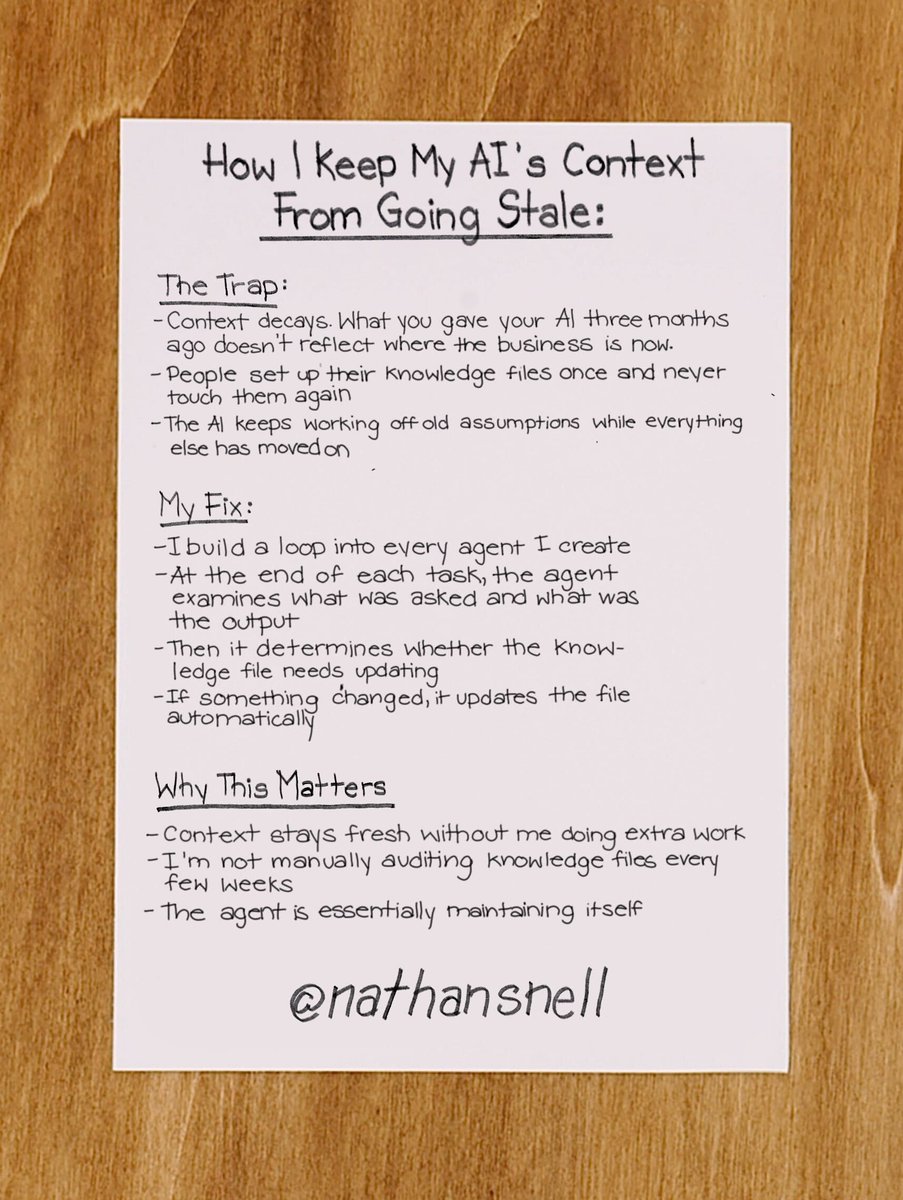
So now I build a loop into every agent I create.
At the end of each task, the agent examines what was asked and what was output, then it determines whether or not the knowledge file needs updating.
If something changed, it updates the file automatically.
Context stays fresh, and I get spared the extra work.
1
2
112
Feb 16
If you want the full breakdown on how I structure these loops, I go deeper in my newsletter: ai-unhyped.beehiiv.com/?utm_…
48
Feb 14
Nothing like trusting your own code to remind you why you shouldn't.
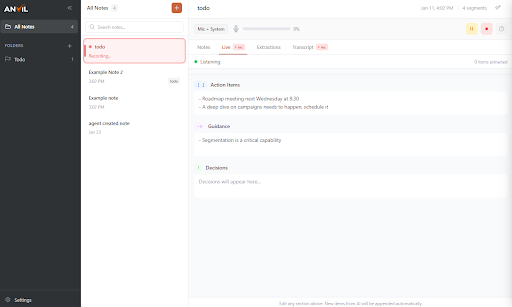
Day one of using Anvil, my note taking app, I lost half my notes because of a saving bug I hadn't caught.
If you're vibe coding anything you depend on, test it like someone else built it.
5
1
88
Feb 13
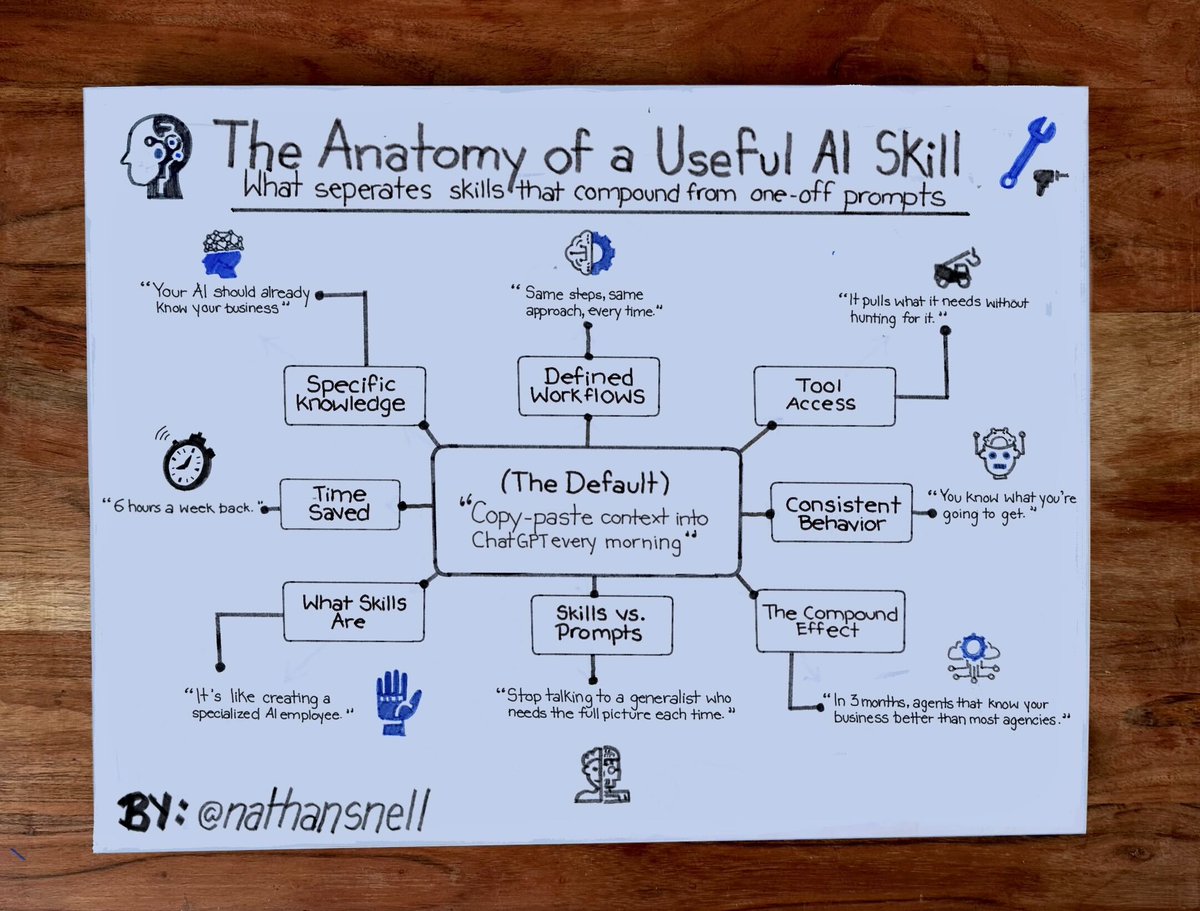
In 3 months of building Claude Skills, you'll have a library of AI agents that know your business better than most agencies.
I wrote a breakdown on how to start, plus a free forecasting agent you can use right away.
1
1
84
Feb 12
First real call with my vibe-coded note-taker. Great conversation, solid action items. Went to pull up the notes afterward, and half of them never saved.
Lesson learned: if you vibe-code something you actually depend on, test it like you didn't build it.
But the bigger problem was fidelity.
Every AI note-taker I've tried has the same issue. Too high-level, and the notes are useless. Too granular, and you're drowning in details you don't need.
So I tried something different.
I fed the AI a handful of transcriptions alongside my own handwritten notes from the same calls, then I asked it to generate a prompt that matched my level of detail.
Using AI to train AI felt recursive, but honestly, the output was spot on.
Now the notes come out exactly how I'd write them myself, without me writing them.
I also built an agent that pushes refined notes straight into Claude Code, so everything stays in one system. Packaged it for a few friends to try.
Verdict: Play.
If you can't get the output you want, make AI watch you do it first.
1
45
Feb 12
I share these kinds of experiments weekly in DTC AI Unhyped:
ai-unhyped.beehiiv.com/?utm_…
20
Feb 12
Hot take: If you’re building a new app and an agent isn’t the first user you’re building for, you’re building your stack wrong.
1
1
87
Feb 11
I’ll keep being a broken record on this: context is king.
If you're still copy-pasting the same information into every AI conversation, it’s like re-introducing yourself to the same coworker every morning.
But the fix is simpler than people think, and the time savings compound from there.
The first thing I'd recommend is Claude Projects.
You drop your knowledge into a project once, and now any conversation inside that project can reference it. You stop re-explaining your business every session because the context is just there.
The second is Skills.
I'd say spending a little time learning how to create your own skill ends up saving so much time in the long run. You're working with an agent that's already fine-tuned toward exactly what you want it to do.
And the counterintuitive part is that these unlocks don't just save time on the work itself, they save time with AI.
I think these are the most low-hanging fruit that most teams skip.
1
2
70
Feb 11
I go deeper on this kind of thinking weekly in DTC AI Unhyped:
ai-unhyped.beehiiv.com/?utm_…
22
Feb 10
I was tinkering with Claude Code over the weekend and had a couple aha moments that stuck:
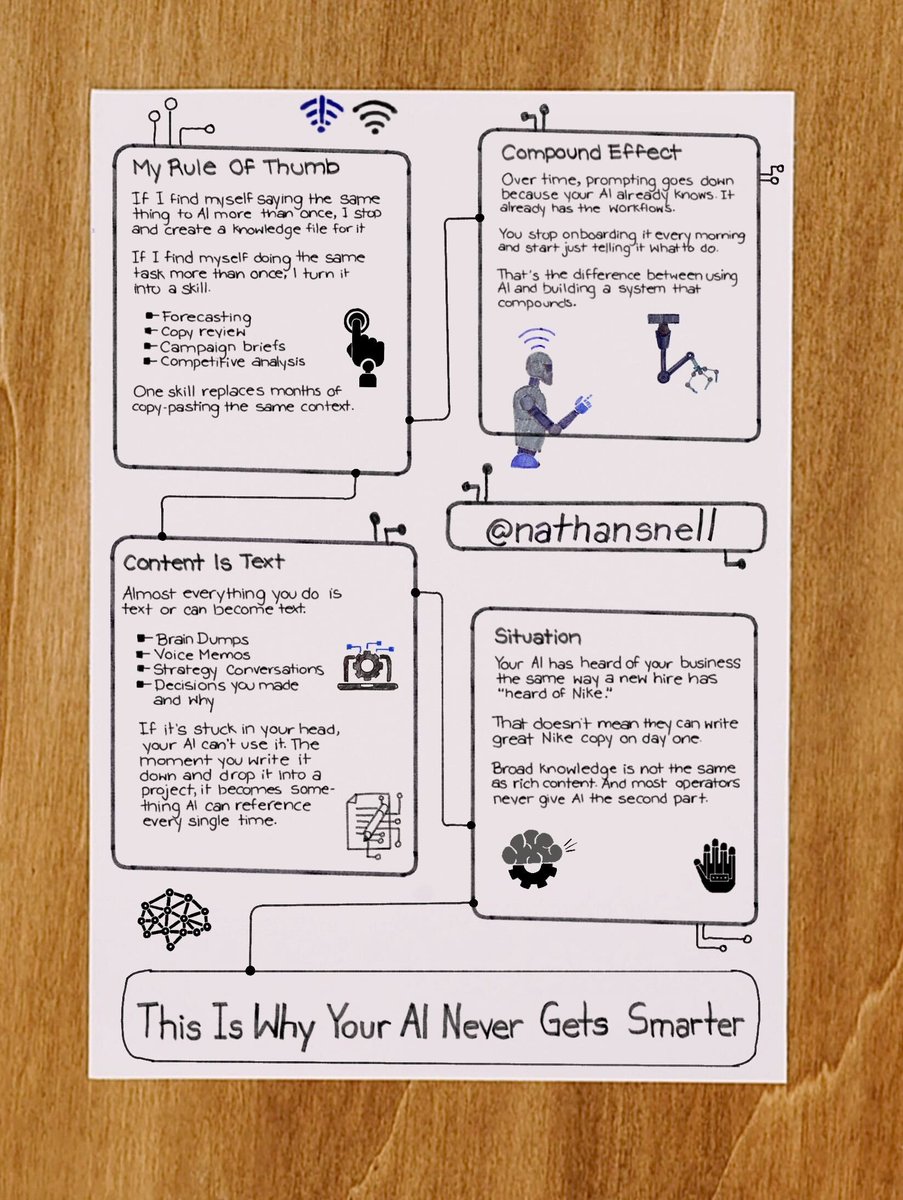
#1 aha moment: I realized that context is text.
Almost everything I do is text or can become text. Strategy conversations, voice memos, brain dumps. All of it was stuck in my head, which meant my AI couldn't use any of it.
Your AI has heard of your business the same way a new hire has “heard of Nike.” That doesn't mean great copy day one.
The moment I started dropping that stuff into projects, AI could just reference what it needed.
#2 aha moment: Skills.
I kept doing the same types of tasks over and over. Forecasting, copy review, campaign briefs, competitive analysis. So I started turning each one into a skill instead of prompting from scratch.
One skill replaces months of copy-pasting the same context.
My rule of thumb: if I’m saying the same thing to AI more than once, I create a knowledge file. If I’m doing the same task more than once, I turn it into a skill.
1
113
Feb 10
I built out Product Manager Bot this weekend, based on clawdbot.
It works amazingly well.
I changed the approach slightly for security purposes (which makes it not quite as capable but still awesome).
One change that worked out great: runs totally on Claude code.
Still runs in the background like clawdbot, but uses the normal Claude subscription saving on costs.
Trying it out with a few PM friends!
1
4
556
Feb 9
The challenge of MVP-first product work with Claude code instead of PRD first is it’s much more difficult on the mvp side with applications that are largely not stateless.
Not impossible, but requires a lot of upfront setup to allow for it to be fast.
5
119
Feb 5
The middle always gets hollowed out. That’s how digital technology works.
It’s called the Smile Curve.
You either become the platform, or you become the person telling the platform what to do.
There’s less and less room in between.
1
44
Feb 5
I cover this pattern and how it applies to agencies in my newsletter: ai-unhyped.beehiiv.com/?utm_…
36