
Botanical artist 🪷Tree Hugger 🌴Gardening column in Deccan Herald- bit.ly/396whyS
Joined May 2009
- Tweets 52,522
- Following 514
- Followers 15,273
- Likes 22,112
3,567 Photos and videos








Pinned Tweet

30 Mar 2023
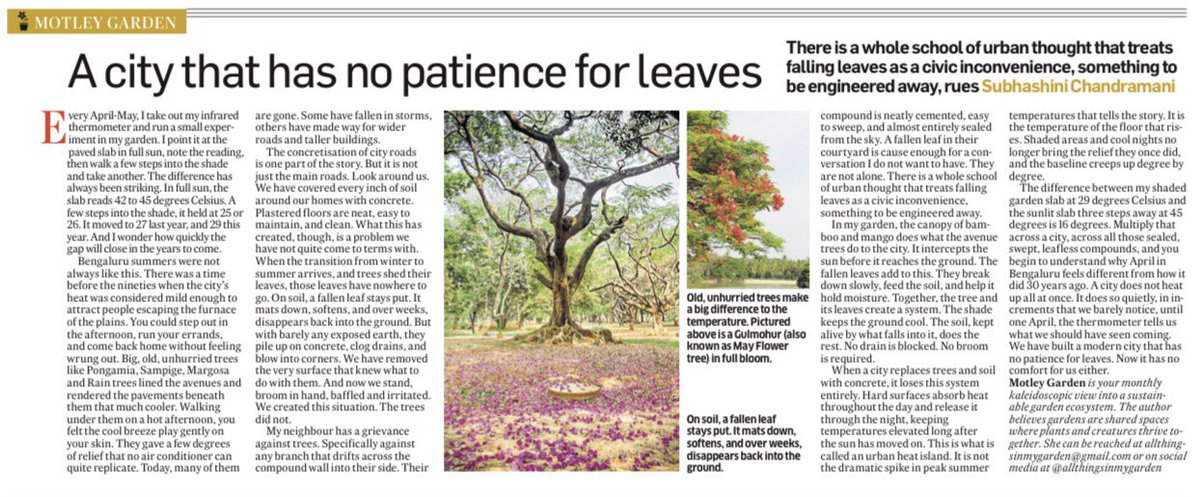
1/19 Did you know Bengaluru has a diverse collection of trees that bloom all year? When the city was planned aeons ago, the trees were chosen in such a way that when one tree ceased blooming, another tree took its place. Bengaluru's seasons are a floral symphony.
196
1,023
4,341
2,089,405
Subhashini Chandramani retweeted

Jun 13
இளையராஜாவின் interludeகள் வெறும் இசை அல்ல அது சொர்க்கத்திலிருந்து தவறி விழுந்த சில நொடிகள்✨....
வசனம் சொல்ல முடியாத உணர்வுகளை வயலினும் புல்லாங்குழலும் பேச வைப்பவர் #இளையராஜா .
சில interlude-களை கேட்கும்போது பாடல் முடிந்துவிடக் கூடாதே என்று தோன்றும்; அதுதான் ராஜாவின் மாயம்
1
57
246
6,821
Subhashini Chandramani retweeted

Jun 12
How many 90s kids actually knew about this natural cork ball? 🏏 Those endless street cricket days with the real desi cork! Pure nostalgia hits different.
#90sKids #CorkBall #StreetCricket
43
94
729
24,796
Subhashini Chandramani retweeted

Horoscopes, Habits and Kesari Bath
The arranged marriage first meeting is one of India's longest-running social performances.
A date and time is fixed. The house undergoes a level of cleaning normally reserved for festivals and visits from important relatives. The good cutlery come out. Somebody is sent on a last-minute mission to buy fresh flowers and fruits . The girl’s father is instructed not to wear that old T-shirt he loves.
The guests arrive. The first few minutes are spent discussing traffic, directions and whether they found the house easily. This conversation can continue for an astonishing amount of time.
"Was the traffic bad?"
"Did you find the place easily?"
“ We are in this area for last 50 years,My father built this house”
Soon arrives the coffee and thindi. There seems to be an unwritten menu for these occasions. Bajji, chips, chow chow bath, maybe a hoLige also if the hosts are feeling generous. Everyone is encouraged to eat. Nobody actually wants to be the first person to attack the food.
"Please take. TogoLi”
"No no."
"Please swalpa .”
A single serving is consumed in several bites spread over twenty minutes. People behave as though they have just walked out of a wedding feast. Sometimes the food is so average that this restraint requires no acting at all.
The real sufferers are the younger members of the household. They have been instructed not to touch anything until the guests leave. They sit around watching complete strangers slowly eat what they consider to be their rightful evening snacks.
The adults meanwhile discuss matters at a wonderfully generic level.
Where is your native?
What does he do?
How many siblings?
Questions whose answers were already available with the distant relative who arranged this meeting are again discussed as though new discoveries are being made.
Every meeting has a supporting cast of uncles and aunts. Nobody is entirely sure why some of them are there. They seem to appear whenever an arranged marriage meeting is scheduled.
There is usually one talkative uncle who asks questions with the seriousness of an income tax officer. One aunt claims to know somebody who knows somebody who worked with the groom's father's cousin twenty years ago.
And there is always someone who asks about "habits"
Habits , a remarkable word.
Nobody is asking whether the boy bites his nails, interested in gardening , reads or collects stamps.
Drinking, partying, eating meat all packed into one innocent-looking word.
The uncle is waiting curiously to see if the answer is "yes, occasionally" so he could get some company sometimes for his drink.
The boy and girl are asked to go and talk in "private". Private in this context means somewhere within visual range of at least six relatives.
A balcony or the dining room or the veranda.. A room whose door remains conspicuously open.
The couple is expected to have a meaningful conversation in a short time while fully aware that half the family is pretending not to listen.
The conversations continue in the hall . One aunt says .
”Yuvara hudugi tumba ambitious from the beginning . She wants to continue to work after marriage also” .
Our son is also in Washington , works as a software engineer .
They return ten minutes later.
Back in the hall, everyone pays attention and develops an interest in body language. The duration of the conversation is analysed .Parents try to read expressions. Uncles are experts in facial analysis. Aunts attempt to determine the outcome from the way the coffee cup was placed on the table.
Everybody wants the result immediately.
The children waiting for the snacks would appreciate a quick decision as a fresh set of bajjis are being fried.
What strikes me is that people often say the boy and girl must be compatible. But in these meetings it feels like the families are being matched first.
Can these people spend the next twenty years attending weddings together?
Will they survive family functions?
And then there is the horoscope matching.
The horoscope has probably saved a lot of awkward conversations .
Sometimes the stars genuinely do not align and Mars is sitting in the wrong place.
Maybe the conversation didn't click. Maybe expectations were different.
Or just maybe, the kesari bath was so bad that no future together seemed possible.
The official reason, however,
"The horoscopes did not match."
48
43
268
22,074
Subhashini Chandramani retweeted

Jun 11
New Yorker recently. This idea will never die.

86
4,000
66,767
1,022,209
Subhashini Chandramani retweeted

Jun 11
A terrific essay by Swarnavel Eswaran: Bharathiraja (1941-2026): The earth remembers its own scroll.in/reel/1093483/bhara… via @TheReel_in
4
46
131
29,062
Subhashini Chandramani retweeted

Jun 8
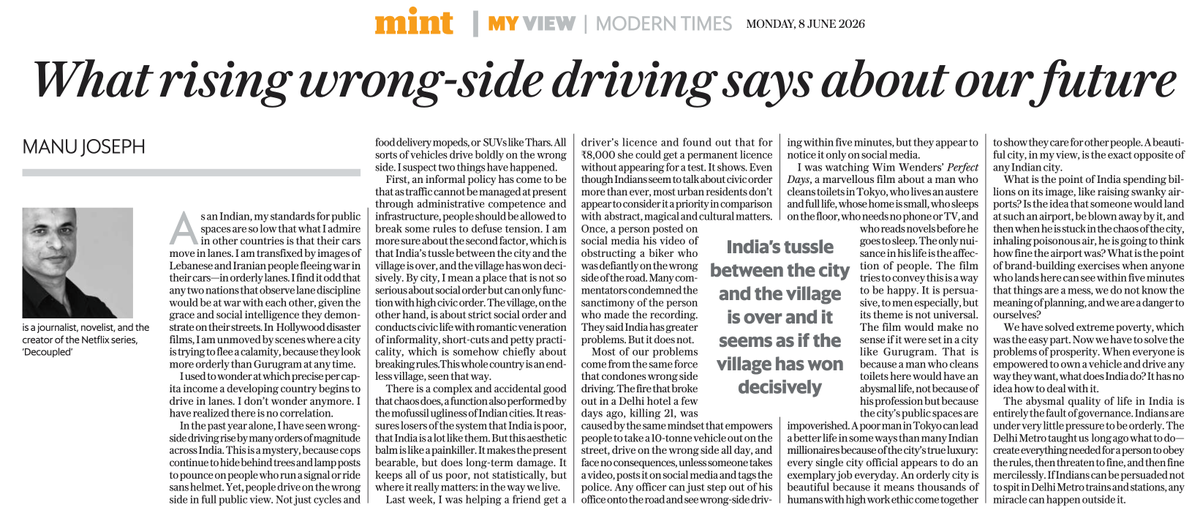
"What is the point of India spending billions on its image, like raising swanky airports? Is the idea that someone would land at such an airport, be blown away by it, and then when he is stuck in the chaos of the city, inhaling poisonous air, he is going to think how fine the airport was? What is the point of brand-building exercises when anyone who lands here can see within five minutes that things are a mess, we do not know the meaning of planning, and we are a danger to ourselves?"
6
27
88
6,400
Subhashini Chandramani retweeted

Monsoon and Mangalore 😍
VC Yogesh Bhat
#KarnatakaRains

2
5
82
2,508
Subhashini Chandramani retweeted

Hugh Laurie responded to a criticism of House


469
2,449
49,292
2,378,615
The rain clouds floating in wipes the heat of summer. Like a duster on a chalk board, one sweat at a time.
1
1
138
Not just tourist spots, temples, malls, whichever place people rush to. The madness is mind boggling.
Jun 7

Himachal will have to enforce a quota system to allow only a limited number of tourists/vehicles for a certain period.
The geography has a certain carrying capacity and we cannot play lose and hard with the nature or damage will be irreversible.
2
16
780
Subhashini Chandramani retweeted
Dream of a ten year old
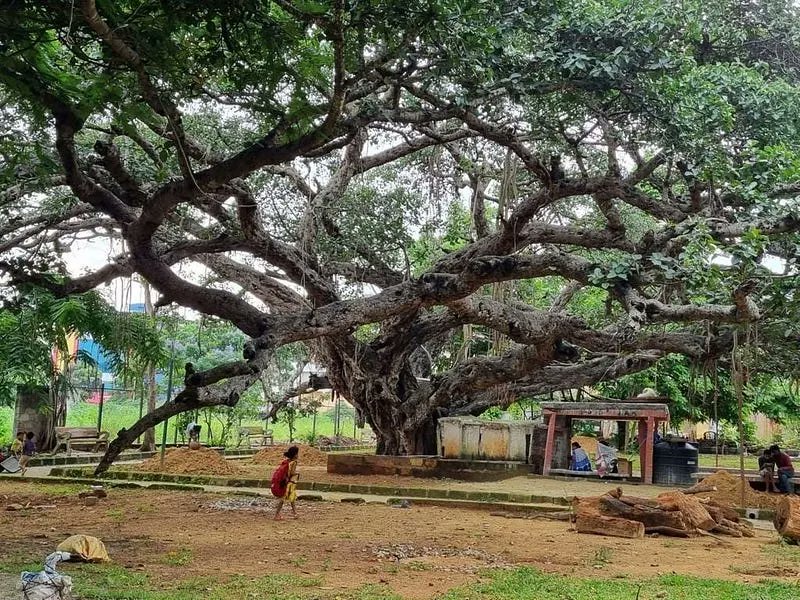
The banyan tree had seen it all.
In the newly formed layout stood this giant banyan tree. It was impossible to miss. It wasn't merely a tree. It was the area's mascot, landmark, meeting point and unofficial clubhouse.
“Alli , aa aaladamara hatra” was all the direction anyone needed.
Around it stretched what felt like an endless wilderness to a ten-year-old boy. There were lakes with dragonflies hovering above the water, orchards filled with guava and mango trees, empty plots that doubled up as cricket grounds.
There was more than enough greenery to convince a child that Bengaluru was one giant forest with a few houses sprinkled in between.
The banyan tree itself had many jobs.
The younger kids learnt how to be Tarzan on its hanging roots. The older uncles occupied the benches and shade beneath it, discussing matters of great importance such as politics, cricket and why the younger generation was doomed.
Teenagers played whatever sport television had convinced them was exciting that month. Cricket was permanent, of course. But hockey would suddenly become fashionable during the Olympics. Hand tennis appeared out of nowhere whenever somebody discovered a new ball or there was French open on TV.
There was India version of games being played. It was the 10 years old first exposure to a large scale event on TV which ran multiple day and also held in India.
One summer vacation afternoon, after returning from an expedition that involved climbing trees, getting chased by a dog and three raw guavas in his pockets, the boy sat beneath the banyan tree and made an announcement.
"I want a baby elephant."
His parents looked at each other.
"A baby elephant?"
"Yes."
"As a pet?"
"Of course as a pet.”
The discussion continued far longer. Instead of immediately rejecting the idea, his parents played along.
"What will you do with a baby elephant?"
The boy had clearly thought this through.
"I'll call him Appu."
"I'll take him everywhere with me."
He could already picture it.
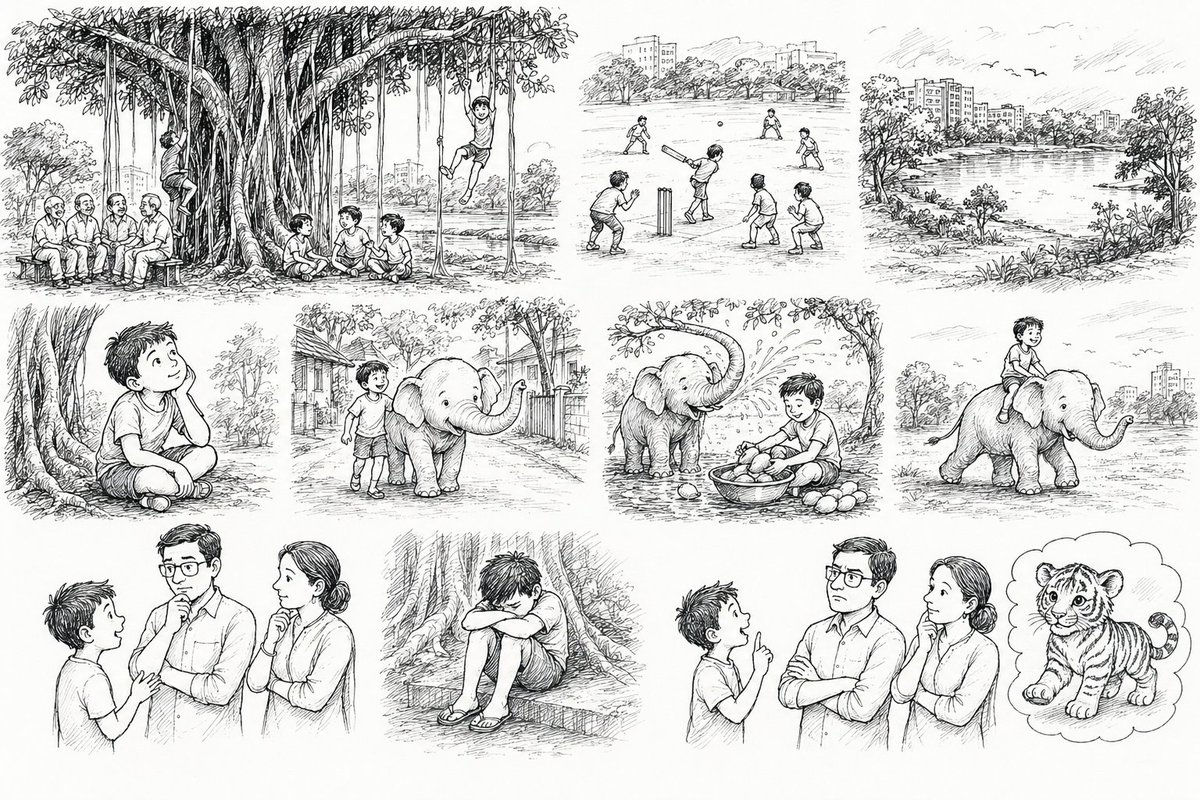
Every summer morning he would stroll through the neighbourhood with Appu walking beside him. All the other children would stare in admiration. Appu would accompany him to the lake. While the elephant enjoyed a refreshing bath, spraying water from his trunk like a municipal tanker , the boy would sit nearby washing freshly plucked guavas and mangoes.
He would eat a couple immediately to check quality.
The remaining fruits that could be fit into his pockets would be brought home for the afternoon.
Sometimes he would ride Appu through the empty fields. Sometimes they would simply wander around together exploring the lakes and orchards.
It was, as far as the boy was concerned, a flawless plan.
His parents listened patiently.
Then
"Do you know how much an elephant eats?"
The boy of course knew but did not respond.
"It eats a lot." The boy felt it wasn’t a problem with all the fields around
"And where will it stay?"
"Outside."
"Outside where?"
The boy looked around.
The entire world appeared to be outside.
His parents continued.
"It will become very big. We don't have enough space. We don't have enough money to feed it. We definitely cannot keep an elephant in the compound."
One by one, the arguments shattered his dream.
The boy spent the next few days sulking. He kicked stones. He stared at the banyan tree. Life was unfair.
An elephant pet was denied
After several days of reflection, he approached his parents again.
"Can I ask you something?"
His parents sensed danger.
"What?"
The boy looked hopeful.
"Okay. If I can't have a baby elephant..."
A pause.
"...can I at least have a tiger cub?"
*The story line drawing image generated by ChatGPT
The banyan tree photo credit @RishiVikram4
2
5
32
3,470
Subhashini Chandramani retweeted

Jun 4
I don't think I have ever heard Rajesh khanna speaking English before.
What a great clip. And that accent. Totally charming. ❤
67
488
2,741
201,490
Subhashini Chandramani retweeted

Jun 3
fuck you
Jun 3


239
4,463
55,604
986,646
Subhashini Chandramani retweeted
Jun 4
'Men will be men' with a wonderful twist!
For the Swiss retailer Migros, agency Thjnk Zürich takes a refreshingly unconventional approach to showcasing fresh produce.
The most predictable route would have been to feature two mothers competing to pack the most imaginative, healthy lunchbox for their kids. But that trope is tired, and wouldn't have made a dent at all. In fact, if it were two mothers, the narrative would probably lean into them exchanging recipes and happily shopping at Migros together.
Instead, by putting two dads in the arena, the ad unlocks a hilarious, hyper-competitive dynamic. What starts as a simple lunchbox comparison quickly spirals into an absurd arms race of food art with cucumber crocodiles and carrot race cars to an all-out gourmet standoff at a neighborhood barbecue.
It’s the petty, silent game of oneupmanship between the dads that makes the ad memorable, all while seamlessly driving home the brand's message: they have the widest range of fresh produce to fuel any culinary ambition.
#advertising #marketing #creativity
3
96
727
75,761
Subhashini Chandramani retweeted

The reason we think dandelions are weeds is because of a 1950s marketing campaign.
Dandelions, native to Europe and Asia, were brought to North America in the 1600s by European colonists who grew them deliberately.
Every part is edible. The leaves are a salad green, the flowers were made into wine, and the roots were roasted as a coffee substitute and used medicinally for liver and kidney conditions for thousands of years. They were a kitchen-garden staple well into the 1800s.
The shift happened after World War II, when 2,4-D (originally developed for chemical warfare research) was approved as a residential herbicide. Companies like Scotts built the modern lawn-care industry around the idea that a perfect green lawn meant zero broadleaf plants.
Dandelions, being bright yellow and resistant to mowing, became a visible enemy, and the campaign worked. By the 1970s, "dandelion-free" was synonymous with "well-kept."
They aren't native, but they aren't doing significant ecological harm either. The herbicides used to kill them, on the other hand, kill bees, contaminate groundwater, and have been linked to non-Hodgkin lymphoma in humans.
If you hate dandelions, it's most likely due to a marketing campaign that ran before you were born.

656
8,044
25,176
671,839
Subhashini Chandramani retweeted

While #Bengaluru City #IMD observatory records a total rainfall of 196 mm in May against an average of 128.7 mm, the #HAL observatory records the lowest May rainfall in at least 10 years by recording just 54.7 mm for the month.
#Karnataka #weather
1
5
35
4,329
The highlight of today is that fresh graduates from my alma mater, Mount Carmel College, are now part of the RedTile team. #womenpower
1
4
494