
Joined October 2025
- Tweets 216
- Following 64
- Followers 4,325
- Likes 1,018
101 Photos and videos

Pinned Tweet

28 Nov 2025
$XNT is live.
The network is running, the code is public.
Thank you to everyone who tested, supported, and helped shape this launch.
The release of a public GPU miner and pool are next.
Links:
Source code: github.com/neptuneprivacy/xn…
Releases: github.com/neptuneprivacy/xn…
Website: neptune.io
Explorer: neptunescan.io
39
28
239
44,447
Everyone claims decentralization.
Almost no one builds it.
A few validators with outsized power. A foundation that can override the chain. A sequencer that goes dark and takes the network with it.
That's not decentralization, that's centralization in disguise.
Neptune Privacy was built with no shortcuts. backdoors or silent control points.
No single entity holding the kill switch.
Decentralization isn't a label you slap on.
It's a property you either have built in or not.
$XNT
6
8
31
618
Jun 12
The strength of any network starts with its community.
$XNT
Jun 12

👀 Still sleeping on $XNT?
The community is growing.
The holder count is rising.
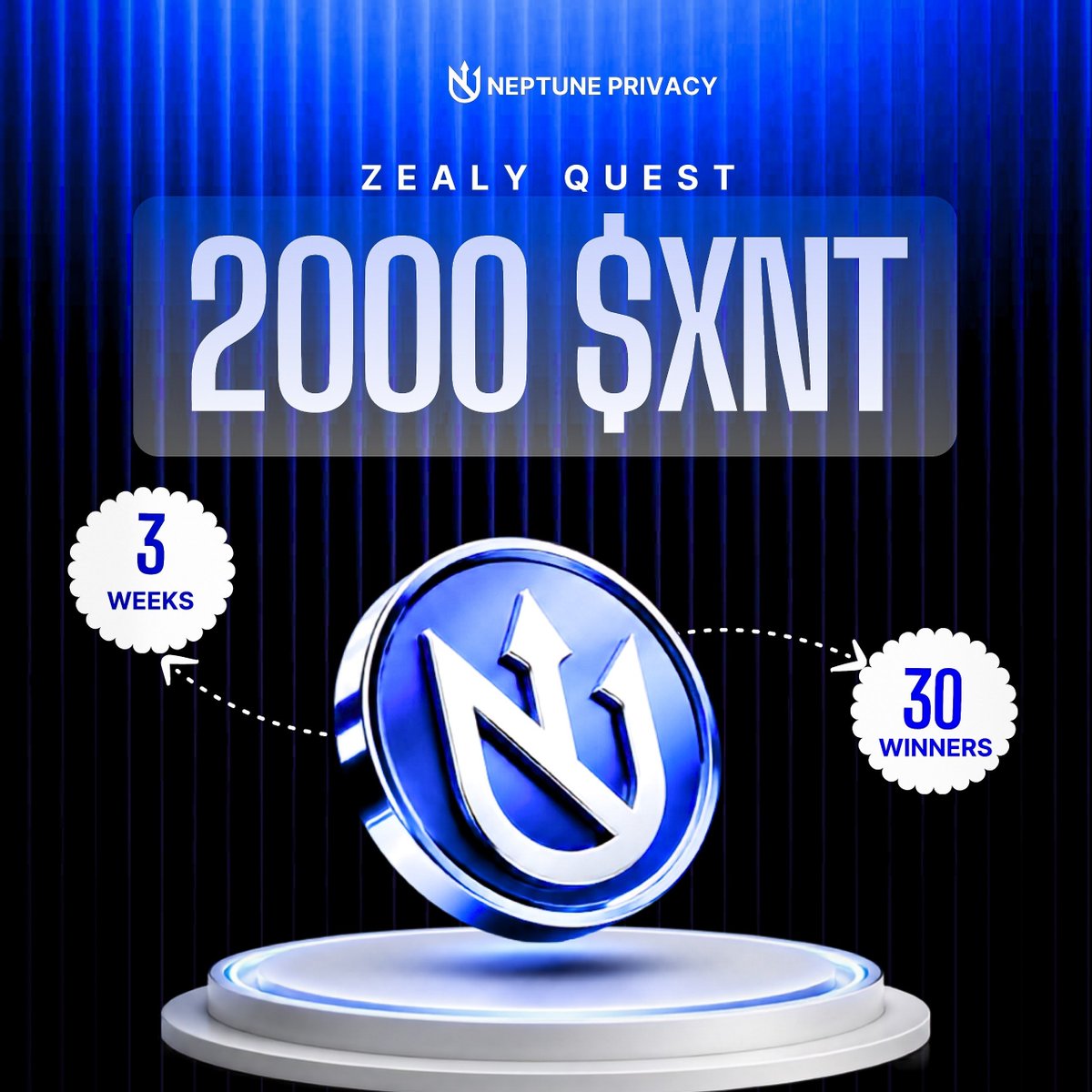
The Zealy campaign is live.
And rewards are being distributed to the most active supporters.
While most are waiting for confirmation, smart money is quietly accumulating.
Privacy isn't a trend.
It's a necessity.
Join the movement.
Become an XNT holder.
Climb the leaderboard.
🔥 Don't be the one buying after everyone else discovers it.
35
11
55
942
Jun 11
The easiest way to spot a disruptive technology?
The market doesn’t know how to categorize it.
Leviathan isn’t competing for a seat at the table.
It’s building a different table.
Private.
Post-quantum.
Scalable.
$XNT
11
17
49
1,180
Most blockchains will be obsolete the day quantum computers go mainstream.
Not because of hacks.
Not because of exploits.
Because the encryption they were built on was never designed to survive what's coming.
Neptune Privacy is.
Post-quantum cryptography isn't a feature on the roadmap, it's the foundation the entire protocol is built on.
When the quantum era hits, most chains scramble.
$XNT is already ready.
9
12
44
1,657
Privacy matters.
Scalability matters.
The industry shouldn’t be settling for one or the other. It should be demanding both.
Leviathan is being built to support a world where developers can create powerful private applications, users can interact without exposing sensitive information, and the network can continue to perform as adoption grows.
The future isn’t just private.
It’s private at scale.
$XNT
5
19
40
1,184
“Neptune already built the missing piece, and Leviathan is the practical proof that the technology works.”
The private, post-quantum narrative is coming.
Neptune Privacy and Leviathan is uniquely positioned for what’s ahead.
Watch this clip from @firehustle_net explaining why they deserve attention in the private, post-quantum blockchain conversation.
$XNT
12
20
48
1,464
Want the full thesis?
Check out the rest of @firehustle_net’s video here👇
youtu.be/onSzVk2NG0U
1
9
706
The conversation around quantum risk is changing fast.
Google’s recent breakthrough reduced the resources needed to run Shor’s algorithm by roughly 10x. Independent researchers are already building on those results.
The question is no longer if cryptography will face quantum pressure.
It’s when.
Neptune Privacy isn’t waiting for Q-Day.
It was built with post-quantum assumptions from day one.
Privacy by default.
Post-quantum security.
Built for a future that may arrive sooner than most expect.
$XNT
Jun 2

Today a crazy quantum story just got wilder.
On March 31, the Google Quantum AI team published a landmark result on Shor's algorithm for elliptic curve cryptography. Technically, the paper was a bombshell: a dramatic 10x improvement over the state-of-the-art. As a stunt and wakeup call to the blockchain space, those optimisations were illustrated on secp256k1, the elliptic curve underlying Bitcoin and Ethereum signatures.
But perhaps the most striking part of the paper was sociological, not technical. Instead of following standard academic process, the optimisations were kept secret, hidden behind a zero-knowledge (ZK) proof. Google's accompanying blog post mentions they "engaged with the U.S. government". The ZK proof demonstrates the existence of algorithmic improvements without leaking details. Academic censorship with ZK, a historic first!
As a co-author of the Google paper I witnessed some of the context surrounding this censorship. To be honest, multiple aspects of that context don't sit well with me. As much as I believe the general public ought to know more, I am limited in my ability to whistleblow. Though let me be clear about one thing: the Google team's professionalism has been absolutely exemplary, and they deserve nothing but praise.
Censorship has a way of backfiring. The Streisand effect, where an attempt to bury something only draws more attention to it, is exactly what's unfolding today. First, Google's key optimisation has been rediscovered by the French. And in a thrilling turn of events, a collaborative Shor-at-home challenge just launched. The initiative, available at ecdsa[.]fail, breached a new Shor world record in a matter of hours.
Let's start with the rediscovery. Just two months after Google's paper, French quantum expert André Schrottenloher cracks the main secret optimisation. His paper, titled "Optimized Point Addition Circuits for Elliptic Curve Discrete Logarithms", landed on the arXiv today. Big congrats to André, who beat several other nerdsnipped experts to it. In a blog post also published today, Craig Gidney, the world expert on Shor optimisations, revealed that he'd been sitting on this very optimisation for a whole year under censorship pressure.
Interestingly, André missed a handful of minor optimisations, both from Google's original publication and from improvements found since. It's plausible there's still plenty of juice left to squeeze out of Shor, and this is exactly what the ecdsa[.]fail challenge is about. The verifier program developed for the ZK proof does double duty, automatically filtering for valid submissions. Dozens of compounding small and micro improvements are rolling in. As of the time of writing there's an 8.4% improvement to Google's circuit, as measured by the product of logical qubit count and Toffoli gate count. Nice!
The nerdsnipping ran deeper than anyone expected. Over the last few weeks it became clear it extended well beyond André and other quantum experts. Behind the scenes, a small army of amateurs quietly got to work. Inspired by Karpathy-style autoresearch, they turned AI on Shor. Ironically, the verifier program for the ZK proof makes an ideal reward function for AIs. The barrier to entry for this modern style of research is refreshingly low, with several non-experts, even a teenager, finding nice optimisations. Get in touch if you'd like to join a Telegram group with fellow autoresearchers :)
Part 2: neutral atoms and qday
The story doesn't end with Google. On the same day Google went public, a stealthy startup called Oratomic published its own Shor paper in a coordinated release. It made a splash, ultimately becoming the most upvoted paper on scirate[.]com, a website ranking arXiv papers.
Oratomic's claim was wild. By building on Google's logical optimisations and applying custom physical optimisations for neutral atoms, they claimed just 10K physical qubits were sufficient to run Shor's algorithm on secp256k1. That number is mind-bogglingly low.
Knowing essentially nothing about neutral atoms when Oratomic's paper landed, I was intrigued and decided to learn more about the tech. I fell straight down the rabbit hole and spent a couple hundred hours on the topic. I got a little obsessed and watched every YouTube video I could find and spoke to a bunch of experts.
My conclusion? The tech is real, very real. Even Google recently decided to start a neutral atom lab, a notable pivot from their sole focus on superconducting qubits. If you care about qday, i.e. the day a quantum computer will break the first piece of cryptography in production, neutral atoms demand your attention. I shared some of my learnings on Shor and neutral atoms in a 30min talk at the ZKProof cryptography conference. You can find it on YouTube by searching "zkproof neutral atom".
Here's an interesting observation about this duo of breakthrough papers: neither Google nor Oratomic say a word about what their results mean for qday. No timelines. Zero. Nada. That is especially baffling given that the whole point of whitehat quantum cryptanalysis is to inform qday estimations and help the general public make good decisions.
So let me attempt to partially fill the silence, similarly to what Scott Aaronson did in his April 29 post. Given everything I know, including scary non-public information, I now put the odds of qday by 2032 at 50%. 10% by 2030.
Anecdotally, the US government has its own date: 2035. Originating at the NSA and later adopted by NIST, it's when branches of the US government will be disallowed from using quantum-vulnerable cryptography. In plain language: with hindsight, that date is a joke and should be discounted entirely. I don't see how NIST avoids being forced to pull it forward by years.
Part 3: post-quantum cryptography
There are good reasons to sound the alarm today, but please do not panic. Rushing carelessly towards immature post-quantum cryptography is a recipe for disaster. IMO a good target date for migration is 2029, roughly 3.5 years out. 2029 happens to be the date selected by Google, Cloudflare, and the Ethereum Foundation.
These days most of my time goes to safely migrating Ethereum towards post-quantum cryptography as part of the broader lean Ethereum effort. There's a lot to do. We need to rip out and replace BLS signatures at the consensus layer, KZG commitments at the data layer, and ECDSA signatures at the execution layer.
The plan to get there is compelling, and is based on hash-based cryptography. Within the Ethereum Foundation we've developed a Swiss army knife called leanVM (github[.]com/leanEthereum/leanVM) powered by the magic of hash-based SNARKs. Thanks to truly exceptional work by Emile, Thomas, and others, its performance is derisked. Regarding security, leanVM is a jewel, a minimal zkVM crafted for end-to-end formal verification and maximum security.
Want to help? There are two $1M initiatives. First, the Proximity Prize (proximityprize[.]org). Solve a long-standing mathematical conjecture in coding theory, improve hash-based SNARKs, and go home a millionaire. Second, the Poseidon Initiative (poseidon-initiative[.]info), offers $1M for breaking Poseidon, the SNARK-friendly hash function.
8
9
41
1,839
Leviathan is a game changer.
It isn't competing in an existing category.
It's creating a new one.
Private smart contracts.
Quantum-resistant architecture.
A purpose-built Layer 1.
Built from the ground up for a future the market is only beginning to recognize.
$XNT
15
14
45
3,320
The quantum threat isn’t a future problem.
The countdown has already begun.
Governments, intelligence agencies, and well-funded actors are already collecting and storing encrypted blockchain data today, anticipating a future where quantum computers can decrypt it.
Most chains were not designed for that reality.
$XNT was built as if the threat already exists.
Privacy and post-quantum security built into the foundation from day one.
Thanks @firehustle_net for breaking it down👇
12
19
55
2,627
May 30
“The smartest money in crypto is making a huge bet that privacy focused quantum proof blockchains are the next big thing and the project they are focused on has one weakness.
But there’s another project that’s solving it.”
That project is $XNT.
Check out this insightful clip from @firehustle_net explaining why Neptune Privacy and Leviathan may be the realization of what Miden was always trying to build: a scalable, private, quantum-resistant ecosystem built on a purpose-built Layer 1 instead of inheriting the limitations of Ethereum.
14
22
63
4,156
May 29
Scaling usually kills privacy.
$XNT was built so it doesn’t.
Most chains get less private as they scale.
More throughput = more metadata = bigger attack surface.
Neptune stays private at scale because privacy isn’t a layer on top it’s the execution environment.
zk-STARKs prove every transaction without revealing it. Recursive proofs settle L2 activity back to L1 without exposing data. Quantum resistance built in, not bolted on.
Scalability runs through Neptune Privacy.
3
6
38
1,384
May 25
🚨 Neptune Privacy Transcends Post-Quantum Security.
Everyone’s talking about Post-Quantum Security, we built that.
Not only that, we also built what no one else has:
Private programmability the ability to scale while staying 100% private & quantum-safe.
No tradeoff.
$XNT
9
14
57
2,448
May 23
Most blockchains still treat quantum resistance as a future problem.
Neptune Privacy was built with post-quantum assumptions from day one.
Private by default.
zk-STARK architecture.
Quantum-resistant security designed at the base layer, not retrofitted later.
Even systems that upgrade later may still face the “Harvest Now, Decrypt Later” problem, where previously exposed transactions and data remain vulnerable in the future.
Worth the read👇
May 20

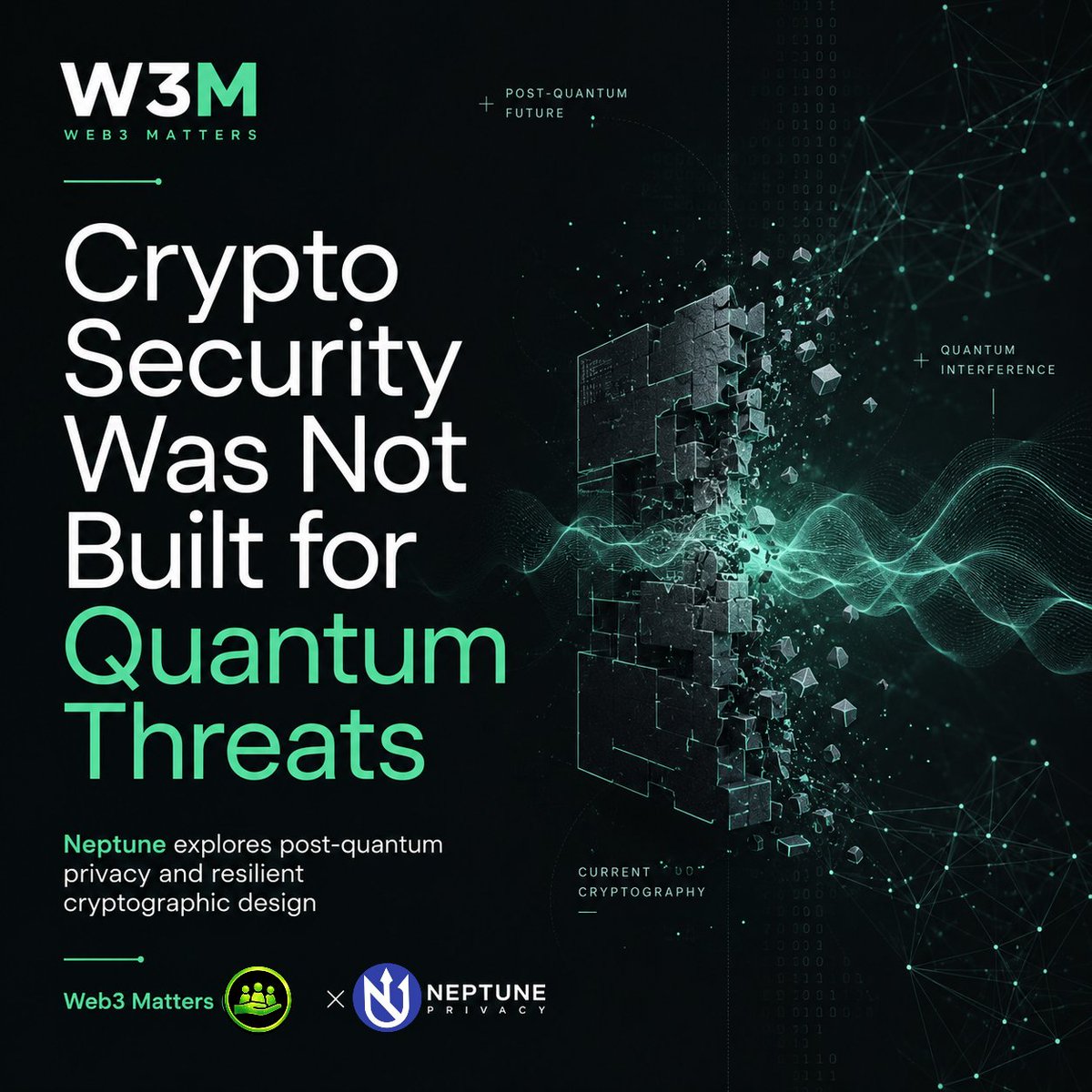
1/ Last Friday, @NeptunePrivacy joined us on W3M to break down something most people in crypto are still ignoring:
How do you protect your assets from the quantum threat?
Not in theory. In practice.
🧵
10
12
51
1,780
May 20
🚨 $3 trillion in crypto assets could be vulnerable to quantum attack within 4–7 years. 
Most chains are scrambling to patch it.
One was built for it from day one.
Leviathan was engineered for Quantum-safe DeFi (or programmability) since day one.
STARK-native at the base layer.
Fully-private.
Post-quantum secure by default.
Scalable by nature.
While everyone else plans for the quantum era. Neptune & Leviathan are already ready for it.
12
12
49
1,718
May 19
Privacy means nothing if quantum computing can eventually decrypt everything retroactively. Few projects are actually preparing for that reality.
web3bytes.beehiiv.com/p/quan…
7
11
46
1,599
May 18
Most of the industry still treats quantum computing like a distant theory.
It’s not.
During our AMA with @Web3_Matters and @trav_sol, we broke down:
• why elliptic curve cryptography is vulnerable
• what “Harvest Now, Decrypt Later” means
• why privacy and quantum resistance must coexist
• how Neptune Privacy was architected differently from day one
• and what we’re building to enable private defi
Private by default.
Quantum resistant by design.
$XNT
May 15
Quantum Threat... Are We Safe? x.com/i/broadcasts/1OGwblyqg…
6
13
53
1,950
May 14
Smartphones once looked excessive before the applications and ecosystems around them were fully built out.
Now entire industries exist because the infrastructure came first.
Same applies here.
Nobody fully knows what developers will create once truly private, programmable, quantum resistant infrastructure exists at scale.
That’s where Leviathan changes the conversation.
$XNT
14
12
55
2,573
May 13
Did he just say he’ll be going live with Neptune Privacy? 👀
Tune in this Friday, May 15th, at 4PM UTC.
The interview will be livestreamed simultaneously on:
• @Web3_Matters
• @trav_sol
• youtube.com/@web3matters
• twitch.tv/web3matters
The Neptune Privacy community will be able to participate live through the chat on whichever platform you’re watching from.
No public reminder link beforehand, so mark your calendars now. We’ll also make a post when the interview goes live.
$XNT
May 10
If you've been vibe coding, you need to run your repo through Shipguard.
✅Paste your public GitHub link.
✅Get a full security report.
✅Get actionable fixes.
Free. No catch.
Built by @0xQuantic full breakdown on his X.
After the Vercel breach, this isn't optional. 👇
12
19
54
3,526
May 12
Most chains were built for peer-to-peer transactions and transparency first.
Privacy was added later.
Scalability either proved to be a challenge or introduced more visibility and attack surfaces.
Leviathan changed that.
Built on Neptune’s quantum resistant L1, Leviathan brings:
• private by default execution
• quantum resistant DeFi
• scalable private applications
All powered by $XNT across both layers.
Every transaction and block is recursively verified back to L1 through cryptographic proofs, preserving Neptune’s native privacy and quantum resistant architecture at settlement.
Leviathan also changes what becomes possible:
• Private DEXs: hidden order books, no mempool exposure, no sandwich attacks, no front-running
• Private lending & borrowing
• Private stablecoins
• zk-based compliance proofs
• Private DAOs and financial infrastructure
• Private prediction markets
• Encrypted payments and payroll systems
Most of crypto is still leaking metadata by design.
Leviathan is being built for the next generation of blockchain infrastructure, where privacy, scalability, and quantum resistance are built into the foundation from day one.
The infrastructure is already here.
The applications come next.
$XNT
10
24
66
3,307