
Neuroscientist (PhD). Research interests include sex differences, dementia, sleep/circadian rhythms, and neuroimmunology.
Joined March 2009
- Tweets 14,068
- Following 111
- Followers 12,163
- Likes 18,404
988 Photos and videos
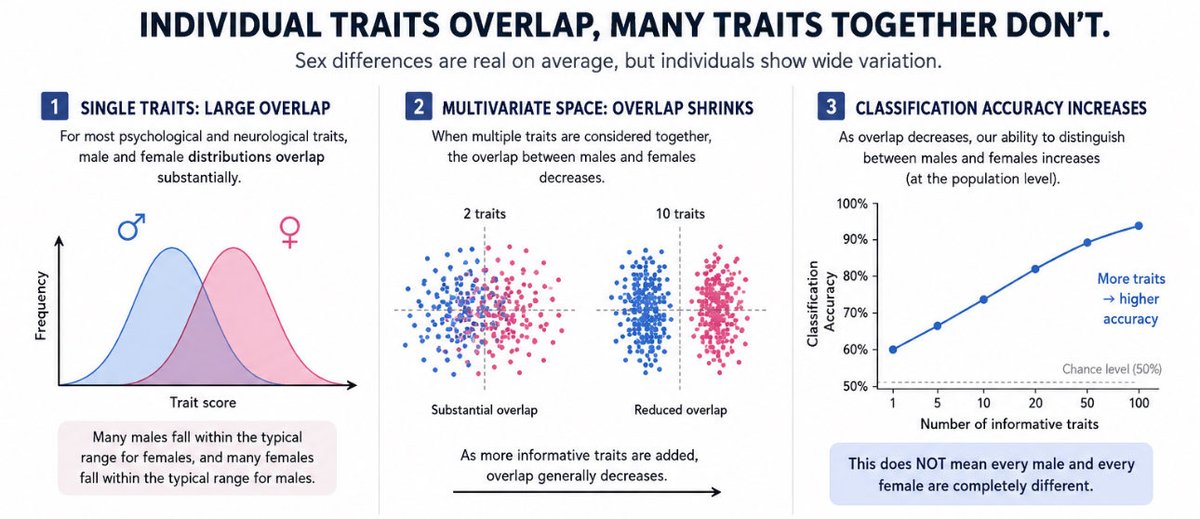



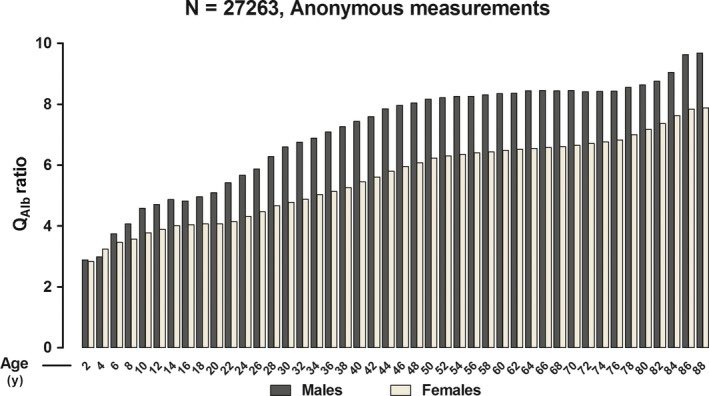
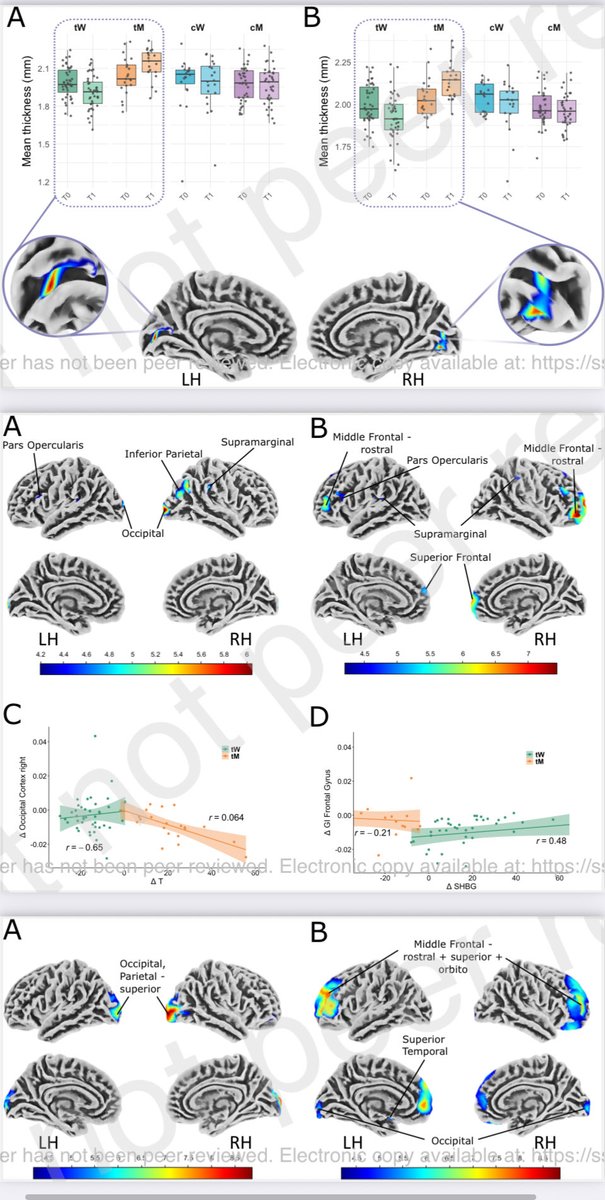


Males and females may differ, on average, across many psychological and neurological traits. For most individual traits, however, the distributions overlap substantially, with many males and females falling well within the same range.
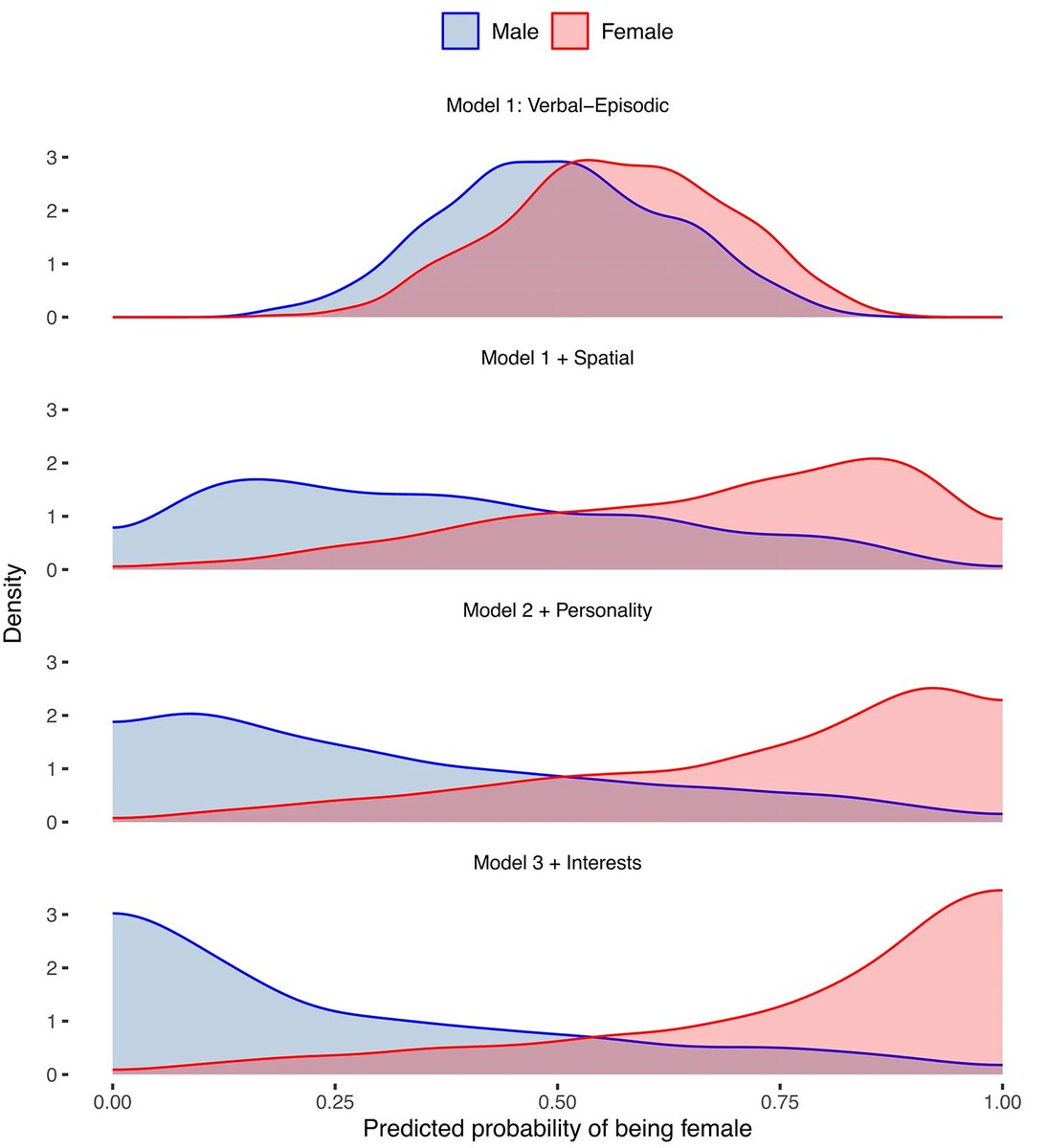
When these traits are considered simultaneously in a multivariate space, the overlap between the sexes can decrease considerably. As more informative traits are added, classification accuracy generally increases.
Some people take this to mean that every male and every female must therefore be profoundly different. But that conclusion does not follow. Multivariate sex differences are primarily population-level patterns: they tell us that groups can be distinguished with increasing accuracy, not that every individual is highly atypical of members of the other sex.
5
16
137
5,925
Sammy retweeted

If I could wave a magic wand and make the world a better place, it would be by making everyone intuitively understand this statistical concept

Males and females may differ, on average, across many psychological and neurological traits. For most individual traits, however, the distributions overlap substantially, with many males and females falling well within the same range.
When these traits are considered simultaneously in a multivariate space, the overlap between the sexes can decrease considerably. As more informative traits are added, classification accuracy generally increases.
Some people take this to mean that every male and every female must therefore be profoundly different. But that conclusion does not follow. Multivariate sex differences are primarily population-level patterns: they tell us that groups can be distinguished with increasing accuracy, not that every individual is highly atypical of members of the other sex.
1
20
1,367
Scientists in the same field can disagree on fundamental issues and still have productive debates.
Put a scientist and a non-scientist in the same debate (especially on a controversial topic) and it often turns into a mess.
What does that tell you?
Disagreement isn’t the problem. Shared standards for judging evidence are.
2
3
13
458
“Plasticity doesn’t rewrite sex-differentiated nuclei” - What evidence has shown this? I don’t care if it’s true or not, but you need to cite data before making base claims like this. If your argument relies on these assumptions, then data is required.

Plasticity doesn’t rewrite sex‑differentiated nuclei. And ‘no male/female brain’ simply means overlap exists, not that sex‑typical patterns don’t. Your argument mixes political talking points with misused neuroscience.
4
1
30
1,194
I’m just gonna leave this here, classic 👍
1
1
12
853
Confounding variables literally detract from the evidence, that’s what they are…
Also, a transgender woman (natal male) who’s sexually attracted to other natal males is considered a homosexual orientation (often referred to as “androphillic”).
So yes, it’s important to control for when investigating the transgender brain.
2
3
67
1,955
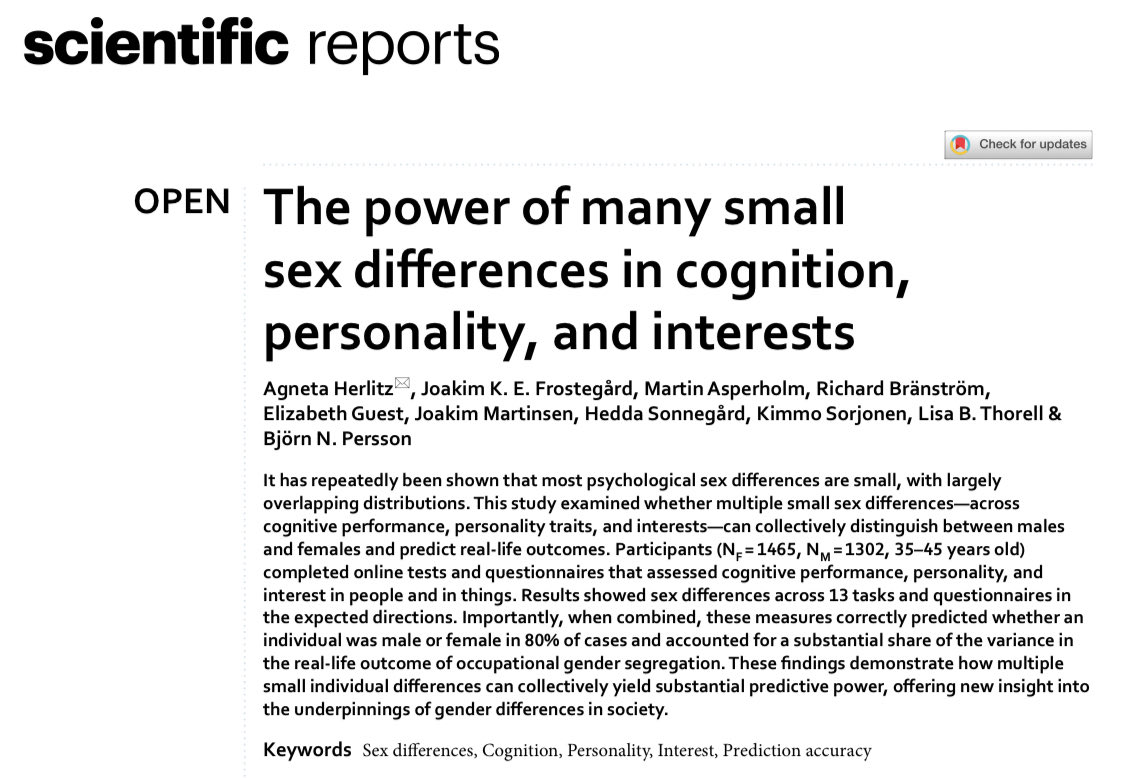
Many psychological, cognitive, and behavioural sex differences are small to moderate when examined individually.
But when dozens of these differences are considered together, the overlap between male and female distributions shrinks substantially:
nature.com/articles/s41598-0…
6
26
123
4,114
“Gender identity” is often presented as a deep, innate psychological essence that exists independently of biological sex. However, the evidence for such a claim is far less clear than is commonly assumed.
At its most basic level, what is called “gender identity” can be understood as an individual’s perception, understanding, or subjective relationship to their biological sex. Neurologically, researchers do not directly observe a “gender identity” module in the brain. Rather, they identify statistical correlations between certain brain regions, networks, or patterns of activity and individuals’ self-reported feelings, beliefs, and experiences. This is no different in principle from studying political identity, religious identity, national identity, athletic identity, or any other self-concept. The fact that a mental state correlates with brain activity does not establish that it is an innate, biologically distinct entity.
The statement that “gender identity is in the brain” therefore risks overstating what neuroscience can actually demonstrate. Every thought, belief, preference, and self-conception is represented in the brain in some form. Saying that gender identity has neural correlates tells us little more than the fact that people think about themselves in sex-related ways.
At most, biological, developmental, psychological, and social factors may influence whether an individual feels comfortable with, identifies with, or rejects aspects of their sexed body. These influences are worthy of study. However, it does not follow that “gender identity” should be treated as a separate category that supersedes biological sex in law, medicine, or public policy.
Biological sex has direct physical, reproductive, and physiological consequences that are relevant in areas such as healthcare, sport, privacy, data collection, and scientific research. Any policy framework that elevates subjective identity above these objective realities bears the burden of demonstrating why such a departure is justified. Simply asserting that gender identity is real or that it has neural correlates does not, by itself, establish that it should take precedence over biological sex in legal or institutional decision-making.
17
107
337
12,240
No, they don’t…
No study has demonstrated any causality, nor have they demonstrated this in any large, un-confounded datasets.
28
115
1,461
27,454
Sammy retweeted

Interesting from @NeuroSGS
"The statement that “gender identity is in the brain” therefore risks overstating what neuroscience can actually demonstrate. Every thought, belief, preference, and self-conception is represented in the brain in some form. Saying that gender identity has neural correlates tells us little more than the fact that people think about themselves in sex-related ways."
“Gender identity” is often presented as a deep, innate psychological essence that exists independently of biological sex. However, the evidence for such a claim is far less clear than is commonly assumed.
At its most basic level, what is called “gender identity” can be understood as an individual’s perception, understanding, or subjective relationship to their biological sex. Neurologically, researchers do not directly observe a “gender identity” module in the brain. Rather, they identify statistical correlations between certain brain regions, networks, or patterns of activity and individuals’ self-reported feelings, beliefs, and experiences. This is no different in principle from studying political identity, religious identity, national identity, athletic identity, or any other self-concept. The fact that a mental state correlates with brain activity does not establish that it is an innate, biologically distinct entity.
The statement that “gender identity is in the brain” therefore risks overstating what neuroscience can actually demonstrate. Every thought, belief, preference, and self-conception is represented in the brain in some form. Saying that gender identity has neural correlates tells us little more than the fact that people think about themselves in sex-related ways.
At most, biological, developmental, psychological, and social factors may influence whether an individual feels comfortable with, identifies with, or rejects aspects of their sexed body. These influences are worthy of study. However, it does not follow that “gender identity” should be treated as a separate category that supersedes biological sex in law, medicine, or public policy.
Biological sex has direct physical, reproductive, and physiological consequences that are relevant in areas such as healthcare, sport, privacy, data collection, and scientific research. Any policy framework that elevates subjective identity above these objective realities bears the burden of demonstrating why such a departure is justified. Simply asserting that gender identity is real or that it has neural correlates does not, by itself, establish that it should take precedence over biological sex in legal or institutional decision-making.
1
3
12
822
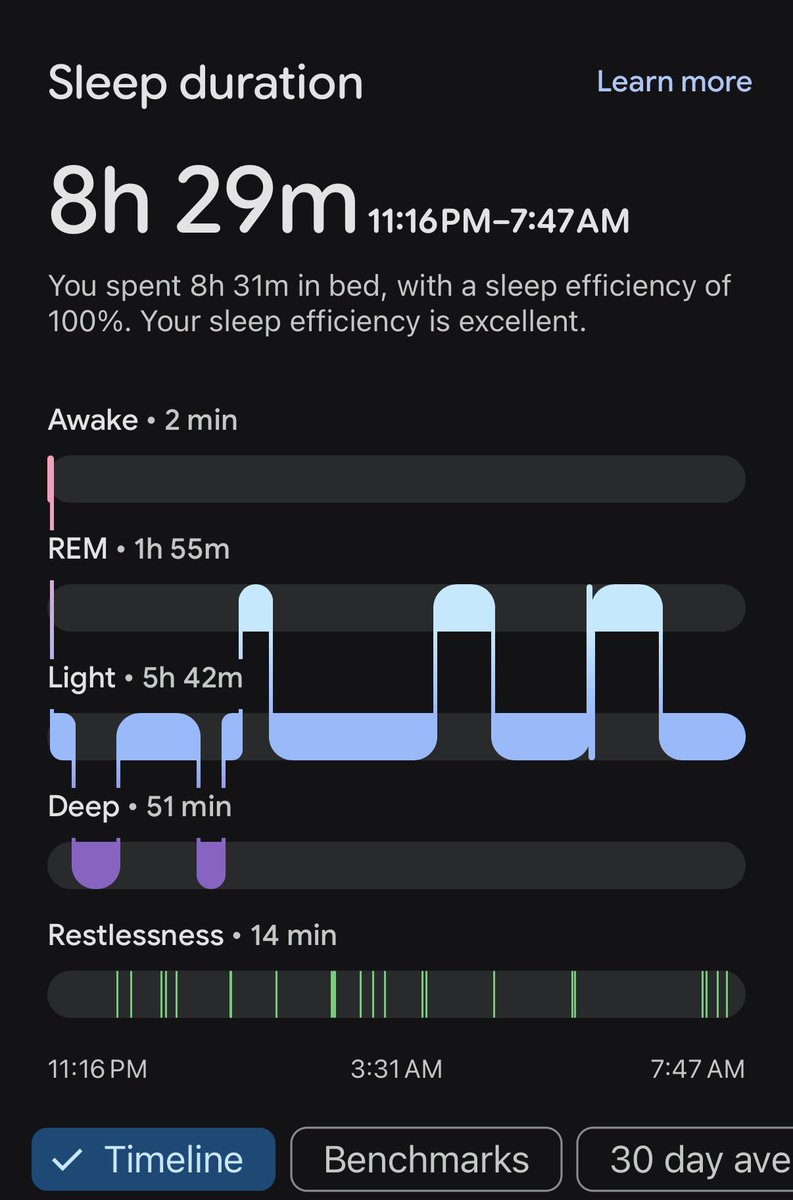
I wouldn’t worry too much about your sleep score.
Most watches estimate sleep from a handful of imperfect signals (movement, heart rate, estimated sleep stages, etc.). The exact score is largely arbitrary, so focus on trends rather than the number itself.
To improve sleep:
• Consistent sleep and wake times (even on weekends)
• Morning sunlight exposure
• Regular exercise
• A cool, dark bedroom (~18–19°C)
• A warm bath or shower 1–3 hours before bed (and, surprisingly, socks in bed can help by increasing heat loss from the body’s core)
• No caffeine after midday (or at least 8–10 hours before bed)
• Avoid large late-night meals
• Dim lights before bed
• If you’re lying awake, get out of bed until you’re sleepy again
Do those consistently and you’ll get more benefit than chasing a higher sleep score.
Jun 7

it feels impossible to get over a 90 point sleep score (whatever that actually means)
what are your best sleep tips and tricks?
3
7
1,411
Everyone talks about supplements.
Far fewer people ask:
• Do you snore?
• Do you sleep on your back?
• Is your bedroom dark?
• Is it quiet?
• Can you breathe properly through your nose?
• Do you wake up multiple times each night?
Fixing those often does more than the latest sleep supplement.
1
4
257
Sammy retweeted

Jun 8
Low-dimensional population dynamics in the brainstem gate REM sleep | Nature Neuroscience nature.com/articles/s41593-0…
9
35
3,083
Sammy retweeted

biological sex differences manifest so early and fundamentally that a deep-learning model can visually identify the sex of a human embryo starting on Day 3 of pre-implantation development . immediately after the eight-cell stage. Other studies have already shown the same thing.

6
63
328
29,068