
Web3 Engineer at @0xFastLane, building on-chain MEV auction protocol. Co-Founder of @squidrouter(excited) and @bitstrays.
Joined January 2018
- Tweets 271
- Following 1,467
- Followers 170
- Likes 557
14 Photos and videos







0x1NotMe retweeted

Jan 22
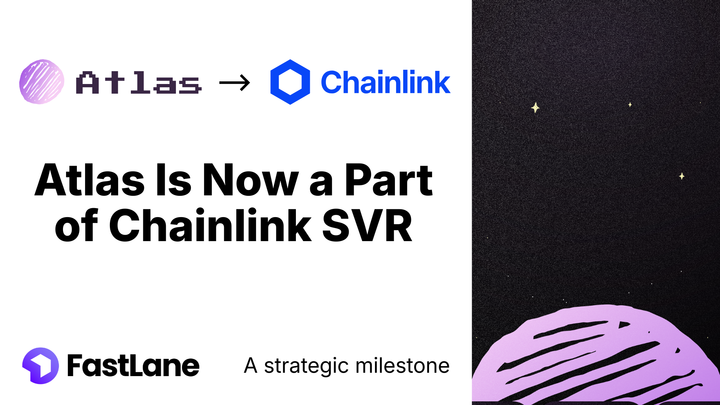
We’re proud to share that Atlas, our protocol for application specific orderflow auctions, has been acquired by @chainlink.
Atlas’s proven orderflow technology is now integrated into Chainlink SVR, enabling applications and protocols to capture and retain value more effectively.
Chainlink has securely enabled over $27 trillion in transaction value and currently secures more than 70% of the DeFi ecosystem. We’re excited to see Atlas scale further through Chainlink’s global distribution and infrastructure.
This is a strategic milestone for FastLane. FastLane will continue to operate independently and remain a strategic partner to Chainlink in the ongoing development and adoption of Atlas.
Our focus remains unchanged. We are doubling down on Monad, building elite staking infrastructure and developer tooling including Application Controlled Execution Software to strengthen network effects and continuing our mission with renewed clarity and focus.
Read more here: <prnewswire.com/news-releases…>
89
46
408
68,057
0x1NotMe retweeted

3 Dec 2025
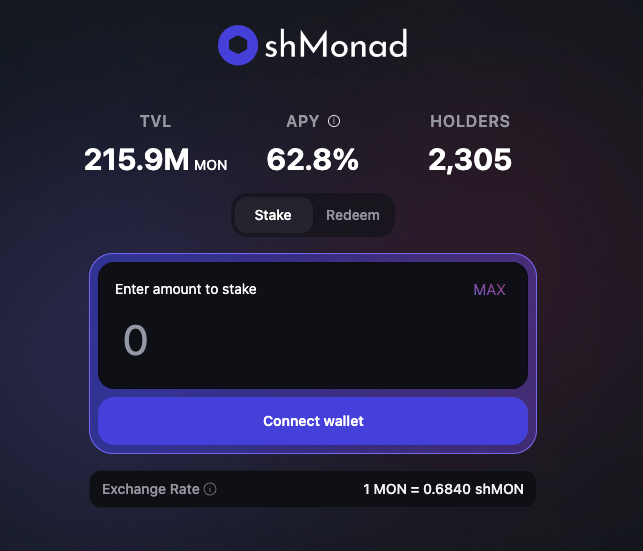
Yesterday, shMonad's APY was added to DeFiLlama's data set and added to the shMonad frontend. Since then, we have gotten *a lot* of questions about whether or not it's bugged.
It isn't bugged.
It doesn't include incentives.
But we do expect it to stabilize lower.
🧵(1/x)
44
28
229
65,594
0x1NotMe retweeted
1 May 2025
1/ FastLane is pleased to announce that 100% of the validator teams on Monad testnet have joined a coordinated research initiative on maximum-extractable value (MEV) and its impact on network safety, liveness and decentralisation.
18
98
335
70,379

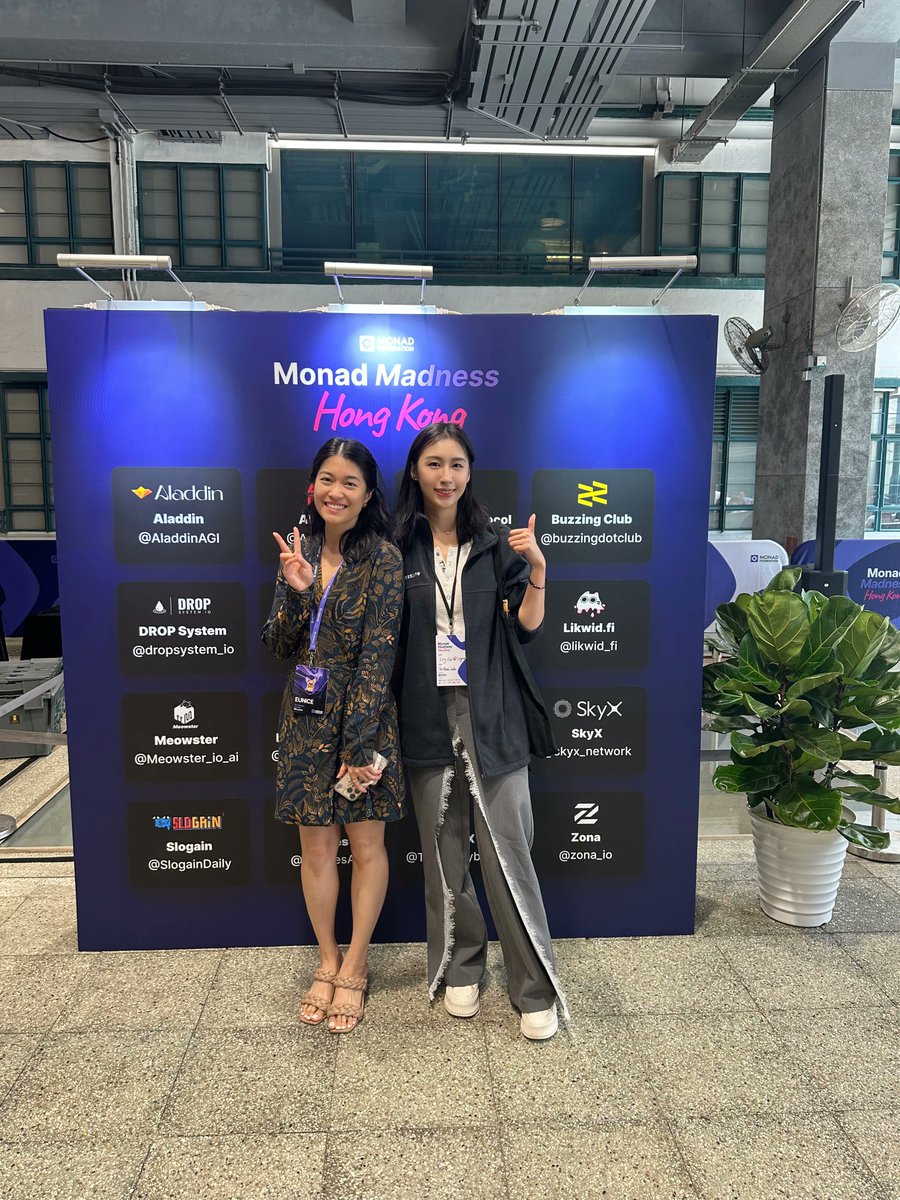
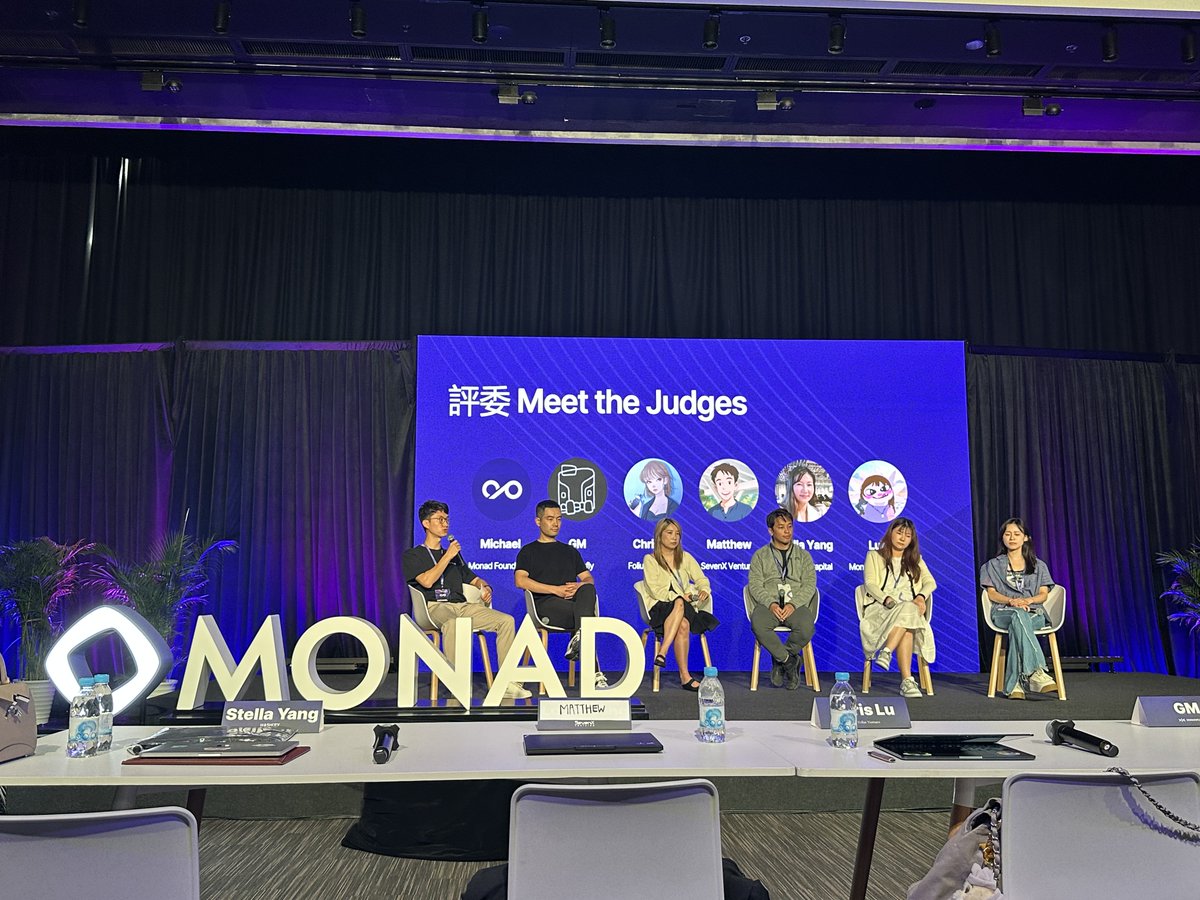
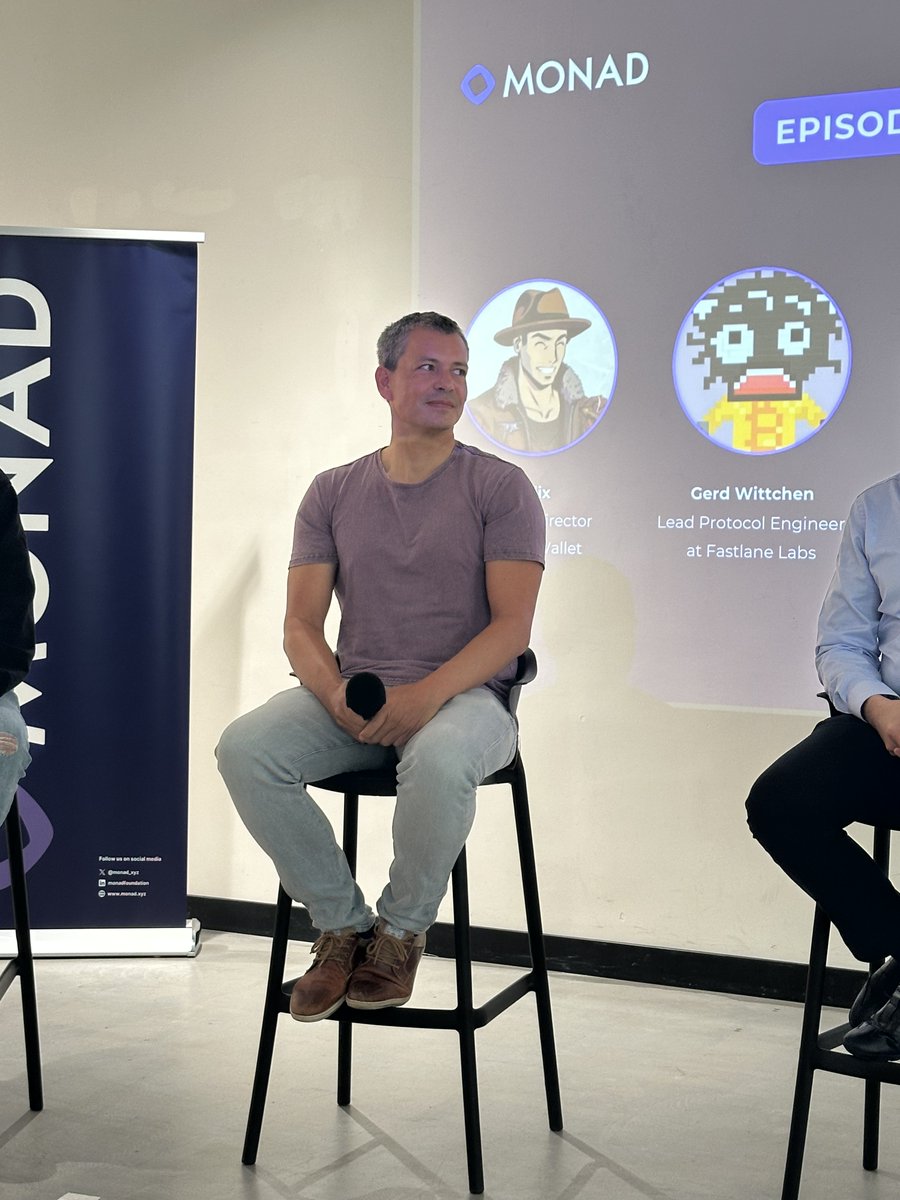
Gshmonad! Our team had a blast at Monad Exhibition Day.
@0xFastLane crushed the panel, sharing Fastlane’s work. Huge turnout, killer projects at Monad Madness, and meeting @0x_eunice
was awesome.
Stoked to connect with APAC’s @monad_xyz community.
Loved @monad_zw’s name tag designs—super cute!

8
1
53
5,213
0x1NotMe retweeted
12 Feb 2025
Today, we're announcing shMONAD: The first Super Holistic liquid staking protocol, developed exclusively for the Monad blockchain by FastLane Labs.
shMON will serve as the Liquid Staking Token to guarantee:
🛡️ Protocol Security
🤖Productive MEV
✨UX Acceleration
🧵👇
1/8
34
53
283
36,479
0x1NotMe retweeted
30 Jan 2025
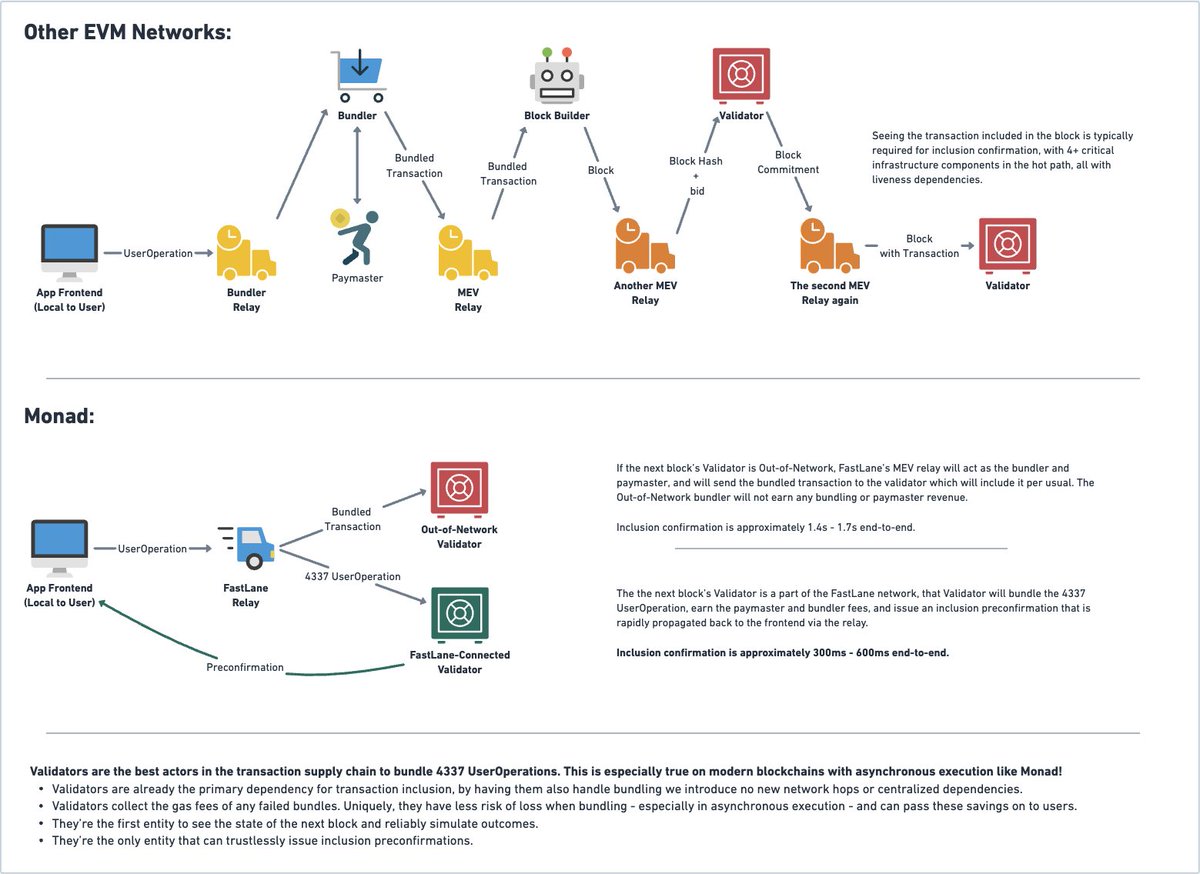
You can just remove middlemen
gmonad
12
18
80
5,608
0x1NotMe retweeted

25 Dec 2024
Layer 2 (L2) solutions are, at their core, applications deployed on Layer 1 (L1) blockchains, defined by their settlement contracts. They rely on default “Application” Specific Sequencing (ASS) provided by their sequencers.
In contrast, for applications explicitly leveraging ASS, this functionality depends on a bundler operating the user-operation (user-op) mempool. Effectively, this bundler serves the same purpose as a sequencer: it bundles and sequences transactions, submitting them to the application for execution. While similar in functionality, there are key distinctions between ASS and L2s that are worth exploring.
The primary differences between ASS and L2s are as follows:
1.Permissionlessness: Becoming a bundler for ASS is permissionless, unlike being a sequencer for L2s, which often involves a centralized entity. Bundlers only need to conform to the specifications defined in the Entry Point contract to participate, enabling anyone to run one.
2.Execution and Security Models: L2s execute transactions off-chain and settle results on-chain, relying on economic security mechanisms. In contrast, ASS requires execution to occur on the settlement layer itself, providing cryptographic security rather than economic security.
3.Composability: ASS preserves L1 composability, whereas L2s inherently lose this due to their off-chain execution model.
When comparing the overarching characteristics of these systems, ASS outperforms L2s in several critical dimensions: permissionless sequencing is superior to permissioned sequencing, cryptographic security outmatches economic security, and composability triumphs over isolation.
This makes ASS more censorship-resistant, secure, and composable than L2s.
The sole advantage of L2s is scalability, but this trade-off comes at the expense of significant downsides, including reduced censorship resistance, diminished security, and a loss of composability.
If the base layer (L1) is scalable, the rationale for adopting L2s weakens significantly. Why accept worse censorship resistance, security, and composability if it isn’t absolutely necessary?
Examining the fee structures highlights another critical point.
With ASS, execution fees are entirely directed to L1 validators, while MEV flows to the application itself. In contrast, with L2s, both execution fees and MEV are claimed by the sequencer, while settlement fees are shared with the L1. If the L2 employs an alternative data availability (DA) layer, even some settlement fees may bypass the L1.
This means ASS unambiguously directs more fees to L1 validators compared to L2s.
This discrepancy in fee allocation raises serious concerns about the impact of L2s on the L1 ecosystem.
Consider this: if an application on the L1 could perform all the same functions as the L1 but returned only a fraction of its fees to the L1 while pocketing the rest, would this be beneficial for the L1?
The answer is a clear no.
Such an application effectively diverts the majority of the L1’s potential revenue for its own benefit, undermining the health and sustainability of the L1. In essence, this is what L2s do.
10
5
55
20,788
0x1NotMe retweeted
30 Aug 2024
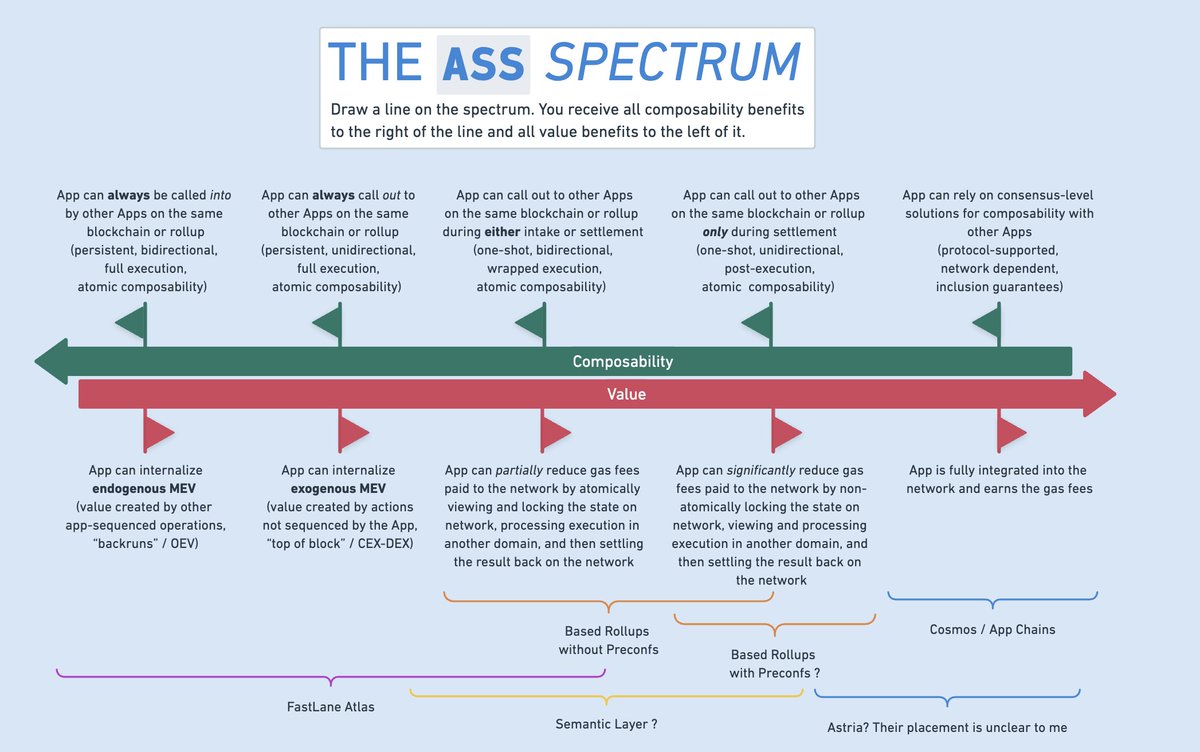
Rough draft of an ASS diagram for some of the generalized solutions and their range on the spectrum. Low conviction on some of the ranges - would love feedback @ballsyalchemist @rainandcoffee @lobstermindset @dex_chen_V
Will include lines of specific apps like sorella next
10
15
76
12,076


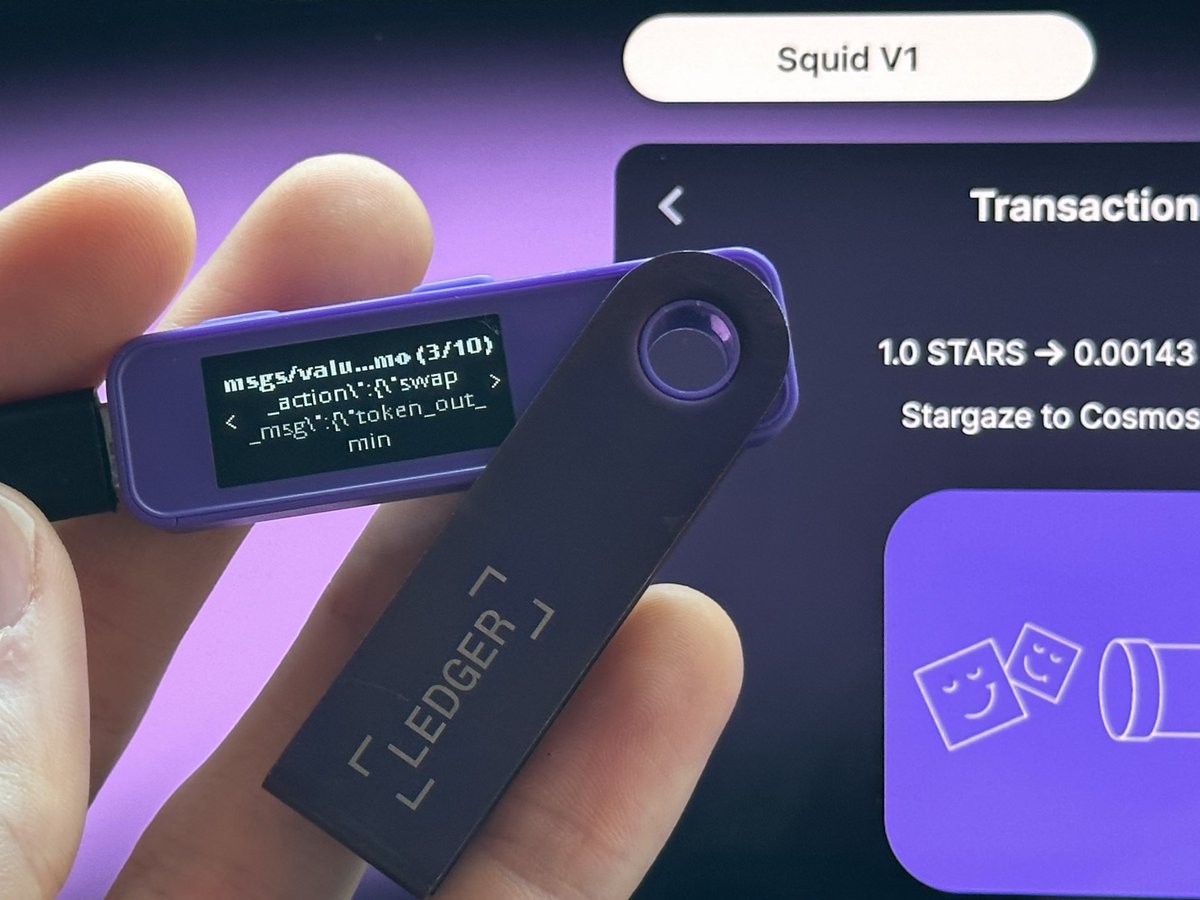
Happy to share that you can now execute Squid transactions in the @cosmos using your @Ledger!
Thanks to the the @confio_tech and Ledger teams for the support. We needed to make a few changes on all sides.
6
11
82
7,428
0x1NotMe retweeted

19 Oct 2023
Bad Kid Goes To Space ✨ bad.squidrouter.com x.com/i/broadcasts/1MnxnMBnE…
34
272
312
64,340
.@mikegrant please send testnet USDC to 0xfd0a84C3BC0F1Db3a3fac4558764823f36388E13 on MATIC
1
1
5
73
0x1NotMe retweeted

27 May 2023
The difference between #Cosmos IBC, @Polkadot interop and @axelarcore is the approach and philosophy to connectivity.
The first two assume homogeneous architecture, and certain rules must be met to achieve connectivity.
@axelarcore supports heterogeneous systems and "adopts" to them via plug-an-play primitives.
The results is that innovation can continue happening at any layer of the stack while enabling connectivity with all others systems.
We're still in the early innings of the space, and it's important to allow innovation to continue happening at all layers.
5
18
83
17,846
0x1NotMe retweeted
26 May 2023
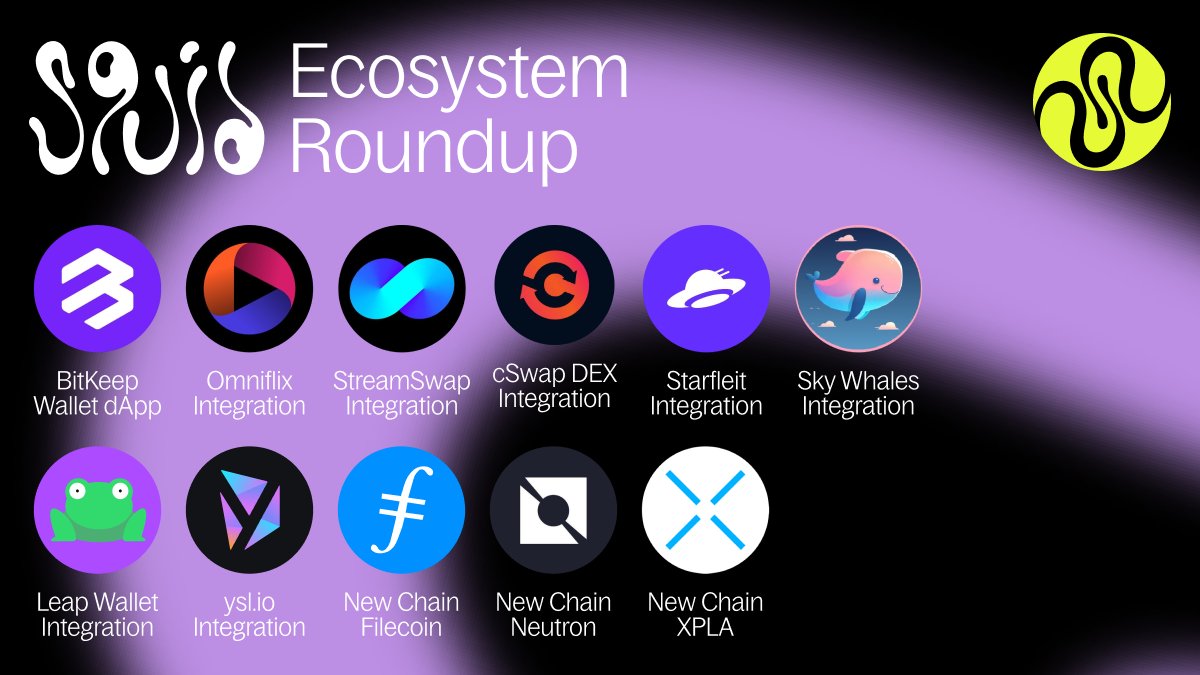
We continue to be impressed by all the innovative ways in which apps are leveraging Squid's cross-chain swaps to:
🛬 Onboard users from other ecosystems
⛲ Unlock new liquidity
💅 Enhance their UX.
Welcome to the second edition of Squid's Ecosystem Roundup 🌐 ↓
3
5
19
2,919
0x1NotMe retweeted
24 May 2023
It's @Neutron_org day ✴️
The launch event is aimed at distributing voting power and liquidity through the $NTRN airdrop, liquidity bootstrapping and rewards for locking tokens.
axlUSDC on Neutron for acquiring $NTRN is now supported at app.squidrouter.com 💜💚
1
1
25
5,573
0x1NotMe retweeted
30 Apr 2023
The new @SonarWallet by @teamkujira represents a new generation of mobile wallets that are truly multichain by design 💫
Sonar leverages Squid @axelarcore's asset transfers for seamless onboarding and interoperability between a wide range of chains 📲
Currently in beta 👀
1
11
56
5,539
0x1NotMe retweeted

27 Apr 2023
Are you familiar with @axelarcore? It's more than just a bridge. There is an emerging ecosystem of natively interchain applications built on top of Axelar's infrastructure. Here are some of the projects:
6
26
97
26,120