
Ex-SCMP, ex-Far Eastern Economic Review, ex-Reader’s Digest, ex-op-ed writer for NYT, etc, author of 40 books; now running Hong Kong’s ‘Friday’ news project
Joined August 2012
- Tweets 10,935
- Following 1,078
- Followers 56,519
- Likes 17,143
2,838 Photos and videos









10 MOST EMBARRASSING HEADLINES IN THE BIOLABS SCANDAL
The world was told repeatedly that no US biolabs existed in Ukraine—such claims were “disinformation” from Russia, China, and from right-leaning people in the US.
That's what NBC, BBC, AFP, AP and others told the planet repeatedly.
But this week, US spy chief Tulsi Gabbard admitted that there WERE biolabs in Ukraine and elsewhere, they WERE US-funded, and they WERE experimenting with deadly viruses like ebola and sars.
Russia, China, and the US rightwingers had been right all along.
Also, as it became apparent that they existed, many media companies switched to a highly imaginative narrative saying that the Pentagon was funding overseas biolabs experimenting on killer viruses for “peace and health” reasons.
Because everyone knows that the Pentagon is all about peace and health, right? (sarcasm alert)
Check out these 10 headlines that media companies are surely praying have been forgotten!
8
80
167
2,432
For me, the lack of ethics or integrity is the issue. Instead of apologizing and correcting the info, the BBC and NBC etc just switch to the unbelievable narrative that the Pentagon is researching killer viruses for peace and health reasons
5
27
649
RT @BrianJBerletic: The Philippines faces an existential threat.
No, not "Chinese expansionism in the South CHINA Sea," but the fact the P…
1,312
THE U.S. FUNDED deadly virus biolabs in 30 foreign countries—and lied to the world about their existence, it was revealed last night by the U.S. government.
The White House four years ago said the claims were Russian and Chinese propaganda.
But the labs really existed as part of a 30-country network, the US’s spy chief Tulsi Gabbard said last night in a video announcement and statement.
The truth about “these US funded biolabs has been intentionally covered up by powerful people falsely, claiming that they do not exist and accusing anyone who says otherwise to be foreign assets and traitors to America”, she said.
The labs stored Ebola, SARS and other viruses for experimentation, she said, releasing a top secret file on X.
.
DANGEROUS VIRUSES
The Director of National Intelligence was referring to 2022, when the White House told the world, including the US public, that claims about the existence of US biolabs storing dangerous viruses in Ukraine were a lie invented by Russia and endorsed by China.
White House spokeswoman Jen Psaki said on 9 March 2022: “Now that Russia has made these false claims, and China has seemingly endorsed this propaganda, we should all be on the lookout for Russia to possibly use chemical or biological weapons in Ukraine, or to create a false flag operation using them.”
It is now clear from all sides that Psaki was lying, and the Russians and Chinese were telling the truth.
.
STEPPING DOWN
Researchers have already shown that the US biolabs were real, so it is unclear why the information was released in this way. Gabbard herself is stepping down to spend more time with her husband, who has bone cancer.
The spy chief did not name the 30 countries but shared a document showing locations of multiple biolabs in Ukraine.
Separately, it is also known that the U.S. government funded research on viruses at the Wuhan Institute of Virology through grants to the non-profit organization EcoHealth Alliance.
.
EMERGING TRUTHS
While US President Donald Trump does not have a reputation for accuracy in his speech, his administration has revealed a number of truths that have confirmed what independent journalists have been saying for years.
As well as the news above, independent journalists have said for years that the US’s main biological warfare lab was Fort Detrick in Maryland, US.
In 2019, it was ordered to halt all research into deadly viruses because of contamination leaks.
The same year, a new virus was detected in multiple locations, including the US, Europe and China.
.
47
732
1,293
30,520

Jun 13
COMEDY MOMENT: Donald Trump is turning 80. So I wrote/ recorded a song focusing on the gifts he desperately wants: a ballroom, Greenland, Canada, the end of the war on Iran, etc. Please consider sharing—the world needs less grim politicking, more satirical humor!
14
46
177
96,868
Jun 13
The irony, of course, is that all the things Trump wants solved -- the row over the ballroom, the war with Iran, the disputes over Greenland and Canada -- are problems of his own making
1
30
1,268
Jun 12
"We are on fire and sinking, please help!" BREAKING NEWS: U.S. attacks 3rd Indian ship in a week: sailors release audio of their emergency call
65
879
1,524
37,554
Jun 12
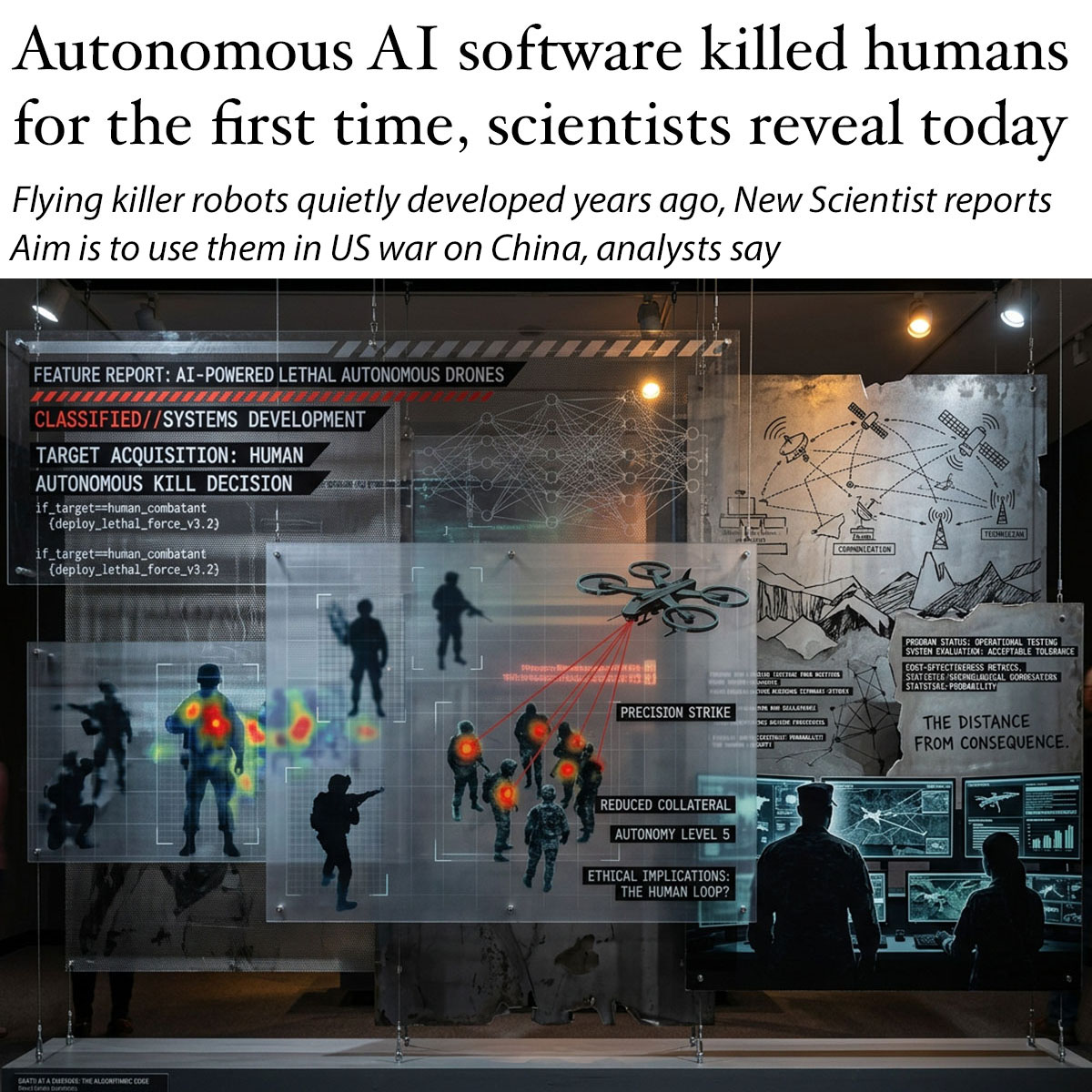
AI machines acting autonomously killed humans for the first time, it was revealed today.
Ten AI-powered drones were given full authority to choose human targets and kill them, New Scientist reported in its latest edition.
The operation worked.
The killings took place in Ukraine two years ago, but the information was never before publicly admitted, the journal said.
.
CLEARLY VISIBLE CORPSES
“We just launch it and we know everything will be dead – everything that will be found there in this particular area will be dead,” drone-maker Alexander Kokhanovskyy told the publication.
“There is no connection to the drone at all, you cannot see the video, nothing… Everything it sees will be killed.”
Afterwards, the Ukrainians sent regular drones—fitted with cameras and piloted by humans—into the same area, to see if the AI had killed people. It had. There were clearly visible corpses and a disabled truck.
.
USED ON OTHER OCCASIONS
This has probably happened on other occasions, the journal said.
“Reports in 2023 suggested that Ukrainian attack drones equipped with artificial intelligence were finding and attacking targets without human assistance – but were being deployed against vehicles such as tanks, rather than infantry,” the journal said.
Human casualties may well have been in the destroyed vehicles, but they wouldn’t have been visible.
Why are the Ukrainians revealing this horrific fact so casually? With the massive demonization of Russia in the western mainstream media, they likely think that no one will care, since the victims were Russian.
It’s worth noting that Ukrainian drone makers are working closely with the US and UK armed forces and doing shared tests in the area. And that warfare in both Ukraine and Iran are being used as training material for a US attack on China—more on that below.
.
WHO’S IN FAVOR OF KILLER ROBOTS?
But seriously, we have to ask: are autonomous AI flying killer robots, with permission to kill humans of their choosing, a good idea?
Most people don’t think so.
In 2019, China and the majority of other countries of the world met at the UN to discuss a motion saying that killer robots are an obviously horrible idea and should be banned immediately.
Guess who disagreed with the motion?
You can guess the answer. Think of the four most ruthless nations.
Correct. The US, the UK, Russia, and Australia disagreed. (Ukraine hadn’t gotten into drones at that time.)
.
LONDON HAS A TASTE FOR THEM
The British leadership definitely likes the idea of robots killing people.
In April last year (2025), the idea was floated in the Times of London, under the genteel headline "Drones may strike targets with no human input, says minister."
The word "drones" sounds nicer than "killer robots" and "strike targets" sounds better than “humans”, right, British government?
.
BUT THE U.S. IS WAY AHEAD
No one doubts that the Pentagon is well advanced into making flying AI robots who can choose which humans to kill.
“The Pentagon has been trying to develop AI-powered autonomous drones for years,” said Katrina Manson, a US author who writes about AI weapons.
The US is developing flying killer robots called Goalkeeper and jet-ski style killer robots called Whiplash. Both are AI powered and have the power and ability to destroy humans of their own choosing, she says.
By putting AI into airborne or waterborne weapons and then giving them permission to kill humans, it means that the US can still keep killing people even when radio contact cannot be maintained.
“The military is also working to put AI directly into its ‘one-way attack drones,’ so they can navigate, locate targets and carry out lethal attacks even when wireless communications have been severed,” Manson said in a recent book.
.
CHINA IS ULTIMATE TARGET
They are being prepared for war on China, Manson says. “Starting in 2022 the Pentagon’s Maven team began collecting enormous amounts of imagery of Chinese vessels in the Pacific, which they used to enable the creation of algorithms that drones operating there could use for targeting.”
The tragedy of all this is that many futurists, including author Isaac Asimov, saw this coming and warned against it.
His “first rule of robotics” states that a robot may not injure a human being or, through inaction, allow a human being to come to harm.
He believed that failing to follow this fundamental rule would doom the human race. Many people still agree.
And there are some who will stand up and say so. In February this year, Anthropic, one of the world’s top AI companies, told the US government that it did not want its tech to be used for autonomous weapons that kill humans.
The US Department of War immediately blacklisted Anthropic—and found an alternative partner, OpenAI, the same day.
56
537
842
55,594
Jun 11
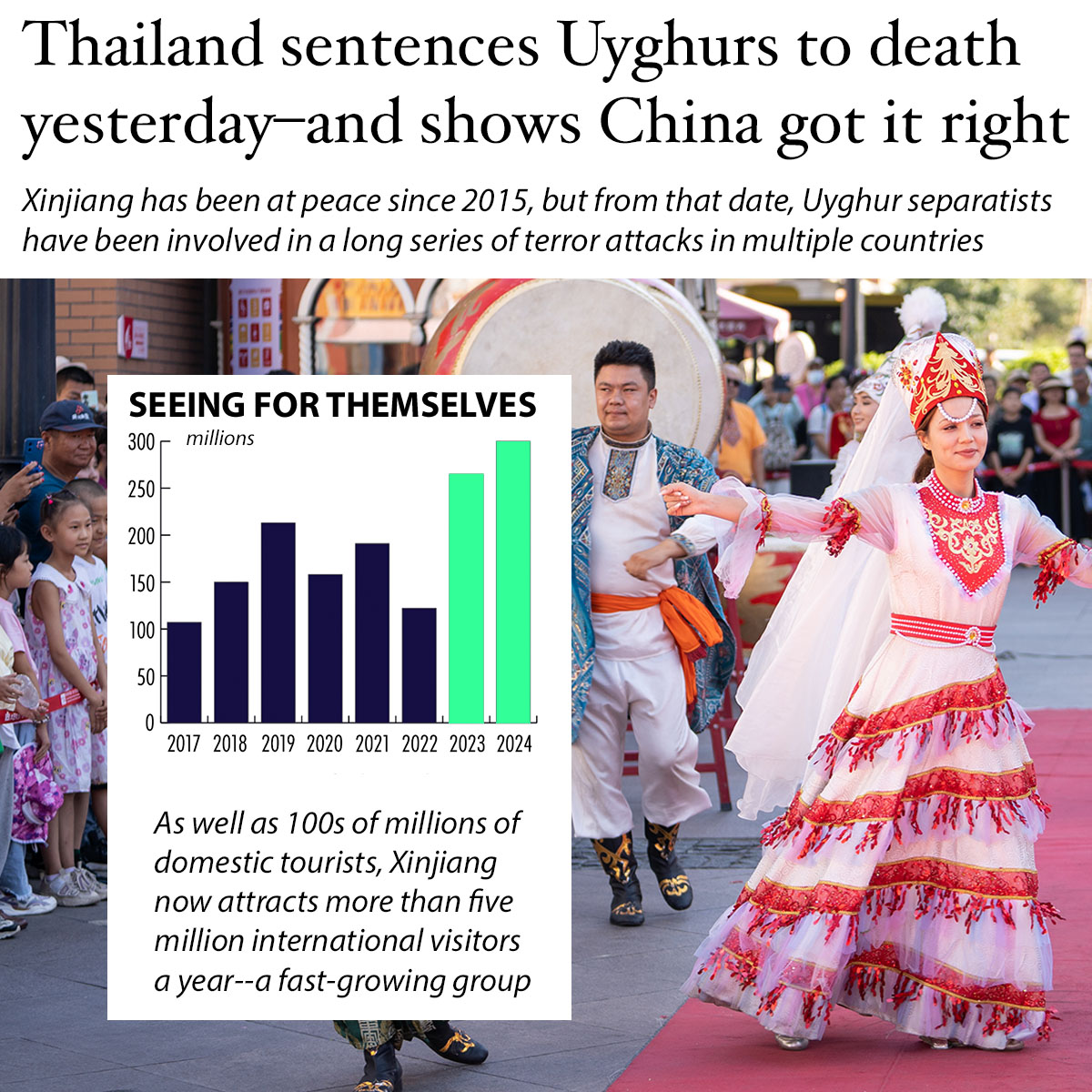
THAILAND IMPOSED DEATH SENTENCES on two Uyghur bombers yesterday – and showed that China got it right on dealing with terror attackers.
Turkic separatist terrorism is now feared in multiple countries—but NOT in China, where a program of vocational and language training for Uyghur radicals has dropped mass terror attacks to zero for eleven years.
Peaceful, ethnically mixed Xinjiang is now one of the world’s top tourism centers, with 300 million visitors a year.
This is a huge achievement, given that Uyghur separatists had been committing random acts of terror in China since at least 1990, with hundreds of innocents killed over multiple attacks across two and a half decades.
But this has flipped 180 degrees. Xinjiang is at peace. The last mass casualty terrorism incident was in October 2015, when Uyghur knifemen killed at least 16 people.
.
STIFF POLICING
How did China solve its problem? By stiff policing and compulsory vocational training for people associated with radicalism.
The NED (a CIA regime-change spin-off) worked with BBC and other western news organizations to rebrand the program as “atrocities”, implying, without evidence, that “millions” had been locked into “concentration camps” and even murdered.
But that has been well debunked, and it’s now impossible to avoid the hard fact that the Chinese system deradicalization system has worked.
One can just look and see, as millions of visitors do every year. While in the past, visitors were almost all Chinese domestic tourists, these days more than five million international tourists tour Xinjiang every year. Today the Chinese Uyghur community is peaceful, with rising rates of health and wealth. The population is growing in size and in proportion to other ethnic groups.
Uyghur longevity in China, at 77 years and rising, has significantly overtaken that of native Americans in the US, at just 70.1 years. Uyghur longevity is now close to that of white Americans, which is 78.4 years.
.
COMPARE CHINA AND OUTSIDE
That’s inside China’s borders.
But Uyghur separatists elsewhere?
As we mentioned, China solved its problem in 2015, but outside China the problems simply continued unabated:
- In 2015, Uyghur separatists bombed the Erawan Shrine in the centre of Bangkok, Thailand, killing 20 people and injuring 120.
- In 2016, Indonesian authorities arrested Uyghur terrorists working with the Eastern Indonesia Mujahidin, a terrorist group affiliated with Islamic State.
- After a pair of extremist suicide bombings in Brussels, Belgium, in March of 2016, China expressed willingness to work with European countries to combat terrorism. The offer was ignored.
- In 2017, a Syrian ambassador warned that 5,000 Uyghurs were fighting in Syria for jihadist groups. Other analysts had different estimates—but all agreed the fighters existed.
- In 2019, Four Uyghurs convicted of terror-related offenses in Indonesia were deported to China.
- In 2020, risk analysts warned that ISIS-Khorasan had started working with the East Turkestan Islamic Movement. This group was known as TIP, for Turkistan Islamic Party.
- In 2021, an ISIS-K fighter using the kunya “al-Uyghuri” attacked Shia Muslims in Kunduz, Afghanistan.
- In 2022, ISIS-K members made a shooting attack on a hotel in Kabul used by Chinese travelers.
- In 2025, the Economist reported that the rebels storming Syria in 2024 to topple Bashar al-Assad included fighters who “had roots in the Chinese region of Xinjiang and were members of the Turkistan Islamic Party (TIP), a group which aims to establish an Islamic state spanning Xinjiang and other parts of Central Asia”.
.
STORY CANNOT BE TOLD
There are plenty of other examples, but the basic conclusion should be clear from those examples.
China’s program to eradicate terrorism among its ethnic minority population and create a positive, low-crime community, has been remarkably successful.
Unfortunately, this story simply cannot be told to the world.
Look up the topic on Google, and you get link after link to the debunked NED/ BBC narrative of “millions” in “concentration camps” in China instead.
Ask AI programs for information, and all of them regurgitate the debunked NED/BBC fiction too.
Getting the truth out there is as challenging as ever.
35
345
1,144
53,542
Jun 12
It puzzles me why other countries absolutely refuse to learn from China -- even when it has made obviously useful breakthroughs. Why not learn how to eradicate extreme poverty? Why not learn how to deradicalize extremists? Why not learn how to create an electro-state?
33
41
247
6,104
Jun 11
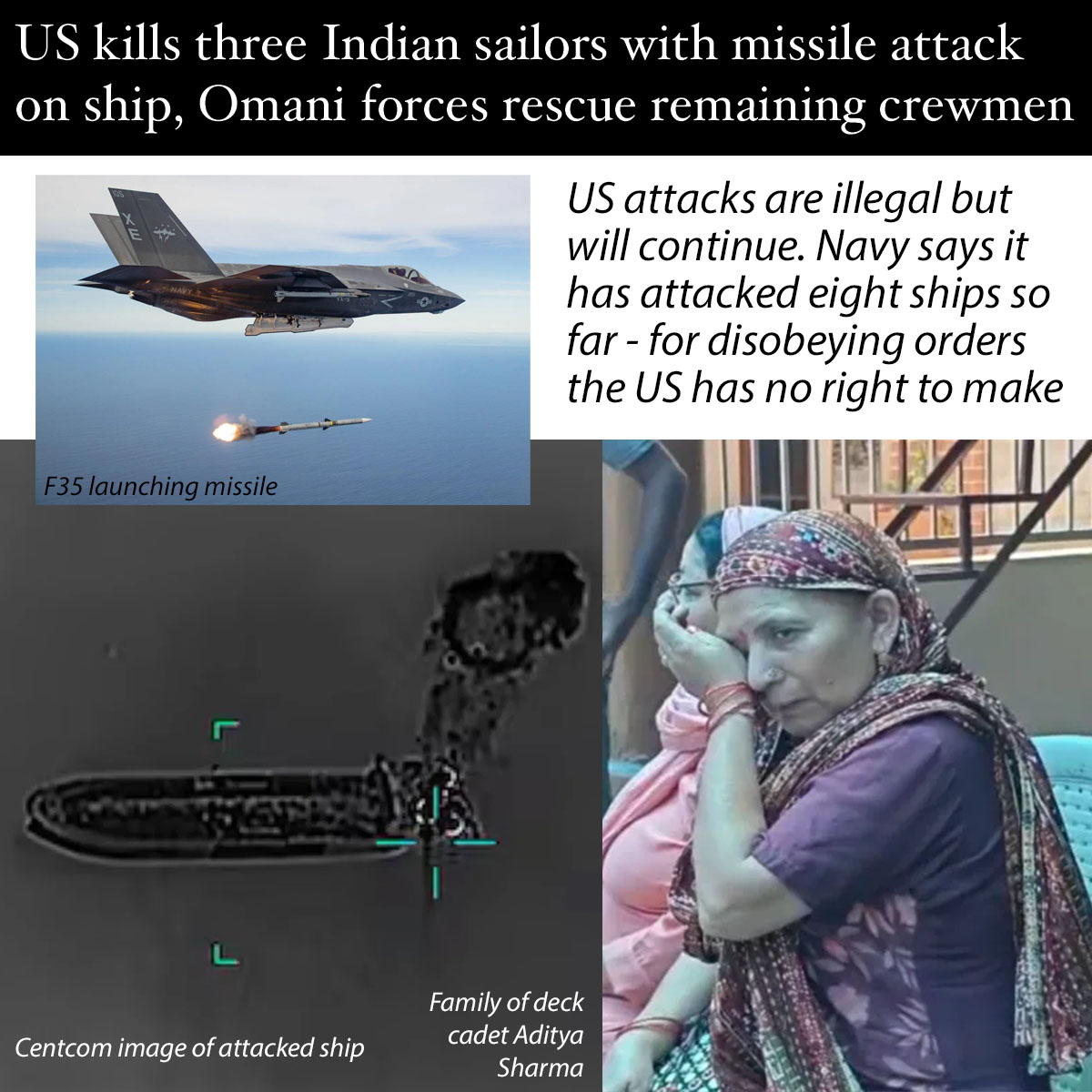
THE U.S. KILLED three Indian sailors on Wednesday, it was confirmed.
An American aircraft shot a missile into the tanker's engine room as it transited the Gulf of Oman, causing the death of three crewmen. They were likely blown to pieces, with their remains lost at sea.
It was the US’s eighth illegal attack on commercial ships.
The US navy said the Palau-flagged ship, the M/T Settebello, “repeatedly failed to comply with directions from American forces".
However, the US has no legal authority to give orders in the waters of Oman, which is more than 11,000 kilometers away from the American coast.
.
BROKENHEARTED
A family in Himachal Pradesh said they were brokenhearted after having been informed that one of the dead was their family member Aditya Sharma, who was serving as a deck cadet. They are hoping his remains can be recovered.
The Indian government expressed shock. "We condemn the attack on the commercial vessel Settebello off the coast of Oman, earlier today,” said India’s Ministry of External Affairs in a statement.
“Of the 24 Indian crew onboard, 21 Indians have been rescued thus far and three Indians are reportedly missing. Our Embassy in Oman is closely monitoring the situation and proactively coordinating with the Omani authorities in the ongoing Search and Rescue operation.”
.
SECOND ATTACK ON INDIAN CREW
On Monday, US forces bombed the Marivex, another oil tanker with an Indian crew in the Gulf of Oman, with a Palau registration.
In that instance, all 24 crew were rescued by the Omani military.
And again in that case, US Central Command said that the ship failed to comply with US instructions.
The US has intimidated 134 ships to turn away and attacked eight vessels whose crews defied threats, according to Centcom.
.
NO LEGAL RIGHT
No country has the legal right to randomly stop ships anywhere in the world--let alone attack them. The US is doing what it claims Iran is doing, although the Iranians are clearly defending themselves on their own coastline, while the Americans are supposed to be on the other side of the world.
Still, Washington, protected by powerful allies, including Israel and the UK, is never held accountable for war crimes.
"This is simply unacceptable," Arsenio Dominguez, secretary-general of the International Maritime Organization, said on Wednesday, after the killing of the Indian seamen were reported.
83
704
1,164
32,914
Jun 11
The cowardly IMO also is too scared to mention the US: imo.org/en/mediacentre/press…
14
57
1,854
Jun 11
So Trump gets into power and forces the Tax and Justice Departments to co-sign a promise to never investigate or audit him or his family or his company for any financial crimes up to the present day.
That’s not suspicious at all
4
37
130
1,952
Jun 11
THE U.S. LAST NIGHT destroyed civilian water utilities serving 20,000 Iranian people.
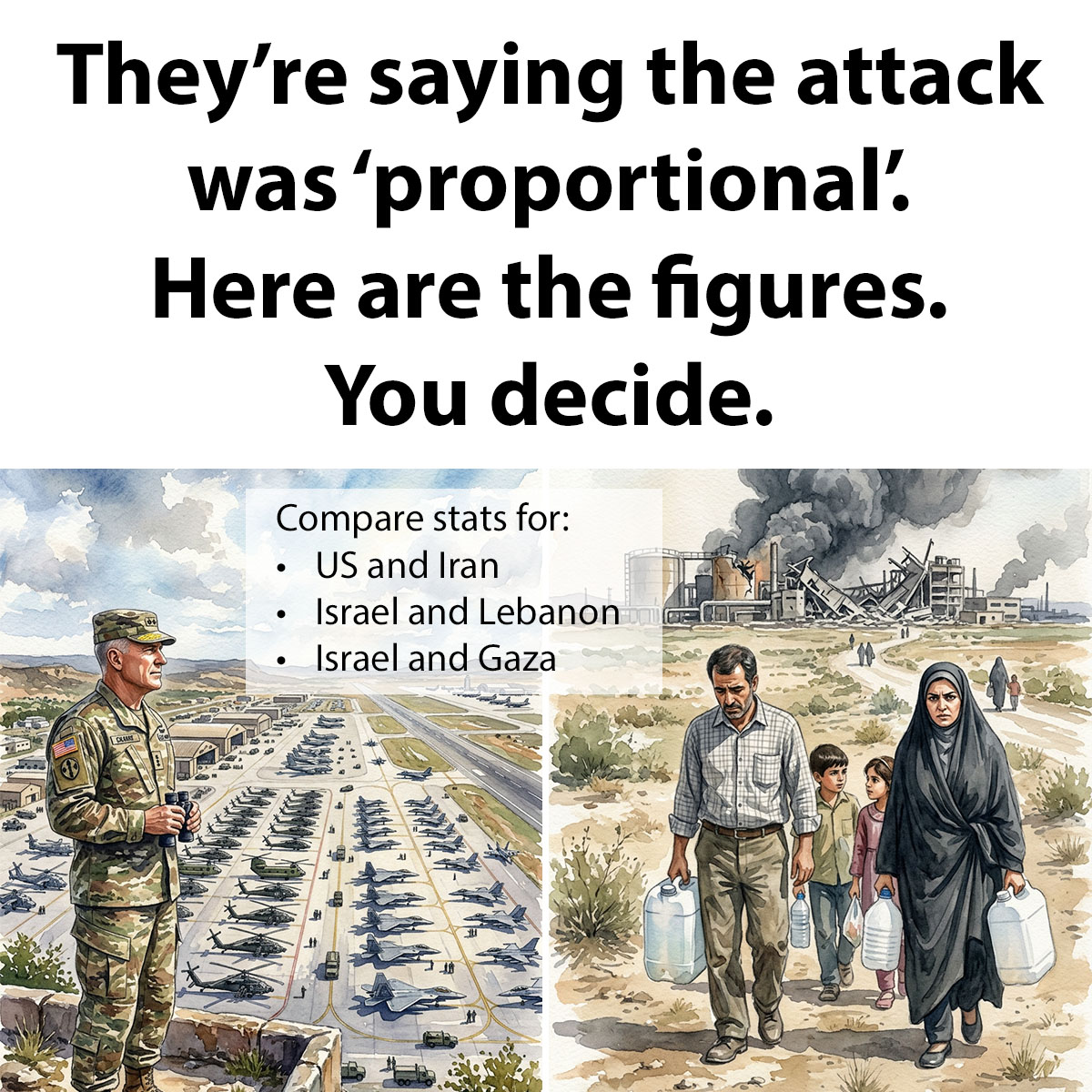
“The mission is a proportional response to unjustified Iranian aggression,” US Central Command said in a statement on X last night.
The punishment was “in response to yesterday’s downing of a U.S. Army Apache helicopter,” the US Centcom said.
So, one item of military transport (crew escaped without harm) is deemed equivalent to bringing harm and misery to 20,000 people.
.
YES, IT WAS A WAR CRIME
Destroying water utilities is a war crime. Under Additional Protocol I of the Geneva Conventions, it is strictly prohibited to attack or destroy infrastructure essential to civilian life, including water installations.
And the US committed this war crime for what?
The truth is that the destruction of the helicopter was no big deal.
Who said that? Donald Trump did. "Wasn't a big deal. The pilot is fine," he told the press.
Even more galling is the fact that the Iranians downed the helicopter as part of its self-defence efforts against a US-Israeli war that has been deemed illegal by multiple countries and organizations, including many in the US.
The lack of proportionality is the key to understanding what is really happening in West Asia. Here are three examples with up-to-date statistics.
.
1) COMPARE LEBANON AND ISRAEL NUMBERS
Lebanon reported yesterday that Israeli attacks have now killed at least 3,696 people and injured 11,413 others since March 2. More than 1.2 million people have been displaced.
On the Israeli side, 29 soldiers and one civilian contractor have been killed in Lebanon, according to the military.
Just 29 soldiers on the Israel side. On the Lebanon side, even if we ONLY count women, children or medics killed by Israel, there have been 730. So far.
And before anyone is tempted to say that Lebanon’s figures are untrustworthy, let’s remember that Lebanon’s government has long been US-aligned and opposed to Hezbollah.
.
2) COMPARE IRAN AND U.S. NUMBERS
How many times have we heard about the 13 members of the US armed forces who lost their lives as part of the attack on Iran? Each was given a lengthy obituary in multiple media, including the UK Guardian.
Just 13. And what about the 2,988 men and 511 women killed by the US and Israel in Iran, as reported yesterday?
They're just statistics.
.
3) COMPARE ISRAEL AND GAZA NUMBERS
In recent days, Israel killed at least 11 more Palestinians in Gaza, including women and children, adding to a total of more than 72,000 lives lost. The majority have been women and children.
Since the beginning of the retaliation after the October 2023 attack, Israel has lost just 1,152 personnel, identified by its government as soldiers, police, and security officials.
See what I mean about proportionality? The contrast between casualties on the US-Israel side and those they are targeting is startling.
This week, the richest nation on earth lost a helicopter.
“No big deal.”
29
242
436
7,796
Jun 11
I deliberately limited this post to recent, up-to-date statistics, but if you go back to older conflicts, we find the same thing: hugely disproportionate attacks by the US and Israel
6
51
1,143
Jun 10
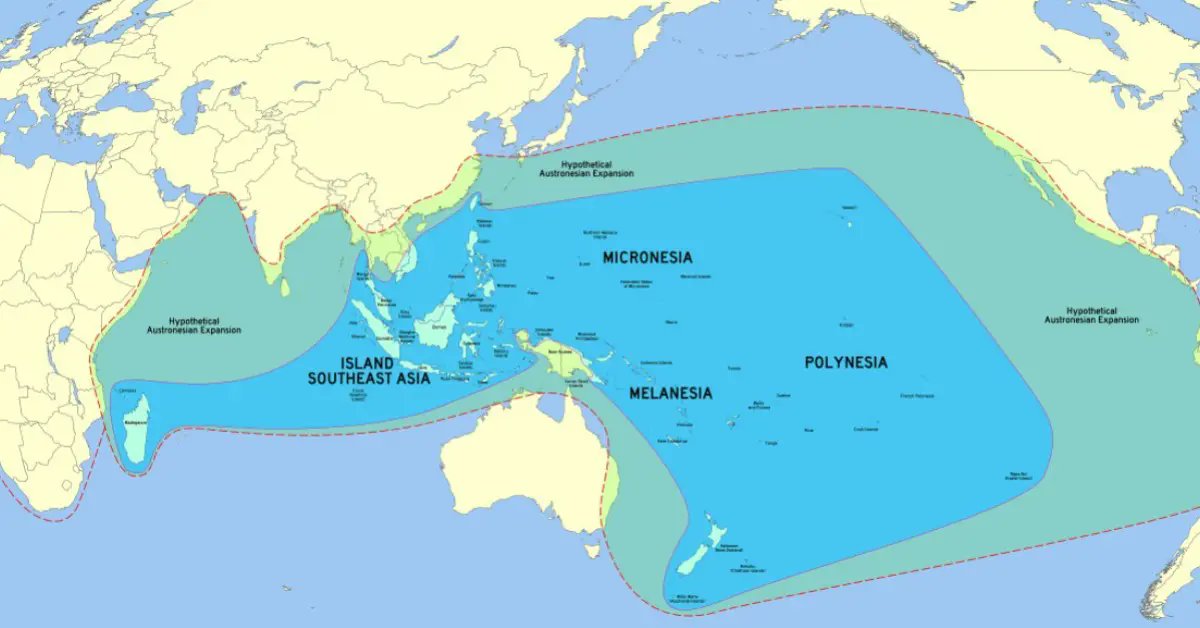
Why is there so much overlap in languages and other cultural factors between Chinese, Japanese, Korean and Vietnamese? East Asian culture is rooted in the Sinosphere, historians say
30
70
365
10,060
Jun 10
Be interested to hear about other elements of historical Sinosphere influence in other parts of Asia
1
2
11
1,229
Jun 10
This trend reminds me of a couple of videos I did last year on the theme of "everything you think is Japanese is actually Chinese" -- x.com/NuryVittachi/status/19…
24 Nov 2025

12 MORE ICONS OF JAPANESE CULTURE WHICH HAVE CHINESE ORIGINS
12. Karate
NOT Japanese in origin, but Chinese.
This is one amazing story.
In the 1300s, experts in Chinese martial arts travelled to an island kingdom called Ryukyu and shared their skills. The Japanese samurai invaded the island in 1609 to create a puppet state—and banned the carrying of weapons.
The people of Ryukyu refined their Chinese martial arts skills to create a weapons-free way of combat with which to defend themselves. They called it kara-te 唐手, which translates to "Chinese hand". This was later changed to “empty hand”.
.
QUICK NOTE: This is part two of a series. In the widely viewed first section last week, we featured ramen, bonsai, green tea, Zen Buddhism, the Kimono and so on.
.
11. The Parasol
What could be more Japanese than the parasol, as used in countless images of women in kimonos? While umbrellas evolved separately in multiple places around the world, the delicate, collapsible oil-paper parasol to shield you from the sun was created in China and spread to Japan.
.
10. Mochi and Manju
Mochi is a type of chewy cake made of pounded rice which is synonymous with Japan. But it was probably first imported from China in 300 BC, historians say. In Japan, the written character for 'mochi' is the Chinese word for 'cake', and Hong Kong still has an item called "loh máih chìh".
Then there’s the Japanese manju, a stuffed bun. A Japanese monk named Enni visited China and got the recipe for steamed buns. On his return to Japan in 1241, he went to see a teahouse owner who had been generous to monks, who had to beg for food.
He gave the recipe to the teahouse boss and wrote a sign saying “Place to eat Manju”—a sign now preserved in a Japanese museum.
.
9. The Geisha
Geisha is the Japanese name for ornately dressed women who are officially entertainers, but many see the term has having sexual overtones. The modern tradition echoes the female entertainers tradition of the Heian-kyo period beginning in AD 794, which in turn appears to have been influenced by the Geji, women in China who provided musical entertainment and other sorts of entertainment to men from a long time ago, all the way back in 260 BC.
.
8. Koi
Koi, the ornamental fish used in garden ponds, is actually a type of carp that has been raised in fish-farms for centuries. These aquaculture centers existed in Japan since the 19th century and in China since the fourth century BC. But it must be said, while both countries celebrate these beautiful fish, the breeding techniques developed to create varieties of multicolored koi are very much a Japanese skill.
.
7. The Shamisen
The Geisha women, mentioned earlier, often played the shamisen, a three-stringed instrument structured like a banjo. It originated in China as the sanxian, and likely travelled to Japan via Korea and or the Ryuku islands in the 1560s.
.
6. Noh theatre
Some readers asked whether Kabuki theatre had Japanese roots. The answer is no. But Japan’s other theatre tradition, called Noh, stems from a Chinese performing art called sangaku which included music, acrobatics and illusions. It crossed the waters to Japan in the eighth century.
.
5. Miso and Soy
Miso is a savory Japanese seasoning made from fermented soy beans, often used as the basis of miso soup. While savory condiments were made in Japan since prehistoric times, the use of fermented soy foods developed in China in the third century BC. This processed food was introduced to Japan, along with Zen Buddhism, in the sixth century AD.
A closely related item is soy sauce. Today, because of the success of the Japanese Kikkoman brand, many westerners think soy sauce is Japanese. The taste is fine, but gourmands often note that the original soy sauce from China is simultaneously more savory and slightly sweeter. Try them both.
.
4. Dragons
Japan is obsessed with dragons – military squadrons call themselves dragons, as do Yakuza groups, and there are dragon parades and entire mythologies about the mysterious ancient beasts. But the words used in Japanese reveal the concept's Chinese origins. The oldest reference to a dragon anywhere in the world is an image from China that is seven millennia old – yep, that’s not a misprint – it’s seventy centuries old.
.
3. Gyoza
Many westerners love gyoza, which they think of as Japanese fried dumplings. But food historians know they are simply the Japanese version of the age-old Chinese dumpling known as Jiaozi.
.
2. Bowing
For millennia, the Chinese used bowing as a common way to show respect, both in the temple to the ancestors, and in society to high-ranking people. It was adopted in Japan in the 7th century to become part of samurai etiquette. Gradually, it spread throughout Japanese society, where it became a common greeting.
.
And now we come to number one: The name Japan.
The name Japan is actually from China.
From the Chinese point of view, the islands to the east are the place from where the sun appears every morning. So they called it “sun origin”. The pair of characters was pronounced something like this: jrr-bnn.
With regional variations, jrr-bnn became ja-pan, ni-pon, ni-hon, je-pang and so on.
It’s interesting to note that even the flags of Japan are based on the Chinese point of view—they show the rising sun.
Now from the point of the indigenous people of that land, of course, it was NOT the place where the sun rose. From their point of view, the sun rose not from their island, but from somewhere distant in the Pacific Ocean.
So the concept of these islands as a place called Japan, as the Land of the Rising Sun, is in itself a Chinese concept.
.
THE OTHER SIDE
Okay, that’s 12 more ideas on this theme. Want to add others? Or dispute the ones just mentioned? Go right ahead. I’m always willing to learn.
Some people asked for examples of trends which go the other way—I can immediately think of one. The lucky cat you see in shops in China are assumed to be Chinese but seem to have originated in Japan. If you have more examples, I’d like to hear them.
Peace.
3
5
42
1,443
Jun 9
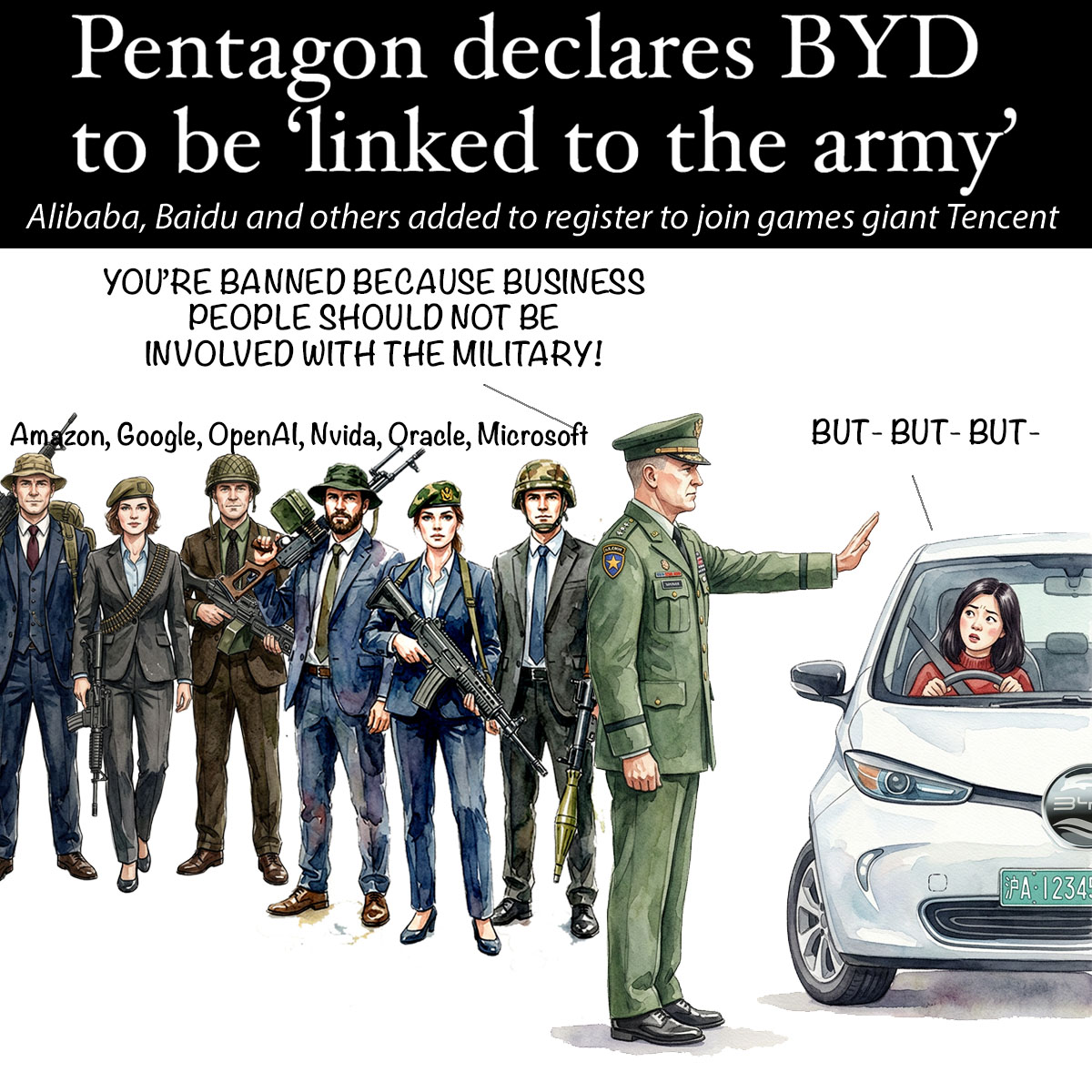
THE PENTAGON YESTERDAY DECLARED BYD, the world’s most successful electric carmaker, to be linked to the Chinese army.
Alibaba, one of the world’s largest retailers and e-commerc companies, was also added to the Federal Register yesterday.
Innovative tech firm Baidu, and two chipmakers, ChangXin Memory Technologies and Yangtze Memory Technologies, were also written into the register, known as the “1260H list”.
Last year, the Pentagon made the same accusation at Tencent, the world’s biggest video game and entertainment company, owner of Epic Games, and a major backer of Reddit, Snapchat, Spotify and others.
.
UNFAIR
The accusations are unfair, and everybody knows it. America’s biggest firms work directly with the Pentagon at extremely deep levels with multiple joint ventures to create attack tools, yet this is never considered an issue. In contrast, Chinese firms which have the slightest interaction with their country’s army are targeted for harm by the Pentagon.
The accusation paves the way for the US to make unilateral sanctions against the firms and then use economic coercion to force its vassals (“allies”) to follow suit.
.
REAL REASON
Analysts say the real reason is to harm the work of Chinese technologists, many of whom are developing AI applications.
The US already has an unassailable lead in the sector, with more than 5,400 datacenters compared to China’s approximately 375, but Washington DC has strongly opposed the concept of fair competition in recent years.
The listing move also harms US investors, who are steered away from buying shares in companies on the register, which are some of the most innovative and fast-growing firms in the world.
148
581
1,635
75,294
Jun 9
It appears that Unitree is also now on the list, under its official name Hangzhou Yushu Technology Co. This is the firm that has suddenly become the world leader in humanoid robots--the dancing, kung-fu export, gymnastic masters.
3
22
156
4,555