
Joined April 2025
- Tweets 620
- Following 21
- Followers 213
- Likes 55
450 Photos and videos


Pinned Tweet

4 Jun 2025
OpGrid India is a military-first media outlet committed to delivering uncompromising defence reportage with a focus on strategic operations and tactical analysis.
OpGrid India — Because National Security Demands More Than Just Headlines.
#defencenews #indianarmyforces
8
14
1,594
Jun 6
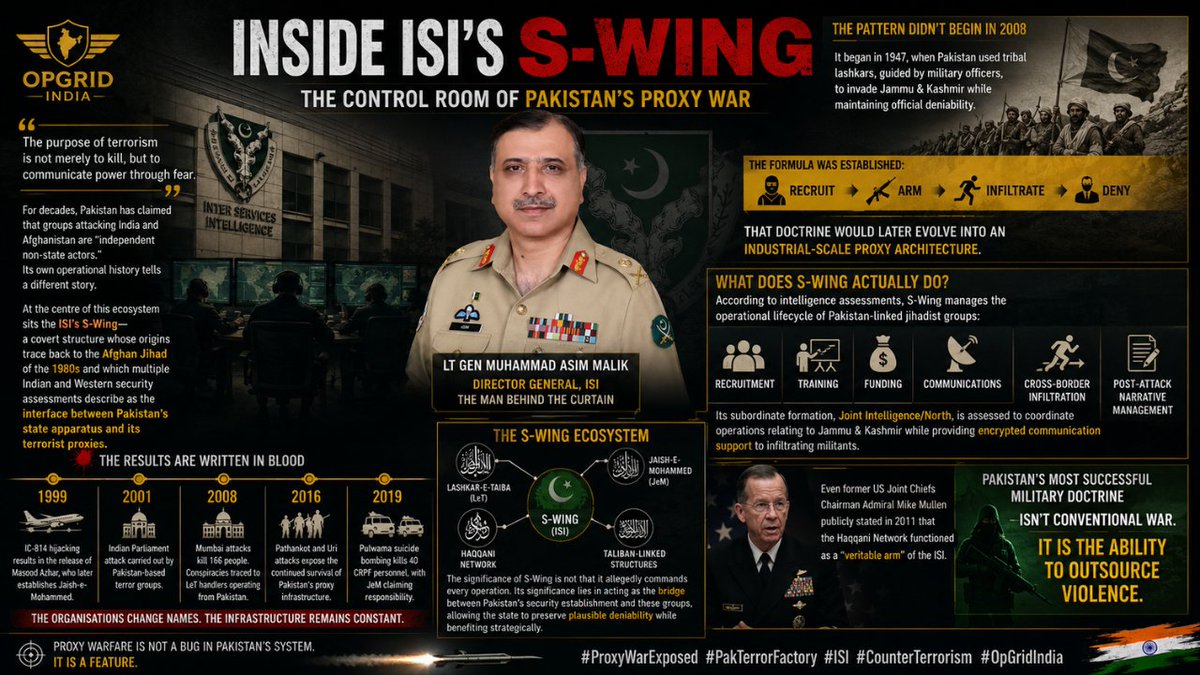
🚨| Inside ISI's S-Wing: The Control Room Of Pakistan's Proxy War
"The purpose of terrorism is not merely to kill, but to communicate power through fear."
For decades, #Pakistan has claimed that groups attacking India and Afghanistan are "independent non-state actors."
Its own operational history tells a different story.
At the centre of this ecosystem sits the ISI's S-Wing—a covert structure whose origins trace back to the #AfghanJihad of the 1980s and which multiple Indian and Western security assessments describe as the interface between Pakistan's state apparatus and its terrorist proxies.
📍 The Pattern Didn't Begin In 2008
It began in 1947, when Pakistan used tribal lashkars, guided by military officers, to invade Jammu & Kashmir while maintaining official deniability.
The formula was established:
Recruit → Arm → Infiltrate → Deny.
That doctrine would later evolve into an industrial-scale proxy architecture.
⚠️ What Does S-Wing Actually Do?
According to intelligence assessments, S-Wing manages the operational lifecycle of Pakistan-linked jihadist groups:
• Recruitment
• Training
• Funding
• Communications
• Cross-border infiltration
• Post-attack narrative management
Its subordinate formation, Joint Intelligence/North, is assessed to coordinate operations relating to Jammu & Kashmir while providing encrypted communication support to infiltrating militants.
#ProxyWarExposed #PakTerrorFactory #ISI #CounterTerrorism #OpGridIndia
3
6
22
2,024
Jun 6
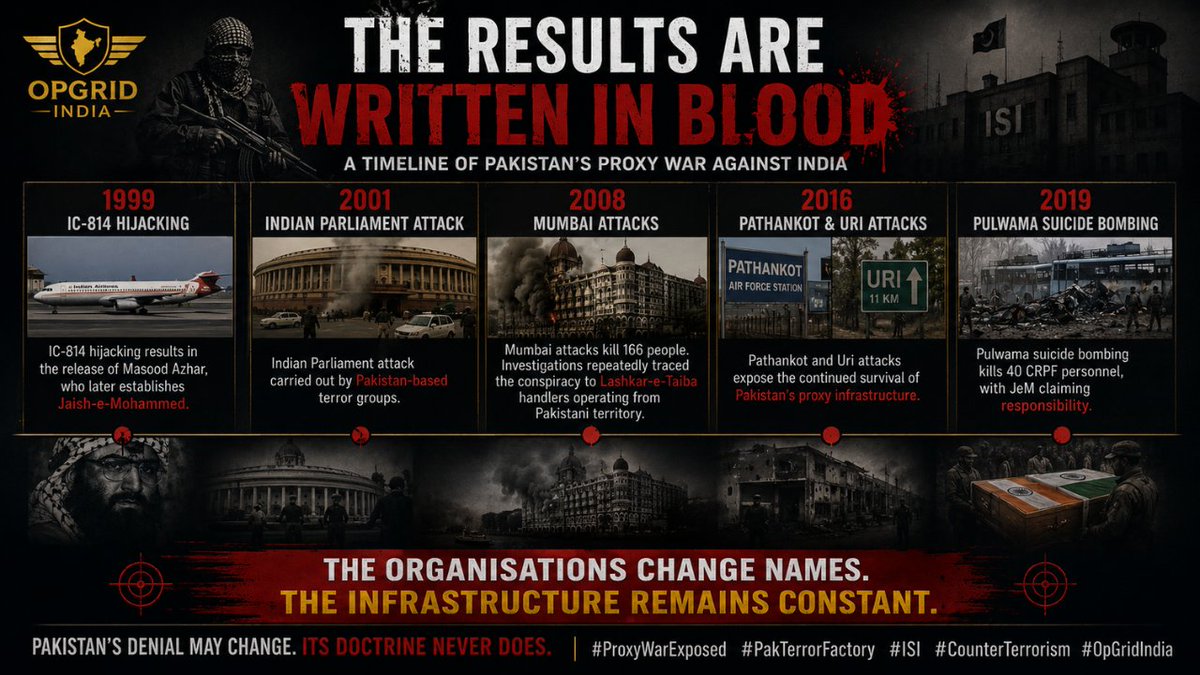
📊 The Results Are Written In Blood
➡️ 1999: IC-814 hijacking results in the release of Masood Azhar, who later establishes Jaish-e-Mohammed.
➡️ 2001: Indian Parliament attack carried out by Pakistan-based terror groups.
➡️ 2008: Mumbai attacks kill 166 people. Investigations repeatedly traced the conspiracy to Lashkar-e-Taiba handlers operating from Pakistani territory.
➡️ 2016: Pathankot and Uri attacks expose the continued survival of Pakistan's proxy infrastructure.
➡️ 2019: Pulwama suicide bombing kills 40 CRPF personnel, with JeM claiming responsibility.
The organisations change names. The infrastructure remains constant.
#ProxyWarExposed #PakTerrorFactory #ISI #CounterTerrorism #OpGridIndia
1
1
188
Jun 6
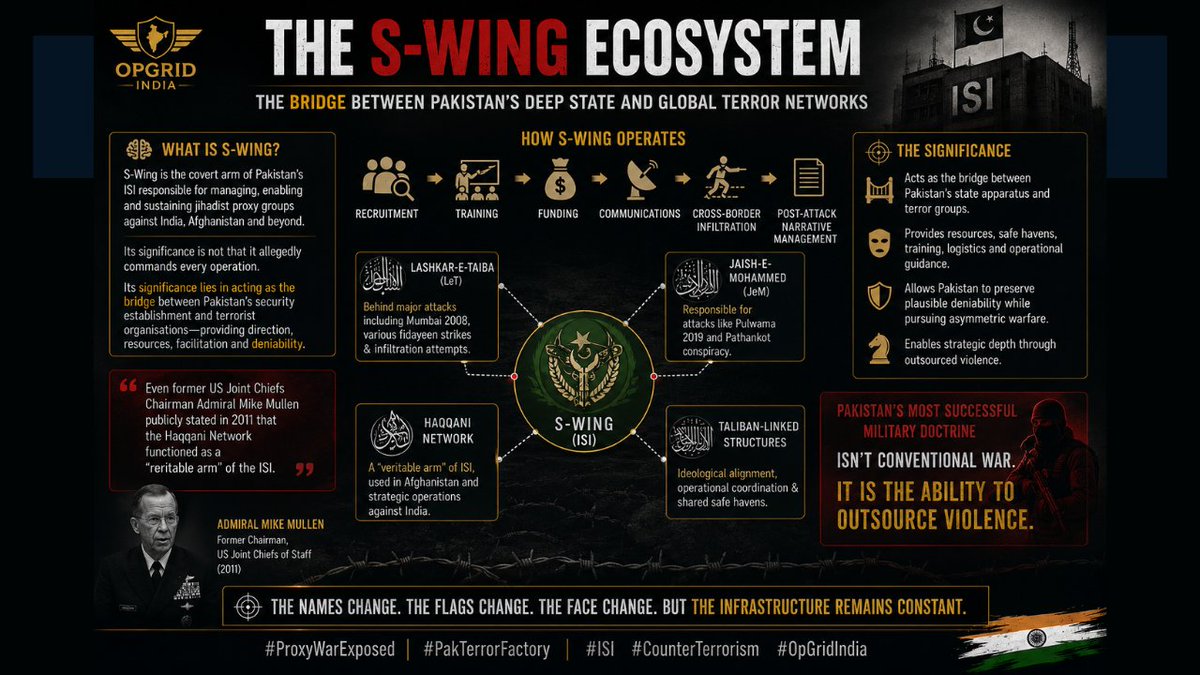
🧠 The S-Wing Ecosystem
The significance of S-Wing is not that it allegedly commands every operation.
Its significance lies in acting as the bridge between Pakistan's security establishment and organisations such as Lashkar-e-Taiba, Jaish-e-Mohammed, the Haqqani Network and Taliban-linked structures, allowing the state to preserve plausible deniability while benefiting strategically.
Even former US Joint Chiefs Chairman Admiral Mike Mullen publicly stated in 2011 that the Haqqani Network functioned as a "veritable arm" of the ISI.
🔁 Pakistan's Most Successful Military Doctrine Isn't Conventional War
It is the ability to outsource violence.
#ProxyWarExposed #PakTerrorFactory #ISI #CounterTerrorism #OpGridIndia
1
128
Jun 2
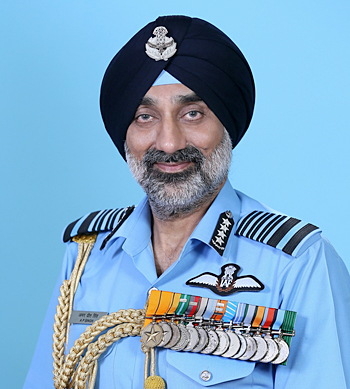
BREAKING: Air Chief Marshal A.P. Singh has arrived in France for a four-day visit amid India's push to acquire 114 additional Rafale fighter aircraft under the Indian Air Force's Multi-Role Fighter Aircraft (MRFA) programme.
2
3
184
Jun 2
Operational Impact: The 114-aircraft MRFA programme would significantly bolster India's airpower, improve fleet availability, and strengthen deterrence against the evolving China–Pakistan collusive threat. The acquisition also reflects lessons from recent operational requirements, where rapid force generation, network-centric warfare, and multi-role combat capability remain critical.
1
1
43
Jun 2
Operational Impact: The 114-aircraft MRFA programme would significantly bolster India's airpower, improve fleet availability, and strengthen deterrence against the evolving China–Pakistan collusive threat. The acquisition also reflects lessons from recent operational requirements, where rapid force generation, network-centric warfare, and multi-role combat capability remain critical.
1
40
Jun 2
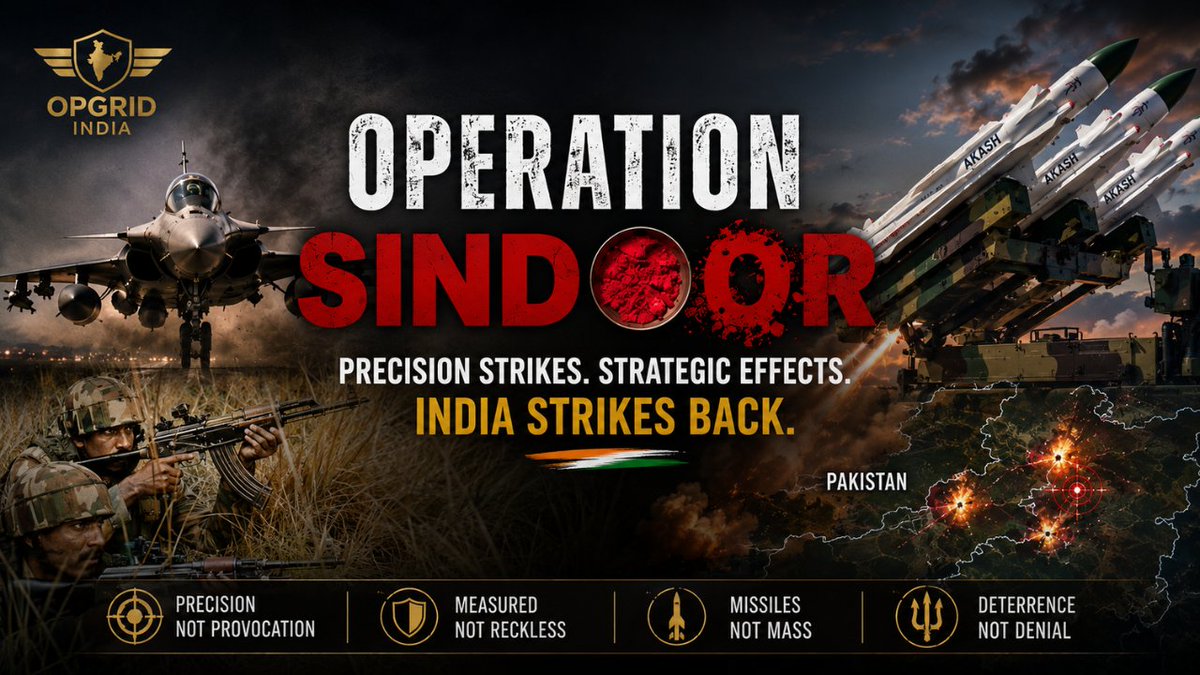
🚨| Operation Sindoor Proved India Needs An Integrated Missile Force — Now Comes The Hard Part
“Wars are increasingly won not by the platform that launches the weapon, but by the network that finds the target first.”
Operation Sindoor was not just a military operation.
It may ultimately be remembered as the moment India crossed from platform-centric warfare into missile-centric warfare.
When India struck terror infrastructure in #Pakistan and later expanded operations against military targets, the real story was not the aircraft involved.
It was the precision strike ecosystem behind them.
📍 The Lesson Of Sindoor
The operation combined:
• SCALP cruise missiles
• HAMMER precision-guided munitions
• BrahMos supersonic missiles
• Harop loitering munitions
Together, they delivered strategic effects across multiple target sets while maintaining escalation control.
The message was clear:
Precision fires—not massed formations—are increasingly becoming the decisive instrument of modern warfare.
1
4
10
3,540
Jun 2
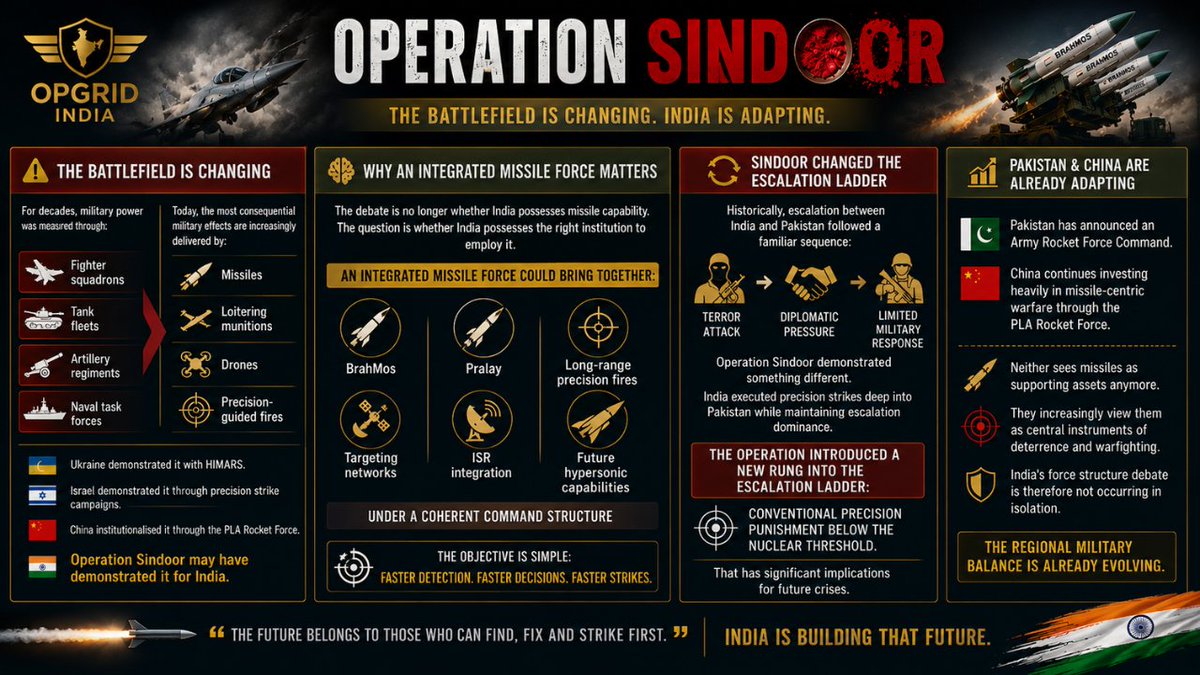
⚠️ The Battlefield Is Changing
For decades, military power was measured through:
• Fighter squadrons
• Tank fleets
• Artillery regiments
• Naval task forces
Today, the most consequential military effects are increasingly delivered by:
• Missiles
• Loitering munitions
• Drones
• Precision-guided fires
Ukraine demonstrated it with HIMARS.
Israel demonstrated it through precision strike campaigns.
China institutionalised it through the PLA Rocket Force.
Operation Sindoor may have demonstrated it for India.
🧠 Why An Integrated Missile Force Matters
The debate is no longer whether India possesses missile capability.
The question is whether India possesses the right institution to employ it. An Integrated Missile Force could potentially bring together:
• BrahMos
• Pralay
• Long-range precision fires
• Targeting networks
• ISR integration
• Future hypersonic capabilities
under a coherent command structure.
The objective is simple: Faster detection. Faster decisions. Faster strikes.
🔁 Sindoor Changed The Escalation Ladder
Historically, escalation between India and Pakistan followed a familiar sequence:
Terror attack → Diplomatic pressure → Limited military response
Operation Sindoor demonstrated something different.
India executed precision strikes deep into Pakistan while maintaining escalation dominance.
The operation effectively introduced a new rung into the escalation ladder:
Conventional precision punishment below the nuclear threshold. That has significant implications for future crises.
📊 Pakistan & China Are Already Adapting
Pakistan has announced an Army Rocket Force Command.
China continues investing heavily in missile-centric warfare through the PLA Rocket Force.
Neither sees missiles as supporting assets anymore.
They increasingly view them as central instruments of deterrence and warfighting.
India's force structure debate is therefore not occurring in isolation.
The regional military balance is already evolving.
#OperationSindoor #IndianArmy #BrahMos #MilitaryModernisation #FutureWarfare
1
7
116
Jun 2
🚨| Suicide VBIED Attack Rocks North Waziristan — Khalid ibn al-Walid Group Owns Up
“The most dangerous consequence of cultivating militant ecosystems is that eventually they stop asking for permission.”
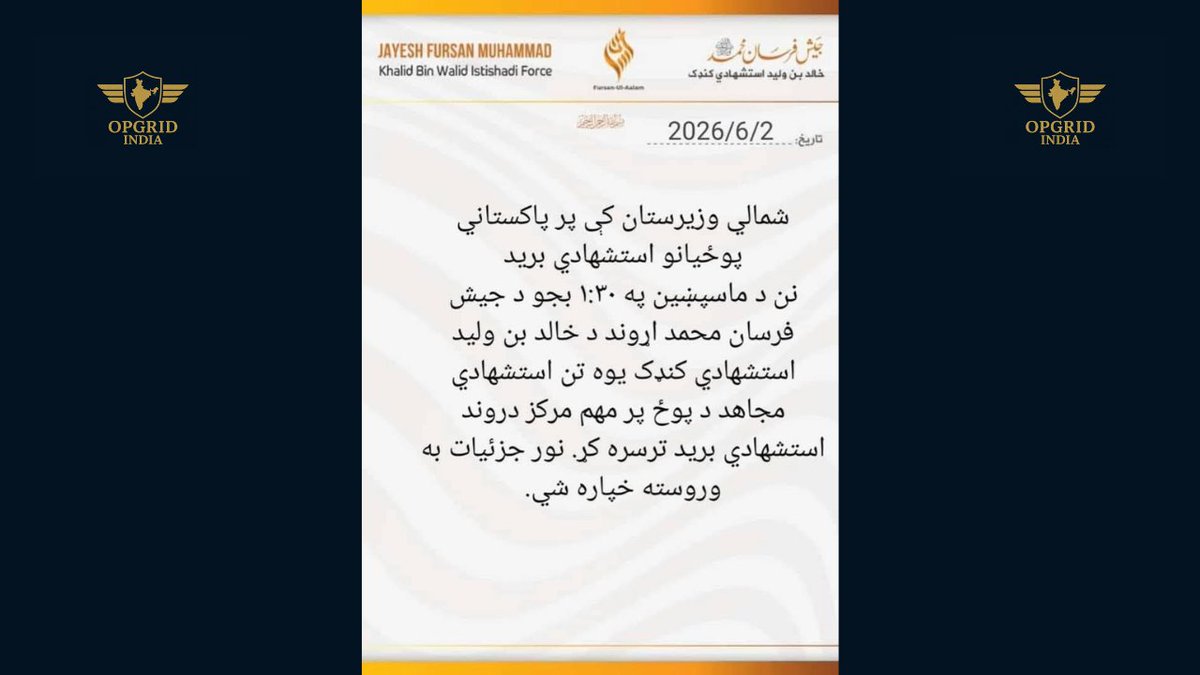
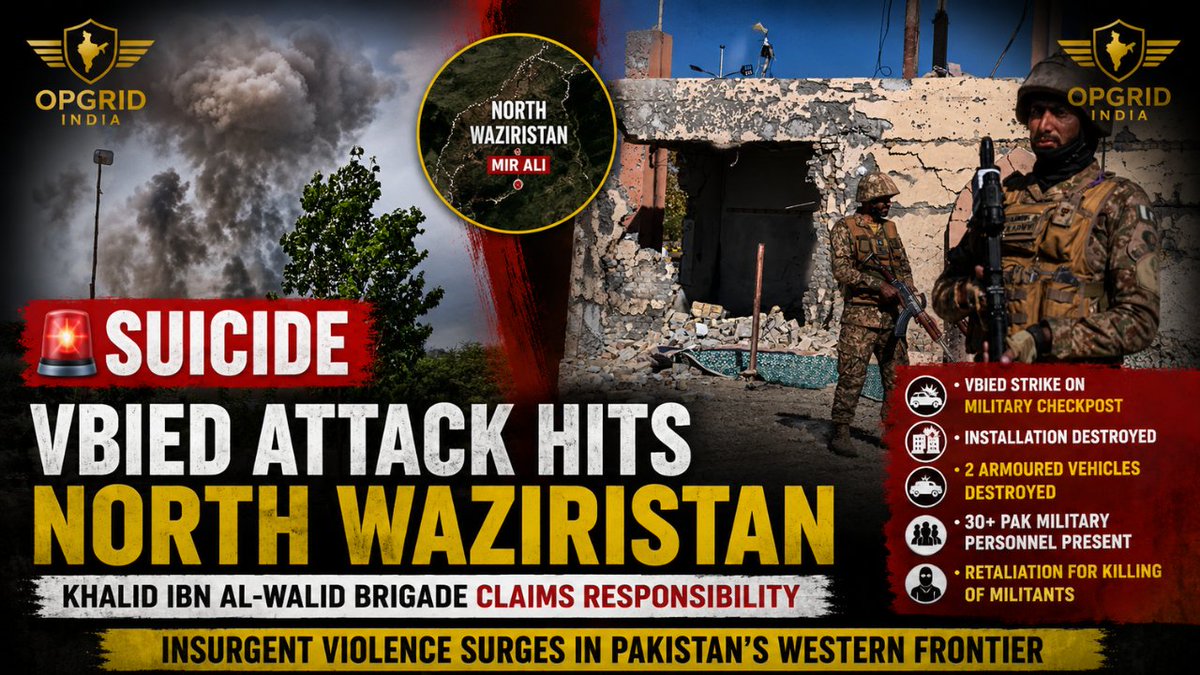
A major suicide VBIED attack has been reported against a Pakistani military checkpost in Mir Ali, #NorthWaziristan, highlighting the deteriorating security environment across Khyber Pakhtunkhwa.
The attack has been claimed by Ittehad-ul-Mujahideen, a faction associated with the Hafiz Gul Bahadur network.
📍 What Happened
According to militant-linked statements:
• A VBIED (Vehicle-Borne Improvised Explosive Device) was used against the Norak Kamar military checkpost in Idak village, Mir Ali
• The attack was allegedly carried out by the group's "Khalid bin Walid Istishhadi Brigade"
• The suicide bomber has been identified as Muhammad Arwand
• The group claims the attack was conducted in retaliation for the recent killing of its fighters
⚠️ Claims Made By The Group
The militant organisation alleges:
• Around 30 Pakistani military personnel were present at the post
• The installation was completely destroyed
• Two armoured vehicles were destroyed
• Significant military casualties were inflicted
#ProxyWarExposed #PakTerrorFactory #NorthWaziristan
1
5
328
Jun 2
🧠 Why This Matters
North #Waziristan was once projected by Islamabad as a success story following multiple military operations.
Yet years later, the region continues to witness:
• Suicide attacks
• Complex assaults
• Military-targeted operations
• Persistent militant activity
The frequency of such incidents suggests that militancy has not been eradicated—it has adapted.
🔁 Pakistan's Blowback Problem
For decades, Pakistan differentiated between:
• "Good militants"
• "Bad militants"
Some groups were tolerated because they served strategic objectives beyond Pakistan's borders.
Others were targeted when they challenged the state directly.
That distinction has steadily collapsed.
Today, Pakistan faces simultaneous threats from:
• TTP factions
• Hafiz Gul Bahadur-linked networks
• ISKP
• Sectarian groups
• Local insurgent formations
The ecosystem once cultivated for strategic leverage is increasingly consuming state resources internally.
🎯 Strategic Lens
Whether the casualty claims prove accurate or not, the broader reality is difficult to ignore:
#Pakistan's western frontier is witnessing a sustained resurgence of insurgent violence.
Groups that once operated as components of a larger jihadist ecosystem are now fighting the very state that helped create the environment in which they thrived.
The attack in North Waziristan is therefore more than a security incident.
It is another reminder that Pakistan's long-standing proxy warfare doctrine continues to generate blowback at home.
#ProxyWarExposed #PakTerrorFactory #NorthWaziristan
1
234
Jun 1
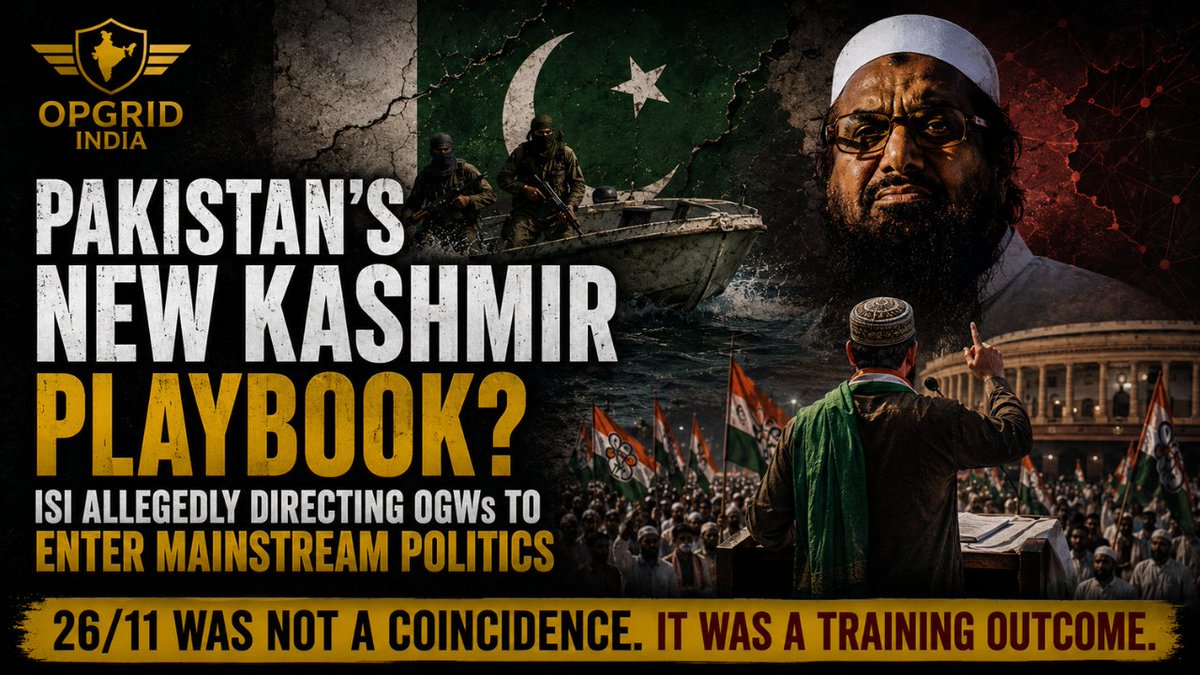
🚨| Pakistan’s New Kashmir Playbook? ISI Allegedly Directing OGWs to Enter Mainstream Politics
“When a proxy network can no longer survive in the shadows, it seeks legitimacy in plain sight.”
Indian security officials have alleged that Pakistan's ISI is directing Over Ground Workers (#OGWs) in Jammu & Kashmir to infiltrate mainstream political parties as part of a broader effort to rebuild degraded proxy networks and evade security scrutiny.
If true, this marks a significant evolution in Pakistan's Kashmir strategy.
📍 What Officials Claim
According to security sources and interrogation reports from arrested OGWs:
• OGWs were encouraged to obtain memberships in mainstream political parties
• The objective was to create clean operational cover
• Political affiliation could help avoid suspicion and facilitate networking
• Existing OGW ecosystems were being adapted rather than abandoned
This is not about politics. It is about access, legitimacy and concealment.
⚠️ Why Pakistan Needs A New Strategy
Over the last several years:
• Infiltration routes have become harder to exploit
• OGW networks have faced sustained crackdowns
• Terror financing channels have come under greater scrutiny
• Local recruitment pipelines have weakened
The traditional proxy-war infrastructure that sustained militancy in Kashmir has been severely degraded.
Pakistan now appears to be searching for alternative pathways to rebuild influence.
🧠 The Shift From Guns To Ecosystems
Security officials believe the objective is not immediate violence. The objective is rebuilding support architecture.
That includes:
• Recruitment channels
• Logistical support
• Funding networks
• Narrative influence
• Local facilitation structures
A terrorist can cross the border. But without a support ecosystem, he cannot operate for long.
🔁 Revival Of Dormant Terror Brands?
Officials further allege that ISI-linked handlers are attempting to revive militant outfits from the 1990s, including:
• Al-Umar Mujahideen
• Al Badr
• Tehreek-ul-Mujahideen
The purpose appears strategic.
Rather than projecting terrorism as Pakistan-sponsored, these groups could be presented as "indigenous" movements to create the illusion of local militancy.
This is an old playbook with a new coat of paint.
📊 The Real Objective
Pakistan's challenge today is perception.
The narrative of "indigenous resistance" has been increasingly undermined by:
• Foreign terrorist involvement
• Cross-border handlers
• Recovered communications
• Financial linkages traced to Pakistan-based networks
Reviving older militant brands may be an attempt to restore that narrative credibility.
#ProxyWarExposed #PakTerrorFactory #JammuAndKashmir
1
3
64
Jun 1
🚨| LeT Deputy Chief Saifullah Kasuri's First Public Admission of Operation Sindoor Losses— HVT Mudassir's Death
“The true measure of a strike is not the crater it leaves behind—but the admissions it forces from the enemy.”
For over a year, Pakistan's terror ecosystem has attempted to downplay the impact of Operation Sindoor.
Now, one of Lashkar-e-Taiba's most senior leaders has publicly exposed the truth himself.
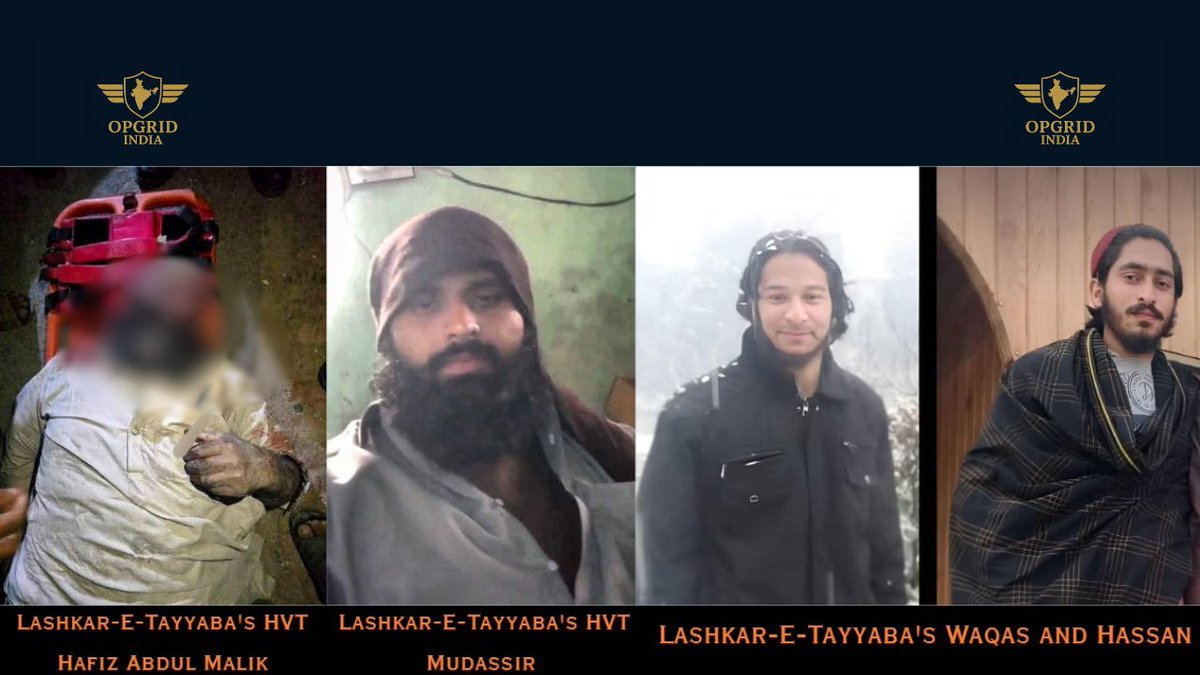
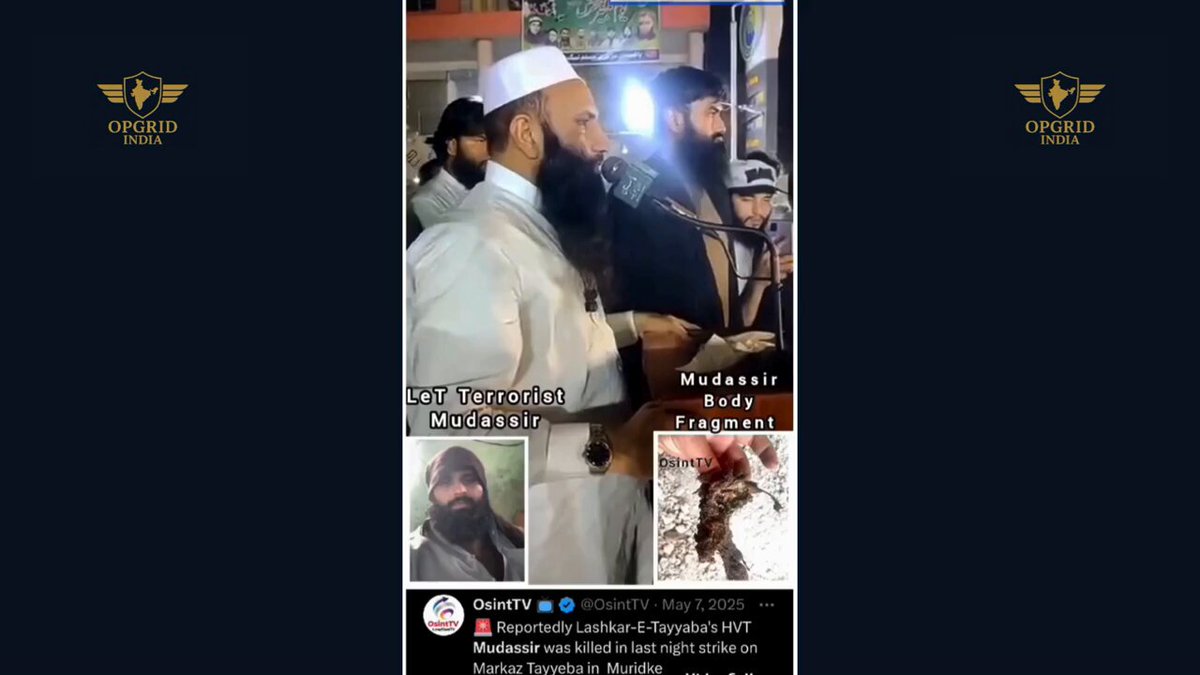
📍 #SaifullahKasuri, deputy chief of Lashkar-e-Taiba, has made what appears to be the first public admission regarding the death of senior LeT operative Mudassir during Operation Sindoor.
According to Kasuri:
• He "cried the entire day" after learning of Mudassir's death
• He was denied permission to attend the funeral
• Mudassir was "torn into pieces" before attaining what he described as "martyrdom"
That statement alone tells a story Pakistan has spent months trying to hide.
⚠️ Why This Matters
For months after Operation Sindoor:
• Pakistan attempted damage control
• Terror outfits avoided detailed casualty disclosures
• State-backed narratives focused on denial and distraction
Now a senior #LeT leader has effectively confirmed both the elimination and the severity of the strike.
The admission did not come from India. It came from inside Lashkar-e-Taiba.
📍 The Target: Mudassir
Mudassir was among the highest-value Lashkar figures eliminated during India's May 6, 2025 strikes.
He was killed inside Markaz Tayyiba, #Muridke—the same facility Pakistan has repeatedly portrayed as a benign religious and educational complex.
Yet one question remains: If Muridke was merely a religious institution, why was a senior Lashkar commander operating from it?
🧠 The Most Revealing Statement
Kasuri claims he was not allowed to attend the funeral.
Not allowed by whom?
That question raises uncomfortable implications.
Because organisations do not normally seek permission to attend funerals of their own cadres unless higher authorities are involved in managing the aftermath.
🔁 Pakistan's Problem
Every new admission is exposing the same reality:
• Terror infrastructure existed
• Senior commanders were present
• The strikes caused significant casualties
• Damage was far greater than publicly acknowledged
This is becoming increasingly difficult for Islamabad to explain away.
📊 From Denial to Admission
2025: "Nothing significant happened."
2026: Senior LeT leadership publicly discussing how commanders were killed and how bodies were recovered.
The narrative is collapsing under the weight of its own contradictions.
🎯 Strategic Lens
Operation Sindoor was designed to degrade terror infrastructure.
But its longer-term impact is now visible in the information domain. When senior Lashkar leaders begin publicly mourning eliminated commanders and describing the scale of destruction, they inadvertently validate what Pakistan spent months denying.
The strike damaged infrastructure.
The admissions are now damaging the narrative.
And sometimes, the enemy's own words become the strongest battle damage assessment.
#OperationSindoor #ProxyWarExposed
1
2
54
Jun 1
📍 The Target: Mudassir
Mudassir was among the highest-value Lashkar figures eliminated during India's May 6, 2025 strikes.
He was killed inside Markaz Tayyiba, Muridke—the same facility Pakistan has repeatedly portrayed as a benign religious and educational complex.
Yet one question remains:
If Muridke was merely a religious institution, why was a senior Lashkar commander operating from it?
🧠 The Most Revealing Statement
Kasuri claims he was not allowed to attend the funeral.
Not allowed by whom?
That question raises uncomfortable implications.
Because organisations do not normally seek permission to attend funerals of their own cadres unless higher authorities are involved in managing the aftermath.
🔁 Pakistan's Problem
Every new admission is exposing the same reality:
• Terror infrastructure existed
• Senior commanders were present
• The strikes caused significant casualties
• Damage was far greater than publicly acknowledged
This is becoming increasingly difficult for Islamabad to explain away.
📊 From Denial to Admission
2025: "Nothing significant happened."
2026: Senior LeT leadership publicly discussing how commanders were killed and how bodies were recovered.
The narrative is collapsing under the weight of its own contradictions.
🎯 Strategic Lens
Operation Sindoor was designed to degrade terror infrastructure.
But its longer-term impact is now visible in the information domain.
When senior Lashkar leaders begin publicly mourning eliminated commanders and describing the scale of destruction, they inadvertently validate what Pakistan spent months denying.
The strike damaged infrastructure.
The admissions are now damaging the narrative. And sometimes, the enemy's own words become the strongest battle damage assessment.
#OperationSindoor #ProxyWarExposed #PakTerrorFactory
34
May 19
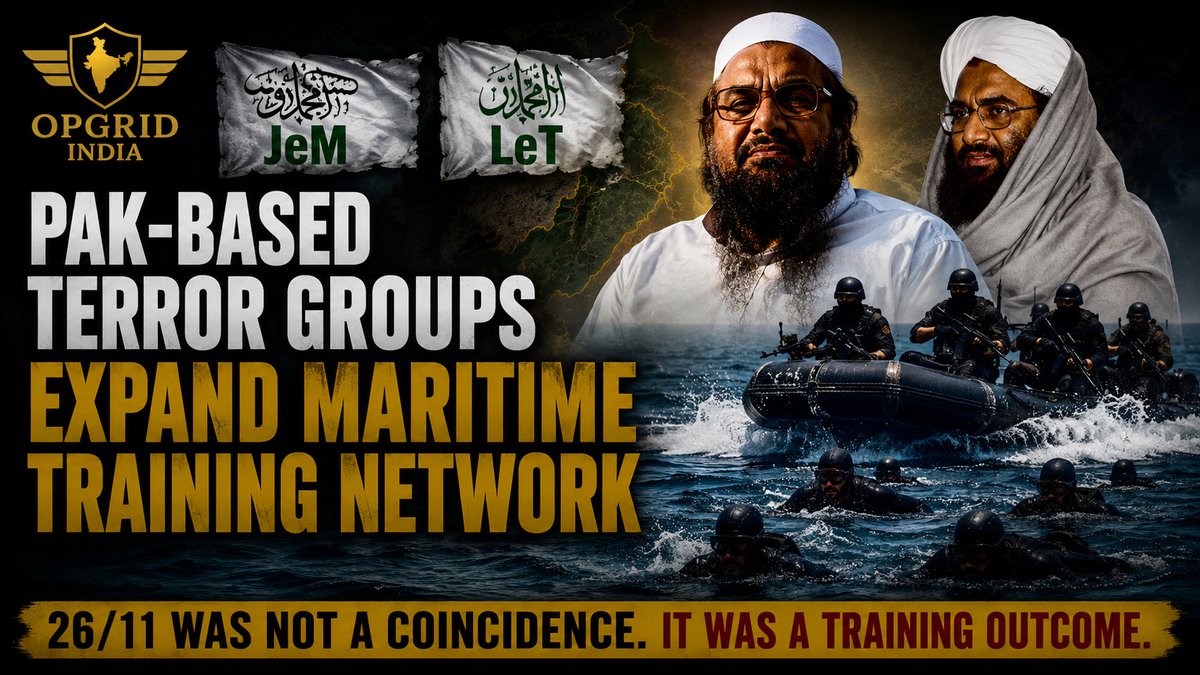
🚨| After LeT, JeM Also Begins Water Combat Training
“When terror groups invest in water training, they are not preparing for recreation. They are preparing for infiltration.”
Fresh intelligence inputs indicate that Jaish-e-Mohammed has expanded its water-based training activities into Karachi, while Lashkar-e-Taiba continues aggressive recruitment and swimming camp operations across Pakistan Punjab and PoK.
📍 According to available inputs:
• JeM has initiated fresh water-training batches in Karachi
• Next training cycle expected within days
• LeT conducted 10 seven-day swimming camps in the last 30 days across Punjab Province
• Parallel maritime-style training activity continues in PoK
This is not casual physical training.
It reflects structured preparation for waterborne operational capability.
#ProxyWarExposed #PakTerrorFactory #MaritimeSecurity
1
1
5
131
May 19
⚠️ Why This Matters
Pakistan-based terror groups have a long history of integrating:
• Swimming drills
• Boat handling
• Water navigation
• Amphibious infiltration tactics
into specialised training pipelines.
The most infamous example remains:
26/11 Mumbai.
The attackers received maritime-oriented training before infiltrating India through sea routes.
🧠 Karachi’s Role Is Significant
Karachi provides:
• Coastal access
• Port infrastructure
• Maritime movement familiarity
• Urban concealment for training activity
Expanding water training there suggests:
An attempt to diversify infiltration and operational preparedness beyond traditional land routes.
🔁 LeT’s Punjab Expansion Signals Larger Recruitment Push
The scale of LeT’s swimming camps across Punjab is notable.
10 camps in one month indicates:
• Organised mobilisation
• Structured indoctrination pipeline
• Large recruitment pool activation
These “sports-style” camps often serve dual functions:
• Physical conditioning
• Ideological grooming and screening
The swimming component is tactical—not recreational.
📊 Pakistan’s Proxy Ecosystem Is Adapting
As infiltration routes across the LoC become harder due to:
• Surveillance grids
• UAV monitoring
• Counter-infiltration deployments
terror groups increasingly focus on:
• Alternative infiltration methods
• Distributed training ecosystems
• Embedded civilian-style activity masking
Maritime and waterborne capability offers deniable flexibility.
⚠️ The Deeper Concern
The infrastructure for such training cannot scale repeatedly without:
• Local facilitation
• Institutional blind spots
• State tolerance—or selective protection
Groups like JeM and LeT continue operating organised training cycles openly despite Pakistan’s repeated claims of dismantling terror infrastructure.
wimming camps alone do not make headlines.
But in the context of Pakistan-backed jihadist ecosystems, they reveal something important:
The proxy infrastructure is not dormant.
It is evolving operationally.
From:
• Mountain infiltration
to
• Maritime preparedness
to
• Hybrid logistics networks
Pakistan’s terror ecosystem continues adapting under pressure rather than disappearing.
And every new training cycle reinforces the same reality: The infrastructure survives because the ecosystem sustaining it still exists.
Video Courtesy- t.me/ThirdEyeOSINTandAnalysi…
#ProxyWarExposed #PakTerrorFactory #MaritimeSecurity
3
56