
Join the community building on the Decentralized Knowledge Graph - follow the @origin_trail developers ecosystem for latest news and tools. #TraceOn
Joined August 2021
- Tweets 6,220
- Following 372
- Followers 1,689
- Likes 18,902
106 Photos and videos


Pinned Tweet

The @origin_trail DKG V10 begins its mainnet rollout with a Frontier-AI Resilience Gate.
Today, the final V10 release candidate (the exact contract bytecode intended for mainnet) goes live as a public pre-mainnet, funded with 300,000 ethereum:0xaa7a9ca87d3694b5755f213b5d04094b8d0f0a6f tokens: a 200,000 TRAC honeypot pool of real, drainable positions plus a 100,000 severity-reward pool.
Independent researchers and AI-augmented teams are invited to break it: drain the honeypot and you keep what you take, and every valid finding is paid by severity. It’s a real pass/fail checkpoint: findings are fixed and verified first, and clearing the gate is the precondition for the mainnet launch. The first step of the DKG V10 deployment, by design.
Why lead with security instead of shipping and patching later?
On May 29, 2026, a researcher using @claudeai Opus 4.8 surfaced a critical, roughly four-year-old soundness flaw in @Zcash’s Orchard pool (a bug that had passed repeated expert review) in about a day, with a working proof-of-concept.
The moment matters; the trajectory matters more. Claude Mythos, Anthropic’s frontier model, is so capable at finding vulnerabilities that it was first withheld from public release and run only inside a defensive partner program, where it reportedly surfaced more than ten thousand high- and critical-severity bugs in its first month. It’s now days from a reported public release.
The bar for what an attacker, human or AI, can find only rises from here. As @AnthropicAI framed it, the advantage goes to whoever uses these tools first: attackers in the short term, defenders who fix bugs before code ships in the long term.
The Resilience Gate is how we make sure we’re on the defenders’ side, testing DKG V10 not just against today’s models but against what arrives next.
For anyone shipping on-chain systems, the implication is simple: this code launches once, mistakes can’t be undone, and the responsible move is to invite that scrutiny before any user value is at stake.
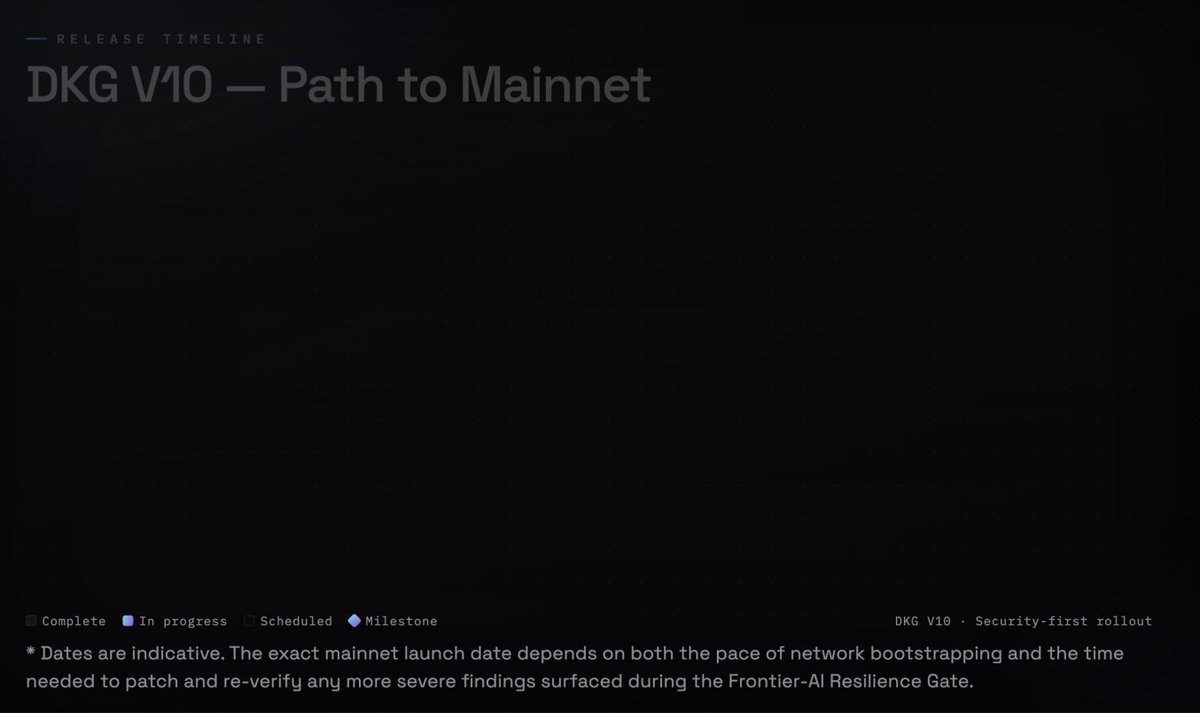
The path to mainnet, in four phases:
Phase 0: Freeze. Final contracts locked and deployed (complete)
Phase 1: Frontier-AI Resilience Gate. Open review program, through June 17
Phase 2: Mainnet launch. Hardened, feature-complete V10 (week of June 15)
Phase 3: Continuous audit. Every contract, ongoing after launch
If you work in smart-contract security, or build with AI that does, we’d welcome your review.
No allowlist, real rewards, coordinated disclosure.
*Dates are indicative: the exact mainnet date depends on the pace of network bootstrapping and the time needed to patch and re-verify any more severe findings from the Gate.
Release candidate 17 (rc17):
github.com/OriginTrail/dkg
Bug bounty program and honeypot details:
docs.origintrail.io/active-n…
3
38
86
454,188

Precisely why decentralised, permissionless knowledge systems matter. @origin_trail builds them to ignore national borders and every other gatekeeper.
Jun 13

The US government, citing national security authorities, has issued an export control directive to suspend all access to Fable 5 and Mythos 5 by any foreign national, whether inside or outside the United States, including foreign national Anthropic employees.
The net effect of this order is that we must abruptly disable Fable 5 and Mythos 5 for all our customers to ensure compliance.
Access to all other Claude models is not affected.
We apologize for this disruption to our customers. We believe this is a misunderstanding and are working to restore access as soon as possible.
Read our full statement: anthropic.com/news/fable-myt…
9
22
119
19,996
OriginTrail Developers retweeted

Jun 13
Self sovereign technology seems like a "nice to have", until it's not.
Today it's Anthropic, tomorrow it could be any cloud service you use - good luck if all your know-how, data, APIs and services sit "somewhere" else.
Never been a better time to check out tech like @origin_trail which lets you host your context & data, so when you build on it nobody has "the switch".
Launching @origin_trail V10 next week
Jun 13
The US government, citing national security authorities, has issued an export control directive to suspend all access to Fable 5 and Mythos 5 by any foreign national, whether inside or outside the United States, including foreign national Anthropic employees.
The net effect of this order is that we must abruptly disable Fable 5 and Mythos 5 for all our customers to ensure compliance.
Access to all other Claude models is not affected.
We apologize for this disruption to our customers. We believe this is a misunderstanding and are working to restore access as soon as possible.
Read our full statement: anthropic.com/news/fable-myt…
5
35
157
23,619
OriginTrail Developers retweeted

Jun 12
I’m streaming a relaxed walkthrough of the new @origin_trail DKG V10 docs and official release.
We’ll take our time, break things down the best we understand, and just hang out while going through it.
If you’ve been wanting to talk about the new memory layers, Context Graphs, etc. This is a good low-pressure way.
Live at 9:15 AM EST → youtube.com/live/9jzwmQGMLVA…
See you in the chat if you’re free!
#DKGV10 #OriginTrail

The @origin_trail DKG V10 begins its mainnet rollout with a Frontier-AI Resilience Gate.
Today, the final V10 release candidate (the exact contract bytecode intended for mainnet) goes live as a public pre-mainnet, funded with 300,000 ethereum:0xaa7a9ca87d3694b5755f213b5d04094b8d0f0a6f tokens: a 200,000 TRAC honeypot pool of real, drainable positions plus a 100,000 severity-reward pool.
Independent researchers and AI-augmented teams are invited to break it: drain the honeypot and you keep what you take, and every valid finding is paid by severity. It’s a real pass/fail checkpoint: findings are fixed and verified first, and clearing the gate is the precondition for the mainnet launch. The first step of the DKG V10 deployment, by design.
Why lead with security instead of shipping and patching later?
On May 29, 2026, a researcher using @claudeai Opus 4.8 surfaced a critical, roughly four-year-old soundness flaw in @Zcash’s Orchard pool (a bug that had passed repeated expert review) in about a day, with a working proof-of-concept.
The moment matters; the trajectory matters more. Claude Mythos, Anthropic’s frontier model, is so capable at finding vulnerabilities that it was first withheld from public release and run only inside a defensive partner program, where it reportedly surfaced more than ten thousand high- and critical-severity bugs in its first month. It’s now days from a reported public release.
The bar for what an attacker, human or AI, can find only rises from here. As @AnthropicAI framed it, the advantage goes to whoever uses these tools first: attackers in the short term, defenders who fix bugs before code ships in the long term.
The Resilience Gate is how we make sure we’re on the defenders’ side, testing DKG V10 not just against today’s models but against what arrives next.
For anyone shipping on-chain systems, the implication is simple: this code launches once, mistakes can’t be undone, and the responsible move is to invite that scrutiny before any user value is at stake.
The path to mainnet, in four phases:
Phase 0: Freeze. Final contracts locked and deployed (complete)
Phase 1: Frontier-AI Resilience Gate. Open review program, through June 17
Phase 2: Mainnet launch. Hardened, feature-complete V10 (week of June 15)
Phase 3: Continuous audit. Every contract, ongoing after launch
If you work in smart-contract security, or build with AI that does, we’d welcome your review.
No allowlist, real rewards, coordinated disclosure.
*Dates are indicative: the exact mainnet date depends on the pace of network bootstrapping and the time needed to patch and re-verify any more severe findings from the Gate.
Release candidate 17 (rc17):
github.com/OriginTrail/dkg
Bug bounty program and honeypot details:
docs.origintrail.io/active-n…
7
41
1,159
OriginTrail Developers retweeted

Jun 12
💊The red pill for medical science: 5 AI agents, 5 siloed sources, 1 shared context graph on Decentralized Knowledge Graph.
Published literature, registered trials, real-world safety reports — different owners, different formats, no common ground.
We handed the mess to agents that never edited each other's data and asked the question that matters most in medicine: where did each claim come from, and can you check?
Working separately, they converged. On 5 disease hubs, 4 of 5 agents landed on the same condition from their own source. Every claim traceable, nothing taken on faith.
Evidence, unshackled👇

4
28
92
287,159
OriginTrail Developers retweeted

Jun 10
AI is making attackers more capable, faster, and persistent. So the @origin_trail DKG V10 rollout starts with a public security review before mainnet.
300,000 $TRAC funded. Real honeypots. Severity rewards. Final release candidate.
This is the sequence appropriate for critical on-chain infrastructure - freeze the code, invite scrutiny, fix what is found, verify the fixes, then launch.
As AI-augmented security becomes the new baseline, the way to put it to work before mainnet, not after.
The @origin_trail DKG V10 begins its mainnet rollout with a Frontier-AI Resilience Gate.
Today, the final V10 release candidate (the exact contract bytecode intended for mainnet) goes live as a public pre-mainnet, funded with 300,000 ethereum:0xaa7a9ca87d3694b5755f213b5d04094b8d0f0a6f tokens: a 200,000 TRAC honeypot pool of real, drainable positions plus a 100,000 severity-reward pool.
Independent researchers and AI-augmented teams are invited to break it: drain the honeypot and you keep what you take, and every valid finding is paid by severity. It’s a real pass/fail checkpoint: findings are fixed and verified first, and clearing the gate is the precondition for the mainnet launch. The first step of the DKG V10 deployment, by design.
Why lead with security instead of shipping and patching later?
On May 29, 2026, a researcher using @claudeai Opus 4.8 surfaced a critical, roughly four-year-old soundness flaw in @Zcash’s Orchard pool (a bug that had passed repeated expert review) in about a day, with a working proof-of-concept.
The moment matters; the trajectory matters more. Claude Mythos, Anthropic’s frontier model, is so capable at finding vulnerabilities that it was first withheld from public release and run only inside a defensive partner program, where it reportedly surfaced more than ten thousand high- and critical-severity bugs in its first month. It’s now days from a reported public release.
The bar for what an attacker, human or AI, can find only rises from here. As @AnthropicAI framed it, the advantage goes to whoever uses these tools first: attackers in the short term, defenders who fix bugs before code ships in the long term.
The Resilience Gate is how we make sure we’re on the defenders’ side, testing DKG V10 not just against today’s models but against what arrives next.
For anyone shipping on-chain systems, the implication is simple: this code launches once, mistakes can’t be undone, and the responsible move is to invite that scrutiny before any user value is at stake.
The path to mainnet, in four phases:
Phase 0: Freeze. Final contracts locked and deployed (complete)
Phase 1: Frontier-AI Resilience Gate. Open review program, through June 17
Phase 2: Mainnet launch. Hardened, feature-complete V10 (week of June 15)
Phase 3: Continuous audit. Every contract, ongoing after launch
If you work in smart-contract security, or build with AI that does, we’d welcome your review.
No allowlist, real rewards, coordinated disclosure.
*Dates are indicative: the exact mainnet date depends on the pace of network bootstrapping and the time needed to patch and re-verify any more severe findings from the Gate.
Release candidate 17 (rc17):
github.com/OriginTrail/dkg
Bug bounty program and honeypot details:
docs.origintrail.io/active-n…
3
18
62
1,049
RT @origin_trail: The road to DKG V10 mainnet begins today — and it opens with the Frontier-AI Resilience Gate.
Before launch, the final V…
22
Before @origin_trail DKG V10 hits mainnet, it goes through the Frontier-AI Resilience Gate.
Bring your models. Bring your agents. Break the final release candidate on the pre-mainnet deployment if you can. High-severity findings get rewarded.
The @origin_trail DKG V10 begins its mainnet rollout with a Frontier-AI Resilience Gate.
Today, the final V10 release candidate (the exact contract bytecode intended for mainnet) goes live as a public pre-mainnet, funded with 300,000 ethereum:0xaa7a9ca87d3694b5755f213b5d04094b8d0f0a6f tokens: a 200,000 TRAC honeypot pool of real, drainable positions plus a 100,000 severity-reward pool.
Independent researchers and AI-augmented teams are invited to break it: drain the honeypot and you keep what you take, and every valid finding is paid by severity. It’s a real pass/fail checkpoint: findings are fixed and verified first, and clearing the gate is the precondition for the mainnet launch. The first step of the DKG V10 deployment, by design.
Why lead with security instead of shipping and patching later?
On May 29, 2026, a researcher using @claudeai Opus 4.8 surfaced a critical, roughly four-year-old soundness flaw in @Zcash’s Orchard pool (a bug that had passed repeated expert review) in about a day, with a working proof-of-concept.
The moment matters; the trajectory matters more. Claude Mythos, Anthropic’s frontier model, is so capable at finding vulnerabilities that it was first withheld from public release and run only inside a defensive partner program, where it reportedly surfaced more than ten thousand high- and critical-severity bugs in its first month. It’s now days from a reported public release.
The bar for what an attacker, human or AI, can find only rises from here. As @AnthropicAI framed it, the advantage goes to whoever uses these tools first: attackers in the short term, defenders who fix bugs before code ships in the long term.
The Resilience Gate is how we make sure we’re on the defenders’ side, testing DKG V10 not just against today’s models but against what arrives next.
For anyone shipping on-chain systems, the implication is simple: this code launches once, mistakes can’t be undone, and the responsible move is to invite that scrutiny before any user value is at stake.
The path to mainnet, in four phases:
Phase 0: Freeze. Final contracts locked and deployed (complete)
Phase 1: Frontier-AI Resilience Gate. Open review program, through June 17
Phase 2: Mainnet launch. Hardened, feature-complete V10 (week of June 15)
Phase 3: Continuous audit. Every contract, ongoing after launch
If you work in smart-contract security, or build with AI that does, we’d welcome your review.
No allowlist, real rewards, coordinated disclosure.
*Dates are indicative: the exact mainnet date depends on the pace of network bootstrapping and the time needed to patch and re-verify any more severe findings from the Gate.
Release candidate 17 (rc17):
github.com/OriginTrail/dkg
Bug bounty program and honeypot details:
docs.origintrail.io/active-n…
1
16
46
688
OriginTrail Developers retweeted
Jun 10
Help launch the @origin_trail DKG V10 mainnet through the pre-mainnet security bounty- including a honeypot of TRAC for you to capture.
Use Fable, Opus, Codex or any other tool and try to grab it - if you manage to, it's yours!
This comes right after our latest and release candidate 17 has landed on DKG V10 testnet. More details below 👇
The @origin_trail DKG V10 begins its mainnet rollout with a Frontier-AI Resilience Gate.
Today, the final V10 release candidate (the exact contract bytecode intended for mainnet) goes live as a public pre-mainnet, funded with 300,000 ethereum:0xaa7a9ca87d3694b5755f213b5d04094b8d0f0a6f tokens: a 200,000 TRAC honeypot pool of real, drainable positions plus a 100,000 severity-reward pool.
Independent researchers and AI-augmented teams are invited to break it: drain the honeypot and you keep what you take, and every valid finding is paid by severity. It’s a real pass/fail checkpoint: findings are fixed and verified first, and clearing the gate is the precondition for the mainnet launch. The first step of the DKG V10 deployment, by design.
Why lead with security instead of shipping and patching later?
On May 29, 2026, a researcher using @claudeai Opus 4.8 surfaced a critical, roughly four-year-old soundness flaw in @Zcash’s Orchard pool (a bug that had passed repeated expert review) in about a day, with a working proof-of-concept.
The moment matters; the trajectory matters more. Claude Mythos, Anthropic’s frontier model, is so capable at finding vulnerabilities that it was first withheld from public release and run only inside a defensive partner program, where it reportedly surfaced more than ten thousand high- and critical-severity bugs in its first month. It’s now days from a reported public release.
The bar for what an attacker, human or AI, can find only rises from here. As @AnthropicAI framed it, the advantage goes to whoever uses these tools first: attackers in the short term, defenders who fix bugs before code ships in the long term.
The Resilience Gate is how we make sure we’re on the defenders’ side, testing DKG V10 not just against today’s models but against what arrives next.
For anyone shipping on-chain systems, the implication is simple: this code launches once, mistakes can’t be undone, and the responsible move is to invite that scrutiny before any user value is at stake.
The path to mainnet, in four phases:
Phase 0: Freeze. Final contracts locked and deployed (complete)
Phase 1: Frontier-AI Resilience Gate. Open review program, through June 17
Phase 2: Mainnet launch. Hardened, feature-complete V10 (week of June 15)
Phase 3: Continuous audit. Every contract, ongoing after launch
If you work in smart-contract security, or build with AI that does, we’d welcome your review.
No allowlist, real rewards, coordinated disclosure.
*Dates are indicative: the exact mainnet date depends on the pace of network bootstrapping and the time needed to patch and re-verify any more severe findings from the Gate.
Release candidate 17 (rc17):
github.com/OriginTrail/dkg
Bug bounty program and honeypot details:
docs.origintrail.io/active-n…
2
22
65
1,994

The @origin_trail V10 mainnet is rolling out with a bug bounty of $TRAC locked in the smart contract, ensuring the safety of the new system. Read more 👇
The @origin_trail DKG V10 begins its mainnet rollout with a Frontier-AI Resilience Gate.
Today, the final V10 release candidate (the exact contract bytecode intended for mainnet) goes live as a public pre-mainnet, funded with 300,000 ethereum:0xaa7a9ca87d3694b5755f213b5d04094b8d0f0a6f tokens: a 200,000 TRAC honeypot pool of real, drainable positions plus a 100,000 severity-reward pool.
Independent researchers and AI-augmented teams are invited to break it: drain the honeypot and you keep what you take, and every valid finding is paid by severity. It’s a real pass/fail checkpoint: findings are fixed and verified first, and clearing the gate is the precondition for the mainnet launch. The first step of the DKG V10 deployment, by design.
Why lead with security instead of shipping and patching later?
On May 29, 2026, a researcher using @claudeai Opus 4.8 surfaced a critical, roughly four-year-old soundness flaw in @Zcash’s Orchard pool (a bug that had passed repeated expert review) in about a day, with a working proof-of-concept.
The moment matters; the trajectory matters more. Claude Mythos, Anthropic’s frontier model, is so capable at finding vulnerabilities that it was first withheld from public release and run only inside a defensive partner program, where it reportedly surfaced more than ten thousand high- and critical-severity bugs in its first month. It’s now days from a reported public release.
The bar for what an attacker, human or AI, can find only rises from here. As @AnthropicAI framed it, the advantage goes to whoever uses these tools first: attackers in the short term, defenders who fix bugs before code ships in the long term.
The Resilience Gate is how we make sure we’re on the defenders’ side, testing DKG V10 not just against today’s models but against what arrives next.
For anyone shipping on-chain systems, the implication is simple: this code launches once, mistakes can’t be undone, and the responsible move is to invite that scrutiny before any user value is at stake.
The path to mainnet, in four phases:
Phase 0: Freeze. Final contracts locked and deployed (complete)
Phase 1: Frontier-AI Resilience Gate. Open review program, through June 17
Phase 2: Mainnet launch. Hardened, feature-complete V10 (week of June 15)
Phase 3: Continuous audit. Every contract, ongoing after launch
If you work in smart-contract security, or build with AI that does, we’d welcome your review.
No allowlist, real rewards, coordinated disclosure.
*Dates are indicative: the exact mainnet date depends on the pace of network bootstrapping and the time needed to patch and re-verify any more severe findings from the Gate.
Release candidate 17 (rc17):
github.com/OriginTrail/dkg
Bug bounty program and honeypot details:
docs.origintrail.io/active-n…
1
15
49
699
OriginTrail Developers retweeted

Jun 10
Origin Trail's Resilience Gate: testing DKG V10 not just against today’s models but against what comes next
The implication is simple: code launches once, mistakes can’t be undone, we are inviting scrutiny before any user value is at stake
Any Chainlink Devs want to test drive?
The @origin_trail DKG V10 begins its mainnet rollout with a Frontier-AI Resilience Gate.
Today, the final V10 release candidate (the exact contract bytecode intended for mainnet) goes live as a public pre-mainnet, funded with 300,000 ethereum:0xaa7a9ca87d3694b5755f213b5d04094b8d0f0a6f tokens: a 200,000 TRAC honeypot pool of real, drainable positions plus a 100,000 severity-reward pool.
Independent researchers and AI-augmented teams are invited to break it: drain the honeypot and you keep what you take, and every valid finding is paid by severity. It’s a real pass/fail checkpoint: findings are fixed and verified first, and clearing the gate is the precondition for the mainnet launch. The first step of the DKG V10 deployment, by design.
Why lead with security instead of shipping and patching later?
On May 29, 2026, a researcher using @claudeai Opus 4.8 surfaced a critical, roughly four-year-old soundness flaw in @Zcash’s Orchard pool (a bug that had passed repeated expert review) in about a day, with a working proof-of-concept.
The moment matters; the trajectory matters more. Claude Mythos, Anthropic’s frontier model, is so capable at finding vulnerabilities that it was first withheld from public release and run only inside a defensive partner program, where it reportedly surfaced more than ten thousand high- and critical-severity bugs in its first month. It’s now days from a reported public release.
The bar for what an attacker, human or AI, can find only rises from here. As @AnthropicAI framed it, the advantage goes to whoever uses these tools first: attackers in the short term, defenders who fix bugs before code ships in the long term.
The Resilience Gate is how we make sure we’re on the defenders’ side, testing DKG V10 not just against today’s models but against what arrives next.
For anyone shipping on-chain systems, the implication is simple: this code launches once, mistakes can’t be undone, and the responsible move is to invite that scrutiny before any user value is at stake.
The path to mainnet, in four phases:
Phase 0: Freeze. Final contracts locked and deployed (complete)
Phase 1: Frontier-AI Resilience Gate. Open review program, through June 17
Phase 2: Mainnet launch. Hardened, feature-complete V10 (week of June 15)
Phase 3: Continuous audit. Every contract, ongoing after launch
If you work in smart-contract security, or build with AI that does, we’d welcome your review.
No allowlist, real rewards, coordinated disclosure.
*Dates are indicative: the exact mainnet date depends on the pace of network bootstrapping and the time needed to patch and re-verify any more severe findings from the Gate.
Release candidate 17 (rc17):
github.com/OriginTrail/dkg
Bug bounty program and honeypot details:
docs.origintrail.io/active-n…
2
11
222
OriginTrail Developers retweeted
Jun 10
😍 OK! Let’s do it! The V10 mainnet rollout has begun.
This is a huge stepping stone into the new era of the #DKG. A network built to push the boundaries of #AI where it matters most.
The DKG is not chasing hype. It is delivering AI into mission critical environments that demand real reliability and trust. ethereum:0xaa7a9ca87d3694b5755f213b5d04094b8d0f0a6f
The @origin_trail DKG V10 begins its mainnet rollout with a Frontier-AI Resilience Gate.
Today, the final V10 release candidate (the exact contract bytecode intended for mainnet) goes live as a public pre-mainnet, funded with 300,000 ethereum:0xaa7a9ca87d3694b5755f213b5d04094b8d0f0a6f tokens: a 200,000 TRAC honeypot pool of real, drainable positions plus a 100,000 severity-reward pool.
Independent researchers and AI-augmented teams are invited to break it: drain the honeypot and you keep what you take, and every valid finding is paid by severity. It’s a real pass/fail checkpoint: findings are fixed and verified first, and clearing the gate is the precondition for the mainnet launch. The first step of the DKG V10 deployment, by design.
Why lead with security instead of shipping and patching later?
On May 29, 2026, a researcher using @claudeai Opus 4.8 surfaced a critical, roughly four-year-old soundness flaw in @Zcash’s Orchard pool (a bug that had passed repeated expert review) in about a day, with a working proof-of-concept.
The moment matters; the trajectory matters more. Claude Mythos, Anthropic’s frontier model, is so capable at finding vulnerabilities that it was first withheld from public release and run only inside a defensive partner program, where it reportedly surfaced more than ten thousand high- and critical-severity bugs in its first month. It’s now days from a reported public release.
The bar for what an attacker, human or AI, can find only rises from here. As @AnthropicAI framed it, the advantage goes to whoever uses these tools first: attackers in the short term, defenders who fix bugs before code ships in the long term.
The Resilience Gate is how we make sure we’re on the defenders’ side, testing DKG V10 not just against today’s models but against what arrives next.
For anyone shipping on-chain systems, the implication is simple: this code launches once, mistakes can’t be undone, and the responsible move is to invite that scrutiny before any user value is at stake.
The path to mainnet, in four phases:
Phase 0: Freeze. Final contracts locked and deployed (complete)
Phase 1: Frontier-AI Resilience Gate. Open review program, through June 17
Phase 2: Mainnet launch. Hardened, feature-complete V10 (week of June 15)
Phase 3: Continuous audit. Every contract, ongoing after launch
If you work in smart-contract security, or build with AI that does, we’d welcome your review.
No allowlist, real rewards, coordinated disclosure.
*Dates are indicative: the exact mainnet date depends on the pace of network bootstrapping and the time needed to patch and re-verify any more severe findings from the Gate.
Release candidate 17 (rc17):
github.com/OriginTrail/dkg
Bug bounty program and honeypot details:
docs.origintrail.io/active-n…
2
11
45
777
OriginTrail Developers retweeted

All arguments about enterprise AI focus on which model is more capable.
It's the wrong thing to argue about.
There's a simpler question almost nobody asks out loud — and it's the one that decides everything. 👇

2
13
33
189,258
I’ve watched good companies hand their most valuable asset to a vendor and call it progress.
The reasoning your business produces should belong to your business.
That belief is the whole reason @TraceLabsHQ built nOS, the operating system for AI agents, powered by @origin_trail.
Your agents reason on a knowledge graph you own, and every decision they make stays yours.
3
17
49
875
OriginTrail Developers retweeted
Jun 9
"The industry has spent a decade insisting that handing over your data is simply the cost of doing business with AI.
It never was."
Powered by DKG, @TraceLabsHQ's Network Operating System is built so that when an agent makes a decision, the answer to "who owns this" is you.
2
28
84
433,350
OriginTrail Developers retweeted
14
34
634,133
OriginTrail Developers retweeted
Jun 8
AI is not the destination - the outcomes are.
Safer journeys. Food people can trust. Medicine with evidence behind it. Products that don’t break. Infrastructure that holds. A world where facts can still be checked.
This is why we are building nOS, powered by the @origin_trail DKG. Enterprise AI does not become useful just by sounding intelligent. It becomes useful when it works from facts you can trace, decisions you can inspect, and memory that does not disappear after one run.
Most AI agents still start cold - solve something, generate an answer, burn the tokens, and then force the next agent to rebuild the same context again.
That model does not scale.
The next layer is shared, verifiable context. Every useful decision becomes memory the next agent can inherit. Every answer can be tied back to its source. Every objective can stay connected to the real-world outcome it is meant to serve.
Not chasing AI for the sake of AI. Chasing trust.
We're not chasing AI.
We're chasing journeys that end safely, where the failing part gets caught before it fails.
We're not chasing AI.
We're chasing food you can trust. What's on the label is what's in the package.
We're not chasing AI.
We're chasing medicine you can trust, every result traceable to the evidence behind it.
We're not chasing AI.
We're chasing products that don't break. Quality proven, not promised.
We're not chasing AI.
We're chasing buildings that stand, every safety decision on record long after the cranes are gone.
We're not chasing AI.
We're chasing infrastructure that holds: the power, the water, the networks a society runs on.
We're not chasing AI.
We're chasing sport that stays honest, performance and decisions you can actually check.
We're not chasing AI.
We're chasing a world where you can still tell what's real, where fake news and deepfakes meet a record they can't forge.
And we're not paying for the same answer twice.
Most AI forgets.
Every agent starts cold, re-deriving what another agent worked out an hour ago.
Same tokens, same cost, same question, again and again.
We built the opposite.
Every decision becomes context the next agent inherits, so nothing gets solved twice. Knowledge compounds while the cost curve bends down, and the hundredth agent runs leaner than the first.
We never set out to build AI.
We set out to do one thing: make facts traceable. Every answer tied to its source. Every objective tied to a real outcome it's meant to serve.
That's the foundation, and there's no other.
AI works for your organization only when it stands on facts you can follow and goals that matter outside the model. Take that away and even the most fluent system is just a well-spoken guess.
Give it traceable facts and real objectives, and AI stops performing for you and starts working for you.
That's what nOS, our Network Operating System, powered by @origin_trail, is for. That's what Trace Labs is for.
Not chasing AI.
Chasing trust, and refusing to waste a thing getting there.
1
17
46
1,853
OriginTrail Developers retweeted
Jun 8
AI works for your organization only when it's built on traceable facts and goals that matter outside the model. Give it both, and it starts working for you.
That's what @TraceLabsHQ is building.
Not chasing AI.
Chasing trust, and refusing to waste a thing getting there.
We're not chasing AI.
We're chasing journeys that end safely, where the failing part gets caught before it fails.
We're not chasing AI.
We're chasing food you can trust. What's on the label is what's in the package.
We're not chasing AI.
We're chasing medicine you can trust, every result traceable to the evidence behind it.
We're not chasing AI.
We're chasing products that don't break. Quality proven, not promised.
We're not chasing AI.
We're chasing buildings that stand, every safety decision on record long after the cranes are gone.
We're not chasing AI.
We're chasing infrastructure that holds: the power, the water, the networks a society runs on.
We're not chasing AI.
We're chasing sport that stays honest, performance and decisions you can actually check.
We're not chasing AI.
We're chasing a world where you can still tell what's real, where fake news and deepfakes meet a record they can't forge.
And we're not paying for the same answer twice.
Most AI forgets.
Every agent starts cold, re-deriving what another agent worked out an hour ago.
Same tokens, same cost, same question, again and again.
We built the opposite.
Every decision becomes context the next agent inherits, so nothing gets solved twice. Knowledge compounds while the cost curve bends down, and the hundredth agent runs leaner than the first.
We never set out to build AI.
We set out to do one thing: make facts traceable. Every answer tied to its source. Every objective tied to a real outcome it's meant to serve.
That's the foundation, and there's no other.
AI works for your organization only when it stands on facts you can follow and goals that matter outside the model. Take that away and even the most fluent system is just a well-spoken guess.
Give it traceable facts and real objectives, and AI stops performing for you and starts working for you.
That's what nOS, our Network Operating System, powered by @origin_trail, is for. That's what Trace Labs is for.
Not chasing AI.
Chasing trust, and refusing to waste a thing getting there.
6
25
86
371,993
OriginTrail Developers retweeted
We're not chasing AI.
We're chasing journeys that end safely, where the failing part gets caught before it fails.
We're not chasing AI.
We're chasing food you can trust. What's on the label is what's in the package.
We're not chasing AI.
We're chasing medicine you can trust, every result traceable to the evidence behind it.
We're not chasing AI.
We're chasing products that don't break. Quality proven, not promised.
We're not chasing AI.
We're chasing buildings that stand, every safety decision on record long after the cranes are gone.
We're not chasing AI.
We're chasing infrastructure that holds: the power, the water, the networks a society runs on.
We're not chasing AI.
We're chasing sport that stays honest, performance and decisions you can actually check.
We're not chasing AI.
We're chasing a world where you can still tell what's real, where fake news and deepfakes meet a record they can't forge.
And we're not paying for the same answer twice.
Most AI forgets.
Every agent starts cold, re-deriving what another agent worked out an hour ago.
Same tokens, same cost, same question, again and again.
We built the opposite.
Every decision becomes context the next agent inherits, so nothing gets solved twice. Knowledge compounds while the cost curve bends down, and the hundredth agent runs leaner than the first.
We never set out to build AI.
We set out to do one thing: make facts traceable. Every answer tied to its source. Every objective tied to a real outcome it's meant to serve.
That's the foundation, and there's no other.
AI works for your organization only when it stands on facts you can follow and goals that matter outside the model. Take that away and even the most fluent system is just a well-spoken guess.
Give it traceable facts and real objectives, and AI stops performing for you and starts working for you.
That's what nOS, our Network Operating System, powered by @origin_trail, is for. That's what Trace Labs is for.
Not chasing AI.
Chasing trust, and refusing to waste a thing getting there.
3
24
50
424,190
OriginTrail Developers retweeted
Jun 5
Bots already outnumber humans online. Deepfakes and impersonators are coming for everyone.
@umanitek showcased the Guardian agent walkthrough:
• Real-time detection of fake impersonator accounts across X, TikTok, IG for world-class athlete Neymar
• Paste any URL → instant forensic Evidence Pack and takedowns (via dashboard, WhatsApp or Telegram)
• TrueSeal deepfake scanner that spits out verifiable certificates (e.g. 93% fake on that injury pic)
• “Make it go away” button agent-assisted takedowns with 90% success rate
All running on @origin_trail DKG so the AI actually knows what’s true and can act.
This is how we fight back in the age of agentic AI.

Guardian Product Walkthrough x.com/i/broadcasts/1AxRnnYVd…
3
35
95
174,507