Operations account of the Dwingeloo Telescope, operated by CAMRAS. General account is @radiotelescoop. Tweets by @tammojan. Also at botsin.space/@pi9cam
- Tweets 2,525
- Following 50
- Followers 1,146
- Likes 553


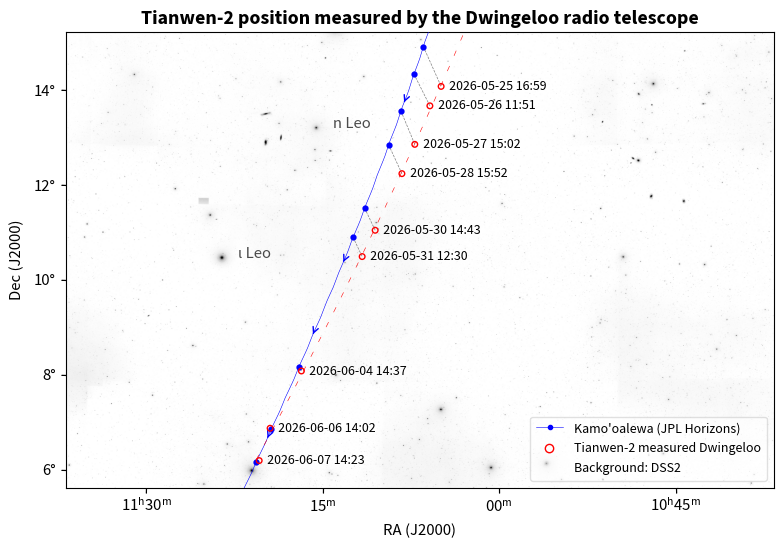
ALT Sky plot showing the location where the Dwingeloo telescope measured the Tianwen-2 spacecraft, with a 0.1 degree field of view. On 7 June, the spacecraft is apparently within 0.1 degree of the asteroid.
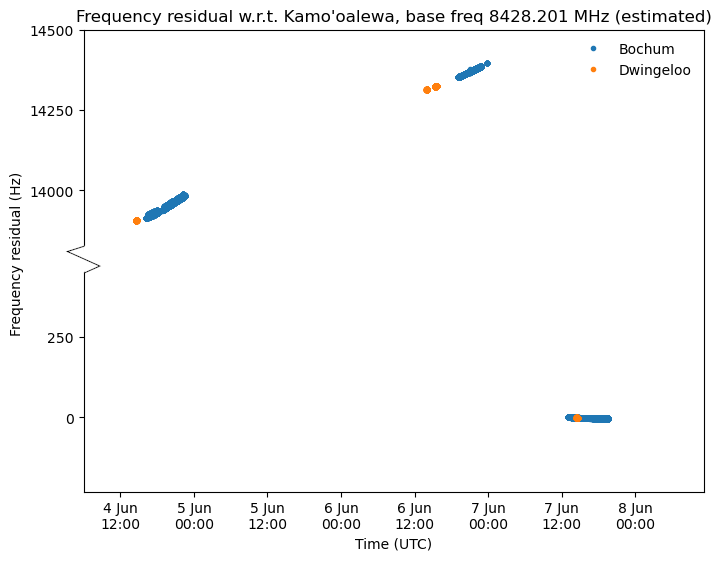
ALT Frequency residual w.r.t. Kamo'oalewa, with an estimated base freq of 8428.201 MHz. On 4-6 June the residual is between 13800 and 14300 Hz, increasing. From 7 June, the line is almost flat, changing only a few Hz in hours. This shows the change in line-of-sight velocity is now close to that of Kamo'oalewa.

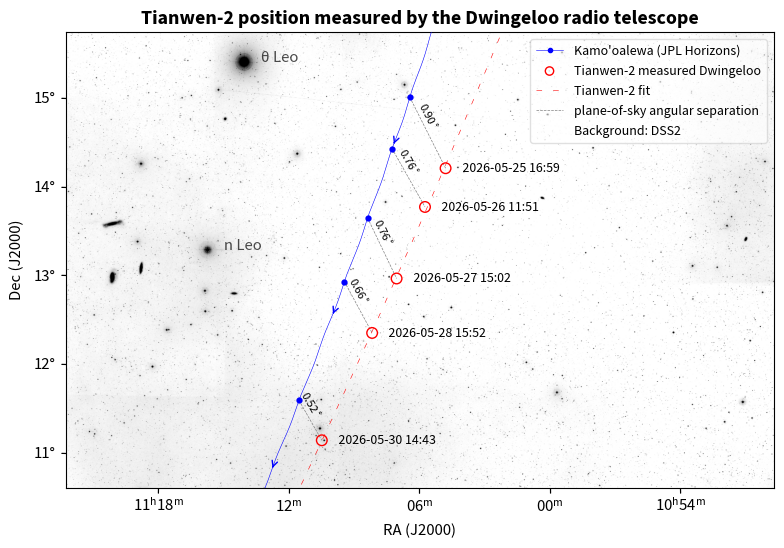
ALT Dwingeloo observations of Tianwen-2. A star plot (DSS background) with a blue line showing the coordinates of Kamo'oalewa over time and red dots showing the Dwingeloo radio telescope localizations of the spacecraft. A fit through the localizations shows that the spacecraft is getting closer to the asteroid.



ALT A post of a GNU Radio flowgraph GUI demodulating the signal from Tianwen-2, which has rather high SNR.
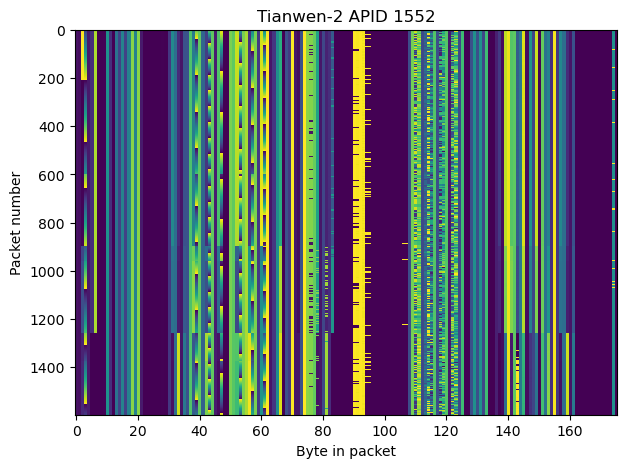
ALT A raster map of one of the decoded Space Packet APIDs. We can see a few fields changing values, but most of the contents are fairly static.