
Marathon Runner | Coach | Dad | Boston Marathon Qualifier | Helping runners build fitness one week at a time
Joined May 2026
- Tweets 29
- Following 49
- Followers 1
- Likes 7
Photos and videos
Pinned Tweet

The biggest mistake I see marathoners make:
Running easy days too hard.
Most runners think they’re limited by speed, but they’re actually limited by recovery.
The athletes I coach improve most when they slow down easy runs.
Recovery ➡️ Consistency ➡️ Improvement
1
37
The fastest athletes in the world aren’t just training their legs. They’re training their gut.
Sabastian Sawe reportedly fueled at ~115g of carbs/hour during his historic London Marathon. That didn’t happen overnight- it was made possible by months (or years) of gut training.
Your gut is trainable, just like your aerobic system.
Don’t save your fueling strategy for race day.
8
Many runners are excellent at accumulating fatigue and not at accumulating fitness.
One of the big differences can be recovery.
The best training plan isn’t the one with the most miles. It’s the one that allows you to stay healthy, recover, and string together months of consistent training.
That’s how PRs happen.
15
Most runners focus on VO₂max.
The best marathoners focus on running economy, threshold, fueling, and fatigue resistance.
The ability to keep producing near-maximal performance in the final 10K is where records are won.
Jun 12

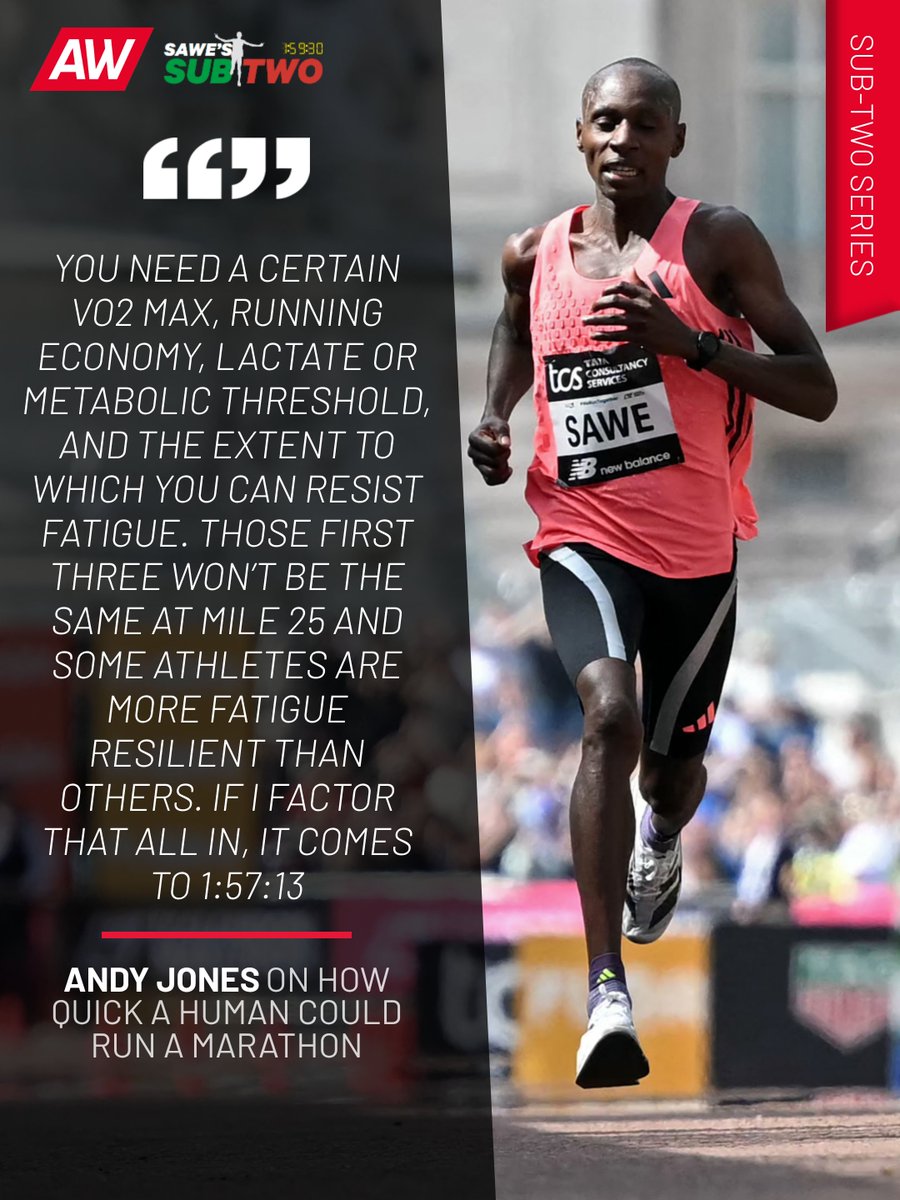
What might happen next with the men’s marathon world record ‼️
An interview with Andy Jones, a professor of applied physiology at the University of Exeter who worked on the INEOS 1:59 Challenge, on the future of marathon running 🗣️
With an imminently movable target, it begs the question how low can man potentially run 26.2 miles? “I can get 1:57:13" says Jones 🏃
There are four components – VO2 max, running economy, lactate or metabolic threshold, and the extent to which you can resist fatigue ⚡️
🖊️ @mattmajendie
📸 @GettyImages
47
The best marathoners aren’t always the fastest runners.
They’re often the best fuelers.
A new review found that nutrition, pacing, and experience are among the strongest predictors of ultra-endurance performance.
Fitness matters. But once fatigue sets in, execution becomes a performance skill.
link.springer.com/article/10…
1
14
Fueling, hydration, and pacing discipline are trainable skills. They should be practiced with the same intention as threshold runs or long runs.
11
Most runners focus on VO₂max, threshold, and running economy.
Researchers are starting to call durability the “4th dimension” of endurance performance.
The question isn’t just how fit you are.
It’s how much of that fitness is left after 2 hours of running.
That’s what marathon training is really about.
11
One sign of a mature runner:
They stop treating every long run like a race.
Fuel when needed.
Drink when needed.
Adjust when needed.
The goal is to absorb the training over the long term, not win the workout.
10
One of the most valuable skills for runners isn’t training harder. It’s staying calm when training gets interrupted.
Fitness is built over years. It isn’t erased by a few missed workouts.
The best runners understand the difference.
18
Interesting finding from one of the largest running injury studies ever conducted:
Your injury risk may be driven more by one unusually long run than by your total weekly mileage.
When building fitness, pay attention to your longest recent run, not just recent weekly mileage.
bjsm.bmj.com/content/59/17/1…
16
A lot of runners label themselves as “responders” or “non-responders” to training.
A new study suggests it’s not that simple.
When people completed the same 8-week endurance program twice, their adaptations weren’t very reproducible. The athletes who improved the most the first time often didn’t improve the most the second time.
One training block doesn’t define your potential.
journals.physiology.org/doi/…
6
Happy Global Running Day!
A few years ago, I questioned whether I’d be able to get to the Boston Marathon.
The biggest lesson I learned through my training:
Consistency is key.
Stack quality weeks together and you can improve more than you might think.
#GlobalRunningDay
6
Want to get faster without adding more miles?
Run uphill.
Uphill treadmill workouts build strength, improve running economy, and raise your aerobic ceiling - all while reducing impact.
Don’t just run more. Run uphill! 
5
My takeaway isn’t that Zone 2 doesn’t work, it’s that many runners don’t know where their actual Zone 2 is.
The science supporting Zone 2 base training is strong. The challenge is that “Zone 2” can be very different between individuals depending on how it’s measured.

Much Ado About Zone 2 open.substack.com/pub/realex…
Influencers can’t get enough of Zone 2 training. So why did @gibalam publish a research paper challenging Zone 2 for the general public? In this episode, we go through a critical examination of Zone 2.
link.springer.com/article/10…
1
7
To me, this validates individualized training more than it disproves Zone 2.
4
The biggest mistake I see marathoners make:
Running easy days too hard.
Most runners think they’re limited by speed, but they’re actually limited by recovery.
The athletes I coach improve most when they slow down easy runs.
Recovery ➡️ Consistency ➡️ Improvement
1
37
I ran 2:53 at Boston this year, and most of my easy runs were 7:30-8:30 min/mile pace. Faster isn’t always better.
5
People can debate nutrition all day, but carb loading and high-carb fueling during endurance events are among the most consistently supported findings in sports science. This shouldn’t be a debate anymore.
Most runners don’t need more intensity.
They need more consistency.
Stack enough weeks together and your fitness eventually shows up.