“There are two kinds of forecasters: those who don’t know, and those who don’t know they don’t know.”
John Kenneth Galbraith
= We are fallible
= Stay humble
= Caveat emptor
Tulip Mania — Peak 1637, decline ~–90%
“The tulip is worth its weight in gold.”
— Dutch trader, 1636
“Rare tulips are not subject to the laws of supply and demand.”
— Leiden speculator, 1637
Mississippi Bubble — Peak 1720, decline ~–85%
“The shares will keep rising as long as confidence holds.”
— John Law, 1719
“The Mississippi Company’s value cannot fall, for the wealth of Louisiana is boundless.”
— Paris financier, 1719
“The value of Mississippi stock must increase as France expands.”
— French pamphlet, 1719
“Confidence will maintain the system.”
— John Law, 1720
South Sea Bubble — Peak 1720, decline ~–85%
“I can calculate the motions of the heavenly bodies, but not the madness of people.”
— Isaac Newton, 1720
“The only way to secure great fortunes with certainty is through South Sea stock.”
— London Gazette, 1720
“Shares in South Sea are safer than any other investment.”
— London pamphleteer, 1720
“South Sea stock will rise forever.”
— London crowd phrase, 1720
Canal Mania — Peak 1793, decline ~–70%
“The canals will return a fortune without risk. Nothing can prevent their prosperity.”
— Investor testimony, 1793
“No safer investment than canal shares.”
— British prospectus, 1793
Railway Mania — Peak 1845, decline ~–70%
“Railways are destined to pay high dividends forever.”
— Parliamentary witness, 1836
“Railway shares will double every few years.”
— British investor, 1837
“There is no investment safer than railway shares.”
— George Hudson, 1845
“There is no reason whatever to fear a crash.”
— Railway Times, 1845
“Fortunes will be made in railways without risk.”
— British MP, 1845
Panic of 1873 — Peak 1873, decline ~–60%
“They are as safe as a government bond.”
— Jay Cooke, 1873
“No cause for uneasiness in the financial situation.”
— New York Tribune, 1873
Panic of 1907 — Peak 1907, decline ~–50%
“There is no danger of a panic.”
— Wall Street Journal, 1907
“Prosperity is permanent.”
— Banker, 1906
“The country is sound.”
— New York Clearing House, 1907
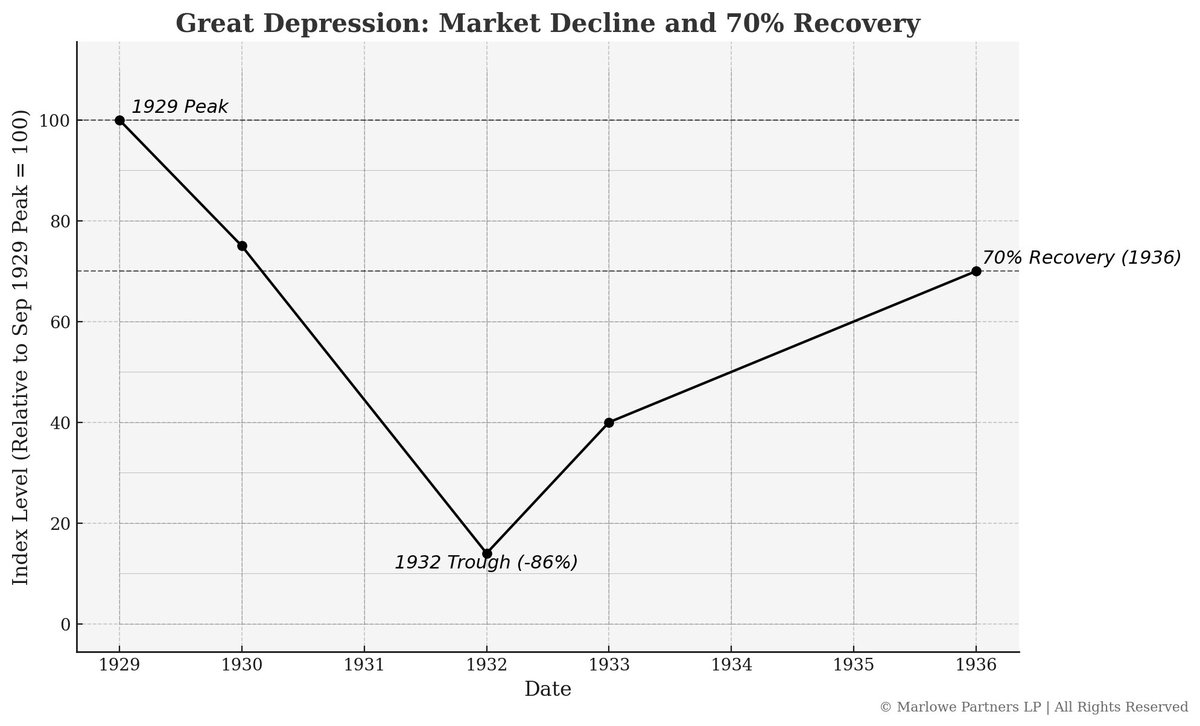
Roaring Twenties / Great Depression — Peak 1929, decline ~–89%
“We in America today are nearer to the final triumph over poverty.”
— Herbert Hoover, 1928
“Everybody ought to be rich.”
— John Raskob, 1929
“Stock prices have reached what looks like a permanently high plateau.”
— Irving Fisher, 1929
“We are in a new era of permanently rising values.”
— Charles Mitchell, 1929
“Business conditions are sound.”
— Bernard Baruch, 1928
“The outlook is favorable for sustained prosperity.”
— Harvard Economic Society, 1929
“Only the lunatic fringe has been shaken out.”
— Irving Fisher, Oct 1929
“The fundamentals are sound.”
— Herbert Hoover, 1930
“Recovery is just around the corner.”
— Herbert Hoover, 1930
Nifty Fifty — Peak 1972, decline ~–70%
“Buy the Nifty Fifty and hold forever.”
— Institutional brokers, 1972
“Those who buy these stocks are guaranteed to make money.”
— Forbes, 1971
“Growth companies are the only investment worth holding indefinitely.”
— Morgan Guaranty Trust, 1972
Black Monday — Peak 1987, decline –22% in one day
“The market will keep rising because investors can’t think of any reason it should stop.”
— David Shulman, Salomon Brothers, 1987
Japan Asset Bubble — Peak 1989, decline ~–80% (Nikkei, real estate)
“Japan is number one. Our prosperity will not end.”
— Noboru Takeshita, 1989
“Land prices in Tokyo will never go down.”
— Tokyo real estate broker, 1989
“The Nikkei will reach 100,000.”
— Japanese strategist, 1989
“Japan will dominate the 21st century.”
— MITI official, 1989
Dot-Com Bubble — Peak 2000, decline ~–78% (Nasdaq)
“Stocks are still undervalued. The Dow will hit 36,000 within five years.”
— Glassman & Hassett, 1999
“Amazon to $400.”
— Henry Blodget, 1999
“The American financial system is as strong and resilient as it has ever been.”
— Larry Summers, 1999