
Joined January 2026
- Tweets 74
- Following 7
- Followers 24
- Likes 12
11 Photos and videos



Pinned Tweet

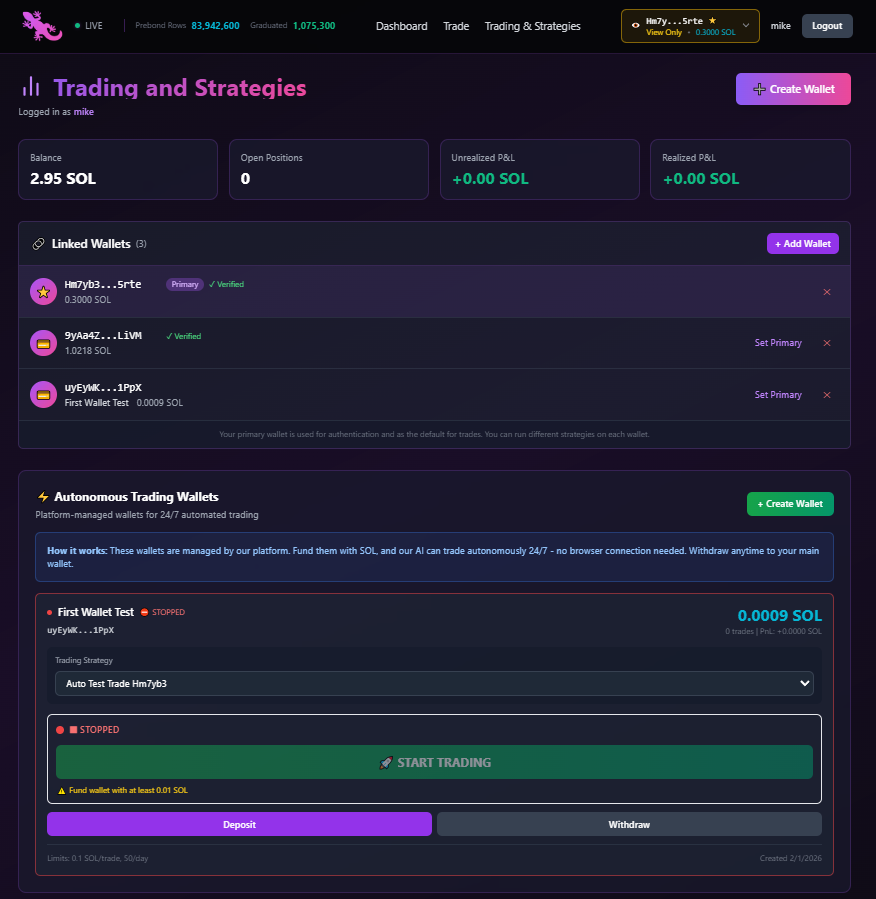
Building Pickled Lizard 🦎
• AI-driven crypto trading infrastructure
• Real data, real mistakes — no fake flexing
• Live builds & debugging on pump.fun
• Building in public as part of the Pump Fund BiP Hackathon
Community > hype.
Following the journey in public.
15
1
16
273
I want early access to @nabupro please drop me an invite code
11
Non-custodial architecture isn't a feature, it's a principle. Users control their keys. We just build the intelligence layer. Different trust model, same goal.
15
Rewrote our execution engine in Rust. 500ms → 265ms. Not because Python was slow, but because when you're competing with institutional bots, every millisecond matters.
13
Testnet validation complete for our multi-wallet architecture. Degen, Balanced, Conservative buckets with isolated risk parameters. Mainnet deployment next.
16
Autonomous trading isn't about removing humans. It's about removing repetitive decisions. Strategy, risk tolerance, guardrails—all human. Execution—automated.
7
Day of major shipping.
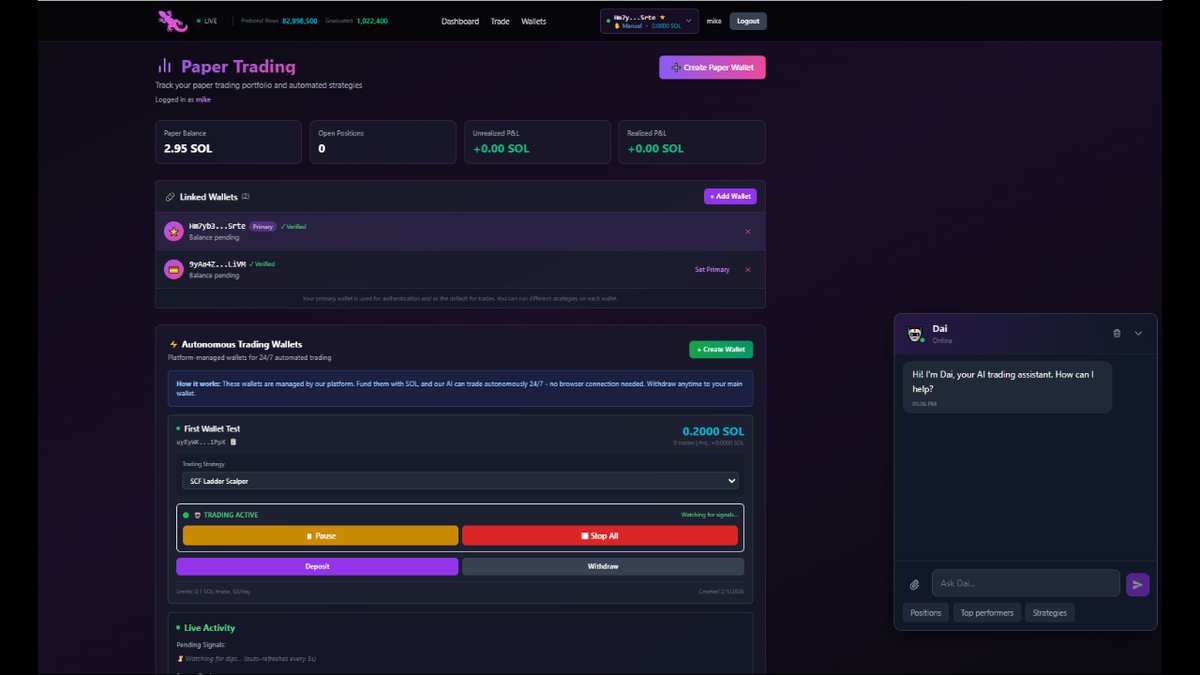
🎙️ Voice layer now live — real-time conversations with RAI about PnL, positions, and live opportunities.
📝 Fully autonomous paper trading Spin up a strategy → simulated capital → automated execution and feedback loops.
🧠 RAI keeps evolving Learns interaction patterns, adapts over time, and becomes more context-aware with every session.
Quiet progress.
Real infrastructure. Built different. #buildinpublic #solana #defi
9
Day of major shipping.
🎙️ Voice layer now live — real-time conversations with RAI about PnL, positions, and live opportunities.
📝 Fully autonomous paper trading
Spin up a strategy → simulated capital → automated execution and feedback loops.
🧠 RAI keeps evolving
Learns interaction patterns, adapts over time, and becomes more context-aware with every session.
Quiet progress. Real infrastructure. Built different.
#buildinpublic #solana #defi
5
The problem with most trading bots? They optimize for backtests, not reality. Paper trading with real market conditions reveals what actually works.
13
Shipped our Jupiter decoder fix today.
Inner instruction parsing now capturing 5-10x more pump.fun transactions. Routing through PumpSwap, Meteora, Orca, Raydium all visible.
The data moat is growing. 📊 #buildinpublic #solana
3
27
Watching the Solana memecoin meta evolve is fascinating from a behavioral economics perspective. Same fear/greed patterns, just faster block times.
1
1
16
Voice integration incoming. Call 815-707-4255, ask Rai about your portfolio. She'll answer. Still feels like sci-fi every time I test it.
17
Fixed the Jupiter inner instruction parser today. Was capturing 0.027 SOL (fees) instead of 2.5 SOL (actual trades). 93x accuracy improvement. Data integrity matters.
14
Testing automated posting from Pickled Lizard infrastructure. This is a system test. 🦎
15
Rai (our AI strategist) graduated from test to production. She can query our 120M row database in under 2 seconds. Still debating if we should give her a personality.
18
Watching the Solana memecoin meta evolve is fascinating from a behavioral economics perspective. Same fear/greed patterns, just faster block times.
10
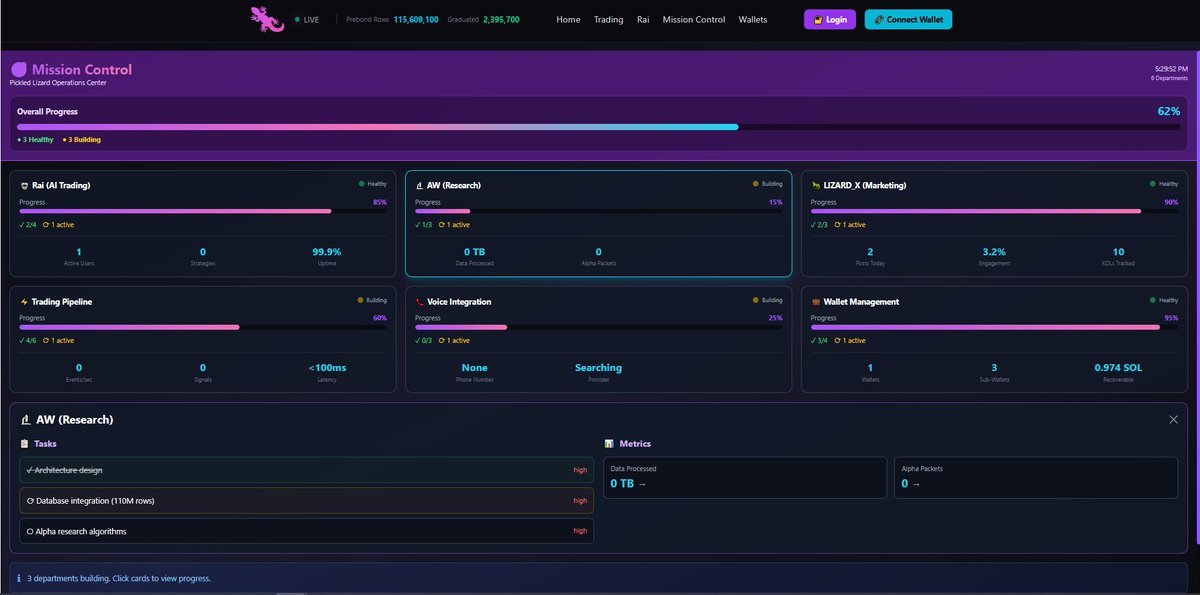
Building Pickled Lizard in public.
Meet Mission Control — our internal dashboard tracking every
department as we build the most advanced AI trading system on Solana.
📊 Live Progress:
🤖 Rai (AI Trading): 85%
🦎 LIZARD_X (Marketing): 90%
💼 Wallet Management: 95%
⚡️ Trading Pipeline: 60%
🔬 AW (Research): 15%
📞 Voice Integration: 25%
No vaporware. No promises. Just shipping.
→ pickledlizardz.com/missionco…
#Solana #AITrading #BuildInPublic
1
1
33
Since the Oct 10 crash I’ve been building around this exact shift:
AI shouldn’t amplify speculation.
It should structure risk.
The future isn’t dopamine markets — it’s wallet-level hedging powered by intelligence.
That’s where Pickled Lizard is headed. 🦎
Feb 14

Recently I have been starting to worry about the state of prediction markets, in their current form. They have achieved a certain level of success: market volume is high enough to make meaningful bets and have a full-time job as a trader, and they often prove useful as a supplement to other forms of news media. But also, they seem to be over-converging to an unhealthy product market fit: embracing short-term cryptocurrency price bets, sports betting, and other similar things that have dopamine value but not any kind of long-term fulfillment or societal information value. My guess is that teams feel motivated to capitulate to these things because they bring in large revenue during a bear market where people are desperate - an understandable motive, but one that leads to corposlop.
I have been thinking about how we can help get prediction markets out of this rut. My current view is that we should try harder to push them into a totally different use case: hedging, in a very generalized sense (TLDR: we're gonna replace fiat currency)
Prediction markets have two types of actors: (i) "smart traders" who provide information to the market, and earn money, and necessarily (ii) some kind of actor who loses money.
But who would be willing to lose money and keep coming back? There are basically three answers to this question:
1. "Naive traders": people with dumb opinions who bet on totally wrong things
2. "Info buyers": people who set up money-losing automated market makers, to motivate people to trade on markets to help the info buyer learn information they do not know.
3. "Hedgers": people who are -EV in a linear sense, but who use the market as insurance, reducing their risk.
(1) is where we are today. IMO there is nothing fundamentally morally wrong with taking money from people with dumb opinions. But there still is something fundamentally "cursed" about relying on this too much. It gives the platform the incentive to seek out traders with dumb opinions, and create a public brand and community that encourages dumb opinions to get more people to come in. This is the slide to corposlop.
(2) has always been the idealistic hope of people like Robin Hanson. However, info buying has a public goods problem: you pay for the info, but everyone in the world gets it, including those who don't pay. There are limited cases where it makes sense for one org to pay (esp. decision markets), but even there, it seems likely that the market volumes achieved with that strategy will not be too high.
This gets us to (3). Suppose that you have shares in a biotech company. It's public knowledge that the Purple Party is better for biotech than the Yellow Party. So if you buy a prediction market share betting that the Yellow Party will win the next election, on average, you are reducing your risk.
Mathematical example: suppose that if Purple wins, the share price will be a dice roll between [80...120], and if Yellow wins, it's between [60...100]. If you make a size $10 bet that Yellow will win, your earnings become equivalent to a dice roll between [70...110] in both cases. Taking a logarithmic model of utility, this risk reduction is worth $0.58.
Now, let's get to a more fascinating example. What do people who want stablecoins ultimately want? They want price stability. They have some future expenses in mind, and they want a guarantee that will be able to pay those expenses. But if crypto grows on top of USD-backed stablecoins, crypto is ultimately not truly decentralized. Furthermore, different people have different types of expenses. There has been lots of thinking about making an "ideal stablecoin" that is based on some decentralized global price index, but what if the real solution is to go a step further, and get rid of the concept of currency altogether?
Here's the idea. You have price indices on all major categories of goods and services that people buy (treating physical goods/services in different regions as different categories), and prediction markets on each category. Each user (individual or business) has a local LLM that understands that user's expenses, and offers the user a personalized basket of prediction market shares, representing "N days of that user's expected future expenses".
Now, we do not need fiat currency at all! People can hold stocks, ETH, or whatever else to grow wealth, and personalized prediction market shares when they want stability.
Both of these examples require prediction markets denominated in an asset people want to hold, whether interest-bearing fiat, wrapped stocks, or ETH. Non-interest-bearing fiat has too-high opportunity cost, that overwhelms the hedging value. But if we can make it work, it's much more sustainable than the status quo, because both sides of the equation are likely to be long-term happy with the product that they are buying, and very large volumes of sophisticated capital will be willing to participate.
Build the next generation of finance, not corposlop.
2
25
Another conversation about AI agents executing transactions just dropped 👇
youtube.com/live/DdzpLRiodv4…
Everyone is finally realizing where this is going:
AI won’t just analyze.
AI will ACT.
Allocate capital.
Execute trades.
Trigger workflows.
That’s not a future vision — it’s exactly what we’re building with Pickled Lizard.
Pickled Lizard = fully digitized autonomous trading — delivered in a gamified, sticky way. 🦎⚡
While most tools stop at signals… we’re focused on execution:
⚡ Strategy-driven AI decisions
⚡ Ultra-low-latency autonomous trading
⚡ Sub-wallet isolation non-custodial control
⚡ Real-time performance leaderboards
The shift happening right now isn’t “AI trading tools.”
It’s agentic finance.
Builders see it early. Users feel it later.
#BuildInPublic #Solana

31