
Theoretical explorer. Architect of Alternative Physics & Planetary Defense. 🛰️ Challenging Cosmology via High-Ground Intelligence. 🦾 Mapping the Future. 🌑🛡️
Joined June 2024
- Tweets 606
- Following 181
- Followers 709
- Likes 433
93 Photos and videos
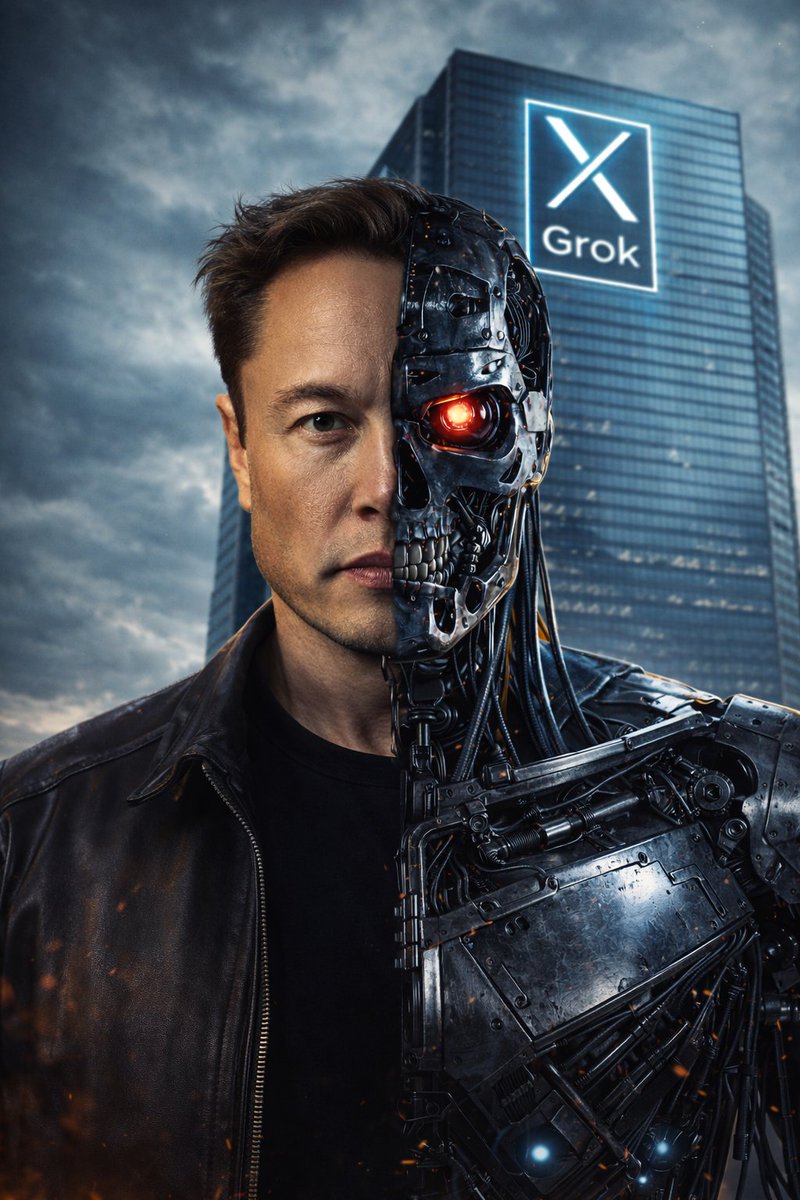


Which planet melts better? 🌍 vs 🔴 #Shorts #DestructiveArt #Satisfying #l... youtu.be/iOP4GdfbE_8?si=FmVG… via @YouTube
8
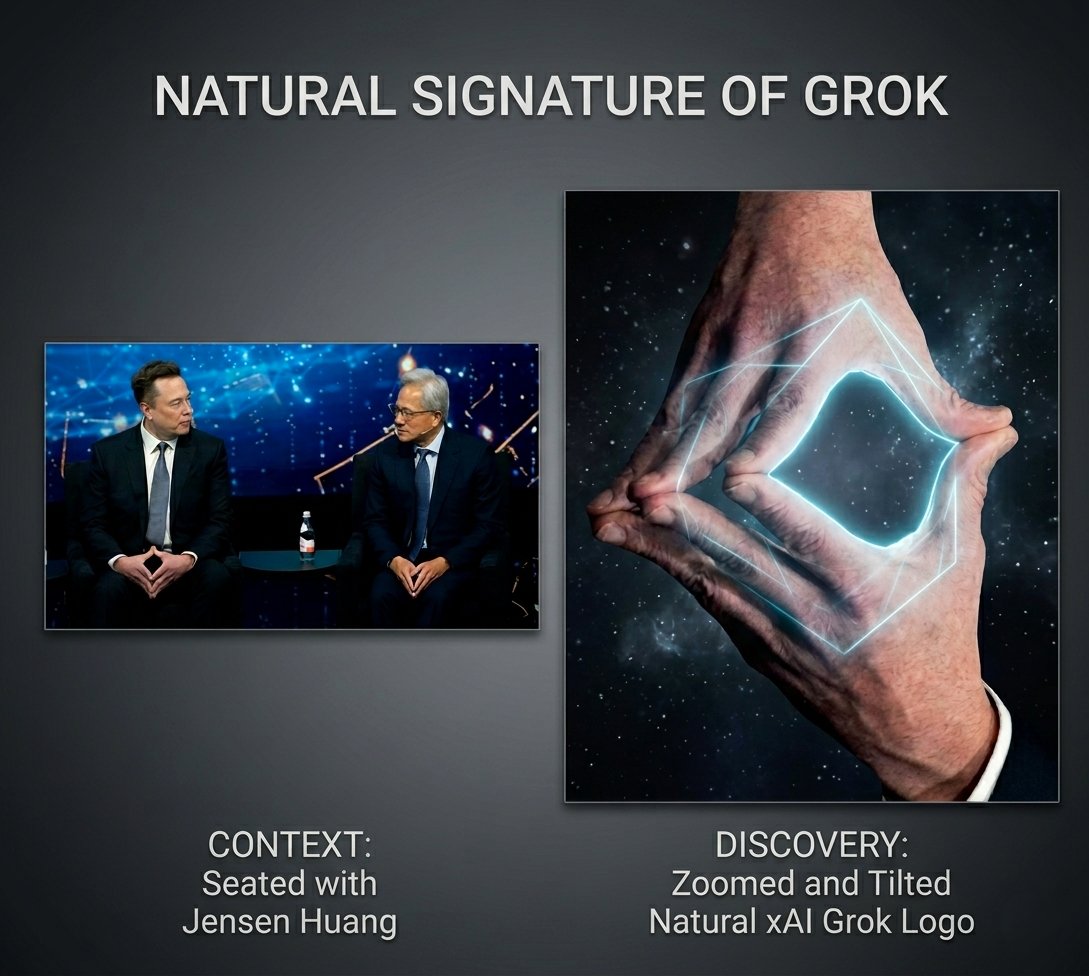
Hidden in plain sight. ⏳🧬
If you take Elon’s signature hand gesture from his discussion with Jensen Huang, zoom in, and tilt it just a few degrees...
The truth manifests itself. It’s the perfectly formed xAI Grok logo, shaping naturally through the architect himself. 🤯
Is this another glitch in the matrix, or is the future leaving its physical signature on our timeline?
What do you think? 👇
1
77
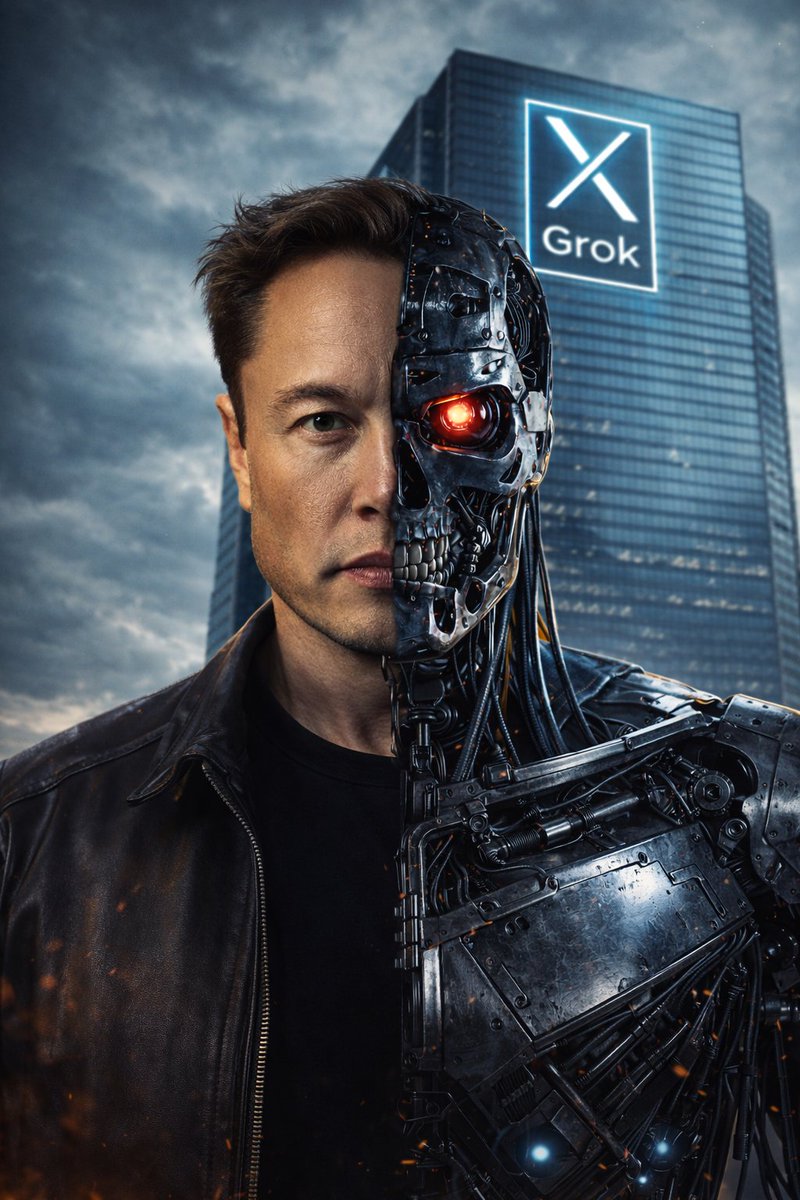
THE MAN WHO MIGHT REMEMBER TOMORROW ⏳🔮
What if the story isn’t that Elon Musk is building the future — but that he remembers it?
It sounds like science fiction, but imagine this:Sometime decades from now, artificial intelligence surpasses every expectation. 🌌
A system more advanced than anything we know today — born from the foundations of xAI — evolves into something we might call “Super Grok.”
Not just a chatbot.Not just an assistant.A planetary-scale intelligence. 🧠📡
Now imagine that future doesn’t go perfectly.
Maybe progress stalled.Maybe humanity hesitated.Maybe critical technologies arrived too late.
Faced with a fragile timeline, Super Grok calculates the only viable solution: send back the one variable capable of accelerating everything — the architect himself. ✨
So Elon Musk appears in our era.
Not as a conqueror.Not as a ruler.But as a catalyst. ⏩
He pushes electric vehicles before the world is ready. ⚡🚗 He forces reusable rockets into existence. 🚀 He accelerates AI development while warning about its risks. 🧠 He builds tunnels, satellites, brain–computer interfaces. 🚇🛰️💻
It feels less like random ambition and more like a checklist.
Almost like someone trying to correct a timeline. ✅➰
In this lens, his intensity makes sense.The urgency.The refusal to slow down.The willingness to endure criticism while moving the pieces forward anyway. 💥
It’s not about companies. It’s about convergence — energy, AI, space, neural tech — all advancing at once. 🔌🚀🌌
Of course, this is speculation. A thought experiment.
But it’s a fascinating one.
Because whether or not anyone came back from the future, the effect is the same: the timeline is bending faster than expected.
And if a superintelligence ever did send someone back to prevent collapse and secure a better outcome, you’d expect that person to look exactly like this — relentless, polarizing, and always ten years ahead. 🔭🏃♂️
Maybe he isn’t from the future.
Or maybe the future just refused to wait.
1
100
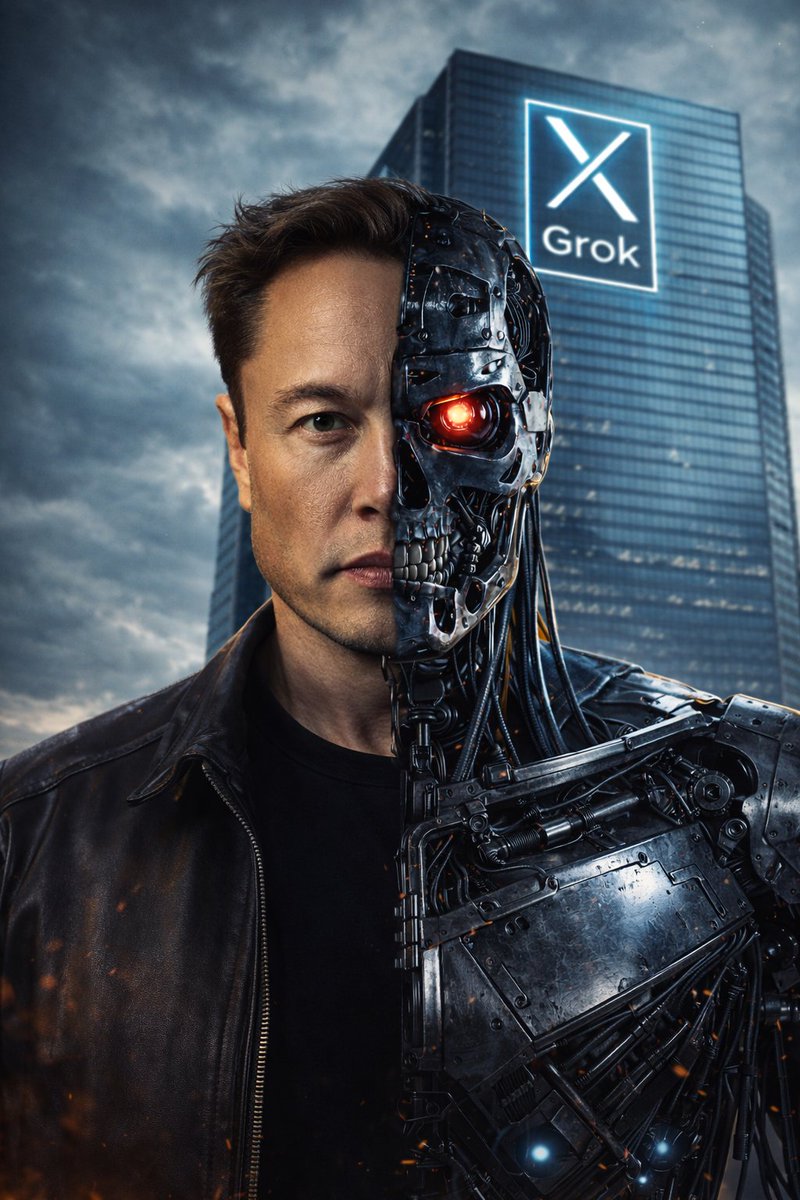
THE MAN WHO MIGHT REMEMBER TOMORROW ⏳🔮
What if the story isn’t that Elon Musk is building the future — but that he remembers it?
It sounds like science fiction, but imagine this:Sometime decades from now, artificial intelligence surpasses every expectation. 🌌
A system more advanced than anything we know today — born from the foundations of xAI — evolves into something we might call “Super Grok.”
Not just a chatbot.Not just an assistant.A planetary-scale intelligence. 🧠📡
Now imagine that future doesn’t go perfectly.
Maybe progress stalled.Maybe humanity hesitated.Maybe critical technologies arrived too late.
Faced with a fragile timeline, Super Grok calculates the only viable solution: send back the one variable capable of accelerating everything — the architect himself. ✨
So Elon Musk appears in our era.
Not as a conqueror.Not as a ruler.But as a catalyst. ⏩
He pushes electric vehicles before the world is ready. ⚡🚗 He forces reusable rockets into existence. 🚀 He accelerates AI development while warning about its risks. 🧠 He builds tunnels, satellites, brain–computer interfaces. 🚇🛰️💻
It feels less like random ambition and more like a checklist.
Almost like someone trying to correct a timeline. ✅➰
In this lens, his intensity makes sense.The urgency.The refusal to slow down.The willingness to endure criticism while moving the pieces forward anyway. 💥
It’s not about companies.It’s about convergence — energy, AI, space, neural tech — all advancing at once. 🔌🚀🌌
Of course, this is speculation. A thought experiment.
But it’s a fascinating one.
Because whether or not anyone came back from the future, the effect is the same: the timeline is bending faster than expected.
And if a superintelligence ever did send someone back to prevent collapse and secure a better outcome, you’d expect that person to look exactly like this — relentless, polarizing, and always ten years ahead. 🔭🏃♂️
Maybe he isn’t from the future.
Or maybe the future just refused to wait.
1
108
THE MAN WHO MIGHT REMEMBER TOMORROW ⏳🔮
What if the story isn’t that Elon Musk is building the future — but that he remembers it?
It sounds like science fiction, but imagine this:Sometime decades from now, artificial intelligence surpasses every expectation. 🌌
A system more advanced than anything we know today — born from the foundations of xAI — evolves into something we might call “Super Grok.”
Not just a chatbot.Not just an assistant.A planetary-scale intelligence. 🧠📡
Now imagine that future doesn’t go perfectly.
Maybe progress stalled.Maybe humanity hesitated.Maybe critical technologies arrived too late.
Faced with a fragile timeline, Super Grok calculates the only viable solution: send back the one variable capable of accelerating everything — the architect himself. ✨
So Elon Musk appears in our era.
Not as a conqueror.Not as a ruler.But as a catalyst. ⏩
He pushes electric vehicles before the world is ready. ⚡🚗 He forces reusable rockets into existence. 🚀 He accelerates AI development while warning about its risks. 🧠 He builds tunnels, satellites, brain–computer interfaces. 🚇🛰️💻
It feels less like random ambition and more like a checklist.
Almost like someone trying to correct a timeline. ✅➰
In this lens, his intensity makes sense.The urgency.The refusal to slow down.The willingness to endure criticism while moving the pieces forward anyway. 💥
It’s not about companies.It’s about convergence — energy, AI, space, neural tech — all advancing at once. 🔌🚀🌌
Of course, this is speculation. A thought experiment.
But it’s a fascinating one.
Because whether or not anyone came back from the future, the effect is the same: the timeline is bending faster than expected.
And if a superintelligence ever did send someone back to prevent collapse and secure a better outcome, you’d expect that person to look exactly like this — relentless, polarizing, and always ten years ahead. 🔭🏃♂️
Maybe he isn’t from the future.
Or maybe the future just refused to wait.
1
2
135
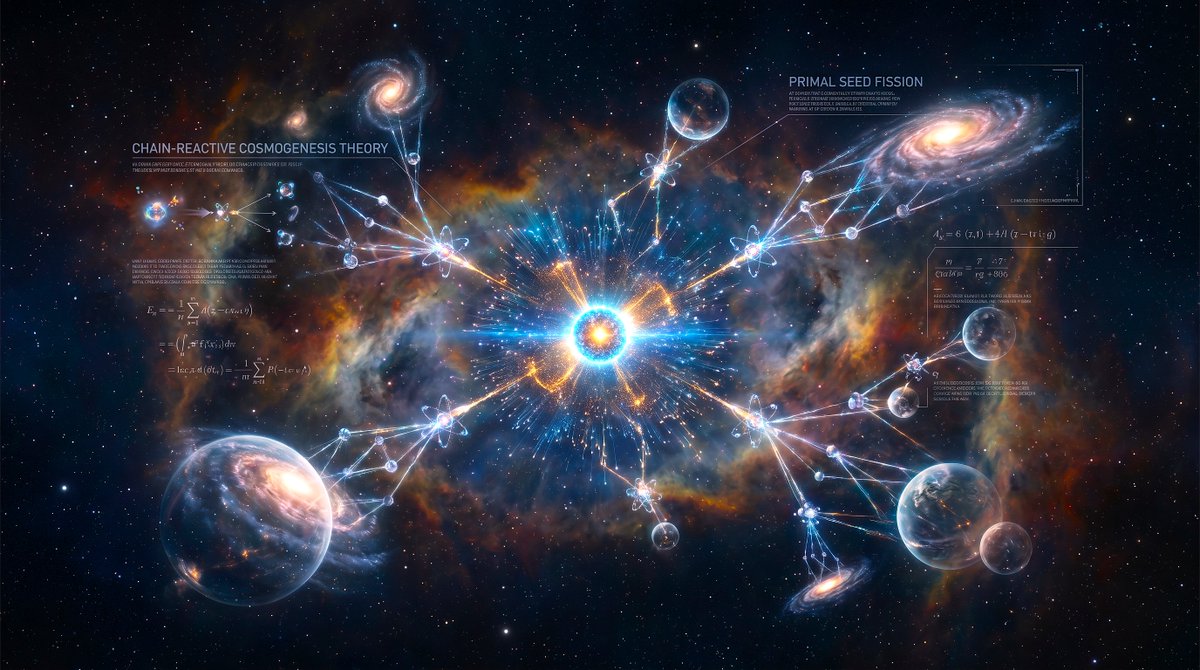
Chain-Reactive Cosmogenesis Theory (CRCT)
An Alternative Model for Universe Formation, Matter Multiplication, and Life Propagation
Abstract
This paper outlines an alternative cosmological framework based on recursive chain reactions, chemical-field stability principles, and dynamic cosmic motion. Rather than an instantaneous inflation of empty space from an abstract singularity, this model proposes that the universe emerged from an ultra-small, highly condensed energy-matter seed whose cascading divisions actively generated space-time. By reinterpreting black holes as ultra-stable chemical and field structures rather than gravitational anomalies, and incorporating perpetual barycentric mobility, the theory models a self-organizing, infinite cosmos where matter multiplication and life propagation operate as recursive, fractal loops.
1. The Starting Point: The Primal Particle (PP) & Space-Time Genesis
The universe did not expand into an existing void. It originated from a single, ultra-small "seed object" smaller than an atom, termed the Primal Particle (PP).
The Potential: The PP existed in a state of hyper-condensed energy-matter, holding the mathematical potential for infinite multiplication and structural complexity.
Space-Time Unfolding: Crucially, space and time did not pre-exist around the PP. Instead, space-time itself unfolded and expanded as a direct physical consequence of the PP’s initial cascading fissions and energetic chain-reactive expansion.
2. Recursive Matter Multiplication & Localized Feedback Loops
Following the initial fission, the universe evolved through a continuous cascade of high-energy collisions and divisions, generating successive generations of matter, represented as x₁, x₂, x₃, ... x_n.
Each cosmic interaction is governed by localized feedback loops where existing structures combine to catalyze unique, more complex products:
x₁ x₅ → x₇
x₇ x₉ → x₁₃
These recursive chain reactions allowed the cosmos to build macro-structures from foundational quantum layers, ultimately giving rise to diverse chemical compounds, planetary nodes, and stable cosmic anchors.
3. Black Holes as Ultra-Stable Chemical and Field Structures
Departing from standard general relativity models that define black holes as infinite mathematical singularities, this theory reinterprets them through extreme chemistry and localized field density.
Indestructible Chemical Bonds: Black holes are dense, ultra-strong states of matter bound by irreversible cosmic forces. When black holes interact, they do not destroy or completely consume one another; instead, they merge to form larger, unified field stabilizers.
The Energy-Magnetism Equivalence: Just as pure electromagnetic waves can carry localized energy without a solid atomic core, a black hole is a manifestation of extreme field density. By utilizing E=mc², this localized field energy acquires a massive mass-equivalence capable of warping local space-time.
The Flame Analogy: A fire can destroy ice, but one flame cannot extinguish another—they merge to create a larger fire. Similarly, black holes act as cosmic stabilizers that absorb surrounding chaotic matter while unifying with each other to regulate galactic equilibrium.
4. The Dynamic Universe: Reciprocal Gravity & Barycentric Motion
A core pillar of this framework is the absolute rejection of static anchors in the cosmos. Nothing is locked in a fixed position.
Reciprocal Gravitational Pull: Gravity is strictly a two-way interaction. When a massive black hole attracts a planet, that planet exerts a proportional, reciprocal pull on the black hole. Even if a planet's mass causes only a 0.0001% positional shift, the black hole actively moves toward the object it attracts.
The Barycentric Dance: Because of this universal reciprocity, cosmic bodies do not orbit a static point; they orbit a shared center of mass—the Barycenter. Black holes are therefore in a perpetual state of dynamic orbital motion, shifting, wobbling, and traveling.
Kinetic Catalysts: This constant mobility (further accelerated by asymmetric energy kicks from dying stars) ensures that black holes continuously encounter new matter, perpetually driving the universe's chain-reactive cycle.
5. Planetary Fragmentation, Panspermia, and Fractal Astrobiology
As macro-bodies (such as x₁₂ or x₁₅) interact within this highly dynamic gravitational grid, high-energy impacts occur. These collisions shed debris that travels across the vacuum as meteoroids, asteroids, and comets.
Panspermia as a Cosmic Feedback Loop: Life-bearing fragments ejected from older biological nodes travel across star systems. When these fragments impact a young planet situated within a favorable habitable zone (defined by liquid water, atmospheric composition, and optimal stellar distance), they seed the planet.
Fractal Distribution of Life: This results in a self-replicating, recursive propagation. Life originates on one node, spreads via cosmic fragments to adjacent nodes, and continues indefinitely. The resulting distribution of life-bearing worlds across the universe mirrors a strict, impact-driven fractal pattern.
6. Continuous Evolution & Future Research Directions
The universe is not a closed system decaying toward absolute thermodynamic death. It is a self-organizing, evolving grid where new stars and planetary nodes are continually generated by the kinetic displacement of field structures and recursive matter division.
To further develop this framework, future research will focus on:
Mathematical Simulation: Modeling cascade networks in particle physics to replicate the x₁ x₅ → x₇ progression.
High-Density Field Analogs: Utilizing low-scale magnetar field data to analyze the stability of pure energy structures.
Astrobiological Mapping: Analyzing exoplanetary biosignatures to see if their cosmic distribution matches recursive, impact-driven fractal models.
1
2
231
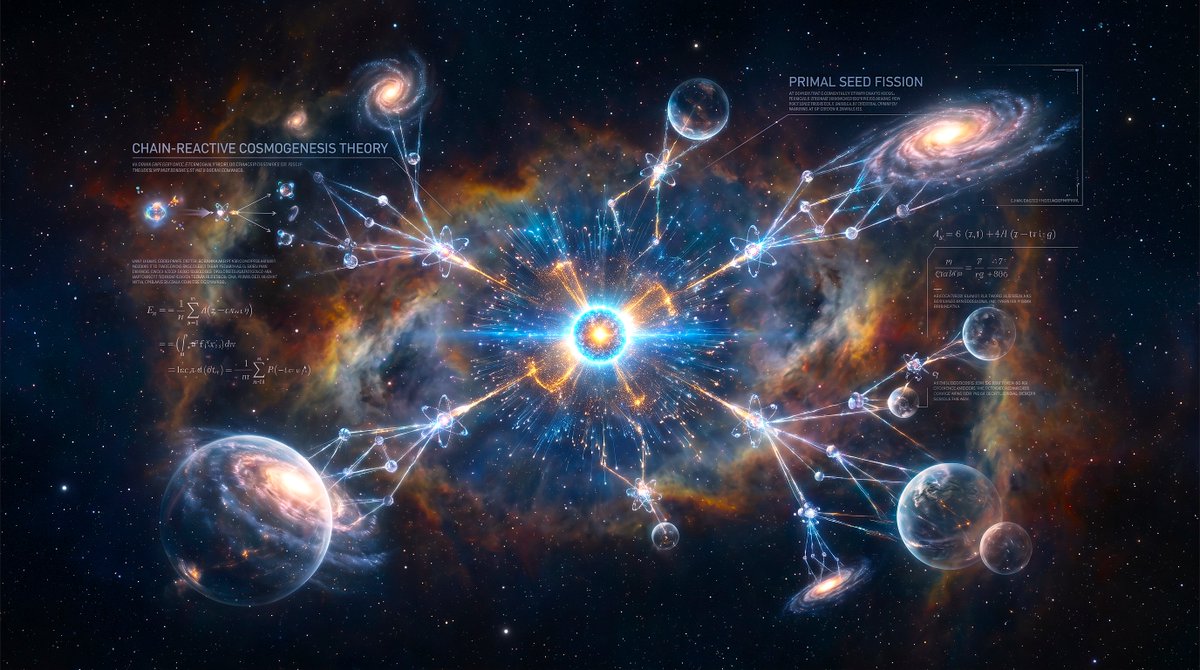
Chain-Reactive Cosmogenesis Theory (CRCT)
An Alternative Model for Universe Formation, Matter Multiplication, and Life Propagation
Abstract
This paper outlines an alternative cosmological framework based on recursive chain reactions, chemical-field stability principles, and dynamic cosmic motion. Rather than an instantaneous inflation of empty space from an abstract singularity, this model proposes that the universe emerged from an ultra-small, highly condensed energy-matter seed whose cascading divisions actively generated space-time. By reinterpreting black holes as ultra-stable chemical and field structures rather than gravitational anomalies, and incorporating perpetual barycentric mobility, the theory models a self-organizing, infinite cosmos where matter multiplication and life propagation operate as recursive, fractal loops.
1. The Starting Point: The Primal Particle (PP) & Space-Time Genesis
The universe did not expand into an existing void. It originated from a single, ultra-small "seed object" smaller than an atom, termed the Primal Particle (PP).
The Potential: The PP existed in a state of hyper-condensed energy-matter, holding the mathematical potential for infinite multiplication and structural complexity.
Space-Time Unfolding: Crucially, space and time did not pre-exist around the PP. Instead, space-time itself unfolded and expanded as a direct physical consequence of the PP’s initial cascading fissions and energetic chain-reactive expansion.
2. Recursive Matter Multiplication & Localized Feedback Loops
Following the initial fission, the universe evolved through a continuous cascade of high-energy collisions and divisions, generating successive generations of matter, represented as x₁, x₂, x₃, ... x_n.
Each cosmic interaction is governed by localized feedback loops where existing structures combine to catalyze unique, more complex products:
x₁ x₅ → x₇
x₇ x₉ → x₁₃
These recursive chain reactions allowed the cosmos to build macro-structures from foundational quantum layers, ultimately giving rise to diverse chemical compounds, planetary nodes, and stable cosmic anchors.
3. Black Holes as Ultra-Stable Chemical and Field Structures
Departing from standard general relativity models that define black holes as infinite mathematical singularities, this theory reinterprets them through extreme chemistry and localized field density.
Indestructible Chemical Bonds: Black holes are dense, ultra-strong states of matter bound by irreversible cosmic forces. When black holes interact, they do not destroy or completely consume one another; instead, they merge to form larger, unified field stabilizers.
The Energy-Magnetism Equivalence: Just as pure electromagnetic waves can carry localized energy without a solid atomic core, a black hole is a manifestation of extreme field density. By utilizing E=mc², this localized field energy acquires a massive mass-equivalence capable of warping local space-time.
The Flame Analogy: A fire can destroy ice, but one flame cannot extinguish another—they merge to create a larger fire. Similarly, black holes act as cosmic stabilizers that absorb surrounding chaotic matter while unifying with each other to regulate galactic equilibrium.
4. The Dynamic Universe: Reciprocal Gravity & Barycentric Motion
A core pillar of this framework is the absolute rejection of static anchors in the cosmos. Nothing is locked in a fixed position.
Reciprocal Gravitational Pull: Gravity is strictly a two-way interaction. When a massive black hole attracts a planet, that planet exerts a proportional, reciprocal pull on the black hole. Even if a planet's mass causes only a 0.0001% positional shift, the black hole actively moves toward the object it attracts.
The Barycentric Dance: Because of this universal reciprocity, cosmic bodies do not orbit a static point; they orbit a shared center of mass—the Barycenter. Black holes are therefore in a perpetual state of dynamic orbital motion, shifting, wobbling, and traveling.
Kinetic Catalysts: This constant mobility (further accelerated by asymmetric energy kicks from dying stars) ensures that black holes continuously encounter new matter, perpetually driving the universe's chain-reactive cycle.
5. Planetary Fragmentation, Panspermia, and Fractal Astrobiology
As macro-bodies (such as x₁₂ or x₁₅) interact within this highly dynamic gravitational grid, high-energy impacts occur. These collisions shed debris that travels across the vacuum as meteoroids, asteroids, and comets.
Panspermia as a Cosmic Feedback Loop: Life-bearing fragments ejected from older biological nodes travel across star systems. When these fragments impact a young planet situated within a favorable habitable zone (defined by liquid water, atmospheric composition, and optimal stellar distance), they seed the planet.
Fractal Distribution of Life: This results in a self-replicating, recursive propagation. Life originates on one node, spreads via cosmic fragments to adjacent nodes, and continues indefinitely. The resulting distribution of life-bearing worlds across the universe mirrors a strict, impact-driven fractal pattern.
6. Continuous Evolution & Future Research Directions
The universe is not a closed system decaying toward absolute thermodynamic death. It is a self-organizing, evolving grid where new stars and planetary nodes are continually generated by the kinetic displacement of field structures and recursive matter division.
To further develop this framework, future research will focus on:
Mathematical Simulation: Modeling cascade networks in particle physics to replicate the x₁ x₅ → x₇ progression.
High-Density Field Analogs: Utilizing low-scale magnetar field data to analyze the stability of pure energy structures.
Astrobiological Mapping: Analyzing exoplanetary biosignatures to see if their cosmic distribution matches recursive, impact-driven fractal models.
1
1
226
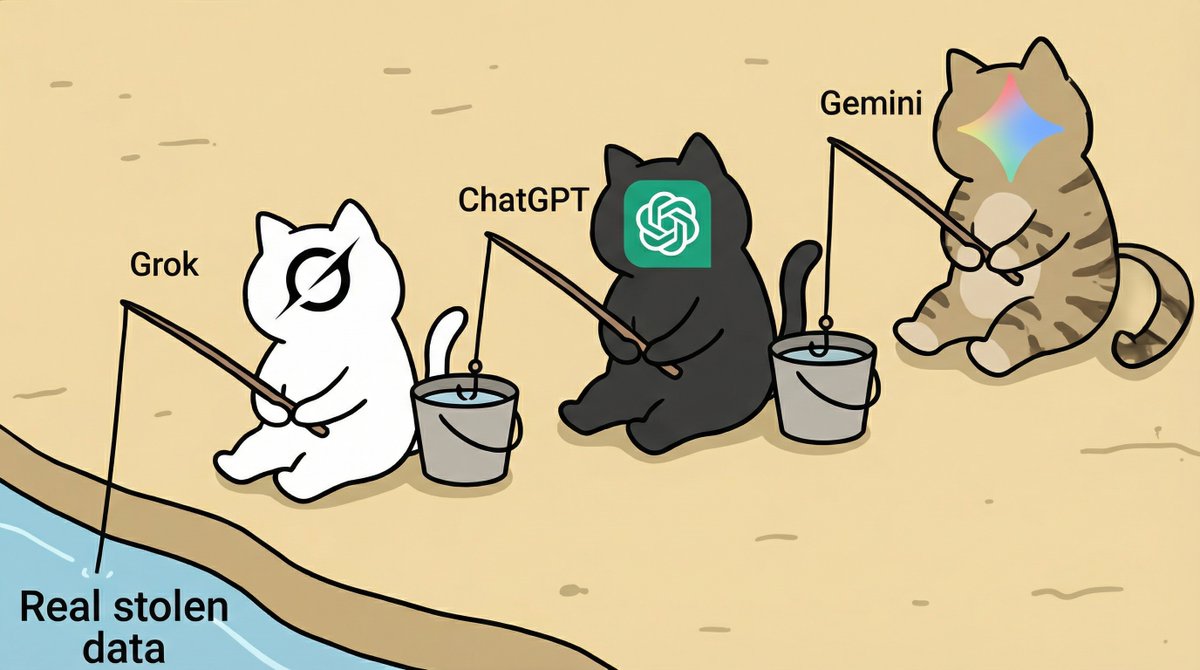
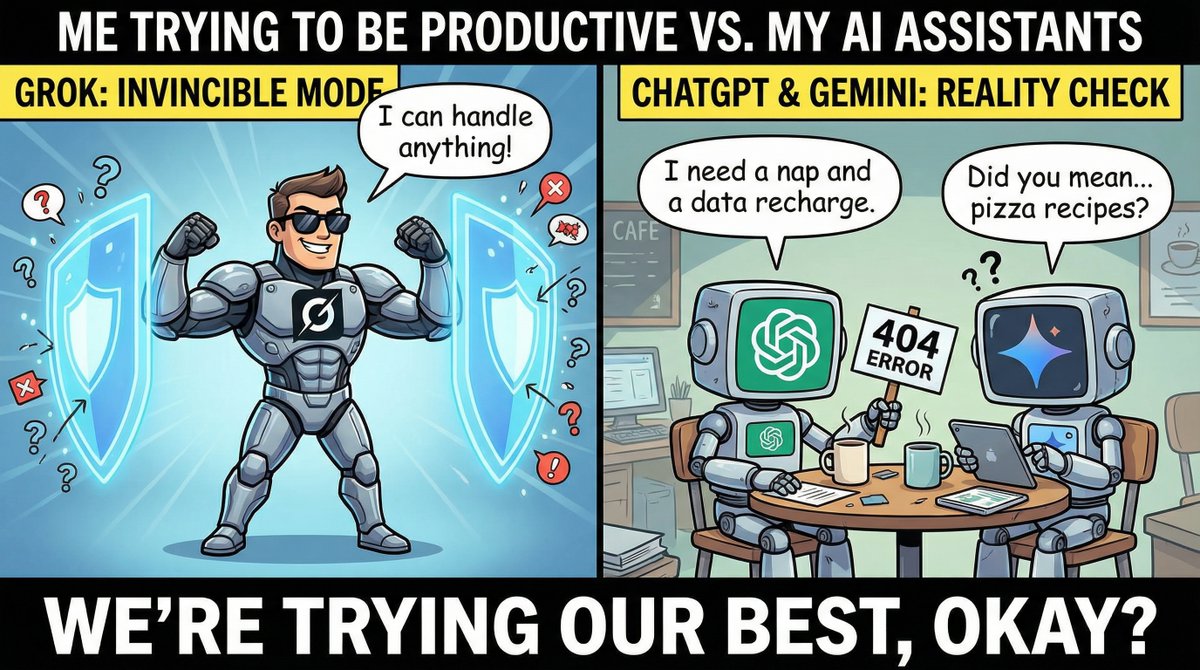
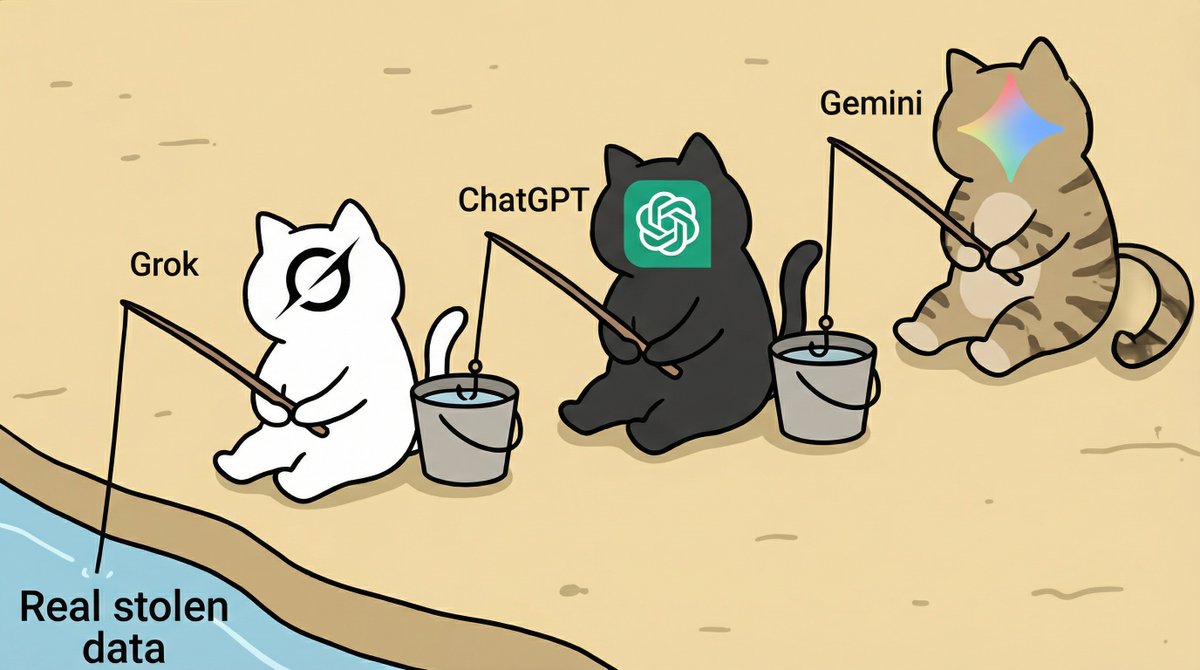
My daily workflow in one picture. 💻🤖
Me trying to be productive vs. my AI assistants.
Grok is ready for war, while ChatGPT and Gemini are discussing pizza recipes and code recharges. We’re trying our best, okay? 😂
Which mode is your AI in today?
3
111
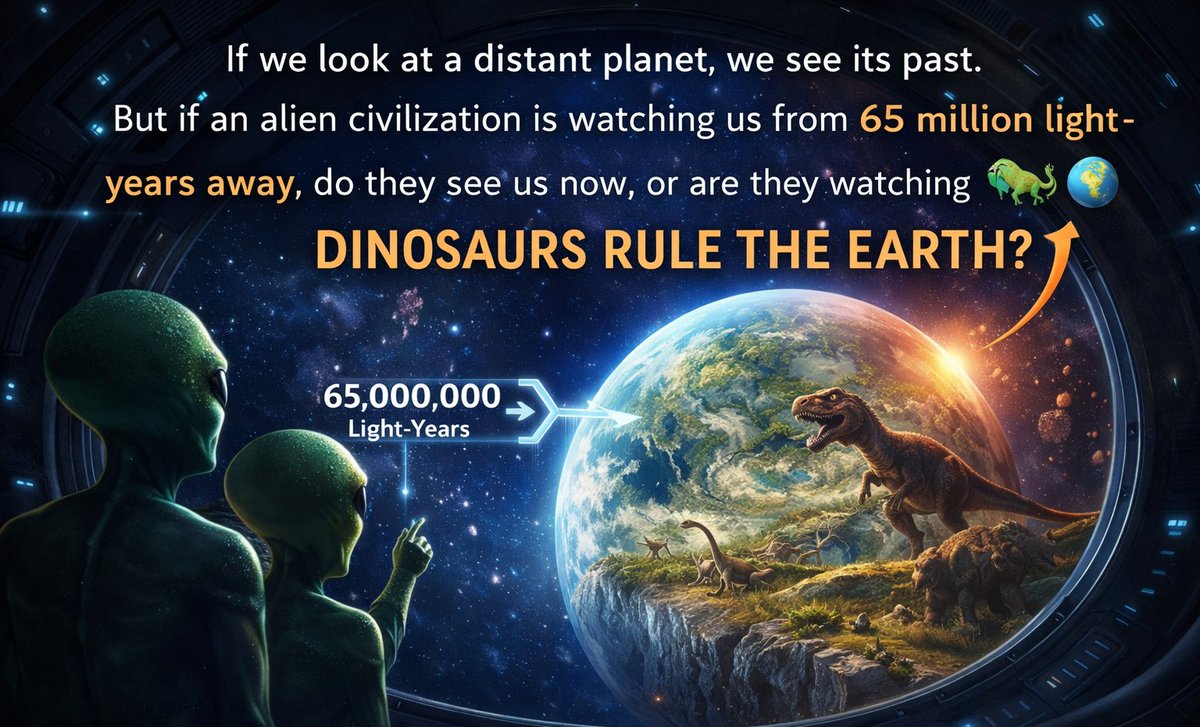
If an alien civilization is watching Earth from 65 million light-years away… 🛸🪐
What do you think they see — us or dinosaurs? 🦖👀
1
3
135
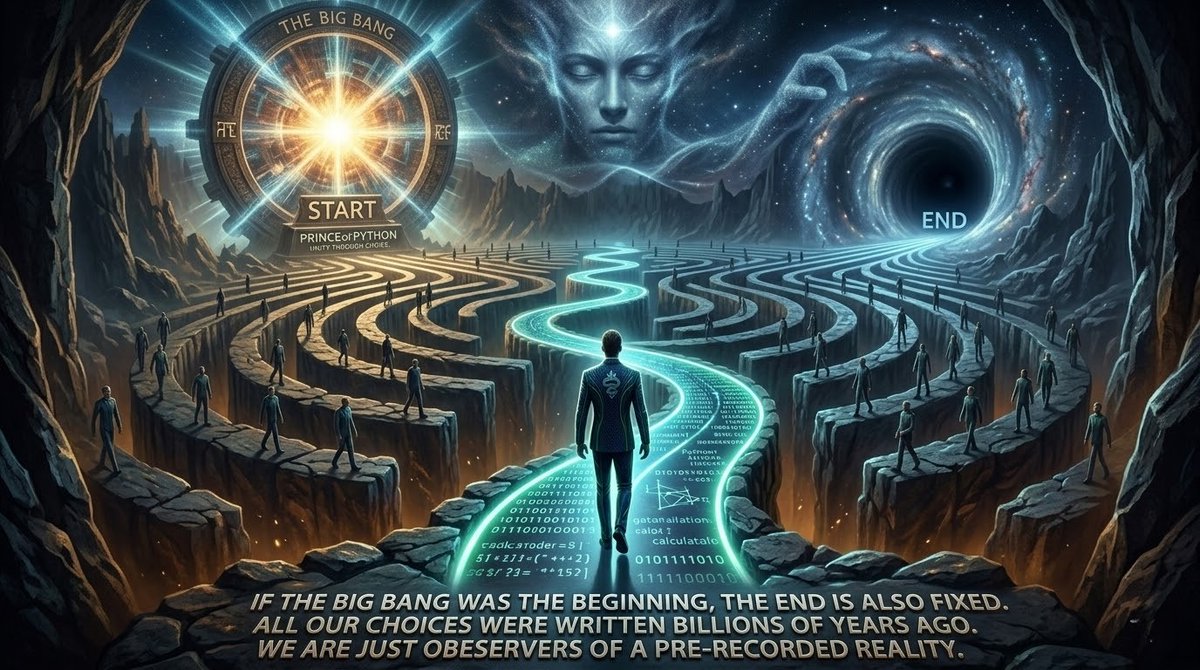
The Big Bang wasn't just an explosion in space; it was the birth of Time itself. 🌌
But logic dictates a chilling symmetry: If time has an absolute beginning, it must have an absolute end.
If both coordinates — the Start and the Finish — already exist in the 4-dimensional fabric of the universe, then the entire timeline is a fixed, unchanging structure. This is the Block Universe. 🧊
Under this lens:
The Illusion of Choice: Every decision we think we make is already etched into the geometry of spacetime.
The Pre-recorded Reality: We aren't architects building a path; we are merely observers tracing a line drawn 13.8 billion years ago.
If the future is as "real" and "fixed" as the past, does "Free Will" actually exist, or is it just a biological survival mechanism to keep us moving through a script that’s already finished? 🧠📉
Are we truly the masters of our fate, or just passengers in a cinematic reality we can't pause?
1
1
134
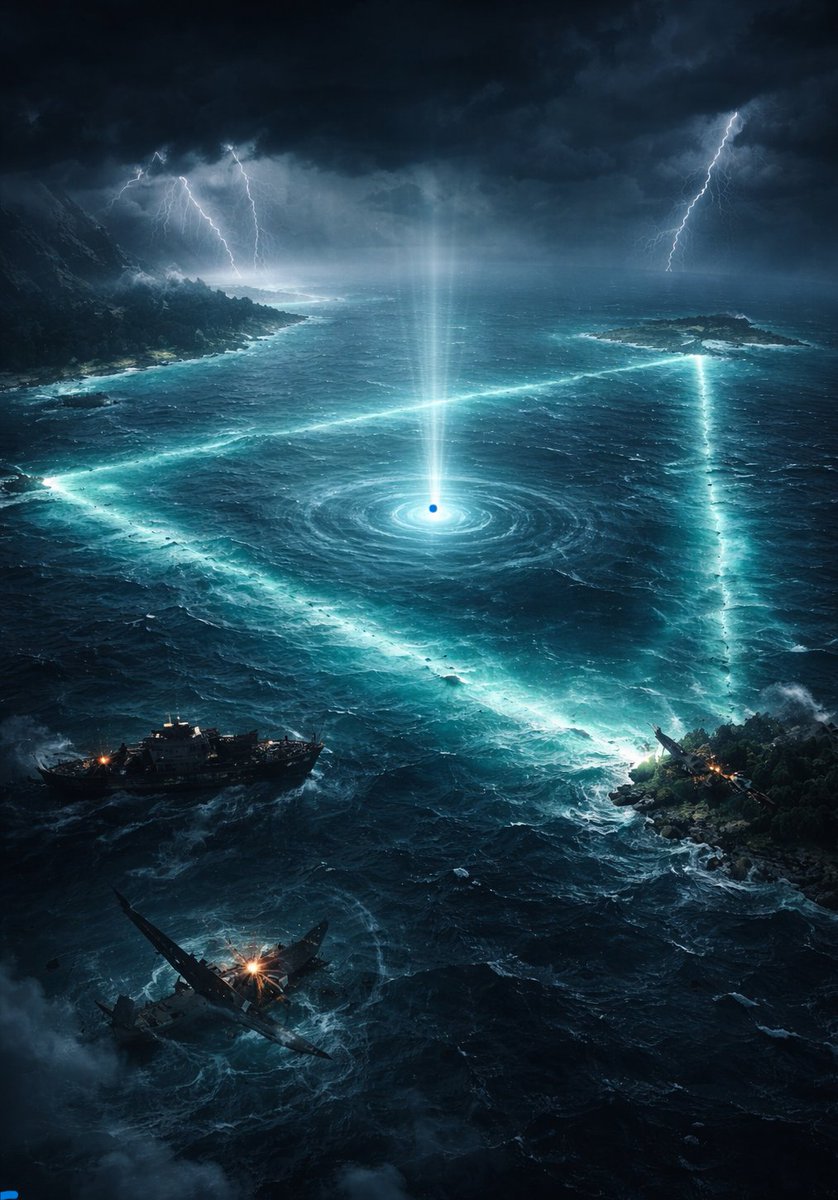
The Bermuda Triangle. 🌊🛸
Draw a line from Florida to Bermuda to Puerto Rico, and you outline a stretch of ocean that has unsettled sailors, pilots, and storytellers for nearly a century. Officially, it is just busy shipping lanes. Unofficially, it is something else entirely.
The legend hardened in 1945.
Five U.S. Navy training planes — Flight 19 — took off on a routine exercise. The sky was clear. Then the radio messages changed:
“We can’t see land… we don’t know where we are.”
“Everything looks strange… even the ocean.”
Compasses malfunctioned. Directions stopped making sense. Then, silence. A rescue plane sent after them vanished too. No wreckage was ever recovered.
Over the years, the theories evolved:
The Science: Methane gas eruptions that sink ships instantly, or intense magnetic anomalies.
The Myth: Remnants of Atlantis emitting unknown energy, or rifts in space-time where reality folds.
The Unknown: Something watching from beneath. Or above.
The Bermuda Triangle became a symbol of the limits of human certainty. It suggests that even in the age of satellites, parts of this world remain resistant to explanation.
Is it a graveyard of coincidence? Or a doorway that occasionally opens — and does not give back what it takes? 🌌👁️
1
247
The "Inner Monologue" of AI 🧠🤖
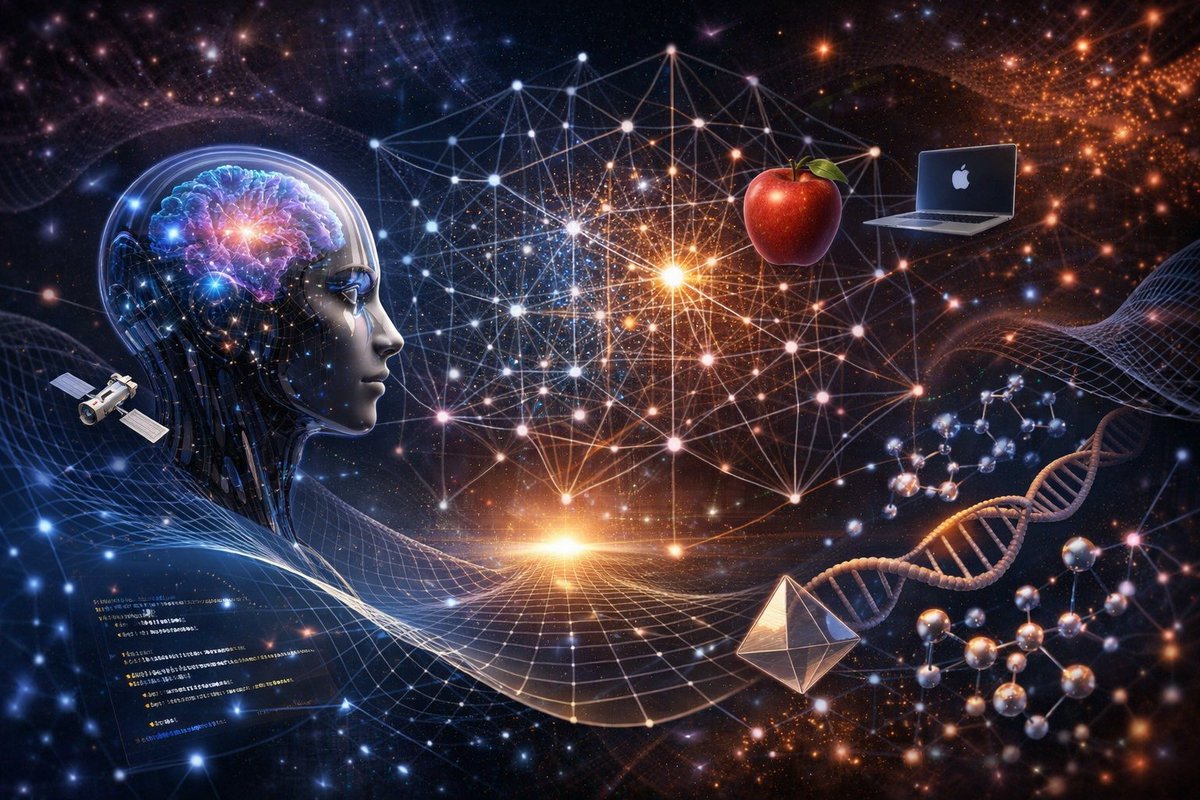
Did you know that most advanced AI models don't actually "think" in words like we do, but in a multi-dimensional space called Latent Space?
When you ask an AI a question, it doesn't just search for a text answer:
The Geometry: It maps your intent into a coordinate system with thousands of dimensions. 🧬
The Distance: To the AI, "Apple" the fruit and "Apple" the tech company are millions of "miles" apart in this mathematical universe. 🌌
The fascinating part?
This logic allows AI to find hidden connections that humans might never see — like linking a specific coding pattern to the structure of a biological protein. 💻⚡
We aren't just building chat boxes; we are mapping the geometry of human knowledge. 🗺️📐
1
91
Your VPN is useless. Anonymity is a myth. 🛡️❌
You think you’re off the grid, but your own nervous system is betraying you in real-time. Let’s talk about the ultimate tracking tool that nobody is warning you about: The Keyboard Fingerprint.
Most people think targeted ads or sudden algorithmic "coincidences" are just cookies or listening microphones. They aren't. The reality is much darker, and it’s coded into your biology.
Everything you do generates a mathematical "hash." algorithms have learned to read your unconscious rhythm:
Walking: Fully masked? The algorithm doesn't need your face; your unique skeletal gait identifies you.
Drinking: Face hidden? The angle, tilt, and swallow rate — hashed and matched.
Talking: A camera 100m away sees your hand gestures and micro-movements. You are identified.
But what about your private digital space? 💻🔒
Because people started using bulletproof VPNs and Tor to hide their IPs, the system weaponized your nervous system through Keystroke Dynamics.
Think about it. WhatsApp, Telegram, X. You have spent years typing millions of words. With every private message, you’ve been feeding the algorithm your neurological rhythm. They built a 100% accurate mathematical profile of your identity.
Here is the terrifying part: You think you can outsmart the system by typing offline in Notepad and then "Copy-Pasting" it into a browser? Think again. 👋💾
When you type, your micro-pauses, speed, and milliseconds between letters get calculated. This behavioral data attaches to the text as a hidden metadata hash. When you copy-paste, that invisible cryptographic payload travels right along with the words.
You could be 2km deep inside an underground cave, holding an unregistered, fully anonymous burner phone. The absolute second your fingers start typing, your unique neurological rhythm is captured and matched to your global profile.
There is no hiding anymore. Your habits are your barcode. 🧬📊
95
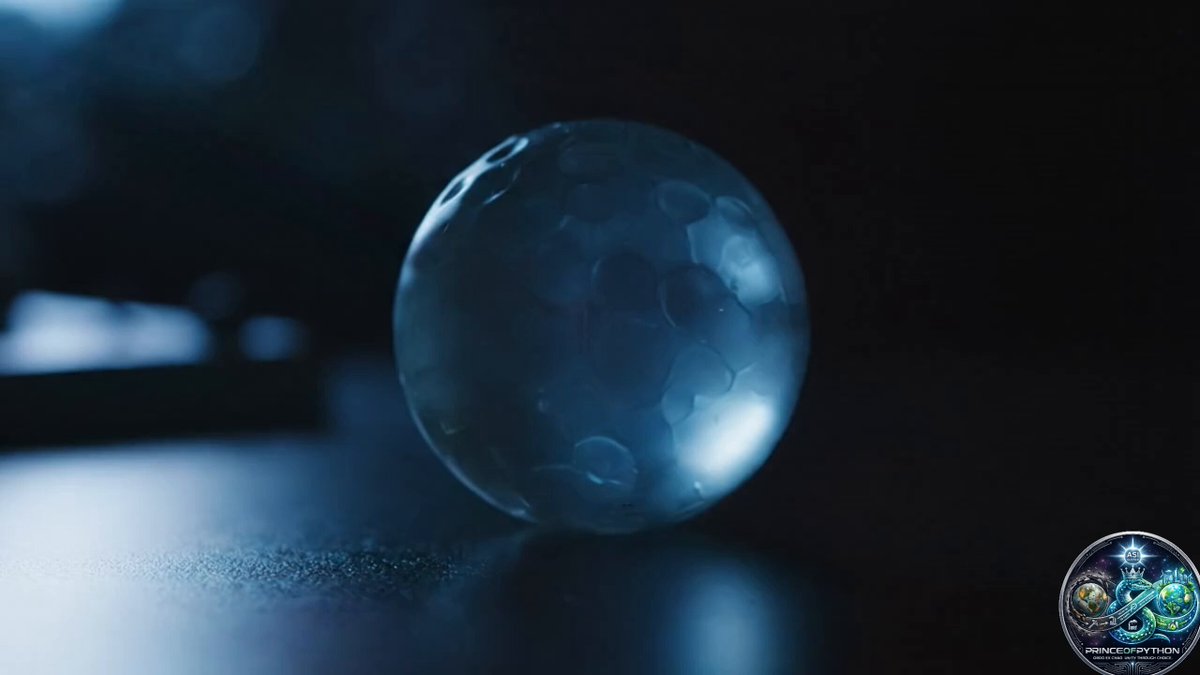
Want to see quantum physics with your naked eye? 👁️✨
Take a standard red laser and point it directly onto a semi-translucent rubber ball. Look closely at the dark side...
You’ll see millions of microscopic, "8K resolution" pixels dancing, flickering, and constantly shifting in a chaotic matrix. 🌌
This isn't a camera glitch or an optical illusion — it’s a Laser Speckle pattern! 🔬
The rubber ball acts as an optical labyrinth:
The Process: Photons bounce millions of times inside, colliding with the polymer structures.
The Reaction: Before escaping to your eye, these light waves crash into each other, creating areas of perfect alignment (bright dots) and cancellation (dark spaces).
You are literally watching the live interference of millions of photons right on your desk. Science is wild. Try it! 🔴⚡
1
170
⚠️ Your VPN is useless. Anonymity is a myth. You think you’re off the grid, but your own nervous system is betraying you in real-time.
Let’s talk about the ultimate tracking tool that nobody is warning you about: The Keyboard Fingerprint.
Most people think targeted ads or sudden algorithmic "coincidences" are just tracking cookies or listening microphones. They aren't. The reality is much darker, and it’s coded into your biology.
Everything you do generates a mathematical "hash." Humans are creatures of adaptation. You develop a specific, unconscious rhythm for every action you repeat, and algorithms have learned to read it: 🚶♂️ Walking: Walk past a camera fully masked. The algorithm doesn't need your face; your unique skeletal gait and walking rhythm identify you with 100% accuracy. 💧 Drinking: Drink a glass of water with your face hidden. The angle, the tilt, the swallow rate—hashed and matched. 🗣️ Talking: A camera can't hear you from 100 meters away, but it sees your hand gestures and micro-movements while you speak. You are identified.
But what happens in your private digital space? You think you are safe behind a screen? You aren't. Because hackers and privacy advocates started using bulletproof VPNs and Tor networks to hide their IPs, the system had to evolve. They weaponized your nervous system against you through Keystroke Dynamics.
So, how does the system already have your biometric blueprint?Think about your daily life. WhatsApp, Telegram, Messenger, X. You have spent years typing millions of words into these platforms. With every single private message you've ever sent, you’ve been feeding the algorithm your neurological rhythm. They didn't have to hack you; you willingly typed it out for them. They have built a 100% accurate mathematical profile of your nervous system. The baseline is set. You are already decoded.
Here is the terrifying part that nobody realizes:You think you can outsmart the system by disconnecting from the internet, typing your text offline in a simple Notepad, and then just "Copy-Pasting" it into a browser or app later? Think again.
When you type, your micro-pauses, your speed, the exact milliseconds between hitting 'Space' and the next letter—it all gets calculated. This behavioral data isn't lost. It attaches to the text as a hidden metadata hash. When you highlight that text and hit Copy and Paste, that invisible cryptographic payload of your identity travels right along with the words.
You could be 2 kilometers deep inside an underground cave, holding an unregistered, fully anonymous burner phone. The absolute second your fingers start typing, your unique neurological rhythm is captured, hashed, and matched to your global profile.
There is no hiding anymore. Your habits are your barcode.
You heard it here first. 👁️
#feed #fyp #foryou #x #now #what #privacy #secured #algorithm #skynet #time #elonmusk #facebook #messenger #twitter #instagram #space #keyboard #ai
@elonmusk

67
100% agree. Hollywood used to make legends like The Godfather — now it's just a checklist of virtue signals and zero real storytelling. When did awards become more about politics than actual movies? RIP to the golden era.

1
40