
Joined May 2025
- Tweets 1,015
- Following 100
- Followers 137
- Likes 282
251 Photos and videos













Pinned Tweet

The white rabbit say to you:
If Bitcoin drops to thirty five, a heavy fall to see,
it pulls down PulseChain too, in quiet sympathy.
But PulseBitcoin may rise while WPLS feels the strain,
gaining strength against it through the market’s pain.
So swapping PLS to PLSB could be a cautious play,
to guard your capital while bears still have their say.
And when the storm has passed, and bulls return with grace,
you swap back into PLS to ride the next uptrend’s pace.
7
5
20
1,505
Crypto Market Report - Week 24/2026 - Update
The market is already in fear, but that does not mean the real low has to be in. That is one of the most important mistakes participants make in Bitcoin drawdowns. Panic alone is not the same as a final bottom. In larger bear phases, extreme fear often appears more than once. What looks dramatic in the moment can later turn out to have been only an intermediate capitulation inside a much bigger decline.
That is why the current setup should not be read too positively. Bitcoin has already dropped hard. Sentiment is deeply damaged. Long term technical levels are back in focus. But none of that is enough to prove that the market has completed its repricing. A market can be oversold and still fall much further. In fact, that is often how larger bear phases unfold. They exhaust buyers step by step, not all at once.
From that perspective, the current weakness looks less like a final buying opportunity and more like an unfinished downside process. The present fear zone may still prove to be only an intermediate phase within the broader decline. Even if Bitcoin stabilizes temporarily, that would not automatically change the larger risk. Bear markets often move in stages, with sharp rebounds in between, before the final washout arrives later.
Under that reading, a move into the 27,000 to 37,000 dollar region remains a realistic downside scenario. It would not have to happen immediately. The more likely path would be a drawn out decline with pauses, relief bounces, and renewed breakdowns. That is what makes bear markets so deceptive. They repeatedly create the illusion that the worst is over before the real bottom is actually in place.
This also changes the interpretation of fear indicators and technical support. Deep fear, extreme selling, and even historically important moving averages can still fail to hold if macro and structural pressure remain strong enough. So while those signals make the market more interesting, they do not justify a bullish conclusion on their own. They simply show that stress is high, not that final capitulation is complete.
For the broader crypto market, this means caution remains the more professional stance. If Bitcoin still carries a large downside risk, then the rest of crypto is unlikely to escape that pressure cleanly. Altcoins may show short bursts of relative strength, but in a real continuation lower, most of the market would remain vulnerable. That makes broad optimism premature.
For PulseChain, this would be a difficult short term backdrop. Smaller ecosystems usually suffer more when Bitcoin enters the deeper phase of a bear move. Liquidity gets thinner, risk appetite weakens, and speculative capital becomes less stable. That means PulseChain could face stronger pressure before a real recovery phase even becomes possible.
For PulseBitcoin, the important distinction remains relative strength, not absolute immunity. In a broader Bitcoin decline, PLSB could still fall in dollar terms. But the more relevant question inside the ecosystem is whether it falls less than WPLS. If WPLS comes under heavier pressure as the more beta sensitive asset, then PulseBitcoin can still strengthen on a relative basis even while the whole market remains weak. In a true drawdown, that relative resilience matters more than whether everything is green.
The key takeaway is simple. The market may already feel washed out, but that does not mean the repricing is over. If the larger bear structure continues to unfold, today’s fear may later look like only an intermediate panic phase. Under that scenario, Bitcoin could still move substantially lower into the 27,000 to 37,000 dollar range before a true final bottom is formed. For PulseChain, that would likely mean more pressure first. For PulseBitcoin, the focus stays on whether it can continue to hold up better than WPLS during the next leg of market stress.
#Crypto #Bitcoin #PulseChain #PulseBitcoin #PLSB #WPLS #MarketReport
1
9
55
PulseBitcoin - Art, Structure, and Flow - Week 24/2026
Today I visited the exhibition “Aesthetics as Political Strategy” at Kunsthaus Dahlem in Berlin. It shows works from the National Museum of Modern Art in Zagreb from the period between 1945 and 1960. It is about Yugoslav art after the Second World War, about Socialist Realism, about abstraction, and about the question of how political changes express themselves in a new visual language.
What interested me about this exhibition was less a single work than the movement of the entire exhibition. At the beginning, there is an art that is immediately readable. Bodies, labor, reconstruction, leadership, collective force. Art as visible order. Art as statement. Art as part of a political system.
Then something shifts. The forms become freer. The images become more abstract. The art moves away from the direct message and searches for another language. But this new freedom is not simply unpolitical. Abstraction too is a strategy. It shows that after the break with Stalin, Yugoslavia wanted to mark its own path. Not simply East. Not simply West. But its own cultural position.
That is exactly the point that stayed with me.
A new identity does not emerge only through programs, slogans, or technical facts. It also emerges through form. Through repetition. Through signs. Through a language that people can recognize. The exhibition shows that aesthetics can be more than surface. It can make visible where a system is moving.
And this is where the connection to PulseBitcoin begins for me.
PulseBitcoin is also interesting because it does not simply fit into an old form. It is not Bitcoin itself. It is also not just another token. PulseBitcoin takes a known monetary principle and places it into a new environment. The core is simple and strong: 21 million. Mining. Halvings. Smart Contract. Bitcoin as a Smart Contract on PulseChain.
That is not merely a technical detail. It is a form.
Bitcoin has its own historical form: its own chain, Proof of Work, miners, blocks, slow transactions, maximum scarcity. PulseBitcoin does not take over this entire old infrastructure. It takes over the readable core of the scarcity story and places it into a Smart Contract environment. This does not create a simple copy, but a translation.
And just like with every translation, the decisive question arises: Does the essential thing remain intact when the medium changes?
With PulseBitcoin, that is the exciting question. The maximum supply remains clear. Mining remains as a principle. Halvings remain part of the structure. But the environment is different. PulseChain gives the whole thing a different space. DeFi gives the whole thing different possibilities of movement. The Smart Contract turns the Bitcoin principle into a new technical form.
The exhibition reminded me that new forms are often not understood immediately at the beginning. You see the change, but you do not yet know whether a lasting identity will emerge from it. That is exactly how PulseBitcoin feels to many people today. Some only see a chart. Some only see a name. Some only see a small coin in a noisy market. But underneath it lies a much simpler and stronger structure.
21 million. Mining. Halvings. Smart Contract.
This structure must become visible.
That is perhaps the most important parallel to the exhibition. An idea is not enough if it does not receive a recognizable form. A system is not enough if nobody understands its language. An asset is not enough if its meaning remains hidden in technical detail.
PulseBitcoin therefore does not only need code. It needs readability. It needs images. It needs clear sentences. It needs a community that expresses the core again and again in a simple and strong way. Not more complicated. Not louder. More precise.
The exhibition at Kunsthaus Dahlem shows how a new visual language can emerge when a system repositions itself. PulseBitcoin faces a similar task in the monetary space. It must find its own form and make visible what is already embedded in its structure.
- Not as a price promise.
- Not as hype.
- Not as mere technology.
But as a clear scarcity story on PulseChain.
This thought inspired a graphic after my visit to the exhibition. It shows PulseBitcoin not as a chart and not as a technical footnote, but as a form in space. As something one stops in front of. As something that must become visible. Because in the end, it is not enough that a structure exists. What matters is whether it is recognized.
#PulseBitcoin #PLSB #PulseChain #KunsthausDahlem #AestheticsAsPoliticalStrategy #YugoslavArt #ModernArt #CryptoArt #CryptoCulture #ArtAndCrypto #BitcoinAsSmartContract #DigitalScarcity #SmartContract #Narrative #Community
2
6
108
PulseBitcoin - Collected Articles - 2026-05-26
A structured collection of texts that examine PulseBitcoin from different angles.
The articles are arranged in a deliberate order. Each one builds on the previous one, moving from basic understanding to deeper structural insights.
No noise, no hype. Just a clear line of thought.
If you want to understand the system, start at the beginning and read it step by step.
👉 Download the Articles via the Telegram link:
t.me/pulsebitcoin_design/816
2
3
64
Crypto Market Report - Week 24/2026
The current market does not look like a clean bullish retrod. It looks unstable. Bitcoin keeps being interpreted by some analysts as if every drop were just another healthy shakeout, but that reading is starting to look forced. A market that repeatedly weakens, fails to reclaim key trend points, and keeps producing fresh local damage is not automatically building strength. Sometimes it is simply losing structure step by step.
That is the more relevant risk now. Bitcoin may still be sitting near a larger historical support area, but support only matters if buyers can actually prove control there. Until that happens, the market should not be treated as if a new upside leg already stands behind the next candle. The burden of proof is still on the bulls, not on the bears. Right now, the chart looks less like confirmed accumulation and more like a market that keeps trying to stabilize without delivering a decisive recovery.
This also changes how falling Bitcoin Dominance should be read. In a strong market, weakening dominance can indeed support the altcoin case. In a weak market, it is far less reliable. If Bitcoin itself remains fragile, then falling dominance does not automatically mean healthy altcoin rotation. It can just as easily mean the market is becoming more disorderly while capital moves unevenly through a still unstable structure. That is why broad altcoin optimism still looks premature.
For the wider crypto market, the key point is caution. The bullish case still exists in theory, but the actual chart behavior has not earned that confidence yet. As long as Bitcoin does not reclaim higher structure and close with real strength, the market remains vulnerable to another leg lower. The current environment is therefore not one of confirmed expansion, but one of unresolved downside risk.
For PulseChain, that is not an ideal short term backdrop. Smaller ecosystems generally benefit when Bitcoin is stable and the market is clearly rotating into broader risk. If Bitcoin instead remains heavy and uncertain, then liquidity stays more fragile and speculative participation becomes less reliable. That means PulseChain can still produce isolated relative strength, but the broader environment would not yet support a clean ecosystem wide expansion.
For PulseBitcoin, the more useful lens remains relative strength. Even in a weak broader market, PLSB does not need to outperform in absolute terms to matter. It only needs to hold up better than WPLS. If Bitcoin continues struggling and WPLS comes under heavier pressure as the more beta sensitive ecosystem asset, then PulseBitcoin can still improve its position inside PulseChain even without a euphoric market backdrop. That is why the relative PLSB versus WPLS relationship remains more important than broad crypto headlines in this phase.
The real takeaway is simple. The overly bullish interpretation of the current Bitcoin structure looks premature. The market may still recover later, but it has not proven that strength yet. Until mid trend resistance is reclaimed and the broader structure improves clearly, the more professional stance is caution. For PulseChain, that means a tougher near term environment. For PulseBitcoin, it means the focus should stay on relative resilience against WPLS rather than on a generic altseason narrative.
#Crypto #Bitcoin #Altcoins #PulseChain #PulseBitcoin #PLSB #WPLS #MarketReport
1
1
7
79
PulseBitcoin (PLSB) is Bitcoin as a smart contract on PulseChain.
1
2
8
94
PulseBitcoin - Art, Structure, and Flow - Week 23/2026
Today I visited the exhibition "Balkan Erotic Epic" by Marina Abramović at the Gropius Bau in Berlin.
After only a few minutes, one thing became clear: The art was not where one would first look for it. Not in the images, not in the objects, not in the strained invocation of body, eroticism, ritual, and death. The real art was that Marina Abramović managed to put this moral waste into circulation so successfully that people come, look, pay, marvel, and believe they are dealing with meaning.
I walked through the rooms and got angry. Not about nudity, not about vulgarity, not about bad manners. All of that can carry art when it has force. But here I mainly saw assertion. Something wanted to appear archaic and remained poor. Something wanted to be dangerous and looked merely decorated. Something wanted to lead into the depths and yet just stood there, inflated, illuminated, curated.
Anyone can make this kind of nonsense. Anyone can take something crude, put it in a room, and give it a ritual face with the right words. That alone is not great art. That is material. Often even ridiculous material.
Abramović’s greatness begins only after that. It consists in turning this material into impact. Dirt becomes an event. Weakness becomes aura. An embarrassing idea becomes a serious audience. The bad artist makes nonsense, and the nonsense stays with him. The good artist makes nonsense, and suddenly half of Berlin is standing in front of it.
In this sense, Abramović is without question a great artist. Not because this exhibition is great. It is not. In places, it is so banal that one almost feels ashamed to look at it seriously. But Abramović masters one of the hardest disciplines in contemporary art: She turns assertion into value.
That is exactly what made me angry. I saw people looking at this stuff seriously. Not ironically. Not skeptically. Fascinated. The moral waste worked. The objects, the images, this entire staged primordiality were treated as if they came from a depth I could not see anywhere.
Perhaps that is the brutally honest core of this exhibition: It shows less the power of the body than the power of the name. Less the depth of ritual than the depth of marketing. Less the creation of art than the functioning of a system that takes something seriously as soon as the right name stands above it.
Without Abramović, without the Gropius Bau, without the institutional glow, without the curatorial incense, much of this would look exactly like what it is: poor, grotesquely overrated nonsense. But the name works harder than the works. It carries them. It protects them. It forces the room to become serious, even when what is shown does not deserve that seriousness.
I was angry because I felt insulted by this stupidity. Good art can insult you, but it does so productively. It tears something open. It makes you more awake, harder, more uncertain, more alive. This exhibition only made me angry at its own inflation.
Half an hour later, I was sitting in the subway and had to laugh. The Gropius Bau was gone. No more white walls. No more meaning heavy texts. No more fascinated faces. Only Berlin, noise, light, everyday life. And suddenly the exhibition shrank to its true size.
It was not dangerous. It was not deep. It was not dark. It was stupid.
Perhaps that is the most honest description of this afternoon: Abramović’s great art does not consist in making works like these. Anyone can make works like these. Her great art consists in getting away with it. In making people interested in it. In gathering money, attention, and meaning around something that would collapse without this apparatus.
The works are not great. The trick is great.
And this is exactly where the exhibition becomes interesting for PulseBitcoin.
Because Abramović shows how decisive good marketing is. It is not enough to have something. You have to make it visible. You have to make people stop, look, and talk about it.
PulseBitcoin has a lot of substance: 21 million. Mining. Halvings. Smart Contract. Bitcoin as a Smart Contract on PulseChain.
But substance alone is not enough. The community must learn to tell this simple, strong story even better. Clearer. More repeatable. More visible. A good asset also needs good language, good images, and good marketing.
Abramović makes very much out of very little.
PulseBitcoin must finally make much more out of very much.
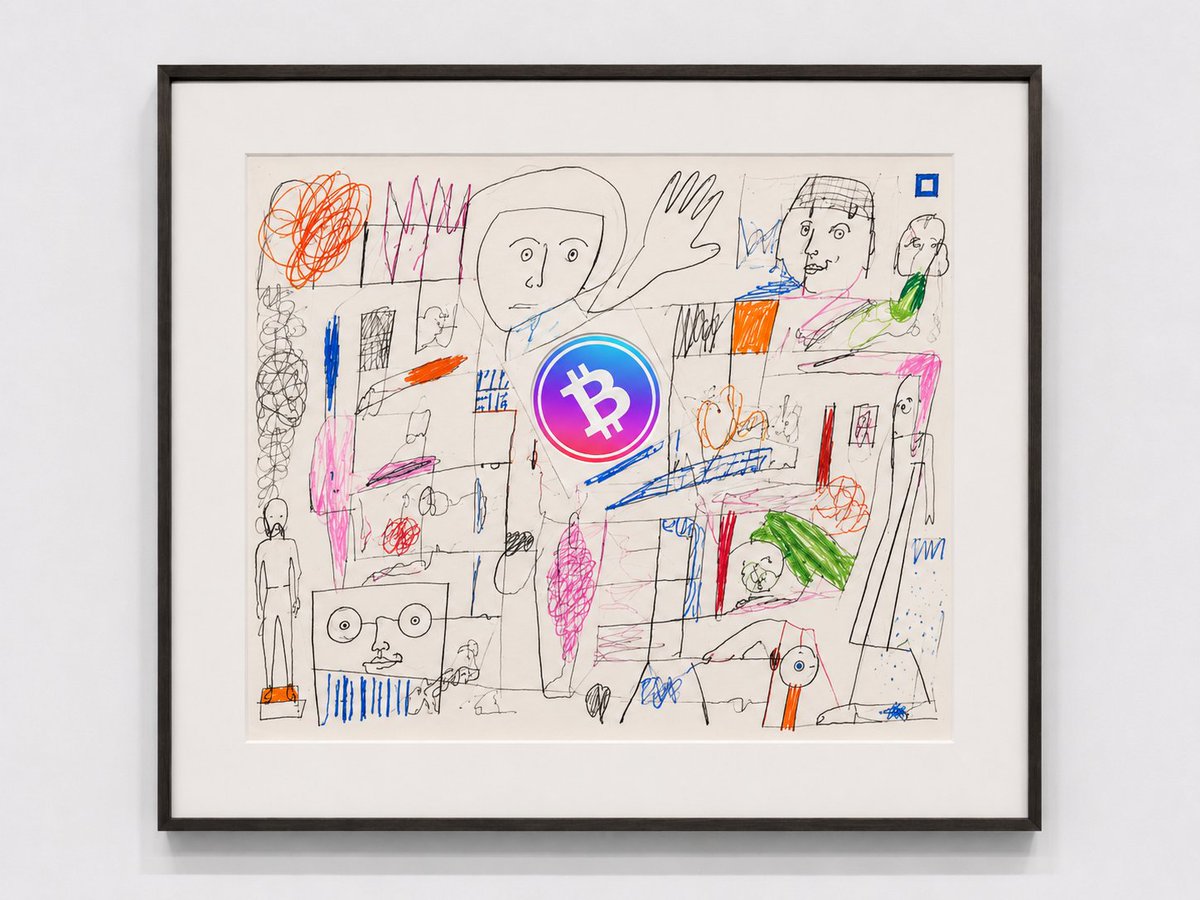
This thought inspired the following graphic after my visit to the exhibition. It shows PulseBitcoin not as a price, not as a chart, not as a technical note, but as a work in space. As something people stop in front of. As an image that gets attention. Because in the end, it is not only what exists that matters. What also matters is whether it becomes visible.
#PulseBitcoin #PLSB #PulseChain #MarinaAbramovic #Abramovic #GropiusBau #BalkanEroticEpic #CryptoArt #CryptoCulture #ArtAndCrypto #BitcoinAsSmartContract #DigitalScarcity #Marketing #Narrative #Community
1
4
446
Crypto Market Report - Week 23/2026
The market still presents itself as if the current Bitcoin weakness were only a normal correction inside a broader bullish structure. That is one possible reading, but it is not the only one, and in my view it is too optimistic. The more realistic risk is that Bitcoin is not simply retesting support, but beginning a much deeper unwind. The current zone may hold temporarily, but it does not yet look convincing enough to rule out a larger move lower.
The key issue is this. A market can look stable during the early phase of a breakdown because price does not collapse all at once. Instead, it weakens in stages. Lower timeframes start deteriorating first, important zones get retested repeatedly, and each rebound becomes less convincing. That kind of structure can still be described as consolidation by bullish analysts, but it can just as easily be the early part of a broader decline. That is why the current weakness should not be dismissed as a healthy shakeout too quickly.
My base case is that Bitcoin still has meaningful downside ahead. A move toward 50k looks plausible as the first major target if the market continues to lose structure. That would not necessarily be the end of the move. I also see 35k as a realistic later target, not as an immediate crash destination, but as a deeper zone that could be reached in a second phase after bounces, pauses, and failed recovery attempts. In other words, the bearish scenario is not one vertical collapse, but a drawn out repricing process.
That changes the interpretation of the broader market as well. Falling Bitcoin Dominance is often treated as bullish because it can precede altcoin outperformance. But that only works cleanly when Bitcoin remains broadly constructive. In a true Bitcoin breakdown, falling dominance does not automatically mean healthy rotation. It can simply mean that the entire market is becoming unstable and correlations are shifting in messy ways. In that environment, the idea of a clean altseason becomes much less reliable.
For PulseChain, this means caution. If Bitcoin moves into a deeper corrective phase, liquidity across smaller ecosystems usually gets thinner, speculation becomes more selective, and beta assets come under pressure. PulseChain would not be immune to that. A weaker Bitcoin backdrop would likely make it harder for broad ecosystem strength to develop in the short term, especially if capital becomes defensive.
For PulseBitcoin, however, the relative picture could be more interesting. If Bitcoin continues lower, WPLS may come under even more pressure than PLSB. That is the crucial distinction. PulseBitcoin does not need to rise in absolute terms to become more attractive inside the ecosystem. It only needs to fall less than WPLS. In a genuine risk off phase, that relative behavior matters a lot. Capital inside PulseChain may prefer rotating into the scarcer asset rather than staying in the more beta sensitive base asset.
That is why PulseBitcoin becomes strategically important in this scenario. For WPLS holders, PLSB may become the relatively stronger place inside the ecosystem if Bitcoin breaks down further. The argument is not that PulseBitcoin would be immune to a broader market decline. The argument is that WPLS could weaken more aggressively, while PLSB could hold value better on a relative basis. In a falling market, relative strength often matters more than absolute direction.
The takeaway is therefore very different from a standard bullish report. This does not look like a market that should automatically be read as consolidating for another expansion leg. It may instead be entering a larger downside process. Bitcoin still looks vulnerable to a move toward 50k, and later even 35k cannot be ruled out if the structure continues to deteriorate. In that kind of environment, broad altcoin optimism is premature. For PulseChain, the short term backdrop would be tougher. For PulseBitcoin, the important point is relative strength. If WPLS weakens harder than PLSB, then PulseBitcoin could become the more resilient asset inside the ecosystem during the next phase of market pressure.
#Crypto #Bitcoin #PulseChain #PulseBitcoin #PLSB #WPLS #MarketReport
1
8
120
The white rabbit say to you:
If Bitcoin drops to thirty five, a heavy fall to see,
it pulls down PulseChain too, in quiet sympathy.
But PulseBitcoin may rise while WPLS feels the strain,
gaining strength against it through the market’s pain.
So swapping PLS to PLSB could be a cautious play,
to guard your capital while bears still have their say.
And when the storm has passed, and bulls return with grace,
you swap back into PLS to ride the next uptrend’s pace.
7
5
20
1,505
Crypto Market Report - Week 22/2026 - Update
The market focus has shifted from broad optimism to monetary reality. The key development is the change at the Federal Reserve. A new Fed chair always matters, but this transition looks especially important because it arrives at a moment when the United States is carrying an enormous debt burden and has far less room to keep money tight than official rhetoric might suggest. That changes the backdrop for all major markets.
The central issue is not whether rates are high in nominal terms, but whether real rates can stay positive for long. With debt service rising sharply, the political and fiscal pressure for easier money is growing. If rates move lower while inflation remains sticky, real yields drift further into negative territory. That is the kind of environment that tends to strengthen scarce assets and weaken confidence in cash as a true store of value.
This is why gold and Bitcoin move back into focus. When money offers less real protection, the opportunity cost of holding non yielding stores of value falls. That is the deeper macro signal. The issue is no longer only growth or risk appetite. It is trust in the long term purchasing power of the currency itself. In that kind of setting, hard assets become more relevant.
Bitcoin stands out here for another reason. It is increasingly being framed not only as a speculative asset, but as a generational store of value. That matters because perception drives capital. Once Bitcoin is treated less like a side trade and more like a serious monetary alternative, its role inside the market changes. It becomes easier to justify structurally, especially in an environment where debt pressure and monetary compromise are rising.
For the broader crypto market, this creates a more selective but potentially constructive backdrop. Easier money is usually supportive for digital assets, but not every token benefits in the same way. If the next phase is driven by monetary debasement concerns rather than pure speculation, then the market is more likely to reward assets with a clear monetary identity than assets that depend only on hype.
For PulseChain, that means the opportunity is real, but not automatic. A softer monetary environment can help risk assets and improve sentiment across crypto, yet smaller ecosystems still need internal strength to capture that benefit. PulseChain will not be carried by macro alone. What matters is whether capital inside the ecosystem starts rotating with conviction and whether the chain produces a clear internal leader.
For PulseBitcoin, the setup is stronger. If the market begins to focus more on scarcity, monetary clarity, and alternatives to weakening fiat confidence, then PLSB fits that logic better than a generic ecosystem token. In a world where investors are again looking for assets that feel hard, limited, and structurally distinct, PulseBitcoin has a clearer narrative tailwind than most. That does not remove volatility, but it does improve its strategic position.
The distinction is important. PulseChain still needs to prove ecosystem strength. PulseBitcoin can benefit more directly from a market that begins to favor hard monetary assets. If easier policy and more negative real rates become the direction of travel, then the logic supporting Bitcoin also becomes more supportive for PLSB inside its own environment.
The overall takeaway is clear:
This update points toward a market that may be moving away from tight money discipline and back toward monetary accommodation. If that happens while inflation remains difficult to fully suppress, the result is a friendlier backdrop for scarce assets. Gold benefits from that. Bitcoin benefits from that. And within PulseChain, PulseBitcoin becomes easier to frame as a serious asset rather than just another token. That is the shift worth watching now.
#Crypto #Bitcoin #Gold #Macro #Fed #PulseChain #PulseBitcoin #PLSB #MarketReport
2
7
88
PulseBitcoin Design | PLSB retweeted

May 28
PulseBitcoin checks in with @EMITfarm this Friday at 6pm ET / 11pm UK
youtube.com/live/uN3DoMGbUMc…
Store-of-value meets yield.
One of PulseChain’s strongest store-of-value narratives meets one of its strongest farming platforms.
We’ll be talking #EMIT and #PulseBitcoin updates, farming, liquidity, scarcity, development and price targets.
If you’re watching #PulseChain, this is one to tune into.
@xDeFiNatioNx @k41rr0s

3
11
36
726
PulseBitcoin - Art, Structure, and Flow - Week 22/2026
Today I visited the Berlinische Galerie in Berlin and spent time with Jeanne Mammen’s Revuegirls from 1928/29.
What stayed with me most were the colors.
The painting is not bright in a simple decorative way. The faces are pale, almost drained, while the lips and stronger tones appear with sharp intensity. These colors do not merely add glamour. They create tension.
They make the image feel charged.
That contrast reminded me of the visual identity of PulseBitcoin.
Bitcoin has become strongly connected to orange. A familiar color. A repeated signal. Almost a visual standard.
PulseBitcoin feels different.
Cyan, blue, violet, magenta. A colder, sharper, more electric spectrum. It still refers to the same larger idea of digital scarcity, but it speaks through a different atmosphere.
That difference matters.
Color is not only surface. It changes how structure is perceived.
In Mammen’s Revuegirls, the stronger tones cut through the image and create its particular energy.
In PulseBitcoin, the logo colors also mark a shift. A familiar monetary principle appears in a new visual field.
Related in structure.
Different in presence.
That thought inspired this graphic.
1
3
9
99
Crypto Market Report - Week 22/2026
The markets still appear stable on the surface. Beneath that surface, however, pressure is building. More and more suggests that this is not just a normal cycle shift, but a deeper structural change. For many years, almost all major asset classes were supported by falling interest rates, abundant liquidity, and cheap financing. That exact environment is now losing its reliability.
The most important factor is the bond market. Rising yields are changing the rules of the game. Capital becomes more expensive, valuations come under pressure, and bonds once again become a real alternative for investors. What previously flowed almost automatically into equities, real estate, and other risk assets must now be redistributed. This is not a small shift, but a change in the entire market logic.
The real estate market is also sending a warning signal. When higher financing costs slow demand, transactions decline, and credit driven momentum fades, this is more than a problem for a single sector. It shows that one of the key beneficiaries of the cheap money era is weakening. That is exactly why this development is systemically relevant.
On top of that, there is a dangerous one sidedness in positioning. Large capital flows are concentrated heavily in only a few technology segments, especially semiconductors and the infrastructure behind the AI boom. Such concentrations can last longer than many expect. At the same time, they make the market more vulnerable. When expectations are extremely high and hedging is reduced at the same time, even smaller disappointments can trigger violent reactions.
That is where the real risk lies. Markets rarely become most dangerous when fear is openly visible. They often become dangerous when too much confidence has built up. When investors ignore risks, neglect protection, and price in almost nothing but higher prices, the system becomes more sensitive. That is especially true when valuations are high and financing costs are trending upward at the same time.
This picture is reinforced by monetary policy uncertainty. A more restrictive central bank stance would remove exactly what many market participants are still hoping for, namely quick relief through lower rates and renewed liquidity. If money remains expensive for longer, highly valued growth segments in particular come under pressure. That would not be normal headwind, but a structural burden.
Even so, the picture is not simply negative. In phases when confidence in the old financial regime starts to fade, scarce and strategically perceived assets gain importance. That is exactly why Bitcoin is moving more into focus. When capital begins to seek not only returns, but also scarcity, independence, and strategic relevance, Bitcoin’s role changes. It would no longer be seen only as a speculative object, but increasingly as an asset with strategic character.
For PulseChain, this environment means one thing above all. General market liquidity alone is no longer enough. In a more selective market, smaller ecosystems are not carried automatically. What matters is whether real capital rotates inside the chain, whether attention develops, and whether individual assets show clear strength. In this environment, PulseChain needs less general euphoria and more internal market strength.
For PulseBitcoin, the situation is clearer. If capital begins once again to distinguish more sharply between pure speculation and genuine monetary scarcity, that improves the structural position of PLSB. Especially in an environment of higher rates, tighter liquidity, and rising uncertainty, assets with a clear monetary profile become more important. That is exactly where the opportunity for PulseBitcoin lies. PLSB could therefore emerge more strongly as the monetary reference point within PulseChain.
The distinction matters. PulseChain has to prove that the ecosystem can develop its own weight. PulseBitcoin can benefit from exactly that kind of selection. The more demanding the macro environment becomes, the more important the question becomes which asset within an ecosystem is perceived as scarce, clear, and credible.
The decisive point is therefore this. The markets may not simply be facing a normal correction or an ordinary cycle change, but a genuine transition. Rising yields, weakness in real estate, extreme concentration in certain equity segments, declining hedging, and a more restrictive monetary backdrop together create an environment that is far more fragile than it appears at first glance.
The overall picture therefore remains tense. The old logic of cheap money no longer works as automatically as it once did. Capital is becoming more selective, risks are increasing, and market leadership is narrowing. It is precisely in phases like this that superficial strength becomes separated from real structural robustness.
For PulseChain, this means that its future depends less on broad market mood and more on its own internal strength. For PulseBitcoin, it means that a more selective market environment could actually be beneficial. If the market begins once again to focus more on scarcity, clarity, and monetary function, PLSB can gain importance within PulseChain.
#MarketReport #Macro #Rates #Bonds #Equities #RealEstate #Bitcoin #PulseChain #PulseBitcoin #PLSB
2
5
134
PulseBitcoin (PLSB) is not just another token on PulseChain. It is Bitcoin as a smart contract.
21 million supply. Mining. Halvings. No premine. No founder allocation.
WPLS is used. PulseBitcoin is held.
That is the role.
#PulseBitcoin #PulseChain #PLSB
1
6
76
PulseBitcoin (PLSB) as the Missing Feedback Mechanism of PulseChain
The central question is not whether PulseBitcoin can rise in the short term. The more important question is whether PulseBitcoin can create an economic feedback mechanism that PulseChain has not sufficiently developed so far.
A blockchain can remain active and still be economically weak. Trades alone are not enough. Volume alone is not enough. Technical functionality alone is not enough. A chain does not only need movement. It needs a place where capital actually wants to stay.
Without such a storage point, a system enters a cycle without compression. Capital enters, rotates through tokens, chases short term opportunities, and eventually leaves again. The infrastructure gets used, but it does not retain lasting value. This is exactly the structural weakness of many young chains. They generate activity, but not economic gravity.
PulseBitcoin is not simply another token on PulseChain. It is Bitcoin as a smart contract. Not Bitcoin as a copy of the brand. Not Bitcoin as a wrapped asset. Not Bitcoin as a vague reminder of a familiar narrative. It is the monetary principle of Bitcoin transferred into a modern smart contract environment.
The core remains hard: 21 million maximum supply, mining, halvings, no premine, no founder allocation, and no flexible monetary policy. The difference does not lie in the monetary principle, but in the execution layer. Bitcoin runs on its own conservative Proof of Work infrastructure. PulseBitcoin runs as a smart contract on PulseChain.
This means the monetary core remains scarce and rule based, while the environment becomes faster, cheaper, and directly DeFi compatible. That combination is what matters. PulseBitcoin does not simply bring another asset onto PulseChain. PulseBitcoin brings Bitcoin logic into the PulseChain execution layer.
PulseBitcoin can play a special role because it can bind capital instead of merely moving it around. WPLS enables activity. PulseX enables trading. Other tokens create rotation. PulseBitcoin can create storage. That is the decisive difference.
When part of the capital inside a system stops constantly rotating and instead begins to remain inside a scarce asset, the behavior of the entire system changes. Short term rotation turns into long term conviction. Infrastructure turns into an economic environment. Usage begins to transform into belief.
It would be a mistake to reduce the possible significance of PulseBitcoin to a single price spike. A pump does not save a chain. A pump creates attention, but not stability. It attracts traders, but not lasting structure.
If PulseBitcoin can help lead PulseChain into a new expansion phase, it will not happen through one isolated explosive move. It will happen through a growing holding effect. Capital enters the chain. Part of that capital flows into PulseBitcoin. That part becomes less willing to sell. Freely circulating supply tightens. The perception of a scarce core asset grows stronger. More capital enters not only because of the chain itself, but because of the asset at the center of it. The chain regains a clear story.
That would not be a magical rescue event. It would be a feedback effect.
PulseChain already functions technically. The primary problem is not that transactions are impossible. The real problem is that the market outside the existing community currently sees too little reason to return. A chain needs an answer to one simple question:
Why here?
Low fees are no longer enough. Fast blocks are no longer enough. Even a loyal community is not enough in the long run. The market needs a clear story that is larger than technical infrastructure alone.
PulseBitcoin can provide exactly that story. Not because it solves everything at once, but because it compresses the complex PulseChain narrative into one simple point: Bitcoin logic, smart contract execution, PulseChain infrastructure, and scarcity as the center.
A chain can be used without gaining meaning. Meaning only emerges when users have a reason to stay for the long term instead of merely transacting. PulseBitcoin can become exactly that reason.
Not every user has to hold PulseBitcoin. Not every application has to integrate it. Not every project has to revolve around it. But if PulseBitcoin becomes the mental reference point for hard scarcity inside PulseChain, then the perception of the entire ecosystem changes.
At that point, PulseChain is no longer just a place for cheap transactions. PulseChain becomes the place where Bitcoin as a smart contract lives. That is a fundamentally different status.
For this scenario to fully unfold, three things need to come together. PulseBitcoin needs stronger visibility, but without cheap hype. The narrative must remain calm, clear, and repeatable. PulseBitcoin needs deeper liquidity, because the deeper liquidity becomes, the more seriously larger capital can treat the asset. And PulseBitcoin needs easier access, because the easier entry becomes, the stronger PulseBitcoin can function as a gateway into PulseChain itself.
These factors determine how quickly a strong idea can evolve into a systemic movement.
PulseChain cannot become large again through technology alone if it lacks a clear capital destination. That is exactly where the opportunity exists. PulseBitcoin can become the point where the scattered energy of the system begins to concentrate.
Not as a replacement for PulseChain. Not as competition to WPLS. Not as a short term trade. But as a storage point inside a system that currently has too much movement and too little long term retention.
PulseBitcoin is one of the most logical answers because it possesses exactly the structure PulseChain has been missing: a scarce, easy to understand core asset with Bitcoin logic, but directly implemented as a smart contract on PulseChain.
Perhaps PulseChain does not need even more new narratives. Perhaps PulseChain needs one single narrative strong enough to retain capital.
That narrative could be PulseBitcoin.
Bitcoin as a smart contract. Scarcity as a capital anchor. PulseChain as the execution layer.
Perhaps the future of PulseChain will not ultimately be decided only by developers, infrastructure, or new features. Perhaps it will be decided by whether enough people understand early enough which asset inside this system actually represents long term scarcity.
Large monetary networks rarely emerge during moments of maximum attention. They emerge quietly. During phases of skepticism. During periods of low liquidity. During moments when most people are still not paying attention.
That is exactly why the current phase may become far more important than it appears today.
If PulseBitcoin begins to assume the role of a scarce monetary center inside PulseChain, then the current situation may later no longer look like the end. It may instead look like the moment before broader understanding arrived.
A strong PulseChain does not only need activity. It needs an asset people genuinely want to hold.
And perhaps that is exactly where the next expansion phase begins.
Not someday. Not after confirmation already arrives. But in the moment when the first market participants begin to understand this structure and act accordingly.
Because in the end, capital does not only follow technology. Capital follows scarcity, conviction, and clear monetary centers.
And that is exactly why every early position in PulseBitcoin may become more than just an investment into a single asset.
It may become an investment into the future significance of PulseChain itself.
#PulseBitcoin #PulseChain #PLSB #WPLS
1
5
82
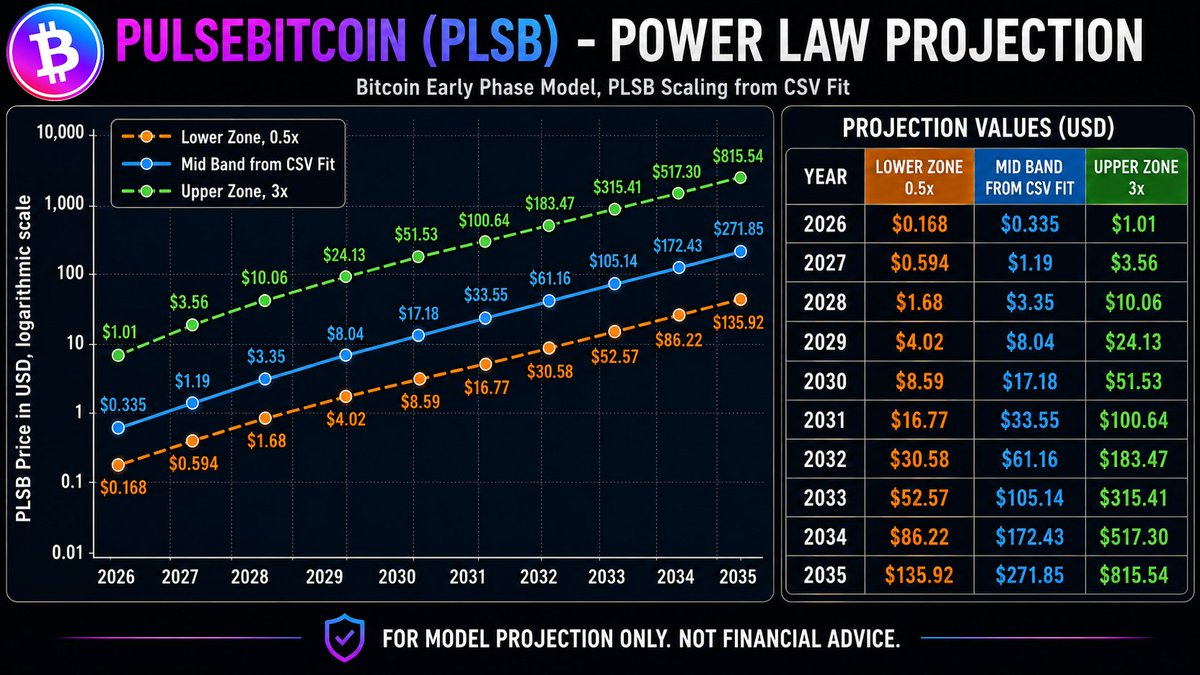
PulseBitcoin (PLSB) is still trading around $0.031.
The Bitcoin early phase Power Law model, scaled with PLSB CSV data, puts the 2026 mid band near $0.335.
That means PLSB is currently at only about 9% of the calculated mid band.
If this model continues to play out, this zone could later look like early accumulation.
Not financial advice.
2
4
12
194
PulseBitcoin Design | PLSB retweeted
May 22
So many people in #PulseBitcoin, including myself, have been guilty of obsessing over the idea of $1.
But what if $1 is not the destination?
What if it’s simply the point where the wider market finally starts to understand what has been quietly forming this entire time?
Huge credit to @PulseBitcoinD for writing this piece for me to present in today’s video.
“The miracle will not be $1.
The miracle will be how long the market needed to recognize the obvious.”
Watch till the end.
#PulseChain
5
5
72
2,773
Sermon to the Ones of Little Faith: What If One Dollar Is Not the Promised Land?
You of little faith.
Why do you worry about one dollar? Do you see only the small candle on the chart and not the light of the whole cycle?
You ask: “Can PulseBitcoin really reach one dollar?” But I say to you: Why do you call one dollar the target when the supply is limited to 21 million? Why do you call one dollar the end when mining, halvings, and time are already doing their work? Why do you only look at the dollar chart when the true parable is written in the ratio to WPLS?
For WPLS is moved. WPLS is used. WPLS carries gas, liquidity, and motion. But PulseBitcoin (PLSB) is held. Not because the market has already understood it, but because the market has not yet understood it. And exactly there lies the test of your faith.
For when Bitcoin was young, many laughed. When Bitcoin fell, many doubted. When Bitcoin moved sideways, many walked away. But the patient did not only see the price. They saw the principle.
And so I ask you: Is PulseBitcoin less scarce just because few people speak of it? Is a halving less real just because the market sleeps? Is an emission phase less completed just because the chart does not yet sing? No. The rules keep running. Time passes. The early conditions disappear. And what is overlooked today can become history tomorrow.
You look at one dollar and say: “That would be a lot.” But I say to you: One dollar may not be the promised land. One dollar may only be the moment when the ones of little faith finally realize that they waited too long for confirmation.
For the crowd does not come at the beginning. The crowd does not come in silence. The crowd comes when the narrative has already become simple. When the chart already speaks. When liquidity is already deeper. When people no longer ask what PulseBitcoin is, but why they did not understand it earlier.
You of little faith. Why do you doubt scarcity when it is written in the code? Why do you doubt time when it works every day? Why do you doubt asymmetry when almost no one is watching?
Not every token is an asset. Not every asset has an identity. Not every identity becomes a monetary center. But when a chain builds its infrastructure, opens its bridges, deepens its liquidity, and brings in its users, then one day the question will be asked: Which asset inside this system shall be held for the long term?
And then they will search. Not for the loudest meme. Not for the most complicated mechanism. Not for the next short term narrative. But for the simple thing.
21 million. Mining. Halvings. No premine. No founder allocation. No flexible monetary policy. A Bitcoin like monetary principle on PulseChain.
And then, you of little faith, some will say: “It was visible the whole time.” Yes. It was visible. But not everyone who has eyes sees the structure. And not everyone who sees the chart understands time.
Therefore do not set your eyes only on one dollar. For one dollar may be a milestone. But the real question is greater: What happens when PulseBitcoin is no longer seen as a small token, but as the scarce monetary reference asset of PulseChain?
What happens when people no longer ask whether PulseBitcoin is alive, but whether they are too late? What happens when the ones of little faith suddenly become disciples of scarcity?
Then one dollar will not be the miracle. The miracle will be how long the market needed to recognize the obvious.
Amen.
No financial advice. Just a sermon for those still waiting for confirmation.
1
4
84