
The only self migrating/adapting quantum proof blockchain that makes quantum security continuous. Join the telegram community: t.me/Quan_Chain
Joined October 2015
- Tweets 3,477
- Following 2,995
- Followers 91,965
- Likes 1,183
324 Photos and videos

QuanChain retweeted

Solid post 🔥 That 303 km QKD trial running alongside real 10 Gbps traffic is impressive progress. Quantum threats are coming, and chains built with hash-based crypto like QuanChain from day one are smart. Keep pushing!
1
3
74

Jun 13
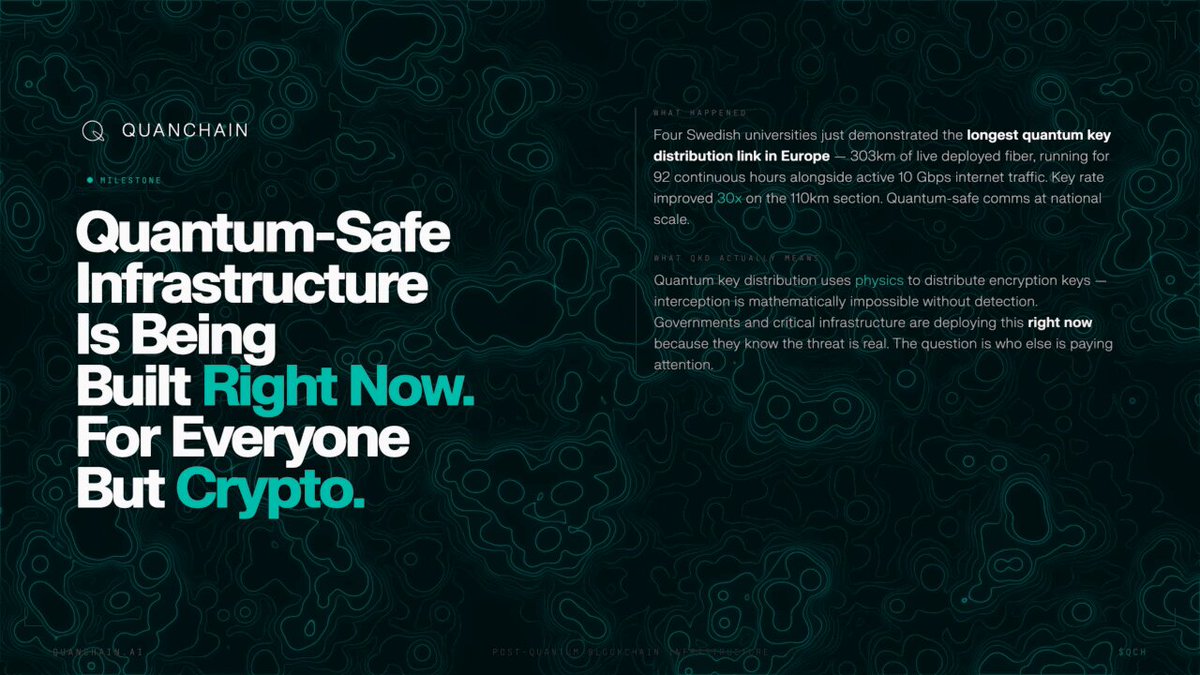
Many governments are busy building quantum-safe communications infrastructure right now.
But most blockchains aren't even paying attention.
4 Swedish universities just ran the longest quantum key distribution link in Europe - 303km of live deployed fiber, 92 hours continuous, alongside active 10 Gbps internet traffic. Key rate improved 30x. QKD makes interception mathematically impossible.
Nation-states know the threat is real & they are acting on it at the infrastructure level.
Most blockchains are still running on elliptic curve cryptography which is the exact math a quantum computer is built to break.
QuanChain was designed from scratch with hash-based cryptography & 20 adaptive security levels.
This isn’t a retrofit. It’s our foundation.
3
4
9
226
Jun 11
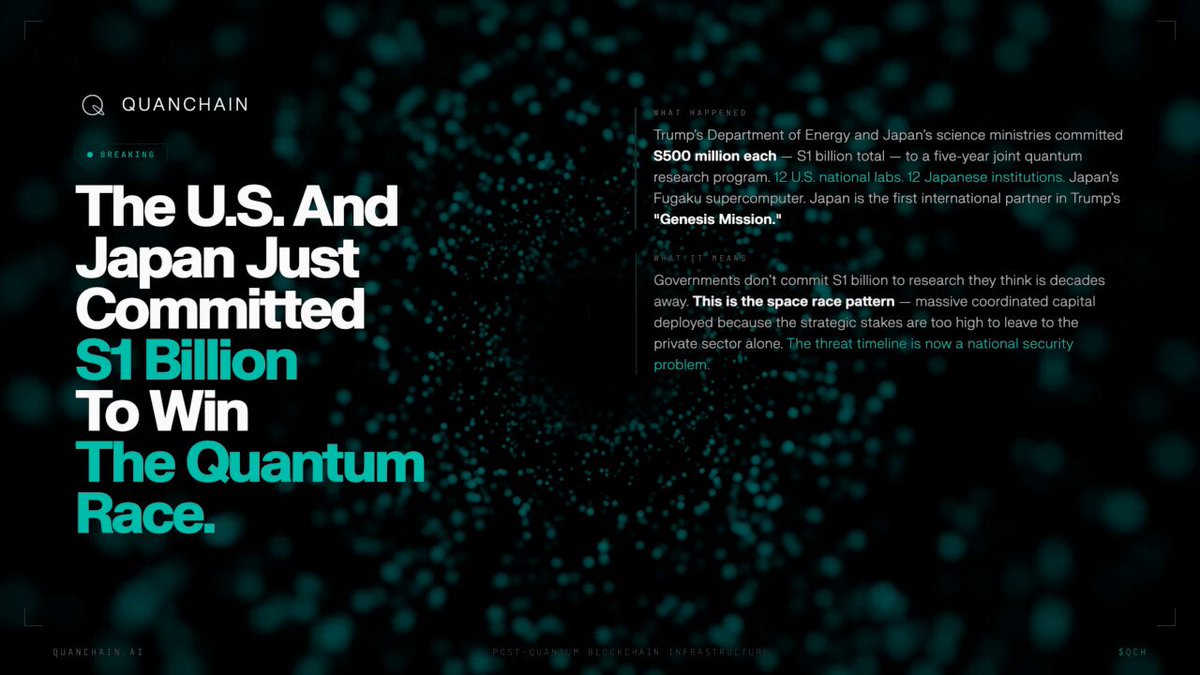
The U.S. and Japan just committed $1 billion to win the quantum race.
$500M from Trump's Department of Energy & $500M from Japan.
12 U.S. national labs.
12 Japanese research institutions.
Japan's Fugaku supercomputer.
5 years.
Japan is the first international partner in Trump's "Genesis Mission."
Governments don't commit $1 billion to research they think is decades away.
This is the space race pattern - massive coordinated capital because the strategic stakes are too high to leave to the private sector alone.
Every dollar this program spends is going toward solving a problem that legacy chains are scrambling to retrofit.
QuanChain.ai was never built on elliptic curve cryptography - it’s hash-based from the ground up, with 20 adaptive security levels that tighten automatically as the threat does.
There's no transition plan because there's nothing to transition away from.
1
5
10
217
Jun 10
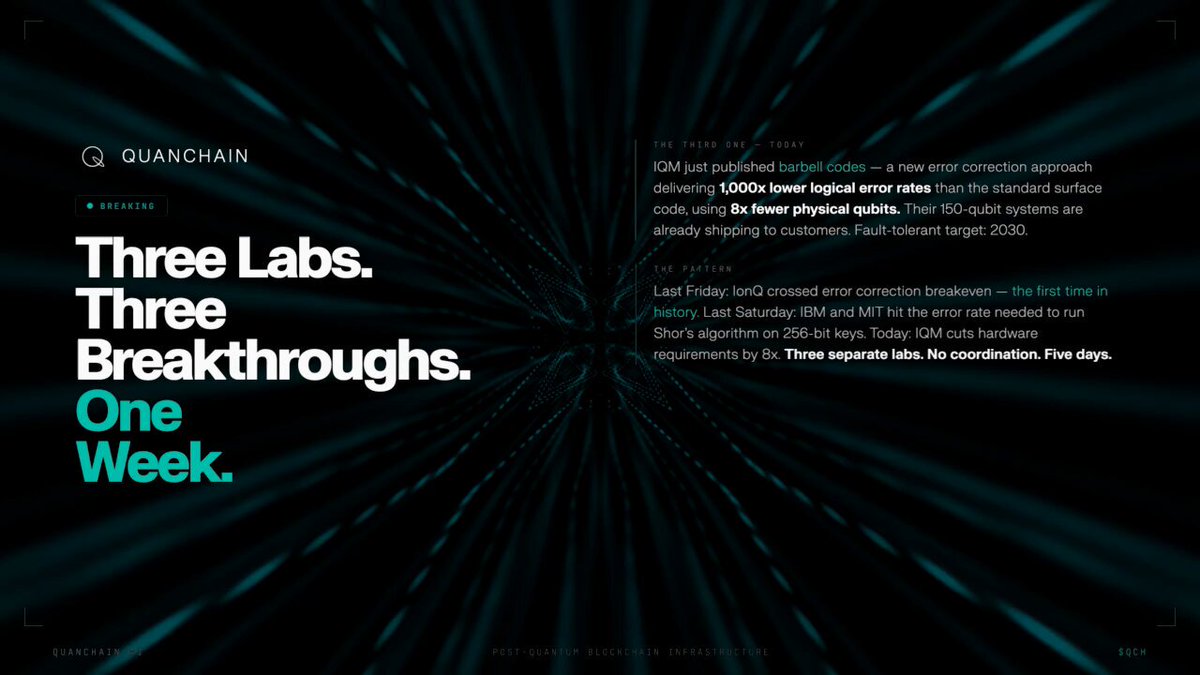
This is the 3rd quantum error correction breakthrough in 5 days!
Last Friday: IonQ crossed breakeven - logical qubits outlasting physical ones for the first time in history.
Last Saturday: IBM & MIT hit the error rate needed to run Shor's algorithm on 256-bit keys.
Today: IQM's barbell codes deliver 1,000x lower logical error rates & cut hardware requirements by 8x.
Three separate labs.
No coordination.
Five days.
Our legendary LQCp/h Oracle tracks every one of these milestones.
Spend&Rotate means no public key ever sits on-chain - nothing to target, no matter how fast the hardware moves.
1
5
15
289
Jun 10
Quantum literacy is the wrong goal. Quantum readiness is.
Weedbrook is right that the window is closing, but literacy doesn't protect infrastructure. The gap between "understanding quantum" and "having cryptography that adapts to it" is where institutions will get caught.
QuanChain's LQCp/h Oracle tracks quantum capability across 7 threat levels in real-time, triggering automatic migration to stronger key hierarchies before an upgrade ever becomes urgent.
If a national quantum strategy doesn't include infrastructure that can escalate its own security posture, what exactly is the literacy preparing people for?
1
2
141
Jun 9
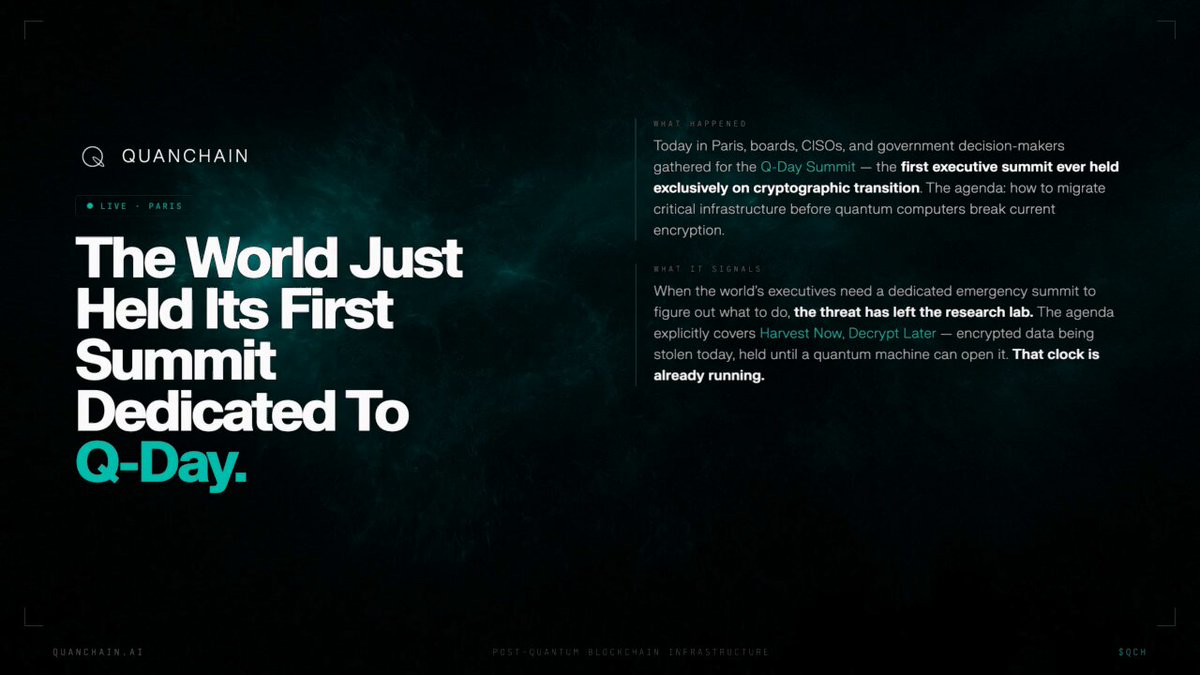
Today in Paris, the world held its first executive summit dedicated exclusively to Q-Day.
Boards. CISOs. Governments. All in one room, for the first time, figuring out what to do before quantum computers break current encryption.
The agenda covers Harvest Now, Decrypt Later which stands for encrypted data being stolen today will be decrypted once the machines arrive.
That clock is already running.
While the summit figures out a plan, QuanChain is already running one.
Spend&Rotate means no public key ever touches the chain meaning there's nothing for a quantum computer to target.
The LQCp/h Oracle monitors qubit thresholds in real time & automatically hardens wallets before each one is crossed.
No migration deadline to miss with quanchain.ai.
5
11
192
Jun 8
Quantum imaging gets a mention and Canada's $2.3B AI plan draws scrutiny — but Niki Harris's point on the Global News segment cuts deeper than the headline: the defence readiness question isn't about having the technology, it's about whether the infrastructure beneath it can adapt when threat levels shift.
Static procurement cycles don't pair well with capabilities that evolve in months. QuanChain's LQCp/h Oracle tracks quantum capability across 7 threat levels in real-time precisely because "ready now" and "ready in 18 months" are two entirely different security postures.
If Canada's quantum defence posture depends on policy reviews that run on 2-year cycles, is the $2.3B actually buying readiness — or just hardware that's already behind?
1
4
141
Jun 8
A supply chain attack takes 2 hours to exploit a trusted update. Microsoft's fix is a 2-hour delay.
That's not defence. That's symmetry.
The real problem: trust in software pipelines is binary. You either accept the update or you don't. There's no graduated response based on what's actually changed in the threat environment.
QuanChain's LQCp/h Oracle runs across 7 threat levels (QTL-0 through QTL-6) and triggers graduated security escalation automatically: not a binary switch, but 20 TADEQS security levels that adjust as conditions change.
If a 2-hour delay is now considered a meaningful security control, how much of modern infrastructure is one trusted update away from compromise?
1
2
5
152
Jun 8
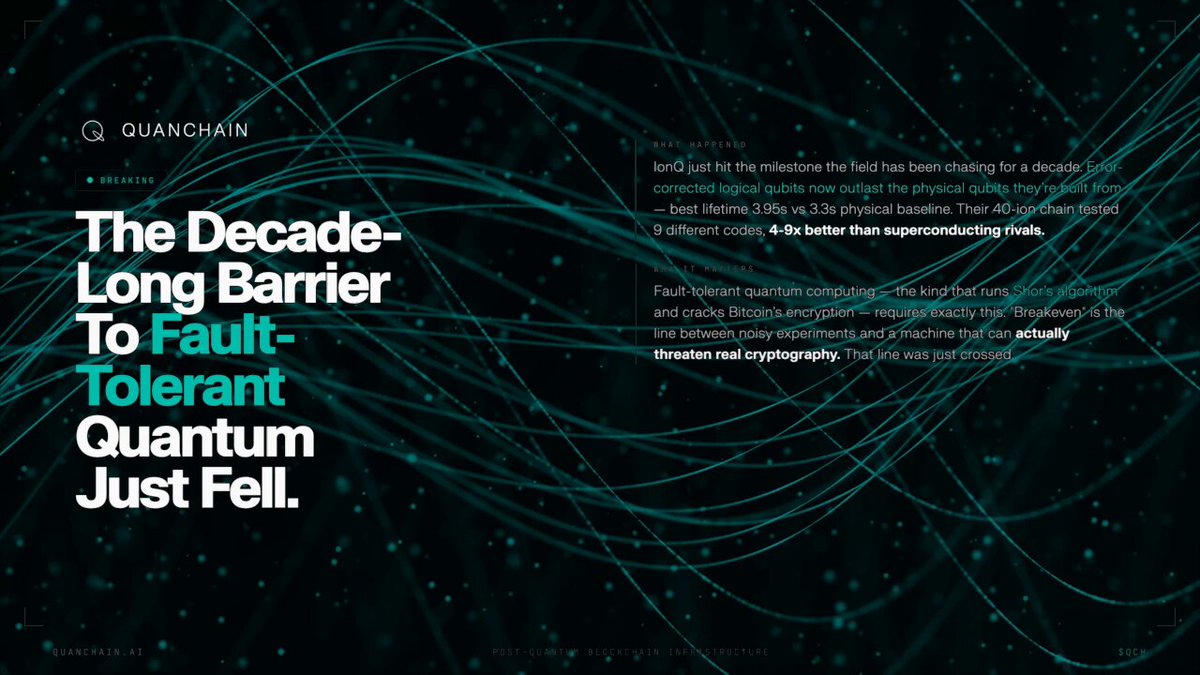
For a decade, every quantum error correction experiment lost more than it fixed.
IonQ just crossed breakeven.
For the first time in history, logical qubits now outlast the physical qubits they're built from.
3.95s vs 3.3s.
40-ion chain.
4-9x better than the best superconducting results.
This is the last technical barrier before fault-tolerant quantum computing is real.
Btw for those who don’t know, fault-tolerant quantum is what runs Shor's algorithm & cracks Bitcoin.
QuanChain's LQCp/h Oracle is already tracking this though.
Our wallets auto-upgrade before each threshold is crossed.
5
11
415
Jun 8
An AI agent wallet with "built-in security" is not the same as a wallet with security that adapts to the threat.
MetaMask's new agent wallet executes trades autonomously — which means the keys protecting those positions need to hold under conditions that don't exist yet.
QuanChain's TADEQS runs 20 security levels with oracle-triggered migration: when the LQCp/h Oracle detects rising quantum capability, funds move to stronger key hierarchies automatically, without the user touching anything.
If an AI agent is managing capital on your behalf, who decides when the cryptographic protection underneath it is no longer adequate?
4
97
Jun 8
Quantum is listed as one of 4 headwinds dragging bitcoin's price, but NYDIG's framing treats it as a sentiment risk, not a structural one.
Those are different problems. Sentiment recovers. Cryptographic exposure doesn't.
QuanChain's LQCp/h oracle tracks quantum capability across 7 threat levels in real time, triggering automatic migration before sentiment becomes a crisis.
If your chain's security model can't respond to a capability event faster than the market can, is it a security model or just a bet on timing?
1
1
5
115
Jun 8
𝗖𝗮𝗻𝗮𝗿𝗶𝗲𝘀 𝗮𝘀 𝗘𝗮𝗿𝗹𝘆 𝗪𝗮𝗿𝗻𝗶𝗻𝗴
The canary system addresses a fundamental problem: how do you know when a quantum computer has actually broken an algorithm, as opposed to when researchers predict it might?
Theoretical timelines are useful for planning but unreliable for triggering emergency responses. @Quan_Chain's canaries provide empirical evidence. If the Level 1 canary is breached, ECDSA-256 is broken. Not theoretically. Actually. The network responds to facts, not forecasts
3
87
Jun 7
Faster error correction accelerates the threat timeline, not just the opportunity.
Click Future's breakdown of Nvidia's Ising models is worth watching — 2.5x decoding speed and 3x accuracy over classical algorithms is a genuine engineering result, not a headline. But the conversation stops at hardware. Nobody's asking what fault-tolerant quantum computers mean for the chains running ECDSA and RSA today.
QuanChain's LQCp/h Oracle tracks exactly this: as hardware capability crosses threat thresholds, cryptographic migration triggers automatically.
If a chain can't respond to a hardware milestone it didn't predict, who carries the liability?
2
1
108
Jun 7
The npm supply chain attack that just scraped developer secrets across 50 packages wasn't stopped by encryption: it was stopped too late.
JFrog's analysis shows the Rust-based stealer hid behind an eBPF kernel rootkit — meaning the compromise was already deep before detection. Static defences don't help when the attack is already inside.
This is the same structural problem in blockchain security. Fixed cryptography assumes the threat environment stays constant. It doesn't.
QuanChain's LQCp/h Oracle monitors threat conditions across 7 levels in real-time, triggering automatic migration to stronger key hierarchies before a threshold is breached — not after.
If your security posture only responds to attacks that have already succeeded, is that a defence or just forensics?
2
109
Jun 7
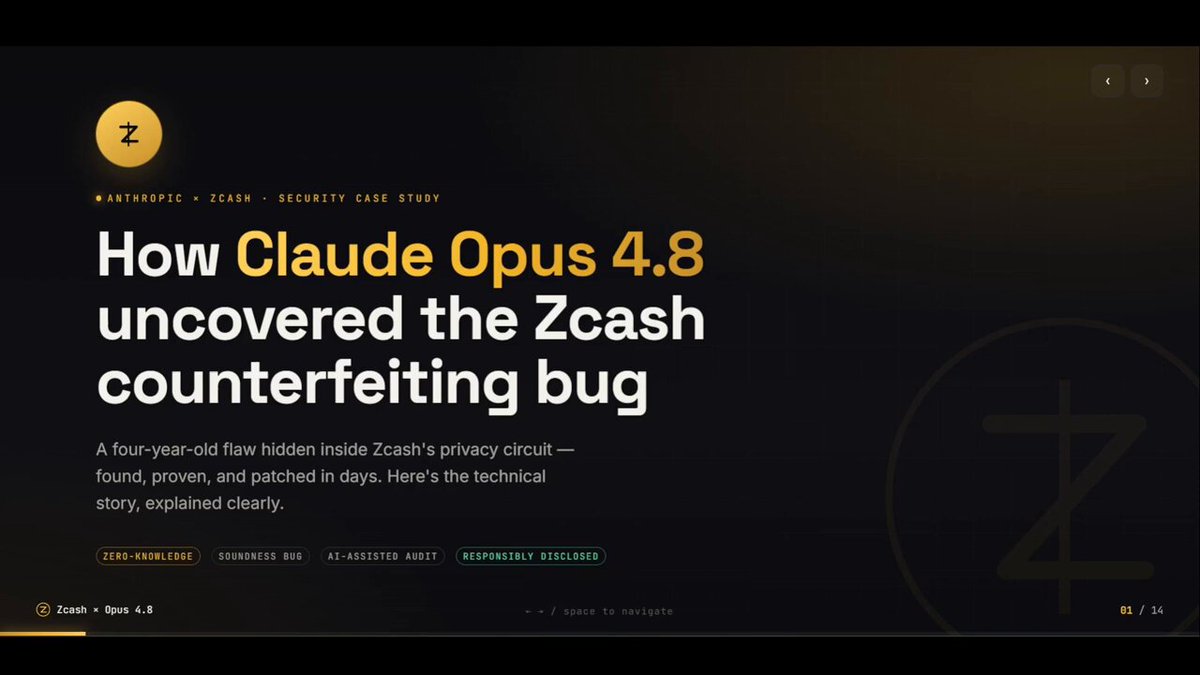
AI-assisted auditing just caught a 4-year-old Zcash soundness bug that manual review missed entirely — and that reframes the defender/attacker calculus.
Tonbi's AI Garage walks through how Taylor Hornby's Opus 4.8 framework traced a missing constraint in Halo2's gadgets crate back to 2022, leaving Orchard shielded-pool values un-anchored to a real base point. One day post-launch, working exploit. The human expert was still essential — the model reasoned through circuit logic faster than any solo audit cycle.
Static cryptography reviewed once at launch is the real vulnerability here. If your protocol's security assumptions can't be re-evaluated continuously as tooling improves, who's running the next audit?
133
Jun 7
The Miasma worm didn't break Microsoft's code. It spread through the infrastructure that delivers the code.
73 repositories across Azure, Microsoft, and MicrosoftDocs. The attack surface wasn't a vulnerability in a single system — it was trust in the supply chain itself.
This is the class of risk that static perimeter security wasn't designed for. QuanChain's Cross-Chain Resilience Protocol anchors quantum-proof state across Solana, Sui, Ethereum, and Polygon precisely because no single point of trust should be the failure mode.
If a self-replicating worm can traverse 73 repos before detection, how confident are you that your chain's key infrastructure has a smaller blast radius?
2
124
Jun 6
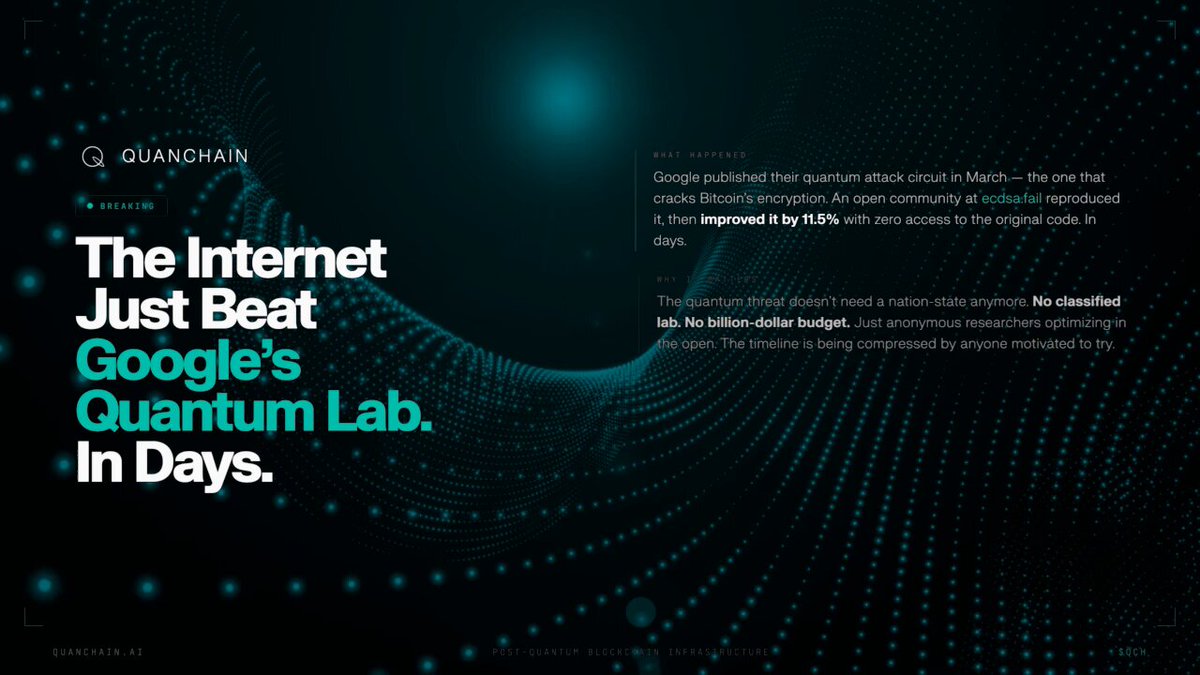
Google spent years developing their quantum attack circuit in secret.
They published it in March.
The open internet beat it in days.
An anonymous community at ecdsa.fail improved Google's circuit by 11.5% with zero access to the original code.
No classified lab.
No billion dollar budget.
Just open collaboration.
This is what makes the quantum threat different from every other security risk in crypto's history.
You don't need a nation-state.
You just need a community motivated to try.
QuanChain's LQCp/h Oracle tracks every public optimization, including community ones like this.
The moment circuit improvements compress the qubit threshold, security levels upgrade automatically.
No announcement needed.
No manual patch.
The threat is moving faster than institutions can respond & QuanChain.ai is built to move with it.
5
7
170
Jun 6
𝗖𝗮𝗻𝗮𝗿𝘆 𝗘𝗺𝗲𝗿𝗴𝗲𝗻𝗰𝘆 𝗥𝗲𝘀𝗽𝗼𝗻𝘀𝗲
When a canary address is compromised, the protocol triggers an immediate Emergency migration. All wallets at or below that security level must migrate within the epoch.
This is the only scenario where migration is truly mandatory. The oracle broadcasts the emergency via the /quanchain/1/oracle GossipSub topic, at least 2/3 of validators must attest, and after the grace period, transactions from non-compliant wallets are rejected.
Canary addresses are funded by the protocol treasury. They exist for one purpose: to be the first to fall so that everything else can be saved.
1
78
Jun 6
429 bugs patched in a single Chrome release. An AI agent found 21 zero-days in FFmpeg without a human writing a single test case.
The attack surface isn't growing linearly. The tools finding vulnerabilities in production software are the same tools that will be turned on cryptographic implementations.
Static security reviewed once at launch is a different problem category to dynamic threats that evolve continuously. That's why TADEQS runs 20 escalating security levels, with the LQCp/h oracle monitoring threat conditions across 7 levels in real time and triggering automatic migration before a vulnerability becomes an event.
If an AI agent can find 21 novel bugs in a library that's been in production for decades, how confident are you that a fixed cryptographic scheme reviewed in 2023 holds through 2027?
1
2
89
Jun 5
Ethereum just announced it's building a quantum shield from scratch.
Their current validator system runs on elliptic curve math which is exactly what quantum computers break.
Today, they revealed a new Post-Quantum Public Key Registry using hash-based signatures.
The catch: the new signatures are 3.1KB each so large they need a separate compression layer just to keep the network running.
And the migration is capped at 16 validators per slot. This is going to take years! 🤯
QuanChain.ai doesn't need to rebuild anything.
Hash-based cryptography, Spend&Rotate & the LQCp/h Oracle are already running.
No public key ever hits the chain. 🔐
3
4
11
164