
Publishing breakthrough research on the fundamental science and application of all quantum-enabled technologies. Published by @IOPPublishing.
Joined March 2017
- Tweets 1,407
- Following 1,373
- Followers 5,394
- Likes 1,153
585 Photos and videos


Pinned Tweet

6 Jun 2025
From Thursday, 5 June, X will no longer be our primary platform for sharing news.
We would love to connect with you on:
🦋 Bluesky - bsky.app/profile/ioppublishi…
LinkedIn - linkedin.com/company/iop-pub…
Facebook - facebook.com/ioppublishing/
Threads - threads.net/@iop.publishing
5
787
Quantum Science & Technology retweeted
7 Apr 2025
📢 We are now on Bluesky!! 📢
Join our community and stay connected with the latest research, news and updates in #quantum science and technology.🌟
Our new account covers quantum research across our journals at IOP Publishing. #QuantumScience #QuantumTech
1
2
631
26 Mar 2025
Congratulations to all recipients of our Outstanding Reviewer Awards! 🎉Your commitment, timeliness, quality, & quantity of reports is celebrated across our journals. Let's celebrate all #PeerReview contributions that uphold #ResearchIntegrity
Discover 👉 ow.ly/bpFL50VkHHJ
2
305
6 Mar 2025
🌟 Together, we're breaking down barriers in scholarly publishing! Discover how double anonymous #PeerReview, and transparent #PeerReview are paving the way for a more inclusive and fair publication process.🌍✨ ow.ly/oyhm50V8iVy
2
257
13 Feb 2025
👋 Are you an #EarlyCareerResearcher looking to gain #PeerReview experience, or an experienced supervisor eager to support the next generation? We've got you covered! Find out more 👇ow.ly/1VoX50UQbpM
257
23 Jan 2025
🌟 Discover our free & rigorously assessed online #PeerReview Excellence training! Enhance your knowledge & skills on the latest topics, issues, & threats in peer review. 📚Learn at your own pace, anytime, anywhere 👉ow.ly/KvrF50UKQNT
#EarlyCareerResearcher #PhysicalScience
1
266
19 Dec 2024
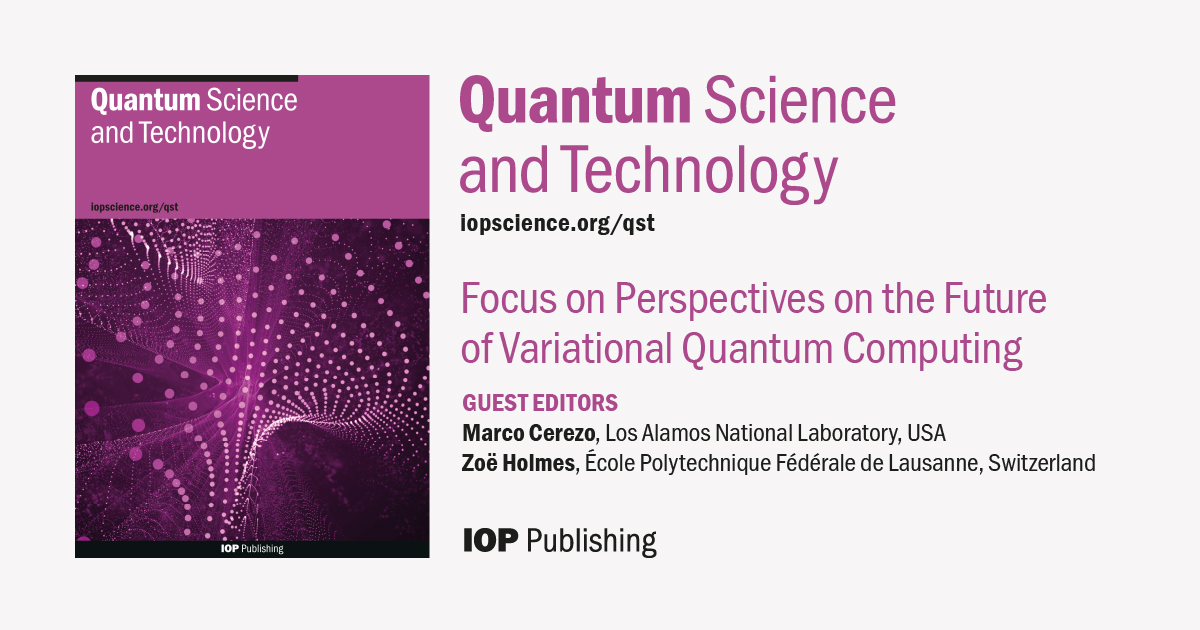
Check out our latest focus issue “Perspectives on the Future of Variational Quantum Computing"
Read it here- ow.ly/fR1W50Uu1av
Guest editors:
✍️ Marco Cerezo @MvsCerezo
✍️ Zoe Holmes @qZoeHolmes
7
26
5,105
Quantum Science & Technology retweeted

1 Dec 2024
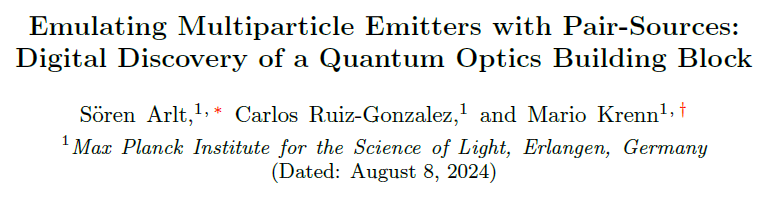
If a clever algorithm finds a super-human solution: What did the machine discover that humans have overlooked?
Happy to have one answer for a super-human quantum optics solution published in @QuantSciTech:
iopscience.iop.org/article/1…
spearheaded by @soerenarlt & @cruizgo_
The super-human solution are experimental designs of high-dimensional GHZ states, discovered by PyTheus (quantum-journal.org/papers/q…). @soerenarlt wanted to know HOW those solutions work. What did the machine find, what's the trick, can we generalize the idea?
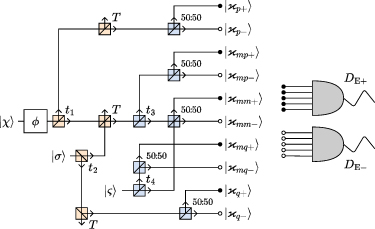
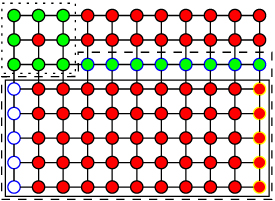
Indeed we discovered that PyTheus has generated an effective experimental blueprint for generating multi-photon emitters from just pair sources, by exploiting complex multi-photon interference.
Multiphoton emitters themselves are extremely challenging to build natively. The algorithm has discovered a way to create effective multi-photon emitters, and used it for solving the high-dimensional GHZ question.
Now that we know how to create effective multiphoton emitters, we can use them in many situations, by hand - without the need of algorithms.
It's an example how we humans can learn new physics ideas from a machine. More to come -- for sure!
4
14
1,154
22 Oct 2024
Discover opportunities to co-review! ✨Together let's raise recognition & improve inclusivity. Whether an #EarlyCareerResearcher with limited experience of #PeerReview, or an experienced supervisor, there's support for you.👫 Who will you collaborate with? ow.ly/SiiE50TLusN
3
340
13 Sep 2024
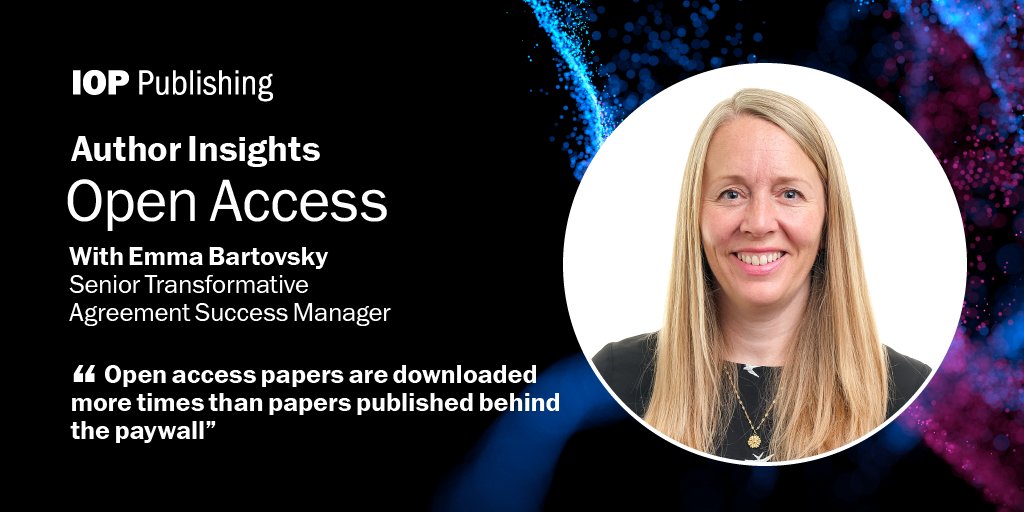
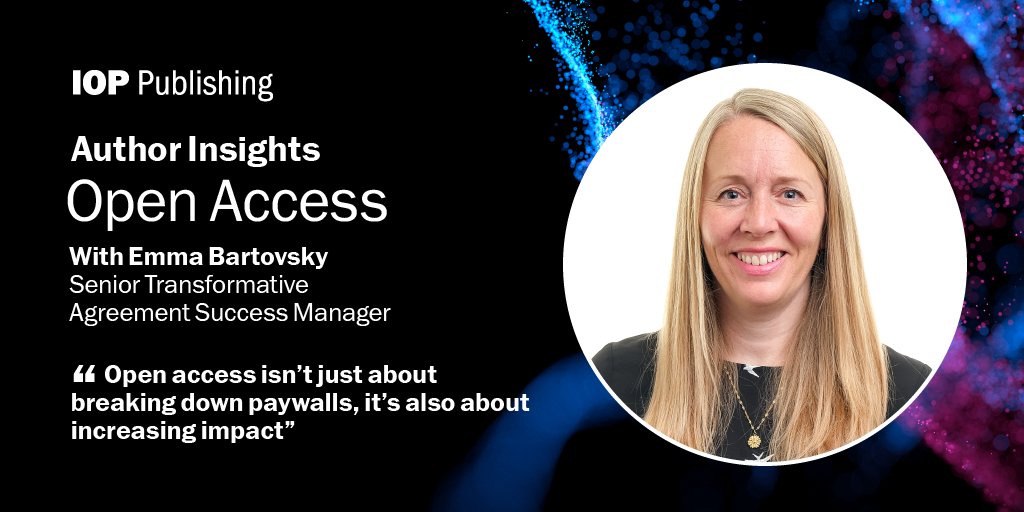
In our new short blog series, Emma Bartovsky discusses key benefits to publishing open access, including how you can get more eyes on your work, and enable wider collaboration.
👉ow.ly/Fc1150SPSHK
#AuthorInsights #PublishingSupport #PublishingAdvice #ResearcherSupport
1
2
433
21 Aug 2024
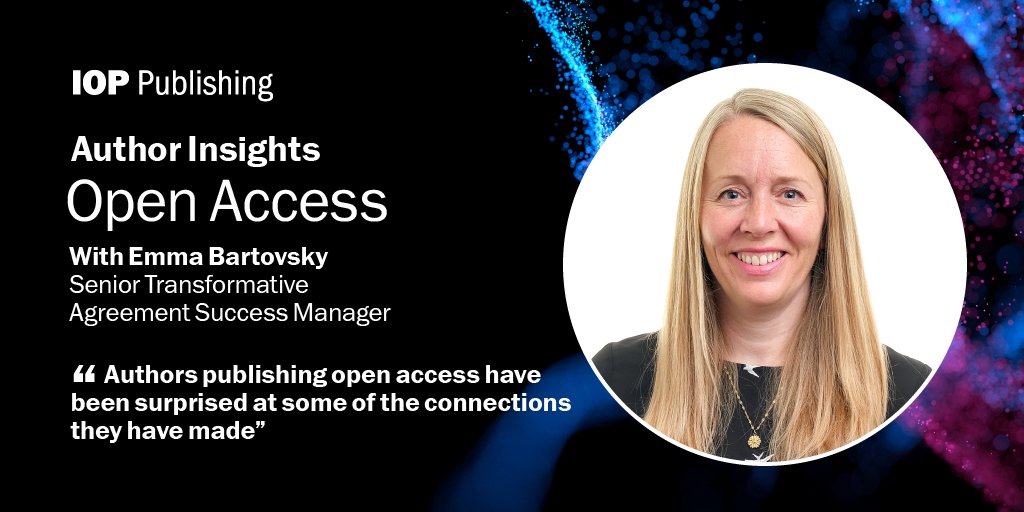
Our latest Author Insights blog is out now.
👉ow.ly/gzWz50SPSFY
Including how you can enable a wider audience for your research, make unexpected connections and more.
#AuthorInsights #PublishingSupport #EarlyCareerResearcher #PublishingAdvice
4
351
20 Aug 2024
Introducing our new focus issue, dedicated to the field of quantum thermodynamics. This issue is intended to provide insights into current trends and developments in the field.
More info: ow.ly/S7Je50T0XLR
#QuantumTechnologies #Thermodynamics #QuantumSystems
1
2
16
953
Quantum Science & Technology retweeted

7 Aug 2024
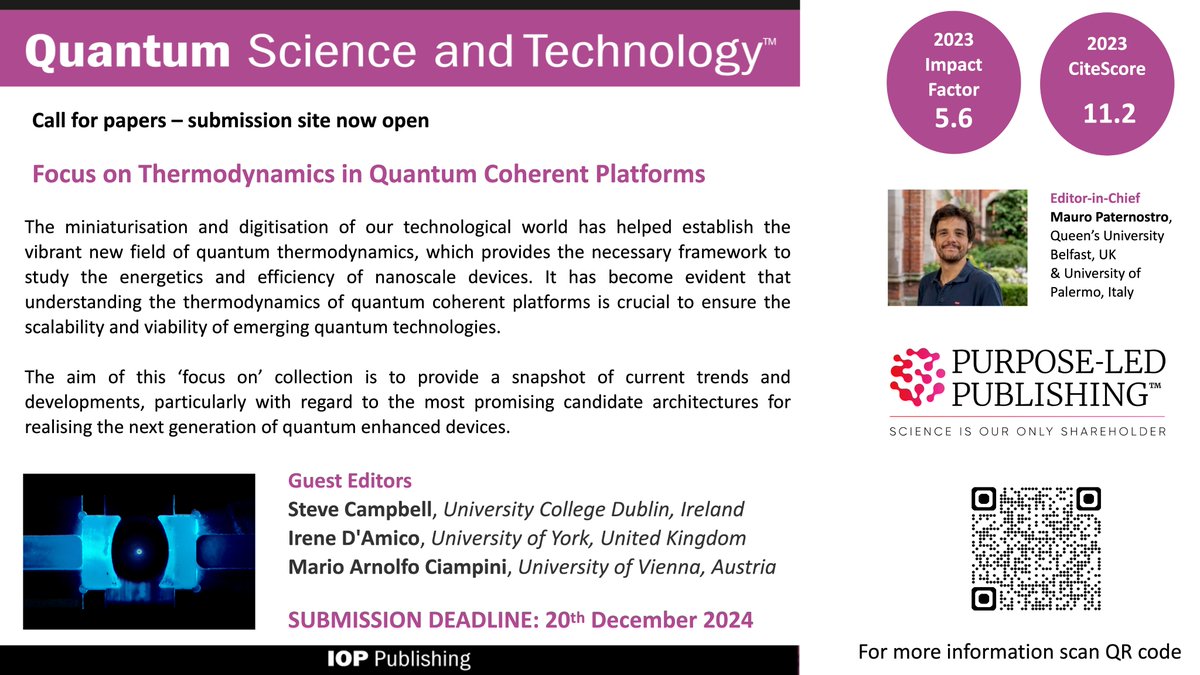
A wonderful paper that also kicks off a new Focus on Thermodynamics of Quantum Coherent Platforms collection for @QuantSciTech we are pulling together.
Submissions are open tinyurl.com/2n2zrcj4
2 Aug 2024

My work with Sebastian Deffner (@quthermo_comp) and Diogo O Soares-Pinto, "Conditional quantum thermometry—enhancing precision by measuring less" has just been published on Quantum Science and Technology: doi.org/10.1088/2058-9565/ad… via @QuantSciTech
Happy reading!
5
18
2,993
7 Aug 2024
Discover how #OpenAccess can:
➡️Increase visibility for your work
➡️Boost downloads and citations
➡️Foster wider collaboration
Find out more: ow.ly/OJXJ50SPSEp
#OpenAccess #EarlyCareerResearchers #AcademicPublishing
1
224
Quantum Science & Technology retweeted

2 Aug 2024
My work with Sebastian Deffner (@quthermo_comp) and Diogo O Soares-Pinto, "Conditional quantum thermometry—enhancing precision by measuring less" has just been published on Quantum Science and Technology: doi.org/10.1088/2058-9565/ad… via @QuantSciTech
Happy reading!
2
4
30
4,342
2 Aug 2024
Hacking coherent-one-way quantum key distribution with present-day technology
Read the paper #OpenAccess here- ow.ly/3l9u50SJTeY
#QuantumKeyDistribution #QuantumTechnology #QuantumComputing
@atlanTTic_uvigo
1
7
371
1 Aug 2024
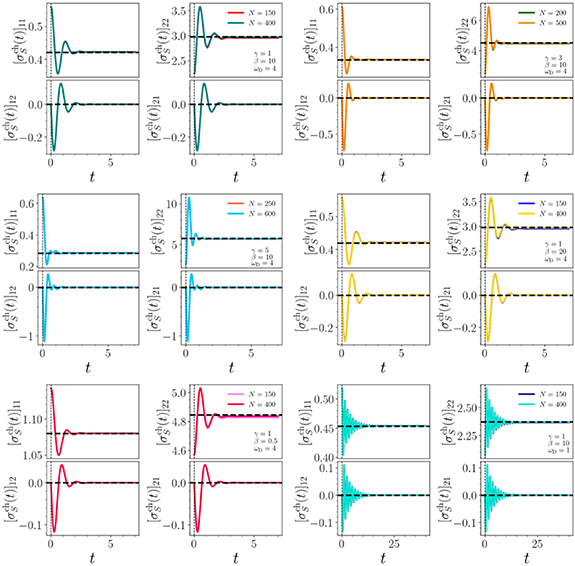
System-bath correlations and finite-time operation enhance the efficiency of a dissipative quantum battery
Read the paper here- ow.ly/y9JC50SJT8i
#QuantumBattery #QuantumTechnology #EnergyEfficiency
@DFI_UChile
2
8
483
31 Jul 2024
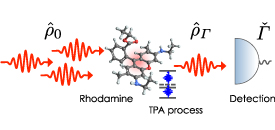
Optimal quantum metrology of two-photon absorption
Read the paper #OpenAccess here- ow.ly/HpqV50SJT1F
1
4
235
31 Jul 2024
🤔Are you ready to start your Peer Review Excellence journey? 🔝Up your peer review game, and join our growing community of expertly trained reviewers. Find out more ➡️🔗ow.ly/iO2R50SKREM
2
191