
Election forecasting, political and economic analysis, and data-driven insights.
Joined October 2021
- Tweets 42,397
- Following 2,036
- Followers 29,553
- Likes 59,425
4,006 Photos and videos
Pinned Tweet

Jun 12
NEW QUANTUS INSIGHTS POLL | June 12, 2026
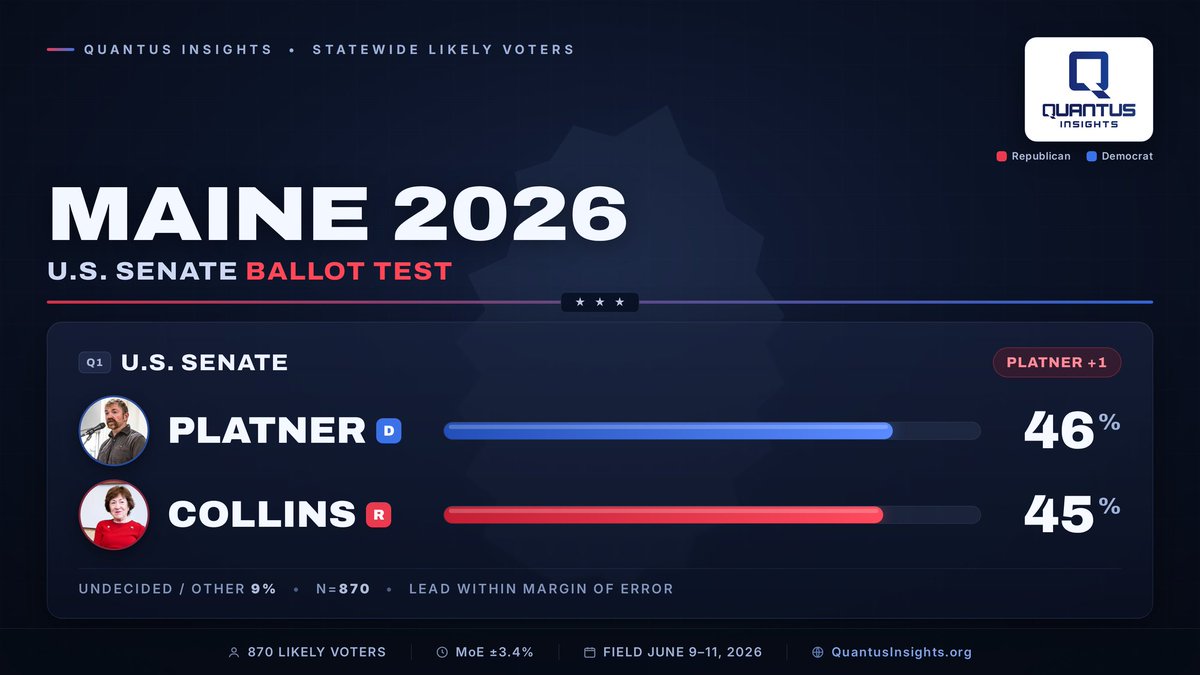
Our latest Maine U.S. Senate survey finds the race tightening sharply since March, with Graham Platner now holding a narrow 1-point edge over Susan Collins.
📊 Maine U.S. Senate
🔵 Graham Platner: 46%
🔴 Susan Collins: 45%
⚪️ Undecided: 7%
⚪️ Other: 2%
––––––––––––––––––––––––––
📊 Generic Congressional Ballot
🔵 Democratic candidate: 50%
🔴 Republican candidate: 40%
⚪️ Undecided: 8%
⚪️ Other: 3%
––––––––––––––––––––––––––
📊 Susan Collins
Favorable: 42%
Unfavorable: 56%
Very unfavorable: 49%
––––––––––––––––––––––––––
📊 Graham Platner
Favorable: 40%
Unfavorable: 57%
Very unfavorable: 37%
The Maine Senate race has moved from an early Democratic advantage to a statistical tie. Platner led Collins by 7 points in our March survey, but now leads by just 1. Collins remains deeply underwater, yet she is running ahead of the Republican brand in a state where Democrats lead the generic ballot by 10. Platner’s standing has softened amid recent controversies, and the race remains highly competitive and unsettled.
25
18
58
22,078
Quantus Insights retweeted

Jun 10
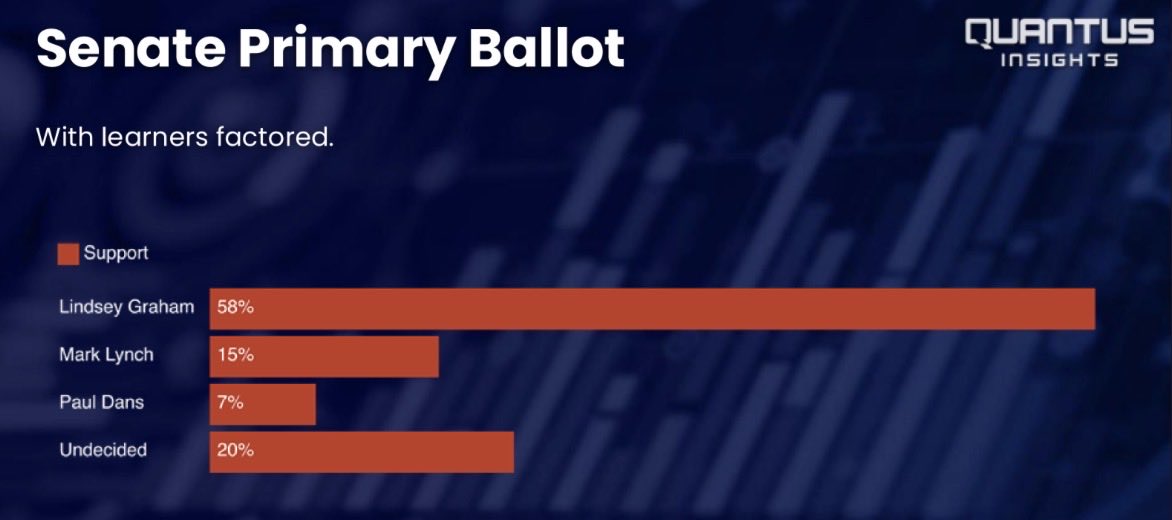
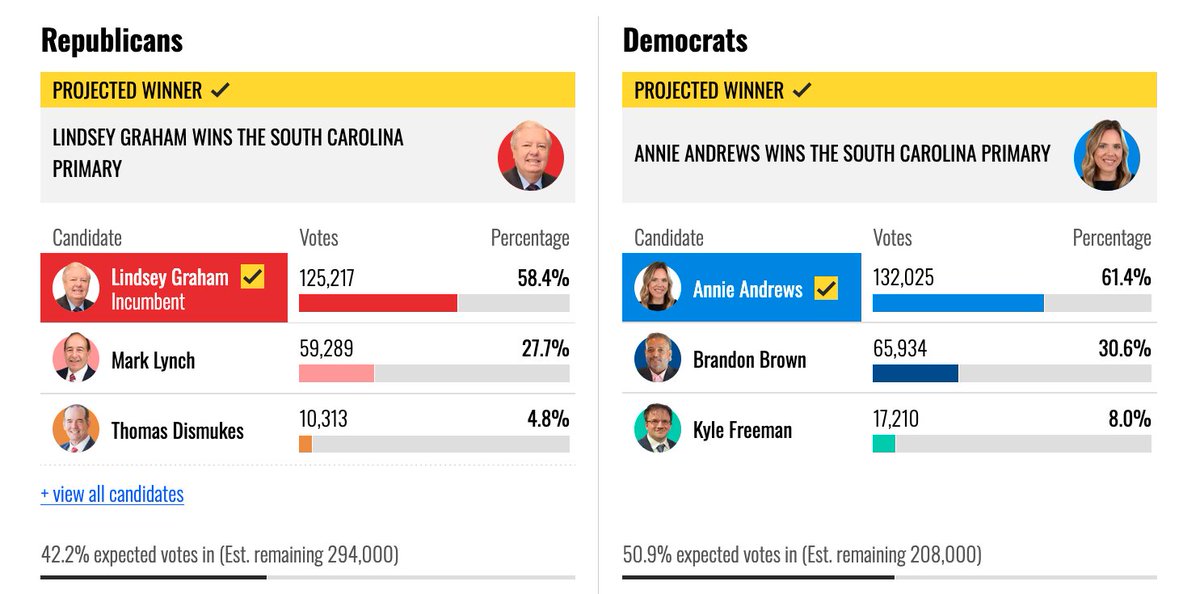
It looks like we have nailed Graham’s top line finish. We never followed up as it looked out of reach from early on.
Jun 10

Sen. Lindsey Graham (R) will face Annie Andrews (D) in the South Carolina Senate race this fall, @NBCNews projects.
Graham is a heavy favorite to win re-election in this red state.
4
2
26
6,377
NEW QUANTUS INSIGHTS POLL | June 5, 2026
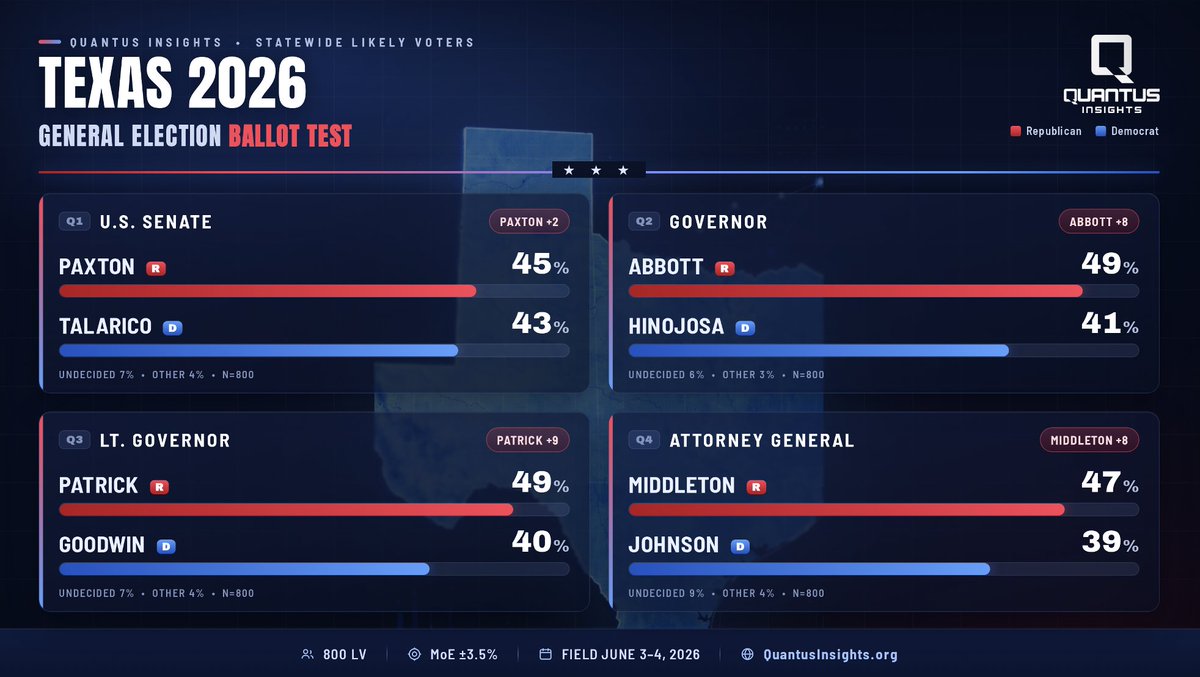
Our first Texas general election survey of the cycle finds Republican candidates leading across the major statewide contests, with the U.S. Senate race standing as the closest fight.
📊 Texas Statewide Toplines
U.S. Senate
🔴 Ken Paxton: 45%
🔵 James Talarico: 43%
⚪️ Undecided: 7%
⚪️ Other: 4%
––––––––––––––––––––––––––
Governor
🔴 Greg Abbott: 49%
🔵 Gina Hinojosa: 41%
⚪️ Undecided: 6%
⚪️ Other: 3%
––––––––––––––––––––––––––
Lt. Governor
🔴 Dan Patrick: 49%
🔵 Vikki Goodwin: 40%
⚪️ Undecided: 7%
⚪️ Other: 4%
––––––––––––––––––––––––––
Attorney General
🔴 Mayes Middleton: 47%
🔵 Nathan Johnson: 39%
⚪️ Undecided: 9%
⚪️ Other: 4%
Key Takeaway
Texas remains Republican-leaning, but still competitive this early in the cycle. The Senate race is the most fluid, with Paxton leading Talarico by just 2 points. Down ballot, Abbott, Patrick, and Middleton hold clearer advantages, with room for Republican consolidation as the general election environment takes shape.
29
62
238
86,537
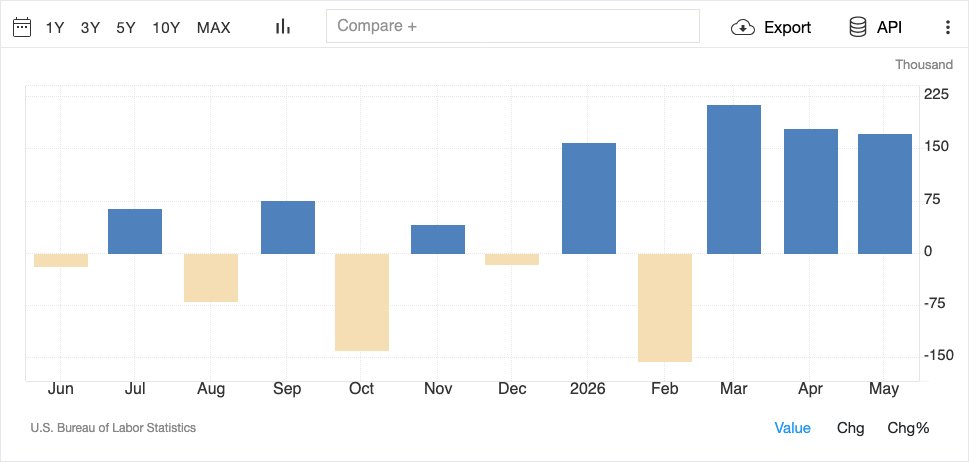
U.S. added 172,000 jobs in May blowing past expectations of ~80k.
Unemployment rate: Steady at 4.3% (narrow range of 4.3–4.5% since mid-2025)
Wage growth: Average hourly earnings 0.3% MoM to $37.53. 3.4% YoY.
1
4
27
1,611
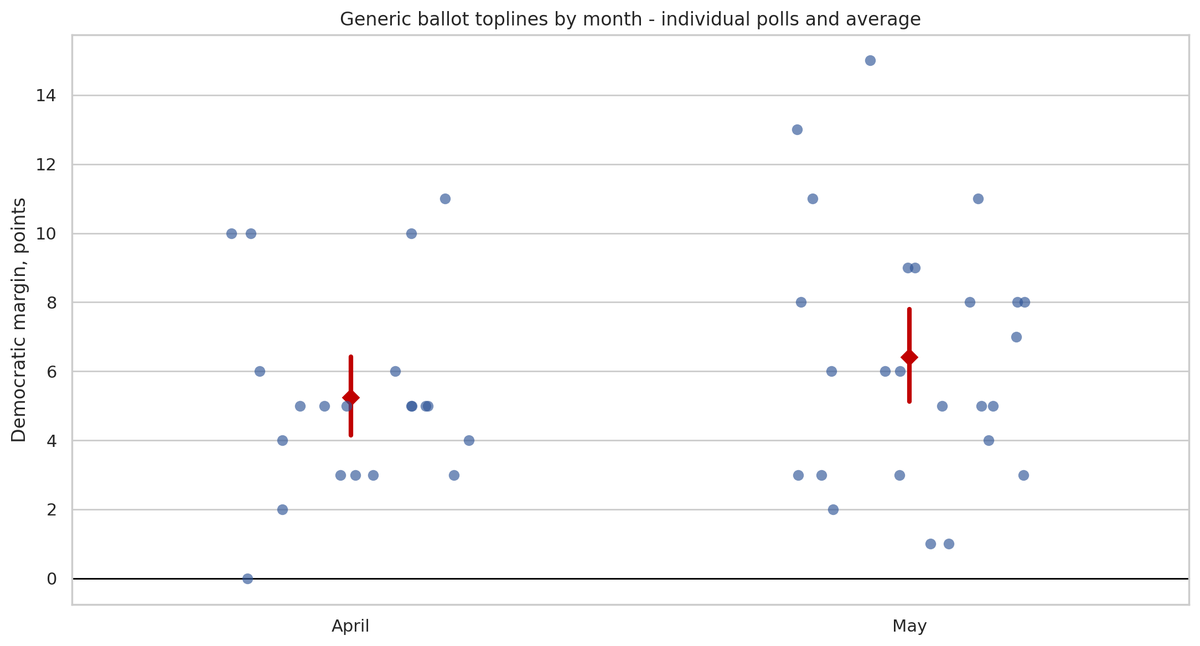
Generic ballot check-in:
Using RCP’s public polling list, we averaged generic ballot toplines since April, treating each poll equally. So, no weighting by pollster or sample size.
🔵 April averaged D 5.2 across 21 polls.
🔵 May averaged D 6.4 across 25 polls.
That puts May about 1.2 points more Democratic than April.
We also looked at poll-to-poll dispersion using a t-based confidence interval.
Even applying a conservative 2.5-point directional polling-error band, the picture remains consistent:
🔵 April: D 2.7 to D 7.7
🔵 May: D 3.9 to D 8.9
That lines up with Quantus’ own 2026 generic ballot trend, which has shown similar stability: D 6 in January, D 6 in February, D 5/D 6/D 5 in March, D 5 in April, and D 5 in June.
So the polling trend remains the same. A continued modest polling lead (we'd call 5-6 pt margin modest) for Democrats in April, and May was modestly stronger for Democrats than April.
2
2
7
2,761
NEW SURVEY: Quantus Insights National Poll
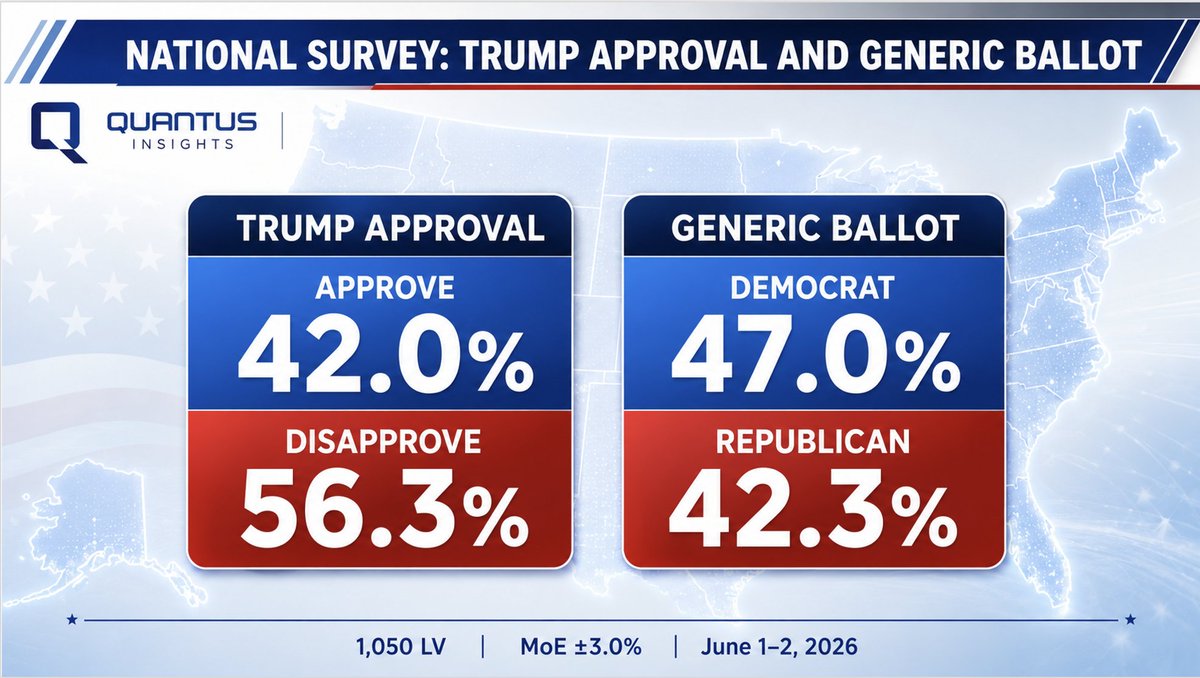
The national mood is largely unchanged from our late April survey. Trump remains underwater on job approval, most voters say the country is on the wrong track, Democrats hold a modest edge on the generic ballot, and voters are highly motivated heading into 2026. Yet the same electorate also gives majority support to proof-of-citizenship voting requirements and Medicaid work requirements.
Trump Job Approval
🟢 Approve: 42.0%
🔴 Disapprove: 56.3%
⚪️ Unsure: 1.6%
––––––––––––––––––
National Direction
🔴 Wrong Track: 60.6%
🟢 Right Direction: 35.7%
⚪️ Not Sure: 3.7%
––––––––––––––––––
Generic Congressional Ballot
🔵 Democrat: 47.0%
🔴 Republican: 42.3%
⚪️ Undecided/Other: 10.7%
–––
🟡 Margin: D 4.7
––––––––––––––––––
2026 Midterm Motivation
🟢 Extremely/Very Motivated: 87.2%
⚪️ Somewhat Motivated: 6.8%
🔴 Not Very/Not At All Motivated: 6.1%
––––––––––––––––––
SAVE America Act (Proof of Citizenship)
🟢 Support: 62.8%
🔴 Oppose: 29.8%
⚪️ Unsure / Haven’t Heard Enough: 7.4%
––––––––––––––––––
Medicaid Work Requirements
🟢 Support: 64.4%
🔴 Oppose: 21.1%
⚪️ Unsure: 14.5%
––––––––––––––––––
Trump Handling Iran
🟢 Approve: 39.0%
🔴 Disapprove: 59.5%
⚪️ Not Sure: 1.5%
––––––––––––––––––
1,050 LV | MoE ±3.0% | June 1–2, 2026.
Visit quantusinsights [dot] org for the report and link to cross tabs.
10
9
56
25,001
May 27
This is a wrap. Major swings all over. Paxton can pull up and walk to the finish line now.
6
17
145
4,322
May 26
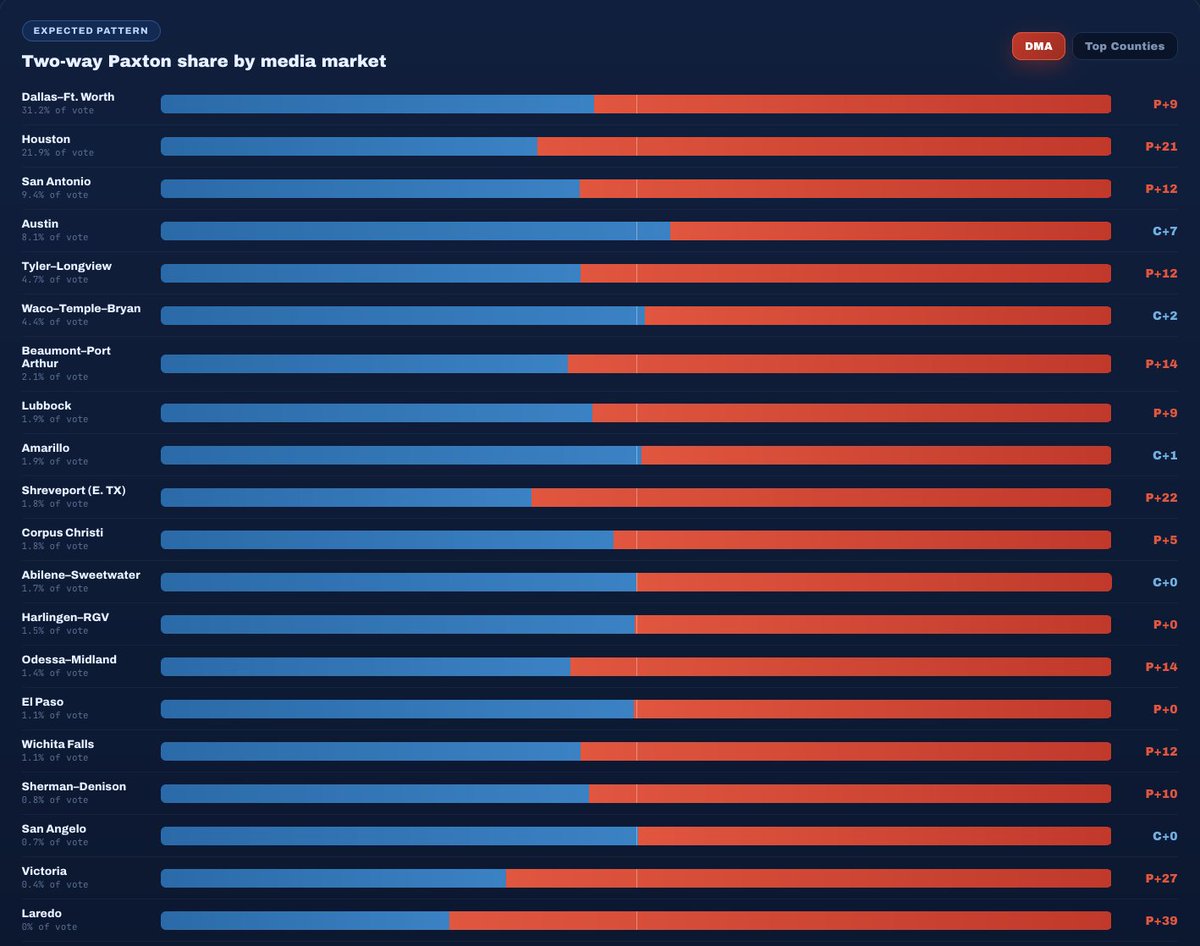
What we're watching for tonight in the Texas Republican Senate runoff.
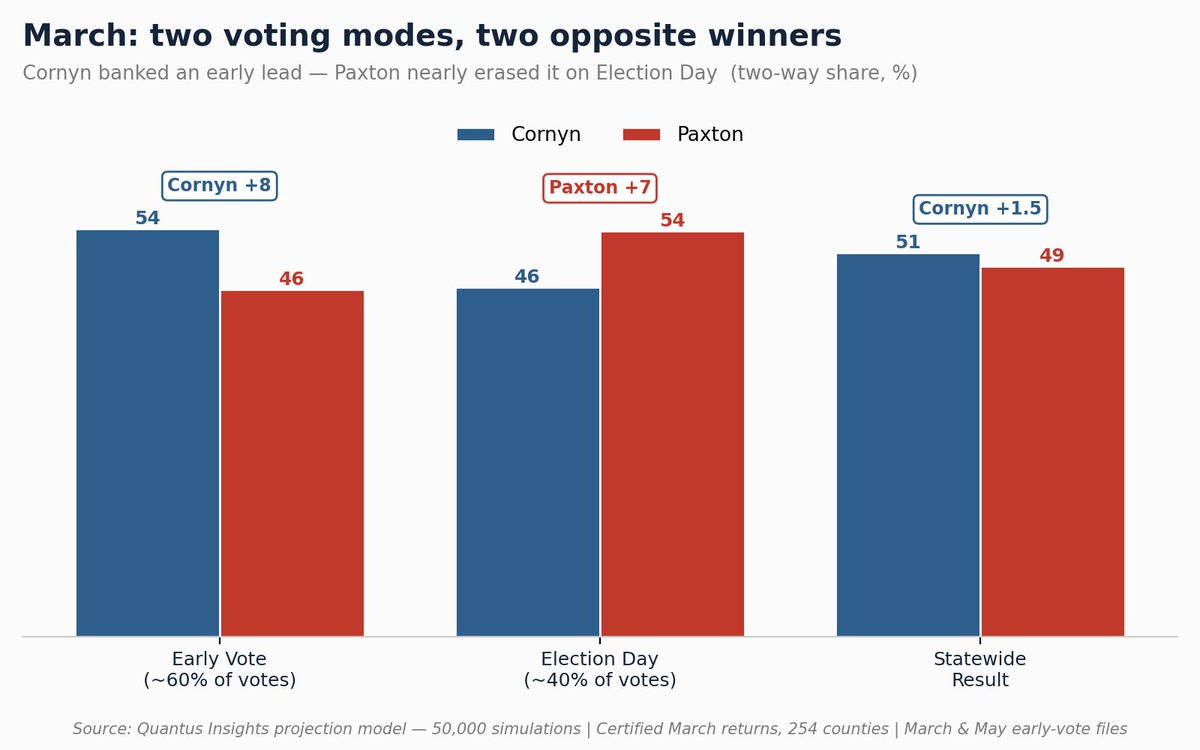
1. Early vote (~61% of ballots) is banked and roughly even. Cornyn's metros turned out early (Travis 80%, Lubbock 78%, Harris 74% recovery). Watch the first EV dump: Near-even or slight Cornyn margin is expected.
2. Election Day breaks Paxton. His rural base votes late (32% early recovery vs 42% suburban). The margin should widen toward Paxton as Election-Day precincts report.
3. Canaries for a Cornyn night: If Paxton wins Austin or Waco-Temple-Bryan, he's overperforming. Both should hold for Cornyn according to our model.
What we might expect to see in a 10 Paxton environment (by media market). We have several other scenarios to the left and to the right of our center tendency as well, and will share them accordingly.
5
11
39
15,149
May 25
The turnout data confirms model uncertainty and model projections in equal measure, and the net is a wash. The early-vote geography is essentially a replay of March to an even outcome. Nothing seems to point toward and expanded electorate for Cornyn as theorized by some. We still project Paxton as the clear favorite to win tomorrow night.
May 25

Very similar to what we found but much more detail offered below. The electorate is real Republicans, not a Cornyn crossover scenario. As for the model, this kills one tail risk entirely. ~6% of early voters are March first-timers, ~4% have no GOP primary history, and 65% have voted in 4-6 of the last 6 GOP primaries.
This is a hardcore, high-propensity Republican runoff electorate. Cornyn is not mobilizing Democrats or low-information crossovers to bank on for Election Day. That "Cornyn brings in new voters" scenario is unlikely and it cuts against a Cornyn expanded electorate.
5
6
34
4,824
Quantus Insights retweeted
May 25
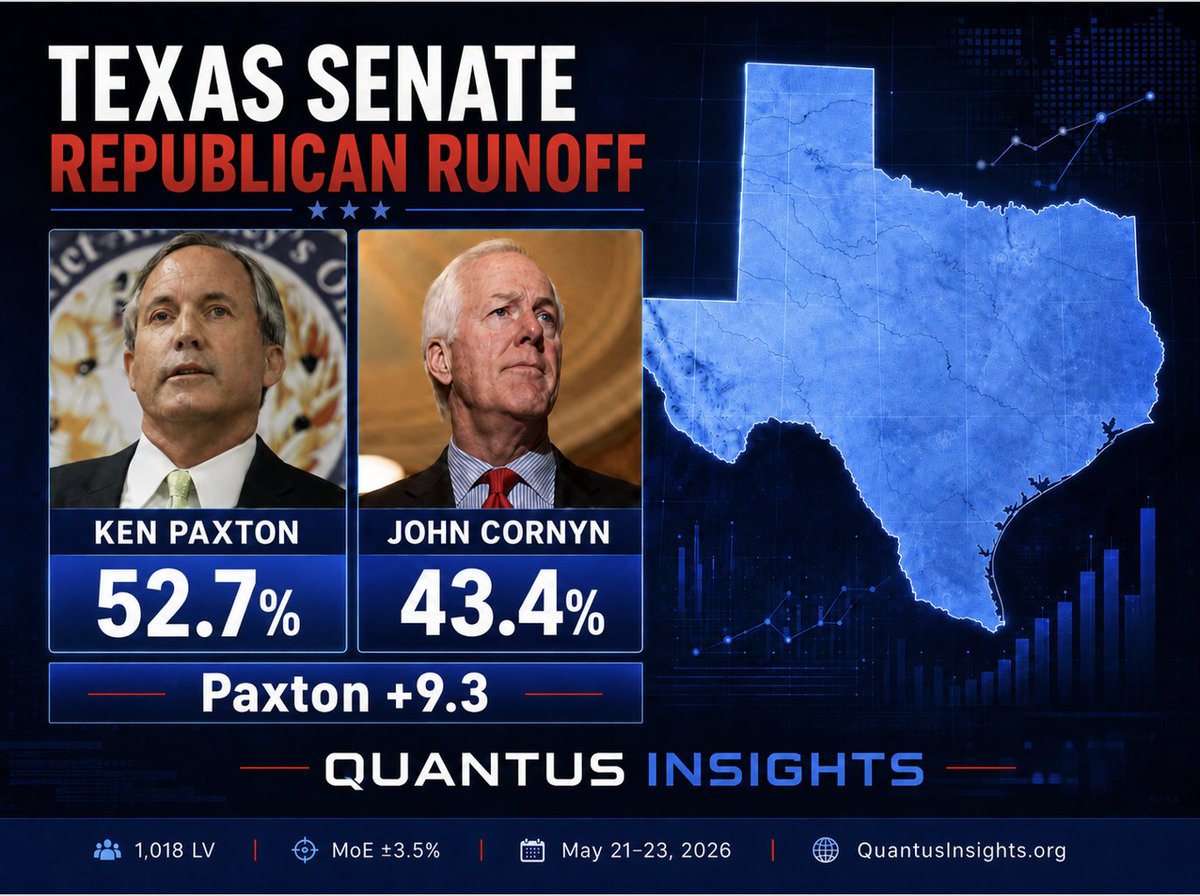
See our election eve poll for the Texas Senate GOP runoff. Link to article and cross tabs in the comments.
5
7
22
2,894
May 25
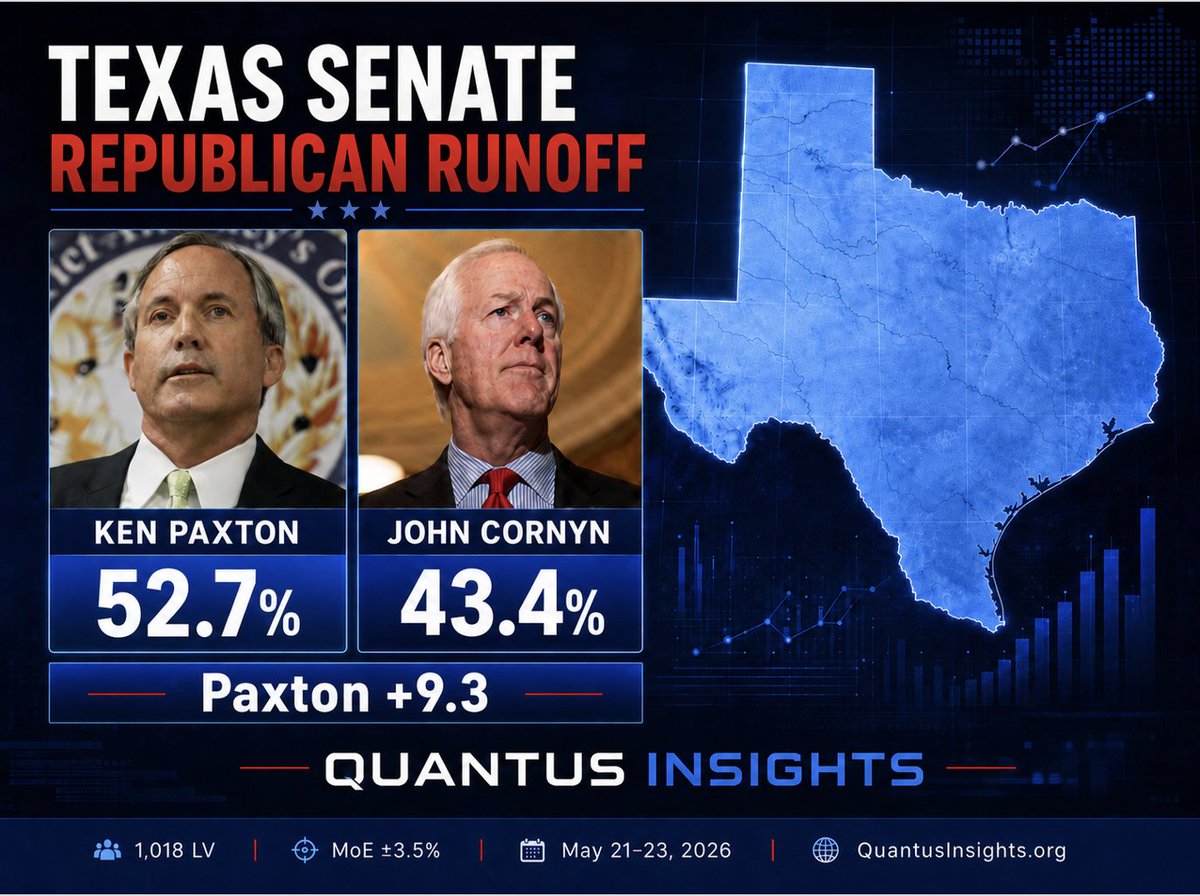
NEW QUANTUS INSIGHTS POLL | May 25, 2026
Texas Republicans vote tomorrow in the U.S. Senate runoff, and our final survey finds Ken Paxton entering Election Day with the edge over John Cornyn.
📊 Texas GOP Senate Runoff
🔴 Ken Paxton: 52.7%
🔴 John Cornyn: 43.4%
⚪️ Undecided: 3.9%
––––––––––––––––––––––––––
📊 Key Takeaway
Paxton begins Election Day above 50% and leads Cornyn by 9.3 points among likely Republican runoff voters.
President Trump’s endorsement was widely known, with 87.8% aware of it. Most voters said it did not affect their vote, but among those who said it moved them, the movement broke toward Paxton: 61.7% moved toward Paxton, compared with 38.3% toward Cornyn.
27
73
315
27,421
May 25
We now have the regional EV drops reconciled into one picture.
Together, the sub/urban, rural, and South TX regions account for essentially the full GOP runoff electorate: ~2.23M March votes and ~855k runoff EV.
The consistent finding across county, precinct, rural, South TX, and sub/urban data: Cornyn’s geography banked early.
Sub/urban/Cornyn-leaning areas recovered about 41% of their March vote, while Paxton-leaning rural areas recovered about 32%.
If March vote behavior held, the banked early vote is roughly Cornyn 2. If persuasion, defections, and transfer votes played any part then the result could be closer to tied or even tilt Paxton.
None of this tells us the final result but it does tell us the likely shape of the race: Cornyn likely banked his best vote early. Paxton’s coaltion best vote is geared for Election Day turnout.
6
5
34
3,230
May 25
One thing standing out in the Texas GOP Senate runoff EV data: Cornyn’s county-mix advantage in the early vote is not coming mainly from deep-Cornyn counties. It’s concentrated in the large counties he won modestly in March.
The strongest overperformance is in counties Cornyn carried by 0–10 points:
-Runoff EV share: 41.4%
-March electorate share: 38.2%
-Net change: 3.1 pts
That is not unexpected and suggest the geographic EV turnout pattern is not obviously tilted toward a Paxton-heavy map.
Still, county composition only tells us so much.
The key unknown is whether voters inside those counties are behaving like they did in March or whether the electorate has consolidated toward Paxton and shifted since then.
May 24

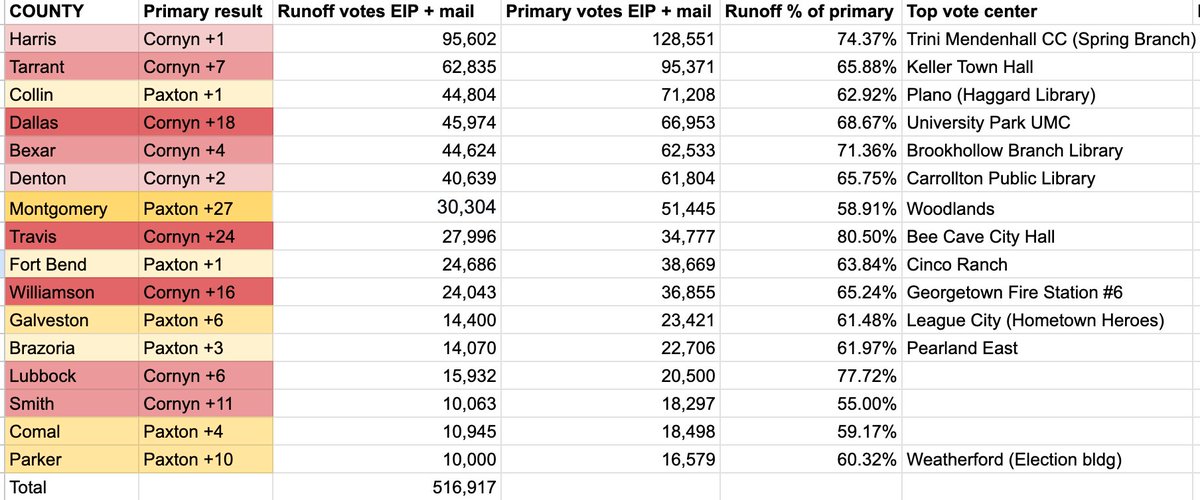
Final count of early voting mail now that the EV period is over in the Texas Republican runoff.
These counties cast >25k Republican primary votes in March. Pretty solid turnout in Travis/ Lubbock/Harris/Bexar
SOS reports ~829k votes total; primary was 1.3M early mail
#txsen
13
9
43
12,565
May 23
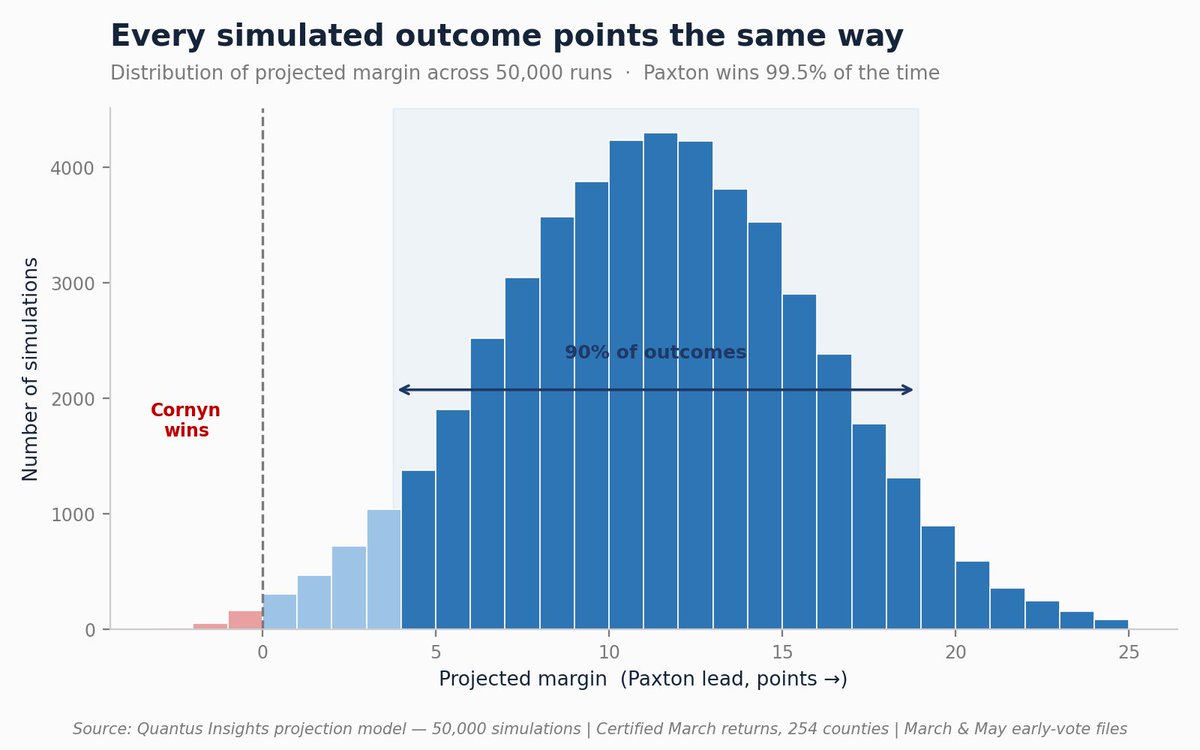
FOLLOWING UP ON THE TEXAS REPUBLICAN SENATE RUNOFF: Ken Paxton is the clear favorite. Our central projection has him winning by a comfortable margin with full final estimate to come.
Across 50,000 simulations, Paxton wins 99.5% of the time. Cornyn only gets close in the extreme tail if: the Trump endorsement barely moves voters, turnout collapses into his best composition, and his early-vote coalition overperforms.
10
26
76
36,384
May 23
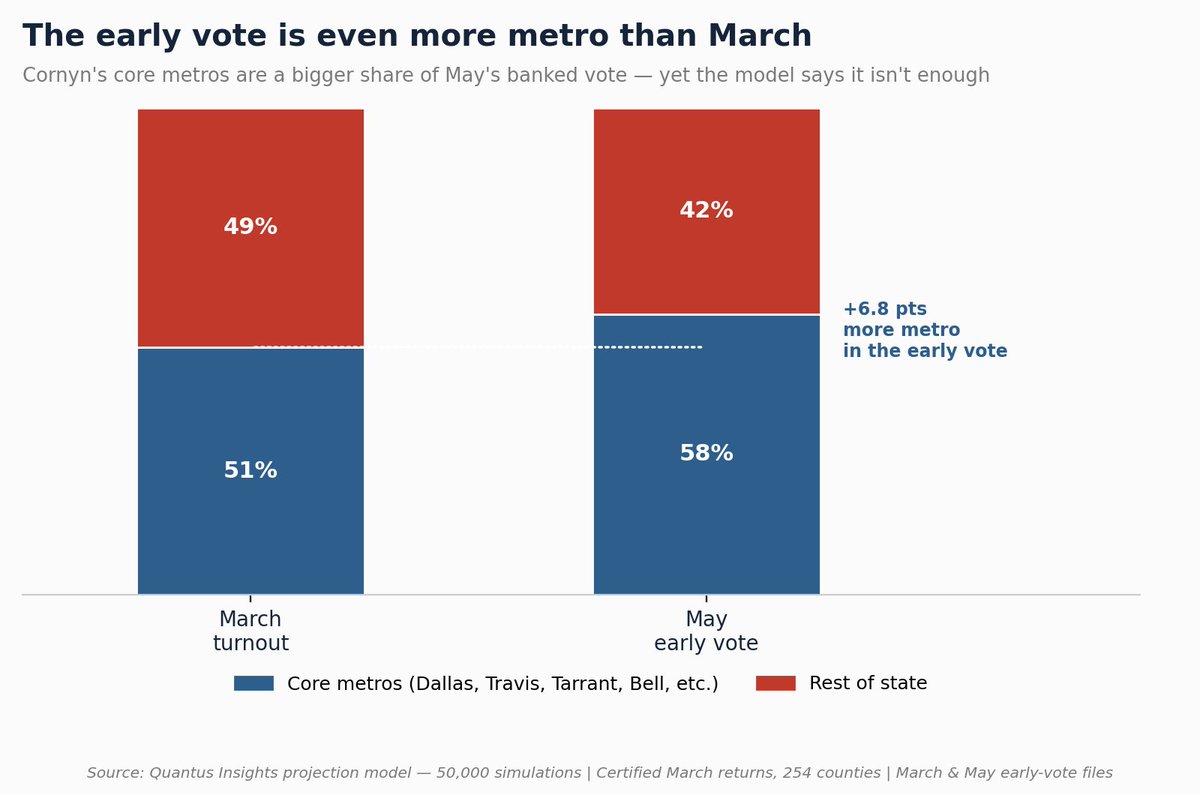
The runoff early vote is even more metro-tilted. Cornyn's core metros are ~58% of the May early vote vs. ~51% of March turnout.
Yet Paxton's preference position has improved enough that the model has him ahead even in the early vote. Potentially by mid-single digits with Election Day likely extending it. The composition edge that saved Cornyn in March no longer looks sufficient.
The biggest wildcard is turnout shock: if runoff turnout falls below ~42% of March, the more committed base wins out and that points historically to Paxton's coalition. A sharp collapse wouldn't just help him; it could push the result toward the extreme end of our range.
1
8
1,907
May 23
Methodology:
Built from certified March county-level returns. All 254 counties, all 8 candidates, 2,166,910 votes reconciled against the combined county file. Incorporates March and May early-vote files, public runoff polling, and our own Quantus Insights polling.
50,000 Monte Carlo simulations across seven parameter ranges. Margins modeled two-way: Cornyn vs. Paxton. Full county detail, assumptions, distribution, and tornado sensitivity informed the projection.
1
6
1,627
May 22
TEXAS GOP RUNOFF early vote update:
Per @DDHQdata, roughly 336,000 early ballots are now in about 15.5% of February’s primary turnout.
That includes about 287k in-person votes and 49k mail ballots.
Early-vote files do not tell us vote choice. They only tell us who is showing up. But that is the core input behind every serious runoff projection.
3
15
53
6,100
May 22
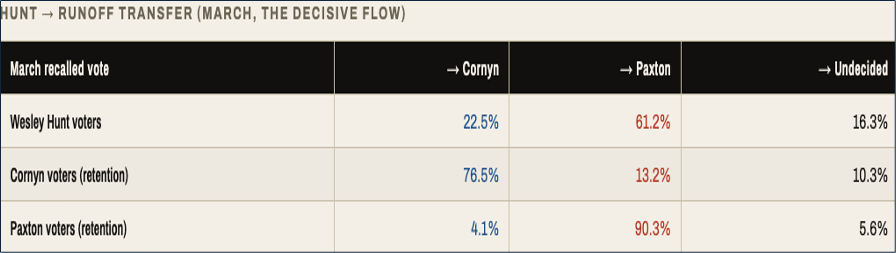
Cornyn won 105 of 254 counties in February.
But in a head-to-head runoff environment, many of those counties become much harder to hold because Hunt’s vote was not evenly transferable.
Where Hunt was strong and rural, the transfer is especially punishing for Cornyn.
Where the electorate is metro/suburban, Cornyn has more room.
1
6
1,277
May 22
Bottom line: The early vote gives Cornyn a small amount of compression but not a reversal.
Paxton remains the clear favorite by every method we are using: February actual results, early-vote geography, March runoff polling, and current Quantus Insights polling ahead of May 26.
1
16
1,169