
Storage Architected for AI™
Joined February 2014
- Tweets 1,054
- Following 288
- Followers 406
- Likes 167
625 Photos and videos

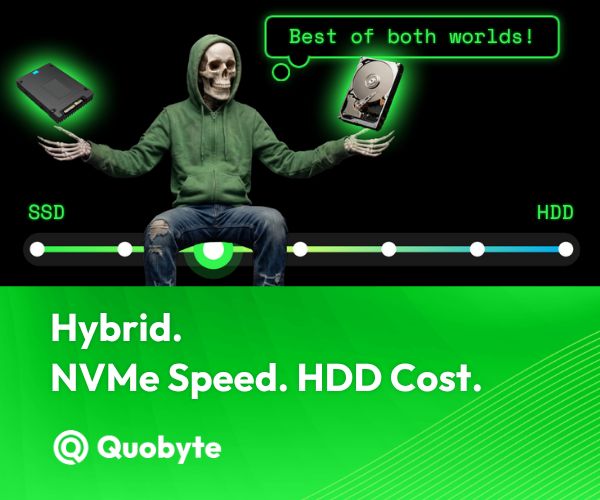

GPU utilization in AI is often limited by how fast data can be delivered.
In practice, storage bottlenecks stall training runs, delay checkpoints, and leave expensive compute underutilized. That means lower efficiency and slower time to results.
Quobyte removes that constraint.
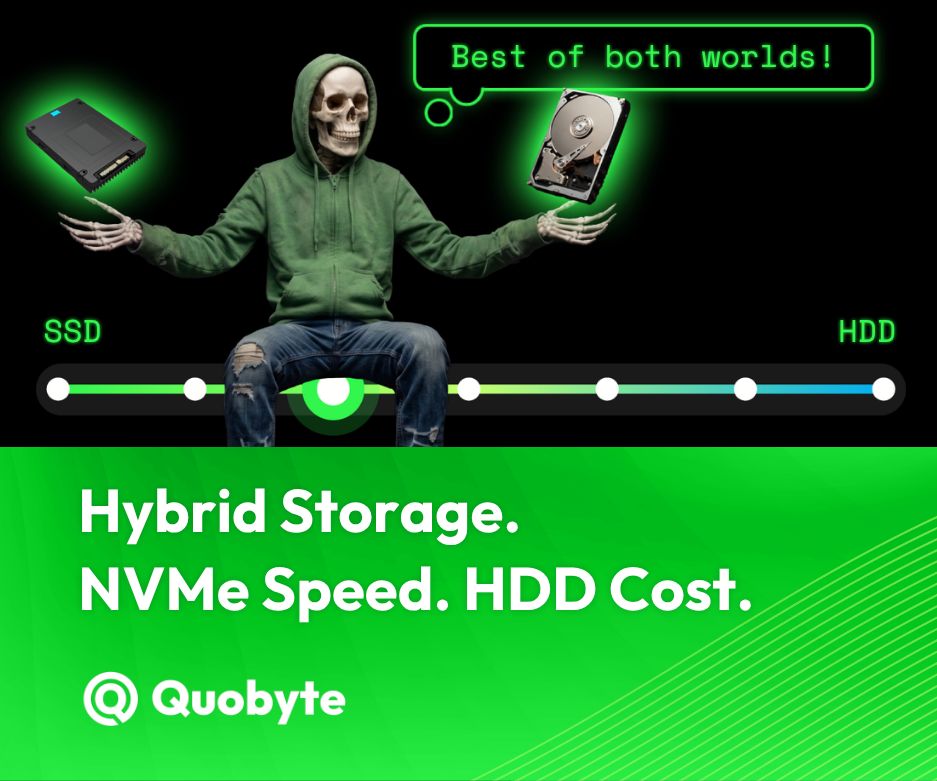
Our software-defined storage delivers parallel performance with linear scaling, keeping GPUs fed as clusters grow. It also combines NVMe and HDD in a single system, intelligently placing data so you get performance where it matters without the cost of an all-flash architecture.
The result is higher GPU utilization, lower total cost of ownership, and faster time to insight
We will be at ISC in Hamburg, June 23 to 25. Visit Booth E01 to see how storage architecture directly impacts AI performance and economics.
Book your demo:
buff.ly/UNh2qWh
#AIInfrastructure #HPC #ISC26 #Quobyte
14
You've already paid for your AI storage tier. It's just sitting idle.
Every GPU node ships with hundreds of gigabytes of RAM, dozens of CPU cores, and multiple NVMe drives that mostly go unused while the accelerators do the work. Quobyte GPU Converged Storage turns that spare capacity into a real, high-performance parallel file system that runs on the GPU nodes themselves. No second cluster to buy or power.
How much storage are you already paying for and not using? We'll do the math with you at ISC High Performance 2026, Booth E01, June 23 to 25: buff.ly/BOb8Hvj
#AIInfrastructure #HPC #ISC26 #Quobyte
18
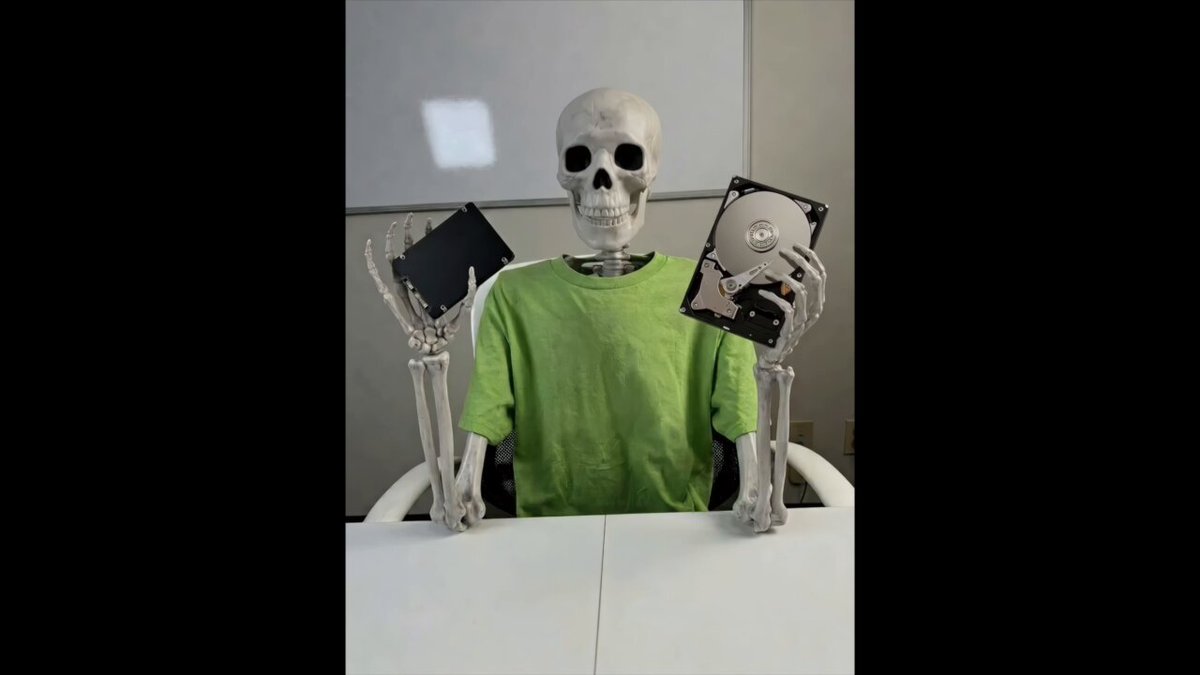
Not every byte of AI data needs flash. But most storage architectures make you pay for it anyway, or push you into a second system to handle the cold stuff.
Quobyte runs flash and hard drives in the same namespace, with policies that decide where data lives based on how it's actually used. Hot training data sits on NVMe, while older checkpoints and reference datasets move to HDD, all under a single file system with a single operations model.
Come talk to us at ISC High Performance 2026 in Hamburg, booth #E01, June 23 to 25.
We can walk you through:
How a single namespace serves both flash and HDD without a separate archive tier bolted on
How policies move data between media without changing paths or breaking workflows
What linear scaling looks like across both tiers as you add nodes
If you're paying flash prices for data that hasn't been touched in months, let's talk: buff.ly/HfwzOXn
#AIInfrastructure #HPC #ISC26 #Quobyte
19
Ever notice how the storage bill for an AI cluster has a way of sneaking up on you?
You buy the GPUs, and then a proprietary appliance shows up at several times the cost of the hardware it runs on. Then a second box for checkpoints. A third for archive. Three contracts, three refresh cycles, three admin workflows for what should be one job.
Quobyte collapses that back into a single system that runs on the x86 and ARM servers you already have. No proprietary appliance, one namespace for everything from hot training data to cold archive.
We'd love to show you the real thing in Hamburg this June. Find us at ISC High Performance 2026, booth #E01, June 23 to 25. Bring your cluster's GPU count and the storage problem that's been bugging you, and we'll walk through how Quobyte handles it, live on a demo screen.
Grab 20 minutes with us: buff.ly/IH1xA5y
#AIInfrastructure #HPC #ISC26 #Quobyte
10
Most AI infra teams run out of power, rack space, and switch ports long before they run out of budget. And then they bolt on a separate storage appliance that needs all three.
Quobyte GPU Converged Storage runs the parallel file system directly on your GPU nodes, drawing on the CPU, RAM, and NVMe already present to deliver a full, high-performance storage tier. No separate appliances, no extra switch ports, and capacity that grows with every GPU node you add.
Runs on x86, ARM, NVIDIA Grace, and AMD, so you're never locked into a hardware path.
See it live at ISC High Performance 2026 in Hamburg, booth E01, June 23–25.
Book a demo: buff.ly/MfWPtUH
#AIInfrastructure #HPC #ISC26 #Quobyte
29
The all-flash vendors built their entire pitch around one idea: that all you needed was flash. Most enterprises bought it. When the bill at scale arrived, the same vendors who had promised an end to tiering turned around and sold a second storage system to handle the data nobody could afford to keep on flash.
They called the result hybrid storage, but it isn't really hybrid. It's two completely separate systems joined by a slow API, with two upgrade paths, two failure domains, and a boundary that breaks every time access patterns shift.
Quobyte built hybrid storage differently. NVMe and HDD operate within a single architecture, with placement governed by policy and applied automatically across the cluster. There's no second system to push cold data to, no slow API to drag it back across, and no archive waiting to rehydrate the data your applications need now.
Read the full discussion here:buff.ly/OQU3OQR
#HybridStorage #AIInfrastructure #HPC
21
The bottleneck in a GPU cluster is rarely the GPUs. More often, it's the storage feeding them.
We'll be at ISC High Performance 2026 in Hamburg, booth #E01, showing how Quobyte handles the part of the stack that decides whether your H100s run at full speed.
What you can see at the booth:
*One cluster for scratch, project, and AI training data, with no separate archive system joined to primary storage by a slow API
*Flash and HDD in the same namespace, with policies deciding what lives where
*Parallel I/O that holds up when hundreds of GPUs hit the same dataset at the same time
*The same software running on-prem and in the cloud, with one operations model
If you're sizing your next cluster or rethinking the one you have, book 20 minutes with us. We'll talk through your actual workload, not a slide deck: buff.ly/Do95IuF
#AIInfrastructure #HPC #ISC26 #Quobyte
23
If your “tiering” solution feels bolted on, your users are probably feeling it too.
Quobyte was built differently: it natively combines Flash and HDD within a single platform and lets its policy engine handle the heavy lifting.
What does that mean for you?
- Drives can be automatically tagged as NVMe, SSD, or HDD
- You can set placement rules based on file type, size, user, project, or access pattern
- Hot data lands on NVMe, and cold data goes to HDD
- Data moves between tiers live and seamlessly, with no downtime
Because everything is in a single cluster and namespace, you can scale flash and HDD independently as workloads demand.
This is what tiering looks like when it’s part of the architecture and not an afterthought.
Learn more: buff.ly/TqDAwCs
#StorageTiering #AIInfrastructure #HPC #Quobyte
28
Quobyte brings smartphone simplicity to your data center; scaling your cluster is as easy as tapping a button. In just seconds, you can add new resources and instantly expand capacity and performance, without downtime or complex reconfiguration.
Learn more: buff.ly/MAKw9Th
#AIInfrastructure #Quobyte #ArchitectedForAI #SmartphoneSimplicity
26
Your storage strategy shouldn't force you to pick between performance and cost.
Most teams end up running two separate storage stacks: one expensive all-flash system for hot data, and another slower HDD system for everything else. But that means more complexity, more overhead, and more budget than you should spend.
With Quobyte, you don’t have to go down that path.
Quobyte natively supports NVMe flash and hard drives in a single architecture, so hot data lives on flash, and cold data lives on HDD, and this is all done automatically and transparently with Quobyte’s policy engine. That way, you only have to manage one system, one namespace, with no silos.
You get the flash performance where it matters, and the HDD economics all in one place.
That’s how modern storage should work.
Learn more: buff.ly/fZAK4R2
#SmarterStorage #TCO #DataInfrastructure #CostOptimization #Quobyte
20
Every autonomous vehicle generates terabytes of sensor data per day. Multiply that across an entire robotaxi fleet, and storage becomes one of your hardest engineering problems.
Zoox scaled their Quobyte storage from 2 PB to 30 PB, kept thousands of GPUs saturated with video, lidar, radar, and simulation data, and built a hybrid tier that balances training speed with long-term cost efficiency.
Worth a read if your storage is the bottleneck in your AI pipeline.
buff.ly/vogSrNj
#AIInfrastructure #Quobyte #ArchitectedForAI
27
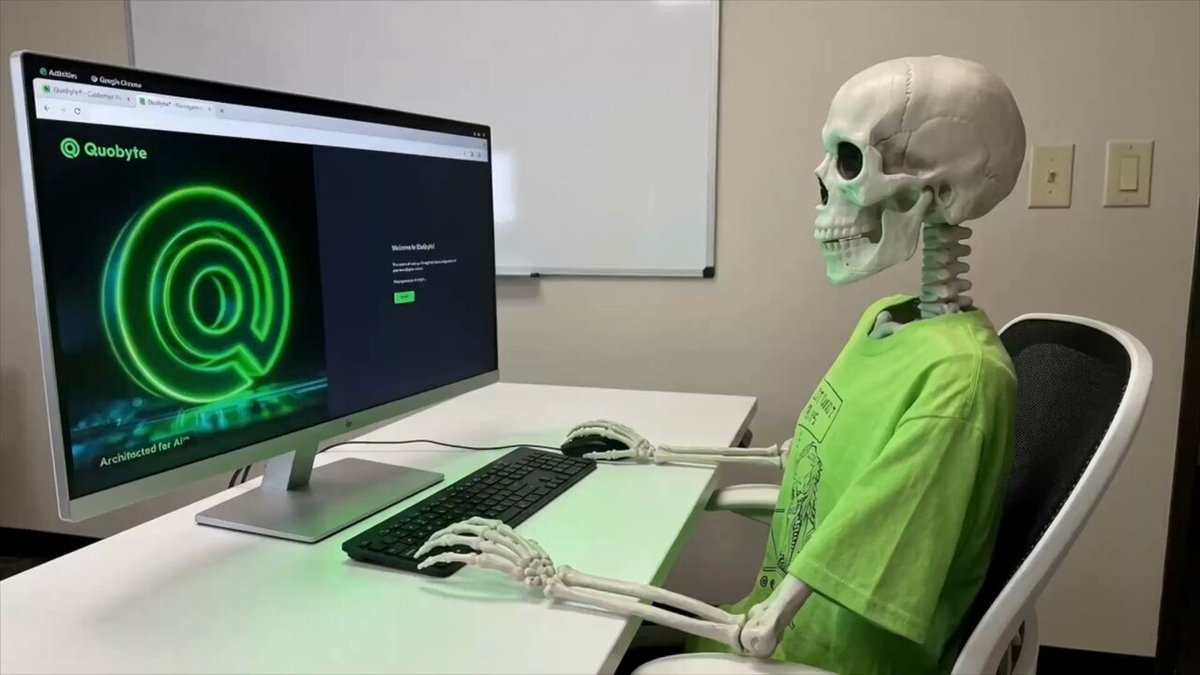
Quobyte brings smartphone simplicity to enterprise storage.
Installation is fast, intuitive, and ready for scale, just like setting up a phone.
Watch the full installation walkthrough:
#ArchitectedForAI #Quobyte #AIInfrastructure #SmartphoneSimplicity
16
Hyperscalers didn't build the world's largest AI infrastructure by buying specialized appliances; they solved it with software resilient enough to run on commodity hardware that anyone could swap or replace without a maintenance window.
That philosophy is available to anyone building serious AI infrastructure today, and most organizations are still ignoring it in favor of vendor lock-in that made sense a decade ago but now actively works against them.
We built Quobyte on exactly these principles. Check out our technology whitepaper if you're making storage decisions at scale. buff.ly/nXDWet2
#ArchitectedForAI # AIInfrastructure #HyperscalersPrinciples #Quobyte
12
When the budget was approved for the GPU cluster, nobody planned for storage to become its own ongoing problem, the separate appliances, the procurement cycles that never quite align with compute growth, the power draw, and the operational overhead of maintaining an infrastructure layer that exists only to serve the infrastructure that actually matters.
Quobyte GPU Converged Storage runs on the GPU nodes you already operate, using idle CPU cycles and local NVMe that would otherwise sit underutilized between training runs, turning them into a shared, high-performance storage tier that scales automatically with your fleet, no new hardware, no new rack footprint, no separate system to keep alive.
The result is 78% lower storage TCO, 89% lower power consumption, and storage lead times that disappear entirely because the hardware is already in place.
Storage was never supposed to be a second job.
buff.ly/U8kticc
#GPUConverged #AIInfrastructure #Quobyte
16
GPUs are already the star of your AI stack; now they can power storage too.
With Quobyte GPU Converged, your GPUs also run your storage stack, so data lives and moves right where the compute happens, not across a maze of external appliances and network hops. That means the same GPUs you bought for training and inference can now serve data at high speed, cut I/O wait time, and keep your pipelines flowing instead of stalling on storage. The result: faster experiments, fewer “why is the cluster idle?” moments, and a lot more ROI from hardware you’ve already paid for.
If you’re tired of explaining why GPUs are idle while your storage graphs are pegged, it might be time to rethink where your storage actually runs. Let’s talk about what happens when it runs on the GPUs themselves.
Learn more: buff.ly/4l31yFf
#GPUConverged #AIInfrastructure #Quobyte
19
Here is Jimmy's recap of GTC, and a quick piece of advice regarding AI workloads:
#NIVIDIAGTCRecap #GPUConverged #Quobyte #AIInfrastructure
15
We had a great week at NVIDIA GTC, filled with great conversations! Thank you to everyone who stopped by our booth, talked to us about their AI projects, and shared their infrastructure challenges.
Our GPU Converged storage solution was a hot topic; AI teams were delighted to hear that Quobyte is the only software storage solution that can run directly on GPU nodes, turning idle resources into a reliable, high-performance storage system.
We hope to see you at our next show!
#NVIDIAGTC #GTCRecap #GPUConverged #AIInfrastructure #Quobyte
19
The energy at GTC is amazing on day three! We've had great discussions and insightful conversations at booth #7003, and it's not over yet!
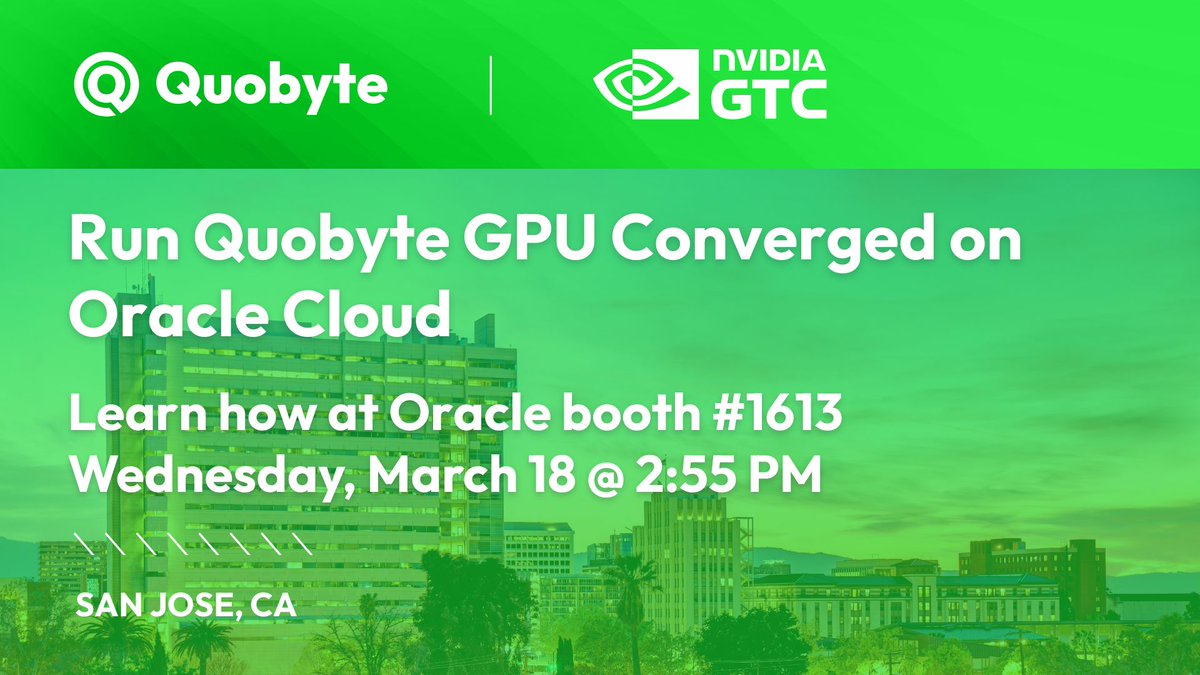
We will be doing our second presentation at Oracle's booth, #1613, today at 2:55 PM. If you want to learn how to leverage the unused resources in the OCI GPU nodes you already paid for!
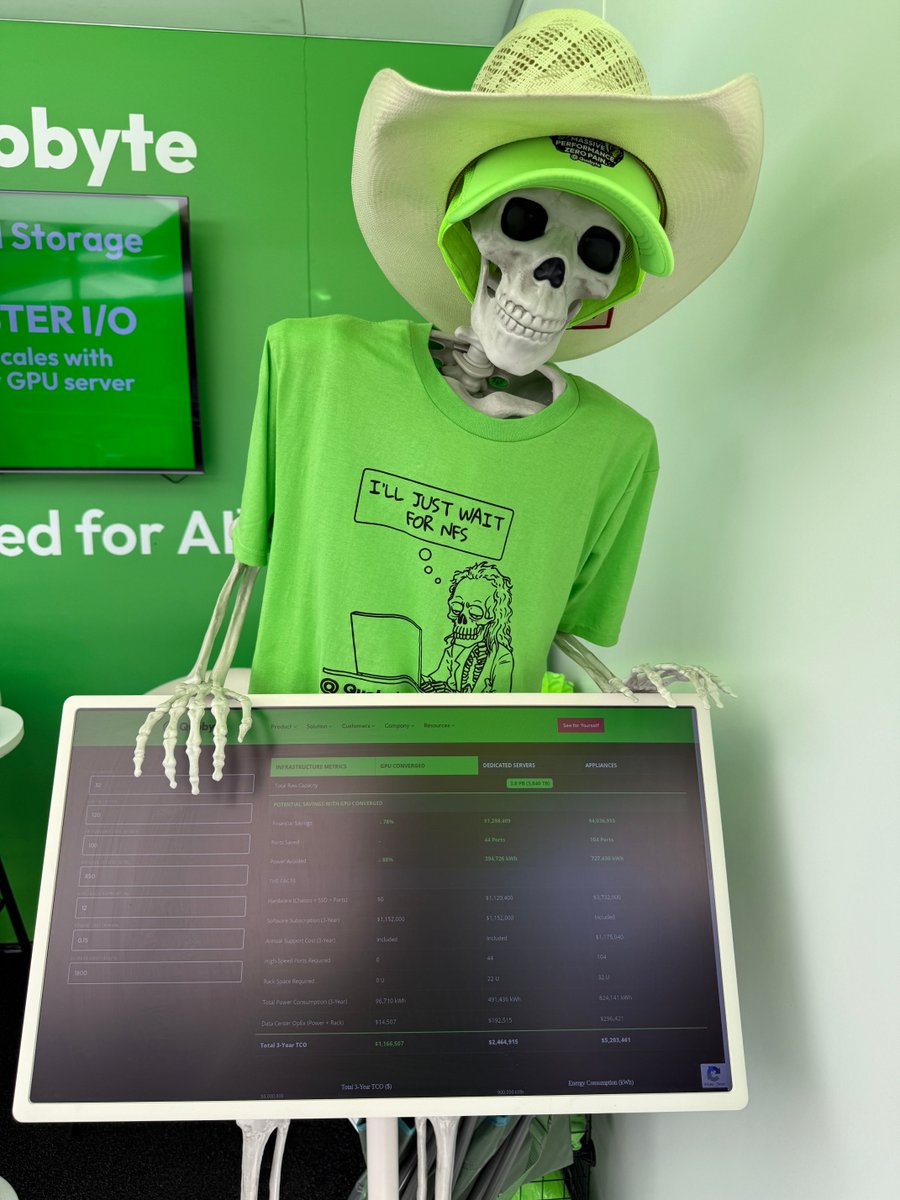
You can also come directly to our booth, #7003, to get some cool swag, take a picture with Jimmy, and learn how he realized NFS is not suited for AI.
#GTC2026 #AIInfrastructure #GPUConverged #Quobyte #OCI


19