Global Stock & Futures Trading Insights | Analysis, Strategies & Edge Tools | FREE/PREMIUM Indicators | Discord.gg/7tWKTTFnJk | #NQ #Gold

Joined December 2017
2,025 Photos and videos
Pinned Tweet
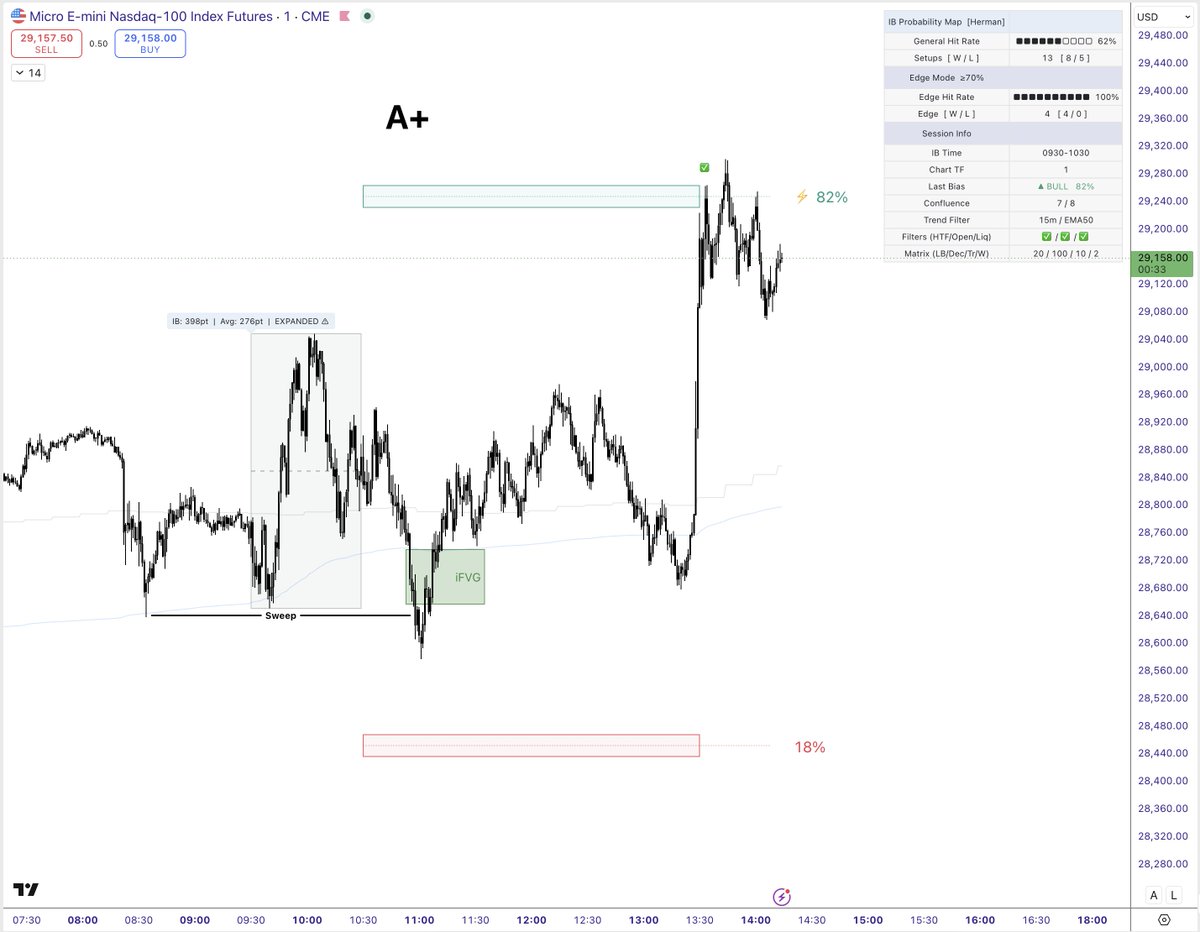
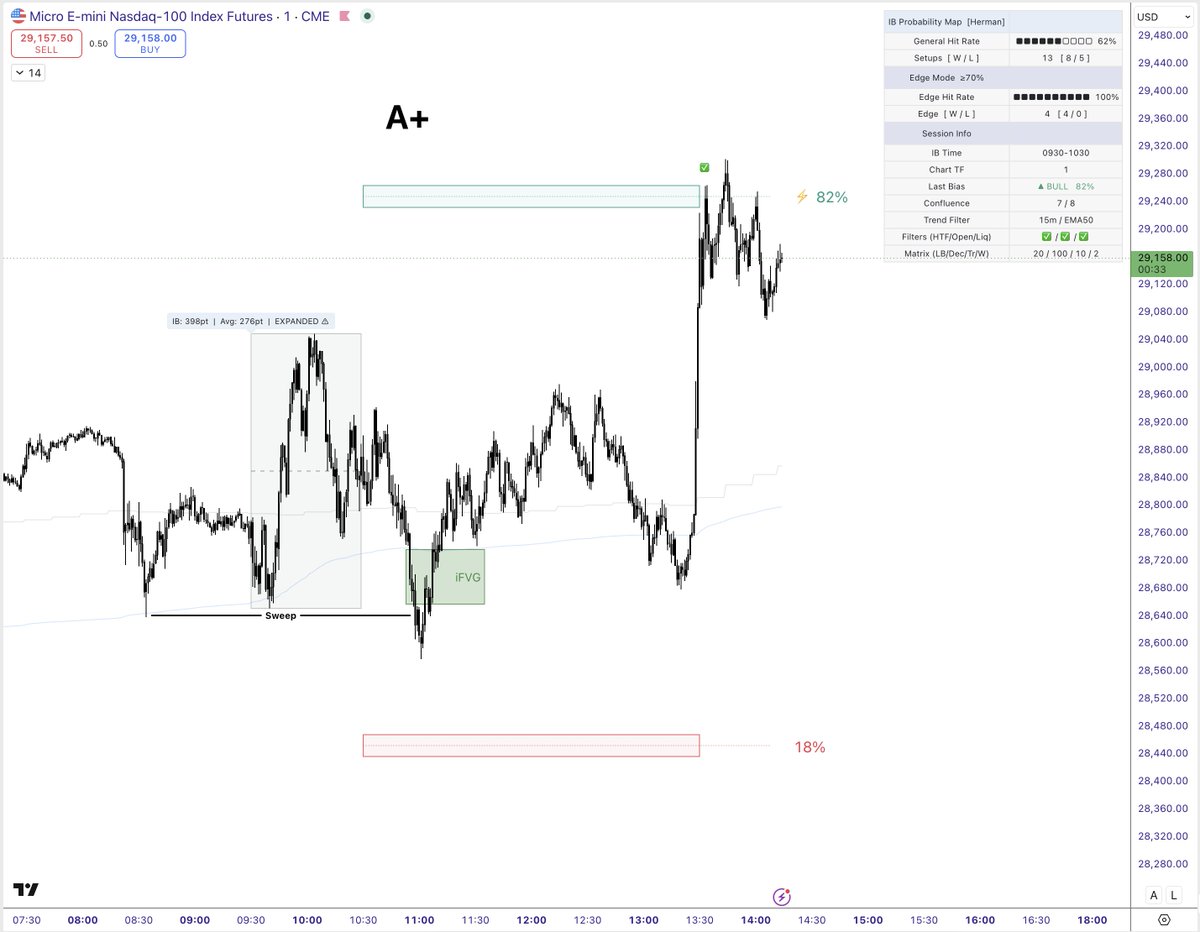
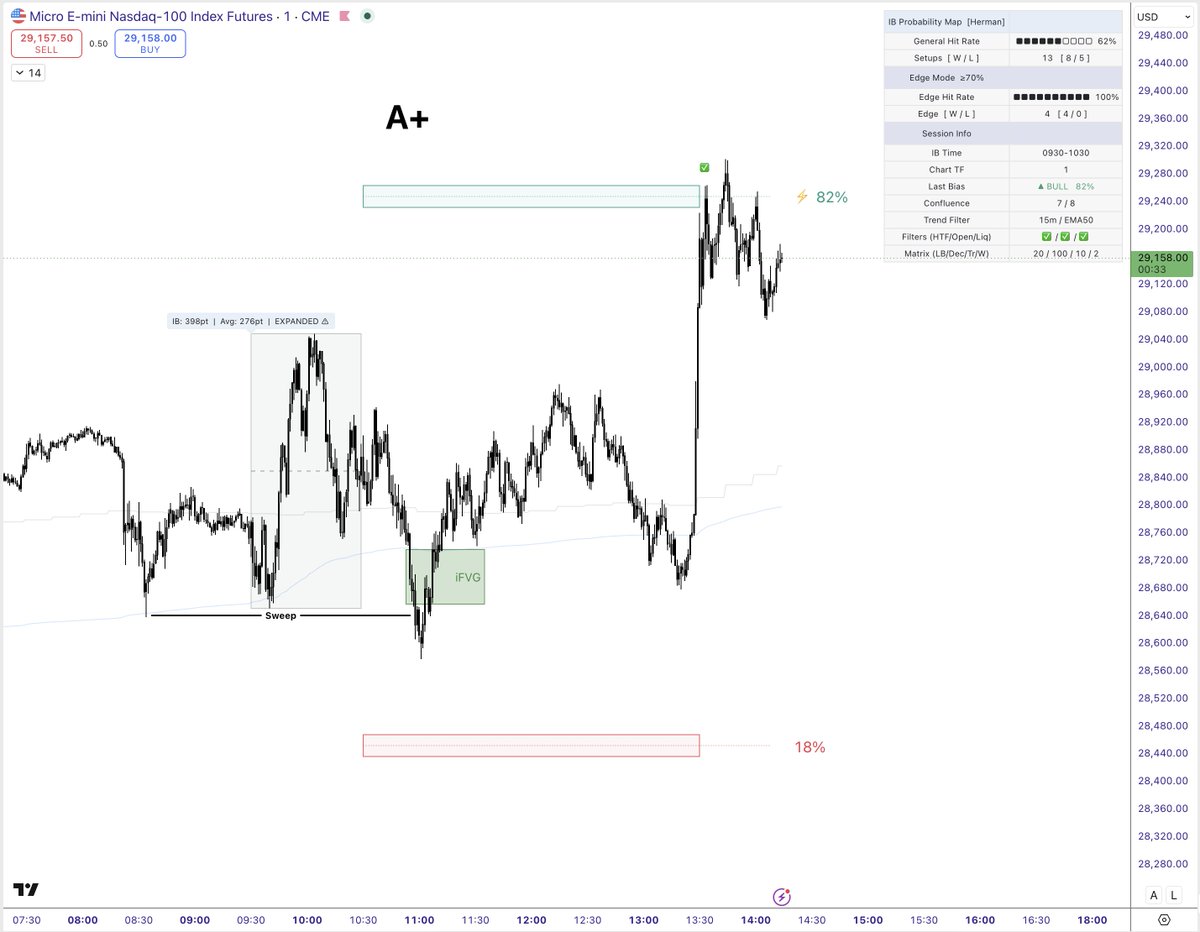
Here is what an A setup looks like using Intelligent Balance: The indicator identifies the statistically more probable side. I completely ignore trades in the opposite direction. I wait for price to create a familiar entry model toward that side: • liquidity sweep • MSS • iFVG • CISD I execute only when the entry confirms the direction already identified by the data. That is it. The entry model is not the edge by itself. An iFVG can appear in both directions. A sweep can trap you. A textbook MSS can still fail. The real advantage is knowing which setups to ignore. My rule is simple: -Direction first. -Confirmation second. -Execution third. I trade ALWAYS and ONLY toward the more probable side. Would this filter improve your trading - or do you still take every setup you see?
24
11
187
25,247
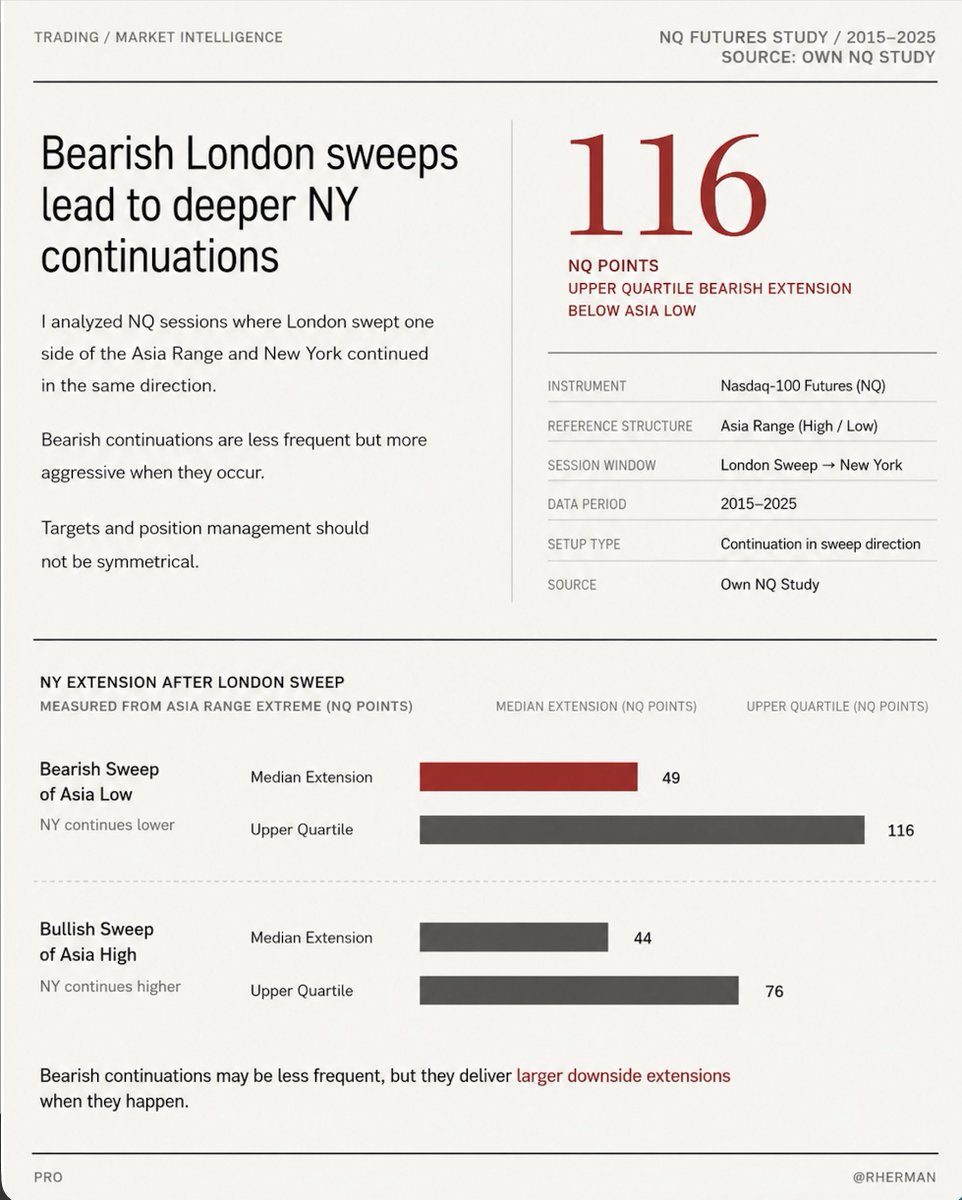
Bearish London breakouts hit harder than bullish ones. Most traders use the same targets in both directions. The data says that is a mistake. After a bearish London sweep of Asia Low: • the median NY extension below the low was 49 NQ points • the upper quartile reached 116 points After a bullish London sweep of Asia High: • the median NY extension above the high was 44 NQ points The difference may look small at the median. -But the bearish tail is where the real asymmetry appears. -Bullish continuation may occur more naturally in equity indices. Bearish continuation can be more violent when it arrives. Same market. Same session structure. Different target expectations. This is why position management should not be symmetrical in both directions. Source: Own NQ study Market: Nasdaq futures Period: 2015–2025 Do you manage bearish continuation trades differently - or use the same fixed targets in both directions?
27
8
160
27,315
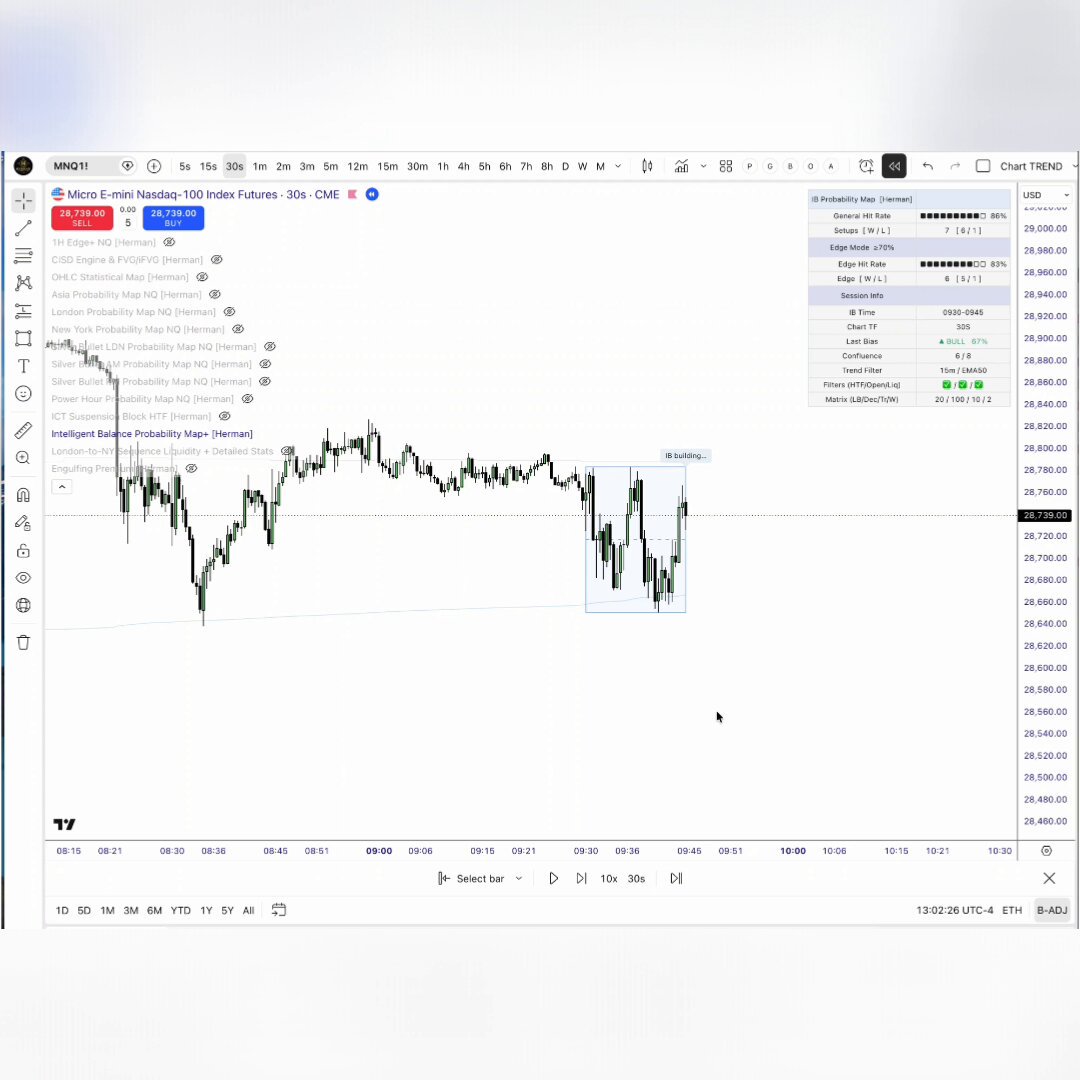
Yesterday, I MECHANICALLY backtested a simple London Session model: → iFVG trade entry → Only towards the more probable side → Fixed 2R target Today, we test the exact same concept on the NY Initial Balance 9:30–10:30 ET. Entire week. Monday to Friday. No cherry-picking. The rules stay simple: → Intelligent Balance identifies the more probable side → I ignore every setup in the opposite direction → I wait for an iFVG towards probability → Mechanical entry → Fixed 2R target No complicated execution model. No predicting every candle. No forcing trades. Just one simple question: Can a basic iFVG entry perform better when every trade is aligned with the statistically more probable side? Full Initial Balance weekly backtest in the video. Would you trade this model mechanically?
25
14
228
28,939
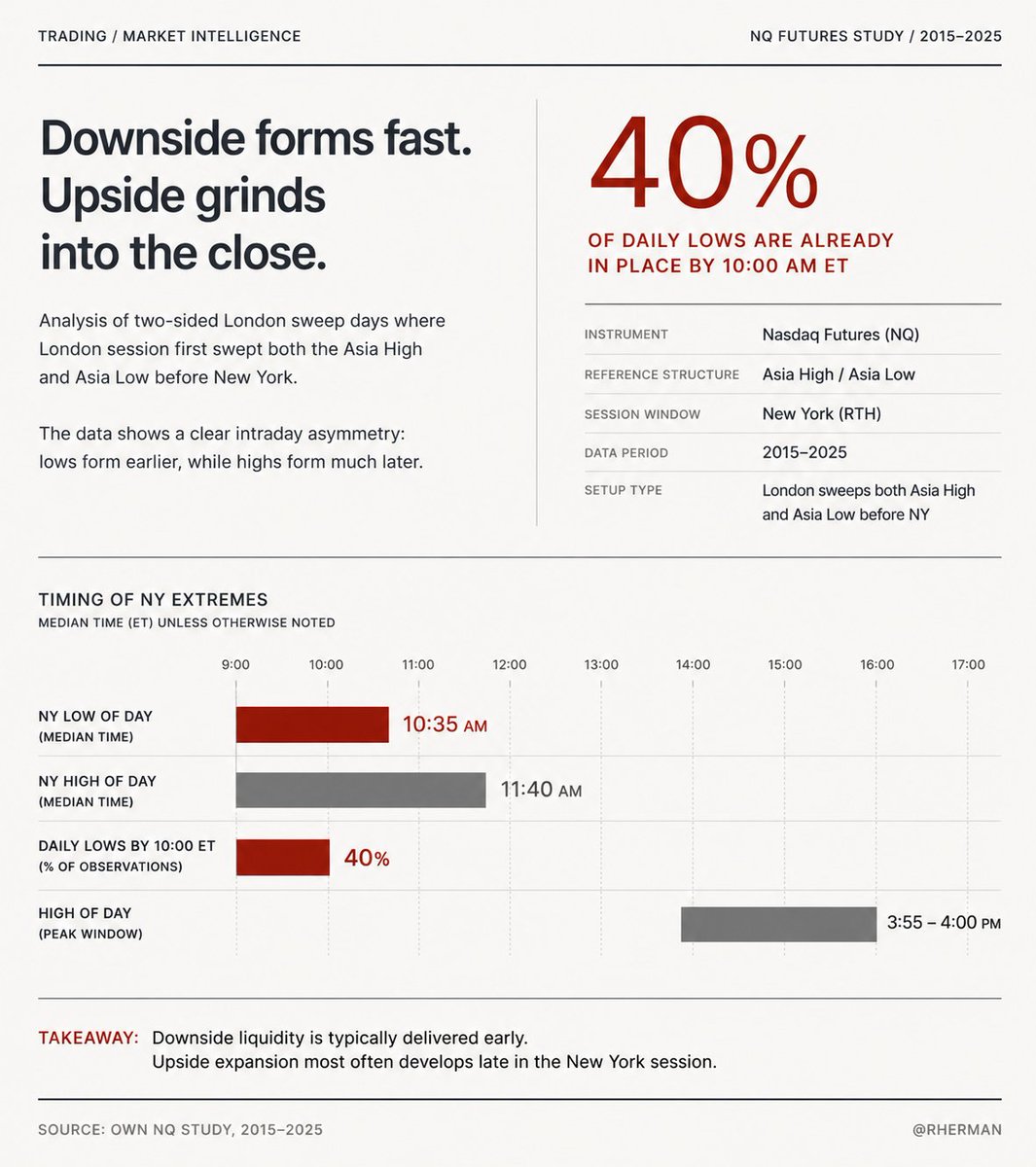
When London sweeps both Asia High and Asia Low before New York: • Median NY Low of Day forms at 10:35amET • Median NY High of Day forms at 11:40am ET • 40% of daily lows are already in place by 10:00am ET • The strongest High of Day window does not arrive until 3:55–4:00pm ET Read that again. The downside move often delivers fast. The upside can keep grinding for hours - sometimes directly into the closing bell. This matters because symmetrical trade management can quietly destroy your edge. A short may require faster profit-taking after the downside liquidity is delivered. A long may need more patience if the structure still supports a late-session expansion. Same market. Same session. Different time distribution. Trade management should follow probabilities - not habit. Source: Own NQ study Market: Nasdaq futures Period: 2015–2025 Scenario: London sweeps both sides of the Asia Range before New York Do you manage longs and shorts differently - or still use the exact same rules for both? #NQ #FuturesTrading
21
12
180
17,205
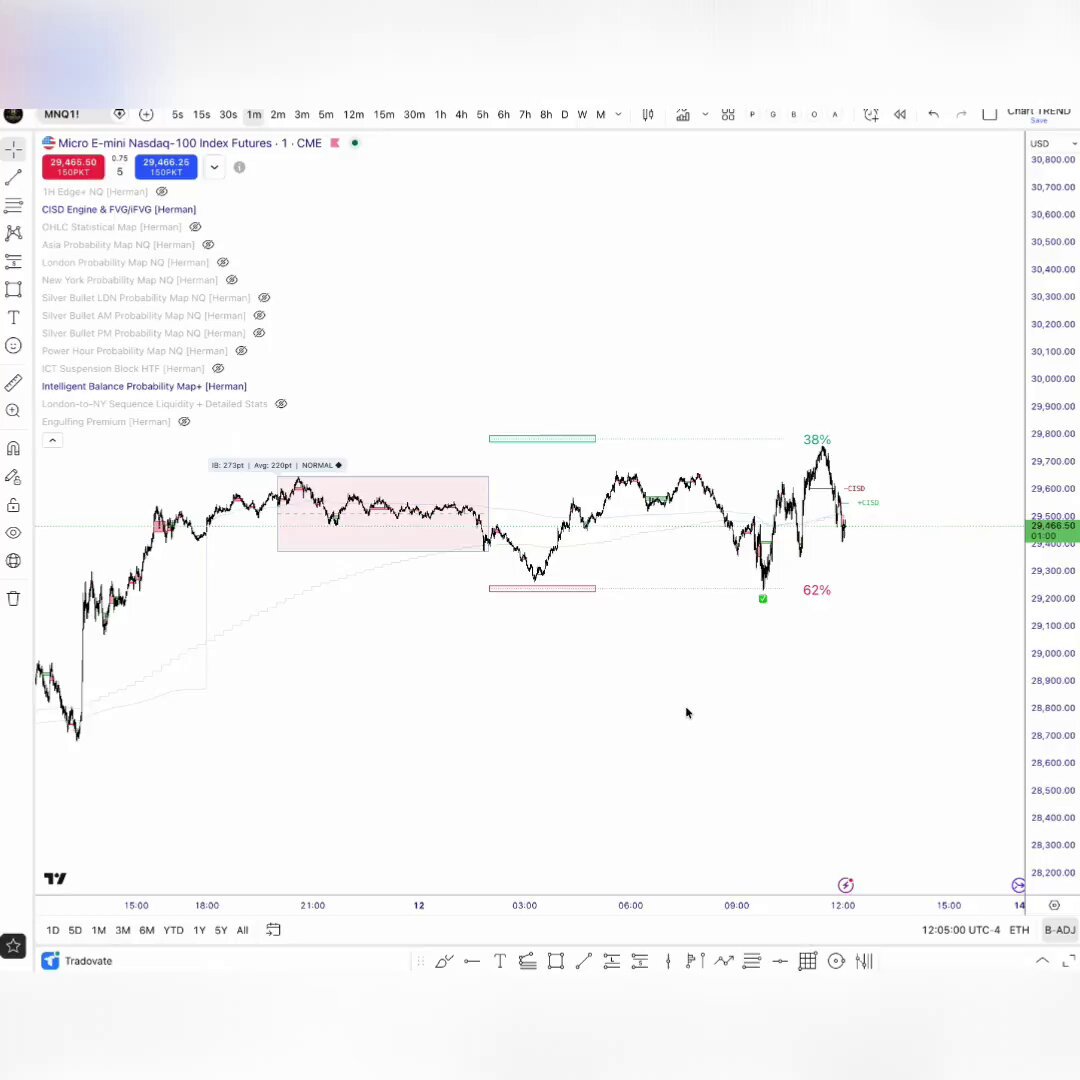
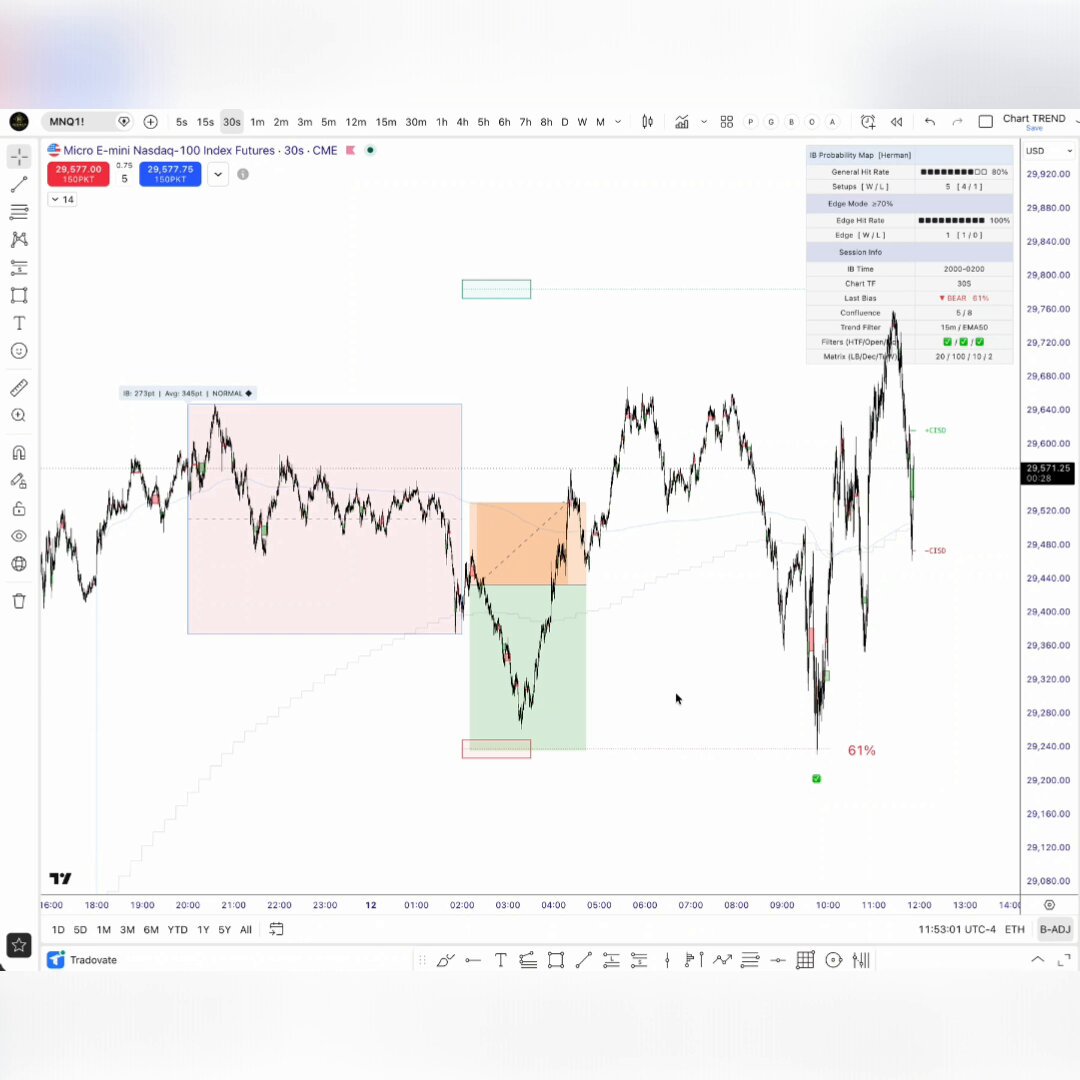
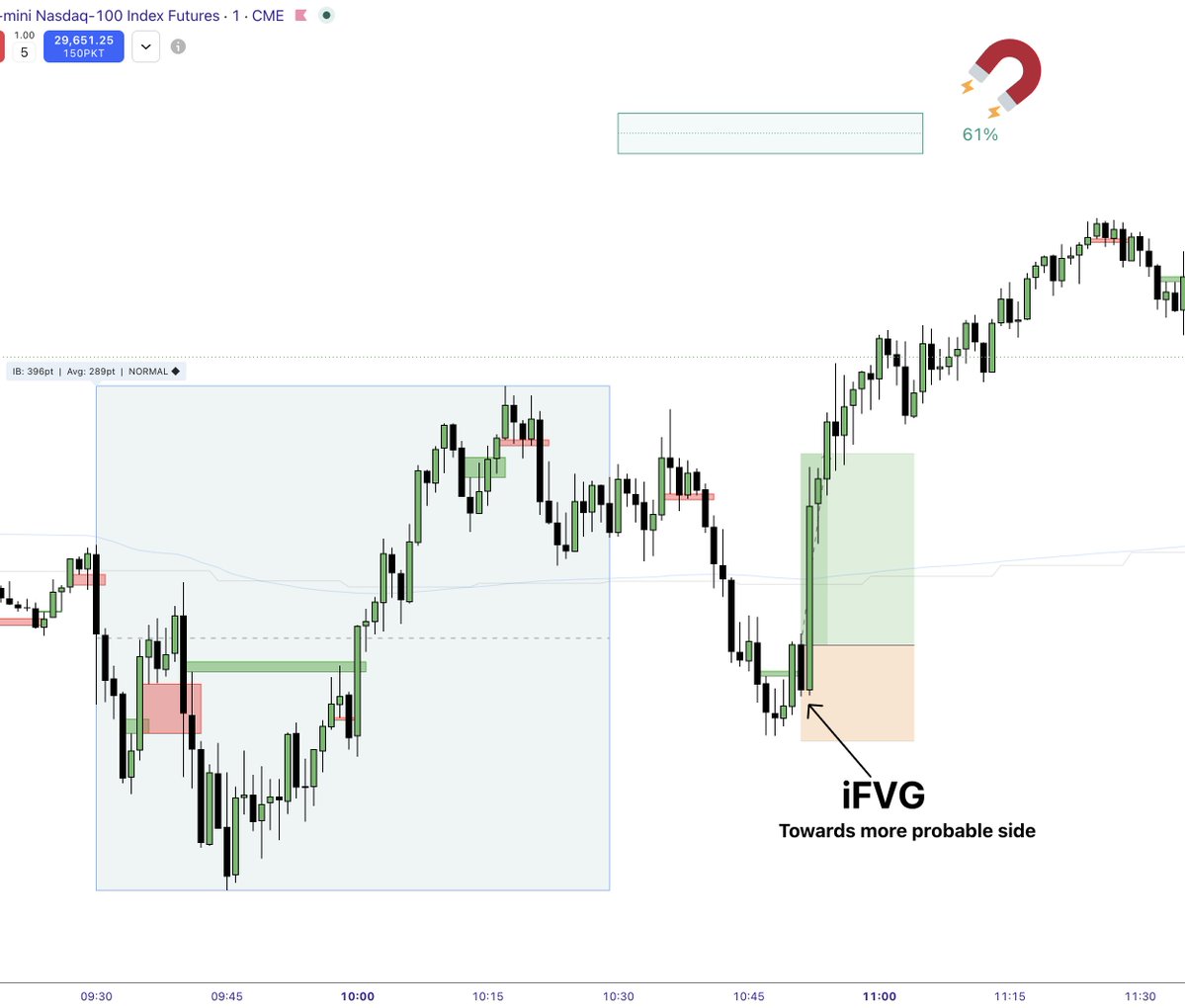
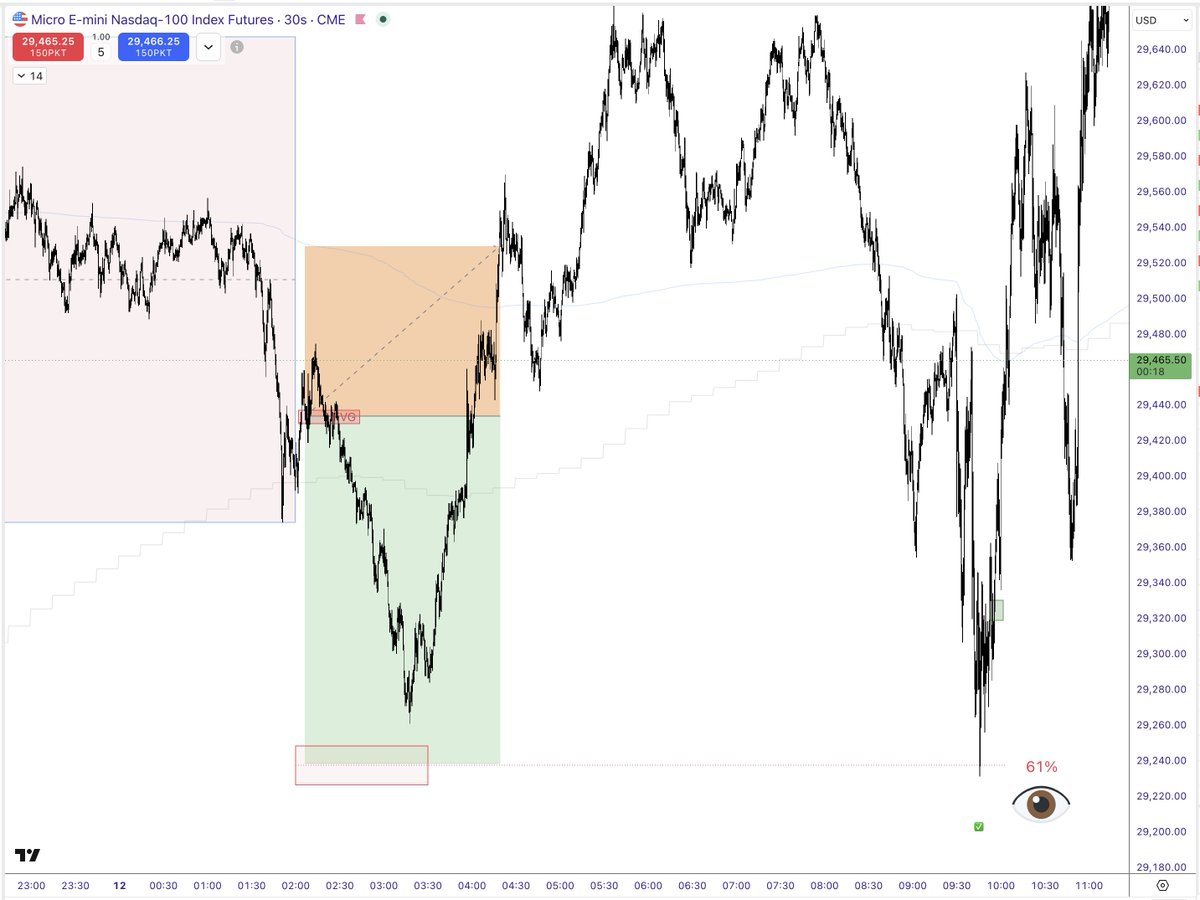
Remember yesterday’s fully mechanical iFVG entry targeting 2R? Same model today. Same direction. Price eventually reached the more probable side… But without us. So here is the real question: -Would you take the loss mechanically? -Move the stop to breakeven after the first reaction? -Manage it differently? The direction was correct The destination was correct (61%) This is the part of trading nobody can solve with a screenshot after the move already happened. How would you manage this trade in real time?
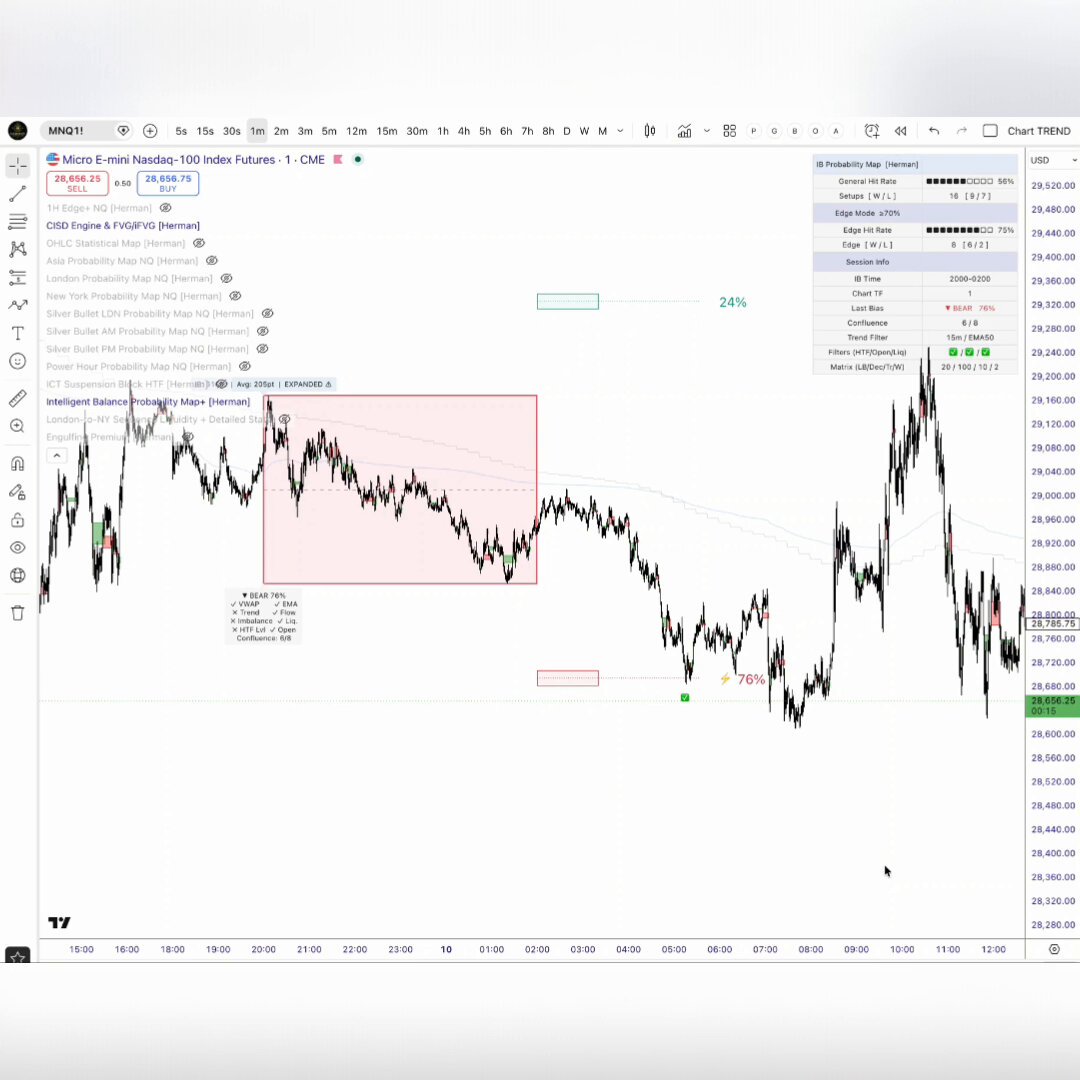
London session using ONE MECHANICAL 2R setup. The model: → Intelligent Balance shows the MORE PROBABLE SIDE → Wait for the first valid iFVG in that direction → Enter mechanically → Target fixed 2R → Ignore everything else That’s it. One direction. One entry model. One fixed target. Most traders keep adding more confirmations because they do not know which side of the market they should be trading. But once the probability is already pointing you toward one side, execution can stay simple. The entry does not need to be complicated. It needs to be repeatable. I recorded London-session backtest so you can see how mechanical a 2R iFVG model becomes when you only trade toward the statistically more probable side. Would you trade this mechanically, or would you still try to add more confirmations?
19
10
196
25,068
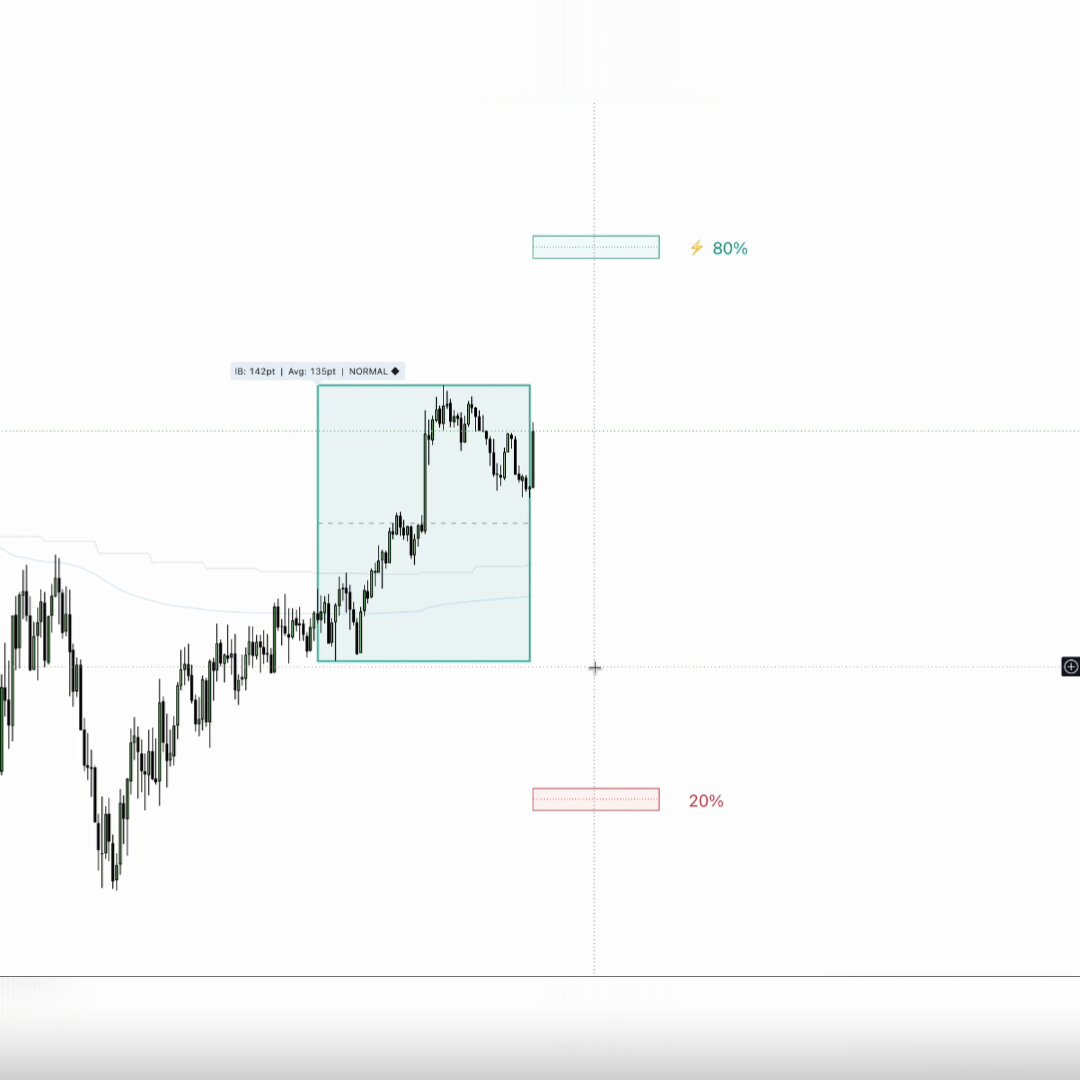
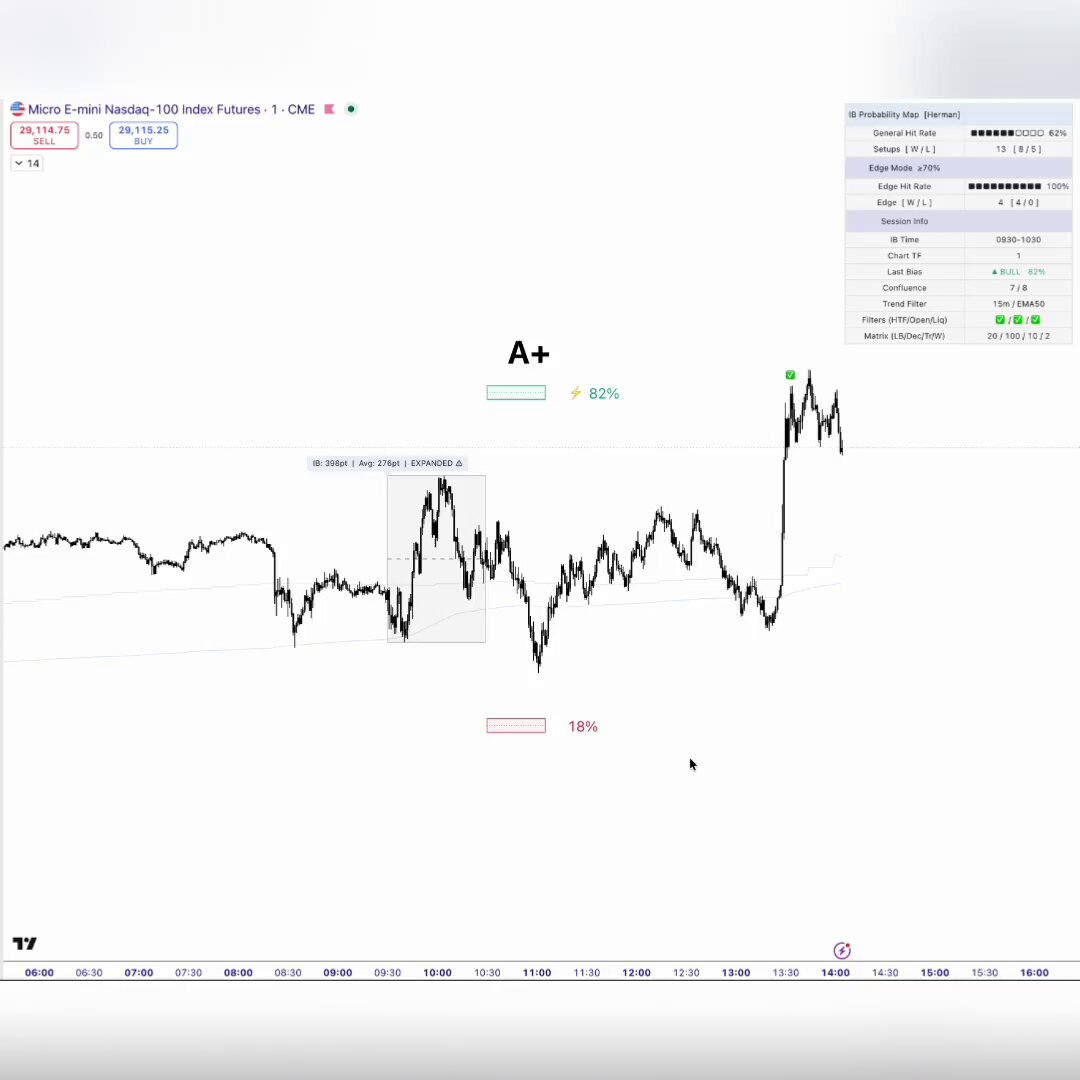
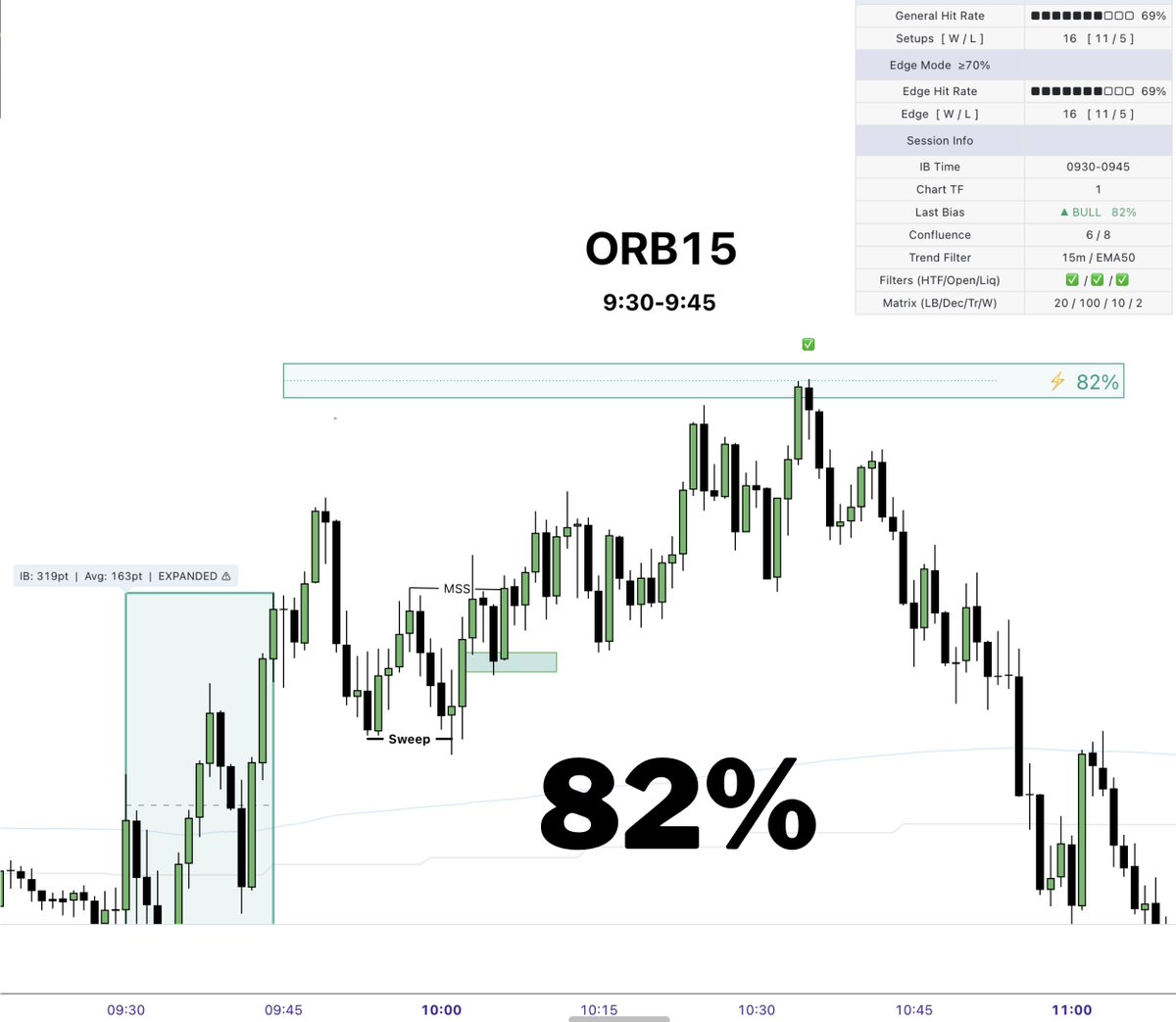
Most traders think an A setup is just a clean entry. It is NOT. In this video, I will show you exactly what an actual A setup looks like using the 9:30–10:30 Initial Balance as an example (82% LONGS) The model is simple: → Intelligent Balance identifies the statistically more probable side → Price sweeps liquidity → An iFVG appears in the expected direction → MSS confirms the delivery shift → The trade is taken only towards the more probable side That last part is the key. A liquidity sweep alone is not enough. An iFVG alone is not enough. Even a clean MSS is not enough. The real edge comes from alignment: Probability for direction. Liquidity sweep for manipulation. iFVG and MSS for execution. If Intelligent Balance points to longs, I am not interested in shorts - even if the short setup looks clean. If it points to shorts, I ignore bullish reactions. That is what makes it an A setup. Not a complicated entry. A simple execution model taken only when every part of the trade points in the same direction. Watch the video and tell me: Would you still trade both sides after seeing the probability?
21
10
176
23,124
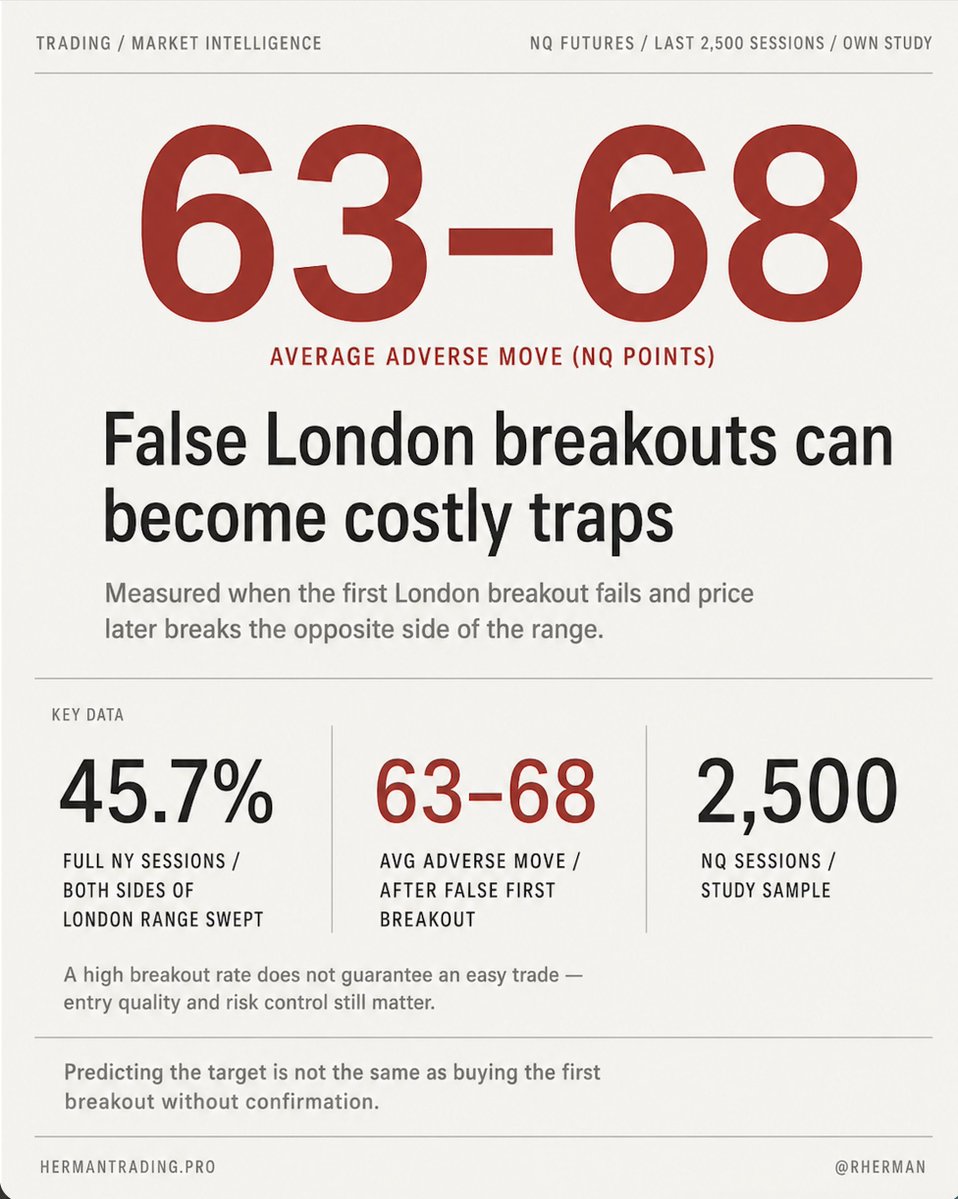
The first London breakout can be the most expensive trap of the day. Not because the stop loss is large. Because traders often assume the first break must be the real move. It is NOT. When the initial London breakout fails and price later sweeps the opposite side of the range, the adverse move averages approximately: 63–68 NQ points. That is not a minor stop hunt. That is a move large enough to punish anyone who enters the breakout blindly, refuses to invalidate the trade, or adds to a losing position without confirmation. And the risk is not rare. Across the full New York session, both sides of the London Range are swept in approximately: 45.7% of sessions. This is why a high breakout probability does not automatically create an easy trade. There is a major difference between: → identifying the likely target → chasing the first breakout → waiting for confirmation → managing risk when the first move fails The level may be correct. The first entry can still be completely wrong. Source: Own NQ study Market: NQ futures Sample: Last 2,500 sessions Do you trade the first London breakout automatically, or wait for confirmation before committing risk?
18
8
170
10,690
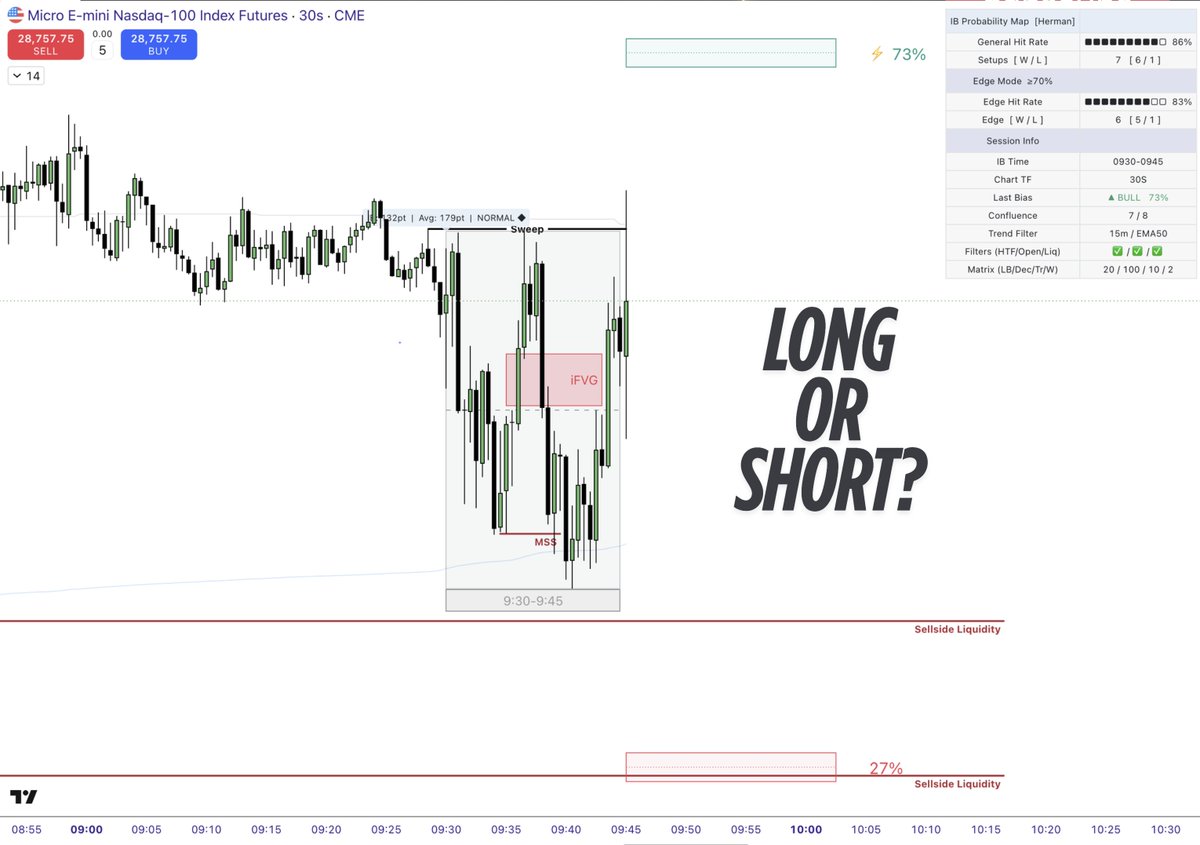
The indicator did not make me money today. It did something equally important: It saved me from a LOSS. The market was in an obvious downtrend. At 9:30, price initiated another move lower. A bearish iFVG appeared, pointing directly toward the liquidity below. It looked like an easy short. But ORB15 Intelligent Balance showed 73% LONGS as the more probable side. So I did not chase the fake move down. I did not short into the trap. I simply stayed out. This is what most traders underestimate. A valuable tool is not only the one that helps you find winning trades. It is also the one that stops you from taking the trades that were designed to trap you. Intelligent Balance does BOTH. Would you have taken that short if the chart looked bearish but the data pointed LONG?
18
12
152
20,972
London session using ONE MECHANICAL 2R setup. The model: → Intelligent Balance shows the MORE PROBABLE SIDE → Wait for the first valid iFVG in that direction → Enter mechanically → Target fixed 2R → Ignore everything else That’s it. One direction. One entry model. One fixed target. Most traders keep adding more confirmations because they do not know which side of the market they should be trading. But once the probability is already pointing you toward one side, execution can stay simple. The entry does not need to be complicated. It needs to be repeatable. I recorded London-session backtest so you can see how mechanical a 2R iFVG model becomes when you only trade toward the statistically more probable side. Would you trade this mechanically, or would you still try to add more confirmations?
17
12
179
17,523
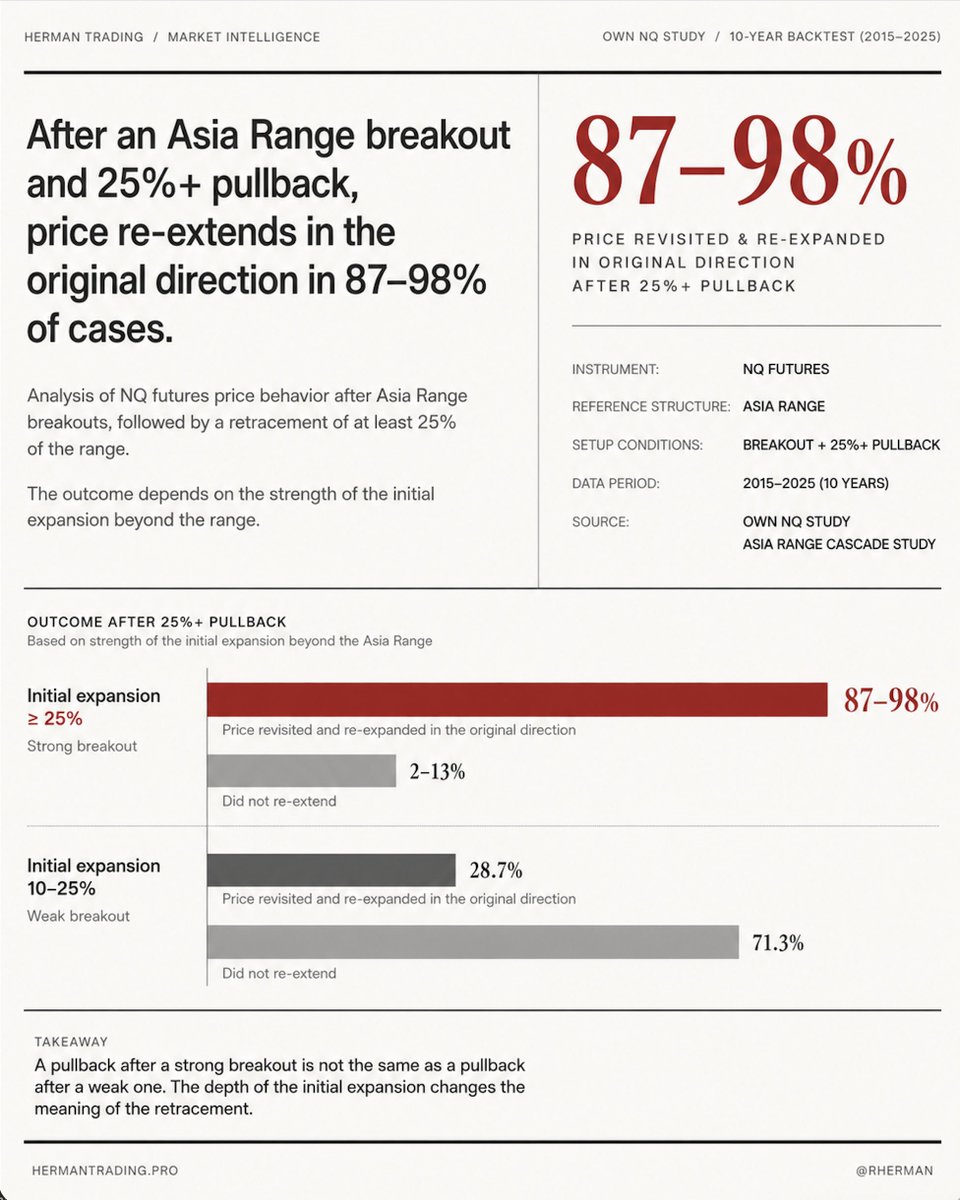
Most traders see a pullback after the Asia Range breakout and immediately assume reversal. That mistake could cost them the entire move. I analyzed what happens after: • Asia Range breakout • retracement of at least 25% of the range • potential re-expansion in the original direction The result depends heavily on the strength of the first breakout. When the initial move reached at least a 25% extension beyond the Asia Range, price later reclaimed the breakout level and expanded again in the original direction in approximately 87–98% of cases. But when the first move was weak and reached only a 10–25% extension, re-extension occurred in just 28.7% of sessions. That is a completely different setup. A pullback after strength is not automatically a reversal. The depth of the initial expansion changes the meaning of the pullback. Do you treat every pullback after an Asia Range breakout the same way? Source: Own NQ Study - Asia Range Cascade Study Data: 10-year NQ backtest
15
16
190
9,363
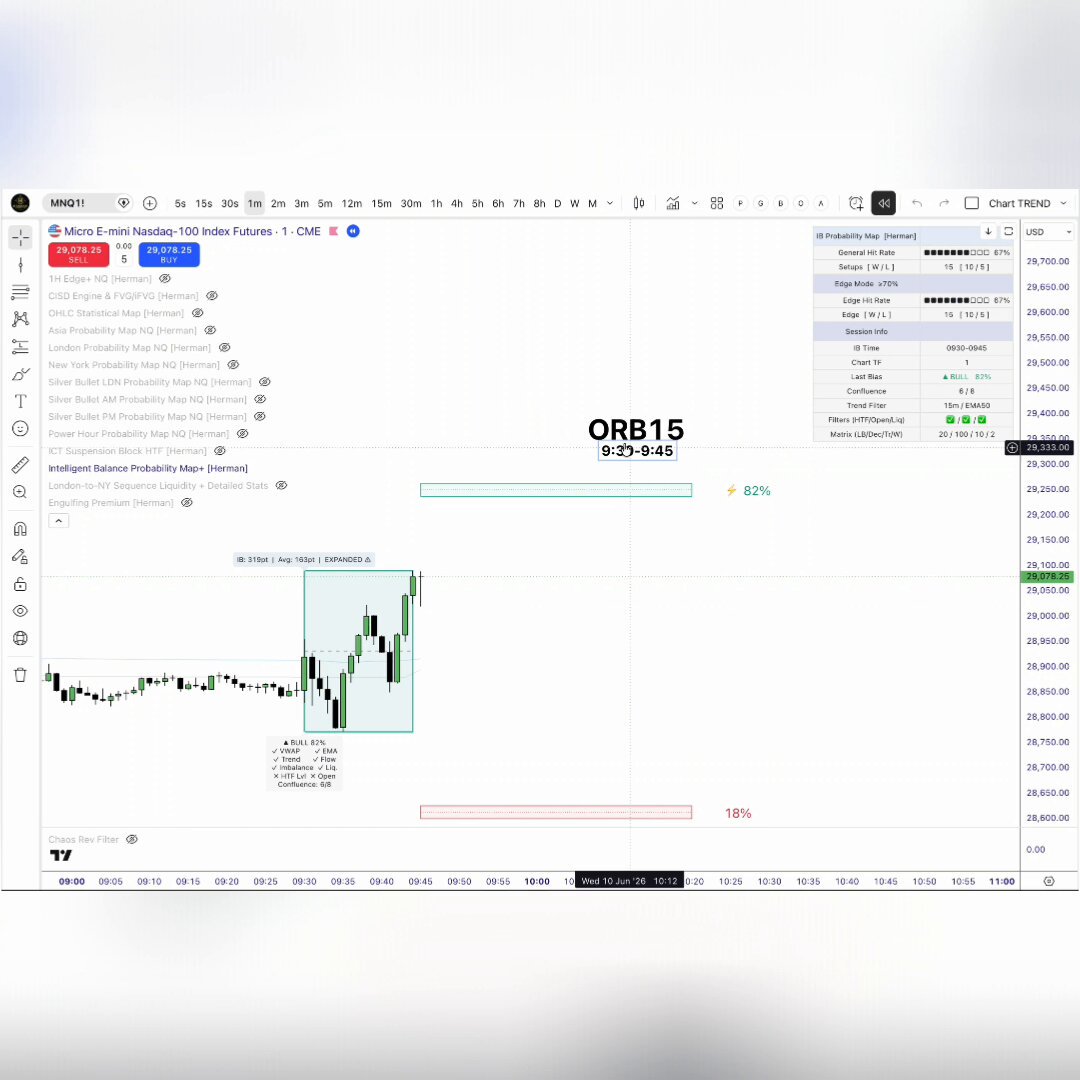
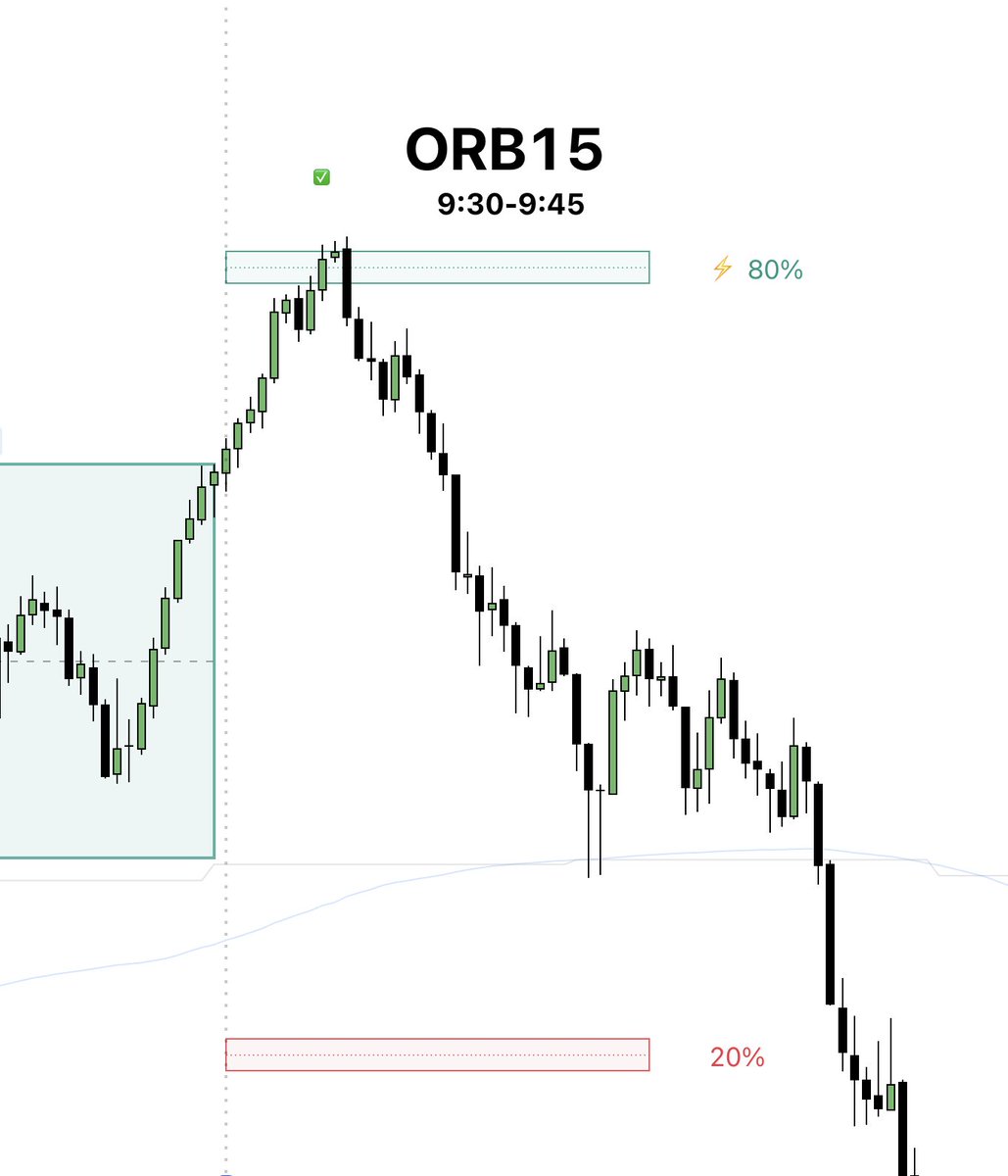
Today’s NQ ORB15 range (9:30–9:45) showed an 82% probability for LONGS. Price pushed directly into the level highlighted by the Intelligent Balance Probability Map… …and immediately reversed. No continuation. No extended move. But the level was respected almost perfectly. That matters. The job of the indicator is not to predict every tick after the target is reached. Its job is to identify the statistically more probable side and highlight the level the market is most likely to seek. Today, it did exactly that. Price reached the mapped level, reacted instantly, and showed that the market clearly “saw” it. Direction first. Target second. Execution only when the setup is there.
18
12
169
18,605
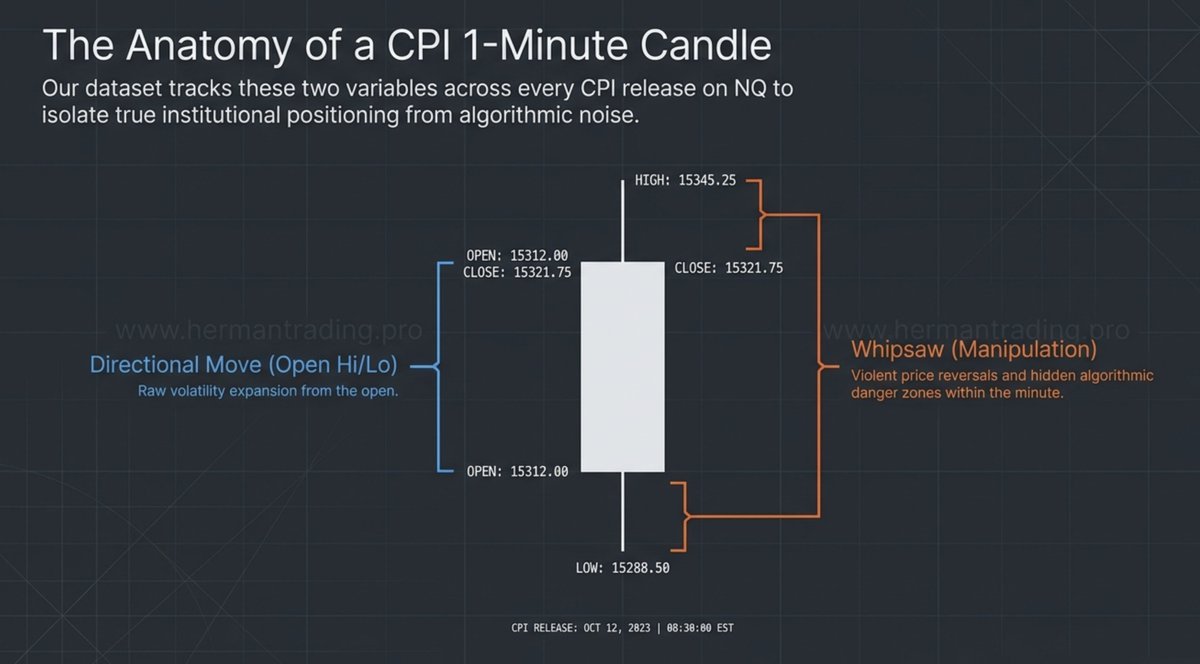
🚨 Are you still getting chopped up during CPI releases? I just analyzed every single 1-minute CPI candle on NQ for the last two years, and the data completely destroys everything you thought you knew about market manipulation. Here are 5 insane stats straight from the algorithmic battlefield: 1️⃣ The Algorithmic Shift: The machines are changing their behavior. The average manipulation range during CPI events is steadily shrinking-dropping from ~17.1 points in 2024, to ~8.3 points in 2025, and plunging to an average of just ~5.8 points in the first half of 2026. 2️⃣ The 79% Trap: Look at Oct 10, 2024. The total 1-minute candle size was only 54.75 points, but the manipulation reached a staggering 43 points! That means nearly 79% of the entire minute's range was pure manipulation designed to sweep liquidity before the real move. 3️⃣ The Volatility Monster: The biggest 1-minute candle we've seen happened on Feb 12, 2025 - a massive 261-point move. But the wild part? The manipulation range during that minute was relatively moderate at just 24.25 points. Massive moves don’t always mean massive traps. 4️⃣ The Zero Correlation Myth: Think a huge market reaction means a huge trap? Wrong. Statistically, there is almost zero correlation (0.12) between the total size of the 1-minute candle and the extent of the manipulation. A small candle can hide a brutal trap, and a massive candle can be relatively clean. 5️⃣ The "Perfect" Prints: Out of the 27 tracked CPI data points, there were exactly two incredibly rare instances where manipulation was completely non-existent (0 points). They happened almost exactly two years apart: March 12, 2024, and April 10, 2026. The game and the algos are evolving right in front of us. Question for you: Are you actively adapting your strategy to these shrinking manipulation ranges, or are you still trying to trade CPI like it's 2024?
15
10
173
13,518
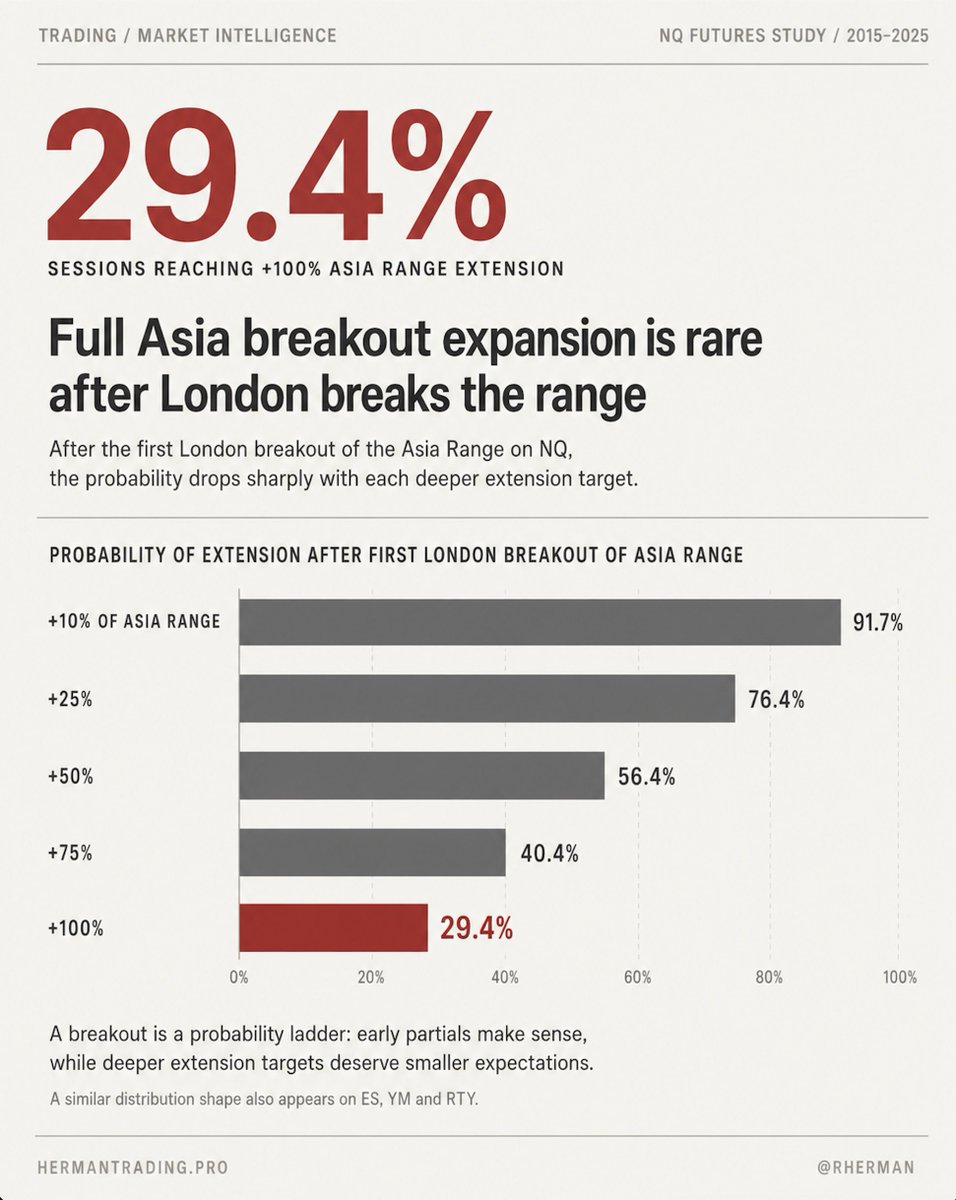
Most traders treat an Asia breakout like a binary event: It breaks. So they expect continuation. But the probability collapses with every additional target. After London first breaks the Asia Range on NQ: → 10% of Asia Range: 91.7% → 25%: 76.4% → 50%: 56.4% → 75%: 40.4% → 100%: 29.4% The first extension is common. A full 1:1 expansion beyond the Asia Range happens in fewer than 3 out of 10 sessions. And this is not only an NQ pattern. The same probability curve appears across ES, YM and RTY, with only minor differences between indices. This is why a breakout should never be treated as a single all-or-nothing target. Every additional extension level is a separate statistical decision: • secure a partial early • leave a runner for further expansion • reduce expectations as price reaches deeper targets A breakout is not a prediction. It is a probability ladder. Do you scale out into extension targets, or hold the full position for one final TP? Source: Herman Trading ,Asia–London session study. NQ futures data: 2015–2025.
17
9
162
21,439
80% LONGS. I still did not take the trade. Today’s $NQ ORB15 was a perfect example. At 09:45 ET, my Intelligent Balance Probability Map indicator showed: 80% LONGS From that moment, my job was simple: I was only interested in LONG setups toward the statistically more probable side. No shorts. No guessing. No forcing entries just because the market was moving. The problem? Price never gave me the confirmation I needed. No clean bullish signature. No entry that matched my rules. No trade. So I watched price move directly toward my target without me. And honestly? That is completely fine. The indicator did exactly what it is designed to do: -identify the side of the market that deserves my attention. It is not supposed to force a trade. It is not supposed to make me chase price. It is not supposed to replace execution. Some days you get the bias and the entry. Some days you only get the bias. The real edge is knowing the difference. Would you rather miss a winning move or force a trade that was never there?
16
8
166
13,180
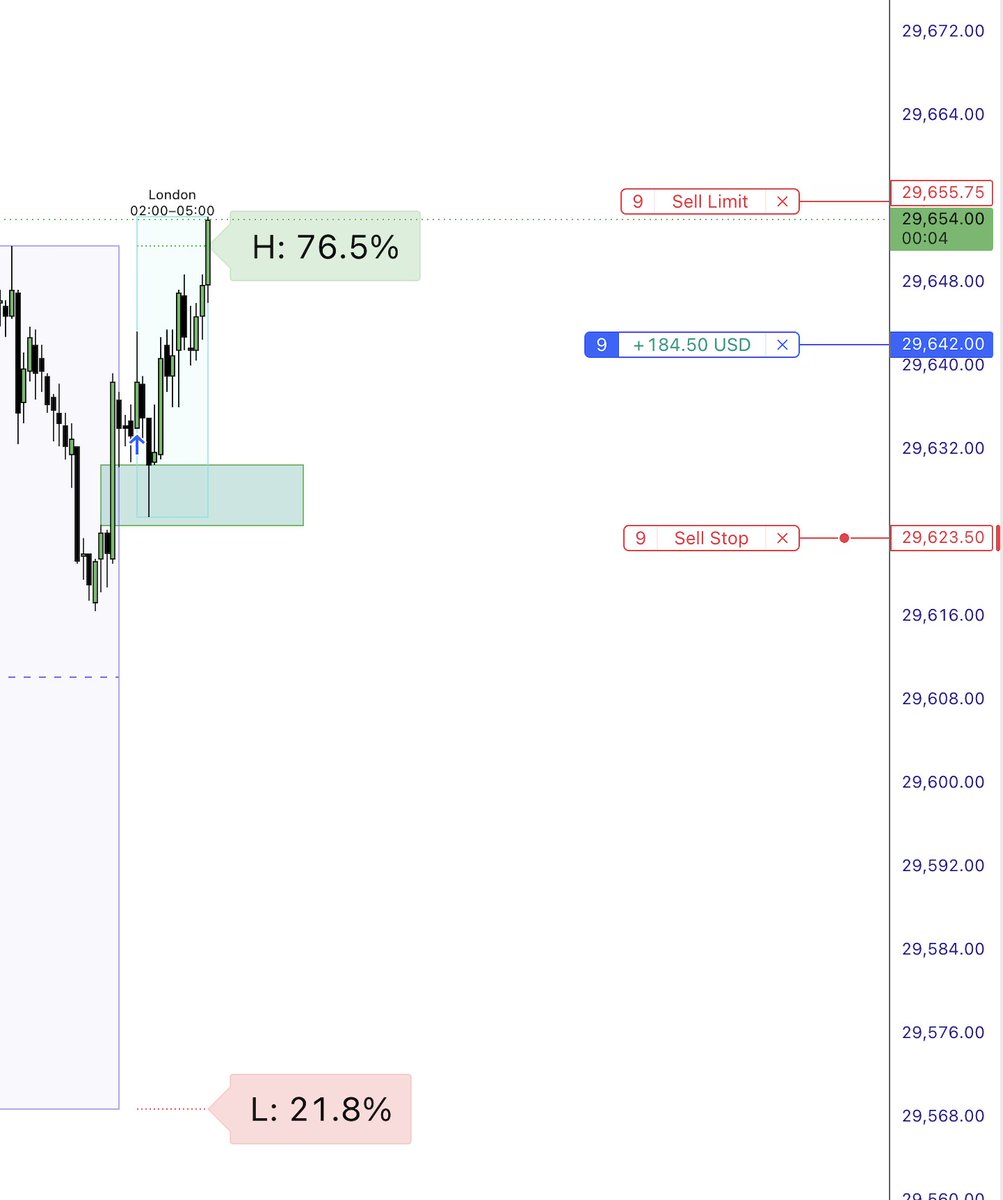
London Session today, both of my probability tools aligned: • Probability Map: 76.5% LONGS • Intelligent Balance: 72% LONGS That immediately simplified the entire session. I was not interested in predicting every candle. I was not looking for shorts. I was looking for one thing only: BULLISH signatures toward the statistically more probable side. Any bullish iFVG? Any FVG supporting continuation? Any willingness from price to expand higher? The moment price started confirming the bias, I was joining in. This is how I approach day trading: Probability gives me the direction. Price action gives me the entry. Entries do not need to be complicated when you already know which side of the market deserves your attention. Would your trading improve if you stopped trying to trade both directions?
19
11
165
14,615
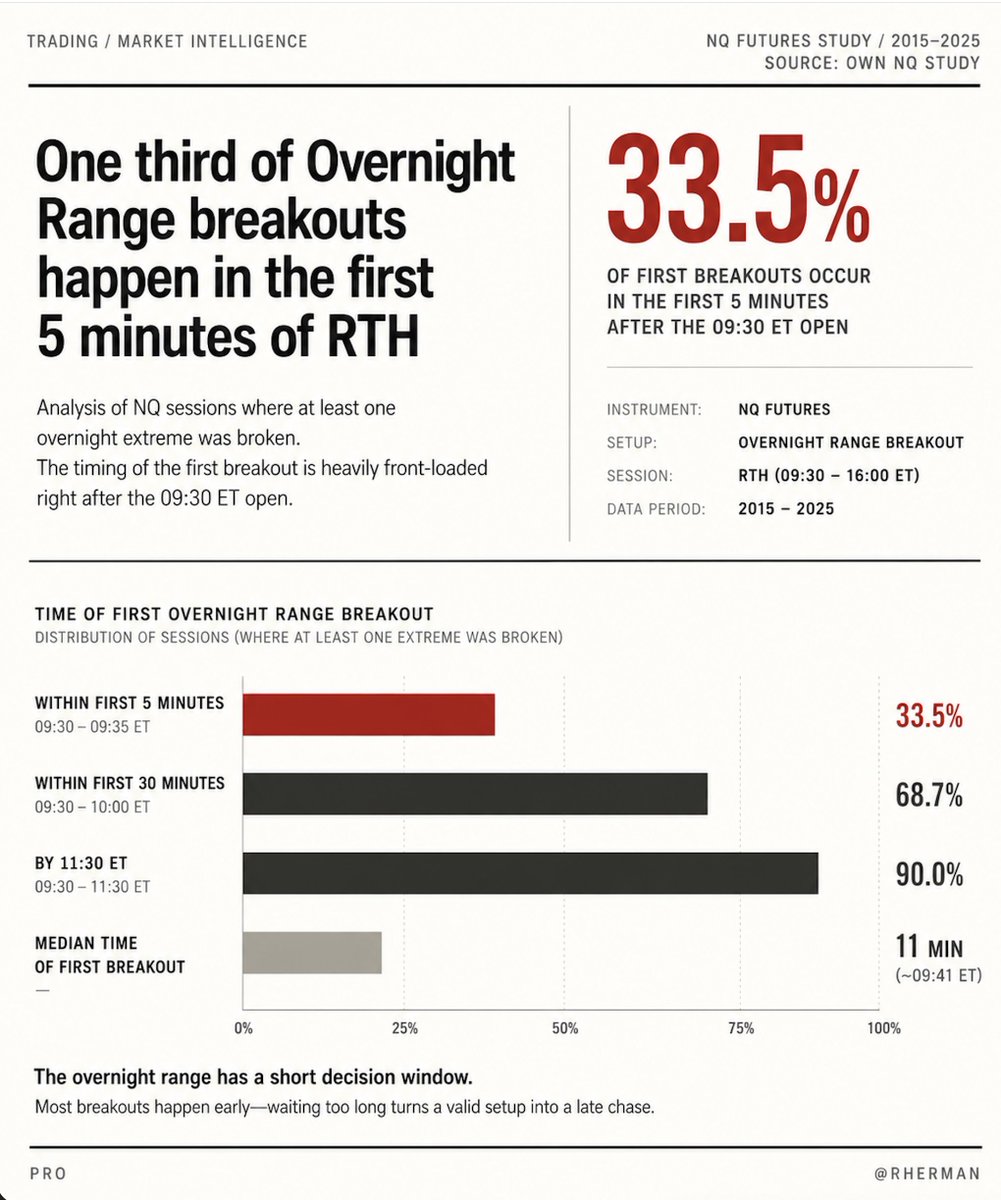
NQ traders: your overnight-range setup may have an expiration time. If the Overnight Range is going to break during RTH, the market often reveals its intention almost immediately after the bell. The timing was surprisingly aggressive: • 33.5% of first breakouts happened within the first 5 minutes after the 09:30 ET open • Median breakout time: just 11 minutes after the bell - around 09:41 ET • 68.7% occurred within the first 30 minutes • 90.0% were delivered by 11:30 ET This is where many traders misunderstand patience. Patience does not mean waiting indefinitely and chasing a move after the clean opportunity has already passed. It means waiting for confirmation inside the window where the setup still has statistical value. Levels matter. But levels also have time decay. Do you reduce your confidence in an Overnight Range setup when the breakout fails to appear early? Source: Own NQ study. NQ futures, RTH sessions, 2015–2025.
14
10
164
9,139
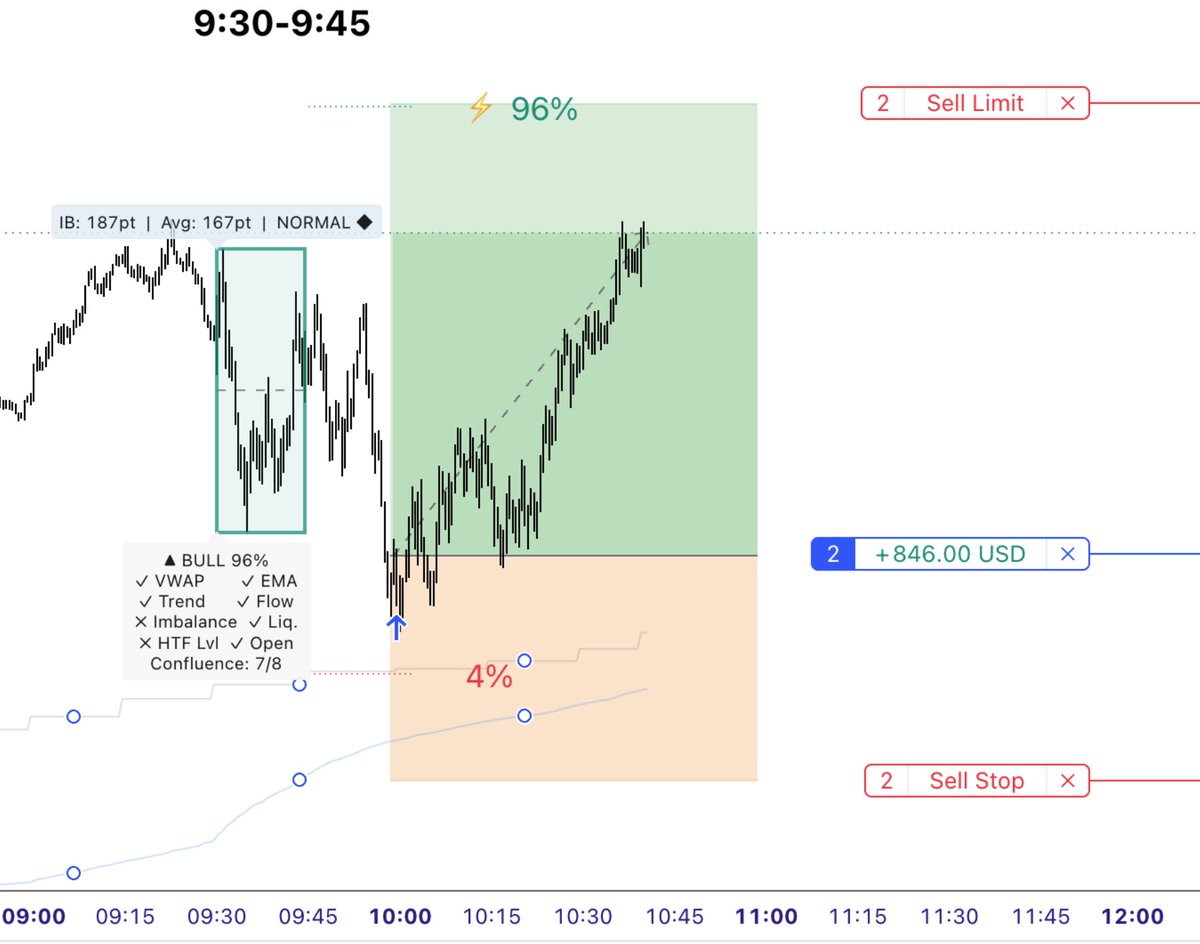
96% Today, my Intelligent Balance Probability Map showed a 96% probability toward the upside after the first 15 minutes of the New York session. From that moment, I had one job: Look for LONGS only. I was not interested in predicting every candle. I was not interested in forcing shorts. I was not interested in trading both directions. The indicator gave me the higher-probability side of the market. Then I simply waited for price to confirm that direction. The entry itself can be simple: -An iFVG. -A CISD. -A sweep followed by a bullish shift in delivery. Basic ICT concepts that almost every trader already knows. The difficult part is not clicking the button. The difficult part is knowing which direction you should be trading in the first place. Today, ORB15 gave me the bias. Price gave me the confirmation. The market delivered a clean 2R LONG. This is how I approach day trading: Statistical bias first. Simple execution second. No random trades against the more probable side. You do not need more setups. You need a better reason to take them. Be honest: If your setup appeared SHORT while the data showed a 96% probability to the upside, would you still take the trade?
21
11
203
30,796
Prop firms are about to start popping up on every corner. I just came across a company advertising a turnkey solution that allows clients to launch their own prop firm in as little as 10 days. Dashboard. Payments. Trading accounts. Platform integration. The entire infrastructure. 10 days. At this rate, your local kebab shop will soon be selling $49 challenges with discount code KEBAB20. Jokes aside, this is why traders need to become more selective. A polished website can be launched quickly. A professional-looking dashboard can be launched quickly. A trustworthy business cannot. Before buying your next challenge, ask yourself: Who is actually behind the company? How long have they been operating? Do they consistently process payouts? What happens when a trader requests a larger withdrawal? The barrier to launching a prop firm is getting lower. Your standards should be getting higher. Would you trust a prop firm launched in 10 days?
22
9
158
15,386
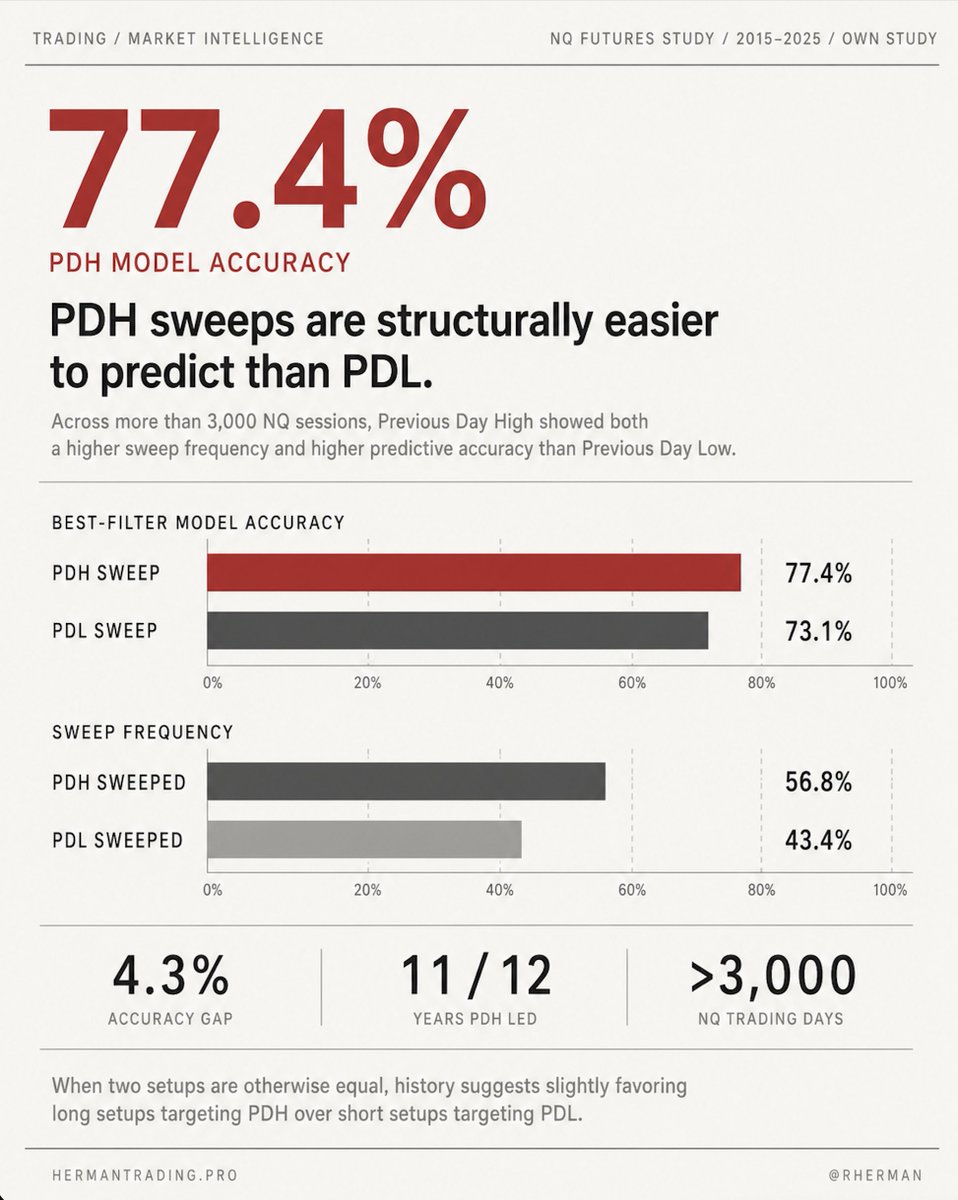
Most traders treat PDH and PDL as perfectly symmetrical. The data says that is a mistake. After analyzing over 3000 NQ trading days, one side of the market consistently proved easier to predict: PDH. Previous Day High was swept on 56.8% of sessions. Previous Day Low was swept on only 43.4%. But the real edge is not just frequency. With the strongest filters applied, the model reached: 77.4% accuracy for PDH sweeps 73.1% accuracy for PDL sweeps That is a 4.3% accuracy gap. It may not sound dramatic at first. But this advantage appeared across different filter combinations, pattern states and market conditions. And PDH was swept more frequently than PDL in 11 out of 12 years. That is not random noise. It is a structural market characteristic. Index markets have a long-term upside bias. Weak companies disappear from the index and are replaced by stronger ones. Over time, that creates a natural upward drift. And that long-term bias appears to influence the daily microstructure too. PDH is not only swept more often. It is also more predictable. This does not mean blindly buying every session. It means that when two setups are equally strong, a long setup targeting PDH historically deserves slightly more weight than a short setup targeting PDL. The market is not perfectly symmetrical. Your risk allocation probably should not be either. Does your strategy treat long and short setups equally, or do you already account for NQ’s structural upside bias?
18
11
122
12,884
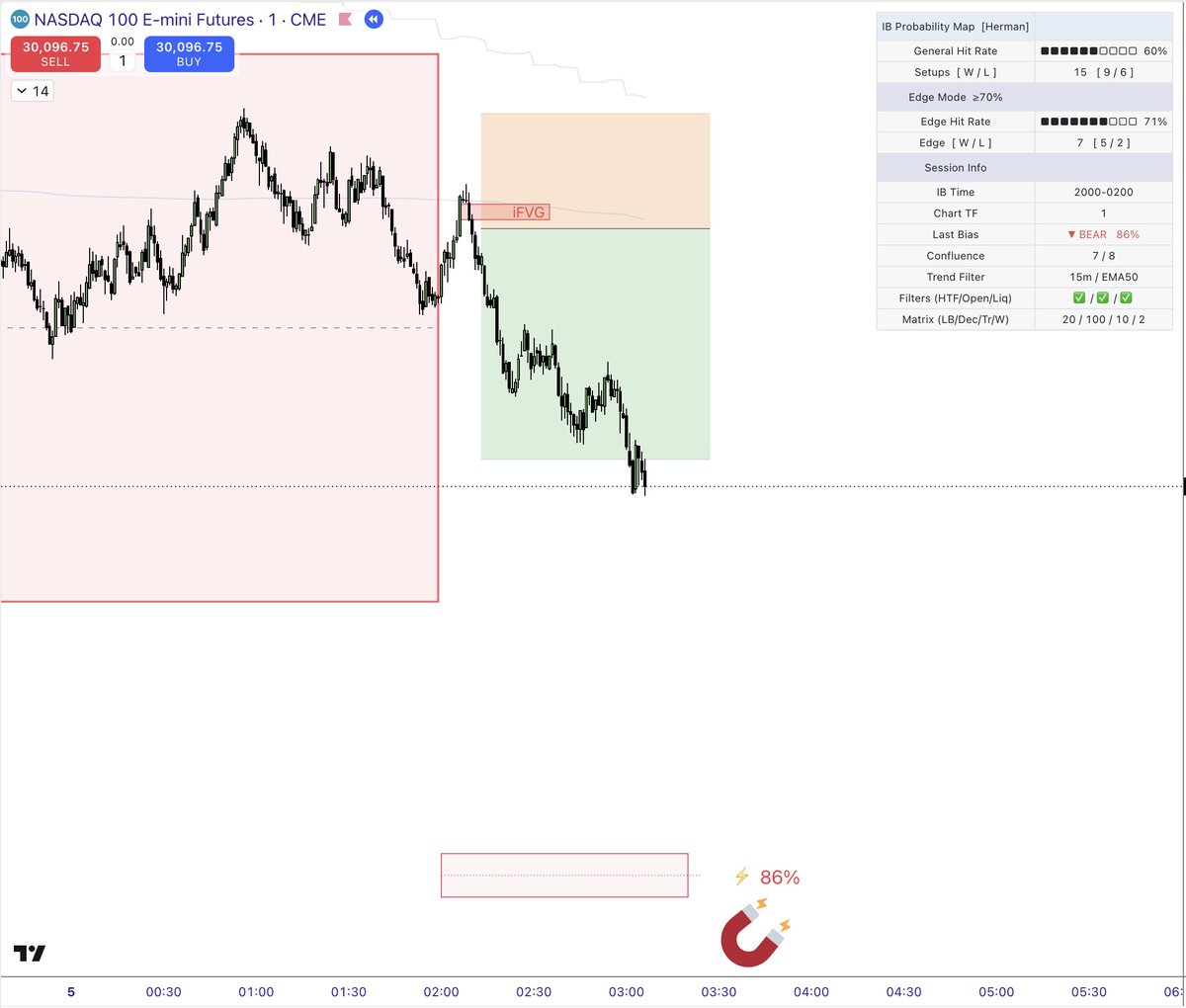
THIS IS HOW YOU STOP TAKING RANDOM TRADES. I start with the direction. At the beginning of the London session, my Intelligent Balance indicator showed an 86% probability toward the SHORT side. That immediately simplified the entire session for me: I was looking for SHORTS only. No guessing. No forcing trades. No reacting to every setup on the chart. The entry comes last. I simply wait for price to show confirmation that it is ready to move toward the more probable side: • iFVG • CISD • liquidity sweep • clear delivery shift Basic ICT concepts. The difference is that I am not using them randomly. A bullish iFVG means nothing to me when the statistically more probable side is short. A perfect-looking setup in the wrong direction is still a bad trade. Direction first. Confirmation second. Execution last. Simple as that. Would you rather trade every setup you see or only the setups aligned with the higher-probability direction?
17
11
204
16,897