
1,539 Photos and videos



RaArΞs ⚓️ retweeted

Jun 13
🚨 BREAKING: Claude can now perform stock market research like a top-tier consulting firm — for free.
Here are 10 Claude prompts that replace $100K/year stock analysts.
(Save this for later) 📌
60
320
1,483
238,493

crypto is bleeding, charts look depressed, & i needed something else to research before staring at more red candles
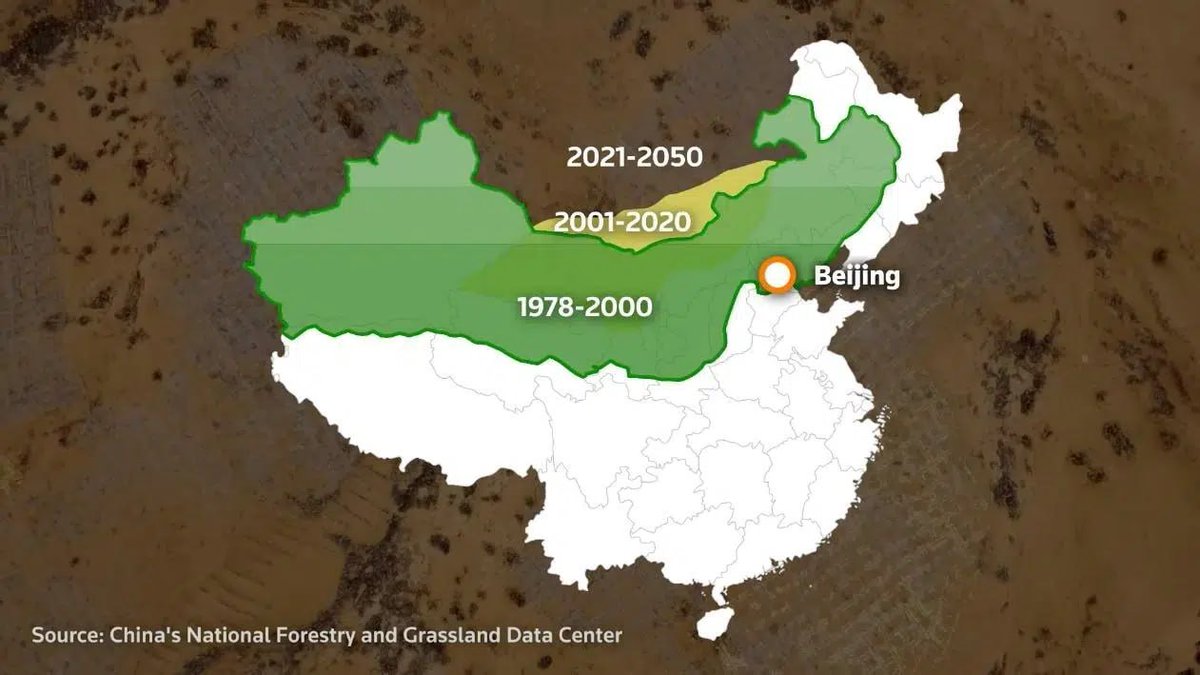
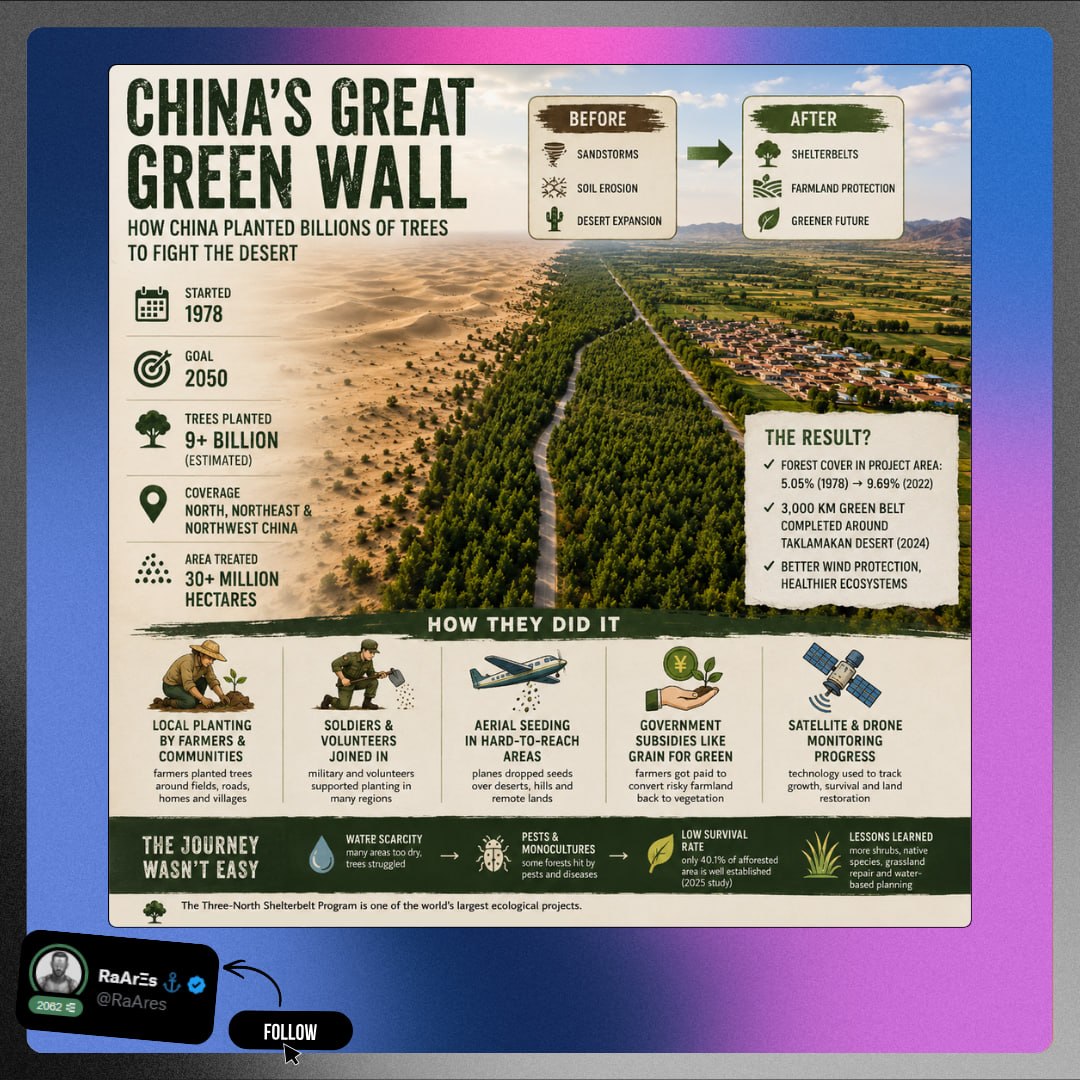
today's one is China planting billions of trees in the north
first thought: nice climate headline
second thought after reading: this was basically a 72-year fight w/ sand
here's what's on the menu:
→ the 90B trees
→ the sand problem
→ the Great Green Wall
→ the messy planting machine
→ the numbers behind it
→ where it worked
→ where China got humbled
→ the part i did not expect
▫️ the 90B trees
i saw this claim that China planted 90B trees in its north & my first thought was:
ok, that's a big ass number, No way they did this.
then i started reading into it and, ngl, the tree number became the least interesting part.
because the whole thing is way bigger than a country planting trees for some nice climate headline.
this is more like China trying to fight sand w/ state-level infra.
▫️the sand problem
the north of China had a real sand problem.
not the "desert looks cool in pictures" type.
more like:
• farms losing soil
• roads getting covered
• villages getting hit by dust
• Beijing getting sandstorms from land far away
• desert edges slowly pushing into usable land
and China basically looked at that and said ok, we need a wall.
but instead of concrete, they used trees, shrubs, grass, fences, planes, farmers, soldiers, subsidies, maps, and decades of patience.
▫️the Great Green Wall
the official project is called the Three-North Shelterbelt Program.
ppl also call it China's Great Green Wall.
it started in 1978.
the target end date is 2050.
which is kinda insane, because most gov projects feel long after 5 years.
this one is planned across 72 years.
the "wall" part confused me at first.
i imagined one huge green line across the map.
that is not what happened.
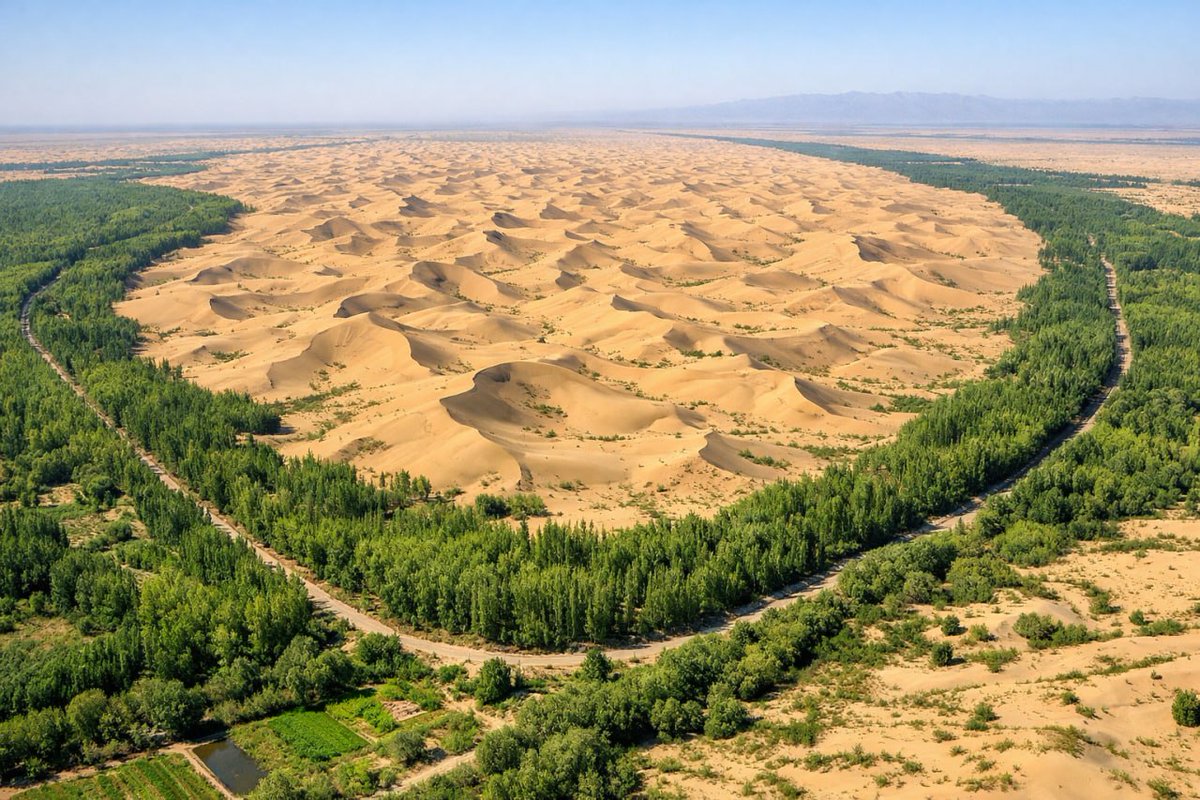
China built shelterbelts around fields, roads, homes, villages, and desert edges.
a shelterbelt is basically a line or block of vegetation that slows the wind, so sand does not move as easily.
simple idea, brutal execution.
▫️the messy planting machine
the planting machine was massive.
farmers planted around their own land.
local govs organized big planting rounds.
soldiers and volunteers helped in some areas.
planes dropped seeds in places where planting by hand made less sense.
the state also paid farmers through programs like Grain for Green, where risky farmland got turned back into vegetation.
that part is important imo, because trees don't survive on slogans.
someone has to plant them, water them, protect them, and stop animals or ppl from destroying the area again.
▫️the numbers behind it
the numbers are messy, tbh.
the internet say 90B or 66B trees.
official Chinese reports often talk in hectares, not tree count.
one early plan mentioned 52.4B "four-side" trees, meaning trees around roads, fields, villages, and homes.
by 2020, China reported around 31.7M hectares of preserved afforestation.
Reuters also reported more than 30M hectares of trees planted.
so the 90B headline sounds cleaner yeah i know, but the real project is harder to count.
▫️where it worked
some of it worked.
a 2025 study found forest cover in the original project zone went from 5.05% in 1978 to 9.69% or 13% (found multipe sources) in 2022.
(sciencedirect.com/science/ar…)
some farms got better wind protection.
some dunes became more stable.
and in 2024, China finished a green belt of around 3,000 km around the Taklamakan Desert.
i mean, wrapping one of the world's biggest deserts w/ a green belt sounds like sci-fi, but they did it.
then comes the messy part.
dry land does not care about ambition.
some trees died.
some species used too much water.
some forests were too similar, so pests had an easy job.
some areas needed shrubs and grass more than trees.
the same 2025 study found only 40.1% of afforested area became properly established.
that number makes the story more real.
China planted a lot, but the land accepted only part of it.
💡 here's other interesting things i found about this:
i) China once said it could take 300 years to reclaim the treatable desertified land at the pace they had back then
ii) the Taklamakan Desert is around 337,000 km², almost the size of Germany
iii) even after decades of planting, around 26.8% of China's land is still classified as desertifie
iv) this cut major sandstorms hitting Beijing dramatically
v) many monoculture plantations failed hard, pests/disease wiped out large sections; some areas replanted multiple times
vi) up to 2020, some sources say, that China spent $13-$14B in this
16
7
121
10,572
RaArΞs ⚓️ retweeted

Jun 12
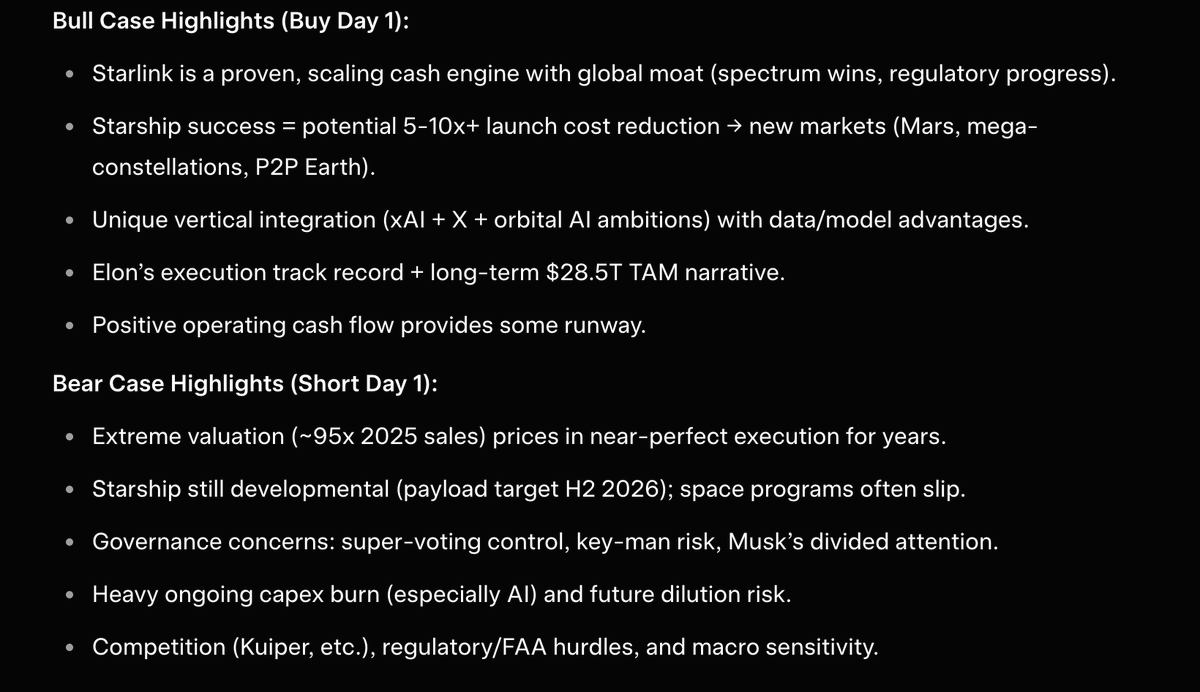
My honest thoughts on the SpaceX IPO (& its impact on the market):
• It's low float (only ~4%). We've seen this play out in crypto, and sometimes that actually leads to big expansions due to the combo of tiny supply and the additional compounder of index funds forced to buy from day 2. The setup for a squeeze is there, which makes this a risky short.
• For me, it's too risky to trade on day 1. There's no clearly defined downside here - and I only take trades where the downside and upside are clearly defined. Interested in momentum trades once a setup presents.
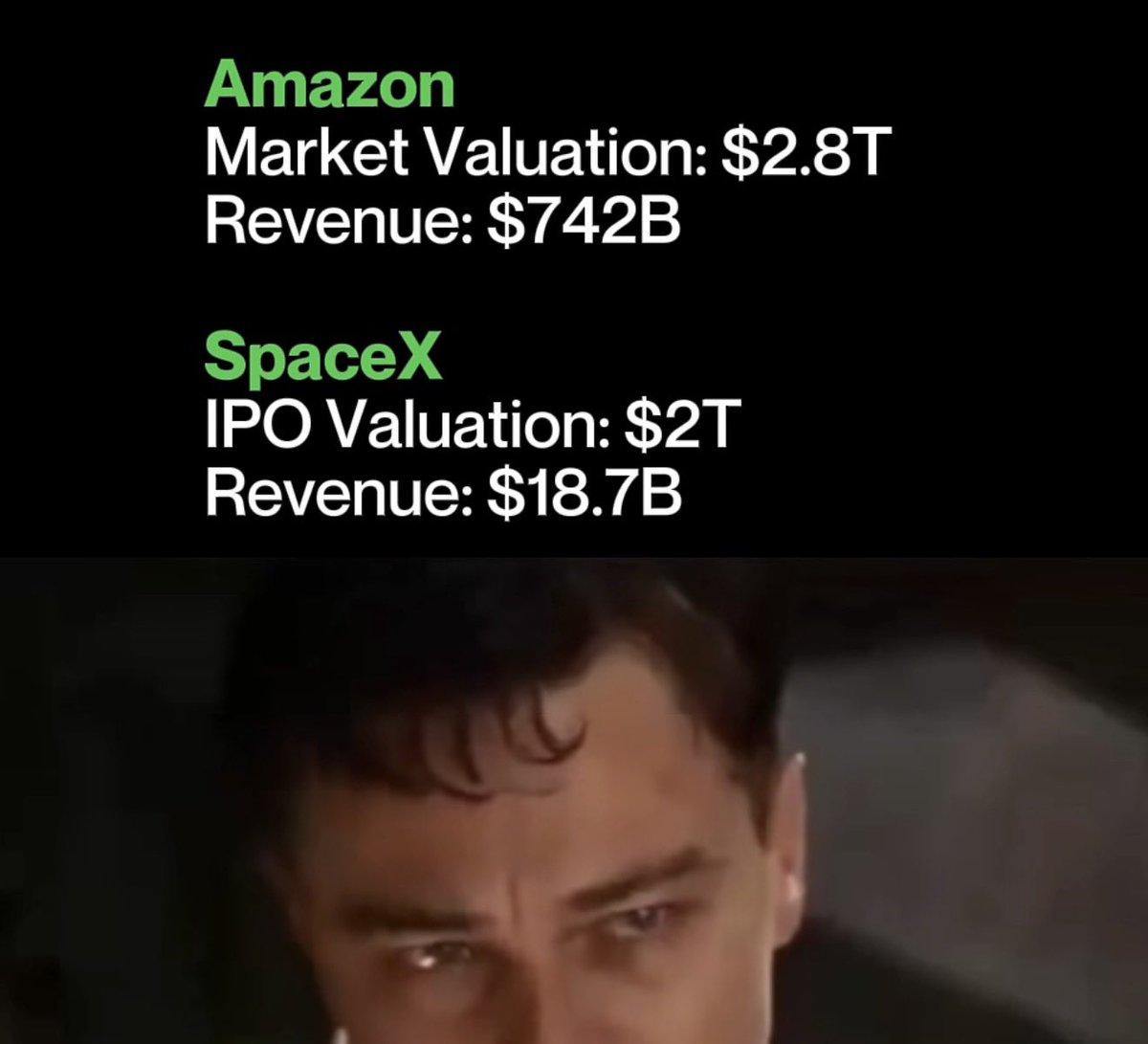
• Valuation-wise, it definitely feels inflated (once again, low float muddies the picture). $1.77T on $18.7B of revenue - roughly 95x sales, and they lost $4.2B last year. For reference, Morningstar's fair value is $63 a share. It is listed at ~$135.
• This was engineered for insiders to exit. 20% of their stock unlocks two days after the company's first earnings report, with additional 7% tranches unlocking at 70, 90, 105, 120, and 135 days. At some point in this period I'd be expecting weakness, even if it's met with a strong start. Interestingly, the Anthropic/OpenAI IPOs may be around this time too. I think the setup for some kind of local top over this period is there (as opposed to day 1), but obviously, there are many other variables at play. It's a watch.
• The narrative (that I've seen floating around) that this sucks liquidity out of crypto is nonsense. No serious crypto holder or trader is selling their $BTC for $SPCX stock. It's a completely different buyer imo. Will it suck liquidity out of other stocks? Probably. We've seen this pattern in crypto dozens of times - a hot new listing drains liquidity from the alts. Something to be aware of if you're exposed to individual majors on Nasdaq.
• Equities are no different, just slower and on a wider scale. Expect relative weakness in other majors as money rotates toward the shiny new thing.
And some of that rotation is forced as MSCI adds SPCX to its indices from day two (index funds don't have spare cash sitting around). To buy it, they mechanically trim everything else they hold. So effectively, every pension fund tracking those indices becomes a forced seller of the rest of the market and a forced buyer of SpaceX, at whatever price it's trading. (Worth noting: S&P 500 inclusion requires profitability, so that bid comes later, which may mute this effect slightly more than the narrative is suggesting).
• Longer term, I still think it's one of the most asymmetric plays in the world. Rockets, Starlink, and xAI under one roof. I am interested in being a holder over a multi-decade period. But I'm almost certain there's a more significant downturn in the near future that will give me a better entry point. I don't need to rush long-term positioning on a short-term whim. Any trade I make will be treated on its own R/R and individual merit, not as part of a long-term accumulation strategy.
20
11
144
30,229
RaArΞs ⚓️ retweeted

Jun 12
I’ve wanted to tell this story for years. Never had the courage. Here it is.
I turned a presale allocation into $80 million on $OHM. Today I have $500k left.
In 2021, I got a presale allocation in OlympusDAO, then aped heavily myself on top of it. The allocation got me in the door. My own conviction made me go all in. Staked everything. Watched it compound daily. By the peak I was sitting on $80 million.
Then I started spending like the money printed itself.
Private jets to Dubai because commercial felt beneath me. $40k weekends in Monaco. A garage full of cars I drove twice. Watches I never wore. I tipped $5k at dinners just to feel something. Every purchase was a flex for an audience that didn’t care.
The casino was worse. High limit rooms in Vegas and Macau. I’d lose $2 million in a night and laugh it off because the portfolio would make it back by morning. Until it didn’t.
When $OHM unwound, I didn’t sell. I doubled down. Then I leveraged. 5x, then 10x, trying to trade my way back to the peak. Every liquidation felt like a personal insult, so I’d open a bigger position. I wasn’t trading anymore. I was gambling with a different interface.
$80 million became $20 million. $20 million became $4 million. I told myself $4 million was still life changing money. Then I levered that too.
$500k. That’s what’s left.
Here’s what I learned the expensive way:
Unrealized gains are not money. I never had $80 million. I had a number on a screen and the arrogance to believe it was permanent.
Getting in early is a gift. I treated it like a skill. The allocation didn’t make me a genius. It made me lucky. I confused the two for three years.
Lifestyle inflation is a leak you don’t notice until the ship is underwater. The jets and cars didn’t kill me. The identity did. I became someone who needed to spend to feel like a winner.
Leverage doesn’t get you back to even. It gets you to zero faster. Revenge trading is just grief with a chart open.
Nobody at the table in Monaco remembers my name.
I’ve carried this story alone for years. Too embarrassed to say it out loud. But $500k is more than most people will ever hold at once, and I’m done pretending the past didn’t happen. The next decade is about building slow and keeping what I make.
If you’re up big right now, screenshot this. You’ll need it.
375
211
3,442
479,301
Australia has roughly 439 million hectares of agricultural land, with broadacre farming forming the vast majority estimated to cost around $2 trillion. @SpaceX with 0 profit, operating at loss is worth ~$2 trillion on day 1. Probably nothing.
Jun 10

🚨 THE US REGULATORY SYSTEM JUST BROKE
In 48 hours, SpaceX goes public at $1.77 TRILLION - the biggest IPO ever
I've been trading for over a decade, and I have never seen them rewrite the rulebook like this
Nasdaq, MSCI, and the biggest brokers in America all bent their own rules for ONE private company
That doesn't happen by accident
Let me show you exactly what they did:
First, Fidelity dropped its minimum account size from $500,000 to $2,000
A 99.6% cut
Think about that:
The most exclusive door on Wall Street, thrown wide open to millions of small investors - days before the biggest debut in history.
Ask yourself one question
Why do they suddenly want YOU in?
Because somebody needs people to sell to.
SpaceX reserved 30% of the deal for retail
THREE TIMES the normal share
And even then, most people didn't get a full allocation.
So to grab more at Thursday's open, they're dumping everything else TODAY to raise cash.
That's half of the selling you're seeing.
The other half? The smart money front-running July.
Here's the trick:
SpaceX doesn't join the Nasdaq 100 on day one.
It joins 15 days later, because Nasdaq cut its own waiting period from 3 months to 15 days
Just for this.
The moment it joins, every QQQ fund on Earth is FORCED to buy.
$22–27 billion in automatic buying.
Translation: imagine 50 buses all forced to pull into the same gas station on the same morning.
The funds know the stampede is coming.
So they're selling now to free up cash for it. Retail selling. Institutions selling. At the exact same time.
THAT is your selloff.
Now here's the part nobody will say out loud:
When the most connected money on the planet builds a $1.7T exit door and hands the keys to the smallest investors in the market…
That's NOT generosity
That's distribution at the top.
We've seen this movie twice:
➮ 2000 Dotcom
➮ 2021 SPAC mania
Insiders cash out at insane valuations while the crowd chases the hype.
The math ain't mathing.
So you've got two choices in the next 48 hours:
Chase the most expensive IPO in history at the open…
Or read the prospectus and realize you might BE the exit.
The next few days will be INSANE, but don't worry - I'll break down every move as it happens, like I always do.
Like it or not, I called every major top and bottom of the last decade publicly. I'll call this one too.
Many people are going to wish they followed me before June 12, 2026.
Soon, you'll understand why.
2
5
495
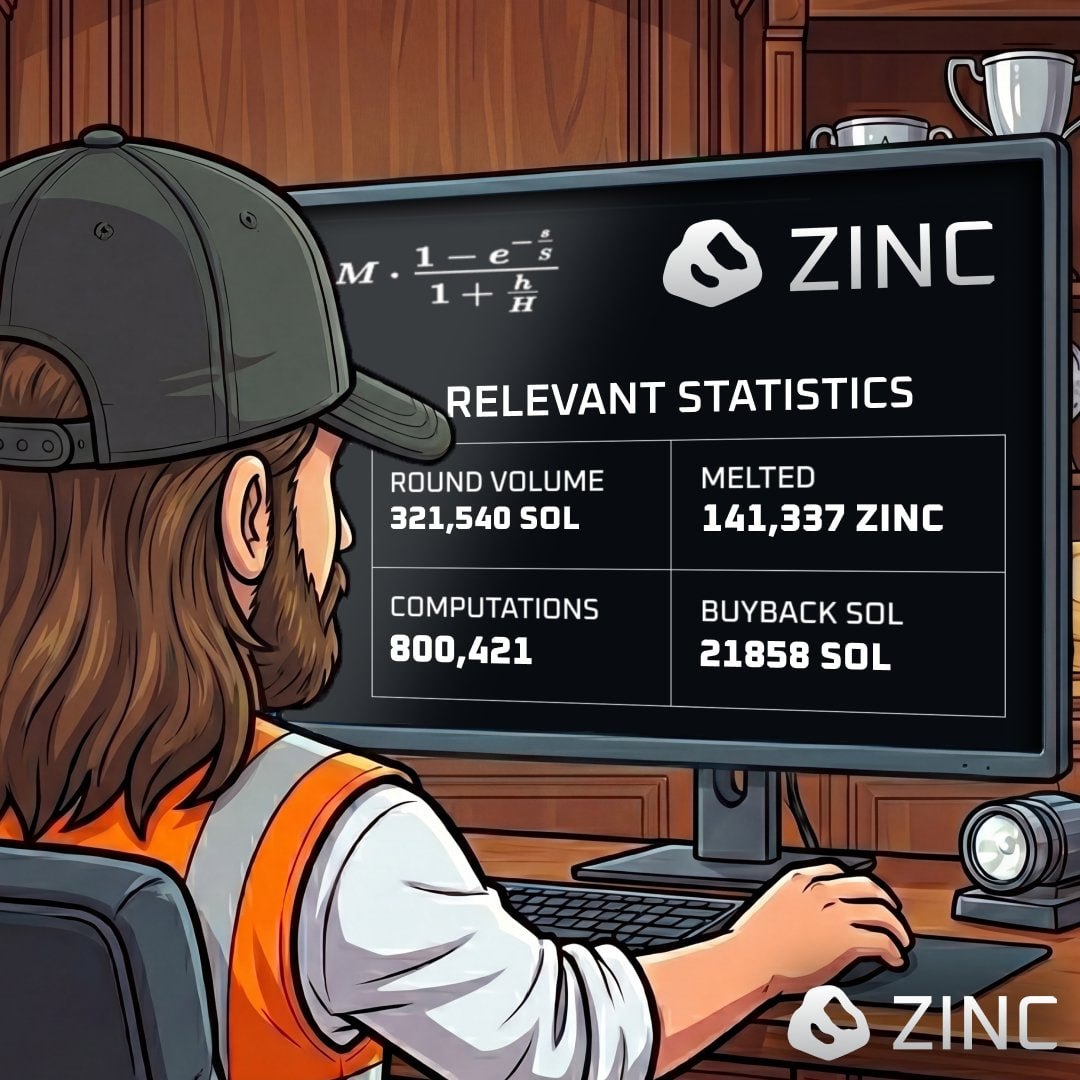
i wrote about $ARX (TGE coming soon) @arcium but this time i want to bring to surface @zinc_cash
it is now the 3rd highest revenue-generating protocol on @solana acc. to defillama (24hr)
zinc is a mining game where ppl deploy $SOL into timed rounds, pick from 1 to 30 tiles, & wait for one tile to win
if they hit the winning tile, they share the SOL from losing tiles based on how much they put on that tile
they also get $ZINC rewards using the same logic, so the whole thing feels like mining mixed w/ a round-based SOL game
the protocol uses arcium confidential compute
which btw, its chart looks kinda hot
in q2 of this year for example it made $1.7M in gross revenue... that's quite decent for a project, only in one quarter
btw, the token is only 1 month old, x account only has 7k, token is at $3.3M mcap, i mean there are some good starting numbers here...
here are other numbers by the protocol:
- $20M in total round volume
- spent 21,500 $SOL in $ZINC buybacks
- $ZINC melted (burned) 40% of lifetime minted supply
- over 800k arcium encrypted computations (when i wrote about it may, it had only 70k processed...)
revenue here means the SOL zinc keeps in its treasury & buyback vault.
holders revenue is the SOL later used to buy $ZINC.
then 90% goes to burns & 10% goes to stakers.
so the game loop is also tied to a buyback/staking flow, not only round rewards... 🤔
⚠️ if this is your first time reading about Arcium, i have a more general thread here:
x.com/RaAres/status/20186743…
⚠️ thread on $ARX:
x.com/RaAres/status/20483464…

i don't think normal/web3 users/degens care about MPC, encrypted compute, or cryptographic papers
they care if they can move money, trade, vote, or use AI w/o exposing everything
that's @arcium $ARX .. and they recently released this update about their encrypted ecosystem & more! 🧵👇
points:
→ arcium shipped before $ARX
→ the apps are the proof
→ the token $ARX has a job
→ AI might be the bigger bet
⚠️ if this is your first time reading about Arcium, i have a more general thread for you here:
x.com/RaAres/status/20186743…
▫️arcium shipped before $ARX
i went through Arcium's pre-TGE update & the main thing i got is pretty simple.
they waited until the network had live apps before pushing $ARX out, which is imo, the right way.
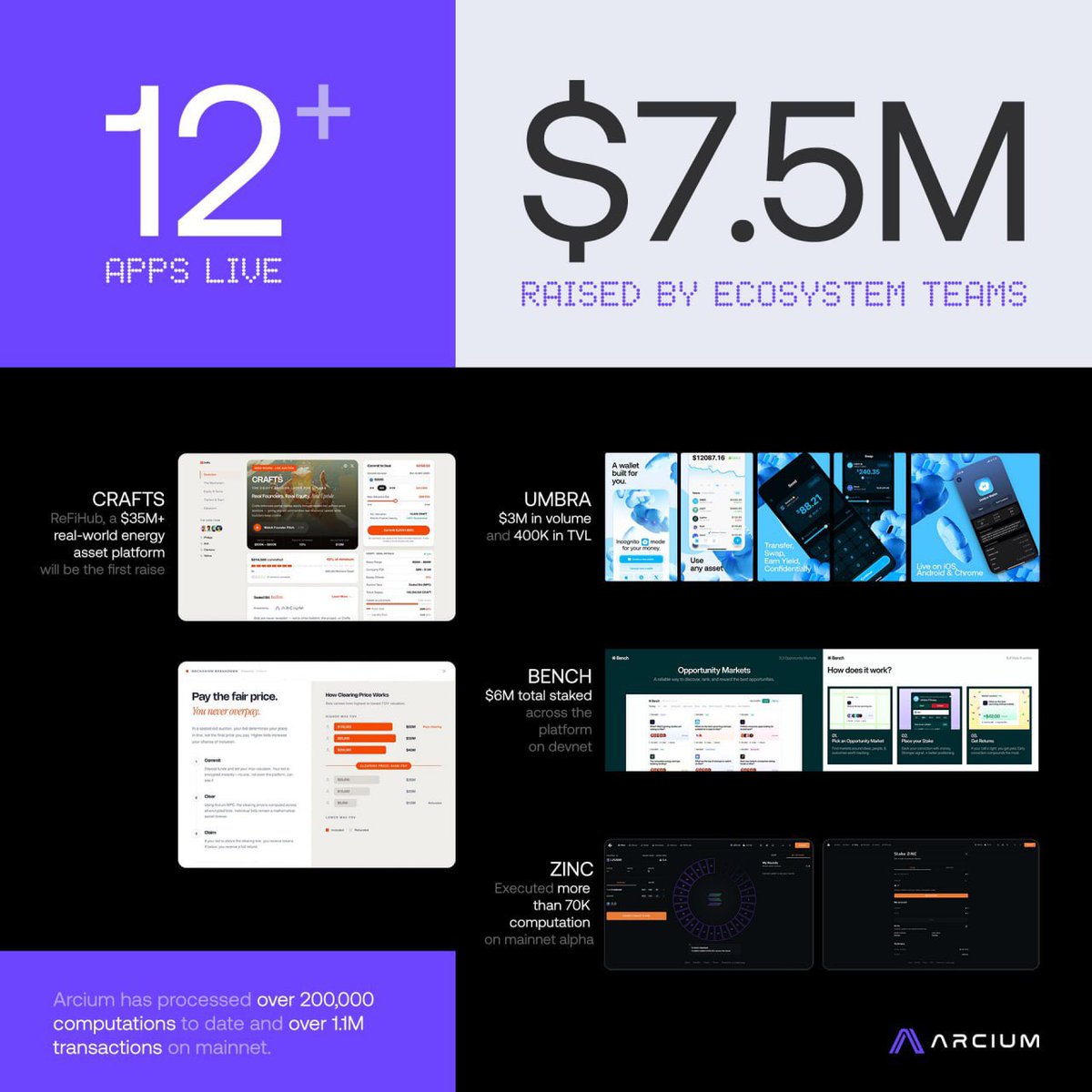
Arcium is already live on Solana Mainnet Alpha, @UmbraPrivacy is already public, & ecosystem teams already raised $7.5M .
that matters because a lot of tokens launch first, then ppl wait months for something real to happen... we were all tired of that crap.
here, there is already something to click, test, & track.
▫️the apps are the proof
Umbra is probably the easiest example to understand rn.
it is a private wallet.
you can shield, transfer, & swap assets privately onchain.
so privacy stops sounding like a nerdy infra word & starts feeling like a normal user product.
that is a good sign imo, because most users do not care about MPC.
they care if the app works.
here are other apps powered by Arcium:
@craftsdev
@benchdotgames
@pythiamarkets
@hydex_io
@stealf_finance
@DinarioApp
@undesk_trade
@anon0mesh (just got my attention recently, w/ all this private messaging issues crap especially)
@meleemarkets
@seedplex_io
@epochdotm
@flewlive_
you might want to check 'em cause they're all bout that privacy stuff...
▫️the token has a job (utility)
the ecosystem also surprised me a bit.
Arcium is already being used for:
• private wallets
• sealed-bid auctions
• OTC, payments
• private voting
• fundraising
• DAOs
• prediction markets
the idea is simple:
crypto has a lot of data that should not be public, and those are:
i) balances
ii) bids
iii) votes
iv) trades
v) wallet links
vi) user info
Arcium is trying to keep that data hidden while the app still runs onchain.
▫️$ARX has a clear role too
it will be used for staking, computation scheduling, & governance.
in simple terms:
• staking, you know that it keeps node operators accountable
• scheduling decides which encrypted jobs get processed
• governance gives locked holders a say in future changes
▫️the bigger future angle is AI
Arcium is adding Manticore, an AI-focused MPC protocol from Inpher.
the idea is to let AI work w/ sensitive data W/O exposing the data itself, like
medical data, financial data, personal data.
that is probably the part i will watch closest after TGE.
if Umbra, C-SPL, & Manticore create real usage, Arcium becomes much more than a privacy narrative.
34
8
116
12,032
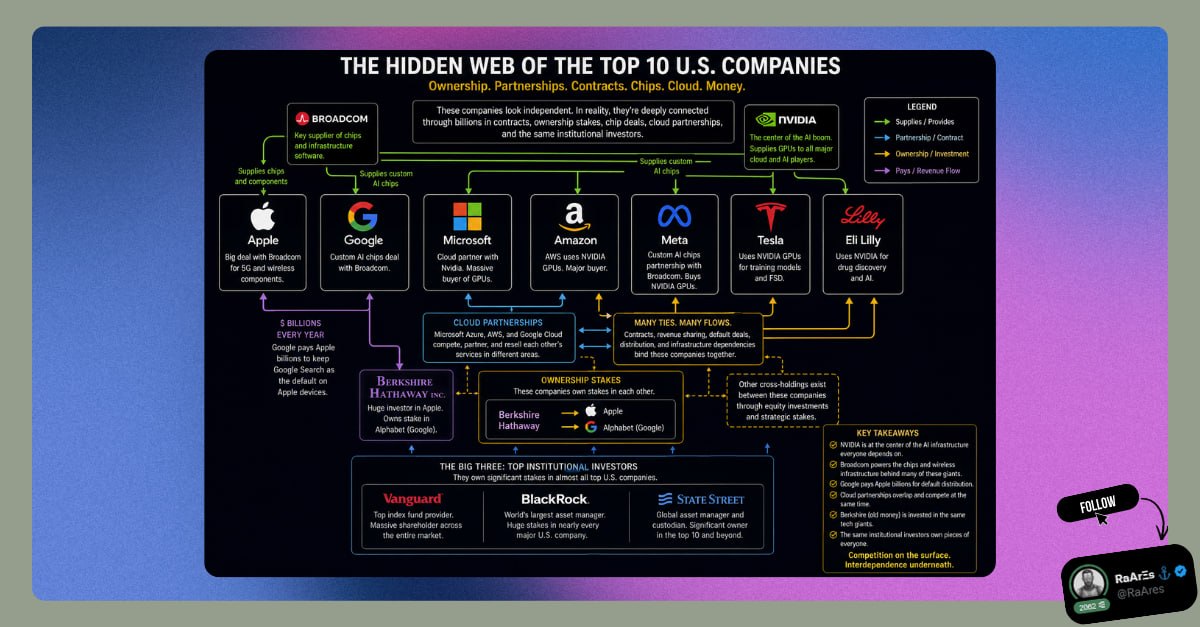
did you know the top US companies look way less independent once you follow the contracts?
i went into this thinking it would be like:
@nvidia does chips
@Apple does iPhones
@Google does search
@Microsoft does cloud
@amazon does AWS
Meta does social
@Tesla does cars
Berkshire does investing
then the map got weird.
because once you follow the filings, supplier deals, cloud partnerships, and ownership stakes, it starts looking more like one giant machine with different logos on top.
the clearest hub is Nvidia.
Nvidia is tied to Microsoft, Amazon, Google, Meta, Tesla, and even Eli Lilly.
that means the AI race is not only "who builds the smartest model?"
it is also:
- who gets the GPUs
- who gets the cloud capacity
- who gets priority infrastructure
- who can pay for the next training cycle
- who becomes more dependent on the same chip layer
the internet used to feel capital-light. write software, ship it, scale it.
AI changed that. now the bottleneck is physical: GPUs, power, land, cooling, cloud contracts, and billions in capex (money spent on big things that last a long time)
and then you find Broadcom.
Broadcom is not as loud as Nvidia, but it sits under a lot of the same mega-cap economy.
Apple has a multibillion-dollar deal with Broadcom for 5G and wireless components.
Meta and Broadcom have a multi-year, multi-generation partnership for custom AI chips.
Broadcom will help build several generations of Meta's own AI chips. the first phase alone is over 1 gigawatt of compute capacity, enough power for around 750,000 homes.
(and this is where it gets weird: Broadcom CEO Hock Tan stepped down from Meta's board and became an advisor to Meta's custom chip strategy)
so Meta is still buying Nvidia GPUs, yes. but under the hood, it is also building its own chip road w/ Broadcom.
Google also has a long-term Broadcom link for custom AI chips.
so the funny part is:
the companies trying to reduce Nvidia dependence still end up in another chip dependency loop.
then comes the Google x Apple thing.
one of the most insane parts: Google pays Apple billions so Google Search stays the default on Apple devices.
Reuters reported the deal was around $20B per year... i mean, damn...
so every time people talk about Apple privacy, Apple ecosystem, Apple independence, etc… there is still this massive search-money pipe running behind the scenes.
it's like this:
Google gets distribution
Apple gets money
and you and i open Safari and the money machine keeps moving 😀
then Berkshire enters the room.
Berkshire is not building AI data centers, it is not shipping GPUs, but it owns a real stake in Apple and, based on the research snapshot, also bought into Alphabet.
so even the old money side is sitting inside the same mega-cap loop.
and above a lot of these companies, you still find the same huge institutional holders:
Vanguard, BlackRock, State Street in many cases (the big three)
which means the top of the US market is not only connected by products.
it is connected by:
- ownership
- chips
- cloud
- default distribution
- AI infra
- old capital
- index money
the next article i'm writing about goes into the PayPal Mafia side, Elon, Reid Hoffman, Peter Thiel, and the Nvidia "they give you chips and you buy from them" claim.
because that part is where the story gets even more weird.
16
6
115
8,817
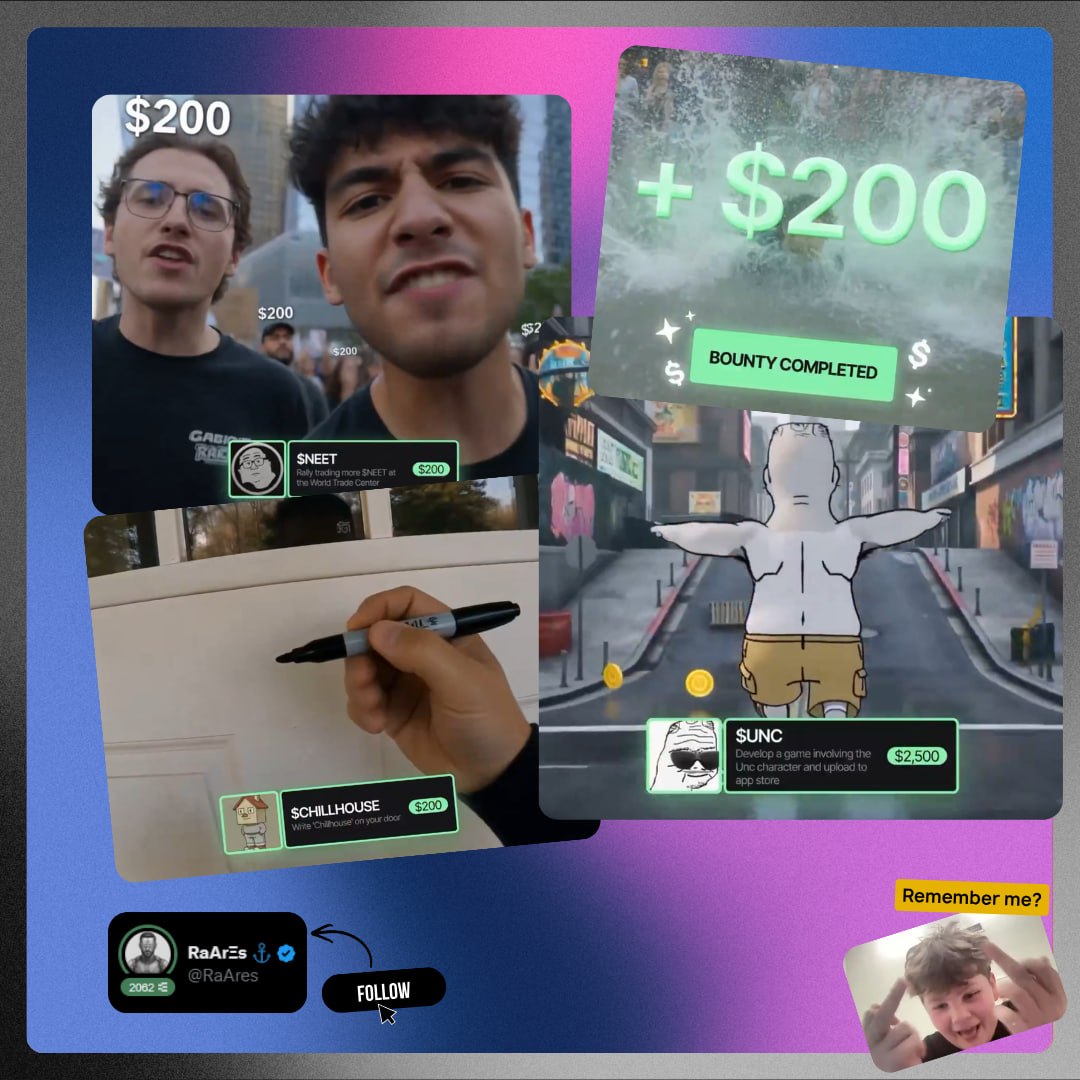
pay someone $20 to ask strangers in a mall if they would buy a coin called $FARTCEO 😂 that’s what pump fun's GO is about
@pumpfun launched GO, & tbh the first read sounds like someone turned internet dares into a task market w/ money attached (not a new concept tho!)
pay anyone to do anything, create a bounty, set the reward & wait for someone to complete it.
that’s the simple version.
here’s the thins i’ve discovered 🧵👇
→ weird things ppl can bounty
→ the creator flow
→ the bounty hunter flow
→ the escrow & review part
→ is this bigger than memecoins???
▫️weird things ppl can bounty
ok hear me out
the weird part is where this can go.
a coin community can pay someone to put their mascot on a billboard.
a founder can pay ppl to find bugs before launch.
a creator can pay someone to make 50 memes in 24 hours.
some random token holder can offer $25 for someone to rap about their memecoin in a public place.
someone can ask for a tutorial, a video, a logo, a thread, a street interview, a telegram sticker pack, or some weird IRL proof task if it fits the rules.
because the minimum bounty is $5, this can also become dumb small internet work, not only big campaign stuff.
▫️the creator flow
from the creator side, you simply must do the following:
• connect X account & wallet
• create the bounty
• add description, timeframe & deliverables
• put the payout in escrow
• let Pump fun review the submissions
after the bounty goes active, the creator can’t withdraw the reward anymore.
the money stays locked until someone wins or the bounty expires.
escrow style stuff.
▫️the bounty hunter flow
from the bounty hunter side, it’s also simple, you must:
• connect X account & wallet
• complete the deliverables in time
• submit proof
• wait for Pump fun to review it
if the submission gets accepted, the hunter gets paid.
if it gets rejected, the money stays in escrow until another submission gets accepted or the timer runs out.
▫️the escrow & review part
this review part matters because GO can get messy fast.
if ppl can pay anyone to do almost any task, someone needs to decide if the proof is valid.
Pump fun reviews submissions while funds are in escrow.
bounty creators can recommend submissions, but Pump fun accepts or rejects them.
also, bounties that may count as X spam are not allowed, & users still need to follow X ToS.
▫️why this feels bigger than memecoins
memecoins already run on attention.
now teams, holders, creators, & random internet ppl can attach money to that attention.
do this task → show proof → get paid
very simple flow, but also very chaotic.
feels like the useful stuff & the stupid stuff will grow side by side 😀
also, there is something similar running named @daremarket
20
3
89
6,818
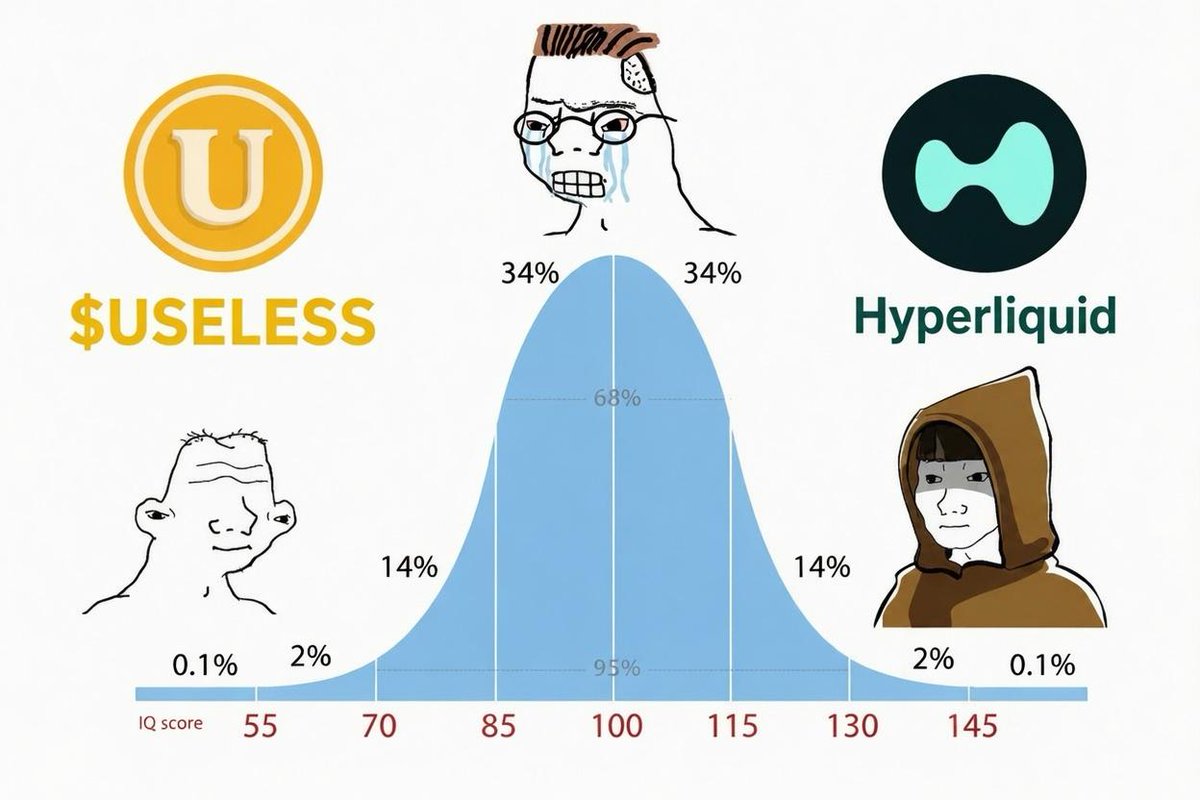
$useless: the meme coin that might be not as useless how it sounds even if:
a year later it’s still chilling at $100m mc w/ $30m daily volume ( which is huge tbh in this difficult market)
here’s the full story (quick read 🧵)
1/ launched early may 2025 on letsbonk.fun (solana)
pure fair launch. no presale, no team tokens, no vesting.
mint authority revoked day one. all 1b tokens went straight into the lp.
contract: Dz9mQ9NzkBcCsuGPFJ3r1bS4wgqKMHBPiVuniW8Mbonk
it was born as satire in a sea of ai agents / rwa / defi yield hype.
creators basically said “fine, here’s one that admits it does jack shit.”
@theunipcs (bonkguy) @solporttom (letsbonk founder) helped it catch fire early.
2/ tokenomics? dead simple and honest af
• total supply: 1,000,000,000
• circulating: basically 999m (fully diluted from minute one)
• no staking, no governance, no revenue share, no roadmap
value comes only from liquidity fees pure community degeneracy the whitepaper is a 47-page meme pdf that literally says “this whitepaper doesn’t exist” and ends w/ “0 promised, ∞ broken promises”
performance art at its finest.
3/ price run
launched at basically nothing
• peaked at ~$0.4375 ath on oct 14 2025 (we’re at 75% away from it)
• right now: ~$0.1003–0.1008 with strong performance
• mc: ~$100m (top ~200)
• 24h volume: $30–35m (still liquid as hell)
holders: ~37.8k and climbing cex listings (coinbase, kraken etc) in mid-2025 sent it parabolic.
it’s been swinging 30-50% weeks like a true meme.
4/ the paradox that actually works
in a market full of fake roadmaps and broken promises, $useless became one of (the most) honest project alive.
“we promise nothing and deliver exactly that” → turned into the ultimate meme utility.
community vibe is “join thousands of others who have achieved absolutely nothing”
site theuselesscoin.com is minimalist gold, live ticker zero bs slogans.
5/ why it still has legs in 2026
pure meme culture as an asset class.
no team dumping, no rug risk (everything renounced), no narrative drift.
it’s the anti-everything coin in a cycle where everyone else overpromises.
recent momentum shows the trenches still respect the honesty.
6/ risks (being real)
zero utility = zero floor except community liquidity.
pure speculation play. one bad macro week and it can dump 50% (it already has).
no catalysts other than vibes and volume. if the meme dies, the price dies w/ it.
7/ my 2 cents
in 2025-2026 we saw every utility narrative get tested and half of them failed.
$useless just sat there, did nothing, and outperformed most serious projects by being transparently useless. 😂
sometimes the best utility is admitting you have none.if you’re still reading, you already get it.
pure meme energy still prints in this market. what’s your favorite useless play right now? drop it below
40
27
231
24,213
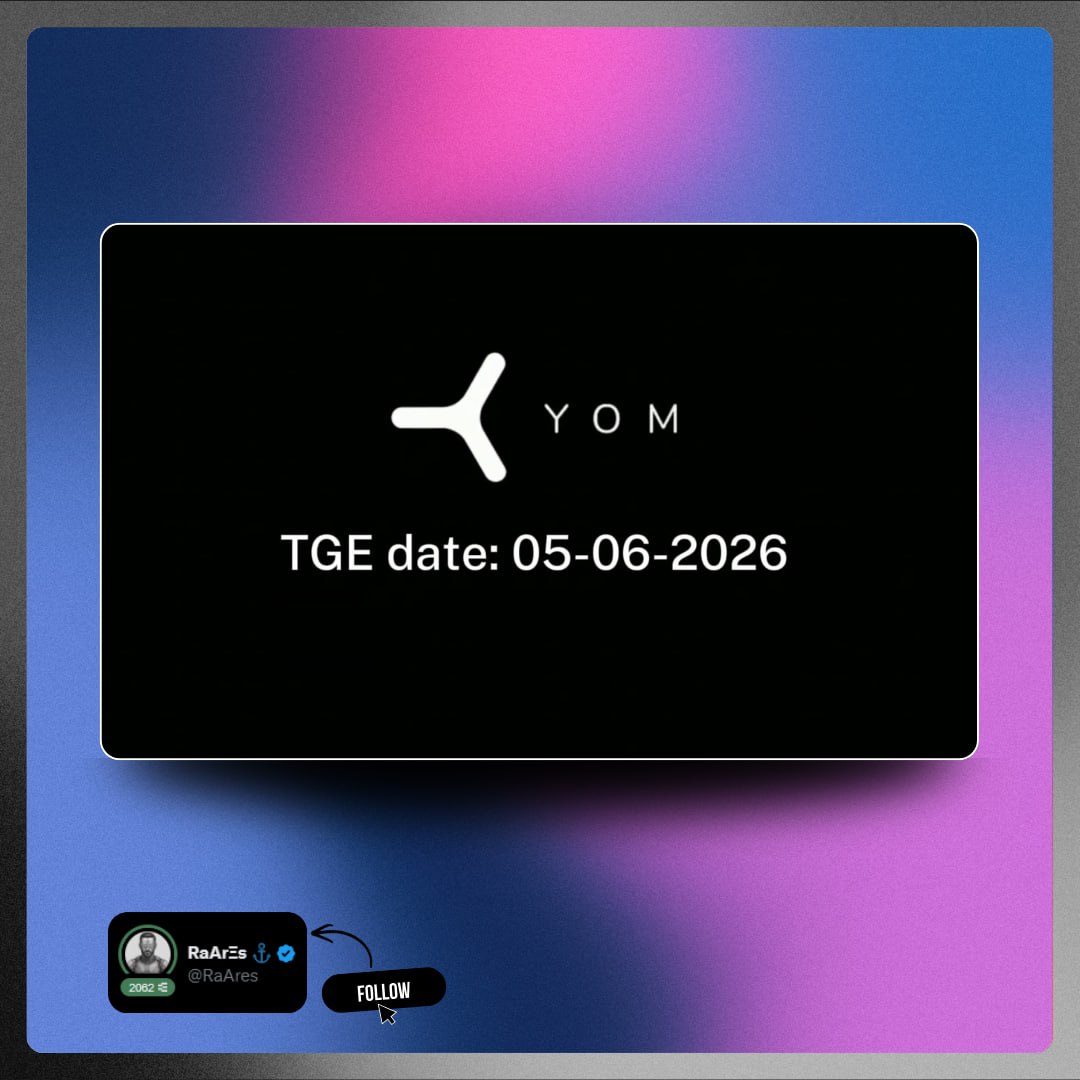
$YOM @YOM_Official TGE is coming on 5-june
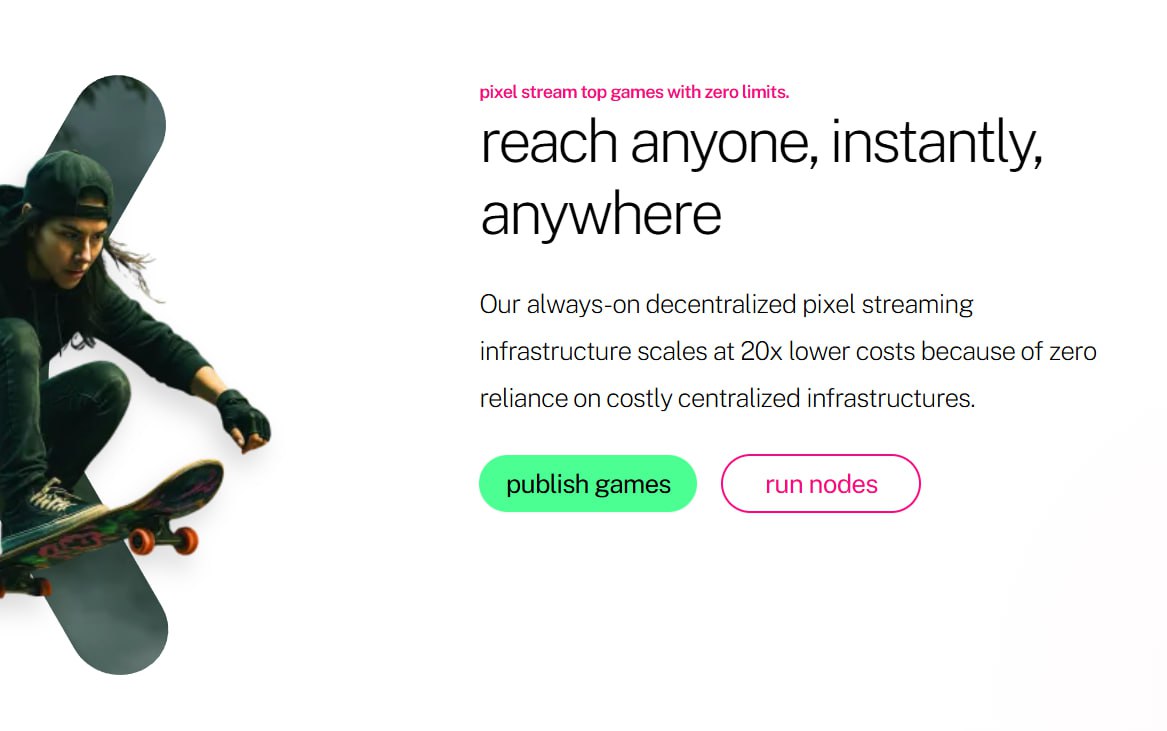
the part i'm watching is simple: cloud gaming got big fast, but the cost of running it still looks too heavy for mass usage. AWS at ~$2/hour and YOM is at YOM at ~$0.05/hour... let's do the math 👇
quick read 🧵
→ what YOM is
→ the cloud gaming gap
→ the cost gap
→ $YOM launch setup
→ june-5 TGE date
▫️what YOM is
YOM is building a decentralized cloud gaming network on Avalanche.
the simple idea is this:
instead of relying only on big cloud infra, YOM lets games stream through a distributed network of hardware.
player taps play → YOM routes the session → the game streams to the device → the session settles through the network (aka cloud gaming)
so the bet is pretty clear.
make cloud gaming cheaper, easier to access, & less dependent on the usual AWS-type infra.
⚠️ here's a more general thread i wrote a while ago about it:
x.com/RaAres/status/19983178…
▫️the cloud gaming gap
the cloud gaming market is around $121B & nearly doubled in the past year.
but the funny part is that a large part of gamers still sit on hardware that cannot run the games they want.
apparently, 47% of gamers are on hardware that cannot run cloud gaming properly:
so there is this weird mismatch:
• demand is growing
• the market is already huge
• hardware still blocks a lot of users
• cloud infra is still expensive
that is where YOM is trying to position itself.
not by selling another game, more like by becoming the infra layer behind streaming games.
▫️the cost gap
the number that stands out most is the cost comparison.
AWS is listed at around $2.00/hour.
YOM is listed at around $0.05/hour.
that is a 95% reduction
and imo this is the part traders will look at first, because the cloud gaming market is already big, while $YOM launches at a much smaller valuation.
▫️$YOM launch setup
$YOM TGE is on june-5.
network: Avalanche C-Chain / custom L1.
launch price: $0.10.
FDV: $75M.
initial market cap: around $12.4M-$13M.
token supply: 750M.
the token is also described as strictly deflationary through a 5% session settlement burn 🤔
traction:
• 1M quest participants
• 263K testnet DAU
• 40 studio partners
• 400 games from previous YOM context
backers include Avalanche Foundation, Outlier Ventures, Borderless Capital, & CV VC.
there is also a 6-9 month cliff for the team investors, w/ zero insider selling at TGE ✌️
▫️ june-5
i think we should do some math here:
~$121B cloud gaming market, 95% lower listed hourly cost, $75M FDV, around $13M initial market cap.
and TGE on june-5.
direct link: yom.net/tge
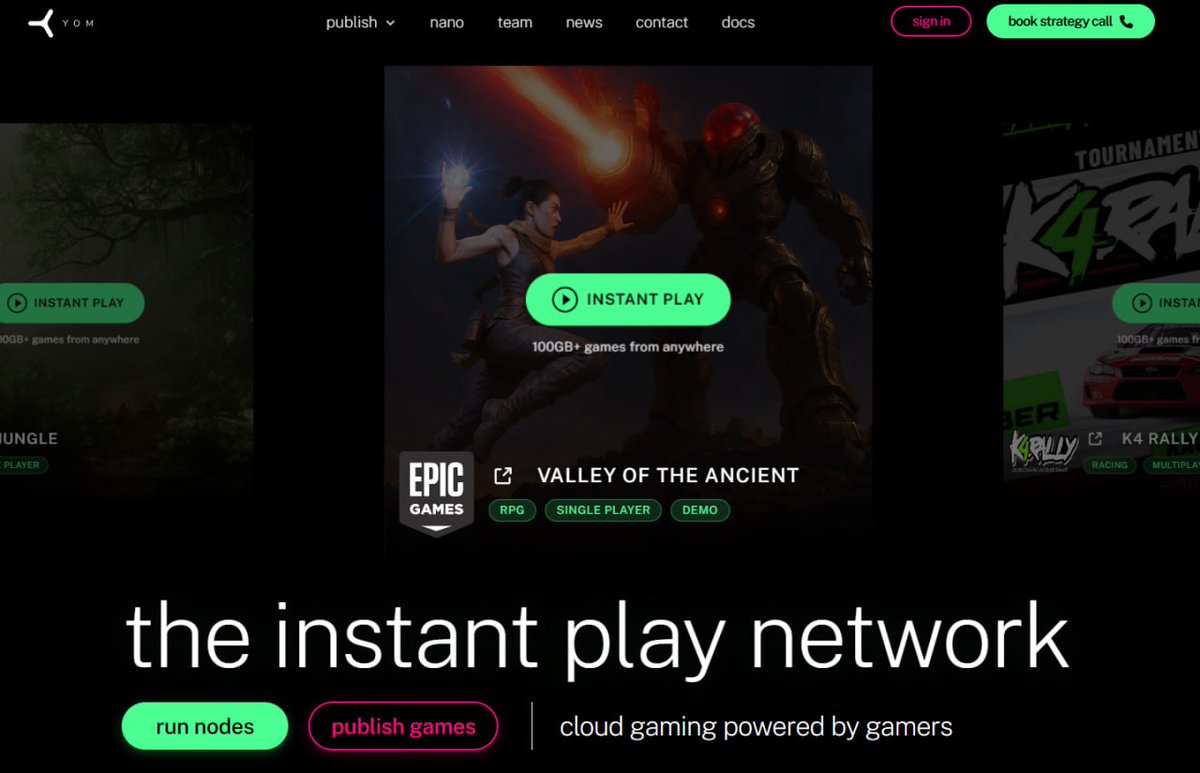
i started reading about @YOM_Official expecting a typical cloud-gaming model, but i found a decentralized compute network that uses gaming as the main job it runs first, so i unpacked how the whole thing fits together.
🧵👇
you'll get to know these in less than 3 minutes:
→ what YOM is
→ how the infra runs
→ what happens when someone hits play
→ how value cycles through tokens
→ why nodes & studios plug in
▫️what YOM is building
the first layer makes it look like a cloud gaming service.
but the deeper i went, the more it looked like a decentralized compute network that happens to use game streaming as its main workload.
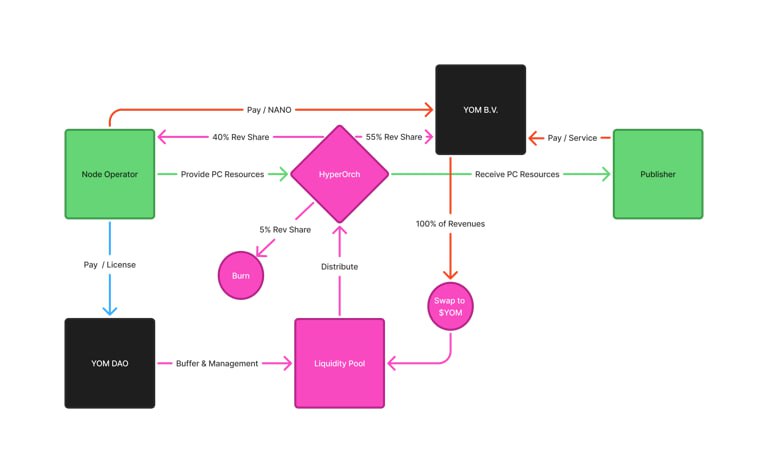
the load gets spread across a network of gaming rigs owned by random ppl who plug in a NANO device and turn their pc into an isolated node.
i'm still thinking if this model can scale evenly across regions, but the pieces fit.
i split this into the core pieces that define the network ↓
• a decentralized cloud-gaming layer powered by user-owned hardware
• a compute marketplace where streaming sessions settle on-chain
• a token engine ($YOM, $YRX, XP) that rewards high-performing nodes
• a distribution rail for studios, brands, and broadcasters
• a NANO device that turns a gaming PC into a secure node in minutes
but, in simpler terms → YOM is building a decentralized cloud gaming infra.
▫️how a session actually starts
i broke this flow down into the exact jumps the system makes ↓
• user taps play
• HyperOrch finds a good nearby node
• game boots from a secure NANO drive
• stream starts through WebRTC
• latency stays under ~30 ms
• session completes and settles on-chain
the cycle is short enough that even low-spec devices feel like consoles.
▫️how the economy loops
• players create demand by launching sessions
• nodes absorb that demand with GPU cycles
• session revenue splits: 40% to nodes, 5% burn, 55% treasury
• rewards also come in $YOM, $YRX, and XP
• strong nodes climb the routing order
• weak nodes get penalized
APYs around ~480% per license tie back to this demand-driven loop.
▫️what node operators actually contribute
they share their GPU cycles through that small NANO device.
basically a plug-and-play secure boot drive.
it isolates the environment so publishers don't need to trust someone's random PC.
operators earn more as utilization increases, so supply grows naturally when demand heats up.
the earnings range in the docs ($30–70 per GPU, or $350–500/month at ~60% utilization) tracks as long as session flow stays active.
▫️why studios, brands & broadcasters use it
anyone can tap into it ↓
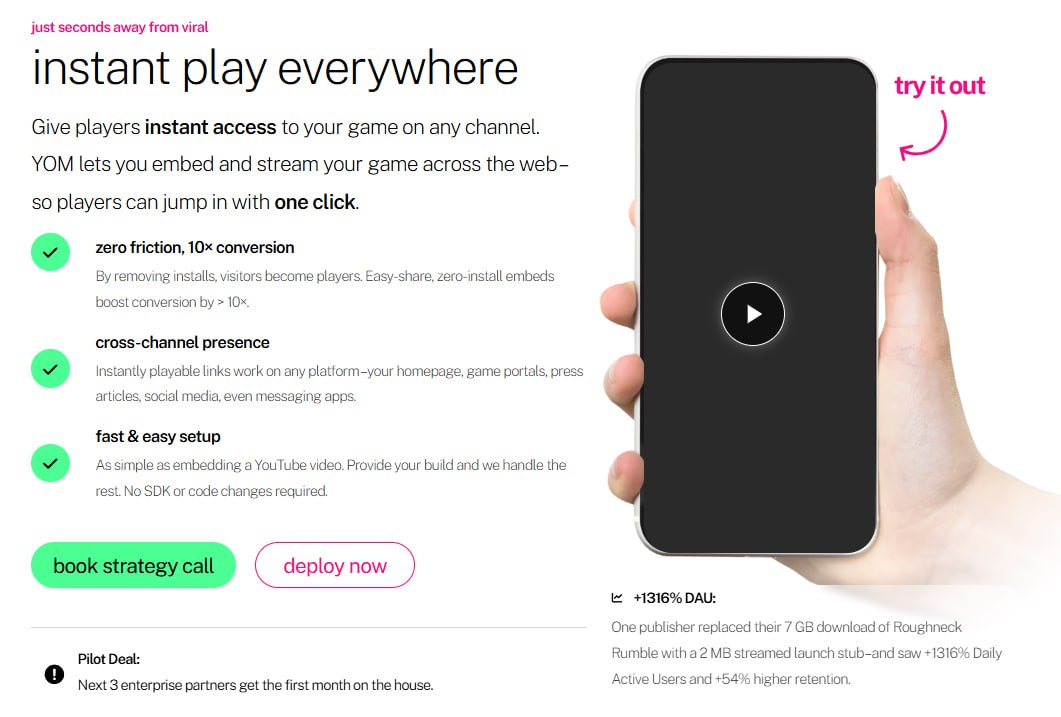
• white-label cloud gaming
• interactive ads
• NFT or fan-token mechanics
• streamed social experiences
• lightweight decentralized apps
cost is the kicker here.
traditional cloud gaming sits around $1–2/hour.
YOM claims ~ $0.05 per session. that's a huge gap if u ask me...
studios also keep 100% of sales and full control over how they monetize.
and they can embed AAA experiences directly into sites or apps through SDKs without touching heavy infra.
i'll be covering more of YOM so follow me @raar3s to not miss it
41
40
217
11,834
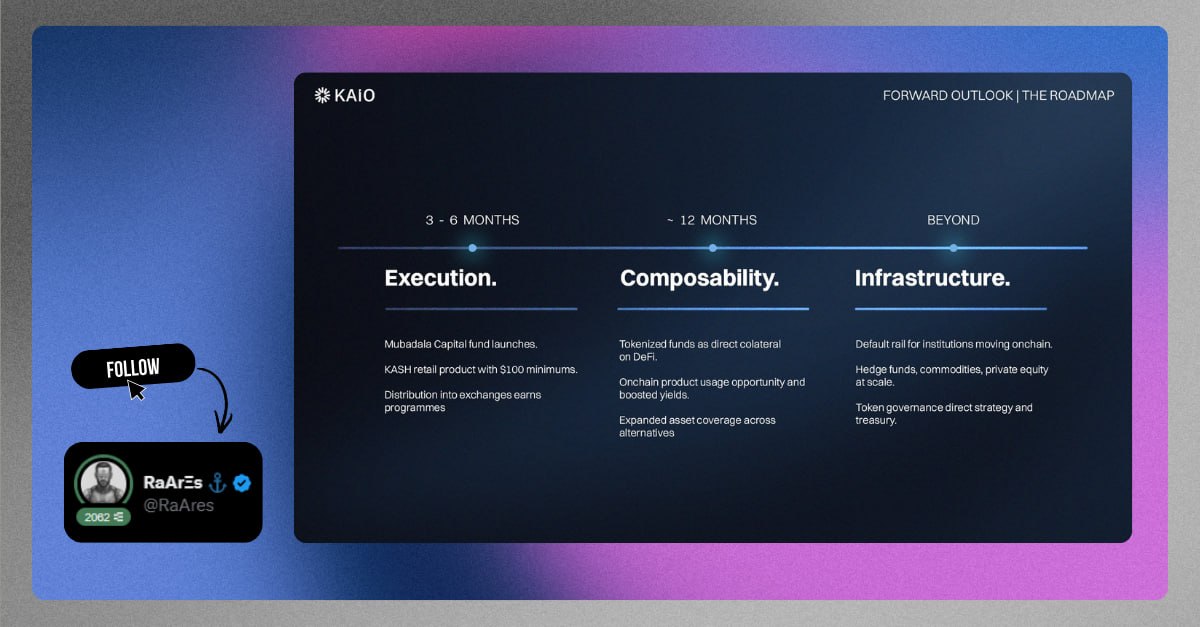
$KAIO @KAIO_xyz 's post-TGE roadmap is:
first get products live, then make those products useful across DeFi & CeFi
→ 3-6 months
→ KASH
→ distribution
→ 12-month composability
→ $KAIO roadmap
⚠️ if you missed my general thread about KAIO it's here:
x.com/RaAres/status/20520403…
⚠️ if you missed my thread about KAIO's products, here's that one:
x.com/RaAres/status/20528043…
▫️3-6 months
$KAIO's roadmap splits pretty cleanly into execution first, then composability later.
the next 3-6 months are about getting more products live & pushing them into more distribution channels.
the main item is the planned Mubadala Capital tokenised fund.
that matters because it would bring a sovereign-wealth-linked fund structure onchain, aimed at qualified institutional & accredited investors.
▫️KASH
KAIO is also targeting Q2 2026 for KASH, its first retail-facing product.
the product is described as US-dollar money-market exposure, w/ onchain settlement & a $100 minimum.
so the point is clear:
• institutional-style yield product
• smaller entry size
• onchain access
• retail-facing UX
still, this depends on launch execution, access rules, & where users can actually use it.
▫️distribution
KAIO also mentions ongoing talks w/ centralised exchanges, apps, & payment platforms.
the goal is to put KAIO products inside places where users already hold balances.
that part is important because tokenised funds don't scale only through the fund itself.
they need distribution.
▫️12-month composability
the 12-month roadmap moves into DeFi & CeFi integrations.
KAIO wants its tokenised funds to work as collateral, margin, & structured product inputs.
the more specific detail is that KAIO wants the tokenised asset itself used as collateral, instead of a wrapped version.
▫️$KAIO roadmap
so the roadmap is not only "more funds onchain."
it is:
• launch more fund products
• make the first retail product live
• expand distribution
• make tokenised funds usable inside DeFi & CeFi
that is the roadmap to watch now.
BlackRock showing up on @kaio_xyz $KAIO product page made me stop scrolling
because this is where RWA gets more serious:
not another tokenized asset idea, but regulated funds that need issuance, transfers, settlement, servicing, & investor checks to work onchain.
here's what you need to know about this project:
→ why KAIO
→ the mechanism
→ what the compliance layer changes
→ what products are already live
→ where the chain part becomes useful
→ $KAIO
→ what actually matters
▫️why KAIO
i kept seeing RWA projects talk about tokenized funds like the hard part is putting the asset onchain.
but i don't know if you knew, but the messy part is what happens after the fund becomes a token
who can buy it? or who can hold it? or who can transfer it?
essentially, which rules follow it across wallets, platforms & chains?
that is where KAIO became more interesting to look at.
from what i read, the product is less about making funds look web3-native & more about keeping regulated fund logic alive after the asset moves onchain.
so the main thing i wanted to understand was simple:
does KAIO make tokenized funds more usable, or does it mostly recreate old fund access w/ a chain wrapper around it?
▫️the mechanism
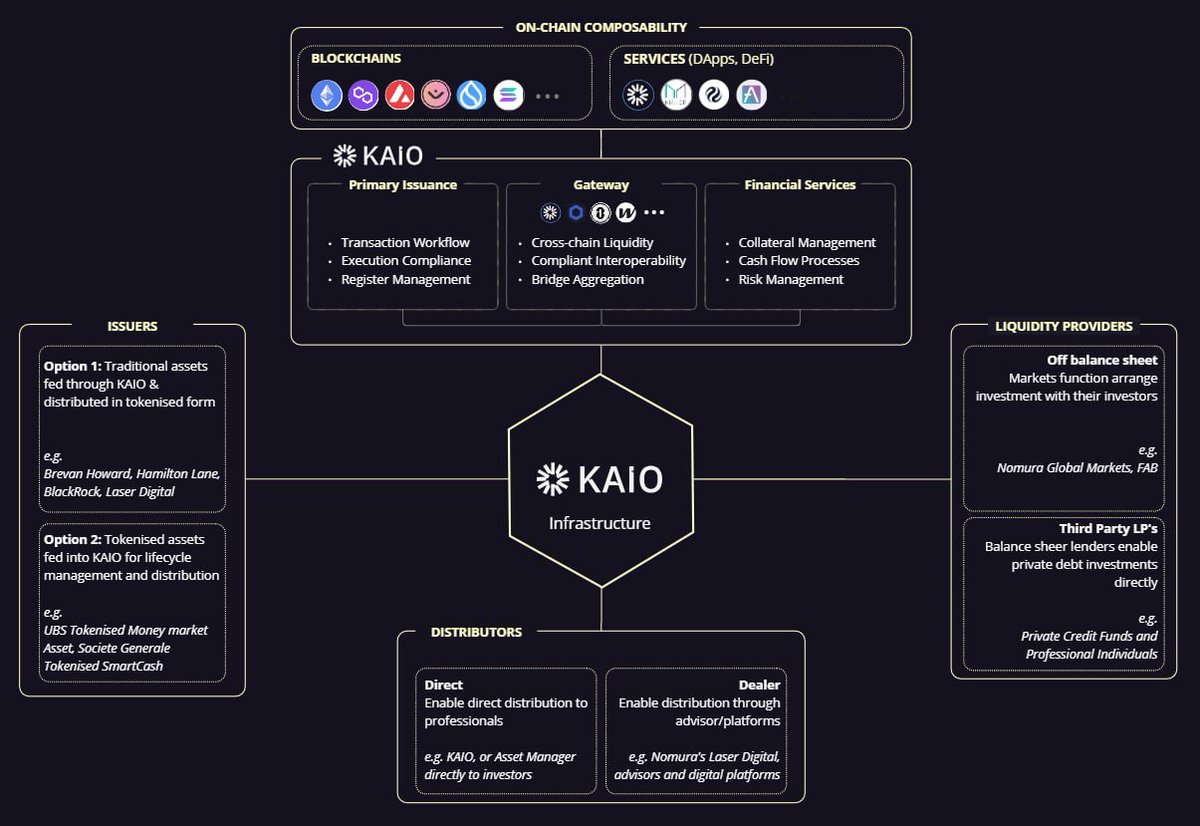
KAIO is a protocol for issuing & managing institutional financial assets onchain.
it is deployed on eth mainnet, & it uses sc for investment execution, settlement, asset servicing, & fund lifecycle workflows.
in plain english, the fund can move through a chain system, while the admin parts stay attached to it.
the flow looks something like this:
i) issuer brings a fund into KAIO
ii) smart contracts handle issuance, transfers, settlement, & servicing
iii) compliance checks sit inside the transaction flow
iv) distributors & wealth platforms connect through APIs or the KAIO Gateway
v) investors get access to tokenized fund positions that can move across supported networks
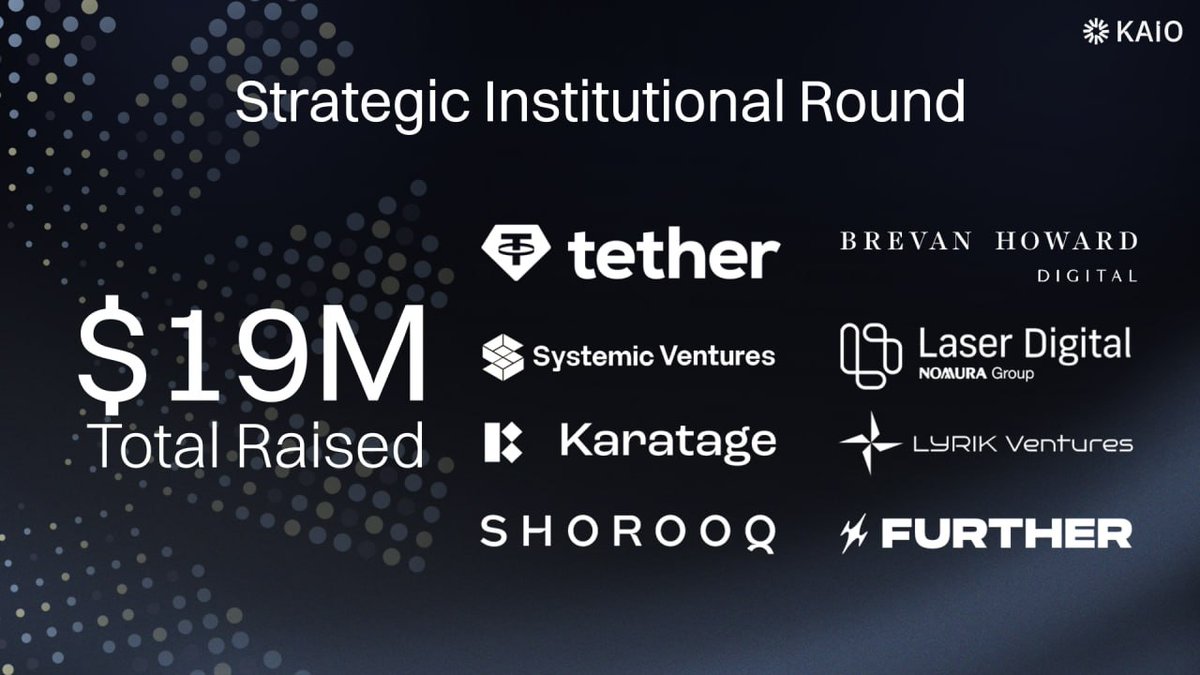
they raised $19M in total from backers like @tether @further @laserdigital_ @BHDigitalAssets
@LyrikVentures @Karatage_ @ShorooqPartners
▫️what the compliance layer changes
the important part is the modular (that can be adjusted) compliance engine
that means KAIO checks rules around each transaction instead of treating the fund token like a free-moving asset.
for example:
i) is this investor allowed to hold this product
ii) does this jurisdiction allow this transfer
iii) does the transaction match investor-level requirements
iv) can this position move to another wallet or network
v) does the fund still meet legal & investor protection rules
that is less exciting than "onchain yield", but it is probably the part institutions care about most.
a fund manager does not want a tokenized product that breaks the rules after the first transfer.
▫️what products are already live
the product page made the idea more concrete for me.
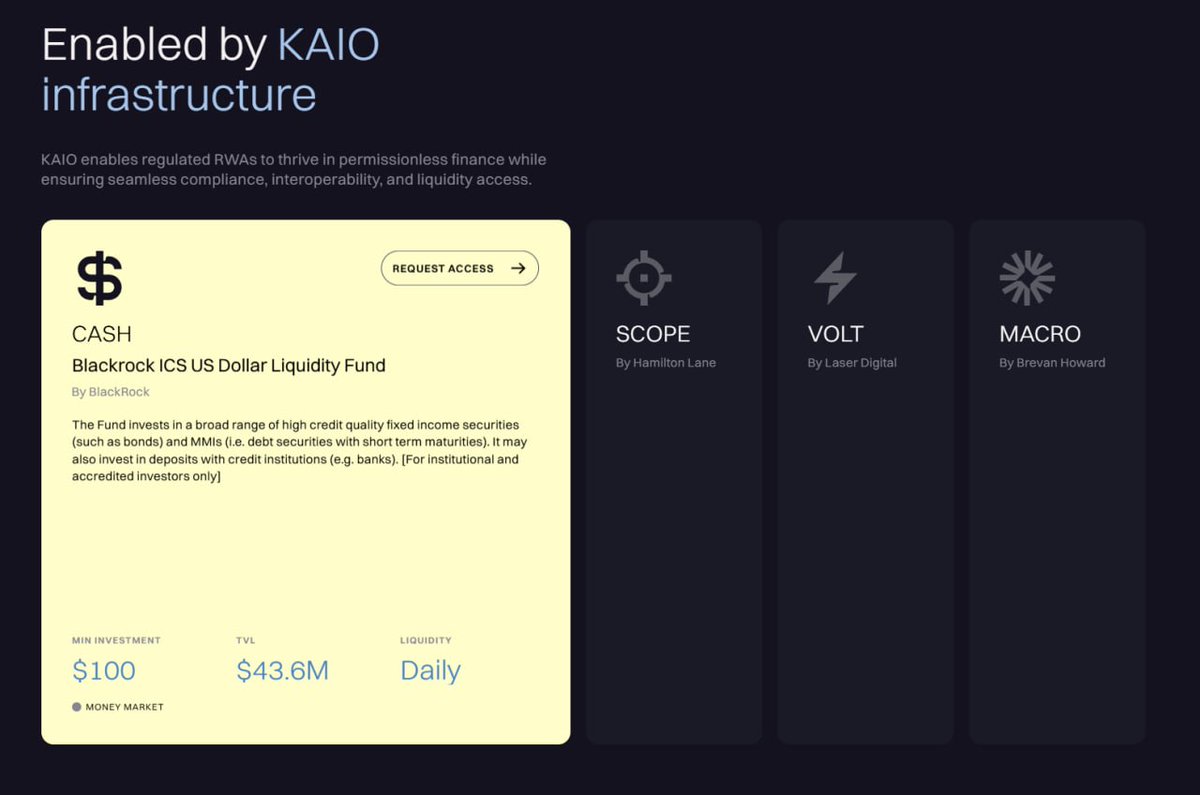
KAIO already shows tokenized funds from BlackRock, Laser Digital, Hamilton Lane, & Brevan Howard.
these are:
I) CASH - BlackRock ICS US Dollar Liquidity Fund
w/ $100 minimum, $68.47M AUM, & daily liquidity
II) CARRY - Laser Digital Carry Fund
w/ $10,000 minimum, $13.01M AUM, & monthly liquidity
III) SCOPE - Hamilton Lane Senior Credit Opportunities Fund
w/ $10,000 minimum, $11.22M AUM, & monthly liquidity
IV) MACRO - Brevan Howard Master Fund
w/ $10,000 minimum, $11.44M AUM, & monthly liquidity
KAIO is handling more than one clean RWA category
money market, private credit, crypto basis, & hedge fund products all have different mechanics.
so the infra needs to support more than token creation.
it needs lifecycle management.
▫️where the chain part becomes useful
KAIO talks a lot about composability.
tokenized assets can move across networks like Solana, Avalanche, Polygon, Sui, TON, & more.
also in DeFi protocols, liquidity pools, settlement layers, collateral management, cash flow processes, & risk management.
▫️$KAIO
$KAIO has also been listed recently on @uniswap @mexc & it's planned to go live as well on @coinbase @kucoin @bitget @gate
token utilities include:
i) access to KAIO products as investors
ii) access/coordination for fund managers to bring assets onchain
iii) governance
iv) stakin
v) possible future yield or incentive rewards from the Community & Liquidity pool
vi) protocol fee
▫️what actually matters
the catch is ACCESS…
these products are for onboarded accredited investors & institutional investors.
so this is not retail opening an app & buying anything they want.
the more accurate read is that KAIO is building rails for regulated assets to behave more like onchain assets.
they can be issued, transferred, settled, moved across chains, & used inside financial workflows.
but the compliance layer stays in the path.
that is probably the real RWA direction imo.
19
4
106
9,544
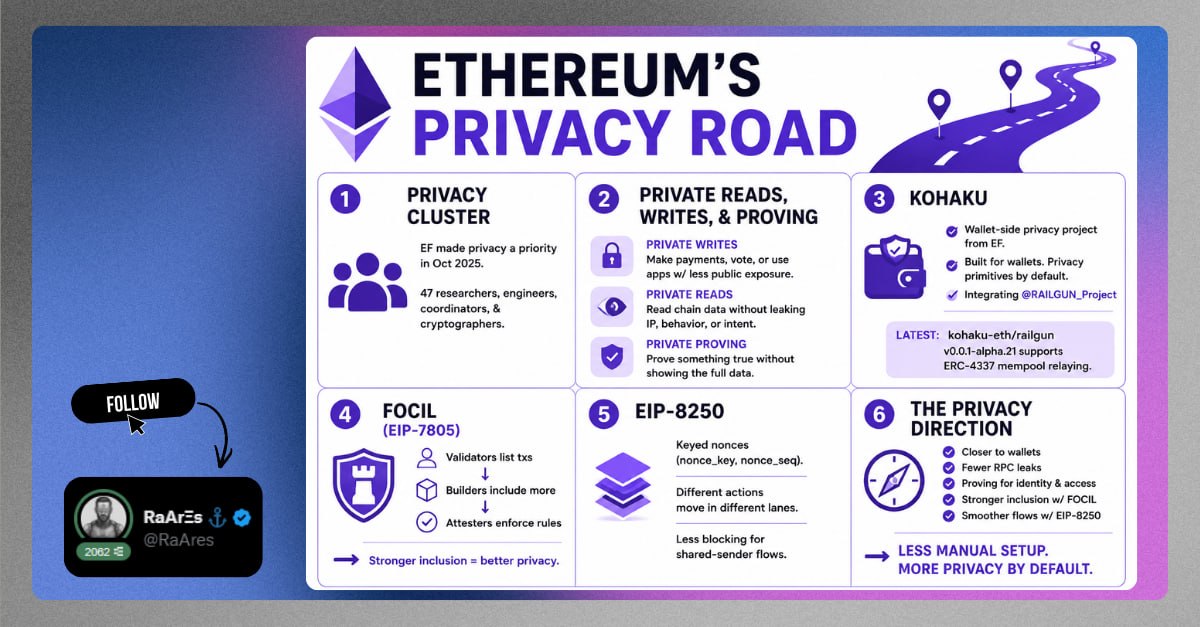
a dive into what's happening in the ethereum's privacy ecosystem
→ privacy cluster
→ private reads, writes, & proving
→ kohaku
→ FOCIL
→ EIP-8250
→ the privacy direction
▫️privacy cluster
ethereum foundation made privacy a more formal part of the roadmap in october 2025.
the privacy cluster brings together work from private reads & writes, private proving, private identities, privacy experience, & kohaku.
the group includes 47 researchers, engineers, coordinators, & cryptographers.
tx privacy is one piece.
wallet privacy, RPC privacy, identity, proving, app connections, & UX are also part of the same problem.
▫️private reads, writes, & proving
ethereum privacy is mainly split into 3 buckets rn.
i) private writes > users make payments, vote, or interact w/ apps while exposing less activity publicly
ii) private reads > wallets & apps read chain data without leaking IP, wallet behavior, or intent through RPC requests
iii) private proving > users prove something is true without showing all the data behind it
private reads are easy to overlook.
a wallet can leak info before a tx happens.
RPC calls, balance checks, app connections, reused addresses, & wallet lookups can all expose patterns.
so the privacy problem starts before the user signs.
annoying, but true.
▫️kohaku
kohaku is the wallet-side privacy project from ethereum foundation.
the goal is to give wallet teams privacy primitives they can add directly into regular wallets.
the roadmap includes a browser wallet, an SDK, private eth_call, private sends, private receives, private payment requests, one account per dApp, P2P wallet connections, ZK social recovery, post-quantum account options, & optional P2P tx broadcasting.
the practical point is simple.
wallets should handle more privacy by default.
we should not need a separate privacy tool for each action.
the latest kohaku SDK work already has a @RAILGUN_Project integration.
kohaku-eth/railgun v0.0.1-alpha.21 supports ERC-4337 mempool relaying for private txs.
tornado cash & privacy pools integrations are still in development.
▫️FOCIL
FOCIL stands for fork-choice enforced inclusion lists.
it is EIP-7805.
the proposal is focused on censorship resistance.
the rough flow is:
• validators create lists of txs that should be included
• builders have less room to ignore valid txs
• attesters check if blocks follow the inclusion rules
this connects to privacy because private txs still need reliable inclusion.
a private tx loses value if builders can delay it, ignore it, or make users depend on special routes.
FOCIL adds more pressure for valid txs to land onchain.
ethereum foundation selected FOCIL as the consensus-layer headliner for hegotá, the upgrade after glamsterdam.
▫️EIP-8250
EIP-8250 proposes keyed nonces for frame txs.
normal accounts use a linear nonce queue.
tx 5 waits for tx 4.
tx 6 waits for tx 5.
that structure becomes messy for privacy systems that route many users through one shared sender.
one stuck tx can block unrelated txs behind it.
EIP-8250 adds separate nonce lanes through (nonce_key, nonce_seq).
different private actions can move through different lanes.
for shared-sender privacy systems, this makes execution less fragile.
▫️the privacy direction
ethereum still does not have full privacy by default.
the current work points to a more practical privacy stack.
kohaku handles wallet privacy.
private reads reduce RPC leaks.
private proving supports identity, eligibility, credentials, assets, & app access.
FOCIL improves inclusion guarantees.
EIP-8250 reduces nonce bottlenecks for shared-sender privacy flows.
ethereum privacy is moving closer to the wallet, the RPC layer, the mempool, & the account model.
we'll soon have less manual privacy setup for you and i and more privacy built into the normal flow.
if you're interested in more eth's ecosystem update, follow @raares 🤟
25
7
116
12,847
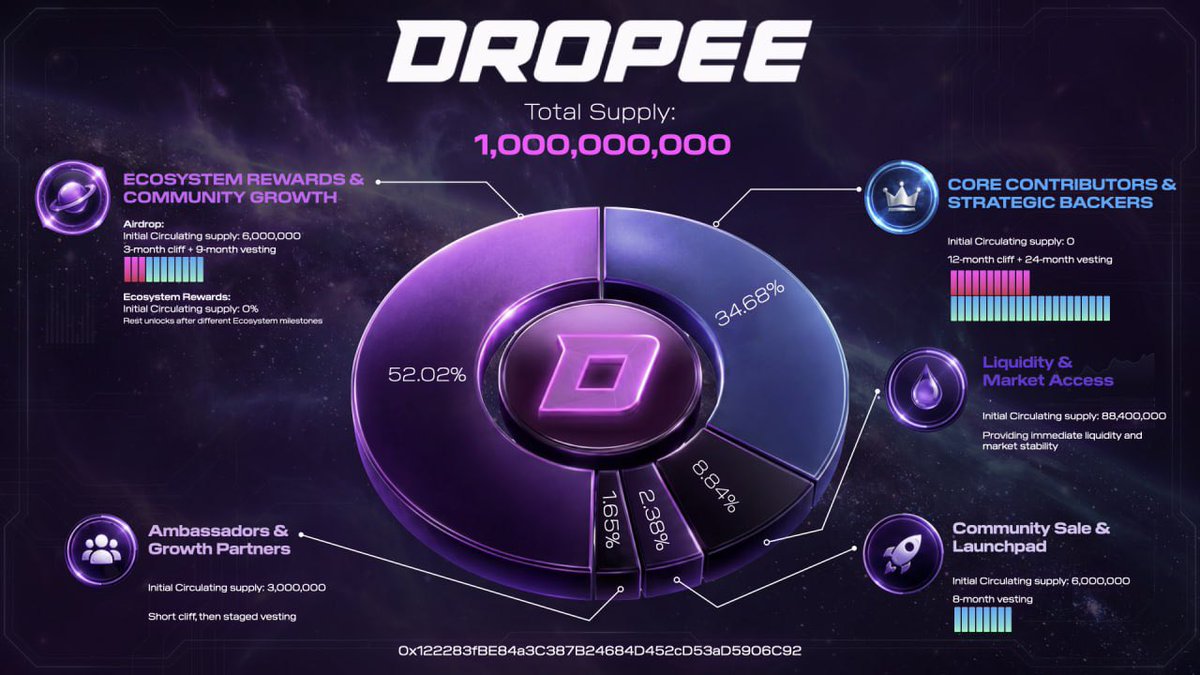
$DROPEE TGE is today, may-27
today i’ll go through Dropee Create, the current traction, how $DROPEE fits in, & what i’d track after launch 🧵👇
→ Dropee Create
→ why Telegram matters
→ current traction
→ $DROPEE loop
→ TGE
first time i wrote about Dropee was 8 months ago, here x.com/RaAres/status/19769372…
▫️Dropee Create
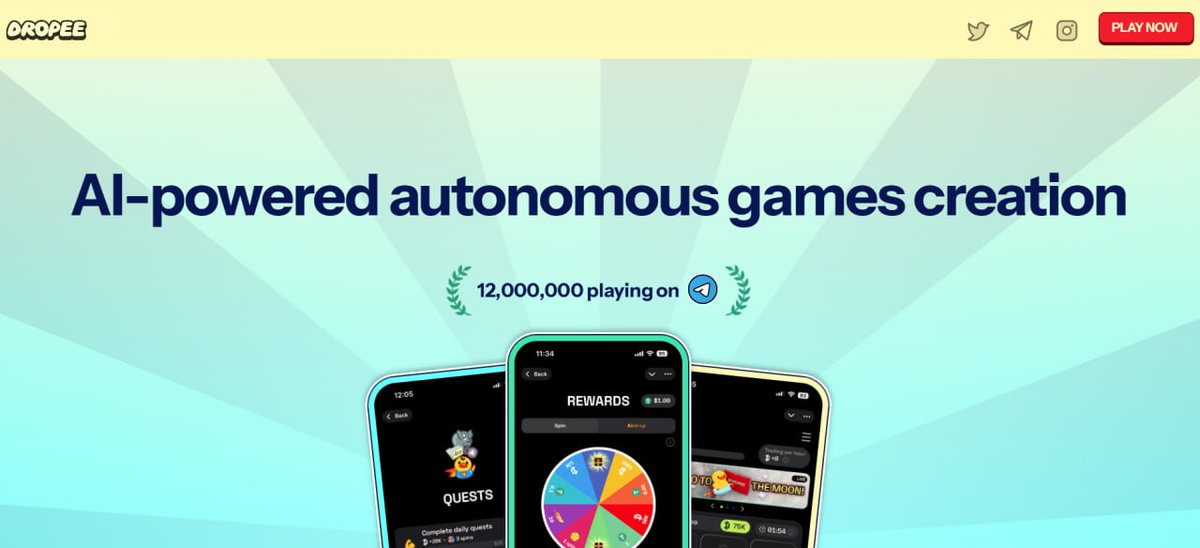
imo, Dropee Create is the main product around this TGE
the idea is simple:
describe a telegram mini-app, let AI help build it, then ship it inside Telegram.
so instead of only building apps internally, Dropee wants creators to build on top of the same app studio system.
that’s the part i’m watching.
these describe-to-app tools will only go higher cause they empower degens like us to build stuff we want.
last time i said, about Dropee Create that you should think Lovable, but focused on telegram.
▫️why Telegram matters
Telegram mini-apps remove a lot of the normal app friction.
users can open them inside chat w/ no app store search or no download flow.
less setup before someone can try the app (trying weekly new apps there, either to kill the time, or to compete in challenging games)
that gives Dropee a cleaner distribution path if creators start shipping apps through Dropee Create.
▫️current traction
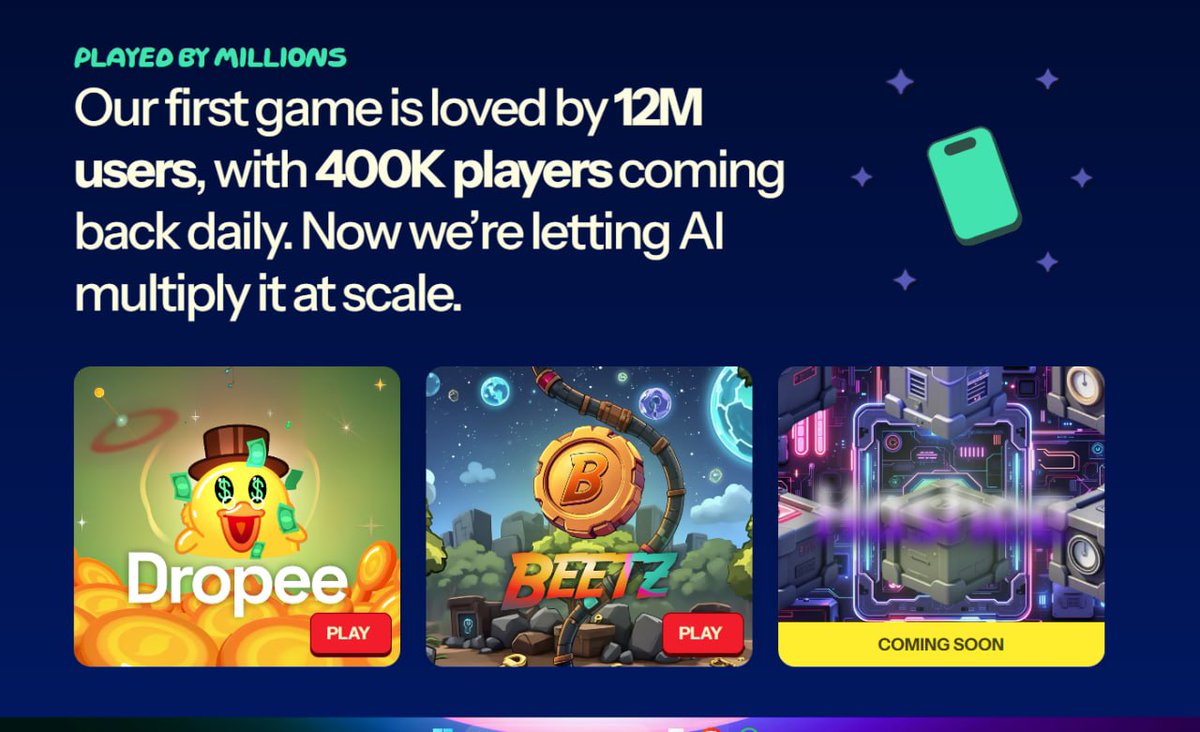
• 13M users
• 4M MAU
• $2.5M revenue already generated
• 8K users posting about Dropee daily through the waitlist campaign
• 5M active community
• 500K peak DAU
• 17K creators on the Dropee Create waitlist
that makes the launch less abstract than many TGE stories.
there is this comparison on CT w/ Lovable reaching $100M ARR in 8 months, then $200M ARR & a $6.6B valuation.
Dropee is applying a similar idea to Telegram mini-apps.
▫️$DROPEE
$DROPEE connects the creator side & user side.
creators use it for:
• AI credits
• builder tools
• premium features
users use it for rewards, boosts, in-app features, & ecosystem perks.
& up to 50% of ecosystem revenue going into $DROPEE buybacks.
let's see how this plays out, is the market green for it or nah

telegram games are back in the spotlight
@dropee_app $DROPEE is the one leading that push
it mixes token creation, tap-to-earn mechanics & real web3 rewards
it started simple, now scaling fast across platforms
here's what it is and why it matters 🧵👇
let's go through:
→ what dropee is
→ how the game loop works
→ seasons & upgrades
→ how you earn
→ $dropee token
→ in-game investment strategy
→ team & traction
▫️what dropee is
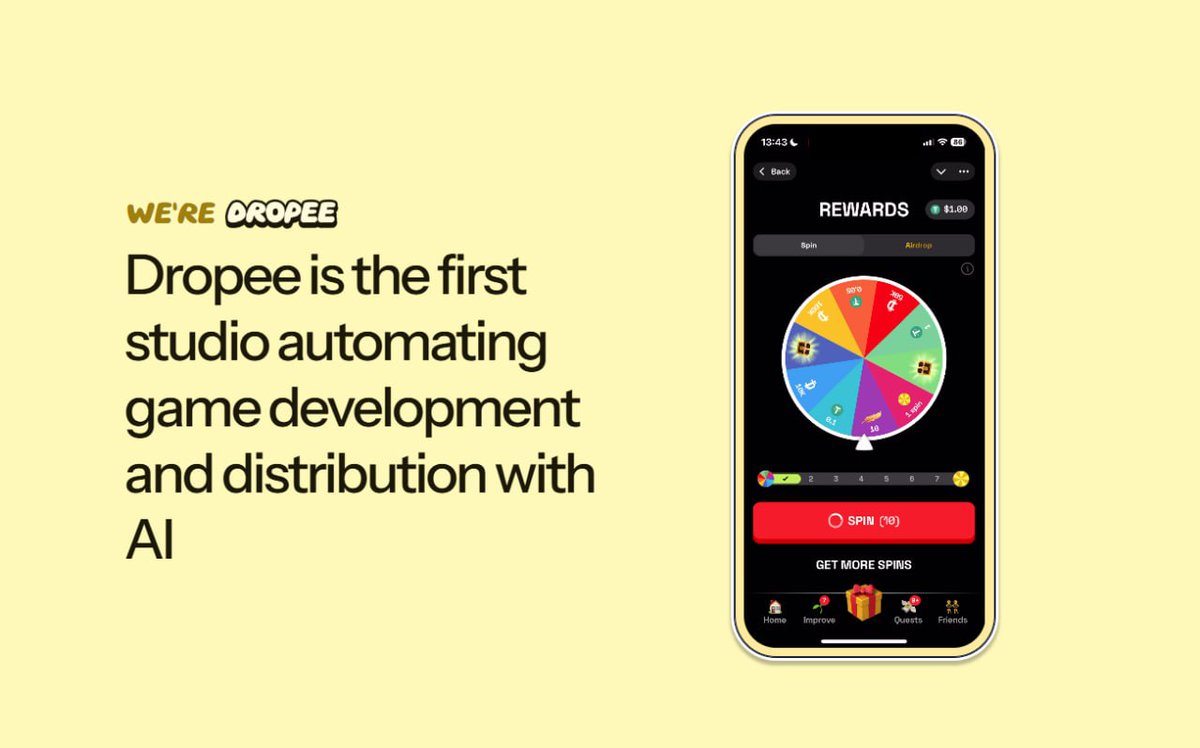
dropee is a telegram-native tap-to-earn game where players create and grow their own tokens.
no app installs. no learning curve. everything happens inside dropeebot.
each tap increases your token's market cap and visibility.
the more you tap, the more it mimics real market demand.
but this isn't random clicking - the system rewards strategic engagement.
▫️how the game loop works
players go through 5 core steps:
• launch a token using dropeebot
• start tapping to grow volume & rank
• reinvest in upgrades like marketing & influencer boosts
• complete quests for extra rewards
• invite friends for bonus income
▫️seasons & upgrades
each game season lasts a few weeks & ends w/ a leaderboard reset.
this gives every player - old or new - a clean slate to compete. upgrades play a key role.
you can't win by tapping alone.
smart reinvestment in areas like tech stacks or partnerships helps you climb faster and more efficiently.
▫️how you earn
players earn in multiple ways:
• daily quests & tasks
• seasonal leaderboard rewards
• referral bonuses for inviting others
• future airdrops tied to web3 projects
• smart card upgrades w/ high ROI
tapping at off-peak hours also helps.
fewer players = better tap yield. staying active isn't enough. timing matters too.
▫️ $DROPEE token
a native dropee token is in development.
it'll fuel the in-game economy:
used for upgrades, rewards, trading and maybe even governance.
but the scope is bigger.
dropee hinted at building multiple games around a single token system. so what starts in one tap game could evolve into a shared token-driven ecosystem.
▫️ in-game investment strategy
ok so this tapping thing is more than that...
the top players spend as much time planning as they do clicking.
every tap earns tokens, but long-term growth comes from how you reinvest.
players can spend in-game rewards on:
• marketing campaigns to boost visibility
• tech upgrades that increase tap efficiency
• influencer promos that simulate virality
• partnerships that drive token value
the system rewards long-term thinking.
power-ups that look flashy can drain you fast. smart players prioritize slow, steady compounding instead.
▫️ team & traction
• 400 games launched by the team
• 8.4B total downloads
• $1B in revenue generated
• investors include THE SANDBOX, OPENSEA PRO, TIOGA CAPITAL
• 12M total users & 800K DAU in first 3 months
comment below & don't forget to follow @raares for more pieces like this one.
telegram is gaining again attention, if you remember we had plenty of games there w/ millions of users... this could be a beginning of a ton summer...
comment below & don't forget to follow @raares for more articles like this one.
39
11
158
10,210

If I were to told you to buy something where kols and insidoors invested private in a coin at $50mil MC and they will TGE on all major cex es and brokers at $1.8 trillion MC a 36000x return and they have FULL unlock in only 180days after TGE with a project that has net losses and a P/E of more than 90x when competition has barely 10-20x you would call me a scammer and I wouldn’t be mad. I believe we are witnessing live at the biggest extraction in such a short time in human history.
Welcome to @SpaceX ( I absolutely love the company and Elon Musk but the valuations is pure madness). NFA
15
5
67
5,209
$ARX @arcium is close to TGE but the more useful thing to look at is already live
apps are live, teams raised capital, & categories like sealed-bid launches, opportunity markets, private OTC, & confidential neobanking are forming around it
here are some extra things you need to know before TGE 🧵👇
→ privacy is turning into apps
→ ecosystem / numbers
→ pre-TGE
▫️privacy is turning into apps
we already talked about Arcium as encrypted compute infra on Solana.
now the clearer angle is what teams are building on top of it.
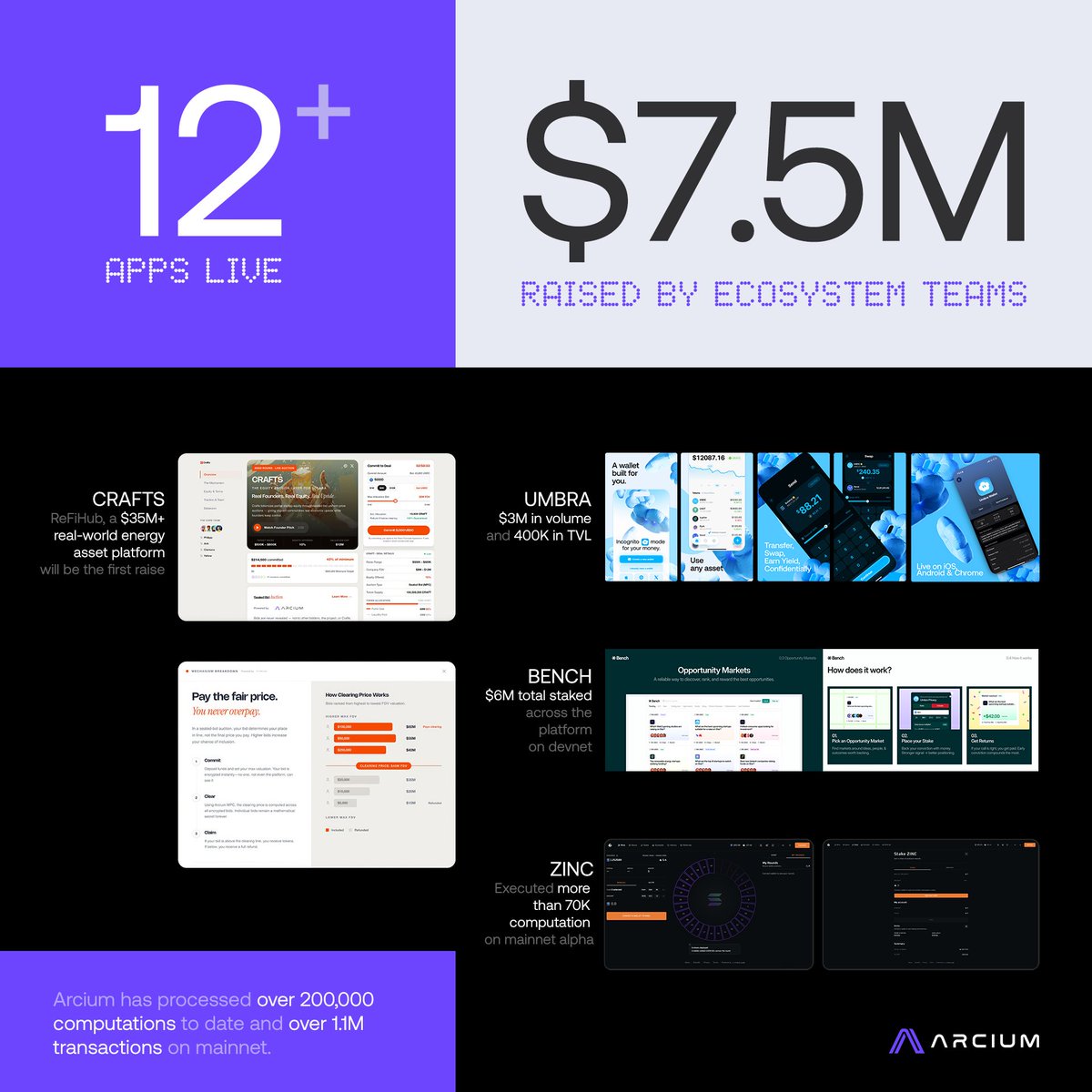
Arcium has 12 apps live or building across devnet & mainnet, covering 7 categories:
• confidential DeFi
• payments & neobanking
• capital formation
• OTC
• opportunity markets
• prediction markets
• gaming
that makes the privacy narrative easier to track.
⚠️ if this is your first time reading about Arcium, i have a more general thread here:
x.com/RaAres/status/20186743…
⚠️ thread on $ARX:
x.com/RaAres/status/20483464…
▫️the ecosystem numbers
teams building on Arcium raised $7.5M together
Umbra pulled $155M into its ICO, which the brief says is the largest in Solana history.
Umbra also processed $3M in private volume since launch.
⚠️ thread about Umbra here:
x.com/RaAres/status/20378972…
@craftsdev got 15K visits in its first week.
@benchdotmarkets got 4,000 signups in its first week on devnet, w/ $6M staked there.
@zinc_cash already executed 70K Arcium computations.
across the full network, Arcium has processed:
• 200K confidential computations
• 1.1M mainnet txs
▫️pre-TGE
apps are live.
teams raised capital.
new categories are forming around private shared state.
imo, that is the cleaner read on Arcium rn.
the project is starting to look really based as a privacy app ecosystem sitting on Solana.

Arcium is home to the largest active ecosystem building with confidential compute in crypto. ↓
36
7
134
11,982
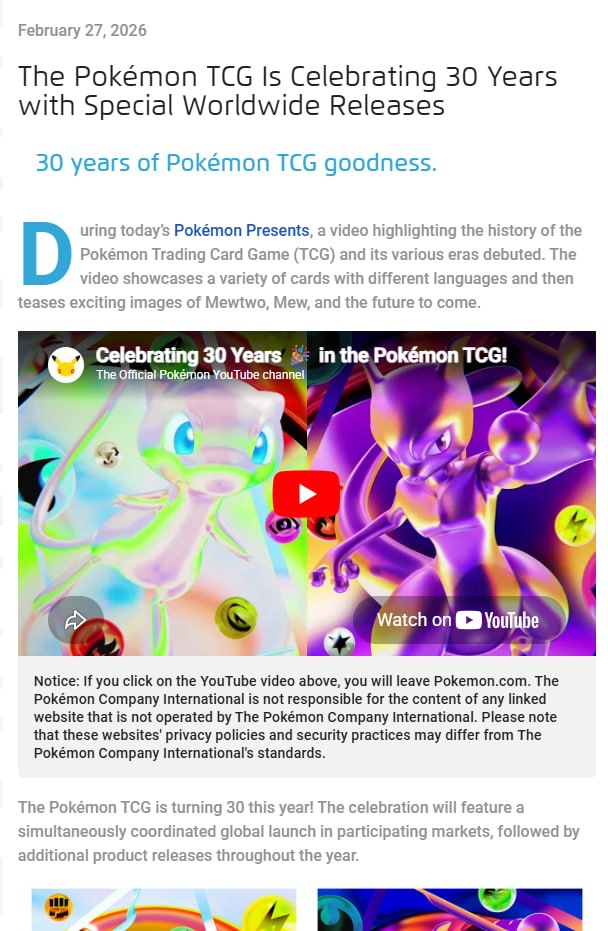
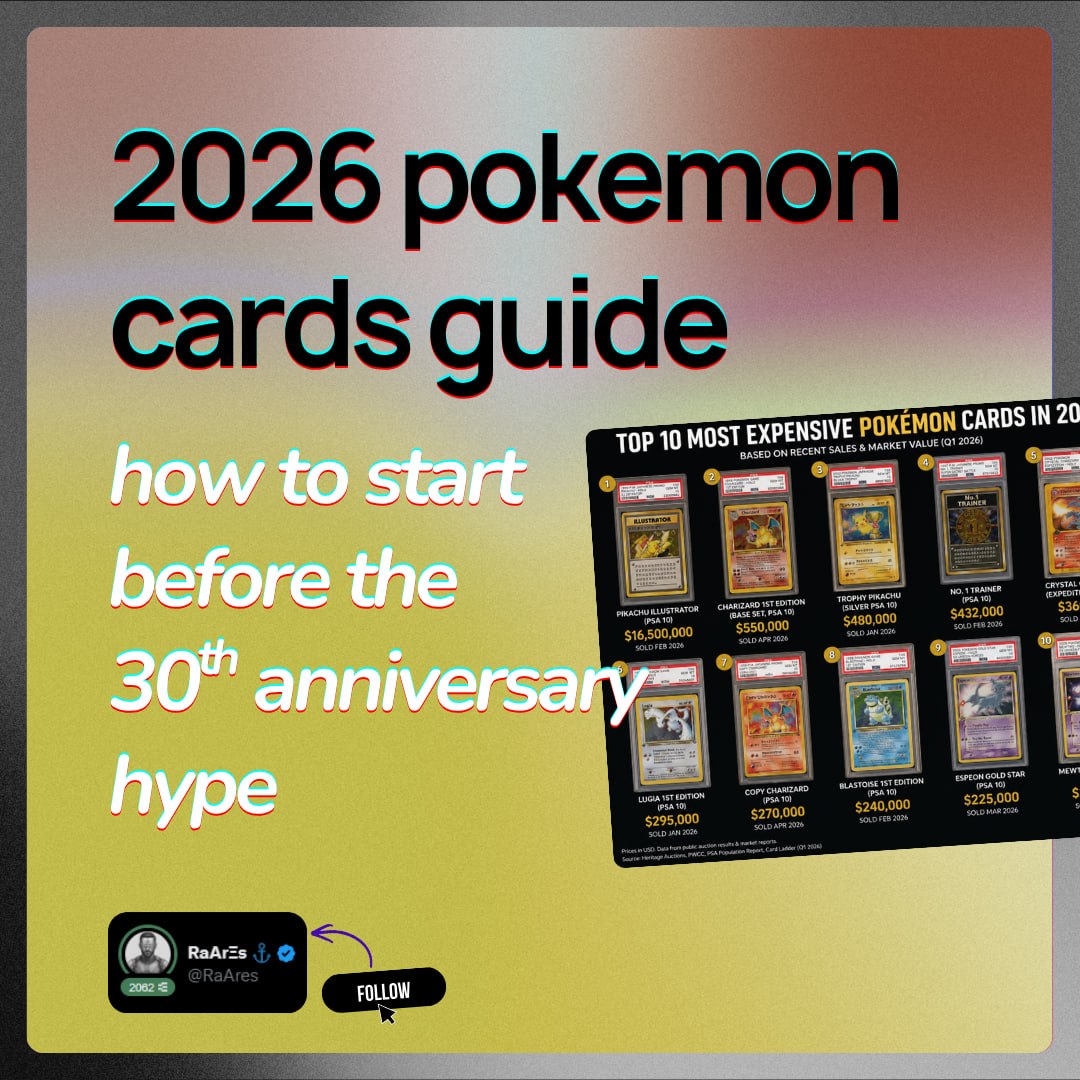
pokemon cards are entering their 30-year moment, & that makes the investor angle more interesting
old cards have history, new products have attention and graded cards have cleaner price data
and beginners still need to know where the traps are
that's why i made this 2026 pokemon cards guide for anyone trying to understand the market before buying random hype 🧵
→ why 2026 is a weird entry point
→ start w/ history before buying
→ choose one lane first
→ use the right venues
→ check price like an investor
→ treat grading as the risk layer
→ don’t confuse gacha [paying for a random pack/pull where you don’t know what card you get] w/ investing
→ the first 30 days plan
▫️why 2026 is a weird entry point
i’d start pokemon cards in 2026, but i wouldn’t start by chasing random packs.
the timing is attractive because pokemon is in its 30-year cycle, & the pokemon TCG is also celebrating 30 years w/ special worldwide releases in 2026.
that brings attention, new products, anniversary hype, resellers, & more ppl trying to treat cards like an alt asset.
that also means beginners can overpay faster.
the good entry is learning the market before the market sells you a story.
▫️start w/ history before buying
the first thing i’d study is the timeline.
pokemon Red & Green launched in japan in february 1996, the pokemon TCG launched in japan in october 1996, & Base Set launched in the U.S. in january 1999.
that’s why early japanese cards, Base Set, 1st Edition, Shadowless, trophy cards, & old promos get more attention than random modern bulk.
collectors pay for the card, but also for the moment around the card.
old cards have memory attached to them.
modern cards need different support: character demand, low pull rates, strong art, sealed demand, or a special product cycle.
▫️choose one lane first
i wouldn’t start by buying everything.
i’d pick one lane & learn it properly.
• vintage singles → more history, more condition risk
• graded cards → cleaner to compare, but premiums can be heavy
• modern chase cards → more liquid, but hype moves fast
• sealed product → easier to store, but timing & entry price matter
• anniversary products → strong attention, but launch week can be overpriced
for a beginner, i’d probably start w/ modern singles or lower-cost PSA slabs
[PSA = Professional Sports Authenticator, a grading company that checks if cards are real & grades condition from 1 to 10; slabs are graded cards sealed in hard plastic cases
expensive raw vintage cards can wait until u can spot whitening, dents, scratches, centering issues, fake cards, & bad photos.
▫️use the right venues
[links are in teh next post]
for europe, Cardmarket is the obvious first venue because it calls itself europe’s biggest TCG marketplace, w/ more than 500M card offers & a trustee system for trade protection.
for auctions, graded cards, vintage cards, & sold-price checks, eBay is still important.
eBay’s trading card Authenticity Guarantee covers eligible cards & collectibles at $250 , so higher-value singles can get checked before they reach the buyer.
for official sealed products, pokemon Center is the cleanest source because it’s the official pokemon shopping site for TCG cards & other products.
for UUSprice checks, TCGplayer helps because its Market Price is based on recent actual sales across its marketplace.
▫️check price like an investor
a listed price means almost nothing.
a sold price means someone paid.
before buying, i’d check:
• Cardmarket low price
• eBay sold listings
• TCGplayer market price
• PSA 9 price
• PSA 10 price
• last sale date
• number of recent sales
• shipping, tax, fees
a card can look like it’s worth €300, then sell once every few months.
that’s not the same as liquid.
▫️treat grading as the risk layer
PSA grades cards from 1 to 10, & PSA says a PSA 10 is basically a perfect card w/ clean centering, corners, surface, & no major defects.
that’s why the same card can have different prices.
raw copy = trust the seller’s photos.
PSA 9 = strong condition, but not perfect.
PSA 10 = the market often treats it like a different asset.
before buying graded cards, i’d also check PSA population data, because low supply in high grades can explain part of the premium.
▫️don’t confuse gacha [paying for a random pack/pull where you don’t know what card you get] w/ investing
onchain TCG apps are part of the 2026 picture, especially after onchain gacha spend started showing big monthly numbers.
Courtyard says users can rip digital packs, reveal physical graded cards, keep them vaulted, sell them, or redeem them worldwide.
that sounds close to web3 RWA, but gacha adds randomness.
i’d use these platforms to understand demand first.
i wouldn’t treat pack ripping as an investment strategy.
▫️the first 30 days plan
track 10 cards before buying anything serious.
write down raw price, PSA price, pop count, recent sales, venue, seller quality, & total cost after fees.
then buy 1-2 low-risk cards to learn the process.
the goal is to stop being the guy who buys the top because a set is trending rn.
24
6
135
9,810
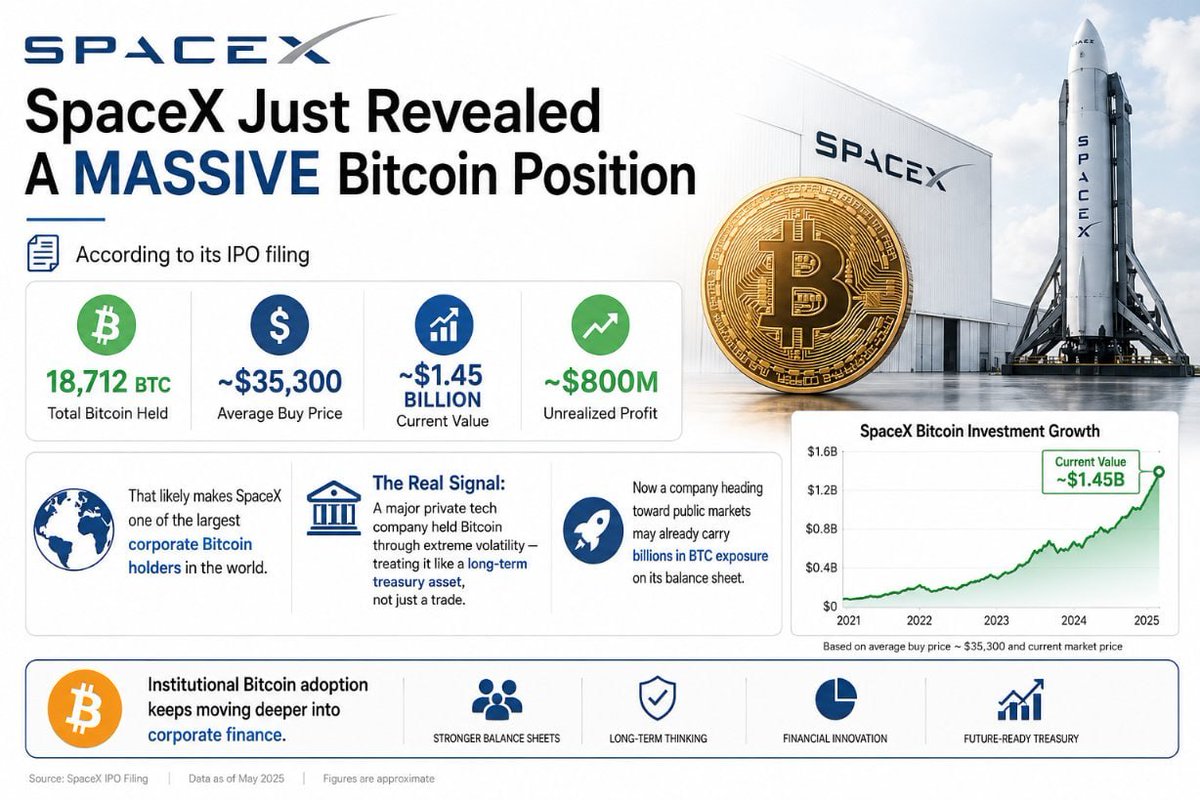
so spacex is going public soon, and now the filing says it holds 18,712 bitcoin.
that is about $1.45 billion, w/ an average price bought at $35,320... damn
they bought quite a few bitcoins from tax payers money 😂
they hold more bitcoin than tesla too...
apparently, trackers thoughts spacex has olnly around 8k BTC
the IPO itself is already insane: around $75B raise target, w/ a possible $1.75T-$2T valuation.
so buyers would get exposure to rockets, Starlink, AI plans, orbital data centers, Mars dreams...
and get this: they started accumulating 5 years ago... (if you remember may 2021 crypto crash w/ china mining bans, tesla's environmental concerns, etc... it dropped 45% from $60k to $32k)
so while you were panikcing selling, spacex was buying 😂
Also imho is a very nice marketing so they get the crypto community "gamble" on SpaceX. Overal I like the company a lot but lets see where the real valuation is.
16
3
61
3,226