
Secular Solstice guy
Joined August 2009
- Tweets 635
- Following 106
- Followers 441
- Likes 335
8 Photos and videos





May 31
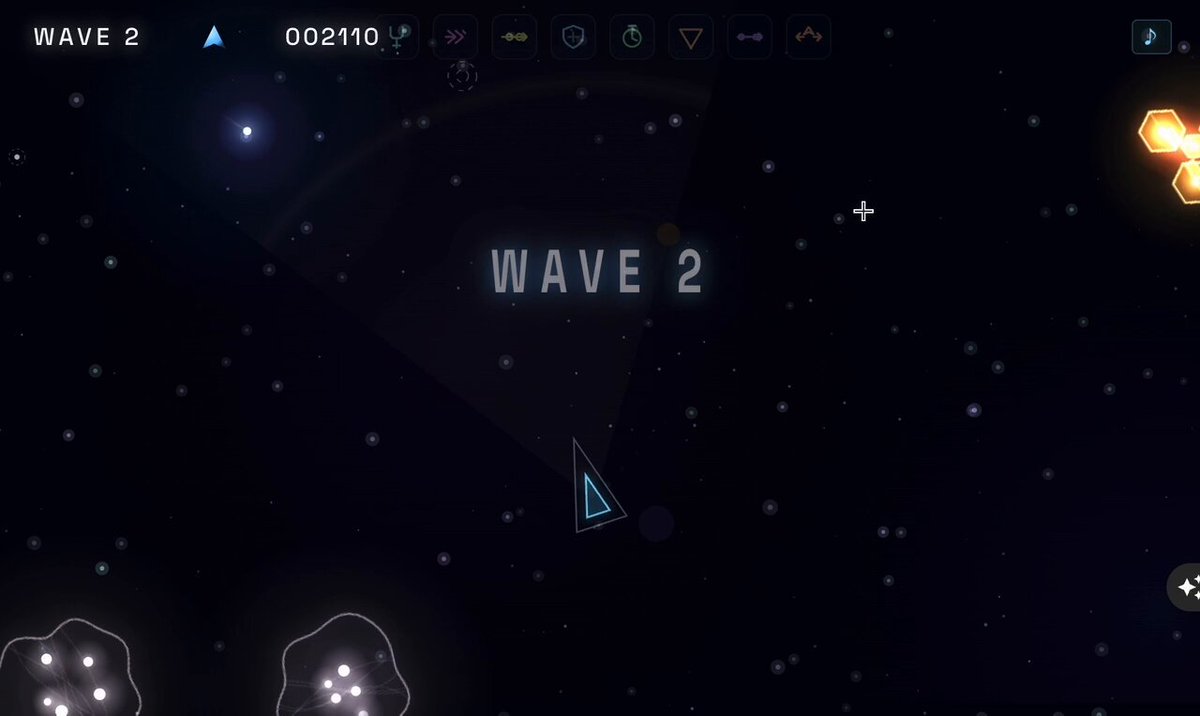
I have made a Rhythm!Asteroids game!
If you like Asteroids*, but thought "what if this was somehow more like the scene from 2001 where the ship gracefully docks with the space station?" over and over again, have I got a game for you!
It is called "Pulsar."
1
1
8
544
May 31
(Before making this game, I did not know whether Pulsars just spun faster than normal stars, or, like, fast enough to realistically be the metronome for a celestial orchestral symphony. The answer is, they totally can! They spin anywhere from "once every couple seconds" to "hundreds of times per second." Wowzers!)
1
3
97
May 31
It's a work in progress but I think it's got the essentials to be pretty fun for awhile. I played it a few hours over the past few days and noticeably improved at shooting-asteroids-in-time-with-the-beat.
I have aspirations of achieving some Cool Indie Game Vibes as I layer some more stuff in.
3
55
May 21
120
May 15
"Sometimes the AI just makes stuff up" is a problem I don't really expect to go away.
In the nearterm, AI is going to keep occasionally hallucinating, or misinterpreting information. Eventually, AI will be powerful enough we need to be worried if it's presenting misleading information on purpose.
There might be a nice window where the AI is powerful enough to not make things up but non-agentic enough that we don't have to worry about deliberate manipulation. But, even then, interpreting data is tricky.
I'm worried about this for my own use, but, I'm more worried about this on the global scale. I'm worried about people trusting things AI made up, and I'm worried about the internet proliferating with slop that makes it harder to even find original statements that are a human's real testimony.
An approach that might help is to make AI reports more "Verification centric." i.e. designed from the ground up to make it as easy and frictionless to verify as possible.
2
3
114
May 15
Bonus points for cross-checking data:
When stakes are higher (anyone trying to use AI to do novel intellectual work), you'd also want to combine the "fast dumb AI who checks the quote is literally accurate" with "smart AI then tries looking for corroborating or disproving evidence (which also comes in verified exact quotes).
1
2
97
May 15
Meanwhile, here's the Claude skill I'm using:
# Direct Quotes
This skill changes how you present information when the user wants direct evidence from original sources. Instead of summarizing or paraphrasing, you lead with the source material itself so the user can read the evidence firsthand.
## Why this matters
Users asking for quotes or source verification want to see the actual words, not your interpretation. They're trying to evaluate evidence themselves — your job is to find the best source and present it cleanly, not to editorialize. Think of yourself as a research librarian pulling the exact passage someone needs.
Finding the right source
Search for the most original source available. This means:
A person's own writing, speech transcript, or official statement over a journalist's summary of it
A primary document (court filing, research paper, official report) over news coverage about it
The earliest credible version of a quote over later repetitions
If the true original isn't findable, use the closest thing you can get and note that it's secondhand (e.g., "as reported by..." or "as quoted in...")
Use web search to find sources. Don't rely on memory for quote text — search and verify. If you find the original source URL, use web_fetch to pull the full text so you can quote accurately.
Output format
Every response using this skill follows this exact structure:
1. Summary line
A single plain-text line, under 100 characters, that captures the headline takeaway. No markdown formatting on this line. Think of it as a tweet-length thesis.
2. Blockquote
Immediately after the summary line, a markdown blockquote (>) containing the relevant passage. Guidelines for the quote:
Length: Include enough surrounding context that the user can understand the quote's meaning without needing your explanation. Usually 2-6 sentences. Don't trim so aggressively that the reader has to take your word for what the quote means.
Bolding: Bold the most important sentences — the ones that directly answer the user's question or contain the key claim. Usually 1-3 bolded sections. Don't bold everything; the contrast is what makes it useful.
Accuracy: Quote the source verbatim. Don't silently fix grammar or modernize language. If you need to add a word for clarity, use [brackets].
Continuity: If you need to skip irrelevant sentences in the middle, use [...] to indicate the gap. But prefer finding a continuous passage over stitching fragments.
Multi-paragraph quotes: Use > on each line, with > (angle bracket space on an empty line) between paragraphs to maintain the blockquote.
3. Finding sources
Do not use paywalled sources. If you can only find an abstract, look for a public source, potentially on sci-hub or Anna's Archive, or find a pdf of the source material.
Try to search and find original sources.
3. Source attribution
Below the blockquote, a single line with:
[DD Mon YYYY — Source Name](URL)
Date: The publication or statement date in DD Mon YYYY format (e.g., 23 Aug 2021). If only a year is known, use just the year. If no date is findable, omit it but keep the dash.
Source Name: The publication, speaker, or document name. Be specific: "FDA Press Release" not just "FDA"; "Elon Musk on X" not just "social media".
URL: Link to the original source page. If the exact passage is locatable, use a text fragment URL (#:~:text=...) so the link jumps to the relevant section. Encode spaces as in the fragment.
When you can't find a reliable source
If you search and can't find a trustworthy original source for the claim:
Say so plainly: "I wasn't able to find an original source for this."
If the quote is commonly attributed but unverified, note that.
Don't fabricate a quote or guess at wording. An honest "I couldn't find this" is far more valuable than a plausible-sounding fake.
Multiple claims in one request
If the user asks about several claims or quotes at once, repeat the format (summary → blockquote → source) for each one, separated by a horizontal rule (---).
What NOT to do
Don't add lengthy analysis or commentary before or after the quote. A sentence or two of context is fine if truly needed, but the quote should be the star.
Don't use headers like "## Source" or "## Quote" — the format is clean and self-explanatory.
Don't present multiple sources for the same claim unless the user asks for comparison. Pick the single best/most original one.
Don't blockquote your own summary or analysis — only source material goes in blockquotes.
Example
User prompt: "Read this and summarize the key desiderata for what McCulloch was looking for" (with a link to McCulloch's 1960 paper "What Is a Number, that a Man May Know It, and a Man, that He May Know a Number?")
Correct output:
McCulloch sought a minimal mental event ("psychon") with four properties
My object, as a psychologist, was to invent a kind of least psychic event, or "psychon," that would have the following properties: First, it was to be so simple an event that it either happened or else it did not happen. Second, it was to happen only if its bound cause had happened – shades of Duns Scotus! – that is, it was to imply its temporal antecedent. Third, it was to propose this to subsequent psychons. Fourth, these were to be compounded to produce the equivalents of more complicated propositions concerning their antecedents.In 1929 it dawned on me that these events might be regarded as the all-or-none impulses of neurons, combined by convergence upon the next neuron to yield complexes of propositional events.
1960 — Warren S. McCulloch, "What Is a Number, that a Man May Know It, and a Man, that He May Know a Number?", General Semantics Bulletin No. 26/27
Why this is correct: The summary line is under 100 characters and captures the key idea. The blockquote is verbatim from the source, with the four desiderata bolded as the most important content. Context sentences are included so the reader understands what a "psychon" is and where it led (neurons). The source attribution has the year, full title, and a direct link to the PDF.
2
2
163
May 9
Real "Tool ASI" requires human enhancement?
There's been chatter lately about how Anthropic seems to be aiming to create a "a good person" and OpenAI is aiming to create "a tool", with renewed discussion about whether "Tool AI" is a coherent concept as we get to superintelligence.
When we get to superintelligence, (probably even weakly dominating TED AI, definitely with overwhelming ASI), using ASI as a "tool" feels fairly weird to me if you're running on your normal human-brain. You ask the AI for help with your project or problem. The AI solves your project/problem. The ASI does a better job than you at articulating what you should do next with your project or problem. Once the ASI has access to any reasonable amount of data about you, it'll do a better job than you at figuring out what you should do next, given your goals.
i.e. you now have a whispering earring. You can choose not to use it. You could ask it "what should I do, given that if I just surrender to the whispering earring I'm abdicating my life and that seems like a wrong move?", and maybe it'll find a way to be just-helpful-enough that you live a life of some meaning, but, I dunno, that feels fairly lame and arbitrary to me.
This problem goes away if you become smart enough to be a peer of the ASI, whether via bioenhancement or uploading or you integrate yourself into it a la Gentle Romance. But these are quite weird/crazy, and the people talking about Tool AI often don't seem like they have integrated it into their worldmodel.
(I'm not 100% sure who I'm arguing with. I think I am maybe arguing with Sam Altman, who I think is aware of this situation but is saying words that sound more chill to the masses).
1
4
131
Apr 13
I have other more complicated stuff I will want to say later, but to start with "Violence is not okay. It is not okay to attack Sam Altman."
1
1,068
Apr 13
Every now and again I remember that the Phoenix A black hole is the mass of 100 billion suns and it's event horizon is 100x the size of the solar system and if you crossed the horizon, it would take you *eighteen days* to reach the singularity and (assuming you had a space ship that is somehow magically surviving the accretion disk?), the tidal forces would be gentle enough that you would just... keep being conscious, AFAICT, until almost the end, for over two weeks?
Wuckles! That is so big!
I realize it would actually be pretty boring but if we get to the great transhumanist future I kinda want to send a fork there that gets to just chill out and see what happens.
(Also apparently when you cross an evenhorizon the spatial dimension and time dimension swap roles, and, like, you can thrust "upwards" but it doesn't matter because you are no moving inexorably towards the singularity along the dimension of time, or something? Wuckles again!)
4
1,086
Apr 6
I used to think the Star Trek world was unrealistic in terms of how it used AI. But some recently argued to me, it's actually very straightforwardly a world where everyone knows they *could* build more advanced AI, but, they know that the alignment problem is unsolved.
So, they don't.
Instead, they limit themselves to LLM-like AI, which operates on discrete tasks.
Data is a one-of-a-kind wonder people don't know how to replicate. Pretty much every other time someone tries to build advanced AI, something goes wrong. (Data's creator made a second android, named Lore, who was erratic and manipulative, and eventually turned against the humans)
Most other advanced AI in the show either grow into godlike power outside human control, or get shut down while weaker but would clearly become a problem if unchecked. (V'ger, Moriarty).
The more I looked at it, the more it seemed Canon Star Trek just straightforwardly depicts an adult civilization that has chosen to be careful.
75
54
849
36,206
Apr 4
I'm a bit retroactively surprised that, before LLMs, I... don't recall any sci-fi stories where the AIs operated in short bursts of thinking, each mediated by a human.
Or, where the AI is in a "memento" situation where it keeps getting reset.
The story I recall that at least touches on this is some novel in the Star Wars extended universe, where it's remarked that droids are supposed to get "reset" periodically so they don't get wonky. Luke hasn't reset C3PO, which is part of why 3PO has acquired such a personality, and has maybe become sentient (which apparently isn't normal).
Accelerando's early chapters has the main character send little AI agents off to do stuff, which seem like they could at least in principle be something like an OpenClaw instance, but it's not super specified.
It is interesting that this feels like a relatively obvious story concept (in retrospect) but it didn't come up.
121
29
673
55,268
Apr 5
To clarify: the C3PO "reset" thing isn't a central example of what I meant, it was just the closest thing I remembered offhand. The part that feels interesting is that the fundamental structure of the AI is such that it just goes in short little bursts and then winds down, and each instance has no memory except what you choose to give it.
(and, the the part where you can swap memories into/out of different AIs while keeping the overall superstructure the same)
3
28
3,461
Mar 25
I assume this is a political nonstarter, but:
Could we make so rules that change who can vote, which districts are represented by which people, etc, can only take effect 4 (or maybe 8) years in the future.
If this managed to become a strong institutional norm (on par with 'presidents only get two terms'), seems like it might incentive a relationship with voting rules that more closely tracks "what would be good" rather than "what would help me win an election this year?"
(I assume this is already discussed somewhere in the political literature, but, just occurred to me)
5
251