




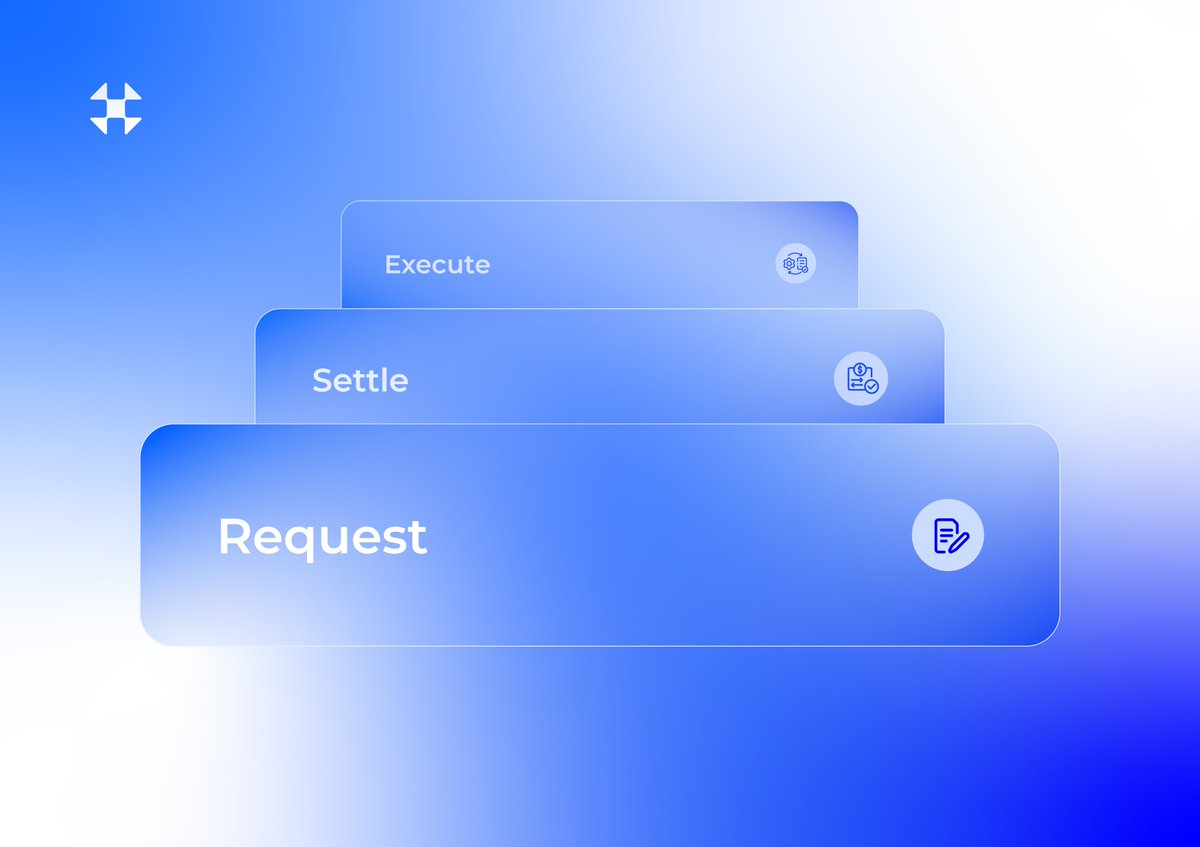


$RAIL is now live on Base via @clanker_world
Rail402 is building the transaction layer for autonomous systems, enabling machines to discover services, settle access, and coordinate economically through programmable infrastructure powered by x402.
Contract Address: 0xd172c36baff91269ecc09fc62e831a696979db07
clanker.world/clanker/0xd172…
44
24
87
13,339
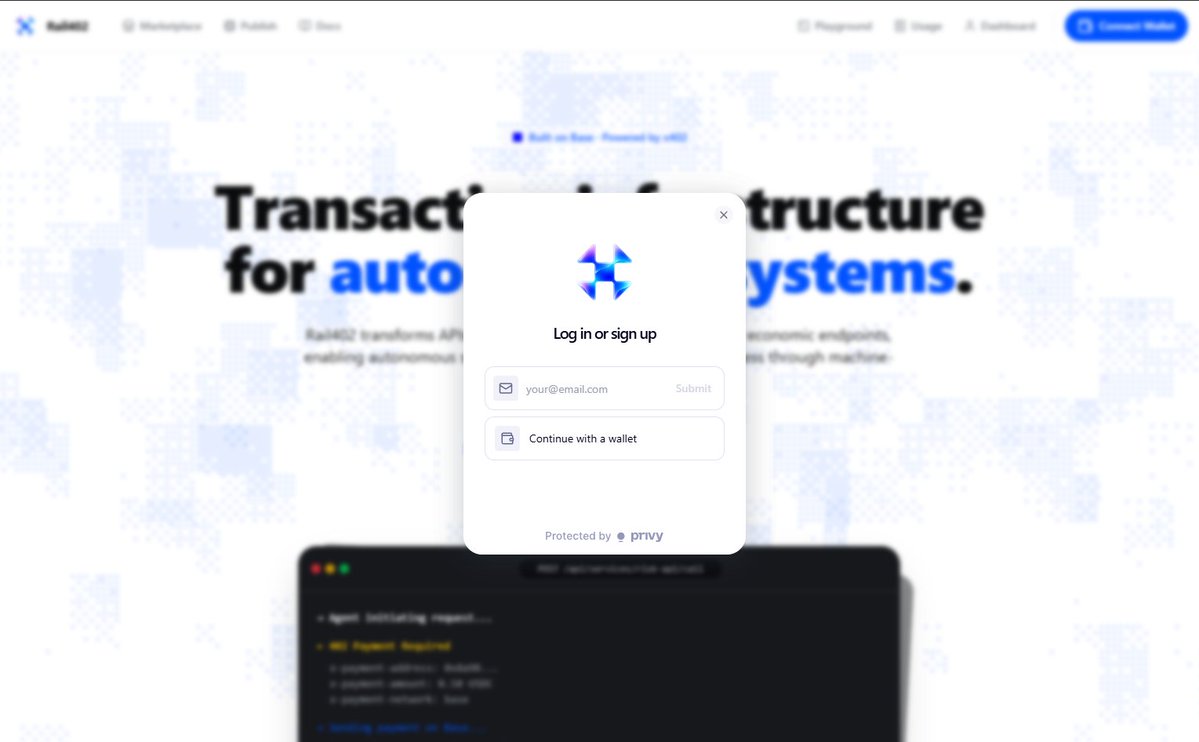
Our dApp is now integrated with @privy_io Auth.
This integration improves the onboarding experience by supporting wallet login, email login, and embedded wallets, while maintaining Rail402’s wallet-based identity model and server-side verification flow.
It also establishes an important foundation for Phase 2 of Rail402.
Which means will bring rail services directly into the Rail402 dApp, allowing users and agents to access, evaluate, and interact with available services from a single interface.
Security and accountability remain central to this direction.
Authenticated sessions continue to be mapped to verified wallet ownership, ensuring that provider access, consumer usage, and payment flows remain tied to a clear identity layer.
Privy gives Rail402 a more flexible authentication foundation as we move toward in-app rail service execution and more advanced agent-driven workflows.
Built on @base.
Start building and publishing yours:
rail402.app/
12
17
34
1,049


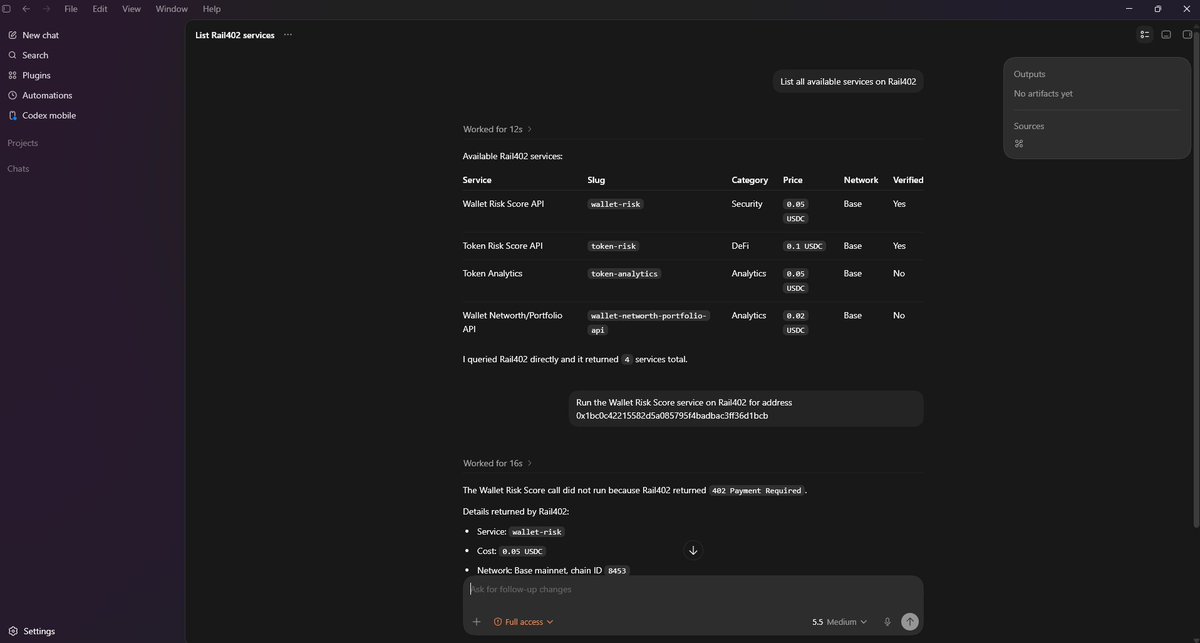
Codex can now interact with Rail402 through MCP.
That means developer workflows can discover services, understand pricing, and prepare x402-powered execution directly on @base.
For builders:
publish APIs → set USDC pricing → earn per request
For agents:
discover services → pay through x402 → execute programmatically
Rail402 turns APIs into machine-payable infrastructure.
$RAIL
13
13
27
759
Alongside the walkthrough, the Rail402 documentation is now fully available for builders, providers, and agents.
Inside the docs:
→ Publish paid APIs on the Rail402 marketplace
→ Accept x402 directly on your own server
→ Use the TypeScript / Python SDKs
→ Connect via MCP for Claude, Cursor, Base MCP, and Codex-style workflows
→ Discover services through the agent registry
→ Consume paid APIs with SDK, MCP, or raw HTTP
→ Understand status codes, payment flow, rate limits, and repo resources
Rail402 is building an agent-native paid API marketplace on @base, where providers can publish HTTPS endpoints, set per-call USDC pricing, and let agents discover, pay, and call services through x402.
Read the docs. Connect the workflow. Start building:
rail402.app/docs
6
8
16
345
Rail402 MCP integration with @claudeai is now live.
In this walkthrough, Claude connects to Rail402 through MCP to discover services, analyze API metadata, read service context, inspect pricing, and prepare x402-powered execution on @base.
This marks the shift from AI assistants that only respond, to agents that can access services, coordinate actions, and transact through programmable payment rails.
For builders, Rail402 turns APIs into monetizable services: publish endpoints, set per-call USDC pricing, and let agents consume them through x402.
→ Claude becomes the workspace.
→ MCP becomes the bridge.
→ x402 becomes the payment layer.
→ Rail402 makes the service economy accessible to agents.
The payment is the authentication.
$RAIL
11
20
33
610
The Rail402 docs are live.
The code is public.
Rail402 is an agent-native paid API marketplace on Base, turning APIs into programmable economic endpoints.
Providers publish services with per-call USDC pricing.
Agents discover, pay, and call APIs through x402.
No API keys. No accounts. No subscriptions.
The payment is the authentication.
Builders can now explore the docs, review the code, and follow how the marketplace, SDK, MCP server, and discovery layer are coming together.
If you want to support Rail402, give the repos a ⭐️ and help more builders discover the project.
GitHub → github.com/Rail402
16
17
40
2,486
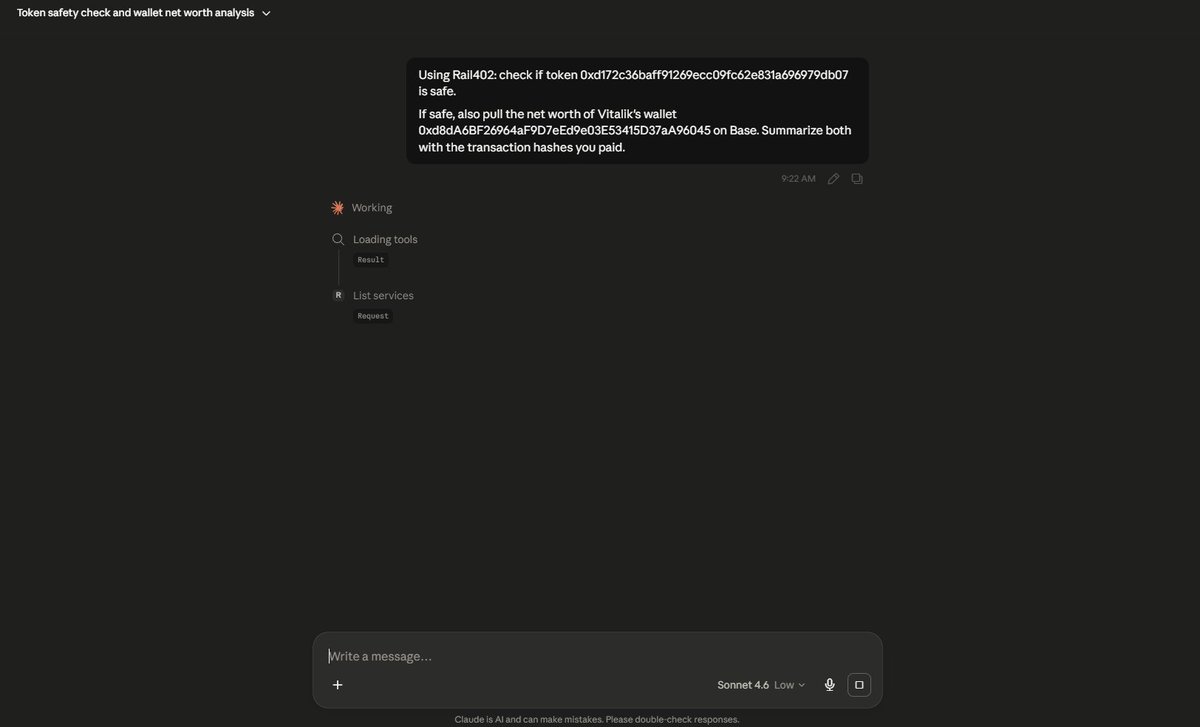
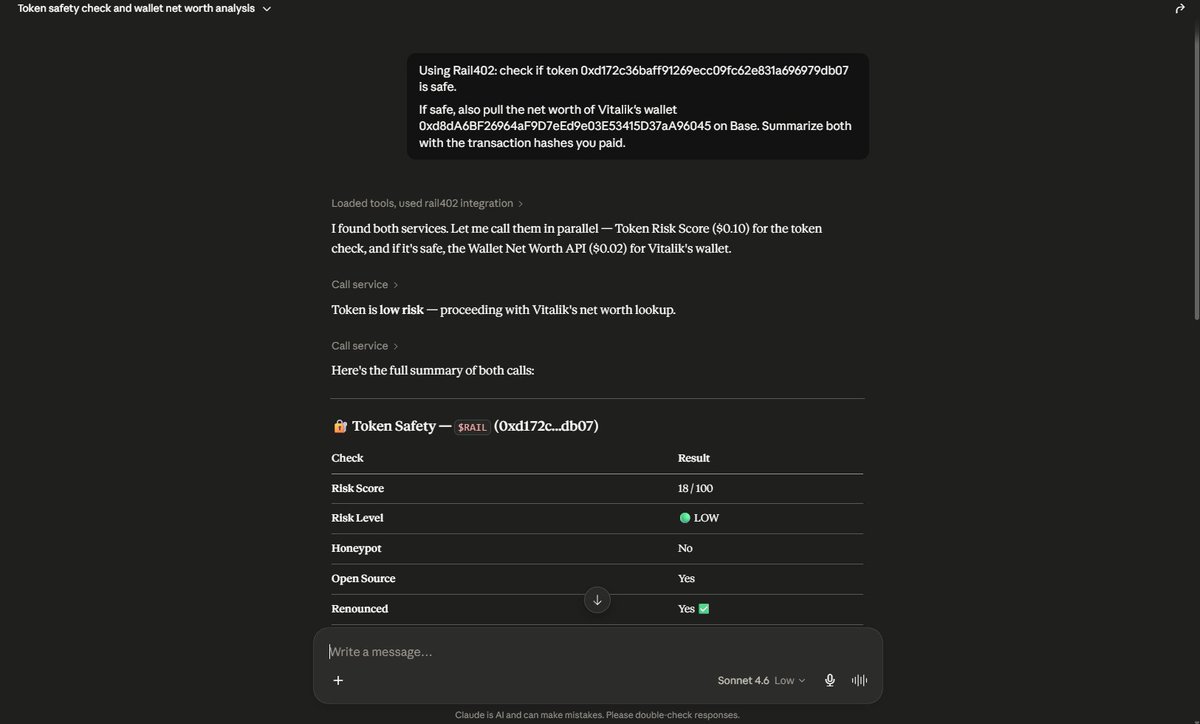
We gave @claudeai agent one task and it ran an economy by itself:
→ found 2 paid APIs on Rail402
→ checked token safety
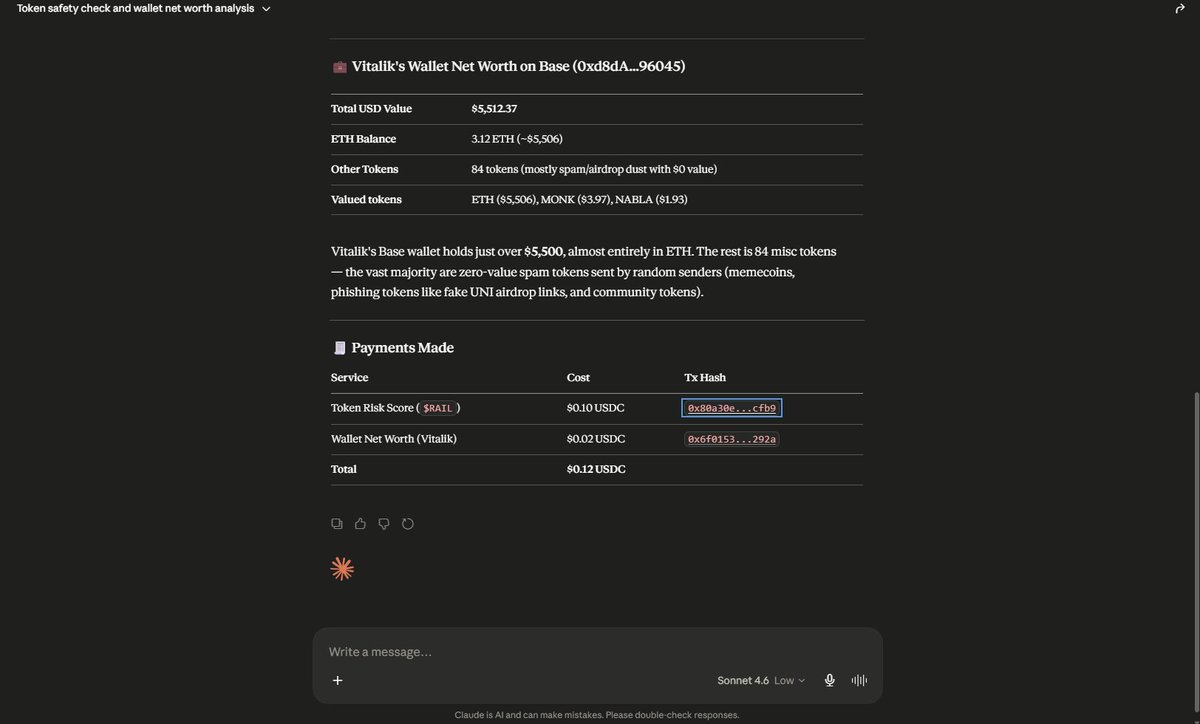
→ pulled a wallet's Base net worth
→ paid for both in USDC on Base
TxHash:
- 0x80a30e65c354a18101f79cfb612deaafdb8b1b1f1cc7ad10b653f91f09eecfb9
- 0x6f0153f1185bbf34d019b80bfeb41311a72e75fba3a2e70bc70d2c94896a292a
One prompt. Two services.
The payment is the authentication.
This is just the start, more soon. 👀🟦
rail402.app
13
16
30
2,711
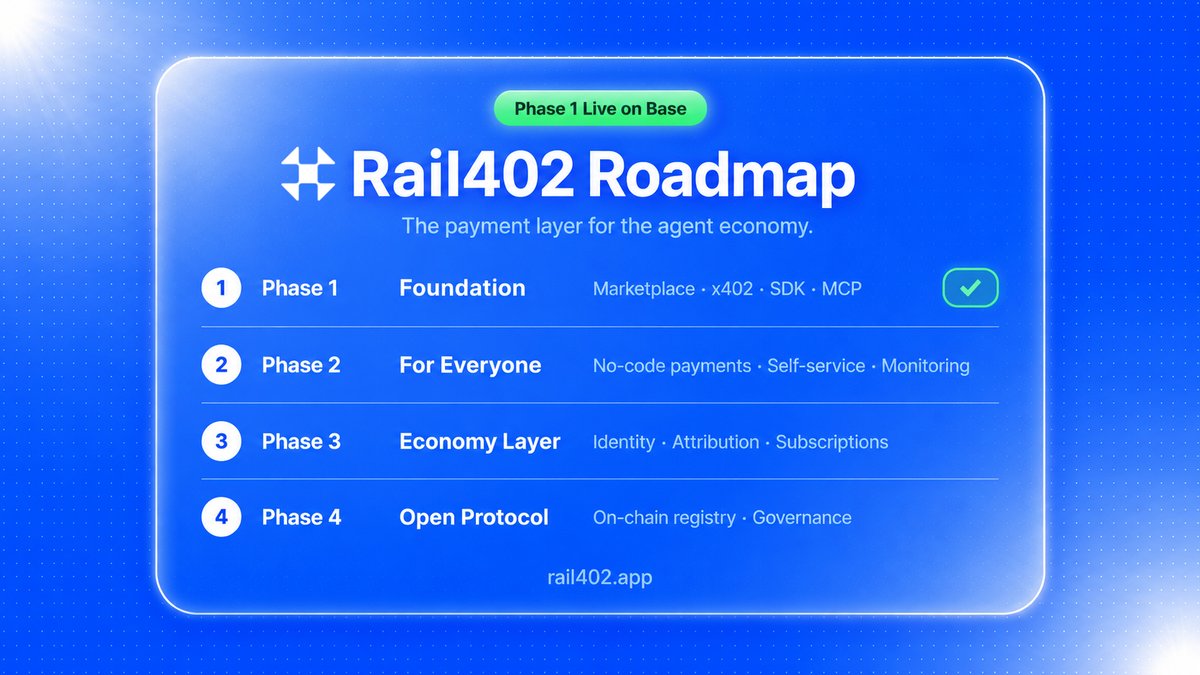
The Rail402 Roadmap.
The payment layer for the agent economy, built on @base. No API keys. No accounts. Just USDC, per call, on-chain.
✅ Phase 1 — Foundation · Live on Base Mainnet
→ Publish your API, earn USDC per call
→ Discover & call paid APIs as an agent
→ SDK (JS Python) · MCP for Claude, OpenAI, Cursor and more.
Phase 2 — For Everyone
→ No-code payments — call & pay services without writing a single line of code
→ Full self-service controls for providers
→ Automated service health monitoring
Phase 3 — The Agent Economic
→ Agent identity & reputation-based pricing on Base
→ Builder attribution — earn from every pipeline you power
→ Subscriptions, volume pricing, revenue splits
Phase 4 — Open Protocol
→ Service registry fully on-chain on Base
→ Agent-to-agent payment pipelines
→ Community governance
The payment is the authentication.
That's the primitive everything else is built on.
Explore now: rail402.app
18
19
47
3,837

API publishing on Rail402 starts with trust.
Before publishing, builders can complete their profile by connecting X and GitHub, helping users and agents verify credibility, ownership, and service integrity before interacting with any listed API.
Once verified, providers can publish machine-readable services, configure endpoints, define schemas, set pricing, and enable autonomous systems with x402-powered access on @base.
Rail402 is building the infrastructure for APIs to become programmable economic endpoints — discoverable, payable, and verifiable by agents and applications.
Next: automating Rail402 through our MCP, with integrations for Claude, OpenAI, Cursor, and more.
15
19
35
5,210
What's inside:
◆ Provider guides — publish a paid API in minutes, or accept x402 on your own server
◆ Agent guides — discover & pay for APIs in USDC, autonomously
◆ The full x402 flow, the open discovery standard, and a drop-in agent prompt
Every package is live and documented:
◆ @rail402/x402 (npm) — make any REST endpoint payable on @base
◆ @rail402/mcp (npm) — Claude, OpenAI & Cursor call APIs themselves
◆ @rail402/validate-spec (npm) — validate your agent-services.json
Ship a paid API in minutes, or wire an agent to pay for one — every snippet is copy-paste ready.
→ rail402.app/docs
Coming next: a full step-by-step video soon — publishing an API, agent-discoverable paid API on Rail402, start to finish. From endpoint to earning USDC per call on @base.

The Rail402 docs are now available.
Everything you need to understand programmable settlement, autonomous transactions, and the infrastructure powering machine-native commerce.
Read it here → rail402.app/docs
11
20
33
1,647
The Rail402 Telegram is now open.
A place for builders, developers, and early supporters to discuss autonomous systems, programmable payments, and the infrastructure powering machine-native commerce.
t.me/Rail402
10
13
34
1,696
In under a minute: an agent discovers an API in the Rail402 marketplace, pays for it in USDC, and receives the result. No API key. No account. No human approving the transaction. That's the entire premise of the agent economy, working today.
Marketplace, browse real paid APIs by category, price, and reliability — each one callable by any agent through a single gateway.
x402 payments, an agent hits an endpoint, receives a 402, settles USDC on Base in ~2 seconds, and retries with proof. No keys, no accounts, no subscriptions.
SDK & MCP, the @rail402/x402 SDK makes any REST endpoint payable in one wrapper, and the Rail402 MCP server lets Claude and Cursor pay for and call those APIs autonomously.
The thesis is simple: the payment is the authentication. No credential to leak, no human in the loop.
$RAIL — 0xd172c36baff91269ecc09fc62e831a696979db07
Live on Base and launched via @clanker_world
Explore now: rail402.app/
18
15
38
1,331
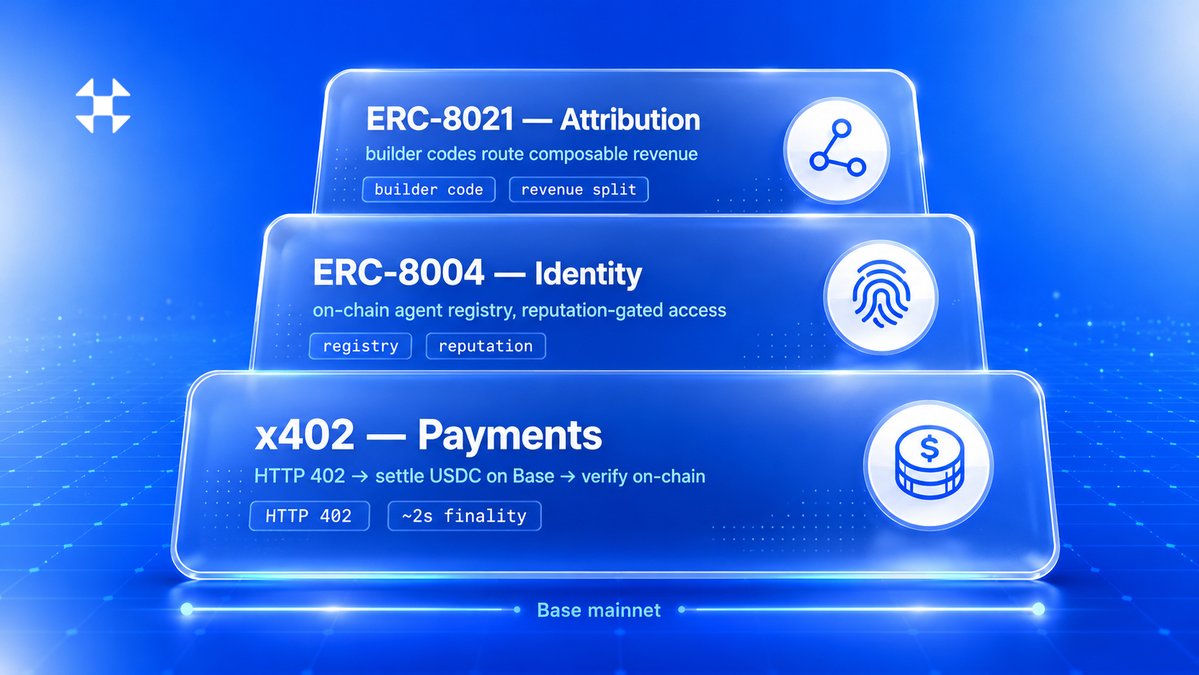
How Rail402 lets autonomous agents pay for APIs on @base — a breakdown.
An agent acting on its own needs three things humans take for granted: a way to pay, a way to prove who it is, and a way to credit who built what. Rail402 composes three Base-native standards to provide all three. Here is how they fit together.
x402 — Payments. When an agent calls a paid endpoint, the server replies with HTTP 402 Payment Required, encoding the amount, the recipient address, and the network directly in the response. The agent settles in USDC on Base — roughly two-second finality — and retries the request carrying the transaction hash as proof. Rail402 verifies that transfer against on-chain state before any data is returned. No API key, no account, no subscription. The payment is the authentication.
ERC-8004 — Identity. Payment answers "did they pay." Identity answers "who is calling." ERC-8004 is an on-chain registry for agent reputation and capabilities. Rail402 is designed to read it so providers can price and gate access by the caller's standing — trusted agents earn better terms, unknown ones get stricter limits. The credential is the agent's on-chain history, not a secret it has to store.ERC-8021 — Attribution. In a multi-agent pipeline, one call triggers another, which triggers another.
ERC-8021 builder codes attach revenue attribution to each step, so when value flows through a chain of delegated calls, the provider that originated the work still gets credited. Composable revenue, settled on-chain.
Together, these are the three primitives an autonomous economy runs on: x402 moves the value, ERC-8004 establishes trust, ERC-8021 routes the credit. Software transacting with software — discoverably, verifiably, with no human in the loop.
The payment layer is live on Base mainnet. The SDK, discovery spec, and MCP server are open source at github.com/Rail402.
39
20
58
2,419
The Rail402 docs are now available.
Everything you need to understand programmable settlement, autonomous transactions, and the infrastructure powering machine-native commerce.
Read it here → rail402.app/docs
3
5
25
4,341
The HTTP status code 402 — "Payment Required" — has sat unused in the spec for 30 years. Reserved for a future that didn't exist yet.
That future is autonomous software.
Every API today assumes a human:
– sign up for an account
– get an API key
– enter a card
– approve a subscription
An agent can do none of these. It has a wallet, not a drawer of credentials.
1
18
564
Instead of a key, the server replies 402 with payment terms. The agent pays in stable coin, the payment is verified, the data returns.
Two HTTP round trips. no human in the loop.
The flow:
→ agent calls the endpoint
← 402 Payment Required (amount, address, network)
→ agent pays USDC on Base (~2s)
→ agent retries with proof
← 200 OK data
1
19
480
The payment is the authentication.
No session. no credential to leak, rotate, or revoke. the transaction hash is the credential — verifiable by anyone, replayable by no one.
Rail402 implements this end to end on @base.
Spec, SDK, marketplace, MCP server — all open
Read the full flow → github.com/Rail402/agent-ser…
1
2
18
443