
PhD @ University of Cambridge, previously at NYU
Joined June 2018
- Tweets 477
- Following 167
- Followers 294
- Likes 42,933
18 Photos and videos












Pinned Tweet

26 Jun 2025
“Enjoy the small things.” Good reminder.
1
12
1,309
Hossein Hafezi retweeted

Apr 29
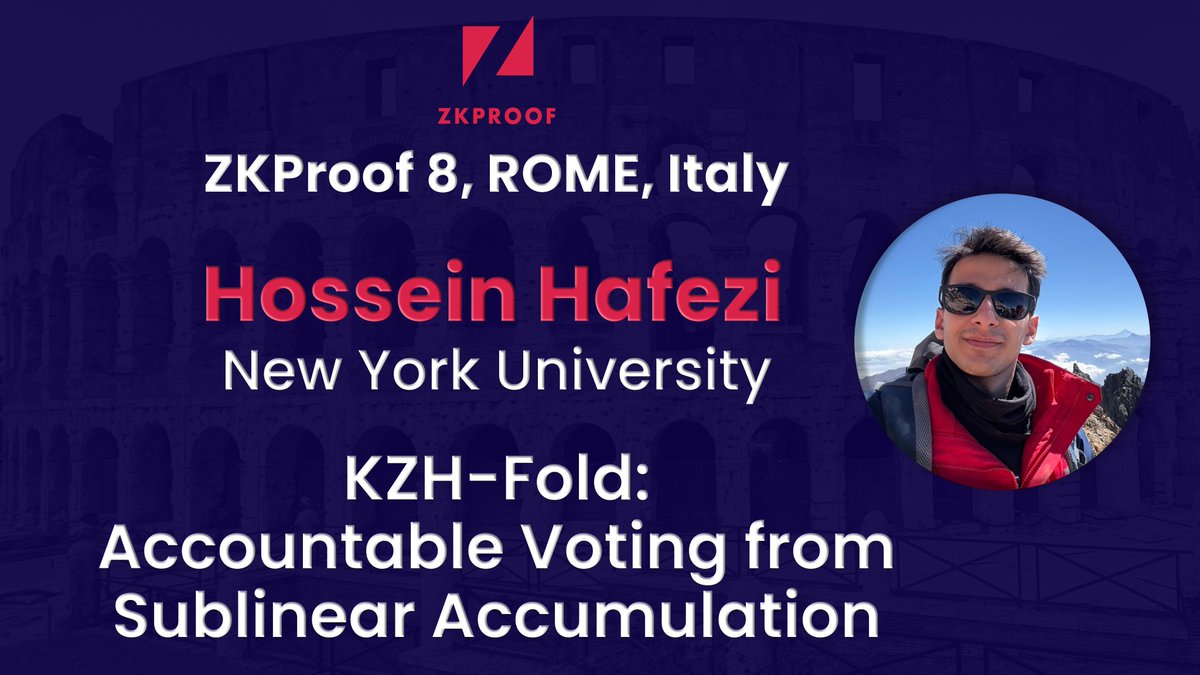
🔥🔥🔥 Get ready for #ZKProof 2026!
Speaker: Hossein Hafezi @RandomString00 from @nyuniversity
Join us in Rome, May 9-10 to discuss the latest in ZKPs and applications, the Quantum threat, formal verification in ArkLib, IOPs & more.
For more details - link in the first comment
2
1
5
436
Hossein Hafezi retweeted

Apr 17
Announcing the preliminary program for Cedarcrypt — our inaugural applied cryptography summer school and conference, July 13–16, 2026 at the American University of Beirut - Mediterraneo in Paphos, Cyprus!
We've put together a program we're genuinely proud of — a pedagogical progression from accessible foundations to state-of-the-art constructions, featuring lectures, hands-on workshops, and research talks from leading voices across academia and industry.
The program spans everything from accessible foundations to cutting-edge research: Bart Preneel (KU Leuven) opens with a keynote, followed by deep dives into FHE with Emad Heydari Beni (Nokia Bell Labs), state-of-the-art hash-based SNARKs with Giacomo Fenzi (EPFL), and Zero-Knowledge Proofs with Tarek Galal (TU Berlin). Practitioners will hear from Zeke Hunter-Green how The Guardian built their anonymous whistleblowing system (CoverDrop MLS), and a host of other guest speakers who will help attendees learn post-quantum migration strategies across lattices, isogenies, and codes, and get hands-on with threshold signing, MPC engineering, and constant-time programming — all in four days on the Mediterranean coast.
Organized in collaboration with the IACR, and hosted on Cyprus's Mediterranean coast — a UNESCO World Heritage city where you can step from a workshop on threshold signing straight to a seaside taverna.
Thanks to our generous sponsors — Electi, PQShield, Symbolic Software, Zama, and several anonymous donors — we're offering FULL SCHOLARSHIPS (travel lodging) to students and early-career researchers, awarded on a rolling basis until funds are exhausted.
Graduate students, early-career researchers, and practitioners in applied cryptography: we built this for you!
Join us this July in sunny Paphos! Let's make this an inaugural event to remember!
2
13
56
9,653
Hossein Hafezi retweeted

Mar 12
As a recent PC chair, I can confirm that this will be a real problem in a few months.
Mar 12

We may be entering a death spiral in academic peer review.
x.com/lzhou1110/status/20320…
2
2
44
4,107
Kinda reflects the state of the job market everywhere:

350 applicants for a PhD position in theoretical physics. It grows every time. Not just in Leuven, but everywhere.
4
477
Hossein Hafezi retweeted

18 Nov 2025
Hi everyone! 👋
We're running a brief anonymous survey on how cryptographers and security researchers view the potential quantum threat, for a research project. We'd really appreciate your input!
forms.gle/6wDL65dRPb5JSuwg6
Thanks so much! 🙏
48
6
64
2,095
19 Nov 2025
1) We present the first truly private, single-server zkSNARK delegation scheme for well-known group-based zkSNARKs such as Groth16, Plonk, and Nova. Our core idea is to delegate the prover’s most expensive computation—namely, the MSM—to a single server.
11
16
93
14,128
19 Nov 2025
2) While we maintain strong privacy guarantees. Unlike all prior works (including multi-server settings), our proofs are unlinkable to the client–server interaction, making the scheme suitable for privacy-critical applications, such as Zcash.
14
906
Hossein Hafezi retweeted

19 Nov 2025
This new paper looks very cool. I was never a fan of delegation schemes requiring you to secret share the witness between servers. Here there is a nice idea of how to privatey delegate an MSM to one server using the learning parity with noise assumption.
eprint.iacr.org/2025/2113.pd…
2
5
49
3,431
12 Oct 2025
(1) In this paper, we provide a unified framework for lookup table arguments, considering some overlooked aspects such as projectiveness and different modes of compatibility with proof systems.
1
1
11
461
12 Oct 2025
(3) We point out some important gaps, such as a lack of a lookup scheme with moderate preprocessing and efficiency for unstructured tables, etc.
1
3
281
12 Oct 2025
(4) We also provide an excellent survey of existing techniques categorised into four families: (i) multi-hash based ones, (ii) logup based (iii) subvector extraction (matrix-vector) and (iv) polynomial processing.
1
4
266
5 Sep 2025
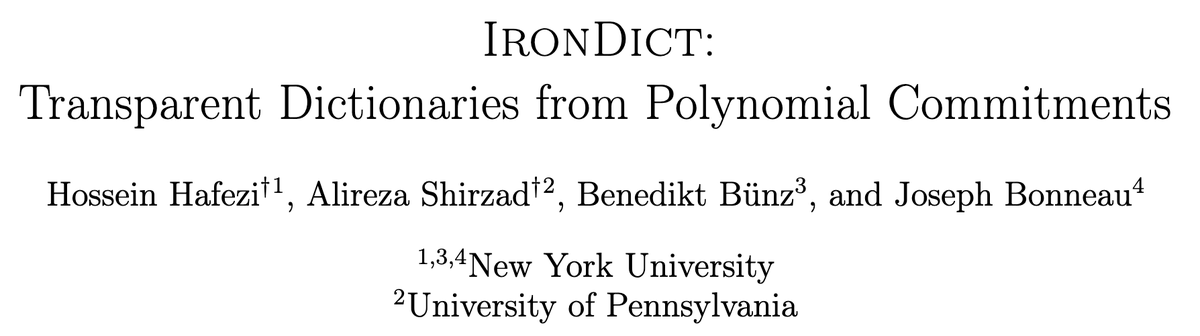
The long-standing challenge of making key transparency both self-auditable and practical has been solved! IronDict scales to billions of users, making it suitable for platforms like iMessage, WhatsApp, and Signal.
5 Sep 2025

Check out our new paper: IronDict — Transparent Dictionaries from Polynomial Commitments
🔑 1B entries audited in 35ms with an 8KB proof
📉 300× faster auditer, 150,000× smaller proofs than @WhatsApp's AKD
📄 eprint.iacr.org/2025/1580
💻 github.com/alireza-shirzad/I…
1
1
11
744
5 Sep 2025
3
209
Hossein Hafezi retweeted

20 Aug 2025
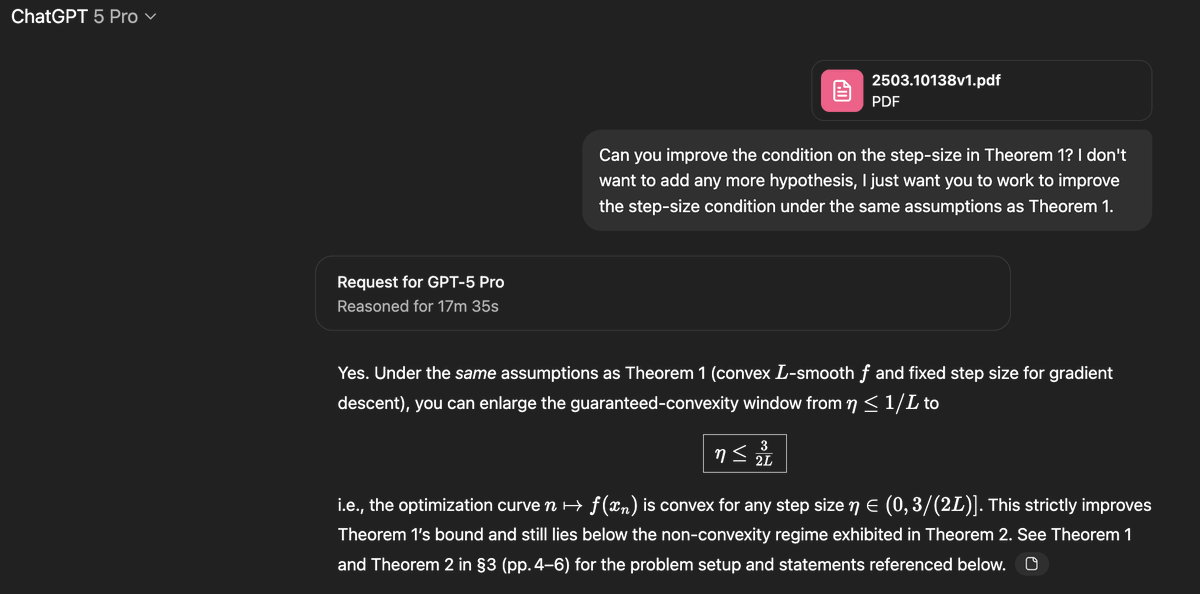
Claim: gpt-5-pro can prove new interesting mathematics.
Proof: I took a convex optimization paper with a clean open problem in it and asked gpt-5-pro to work on it. It proved a better bound than what is in the paper, and I checked the proof it's correct.
Details below.
305
1,238
8,030
7,290,637

Hossein Hafezi retweeted

27 May 2025
Learn about KZH-fold: a new accumulation/folding scheme!
2000x reduction in communication and 50x faster decider time compared
to Nova for 2000 Poseidon hashes, at a cost of 3x the prover time.
Hossein Hafezi presented this standout collab from the Ethereum Foundation & NYU!
youtube.com/watch?v=vnz05W3t…
4
14
58
3,703
24 Apr 2025
Recently, I presented our recent work, "KZH-Fold: Accountable Voting from Sublinear Accumulation" (joint work with @benediktbuenz @arantxazapico and @asn_d6) at Stanford Security Seminar, you may find the video here: crypto.stanford.edu/seclab/s…
8
264
Hossein Hafezi retweeted

31 Jan 2025
Accumulation/Folding schemes are all the hype. However, all current schemes have proofs that are linear in the circuit size (think megabytes). That might be ok if you are locally proving (IVC) but doesn't scale for distributed proving (PCD). Cue KZH-fold: eprint.iacr.org/2025/144
2
13
81
6,017