Joined June 2014
- Tweets 27,299
- Following 10,685
- Followers 47,011
- Likes 25,642
7,731 Photos and videos
Evil English 😈 retweeted
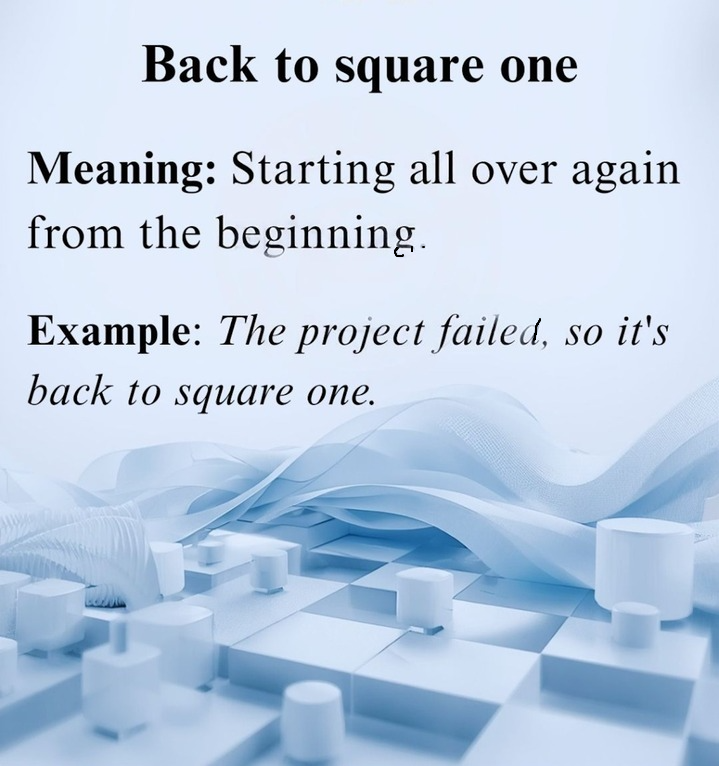
Back To Square One
= returning to the starting point of a process, plan, or project; often after a failure, setback, or dead end.
You have to start completely over from the beginning, with no progress carried forward.
Examples:
•After weeks of negotiations, the two sides couldn't agree and are back to square one.
•I thought I had fixed the bug in my code, but it still crashes. Back to square one.
•She tried a new diet but gained all the weight back. Now she's back to square one.
•The team lost the championship in the final minute. They're back to square one next season.
Origin
The phrase likely comes from board games or puzzles, where "square one" literally refers to the first square on a game board (like in Snakes and Ladders / Chutes and Ladders). If you land on a snake or make a mistake, you slide back to the start.
Another popular theory links it to early BBC radio broadcasts in the 1920s–1930s, where football (soccer) matches were described using a numbered grid of squares on a diagram. Commentators would say things like “the ball is in square 4” — so “back to square one” meant the action had returned to the starting area.
Similar Idioms:
•Back to the drawing board (very close in meaning — often used when a plan or design fails)
•Starting from scratch
•Resetting the clock
•Back to basics
✍️Usage Notes:
•It’s neutral to slightly negative (it implies disappointment or wasted effort).
•You can say “go back to square one” or “be back to square one.”
•It’s informal and used in both spoken and written English, including business and academic contexts.
5
28
1,191
Evil English 😈 retweeted
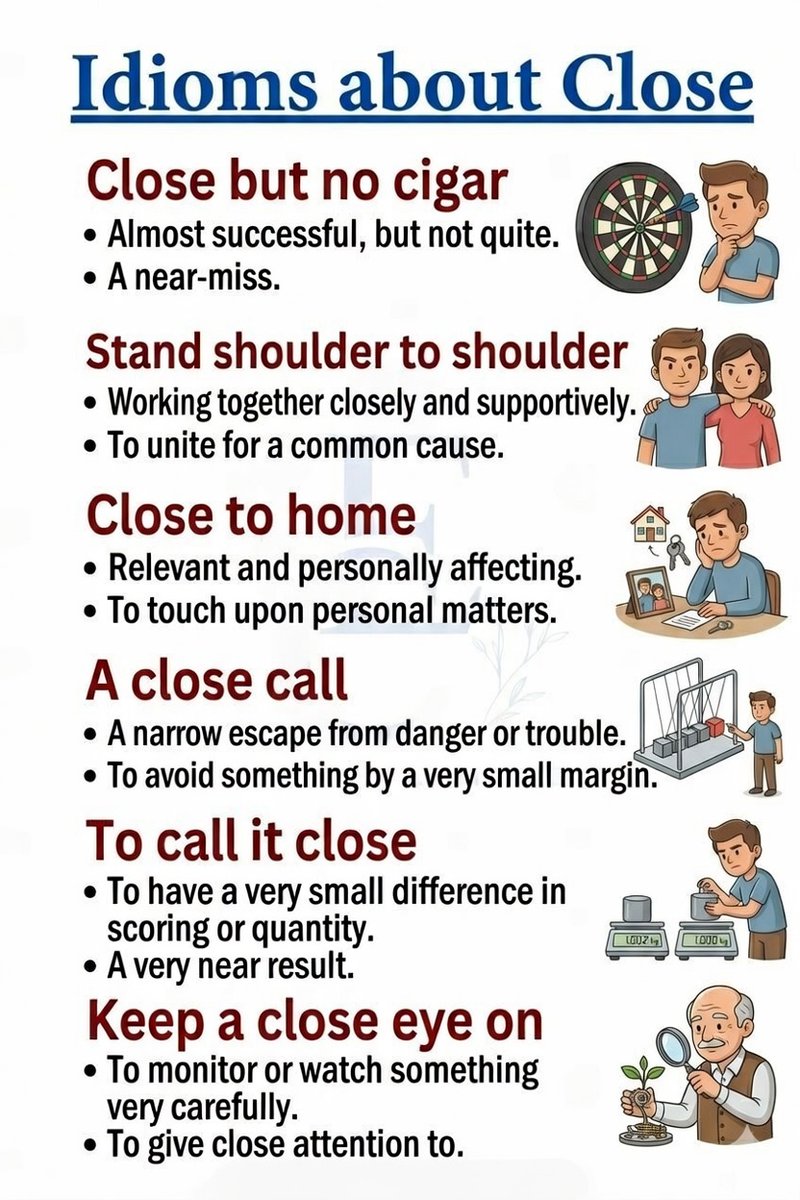
Idioms About Close
🔹Close but no cigar
= You were very near to success or the correct answer, but you didn’t quite make it.
It’s a polite or humorous way to say “almost, but not quite.”
Examples:
“You guessed 98% on the test — close, but no cigar!”
“Our team almost won the championship. Close but no cigar.”
✍️Origin: Comes from old fairgrounds or carnivals where cigars were given as prizes. If you almost won a game, you’d hear “Close, but no cigar!”
🔹Stand shoulder to shoulder
= To work together closely, support each other, and unite for a common goal.
Examples:
“During the crisis, the whole community stood shoulder to shoulder.”
“We need to stand shoulder to shoulder if we want to win this election.”
✍️Usage tip: Often used in contexts of teamwork, solidarity, protests, or difficult times.
🔹Close to home
= Something that affects you personally or emotionally because it relates to your own life or experiences.
Examples:
“The movie about losing a parent hit really close to home for me.”
“When she criticized lazy students, it hit close to home because I hadn’t studied.”
✍️Extra note: Can also mean something is physically near your house (“The new supermarket is close to home”), but in idiomatic use, it’s usually emotional/personal.
🔹A close call
= A situation where something dangerous or bad almost happened, but you narrowly escaped.
Examples:
“That car almost hit me! What a close call!”
“The pilot made a perfect landing after engine trouble; it was a very close call.”
✍️Similar idioms: “A narrow escape,” “by the skin of your teeth.”
🔹To call it close (or “It’s too close to call”)
= When the result is almost equal; very little difference between the options, scores, or competitors. Often used in sports, elections, or competitions.
Examples:
“The election is too close to call — we’ll have to wait for final votes.”
“The tennis match was incredibly close; the final score was 7-6. We can call it close!”
✍️Note: You’ll also hear “too close to call” in news about elections or races.
🔹Keep a close eye on
= To watch or monitor something or someone very carefully and attentively.
Examples:
“The teacher is keeping a close eye on students who cheat.”
“Please keep a close eye on your little brother while I’m cooking.”
✍️Related expressions: “Keep an eye on,” “Watch like a hawk,” “Monitor closely.”
Bonus Related “Close” Idioms
Close-knit → A very tight, supportive group (e.g., a close-knit family).
Close quarters → In a very small or crowded space.
Close shave → Similar to “close call” — narrowly avoiding danger.
Come close → To almost achieve something.
1
19
89
3,089

Jun 13
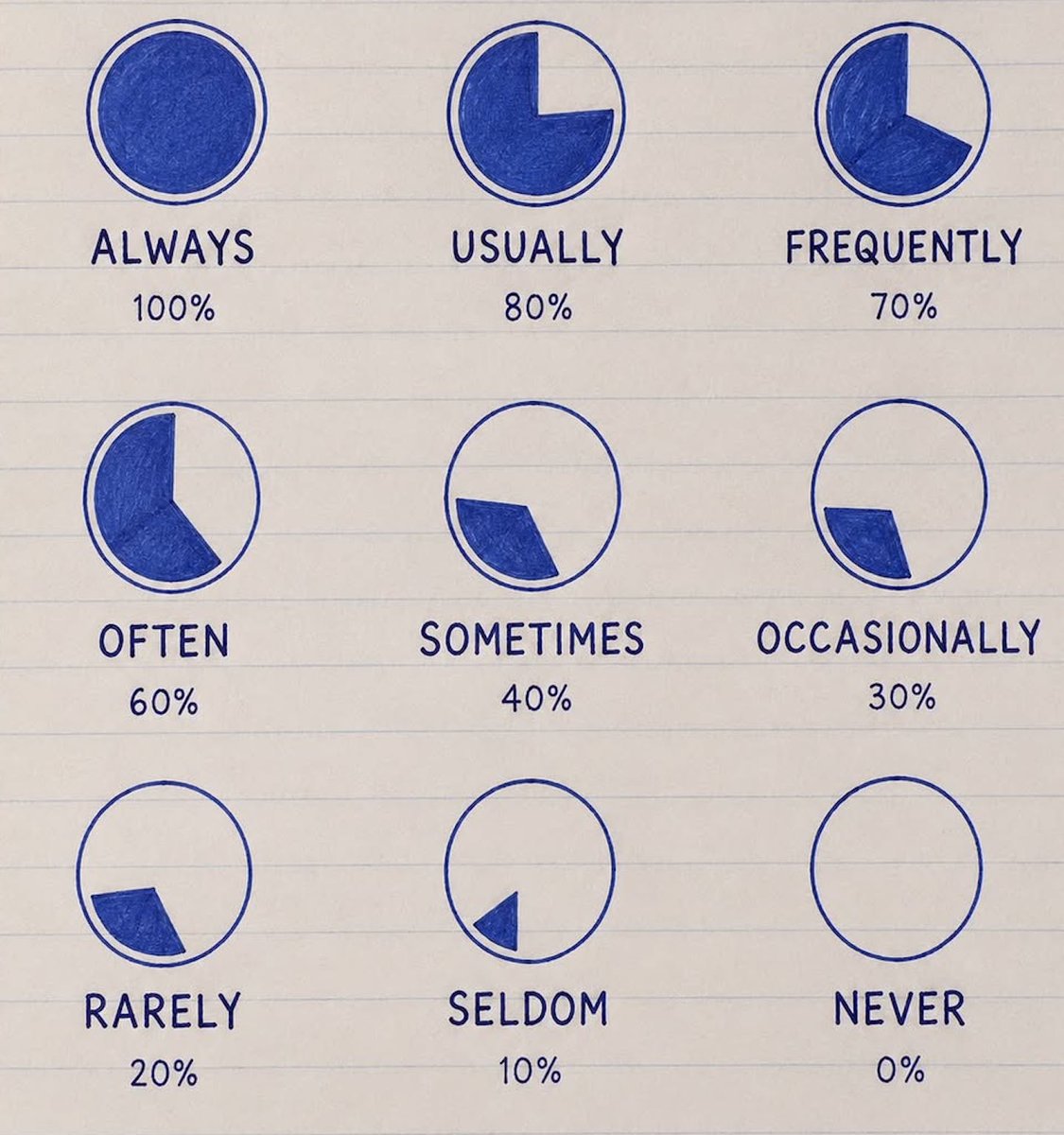
Frequency Adverbs
They tell us how often something happens.
🔹ALWAYS (100%)
= Something happens every time, 100% of the time.
Examples:
I always drink coffee in the morning.
She always arrives on time.
🔹USUALLY (80%)
= Something happens most of the time (but not always).
Examples:
I usually go to bed at 11 p.m.
We usually eat dinner together.
🔹FREQUENTLY (70%)
= Something happens quite often.
Examples:
He frequently travels for work.
I frequently check my email.
🔹OFTEN (60%)
= Something happens many times, regularly.
Examples:
They often go to the cinema on weekends.
She often forgets her keys.
🔹SOMETIMES (40%)
= Something happens on some occasions, but not regularly.
Examples:
I sometimes eat fast food.
Sometimes it rains in the summer.
🔹OCCASIONALLY (30%)
= Something happens once in a while, not very often.
Examples:
We occasionally visit our grandparents.
I occasionally buy new clothes.
🔹RARELY (20%)
= Something happens very infrequently.
Examples:
He rarely gets angry.
I rarely watch TV.
🔹SELDOM (10%)
= Similar to "rarely" — something happens very little.
Examples:
She seldom complains.
They seldom go out during the week.
🔹NEVER (0%)
= Something does not happen at all.
Examples:
I never eat meat. (I’m vegetarian.)
She never lies.
✍️Important Grammar Rules✍️
✍️Position in the sentence:
With be verbs (am/is/are/was/were):
→ She is always late.
→ They are never happy.
✍️With other verbs:
→ I always eat breakfast.
→ He often plays football.
✍️With helping verbs (can, will, have, etc.):
→ You can sometimes see stars here.
→ I have never been to Japan.
✍️"Sometimes" and "Occasionally" are flexible:
They can also go at the beginning or end of a sentence.
→ Sometimes I feel tired.
→ I feel tired sometimes.
✍️Negative sentences:
Don’t use “never” with “not”.
Wrong: I don’t never go there.
Correct: I never go there. / I don’t ever go there.
2
29
125
2,335
Evil English 😈 retweeted
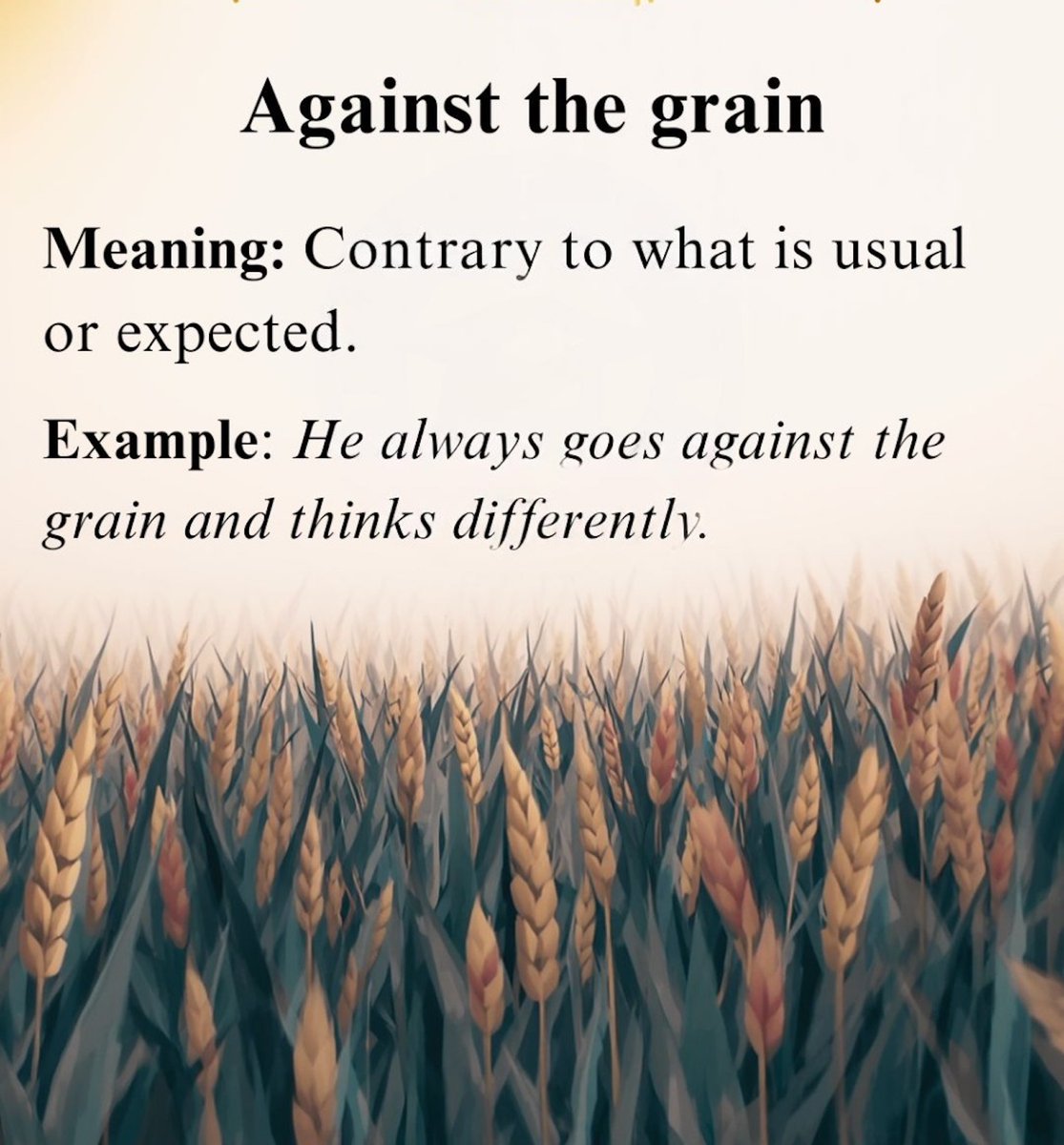
Against the Grain
(idiom)
= doing something that goes against the natural direction, flow, or usual way of things
It describes an action, decision, or behavior that feels unnatural, difficult, or contrary to what is expected or preferred; either by society, a group, or an individual's own instincts or habits.
Origin
The phrase comes from woodworking. When carpenters cut wood with the grain (along the natural lines of the fibers), the cut is smooth and easy. Cutting against the grain is rough, harder, and can splinter the wood. This literal image was transferred to human behavior centuries ago (the expression dates back to at least the 17th century).
Example Sentences
🔹Personal preference / character
"She’s always been quiet and reserved, so speaking in front of 500 people really goes against the grain for her."
🔹Social norms or expectations
"In a company that values long working hours, leaving the office at 5 p.m. every day goes against the grain, but he does it anyway to protect his family time."
🔹General opposition
"His decision to quit a stable job and become a full-time artist went completely against the grain of his conservative family’s wishes."
Additional Notes & Usage Tips
✍️Common variations:
"It goes against the grain" (most frequent)
"It runs against the grain"
"Swimming against the grain" (less common but understandable)
✍️Synonyms / similar expressions:
Against the tide / current
Bucking the trend
Going against the flow
Rubbing people the wrong way
✍️Tone:
The idiom often carries a slightly negative or effortful feeling, implying resistance or discomfort, but it can also be used positively when praising someone for having the courage to do what feels right to them.
✍️Grammar note: It’s almost always used with the verb go, run, or be against the grain.
1
10
47
1,568
Evil English 😈 retweeted
Apr 30
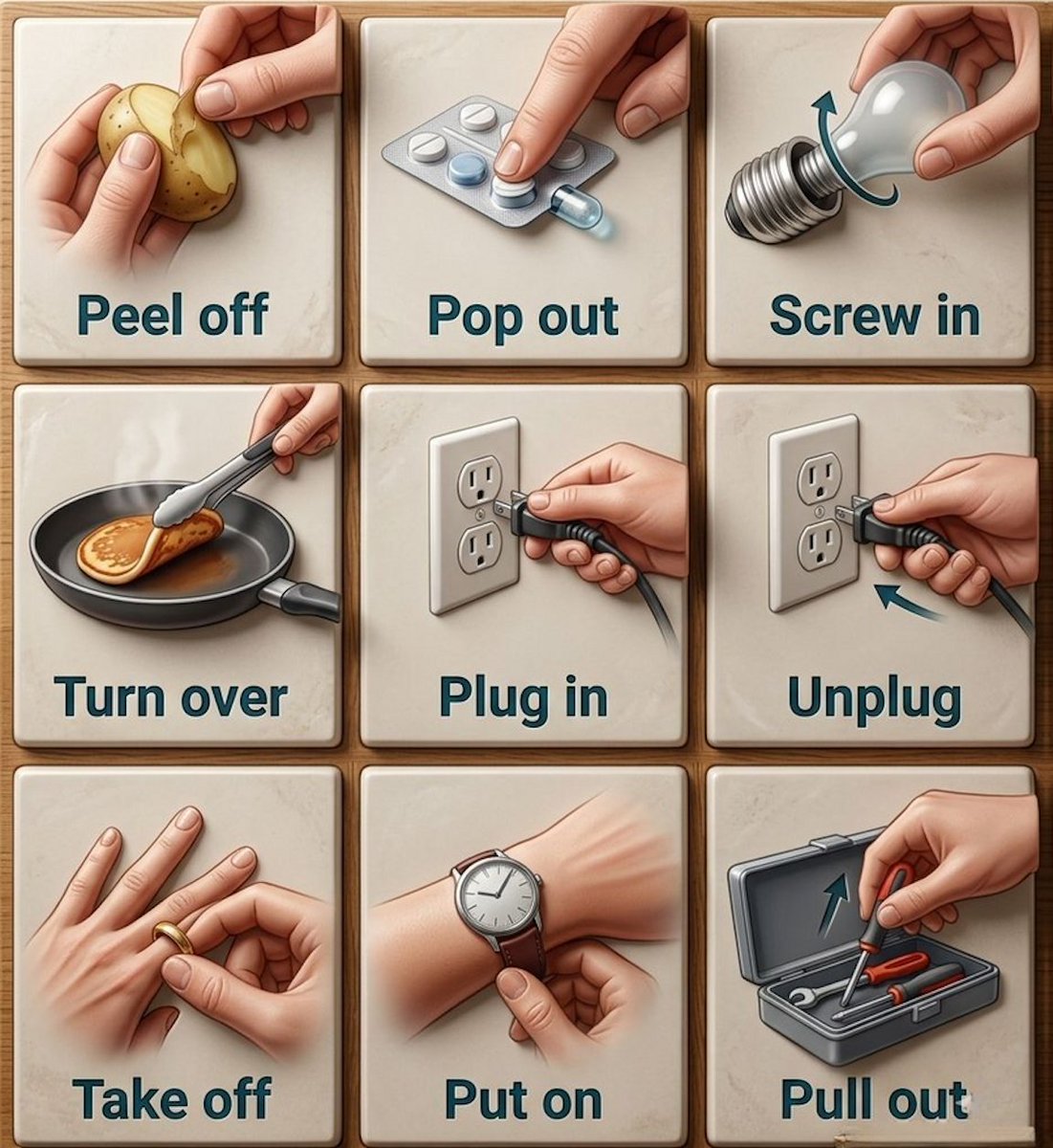
Daily Action Phrasal Verbs
🔹 Peel off
= To remove the outer skin or layer of something (often by pulling it away).
Example:
I need to peel off the sticker from the new phone.
She carefully peeled off the label before recycling the bottle.
✍️Extra: “Peel off” is very common with fruit/vegetables (peel off the skin), stickers, tape, or even clothes in a quick way (He peeled off his wet shirt).
🔹Pop out
= To push or press something so that it comes out suddenly.
Example:
Just pop out two tablets and take them with water.
The button popped out when I pressed it.
✍️Extra: We also say eyes can “pop out” (in surprise) or something can “pop out” of a place unexpectedly.
🔹Screw in
= To attach or tighten something by turning it in a clockwise direction (usually with threads).
Example:
Make sure you screw in the light bulb properly.
I need to screw in a few more screws to fix the shelf.
✍️Extra: Opposite = screw out (unscrew). Also used figuratively: Don’t screw this up! (= make a mistake).
🔹 Turn over
= To flip something to the other side.
Example:
Turn over the steak so it cooks on both sides.
Please turn over the page and continue reading.
✍️Extra: In business, “turnover” (one word) means how much money a company makes. In driving, you “turn over” the engine = start the car.
🔹Plug in
= To connect an electrical device to a power source by inserting the plug into the socket.
Example:
Don’t forget to plug in your phone charger.
I plugged in the laptop and started working.
✍️Extra: Very common with all electronics. Opposite = unplug.
🔹Unplug
= To remove a plug from an electrical socket; to disconnect from power.
Example:
Unplug the toaster after using it.
She unplugged the TV to save electricity.
✍️Extra: Figuratively: I need to unplug and relax this weekend (= disconnect from technology/work).
🔹Take off
= To remove something you are wearing or that is on your body.
Example:
Take off your shoes before entering the house.
She took off her glasses and rubbed her eyes.
✍️Extra: “Take off” has many meanings!
Planes take off (leave the ground).
Sales can take off (increase suddenly).
You can take time off work (= have a holiday).
🔹Put on
= To put clothing or accessories on your body.
Example:
Put on your coat; it’s cold outside.
I always put on my watch after I shower.
✍️Extra: Also means to pretend (He’s putting on an act) or to organize (They put on a great show).
🔹Pull out
= To remove something by pulling it toward you.
Example:
He pulled out a knife from the drawer.
Pull out the USB drive carefully.
✍️Extra: Common in driving (pull out of a parking space) and in meetings (I need to pull out of the project = withdraw).
2
51
293
6,516
Evil English 😈 retweeted
Apr 30
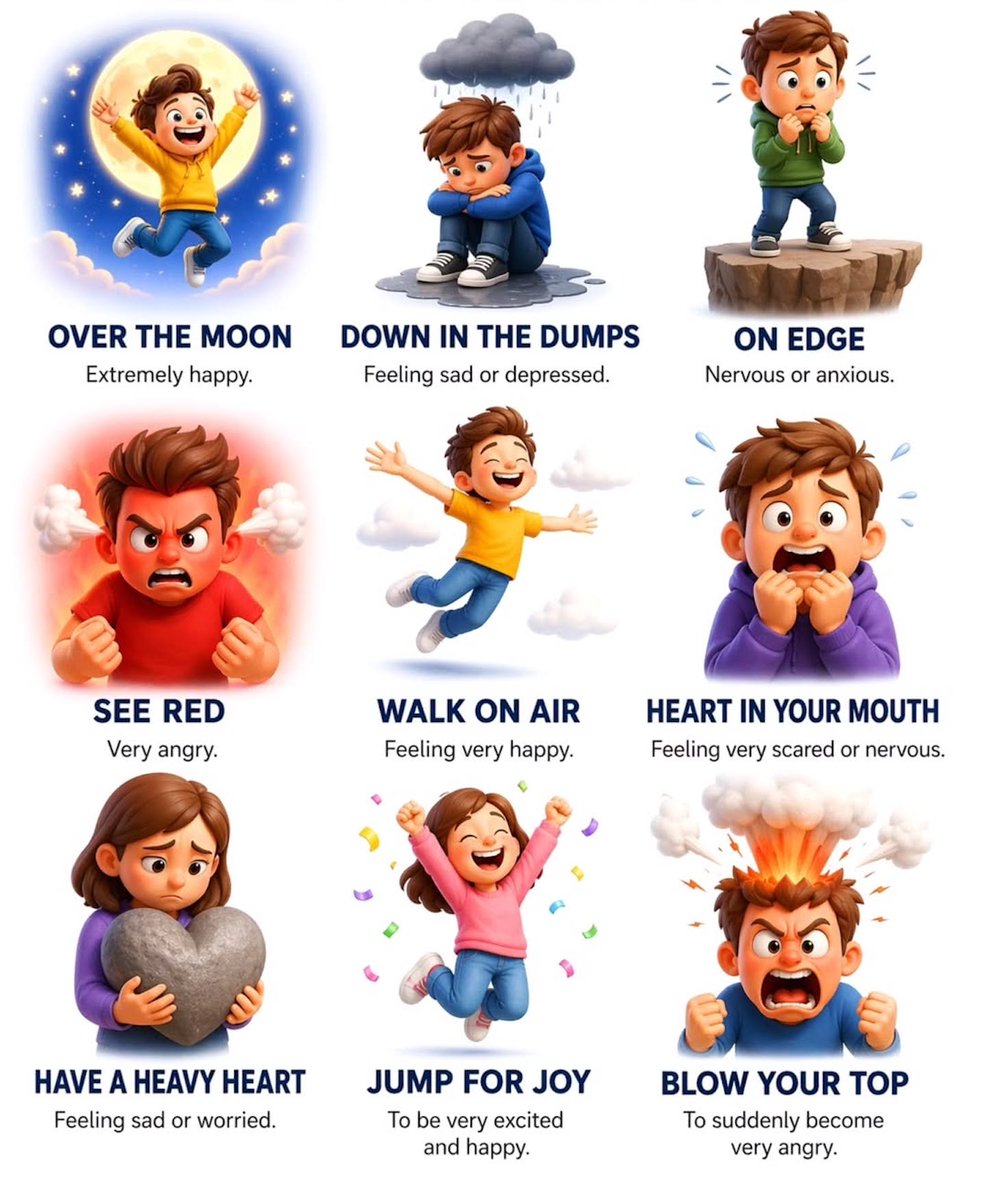
Idioms for Emotion
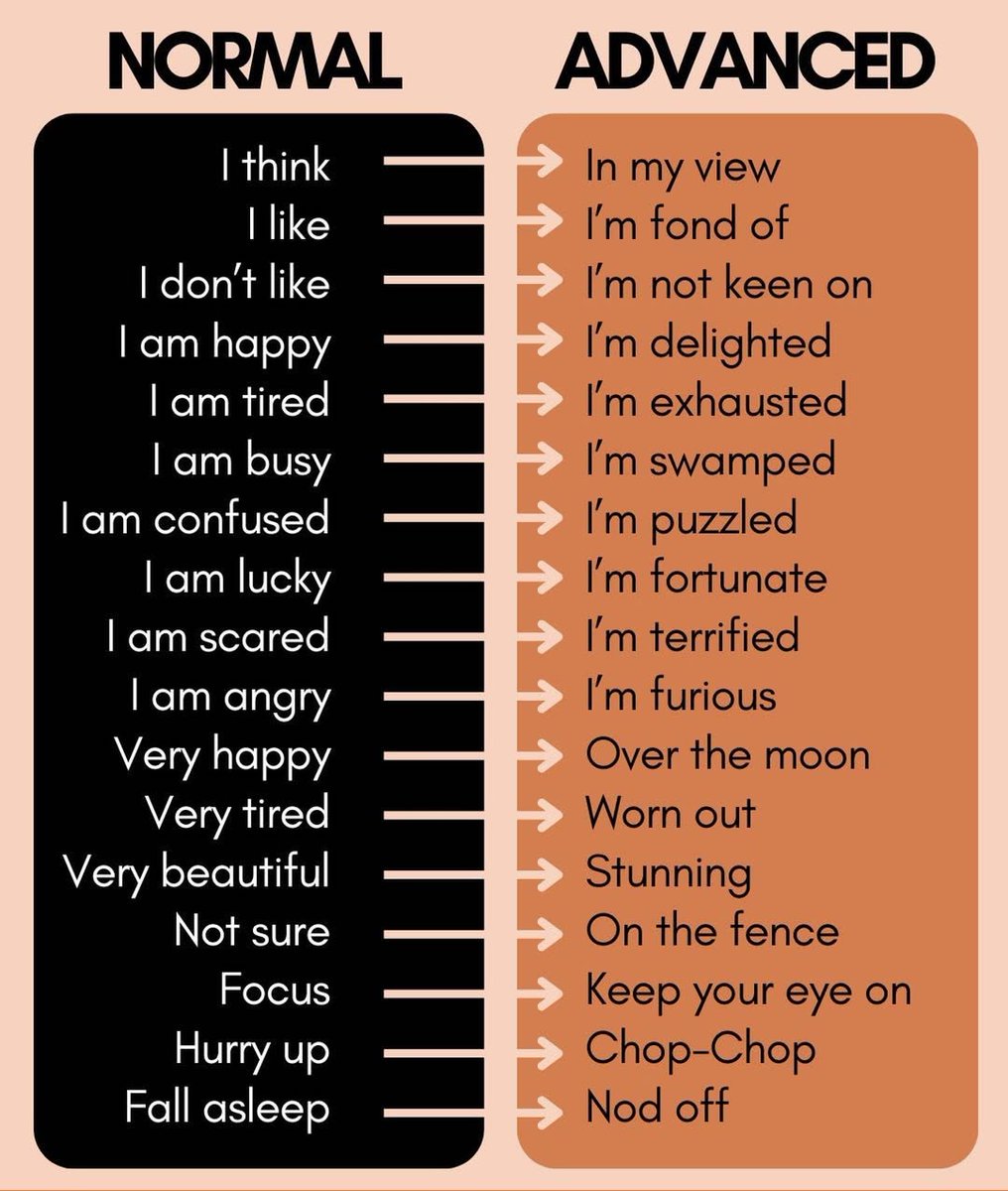
🔹Over the Moon
= Extremely happy or delighted.
Example:
"She was over the moon when she found out she got the job."
✍️Note: This idiom comes from an old nursery rhyme ("Hey Diddle Diddle") and has been used since at least the 17th century to mean extreme happiness.
🔹Down in the Dumps
= Feeling sad, depressed, or low in mood.
Example:
"He's been down in the dumps since his team lost the championship."
✍️Note: "Dumps" here is an old word meaning "melancholy" or "low spirits," not related to garbage.
🔹On Edge
= Nervous, anxious, or irritable (like being tense and ready to react).
Example:
"The students were on edge before the final exam."
✍️Note: It refers to the edge of something sharp or dangerous; you feel "on the edge" of losing control.
🔹See Red
= Become very angry.
Example:
"When someone cuts in line, I see red."
✍️Note: This comes from the idea that anger makes you see the color red (like a bull seeing a red cape).
🔹Walk on Air
= Feel extremely happy, light, and carefree.
Example:
"After winning the award, she was walking on air for days."
✍️Note: Similar to "on cloud nine", both suggest floating above the ground with joy.
🔹Heart in Your Mouth
= Feel very scared, nervous, or anxious (your heart feels like it's jumped up into your throat).
Example:
"My heart was in my mouth as I waited for the interview results."
✍️Note: A very physical description of fear; common in British English.
🔹Have a Heavy Heart
= Feel sad, sorrowful, or worried about something serious.
Example:
"She had a heavy heart when she said goodbye to her old home."
✍️Note: Contrasts with "light-hearted" (carefree and happy).
🔹Jump for Joy
= Be extremely excited and happy (literally jumping up and down).
Example:
"The children jumped for joy when they heard they were going to Disneyland."
✍️Note: This one is very literal and visual; happiness expressed through physical movement.
🔹Blow Your Top (also "Blow Your Stack")
= Suddenly become very angry; lose your temper.
Example:
"He blew his top when he saw the messy room."
✍️Note: The image shows a volcanic explosion; perfect visual metaphor. It suggests pressure building up until it erupts.
Bonus Tips:
These idioms are colorful and figurative; native speakers use them to make conversations more vivid.
Many emotion idioms relate to the body (heart, head, blood) or physical sensations (jumping, floating, exploding).
Similar idioms: "On cloud nine," "green with envy," "tickled pink," "feel blue."
2
48
183
4,135
Evil English 😈 retweeted
Apr 30
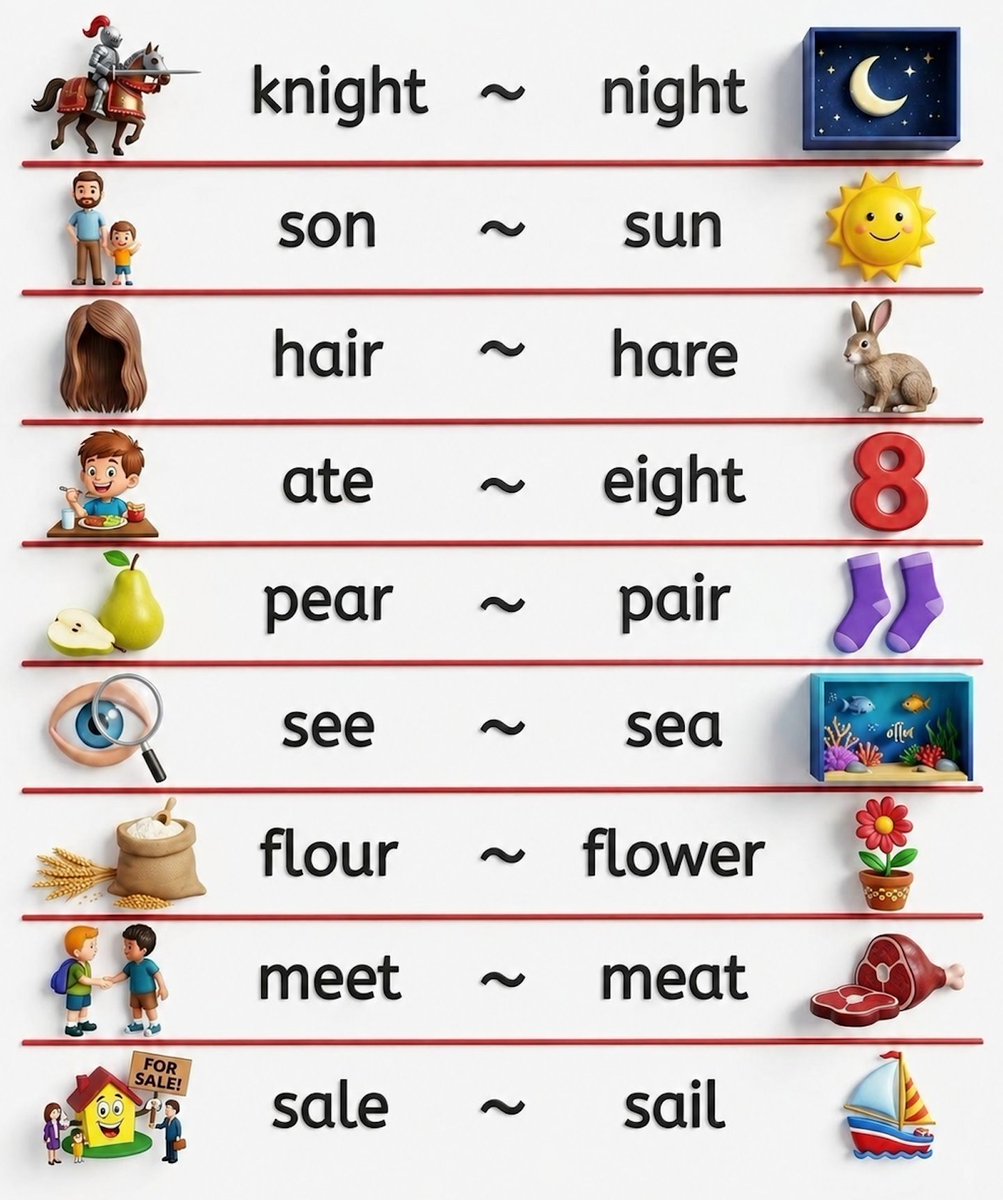
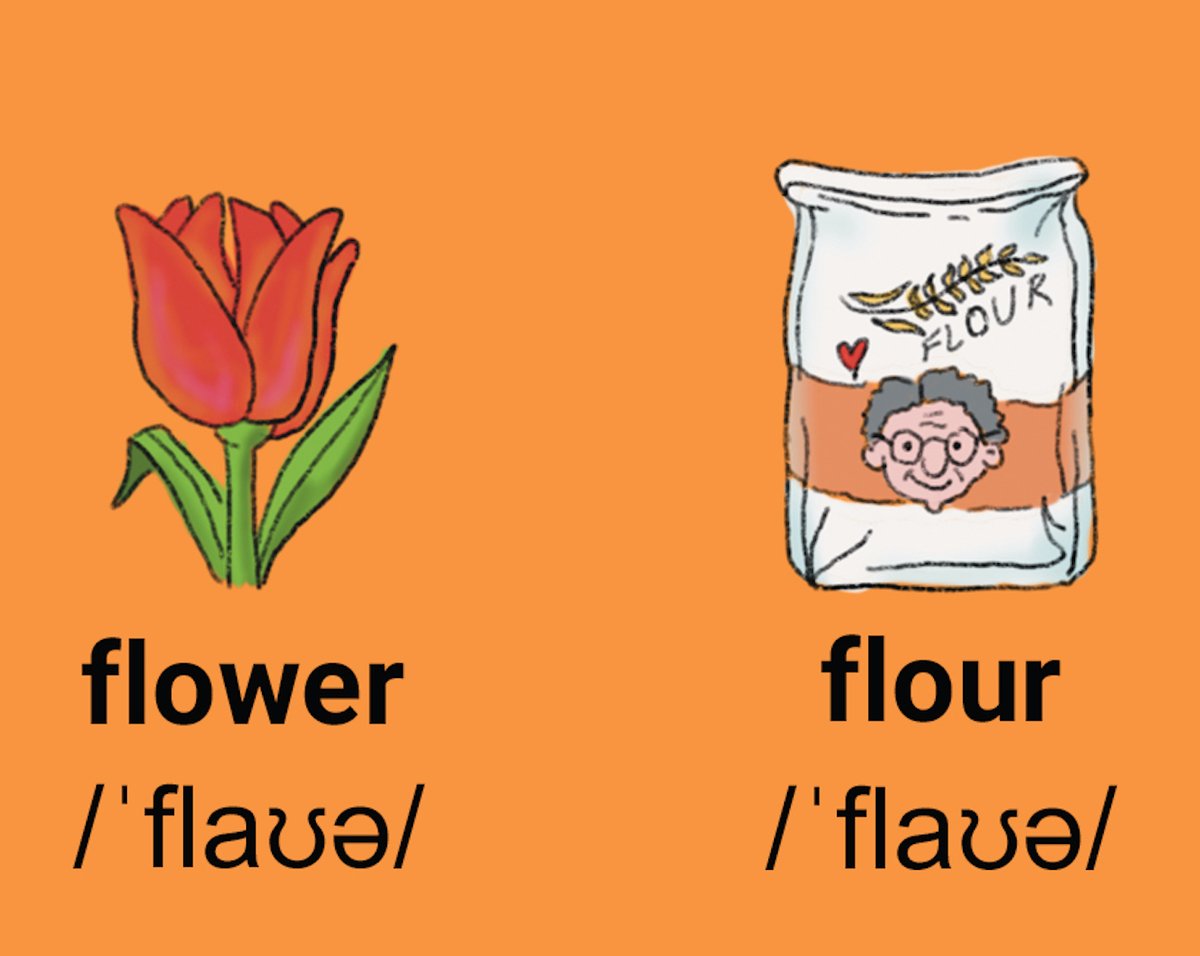
Different Words, Same Pronunciation
🔹Flower
Pronunciation: /ˈflaʊər/ (like "fl-ow-er")
= The colorful, often beautiful part of a plant that produces seeds.
It refers to the actual bloom you see in gardens, bouquets, or nature.
Examples:
I bought a bouquet of flowers for my mother.
The tulip is my favorite flower.
Cherry blossoms are beautiful flowers that appear in spring.
Tip to remember: Think of “flower” as something that flowers (blooms). It has the word “flow” “er”, and it’s a living, growing thing.
🔸Flour
Pronunciation: /ˈflaʊər/ (like "fl-ow-er")
= A fine powder made by grinding grains (usually wheat). It is used in cooking and baking to make bread, cakes, cookies, pasta, etc.
Examples:
I need two cups of flour to make this cake.
This bread is made from whole wheat flour.
The recipe calls for plain flour and baking powder.
Tip to remember: “Flour” comes from the same root as “flower” (the best part of the wheat), but today we use the f-l-o-u-r spelling specifically for the cooking ingredient. Think “flour” = food / baking powder.
Both words sound identical, so native speakers rely on context (the situation) and spelling to understand which one is meant.
9
48
1,831
Jun 12
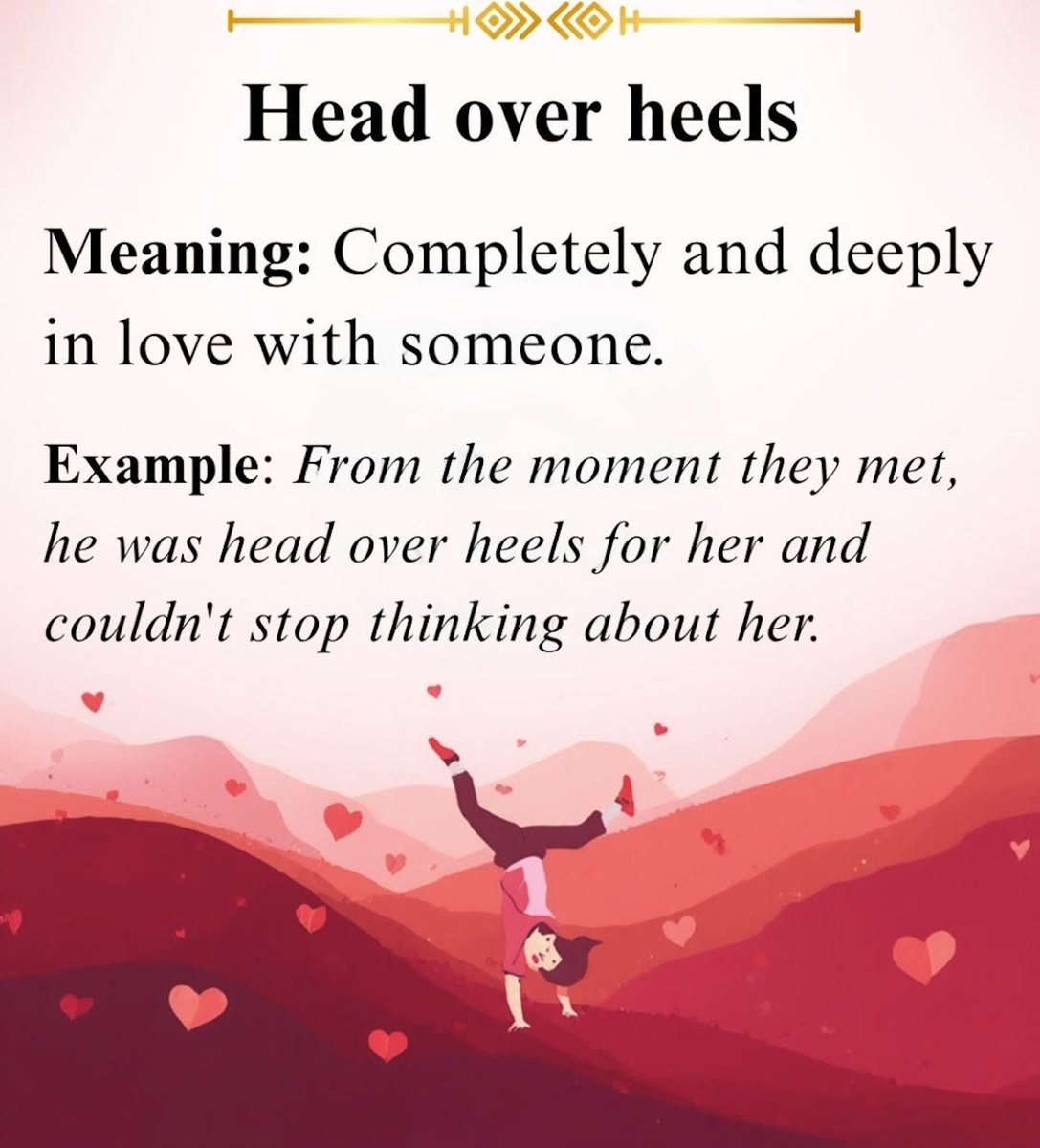
Head Over Heels 💘
(idiom)
= completely and deeply in love with someone
🔑It describes that strong, exciting, almost dizzy feeling when you fall in love very quickly and intensely.
Why “head over heels”?
Literally, if you turn head over heels, you are tumbling or flipping upside down
Examples:
🔹“Sarah met Miguel at the party and now she’s head over heels for him.”
🔹“They’ve only been dating for two weeks, but he’s already head over heels in love with her.”
🔹“I used to be head over heels for that singer when I was a teenager.” (Here it means extremely enthusiastic/fanatical.)
Common Patterns
🔸be head over heels (in love) with/for someone
🔸fall head over heels (in love) with someone
✍️Important Notes✍️
✍️We usually use it for romantic love, not for liking a friend or a hobby (though sometimes people say it jokingly about things they really like).
✍️It’s positive and enthusiastic; it shows strong, happy feelings.
10
50
1,055
Evil English 😈 retweeted
Apr 29
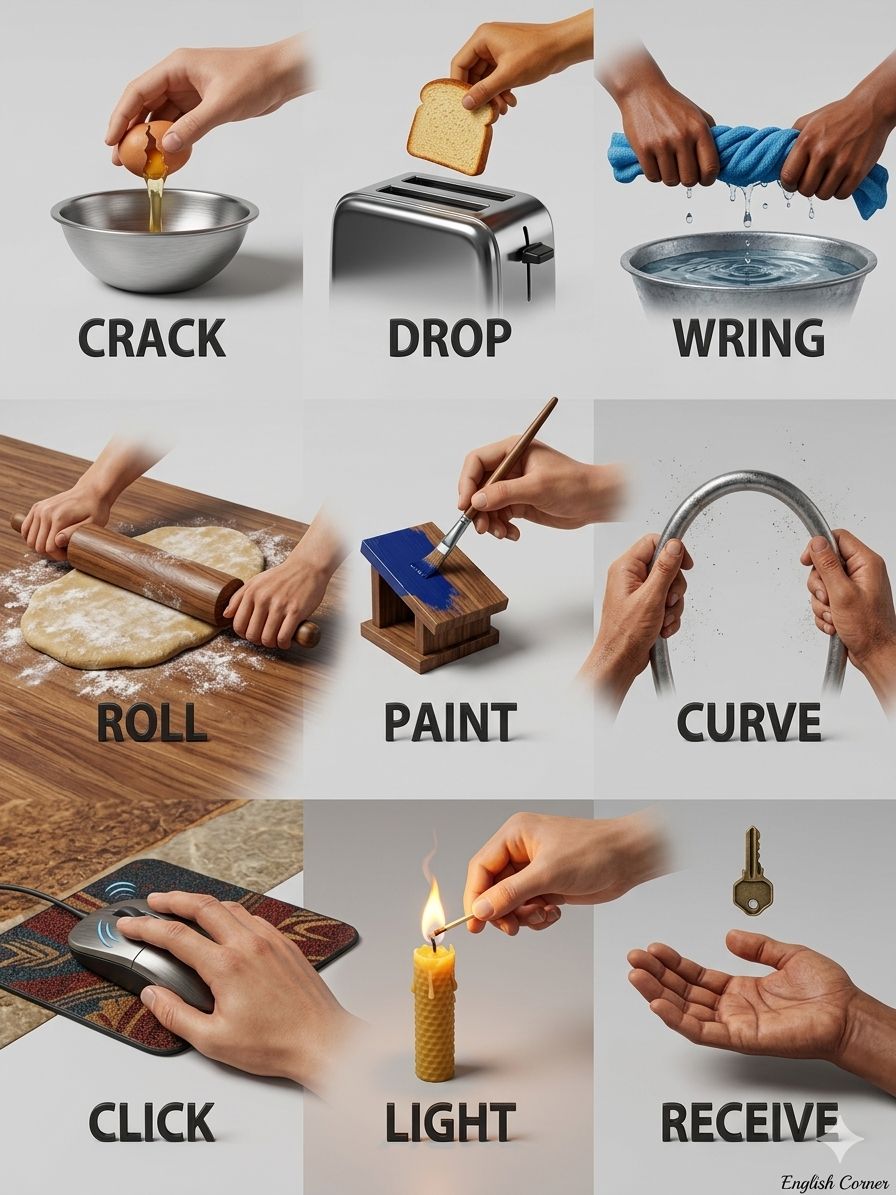
Common Verbs
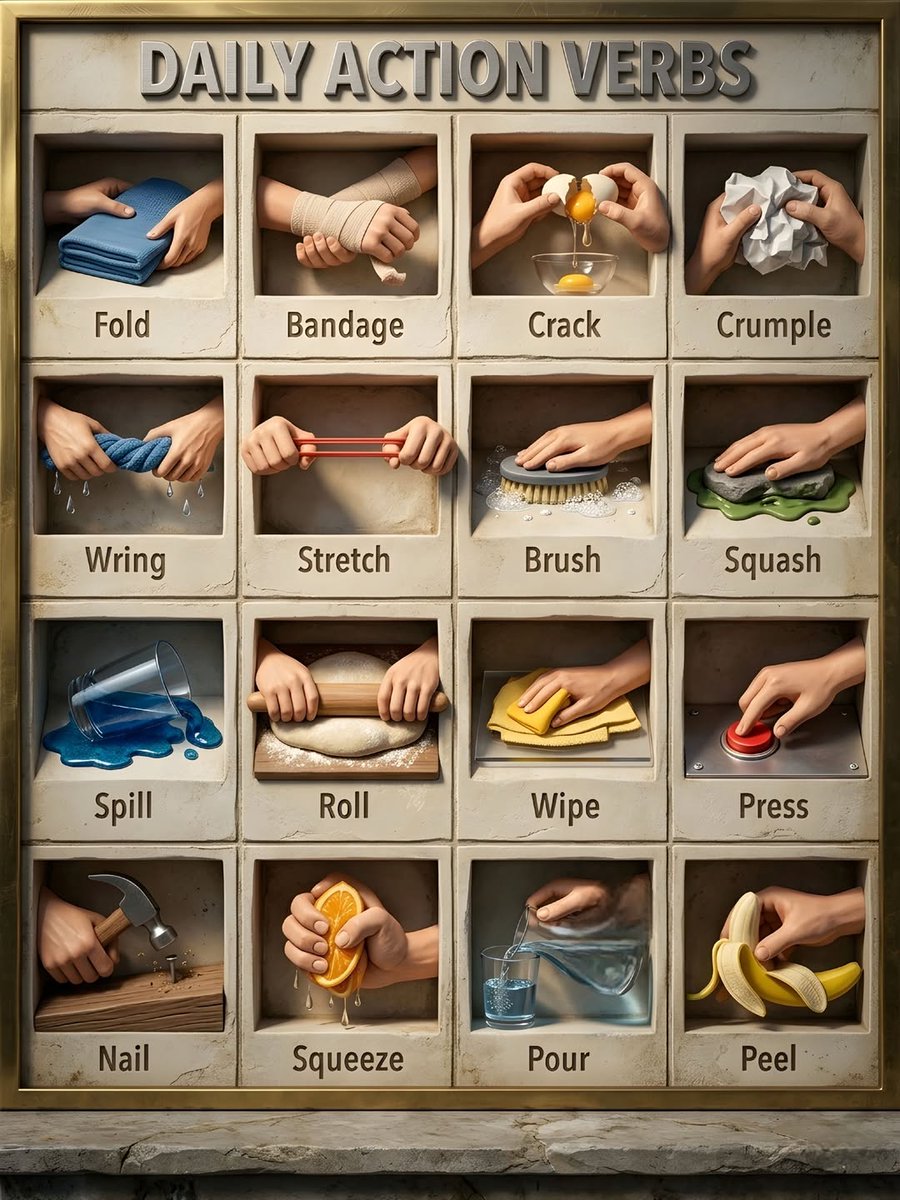
🔹CRACK
= To break something open, especially an egg, by hitting it sharply.
Examples:
“Crack two eggs into a bowl and whisk them.”
“I heard the sound of cracking ice under my feet.”
✍️Extra: “Crack” is also used for jokes (“crack a joke”), passwords (“crack a code”), or even smiling (“crack a smile”).
🔹DROP
= To let something fall (usually intentionally).
Examples:
“Don’t drop your phone!”
“I’m going to drop the kids off at school.” (phrasal verb = deliver)
✍️Extra: Common phrasal verbs:
drop out (quit school/university)
drop by (visit informally)
drop off (fall asleep or deliver something)
🔹WRING
= To twist and squeeze something (usually wet cloth) to remove liquid.
Examples:
“Wring the towel before hanging it up.”
“She was wringing her hands with worry.” (idiomatic = very anxious)
✍️Extra: Pronounced /rɪŋ/ (same as “ring”). Past tense: wrung.
🔹ROLL
= To move something by turning it over and over, or to flatten with a rolling pin.
Examples:
“Roll the dough into a circle.”
“The ball rolled down the hill.”
✍️Extra:
Roll up (make into a cylinder)
Roll out (flatten or launch something new)
“Let’s roll!” = informal way to say “Let’s go!”
🔹PAINT
= To cover a surface with color using a brush or roller.
Examples:
“I’m going to paint the living room white.”
“She painted a beautiful landscape.”
✍️Extra: “Paint the town red” = go out and celebrate wildly.
🔹CURVE
= To bend something into a curve or to form a curved shape.
Examples:
“The road curves sharply to the left.”
“She curved the wire into a heart shape.”
✍️Extra: In sports: “The pitcher threw a curveball.” (unexpected difficulty)
🔹CLICK
= To press a button (especially on a computer mouse).
Examples:
“Click on the link to continue.”
“The door clicked shut.” (sound)
✍️Extra: “Click with someone” = instantly like/get along with a person.
🔹LIGHT
= To start a fire or make something burn (as a verb).
Examples:
“Can you light the candles, please?”
“He lit a cigarette.” (Note: past tense is lit)
✍️Extra: As an adjective: “The room is very light” (= bright). Opposite of heavy.
🔹RECEIVE
= To get or accept something that is given or sent.
Examples:
“I received a lovely birthday present.”
“She received an award for her work.”
✍️Extra: Formal word. In everyday English we often say get instead: “I got a package.
1
25
165
4,546
Jun 11
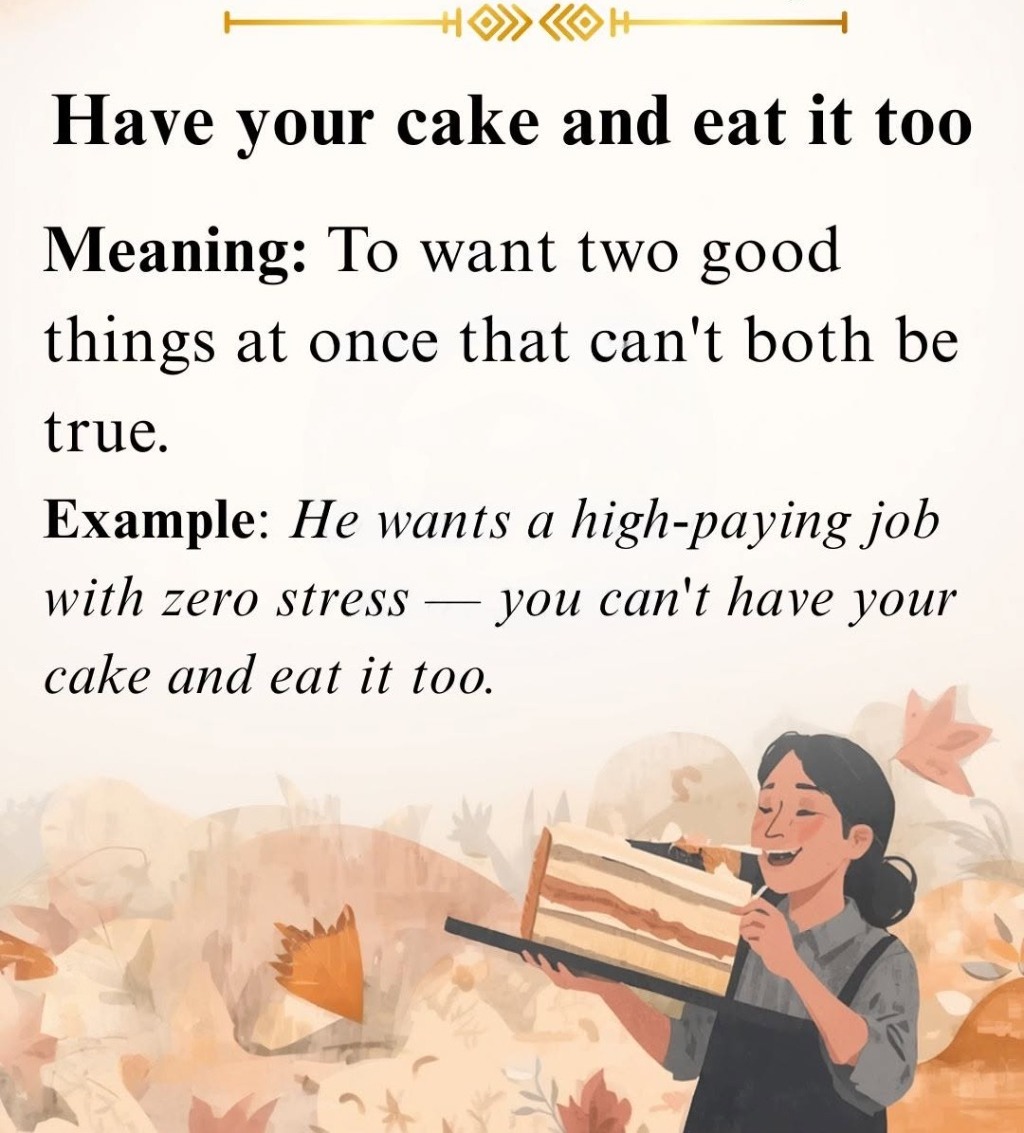
Have Your Cake And Eat It Too.🎂
(idiom)
= wanting to have two good things at the same time, even though they are impossible or cannot both be true
🔑You want the benefits of both options, but in reality, choosing one means you cannot have the other.
✍️Literal idea: If you eat your cake, you no longer have it. Once it's gone, it's gone!
✍️Figurative meaning: You want to enjoy something and keep it at the same time, which is impossible.
Examples:
🔹She wants to eat junk food every day and stay very slim. She can't have her cake and eat it too!
🔹He wants to play video games all night and get top grades at school. Sorry, you can't have your cake and eat it too.
🔹Many people want to save money and buy expensive things every weekend. You can't have your cake and eat it too.
Origin
The phrase comes from an old English proverb from the 1500s. The original version was something like: "You cannot eat your cake and have it too." Over time, people changed the order to "have your cake and eat it too."
Similar expressions in English
🔸You can't have it both ways.
🔸You can't have the best of both worlds.
🔸There’s no such thing as a free lunch. (You always have to give something up.)
How to use it in conversation
🔹Positive: "I wish I could work from home and travel the world at the same time... but I can't have my cake and eat it too."
🔸Negative (warning): "If you quit your job without finding a new one, you can't have your cake and eat it too; you need money to live!"
8
35
903
Evil English 😈 retweeted
Apr 29
Different Words, Same Pronunciation
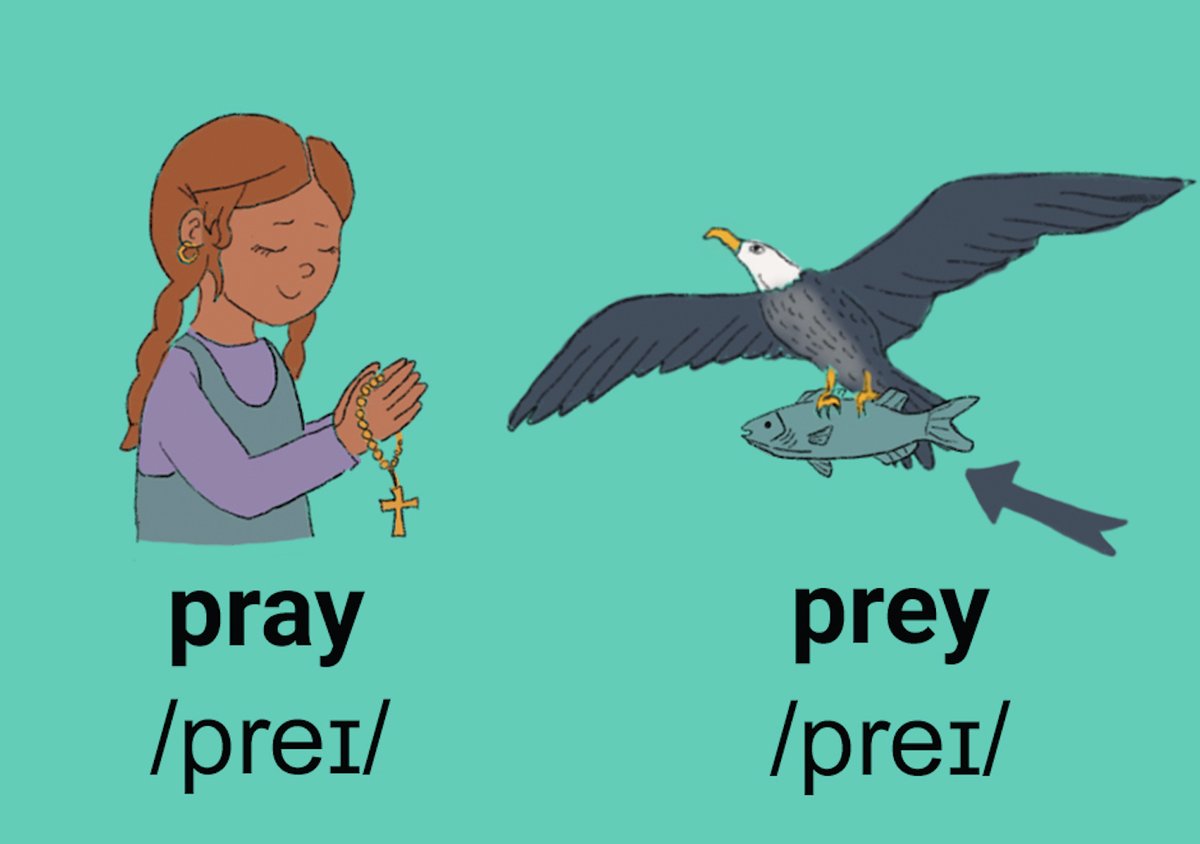
🔹Pray (verb)
Prununciation: /preɪ/
Meaning: To speak to God or a higher power, usually to ask for something, give thanks, or worship.
Examples:
She closed her eyes and began to pray.
Every night we pray for peace.
They prayed that the storm would pass.
Related words: prayer (noun), praying (verb form).
🔸Prey
Pronunciation: /preɪ/
Meaning 1 (noun) = An animal that is hunted and killed by another animal for food.
Examples:
The mouse is prey for the cat.
Fish are the main prey of bald eagles.
The lion stalked its prey.
Meaning 2 (verb) = To hunt and kill for food (used with "on").
Examples:
Eagles prey on fish and small animals.
Spiders prey on insects.
14
65
1,975
Evil English 😈 retweeted
Apr 28
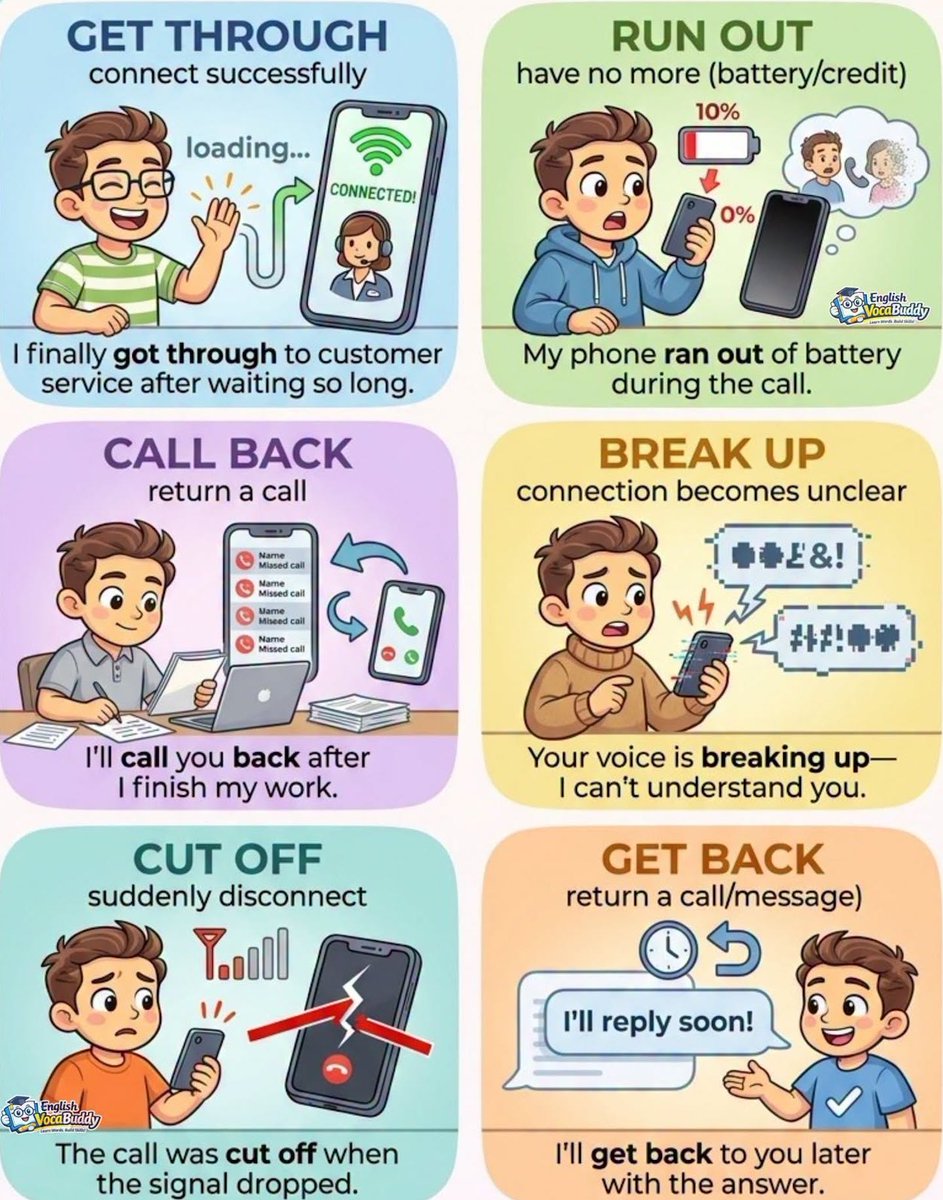
Phrasal Verbs When Using the Phone
🔹GET THROUGH
= connect successfully
To finally reach someone on the phone after trying (often after waiting a long time).
Example:
“I finally got through to customer service after waiting so long.”
✍️Extra info:
You can say:
“It took me 20 minutes to get through.”
“I can’t get through. It’s always busy.”
This is the opposite of “not being able to connect.”
🔹RUN OUT
= have no more (battery/credit/minutes)
To use up all of something (here: battery or phone credit).
Example:
“My phone ran out of battery during the call.”
✍️Extra info:
We use “run out of” for many things:
“I ran out of data.”
“We’re running out of time.”
“She ran out of credit and couldn’t call back.”
🔹CALL BACK
= return a call
To call someone who called you earlier (usually because you missed their call).
Example:
“I’ll call you back after I finish my work.”
✍️Extra info:
Very common in professional or daily life.
You can also say:
“I’ll call him back later.”
“Can you call me back in five minutes?”
(Note: “Call back” is specifically about making a phone call.)
🔹BREAK UP
= connection becomes unclear
When the phone line gets noisy or the voice cuts in and out so you can’t understand the other person.
Example:
“Your voice is breaking up. I can’t understand you.”
✍️Extra info:
You’ll hear this a lot in bad-signal areas:
“You’re breaking up. Can you move to a better spot?”
“The call kept breaking up.”
⚠️Important: “Break up” has two completely different meanings in English!
Phone context = bad connection
Relationship context = end a romantic relationship (“They broke up last week.”).
🔹CUT OFF
= suddenly disconnect
The call ends abruptly, usually because of poor signal.
Example:
“The call was cut off when the signal dropped.”
✍️Extra info:
Very common phrase:
“Sorry, we got cut off.”
“Don’t worry if I get cut off. I’ll call you right back.”
⚠️“Cut off” can also mean “interrupt someone while they’re speaking” (“He cut me off in the middle of my sentence”).
🔹GET BACK (to someone)
= return a call/message
To reply or contact someone later (by call, text, email, etc.).
Example:
“I’ll get back to you later with the answer.”
✍️Extra info:
More general than “call back.” It works for calls, texts, emails, or even messages on WhatsApp/Instagram.
Common phrases:
“I’ll get back to you as soon as I can.”
“Thanks, I’ll get back to you tomorrow.”
Bonus Phone Vocabulary
Here are a few other useful expressions you’ll hear all the time:
Hang up = end the call
Pick up = answer the phone
Hold on / Hang on = wait a moment
Signal dropped / No service / One bar = weak connection
Voicemail = the message you leave when someone doesn’t answer
Drop a call = the call ends unexpectedly (similar to “cut off”)
34
161
4,517
Jun 10
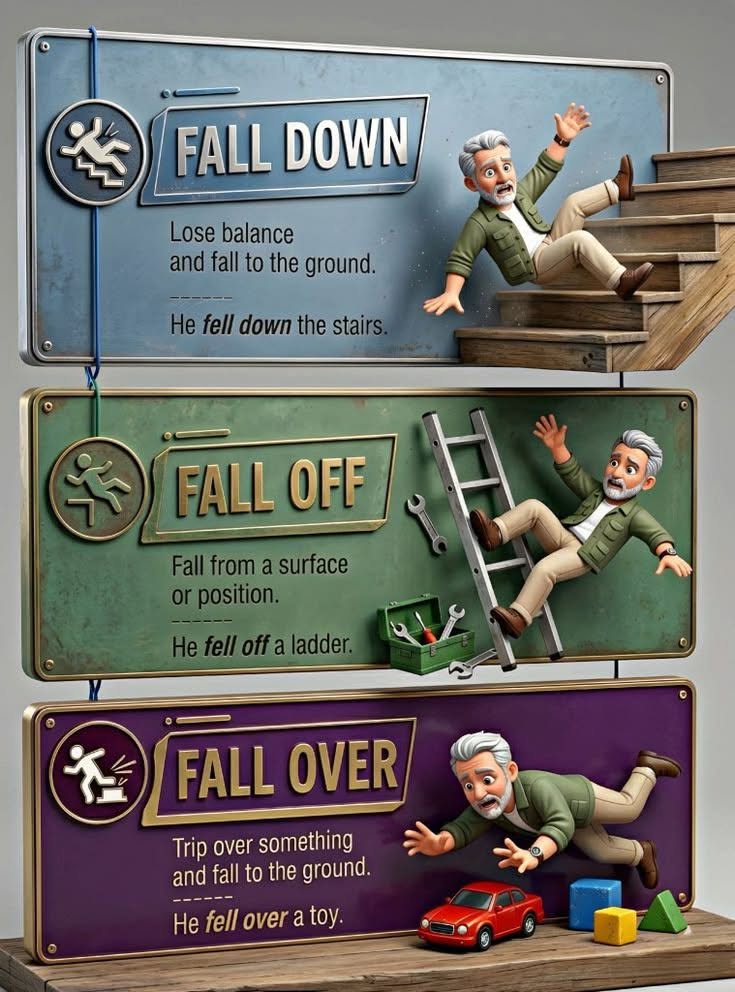
Know the Difference
🔹Fall Down
= Lose balance and fall to the ground (usually from a standing position or while moving).
🔑Key idea: The fall is caused by losing balance. It often happens on stairs, slippery floors, or while walking/running.
Example from image: He fell down the stairs.
Common uses:
The baby fell down but didn't cry.
She slipped on the ice and fell down.
He fell down and hurt his knee.
✍️Note: We often say "fall down the stairs" (the stairs are the path of the fall).
🔹Fall Off
= Fall from a surface or object (you were on something, then you came off it).
🔑Key idea: Emphasizes leaving a higher position or surface (ladder, chair, bike, roof, horse, etc.).
Example from image: He fell off a ladder.
Common uses:
Don't sit on the edge or you'll fall off.
She fell off her bicycle.
The picture fell off the wall.
✍️Note: "Fall off" always implies there was a surface you were on before falling.
🔹Fall Over
= Trip over an object and fall to the ground.
🔑Key idea: Something is blocking your path or feet, so you stumble and fall forward.
Example from image: He fell over a toy.
Common uses:
I fell over my own feet.
The child fell over the rug.
He fell over backwards (can be literal or figurative = very surprised).
✍️Note: "Fall over" is very common with small obstacles on the floor.
✍️Additional Useful Information✍️
🔸Fall down is the most general. You can often replace "fall" with "fall down" in many situations.
🔸Fall over is very British English. Americans also say it, but they're more likely to say "trip over" or just "fall" in similar situations.
🔸Other common "fall" phrasal verbs:
Fall apart = break into pieces (The old chair fell apart.)
Fall behind = get delayed or lag (Don't fall behind in your studies.)
Fall in love = start loving someone
Fall asleep = start sleeping
Fall through = fail to happen (The plan fell through.)
36
183
3,307