
Joined November 2020
- Tweets 2,376
- Following 1,119
- Followers 357
- Likes 3,975
511 Photos and videos





Red Dad Blue Dad retweeted

5 Oct 2025
I am once again reminding @elonmusk and the @X team that a sixty million dollar grant awaits if you are to integrate @XPRNetwork for payments and trading.
147
389
1,085
104,300


Red Dad Blue Dad retweeted

Jun 12
👀

12
85
467
26,589
Red Dad Blue Dad retweeted

Jun 12
🚨 BREAKING: FIRST EVER TRILLIONAIRE IS HERE!!!
SpaceX is going public TODAY at 2 trillion dollar valuation.
Good for @elonmusk.
Not so good for the rest of us!
Here is why, urgent June 12th update:
62
159
2,162
51,795
Red Dad Blue Dad retweeted

Jun 11
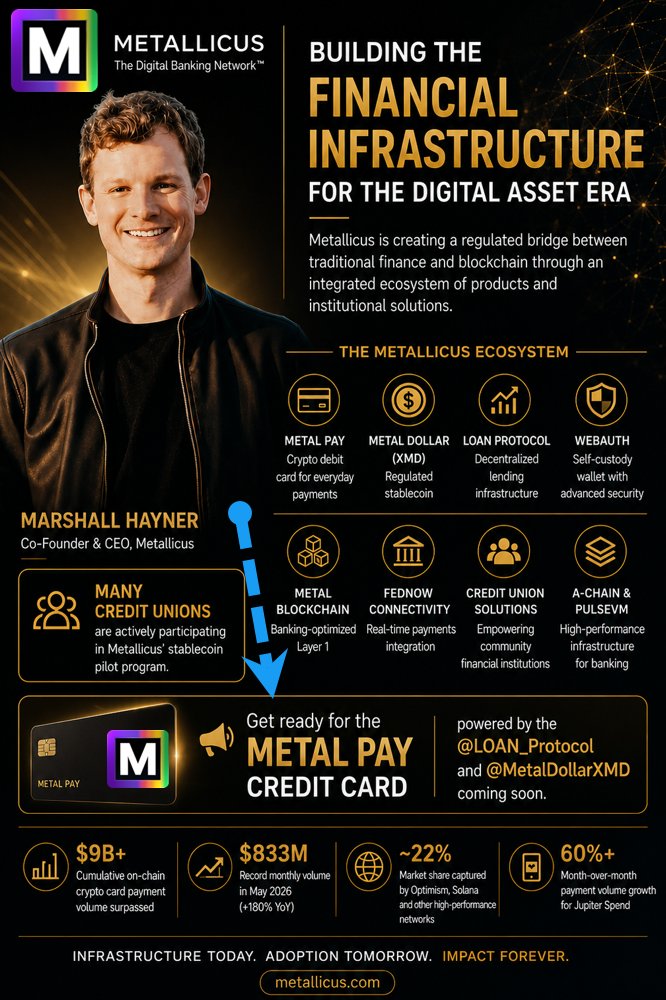
🚨 On-chain crypto card payments just crossed $9 BILLION in cumulative volume.
May 2026 alone hit a record $833M, up 180% YoY.
The narrative is shifting from speculation to utility.
At Metallicus, the pieces are already being assembled:
🏦 Metal Pay
💵 Metal Dollar ($XMD)
⚡ LOAN Protocol
🔐 WebAuth Wallet
⛓️ Metal Blockchain
Many credit unions are already testing stablecoins in @MetallicusTDBN pilot program.
Imagine a future Metal Pay card powered by stablecoins, lending liquidity, and banking infrastructure built for the digital asset era.
The future isn't coming.
It's being built. 🚀
#Metallicus #MetalPay #XMD #LOANProtocol #CryptoPayments #Stablecoins #Fintech #BlockchainPayments #DigitalBanking #TDBN
2
16
81
1,266
Red Dad Blue Dad retweeted

Jun 10
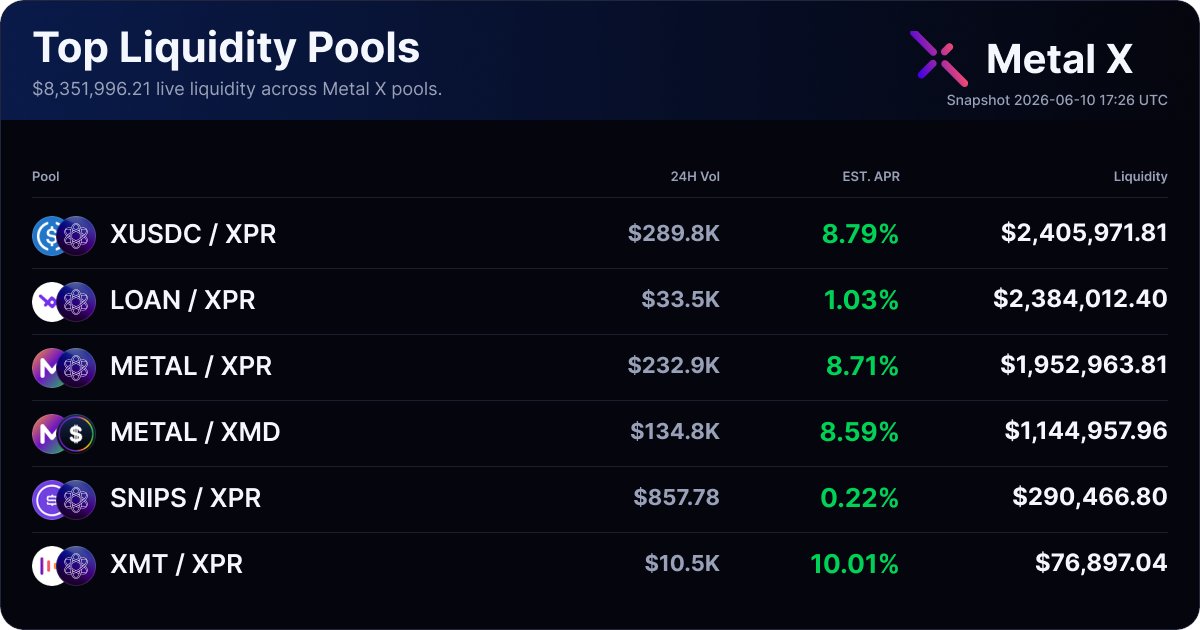
Liquidity Pools on the XPR Network, from @MetalXApp to @SimpleDEXFun, you can put your $XPR to work!
Jun 10

XUSDC / ethereum:0xd7efb00d12c2c13131fd319336fdf952525da2af at the top of the pool board.
Some people chase candles.
Some people provide the liquidity everyone trades through.
LP season on Metal X.
35
132
4,845
Red Dad Blue Dad retweeted

Jun 9
Looking forward to this coming out!
Jun 9

Join us today at 6:30 PM UK time with @HugoPhilion Co-Founder of @FlareNetworks to talk about XRP DeFi, Flare’s data-native Layer 1 architecture, RWAs, FLR tokenomics, and why crypto’s next phase could be built around real utility.
Don’t miss it!
13
92
383
13,032
Red Dad Blue Dad retweeted

Jun 8
Every major financial system runs on credit.
DeFi is next.
LOAN Protocol is building the onchain lending layer for a world where digital assets are more than assets, they’re productive capital.

14
192
448
17,678
Red Dad Blue Dad retweeted
That’s not the first. The first blockchain to fully eliminate gas fees was @XPRNetwork in 2020 (and it applies to all transfers)

For almost 1 year I’ve openly been accumulating sui:native
Now, Sui is the first Layer 1 to fully eliminate gas fees for stablecoin transfers, zero cost, across seven stablecoins.
Stablecoins already move trillions a year and agents are barely a blip of that right now.
But agentic economy runs on machine-speed micropayments, and that volume is moving onto crypto rails.
So which L1 is built for that economy?
...maybe the one with $0 stablecoin fees.
27
143
533
27,346
Red Dad Blue Dad retweeted
Jun 7
Most people see these as separate projects:
🔺 $DAG = Trusted Data
⚛️ $XPR = Transaction Infrastructure
🏦 $LOAN = Liquidity & Lending
🏛️ Metallicus = Compliance Framework
But what if they're actually pieces of the same future financial stack?
AI needs trusted data.
Banks need compliance.
Markets need liquidity.
Assets need settlement.
The next financial system may emerge where all four converge.
Hidden in plain sight. 👀
youtu.be/Lks1ZEV44JM
2
19
97
7,957
Red Dad Blue Dad retweeted

Got 4 million $LOAN locked for 4 years and now AI is telling me how much I can spend on my $MetalPay card.
Because apparently human financial decisions were too mainstream anyway 😂
$Metallicus #AI = my portfolio is now smarter than me.
Just !
$staking and waiting for the card to buy me a house by itself.
Who else is on this train? 🌈🤖

10
16
128
3,234
Red Dad Blue Dad retweeted
Jun 7
🚨 Marshall Hayner just dropped a major hint.
"Compliant auditable institutional private transaction subnet for stablecoins and xTokens.
You heard it here first. Made possible with @MetalBlockchain ."
Read that again.
Not public-chain finance.
Not opaque private networks.
A compliant, auditable, institutional-grade transaction layer built specifically for regulated finance.
🏦 Credit unions
🏦 Community banks
💵 Stablecoins
📑 Tokenized assets
🔒 Private transactions
✅ Regulatory oversight
This is where blockchain starts looking less like speculation and more like financial infrastructure.
What's interesting is that Metallicus has already been discussing stablecoins, private subnets, on-chain identity, and banking-focused blockchain infrastructure designed for financial institutions.
The question is no longer whether institutions will move on-chain.
The question is:
Which blockchain infrastructure is being built to meet them where they are?
If this hint becomes reality, Metal Blockchain could be positioning itself as the compliant settlement layer connecting traditional finance to tokenized finance.
Most people are watching prices.
A few are watching the rails being built underneath the future of money.
👀
#MetalBlockchain #Metallicus #Stablecoins #Tokenization #DigitalAssets #Banking #CreditUnions #Fintech #Blockchain #TDBN #XTokens #FutureOfFinance #CryptoInfrastructure @MarshallHayner @MetallicusTDBN

2
18
84
1,749
Red Dad Blue Dad retweeted

May 30
🚨 $SHX is quietly moving while the market is red. 👀
Here’s why it makes sense. 👇
DTCC just chose Stellar as its public blockchain.
$114 trillion in assets going on-chain. H1 2027. 🏦
And $SHX? Built on Stellar. 👇
✅ NACHA registered — US bank rails
✅ ISO 20022 compliant — DTCC’s standard
✅ Stablecoin infrastructure — exactly what tokenized securities need
✅ Built with IBM — enterprise grade from day one
✅ ACH integration — bridges crypto to traditional banking
When DTCC chose Stellar —
they chose the ecosystem $SHX is built on. 👀
No direct announcement.
No marketing.
Just quiet accumulation. 🤫
Market cap: ~$33M 👀
While the Stellar ecosystem processes trillions.
The market hasn’t connected these dots yet.
But it will. 🔥 Will you? 👀
$XLM $XRP $FLR
#Stronghold #SHX #Stellar #DTCC #RWA #ISO20022 DYOR NFA
2
13
130
4,399
Red Dad Blue Dad retweeted

May 28
$LOAN Credit Card
$XMD Debit Card
"Layer 1 and 2 #Spending"
*The How, Why & What it looks like*
You hold XMD.
You swipe the card.
The system checks the best accepted settlement route.
Behind the curtain, XMD converts into USDC, PYUSD, USDP, RLUSD, or fiat.
Merchant gets paid like normal.
I have been thinking about the moving parts of #Metallicus and some this concept may involve pieces already beyond public awareness and in play.
Marshall Hayner has signaled the larger card concept: a Metal Pay card integrated with XMD, powered by $LOAN Protocol, running on $XPR Network, secured by $Metal Blockchain, and connected to credit unions and banks for access on and off the blockchain.
This experimentation isn't to step on that road. This is a thought-exercise detour: an XMD-first debit version or routing layer that could add to the Metal Pay card system.
A credit card extends spending power. A debit card spends existing value. Marshall has pointed out that financial instrument purchases on credit cards can be treated as cash advances, with rates varying by provider. A debit card avoids that by debiting directly from an account balance.
That makes an XMD debit card concept viable: users are not borrowing. They are spending a stable digital balance.
XMD is the best ecosystem stable asset for staying inside Metal X and XPR Network while parking value. XMD is a reserve-backed stablecoin index treasury from Metallicus. The treasury contains USDC, PYUSD, and USDP, and allows minting or redeeming basket stablecoins 1:1 for Metal Dollar. Metal X also describes XMD as the primary stablecoin on Metal X, used for trading against available assets. That makes XMD strong dry powder.
The basket design spreads stablecoin exposure instead of relying on one coin. $USDC, $PYUSD, and $USDP each represent one route. $RLUSD could become another major route when supported. XMD lets the user hold one ecosystem stable asset while the backend manages multiple settlement paths.
Most payment users will not want to choose between USDC liquidity, PYUSD routes, USDP compliance paths, RLUSD corridors, or fiat conversion.
The card experience could be simple: hold XMD, spend normally, let the system route. One transaction may settle through USDC. Another may route through PYUSD. Another may use USDP. Another could use RLUSD. If the card network needs fiat, the system converts to fiat.
The merchant experience stays normal. The user experience stays simple. The backend becomes the new future normal. This benefits Metallicus in concrete ways: XMD becomes spendable treasury money, Metal Pay and Metal X gain volume, TDBN gains partner-bank utility, and credit unions get a modern account experience where members hold digital dollars, spend anywhere, and settle through compliant routes.
XMD could become the universal stable balance inside Metallicus. Instead of choosing which stablecoin to hold, users hold XMD and let the system route.
The hard parts are clear: regulation, liquidity, redemption, and taxes.
Card programs need banking partners, KYC, AML controls, risk controls, disclosures, and card-network approval. Automatic switching only works because pools are deep enough. XMD will remain cleanly redeemable into supported basket assets. Stablecoin spending can also create tax reporting requirements.
Marshall’s card concept could become the main access layer 1 payments between Metal Pay, XMD, LOAN, XPR Network, Metal Blockchain, banks, and credit unions. An XMD-first debit version could become the stable spending layer 2 within that system. One card concept creates access. The other refines how value routes.
Together, they point toward the same outcome: XMD becomes a treasury interface for everyday money.
Hold XMD.
Spend normally.
Route intelligently.
Settle compliantly.
Keep the user experience simple.
Users spend like normal people while the treasury works quietly behind the curtain.
6
33
124
3,336
Red Dad Blue Dad retweeted
May 28
🌐 Global fintech update
🇺🇸 US: Stablecoins now have a federal framework
🇪🇺 EU: 9 major banks launching a Euro stablecoin
🇯🇵 Japan: Crypto tax dropping from 55% to 20%
🌐 Global: $33T in stablecoin transactions in 2025
The shift is happening everywhere.
14
104
556
18,333
Red Dad Blue Dad retweeted
May 28
LOAN Protocol is where idle assets become productive capital.
Today: lending and borrowing markets.
Tomorrow: deeper credit infrastructure for the entire onchain economy.
$LOAN

12
104
314
10,434
Red Dad Blue Dad retweeted
May 27
The summer of shipping is about to begin.
83
194
735
54,540
Red Dad Blue Dad retweeted

May 28
No CBDC.
Clear rules for digital assets.
Bring crypto onshore.
That was the message from Treasury Secretary Scott Bessent as he pushed for the CLARITY Act.
Regulatory clarity is becoming one of the biggest themes in crypto right now.
5
77
259
7,382
Red Dad Blue Dad retweeted
May 28
Most crypto projects built for attention.
Metallicus built for deployment.
While others chased speculation cycles, Metallicus focused on:
⚡ FedNow integrations
🏦 Credit union infrastructure
⚡ Stablecoin settlement rails
🛡️ Compliance architecture
🌐 Real banking interoperability
The next era of blockchain may not reward the loudest projects.
It may reward the ones quietly upgrading the financial system.
youtu.be/CuukdybpnBY
8
41
862
Red Dad Blue Dad retweeted

May 27
In 2022 @Mastercard said digital assets would only scale through:
• Clear regulation
• KYC / AML
• Trust
• Stable settlement rails
• No anonymous payment infrastructure
Today?
Mastercard just secured a NYDFS BitLicense.
Now connect the dots:
Metallicus brought in @John_TDBN
(Former Mastercard / Visa leadership)
Acquired @BonifiiOfficial
(digital identity credit union infrastructure)
Built:
✔ Compliance-first blockchain rails
✔ Digital identity infrastructure
✔ BSA-aligned DeFi
✔ Institutional-grade settlement architecture
Then came:
CLARITY Act
Stablecoin regulation
Payment modernization
This was never about hype.
It was always about building the compliant rails before the world realized it needed them.
Mastercard just confirmed the direction.
Metallicus was already there.
#KWYH #Metallicus #Mastercard #DigitalAssets #XPR #TDBN #METAL #WeAreMetallicus
May 27

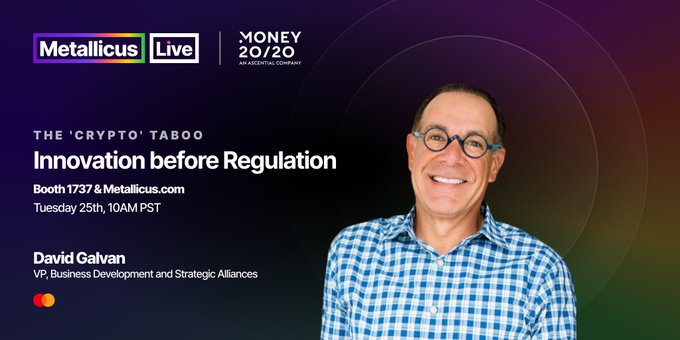
Breaking news! Mastercard has been granted a BitLicense by the New York State Department of Financial Services (@NYDFS), advancing our commitment to secure and compliant digital asset innovation. 🗽🎉
Learn more: mastercard.com/us/en/news-an…
6
58
207
10,755