
Quality, Speed, Openness: Research & Politics is a peer-reviewed, open access journal, which focusses on research in political science and related fields.
Joined August 2013
- Tweets 878
- Following 630
- Followers 4,239
- Likes 79
15 Photos and videos







Research & Politics retweeted

Apr 12
Törnberg, Lundstedt, Vallström & Wahlström introduce a geocoded, nationwide dataset of Sweden’s police-reported xenophobic violence (2009–2022; N=2,522), enabling consistent longitudinal analysis beyond media or surveys.
Read more here: journals.sagepub.com/doi/ful…
3
5
412
Research & Politics retweeted
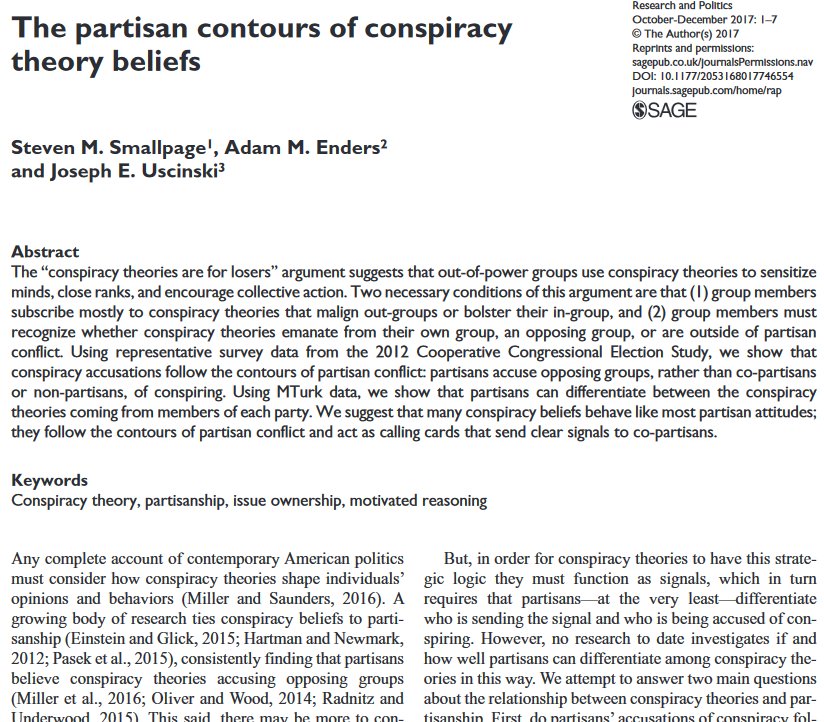
Lisa Basil shows that not all conspiracy theory agreement reflects deep belief. She introduces a salience-based measure that separates fleeting endorsement from consequential belief—and suggests standard surveys may overstate it.
Read more here: journals.sagepub.com/doi/ful…
10
22
1,249
Research & Politics retweeted
Do alliance treaties sway public support for war everywhere? @MichalSmetana3, @mVranka & @OndrejRosendorf find they do—but much less in non-Western, non-NATO countries. Alliance politics travels, but not evenly.
Read more here: journals.sagepub.com/doi/ful…
5
9
1,080
Research & Politics retweeted
Gender shapes candidate choice in both directions. Alejandro Tirado Castro & @femalebrain find that women tend to prefer women candidates and men tend to prefer men—especially when gender identity is more strongly felt.
Read more here: journals.sagepub.com/doi/ful…
1
1
196
Research & Politics retweeted
Why introduce bills that rarely pass? Eunseong Oh & @indridih show MPs use them less to win than to play party roles: government MPs stay cautious, opposition MPs signal credibility.
Read more here: journals.sagepub.com/doi/ful…
2
7
348
Research & Politics retweeted
How do you study political trust across countries and over time? @TaiYuehong introduces TrustGov, a new dataset covering 115 countries from 1973–2020—giving scholars a major new tool to track what shapes trust in government, and why it matters.
Read more: journals.sagepub.com/doi/ful…
12
55
3,497
Research & Politics retweeted
Populist rhetoric may not win many votes—but it can get people to the polls. @akoustov & @yaoyao_dai find that populist messaging has limited persuasive power, yet can slightly boost turnout, especially among already populist voters.
Read more here: journals.sagepub.com/doi/ful…
3
7
608
Research & Politics retweeted
Do younger voters turn against older people when politics feels unfair? Alonso Román Amarales & Scott Williamson show that perceived age-based political exclusion is strongly linked to explicit ageism across Italy, South Korea, and the US.
Read more here: journals.sagepub.com/doi/ful…
1
2
191
Research & Politics retweeted
Philip Moniz, Kyle Endres & @professorcostas show a key weakness in political microtargeting: the most persuadable voters may be the hardest to predict. Cross-pressured voters don’t fit neat party profiles—and campaign data often misses that.
Read more: journals.sagepub.com/doi/ful…
4
10
650
Do prestigious offices make voters less likely to support women candidates? Nichole Bauer finds no direct “prestige penalty,” while showing how prestige and masculinity may shape women’s path through politics.
Read more here: journals.sagepub.com/doi/10.…
1
1
53
Research & Politics retweeted
🧩 Gocer & Miller: In a 2019 U.S. survey experiment, whites who feel like “political losers” oppose redistribution only when explicitly compared to non-whites—a subtle framing cue with big implications for status threat and right-wing populism.
Read more: journals.sagepub.com/doi/10.…
2
10
633
Research & Politics retweeted
🚨 When does motivated reasoning break? Onishi shows that in Britain’s Partygate, clear misconduct clear blame made even copartisans punish the governing party - lower ratings and vote intent.
Read more here: journals.sagepub.com/doi/10.…
1
2
236
Research & Politics retweeted
Birkenmaier, Stroppe, Wurthmann & Sältzer use NLP Wikidata on 50k tweets and 190k FB posts (Bundestag 2017–2021) to map geographic representation. District MPs cite nearer places - and deprived areas in-district - more than list MPs.
Read more here: journals.sagepub.com/doi/10.…
4
1
676