L1 Blockchain of the future. Built on math and logic.
Joined June 2025
- Tweets 90
- Following 163
- Followers 1,890
- Likes 56
27 Photos and videos







Pinned Tweet

Apr 15
The official Retium public Telegram group and Discord are now open.
Everyone is welcome to join, ask questions, follow development progress, discuss blockchain and crypto, and stay up to date with the latest Retium news.
Whether you are here to learn more about Retium, follow the project from the beginning, or simply join the conversation, we would love to have you in the community.
Join the Retium community, meet other members, and stay tuned as Retium continues to grow.
Telegram: t.me/RetiumBlockchain
Discord: discord.gg/yrP3nCCwpg
45
20
244
12,184
May 30
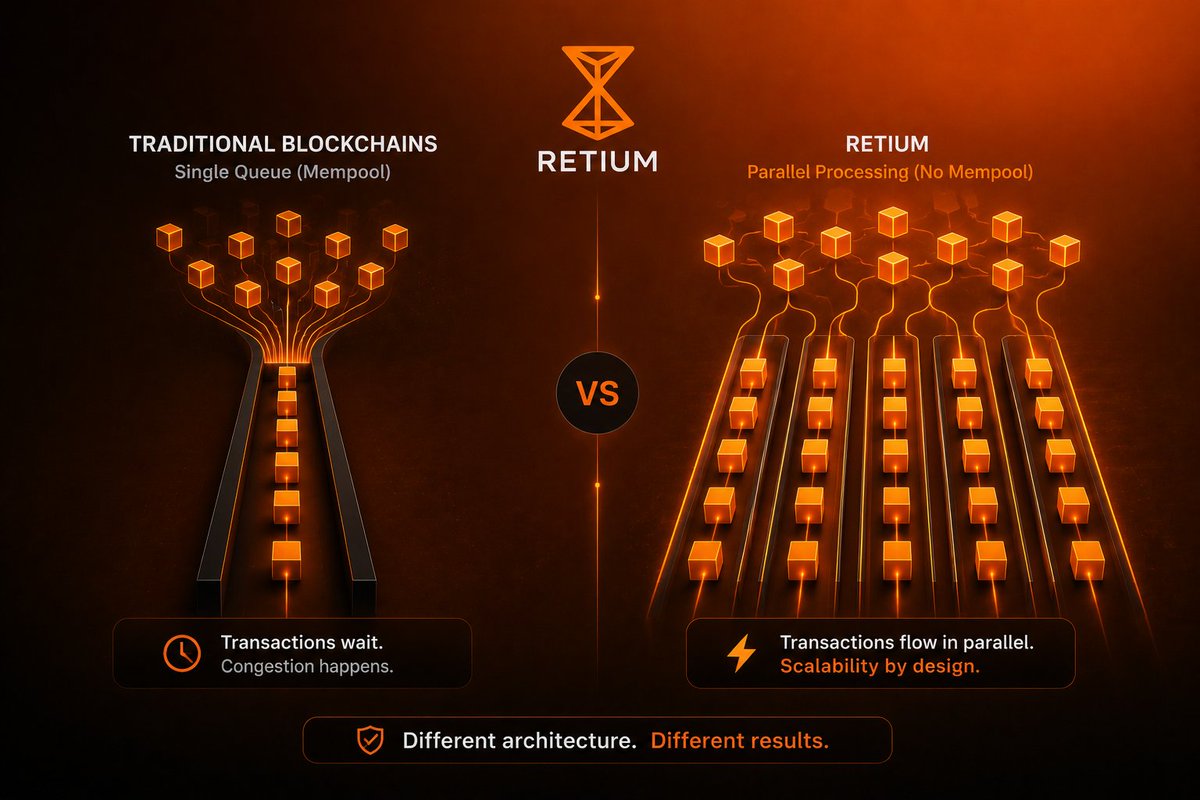
This is about right. But Retium is not just parallel highways side by side. It also has execution highways moving up and down across layers, giving the full idea of multidimensional execution.
May 30

The more I learn about @RetiumChain , the more the pieces start connecting.
No traditional mempool.
Parallel processing.
An architecture designed around transaction flow from the start, rather than scaling fixes added later.
14
8
75
2,778
May 29
Ambassador Program is still open.
So far, we have filled or started covering the following regions:
Africa, Ukraine, United States, Australia, and Russia.
We are still open to strong candidates from other regions and countries, including Asia, Malaysia, Vietnam, the UK, Mexico, Latin America, India, and more.
As mentioned before, we will be selective when choosing new ambassadors, due to past experience. If you believe you can show real skill, leadership, and consistency, you are welcome to try.
The best way to start is by running your own Retium-focused Spaces, tagging us, and letting the team listen in. From time to time, we may also join and participate.
Selected candidates may be invited into the official Ambassador role and work more directly with the Retium team.
We will slowly fill regional positions with the right people and keep the community updated. We do not promise big rewards from day one, but the long-term opportunity could be worth far more than quick profit.
Where to start?
Join our Telegram and Discord, stay active, contribute, and show what you can do.
Telegram: t.me/RetiumBlockchain
Discord: discord.gg/yrP3nCCwpg
46
13
173
6,378
May 27
Retium Contributors Program will start on 01/06/2026. RTM-4DQA6Z
May 24

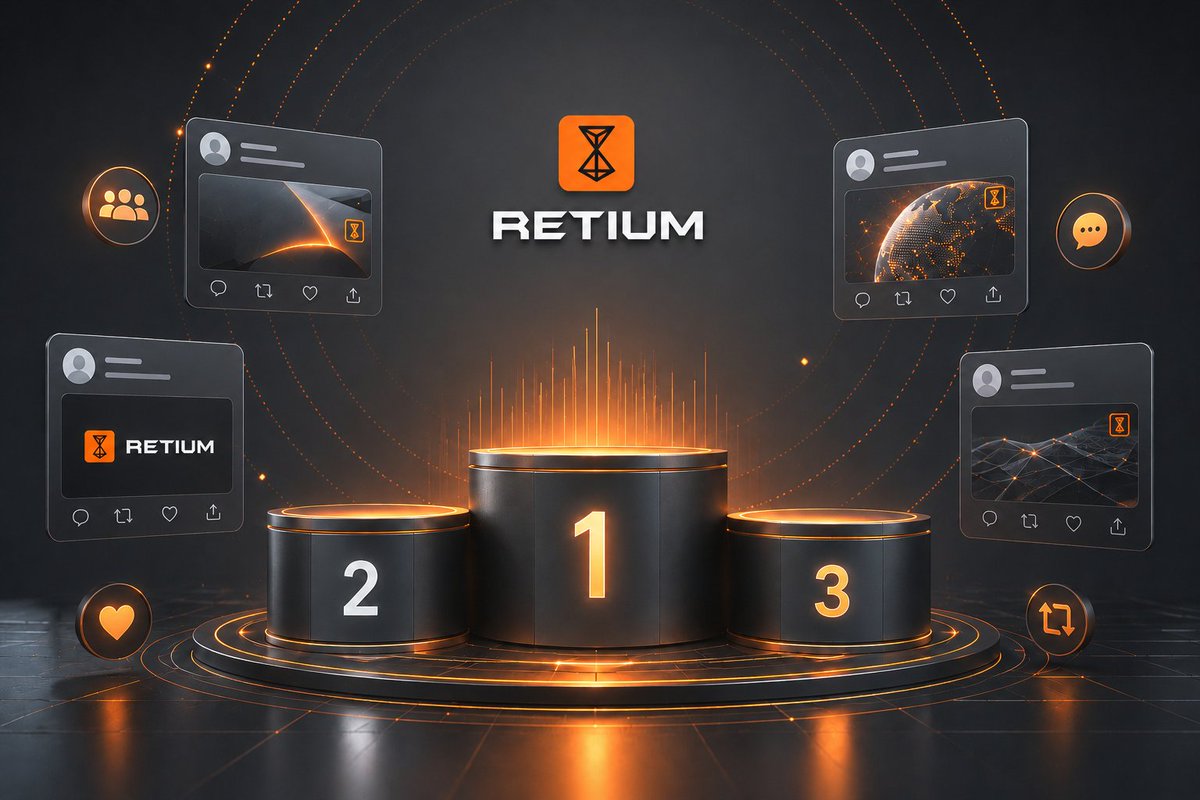
Retium Community Contribution Program launches on 01/06/2026 and is open to everyone.
The program is designed to recognise and reward community members who consistently support Retium through quality public content, meaningful engagement, and accurate information sharing.
To participate, community members will need to join the official Retium Telegram and Discord, then submit their social media post links through the designated contributor channel.
Submissions will be reviewed regularly, with scores updated every 24 hours. A monthly leaderboard will track contributor performance, and the top 3 contributors will receive monthly rewards.
The focus is simple: quality over quantity.
More details, including submission rules and scoring guidelines, will be shared in Discord.
13
7
58
3,063
May 26
Retium Community Space is coming soon.
This will be an open space for the community to ask questions, share thoughts, discuss Retium Blockchain, and stay connected with the project. x.com/i/spaces/1DGleeVNdVgJL
11
3
40
2,950
Retium retweeted
Mar 5
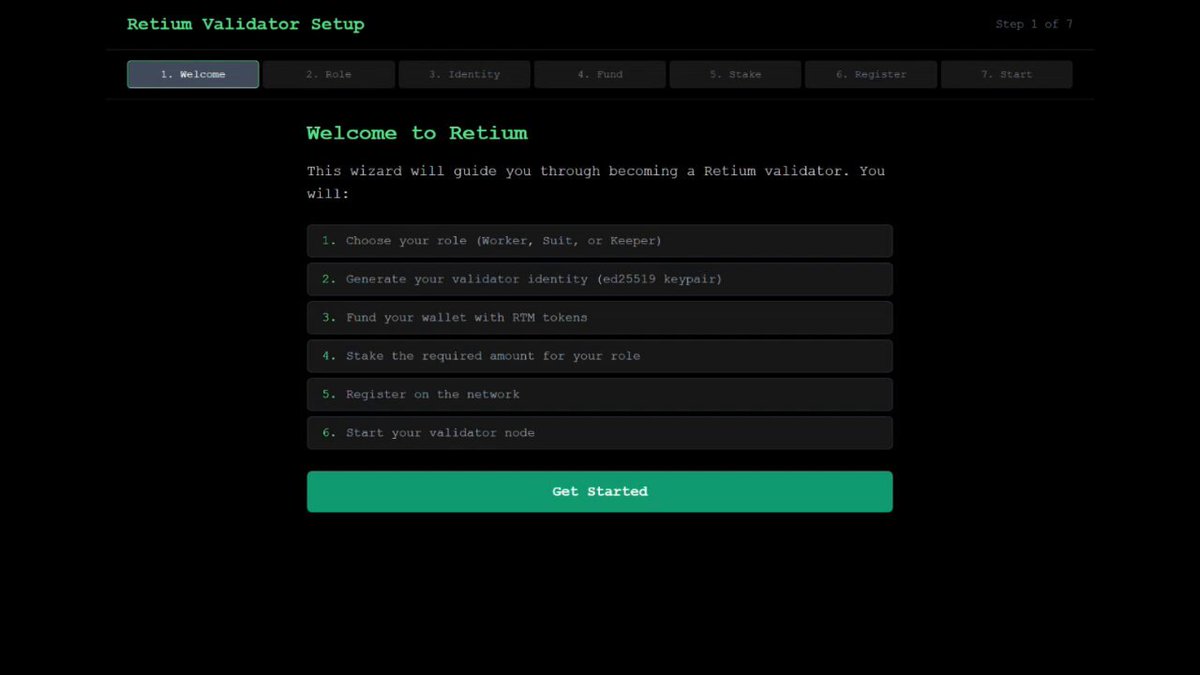
Earlier we mentioned that Retium is working on making it easier for validators to join the network.
Part of this work is helping non-technical users become Retium validators through a simple wizard-based setup dApp. The goal is to make running a validator straightforward and accessible, even for users without deep technical knowledge.
As promised, here is a beta tutorial video showing the validator setup process step by step.
With this wizard interface, users can configure their validator, register on the network, and launch their node through a clear guided setup.
18
4
51
3,377
May 24
Retium Community Contribution Program launches on 01/06/2026 and is open to everyone.
The program is designed to recognise and reward community members who consistently support Retium through quality public content, meaningful engagement, and accurate information sharing.
To participate, community members will need to join the official Retium Telegram and Discord, then submit their social media post links through the designated contributor channel.
Submissions will be reviewed regularly, with scores updated every 24 hours. A monthly leaderboard will track contributor performance, and the top 3 contributors will receive monthly rewards.
The focus is simple: quality over quantity.
More details, including submission rules and scoring guidelines, will be shared in Discord.
32
37
132
8,221
May 18
We are pleased to officially welcome @Fonzyfundz_001 as a Retium Ambassador Representative for the Africa region.
After successfully completing his initial evaluation period, Edward is now officially part of the Retium Ambassador team.
We look forward to seeing more activity, leadership, and community engagement from him as he continues representing Retium in the region.
18
2
58
1,970
May 16
Retium Post-AMA Q&A coming soon.
We noticed a number of community questions were not answered during the AMA. This follow-up X Space will answer them directly and give the community more clarity around Retium.
Feel free to leave your questions in our Telegram community if you are not able to speak during the Space..
x.com/i/spaces/1yKAPMVDBgnxb
15
8
46
2,320
May 16
Join us for AMA.
May 14

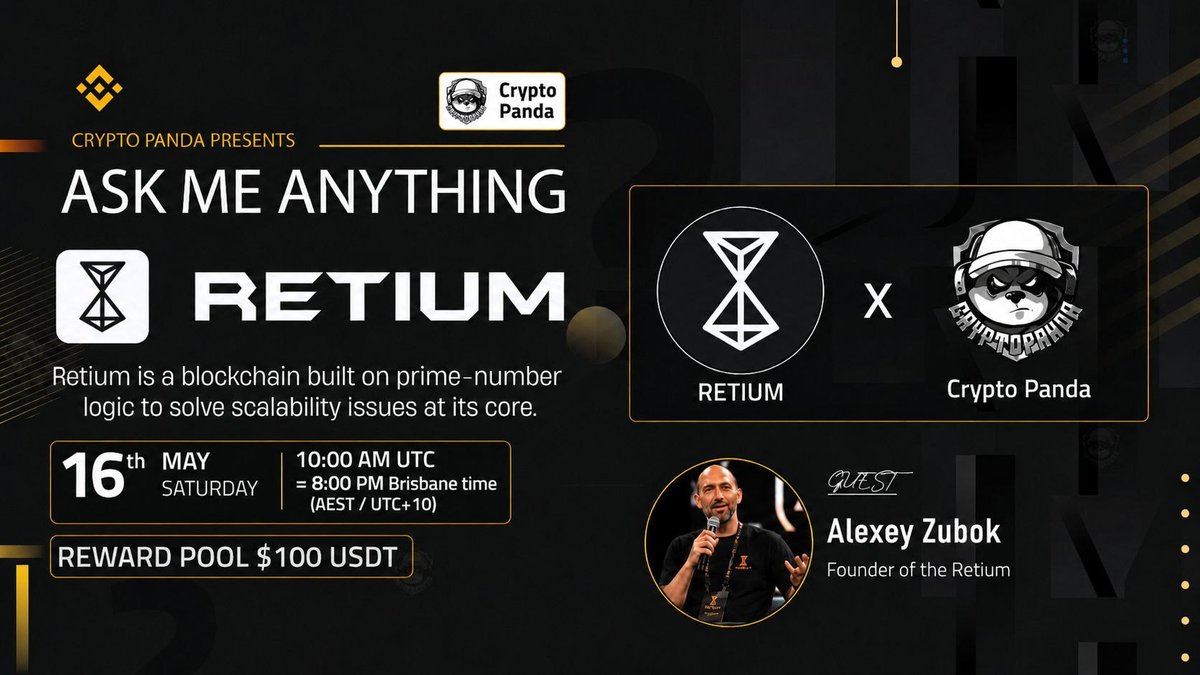
Join us for Exclusive #BinanceSquarAMA with @RetiumChain
🗓️ Date :- 16th , May 2026
🕰️ Time :- 10:00 AM UTC = 8:00 PM Brisbane time (AEST / UTC 10).
🎁 Prize :- $1️⃣0️⃣0️⃣ USDT
🎙️ Guest:-
> Alexey Zubok [ Founder of Retium ]
⏰ Set reminder for Binance Square :-
app.binance.com/uni-qr/cspa/…
〽️ Rules:
1️⃣ Follow :- @RetiumChain
2️⃣ Like & Retweet this post
13
3
27
1,990
May 16
Thank you to everyone who joined today’s AMA and took the time to support Retium.
We noticed that a number of community questions unfortunately did not get addressed during the session. As guests on the AMA, we do not control how questions are selected or managed, but we still believe the community deserves clear answers and open discussion.
Because of that, we will be hosting our own official X Space soon where we will go through the unanswered questions, speak more openly about Retium, and give the community a chance to engage directly with us.
In the meantime, feel free to leave your questions in our Telegram community so we can include them in the upcoming session.
We appreciate everyone who continues to support the project and participate in the discussions around Retium.
2
9
751
May 16
A Different Shape for Blockchain Infrastructure
Most blockchains are built as a single line.
Block 1 comes first. Then Block 2. Then Block 3. Every node follows the same chain, and every new block depends on the...
medium.com/@retiumchain/unde…
16
4
33
1,439
May 15
Retium Network Update — Cassandra Protocol Upgrade
Yesterday, we deployed a major upgrade to the Retium validator protocol, codenamed Cassandra.
This is a fundamental improvement to how the validator network reaches consensus.
Cassandra introduces a new synchronization layer that ensures every validator in the Keeper quorum reaches byte-identical agreement on every block, every cycle.
The design is inspired by battle-tested patterns used in some of the world’s most reliable distributed systems — including the same family of techniques behind Apache Cassandra, BitTorrent, and IPFS — and adapts them for Retium’s high-throughput mesh architecture.
What this means for the network:
Stronger synchronization
Validators now stay in exact step across the Keeper quorum, even during traffic spikes, network pressure, or short-lived node hiccups. There is no more “almost agreement” — only exact agreement by design.
Higher stability under load
The protocol is more resilient as throughput increases. In overnight testing, agreement quality improved as the chain processed heavier ticks — a strong signal that the architecture scales in the right direction.
Prevention, not recovery
Discrepancies that previously required after-the-fact reconciliation are now prevented at the source. Cassandra reduces reliance on backup arbitration during normal operation by making validator agreement cleaner from the beginning.
Cassandra has been running live on the staging network since yesterday. It has already survived the highest-throughput tick the chain has ever processed and is firing cleanly across all Keepers.
This is the kind of foundational work that does not always make headlines, but it changes what kind of system Retium is.
Cassandra moves Retium from a chain that recovers from validator disagreement to one that prevents it at the protocol level.
Validators run cleaner.
The chain runs faster.
The trust surface becomes simpler.
8
5
36
1,261
Retium retweeted

May 14
Join us for Exclusive #BinanceSquarAMA with @RetiumChain
🗓️ Date :- 16th , May 2026
🕰️ Time :- 10:00 AM UTC = 8:00 PM Brisbane time (AEST / UTC 10).
🎁 Prize :- $1️⃣0️⃣0️⃣ USDT
🎙️ Guest:-
> Alexey Zubok [ Founder of Retium ]
⏰ Set reminder for Binance Square :-
app.binance.com/uni-qr/cspa/…
〽️ Rules:
1️⃣ Follow :- @RetiumChain
2️⃣ Like & Retweet this post
11
33
73
29,855
May 10
Retium will soon open additional Ambassador positions.
We are looking for regional community leaders who can represent Retium professionally, build real engagement, and become a trusted voice for Retium across their region and the wider crypto community.
Ambassadors will be expected to:
• Lead regional or language-based communities
• Host Retium-focused Spaces and discussions
• Join official Retium Spaces as speakers or co-hosts
• Bring their community into official Retium conversations
• Create useful posts, comments, translations, and educational content
• Report activity with clear links, results, and feedback
Ambassadors will be measured by consistency, engagement quality, leadership, communication, reliability, and proof of work.
The strongest candidates will be those who can show real community value before applying — through Spaces, quality posts, meaningful conversations, and measurable engagement.
We are looking for leaders, educators, and community builders who want to grow with Retium from the early stage.
More details will be announced soon.
102
22
339
13,600
May 8
Set your reminders for next about Retium space.
May 8

🔥 The next evolution of blockchain: RETIUM
Proof of Math — powered by the raw, infinite power of Prime Numbers!
A revolutionary Multi-Dimensional Mesh Network that processes multiple blocks simultaneously!
No more bottlenecks. Just pure, lightning-fast, mathematical innovation.
The next evolution of blockchain-redefining what’s possible!
Set your reminder!
Saturday May 9th at 2pm est or 7pm utc
#Web3 #blockchain
x.com/i/spaces/1YxNrZylZMNxw
6
18
1,077
May 2
Why Retium isn't "another fast blockchain"
Most chains compete on the same axis: how fast can we package a block and propagate it? Retium isn't on that axis at all.
The architectural difference is upstream of speed. In Retium, every block already exists before any transaction is routed to it. A tick's blocks — their IDs, positions in the mesh, and the validators assigned to them — are pre-planned. When a transaction enters the network, it isn't waiting in a mempool for some future proposer to pick it up. It's dropped into an already-open block whose validators are already known.
That single shift unlocks something most chains can't do cleanly: transaction finality and block finality become two separate events.
A transaction can be validated, executed, confirmed, and synced the moment majority validators agree on its post-execution hash. That happens in mil-seconds. The block it lives in is then hard-finalized later by the Suit layer, which arbitrates agreement on the block's reward state across keepers. Two finality layers, running independently, neither blocking the other.
In Bitcoin or Ethereum, none of this is possible. A transaction has no block until a proposer picks it up. The proposer races to construct one. The network then races to attach it to the canonical chain. Confirmations stay probabilistic until enough blocks pile on top.
In Retium, the transaction's destination block is determined the moment it enters the network.
The consensus question isn't who built which block and which fork wins. It's just do the validators we already assigned agree on the result. Yes or no, in mil-seconds. This isn't a parallelism trick. It's the consequence of admitting the block layout up front and letting roles handle different layers of consensus:
- Workers validate transactions and produce hashes.
- Keepers maintain chain state and reach agreement on transactions.
- Suits arbitrate block-level finality across keepers.
This is what we call Proof of Math (PoM) — consensus on structure comes from math, consensus on result comes from the assigned validators.
Speed is a byproduct, not the goal. The real goal was to stop conflating "the transaction landed" with "the block sealed" — two events that have always been the same thing in legacy chains, and never had to be.
One last thing worth being clear about. We're not here to compete with anyone or prove anyone wrong. Bitcoin, Ethereum, Solana — they're solving real problems on the paths they chose, and they're doing it well. Let them be. Retium isn't measuring itself against them. We built something architecturally different, and we'd rather not pretend it's the same thing graded on the same axis. Apples and eggs. We're on our own path, not crossing anyone else's. The future of blockchain is wide enough for more than one shape — we're just here to deliver a different experience.
11
7
30
1,042