
Medical Billing Experts | Revenue Cycle Optimization | Denial Management Pros | Helping Practices Maximize Cash Flow & Reduce Admin Burden | RevIQ Solutions LLC
Joined December 2020
- Tweets 1,644
- Following 857
- Followers 552
- Likes 1,039
89 Photos and videos







Pinned Tweet

Medical Billing isn’t just paperwork, it’s the financial heartbeat of every healthcare practice.
Behind every successful healthcare provider is a billing system that works quietly but powerfully in the background. From accurate claim submissions to timely reimbursements, effective medical billing plays a critical role in maintaining the financial stability of a medical practice.
When billing is managed correctly, several things improve at once:
• Providers get paid faster
• Claim denials significantly decrease
• Administrative workload becomes more manageable
• Patients experience clearer and smoother billing processes
This allows healthcare professionals to focus on what truly matters delivering exceptional patient care.
At its core, strong medical billing requires a structured and proactive revenue cycle strategy:
✔ Clean and accurate claim submissions to minimize rejections and speed up payer processing.
✔ Proactive denial management to quickly identify issues, correct errors, and recover lost revenue.
✔ Efficient follow-ups and payer communication to ensure faster reimbursements.
✔ Optimized Revenue Cycle Management (RCM) that keeps the entire financial workflow running smoothly.
In today’s complex healthcare environment, billing errors, delayed payments, and denied claims can significantly impact a practice’s revenue. That’s why having the right billing expertise and systems in place is more important than ever.
At RevIQ Solutions, we help healthcare providers simplify their billing processes, reduce claim denials, and strengthen their revenue cycle, so they can focus on delivering quality care while we handle the complexity of medical billing.
Because a strong billing system doesn’t just recover revenue, it protects the future of your practice.
RevIQ Solutions
Medical Billing & Revenue Cycle Management Experts
#MedicalBilling #RevenueCycleManagement #HealthcareFinance #RCM #HealthcareOperations #RevIQSolutions #AI #physicians #Medical #Doctors
ALT Medical Billing isn’t just paperwork, it’s the financial heartbeat of every healthcare practice.
2
401
RevIQ Solutions LLC retweeted
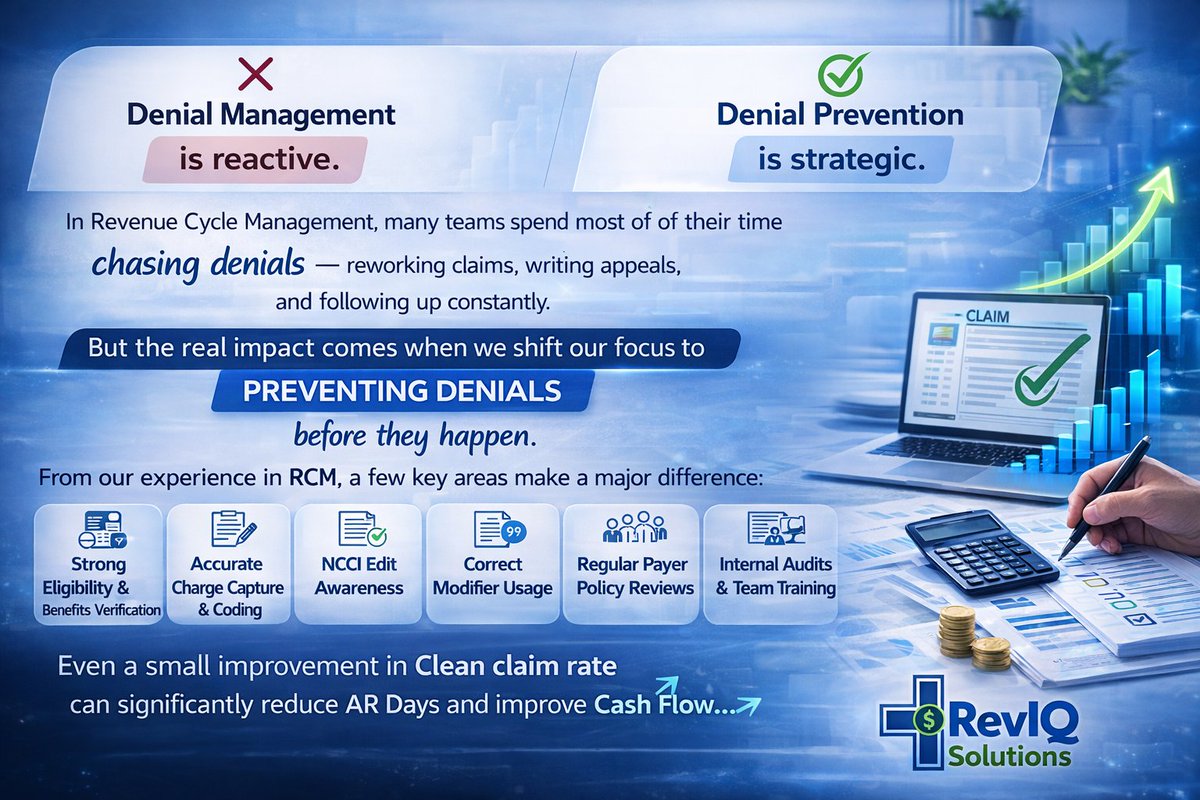
❌ Denial Management is reactive.
✅ Denial Prevention is strategic.
In Revenue Cycle Management, many teams spend most of their time chasing denials reworking claims, writing appeals, and following up constantly.
But the real impact comes when we shift our focus to preventing denials before they happen.
From our experience in RCM, a few key areas make a major difference:
✔ Strong eligibility & benefits verification
✔ Accurate charge capture and coding
✔ NCCI edit awareness
✔ Correct modifier usage
✔ Regular payer policy reviews
✔ Internal audits & team training
Even a small improvement in clean claim rate can significantly reduce AR days and improve cash flow.
Are we spending more time fixing problems or preventing them...?
#RevenueCycleManagement
#RCM
#DenialManagement
#DenialPrevention
#MedicalBilling
#HealthcareRevenue
#CleanClaimRate
#ARManagement
#CashFlowOptimization
#HealthcareFinance
#ClaimsManagement
#EligibilityVerification
#MedicalCoding
#PayerPolicy
#RevIQSolutions
ALT fixing problems or preventing them
1
2
6
395
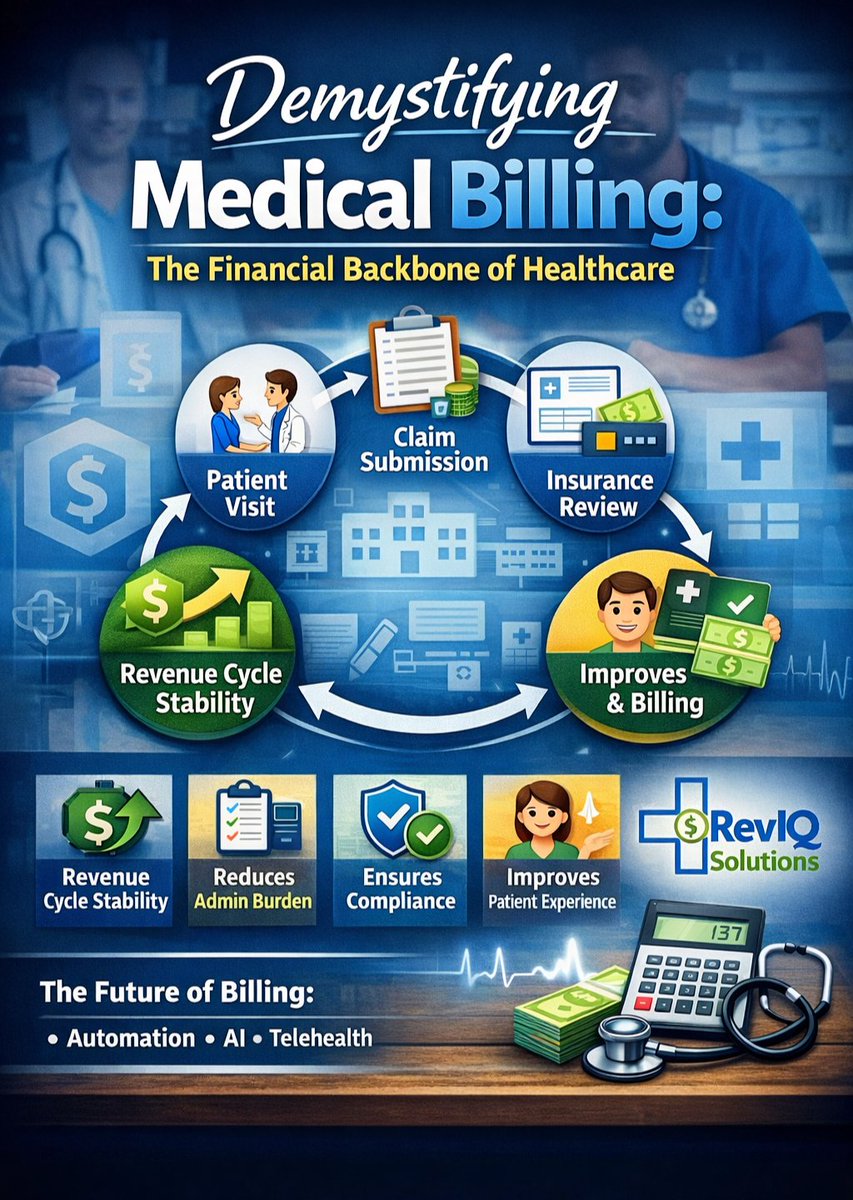
Demystifying Medical Billing: The Financial Backbone of Healthcare
The healthcare industry is often associated with doctors, nurses, and life-saving technology. But behind every successful medical practice, there is a silent, powerful engine that ensures its survival: Medical Billing.
In today's complex healthcare landscape, understanding medical billing is crucial, not just for billers and coders, but for providers, practice managers, and even patients.
Here is a breakdown of what medical billing is and why it matters more than ever.
🤔 What Exactly is Medical Billing?
At its core, medical billing is the process of submitting and following up on claims with health insurance companies to receive payment for services rendered by a healthcare provider. It acts as the crucial bridge between healthcare providers and payers.
Think of it as this cycle:
A patient receives a service (a checkup, a surgery, a lab test).
The billing department translates that service into universal medical codes.
A claim is sent to the patient's insurance company.
The insurance company reimburses the provider (or denies the claim).
The patient pays their remaining balance (co-pay, deductible, etc.).
🧩 Why is Medical Billing So Important?
Medical billing isn't just about sending bills; it's about the financial health of the entire practice. Here’s why it’s the backbone:
Ensures Revenue Cycle Stability: Efficient billing means faster payments. A streamlined billing process ensures a steady cash flow, allowing healthcare facilities to pay staff, invest in new technology, and keep their doors open.
Reduces Administrative Burden: Providers want to focus on patients, not paperwork. A competent medical billing team handles the complex administrative tasks, allowing doctors and nurses to do what they do best provide care.
Maintains Compliance: The healthcare industry is heavily regulated (think HIPAA in the U.S.). Professional medical billing ensures that all claims and patient data are handled in compliance with the law, avoiding heavy fines and legal trouble.
Improves the Patient Experience: When billing is accurate and transparent, patients are less likely to face surprise bills or confusing statements. This builds trust and satisfaction, which is key to patient retention.
🚀 The Future is Digital
The field is rapidly evolving. We are moving away from manual data entry toward automation, AI-powered coding, and telehealth billing. As technology advances, the role of the medical biller is shifting from a data processor to a strategic financial analyst.
💡 Key Takeaway
Medical billing is a complex, detail-oriented profession that requires constant learning and adaptation. It’s a career that offers stability and growth for those interested in the business side of healthcare.
Are you in the healthcare industry? How has your experience been with the billing process? Let’s discuss in the comments!
#MedicalBilling #Healthcare #RevenueCycleManagement
ALT Demystifying Medical Billing: The Financial Backbone of Healthcare
110
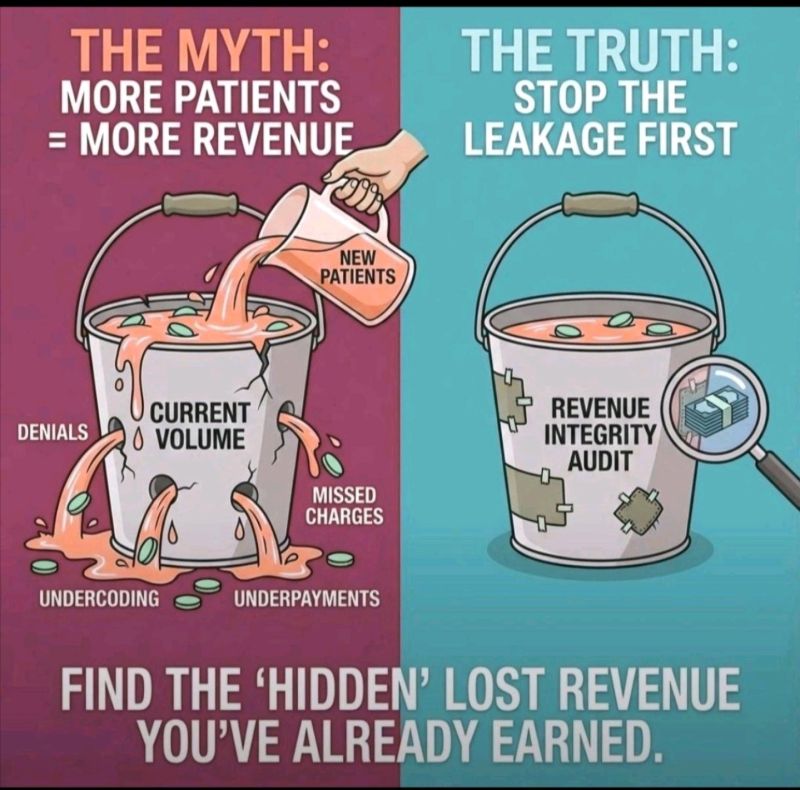
The Real Crisis in Hospitals Isn’t Patient Flow. It’s Revenue Integrity.
In many hospitals today, leadership conversations revolve around increasing footfall, expanding specialties, or adding beds.
But here’s the uncomfortable truth:
We are losing revenue we have already earned.
Every single day, hospitals bleed financially due to:
• Documentation gaps
• Incorrect LCD / procedure mapping
• Unbilled consumables and implants
• Inconsistent package interpretation
• Weak pre-auth → treatment → denial → claim handover processes
Before chasing growth, we must first stop the leakage.
High-performing hospitals don’t grow merely by adding volume. They grow by protecting margins.
They focus on:
✔ Strong clinical documentation practices
✔ Qualified and accountable manpower
✔ Structured revenue integrity audits
✔ Real-time charge capture mechanisms
✔ Medical–Billing–Insurance alignment
✔ Denial analysis, root cause correction, and system fixes
The ultimate truth?
The revenue is already inside your system.
Sustainable growth does not start with more patients.
It starts with retaining existing patients, ensuring operational excellence, and capturing every legitimate rupee earned through care delivery.
Volume without integrity creates stress.
Integrity before volume creates stability and scale.
As healthcare leaders, our responsibility is not just occupancy, it is operational discipline and financial stewardship.
#HealthcareLeadership #HospitalManagement #RevenueIntegrity #HealthcareOperations #COOInsights #MedicalResearch #US #United_States
ALT Real Crisis in Hospitals Isn’t Patient Flow
1
2
79
RevIQ Solutions LLC retweeted
Healthcare providers face growing admin burdens that hurt efficiency & revenue.
💡 Outsourcing medical billing & RCM can:
• Improve cash flow
• Reduce claim denials
• Accelerate reimbursements
• Ease administrative strain
Result? Stronger finances & more focus on patient care.
If you want to optimize your practice, it might be time for a streamlined billing solution.
#MedicalBilling #RevenueCycleManagement #HealthcareEfficiency #PracticeManagement #CashFlow #ClaimDenials #PatientCare #HealthcareFinance #MedicalPractice #RCMP
1
5
217
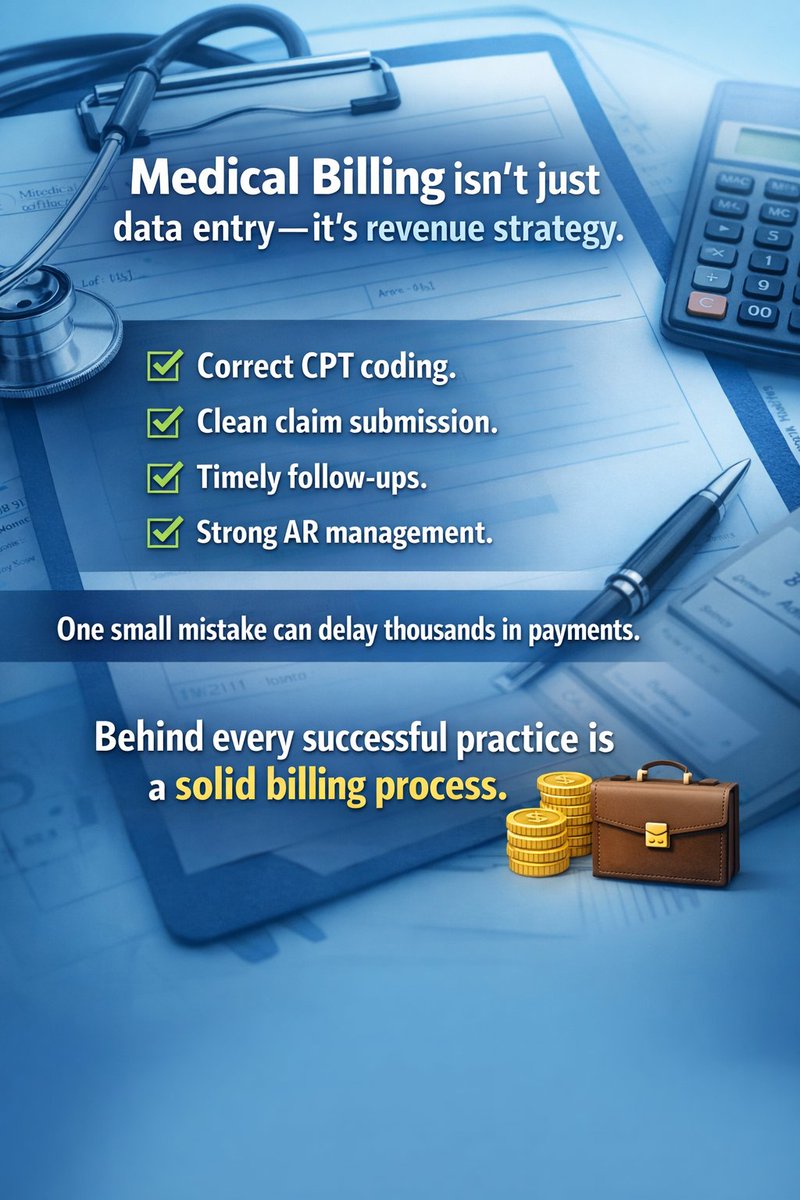
Medical Billing isn’t just data entry, it’s revenue strategy.
Correct CPT coding.
Clean claim submission.
Timely follow-ups.
Strong AR management.
One small mistake can delay thousands in payments.
Behind every successful practice is a solid billing process. 💼💰
#Medical #MedicalBilling #MedicalEducation #RevenueGrowth #RCM #Phyiscian #Billing
ALT Medical Billing isn’t just data entry, it’s revenue strategy
1
5
434
5 Signs It’s Time to Evaluate Your Billing Process:
Most practices don’t realize there’s a billing problem until cash flow tightens.
The reality? Revenue issues usually show warning signs months before anyone looks closely.
Here are 5 signs it may be time to evaluate your billing process:
1️⃣ Your A/R keeps getting older
If accounts over 90 or 120 days are growing, revenue isn’t being actively managed — it’s aging.
2️⃣ Denials feel “normal”
Denials shouldn’t be routine. High-performing practices treat denials as workflow signals, not daily paperwork.
3️⃣ Collections don’t match patient volume
You’re seeing the same (or more) patients but revenue isn’t improving. That’s often a process gap, not a productivity issue.
4️⃣ No one can clearly explain your key metrics
If you don’t know your:
• Days in A/R
• Clean claim rate
• Denial rate
You’re managing revenue without visibility.
5️⃣ Your billing conversations are reactive
If discussions only happen when there’s a problem, you’re missing proactive revenue strategy.
Here’s what many practice owners discover:
Improving collections often doesn’t require more patients — just tighter revenue cycle execution.
At RevIQ solutions, we often start with a simple question:
👉 Where is revenue slowing down in the process?
Sometimes small operational adjustments create the biggest financial impact.
1
4
322
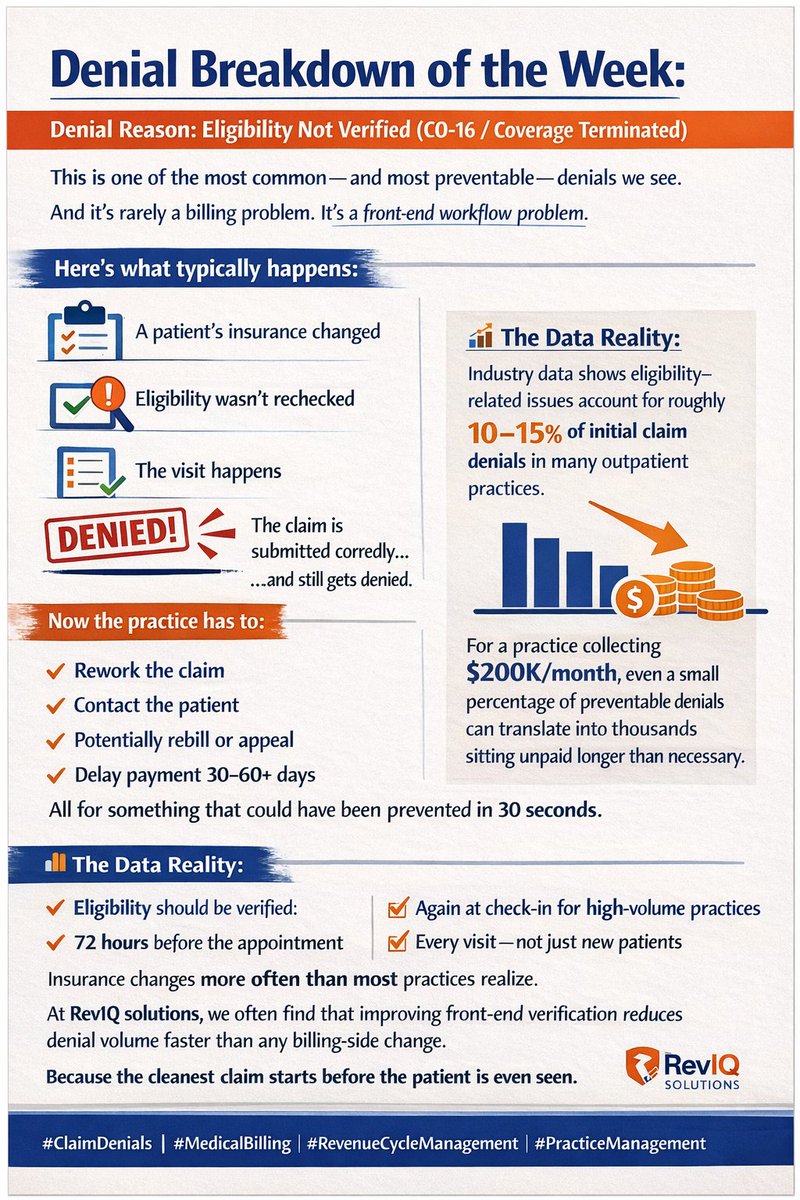
Denial Breakdown of the Week:
Denial Reason: Eligibility Not Verified (CO-16 / Coverage Terminated)
This is one of the most common — and most preventable — denials we see.
And it’s rarely a billing problem.
It’s a front-end workflow problem.
Here’s what typically happens:
A patient’s insurance changed.
Eligibility wasn’t rechecked.
The visit happens.
The claim is submitted correctly…
…and still gets denied.
Now the practice has to:
• Rework the claim
• Contact the patient
• Potentially rebill or appeal
• Delay payment 30–60 days
All for something that could have been prevented in 30 seconds.
📊 The Data Reality:
Industry data shows eligibility-related issues account for roughly 10–15% of initial claim denials in many outpatient practices.
That’s not just administrative friction — that’s delayed cash flow.
For a practice collecting $200K/month, even a small percentage of preventable denials can translate into thousands sitting unpaid longer than necessary.
✅ Prevention Tip:
Eligibility should be verified:
✔️ 72 hours before the appointment
✔️ Again at check-in for high-volume practices
✔️ Every visit — not just new patients
Insurance changes more often than most practices realize.
At RevIQ solutions, we often find that improving front-end verification reduces denial volume faster than any billing-side change.
Because the cleanest claim starts before the patient is even seen.
👉 What denial shows up most often in your practice right now?
hashtag#ClaimDenials hashtag#MedicalBilling hashtag#RevenueCycleManagement hashtag#PracticeManagement hashtag#HealthcareOperations
ALT Denial Breakdown of the Week
5
295
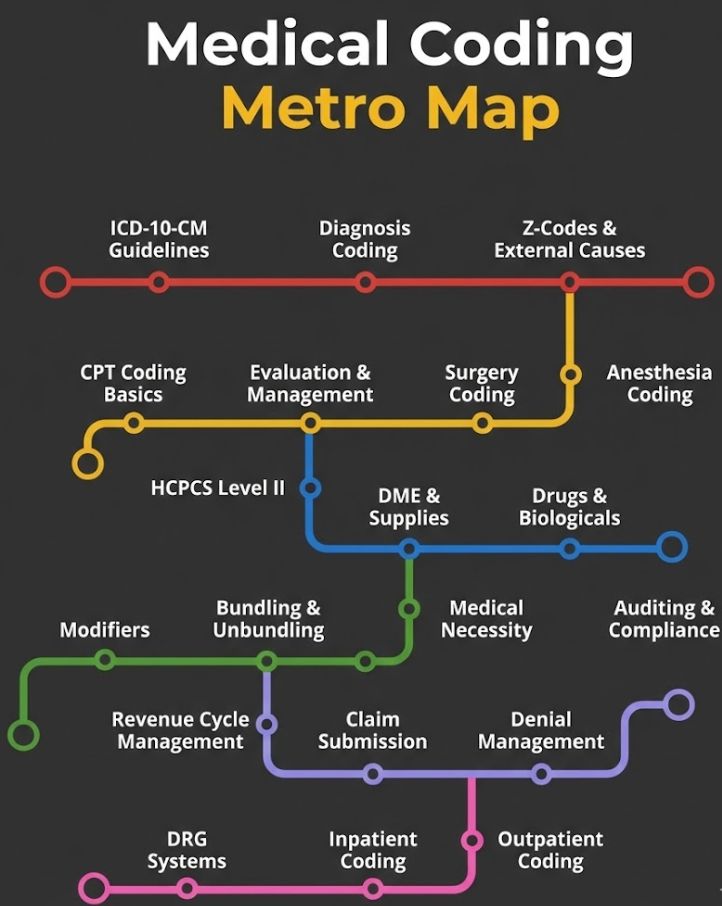
𝐌𝐞𝐝𝐢𝐜𝐚𝐥 𝐂𝐨𝐝𝐢𝐧𝐠 𝐢𝐬 𝐍𝐎𝐓 𝐨𝐧𝐞 𝐬𝐮𝐛𝐣𝐞𝐜𝐭. 𝐈𝐭’𝐬 𝐚 𝐟𝐮𝐥𝐥 𝐌𝐞𝐭𝐫𝐨 𝐌𝐚𝐩.
Most students think medical coding means:
👉 Learn ICD-10
👉 Learn CPT
👉 Get a job
That’s the biggest mistake.
If you really see the industry clearly, medical coding looks like a metro network, interconnected, layered, and strategic.
1. ICD-10-CM Guidelines → Diagnosis Coding → Z Codes
2. CPT Basics → E&M → Surgery → Anesthesia
3. HCPCS → DME → Drugs & Biologicals
4. Modifiers → Bundling & Unbundling → Medical Necessity
5. RCM → Claim Submission → Denial Management
6. DRG → Inpatient → Outpatient
Now ask yourself:
Are you just memorizing codes?
Or do you understand how the entire system connects?
Because in real hospitals and MNCs:
• Coders think like auditors
• Auditors think like payers
• Payers think about compliance & revenue
If your training doesn’t cover the full metro map, you’re only learning one station.
And companies don’t hire for one station.
They hire for people who understand the network.
If you are serious about building a long-term career in medical coding, start learning the system, not just the syllabus.
#MedicalCoding #RCM #HealthcareCareers #CodingLife #MedicalCodingTraining #AuditMindset #HealthcareIndustry #CareerGrowth #MedicalCoding #Freshers #CareerClarity #HealthcareCareers #Students #JobReadyMedicalCoding #MedicalCoding #MedicalCodingCareers
#CPC #HealthcareJobs #LifeScienceCareers #CareerSwitch #CollegeStudents #FinalYear
6
169
#Ramadan #Mubarak to everyone 🌙✨
May this blessed month bring peace to your heart, strength to your faith, and barakah in your life.
May Allah accept our fasting, prayers, and good deeds, forgive our shortcomings, and grant us patience, compassion, and unity.
Let’s use this month to grow spiritually, help those in need, and spread kindness wherever we can.
#Ramadan #Kareem 🤍
#RamadanKareem #RamadanMubarak #RevIQsolutions
ALT Ramadan Mubarak to everyone 🌙✨
3
215
The Billing Reality Most Practices Don’t Hear Early Enough
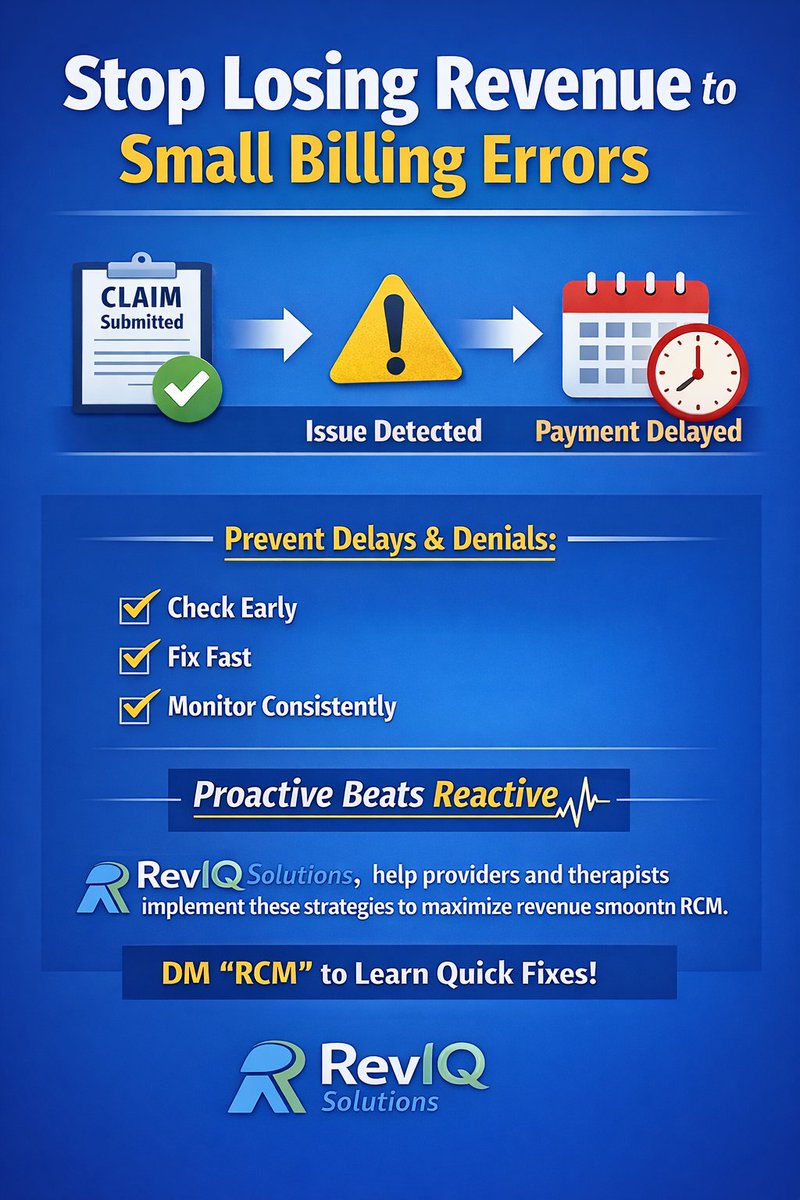
Delayed claim follow-ups can cost your practice months of payments.
Even small issues—a missing modifier, an expired authorization, or a minor rejection, can snowball if not addressed quickly.
✅ The solution?
. Review claims early
. Resolve issues fast
. Consistently monitor AR
Catching problems in the first week or two keeps revenue flowing smoothly and significantly reduces denials.
💡 Proactive always beats reactive in billing.
At RevIQ Solutions, we help providers and therapists implement these strategies to maximize reimbursements and streamline RCM.
If you’re struggling with claims, DM us “RCM” to learn the top fixes we implement first.
ALT The Billing Reality Most Practices Don’t Hear Early Enough
2
179
What Physicians Truly Expect From a High-Performance Billing Partner?
Physicians don’t need more dashboards, spreadsheets, or endless emails. They need predictable revenue, fewer disruptions, and complete peace of mind.
Every billing question that reaches a physician means the revenue cycle isn’t working efficiently. The real job of medical billing is to protect providers from insurance complexity, denials, and patient billing stress.
When billing works properly, physicians feel the results:
• Predictable cash flow
• Fewer disruptions
• Clean claims & faster payments
• More time for patient care
Great billing absorbs problems; it doesn’t pass them to the doctor.
That’s the difference between basic billing and true Revenue Cycle Management.
#MedicalBilling #RCM #PhysicianSupport #HealthcareOperations #PracticeGrowth #RevenueCycleManagement #MedicalPracticeManagement #HealthcareFinance #ClaimsManagement
1
91