
Joined April 2015
- Tweets 1,923
- Following 64
- Followers 11,497
- Likes 525
357 Photos and videos



Pinned Tweet

Feb 6
232
1,118
11,710
5,984,844
If you don’t want to delete your social media but you do want to minimize distraction just ban socal from your phone and only use them on your computer. Desktop UX is far less addictive.
1
2
123
Assume the amount you’ll engage in a behavior is equal to the amount of friction between you and the behavior. Lots of friction, you’ll never do it. No friction, you’ll do it lots.
5
351
Jun 13
Never underestimate how the tiniest source of friction can make or break a behavior. The friction of paperwork to withdraw savings from your bank account can lead to building wealth, versus not. The friction of having to find, plug-in and open your laptop can lead to dozens of hours less work per week.
1
10
418
Jun 12
In flow we get exertion without the experience of effort. That’s near-impossible to compete with.
9
290
Jun 12
Eliminate the friction from your life. The micro-annoyances that exist within and between the movements of your day—having to untangle a cable to charge your laptop, having to search for your airpods, constantly having to re-pack your bag every day for work. As you smooth out friction, you life will begin to take-on a delightfully fluid, effortless quality.
1
8
316
Jun 11
Struggle is paddling hard against the waves. Release is waiting for the right one. Flow is riding the wave. Recovery is resting on the beach before the next session. Skip any phase and you can’t surf... or flow!
8
319
Jun 11
Learning is one of the fastest ways to rebuild momentum and drive. If you’re feeling flat and disengaged, 10x your learning volume and soon you’ll feel flow re-emerging.
1
6
224
Jun 10
The possibility of being distracted is itself a distraction.
1
4
285
Jun 10
Mastering of the flow cycle; struggle persistently, release fully, flow deeply and recover fully.
1
1
2
256
Jun 10
I was sleeping on my grandmother's couch in Dublin.
Two weeks before, I'd co-founded a company with Steven Kotler, the leading expert on flow state.
He called me. We had our final discussion about whether to go all-in on the vision we'd mapped out: synthesize all the neuroscience literature on flow, build a team of PhDs, implement these protocols with the biggest companies in the world.
Steven said, "You in?"
"I'm in. Let's do this."
Then he paused.
"Look. This doesn't happen often. But every now and then, the stars align. You're facing an opportunity that, if seized, will alter the trajectory of your life forever. When you're up against one of these opportunities, grab it with everything you've got."
I got goosebumps. I knew he was right.
Over the next twelve months, I restructured my entire existence around building the company. That year generated more progress than I ever could've imagined being possible.
The work I did during that one year continues to affect every day I live nine years later.
The home I'm living in. The friends and network I have. The skills I exercise daily. The paradigm shifts that changed how I see everything. They all got cemented in that one year.
What I didn't understand at the time was that I had been standing on what researcher Richard Koch calls an Accomplishment Island.
Koch studied achievement patterns across thousands of careers and found something striking: professional output doesn't distribute evenly across a lifetime. It clusters into brief, intense periods separated by vast stretches of more normal output.
You might work for forty years, but the bulk of what matters happens in three or four concentrated periods.
Researchers call this pattern "burstiness." We don't produce linearly.
We produce in compressed bursts separated by lower-output periods.
And the people who accomplish the most aren't the ones who grind hardest across all forty years. They're the ones who recognize these windows and match their intensity to the moment.
Two conditions signal you're standing on one.
First, external opportunity: the market shifted, demand appeared, technology made something newly possible.
Second, capacity to capitalize: you have the time, health, runway, and positioning to go all-in right now in a way you couldn't before and might not be able to again.
I think about that couch in Dublin often. About Steven's voice on the other end of the line. About how close I came to treating that window like a normal year.
If you're standing on an Accomplishment Island right now, you already sense it.
The only question is whether you'll match your intensity to the moment, or look back in a decade and wonder what would have happened if you had.
1
6
20
1,169
Jun 9
Suffering is synonymous with self-consciousness. In flow state, self-consciousness goes offline. That’s why flow is so alluring—in flow, suffering temporarily ceases.
11
326
Jun 9
Flow proneness is our tendency to experience flow state - the state of consciousness where we feel and perform our best.
As soon as you wake up in the morning, your flow proneness is naturally and organically high. And that's for two reasons.
The first is that your cognitive load is low.
Cognitive load is the total amount of stuff your brain is trying to hold at once.
When you wake up, you haven't loaded anything into your conscious mind yet, so all of that mental capacity is just sitting there, available for whatever you point it at.
The less cognitive load you have, the easier it is to access flow.
And second, upon waking, your brain waves are close to flow.
The neuroelectrical signature or brain waves of flow are not far from theta or delta, which are the brain waves of sleep.
And this makes it easier to slide out of bed and deep into a flow state.
15
40
2,102
Jun 9
Assume your phone screen-time is inversely correlated with all the outcomes that will make you flourish in life and act accordingly.
1
12
318
Jun 8
The most dramatic shift I’ve found from eliminating caffeine for the past two and a half years isn’t just steadier energy, it’s more total energy.
7
465
Jun 8
When your day feels derailed, stop. Nap, walk, breathe, exercise, sweat. Then restart. You’ll almost certainly be back on track.
9
576
Rian Doris retweeted
Apr 9
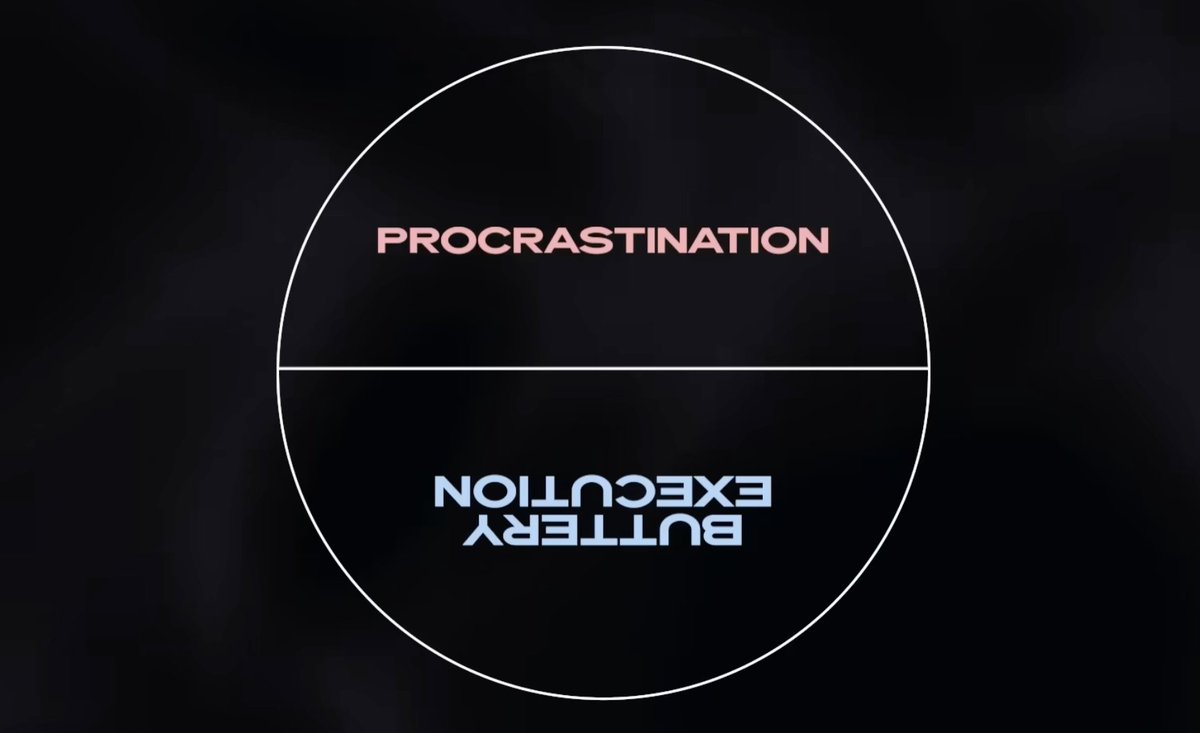
Buttery execution: the antithesis of procrastination.
1. Clear goals that give your brain a target
2. Challenge-skill balance that makes starting effortless
3. Response inhibition that bypasses the conflict entirely
4. Flow payoff that justifies the struggle
When you do all of this, your mind gets sucked toward the task, and you blaze through it like a hot knife through butter.
The compound effect of never saying no to what needs to be done will give you reliable access to flow and lead to extreme accomplishments.
2
9
40
2,084
Jun 8
It's very likely that the more you work, the less productive you become.

2
40
161
17,168
Jun 7
Immersion is about the object — the task you're doing and the context surrounding it. Absorption is about the subject — the mode of consciousness you're operating in while you’re doing the task.
269
Jun 7
Flow states have varying depth levels: micro-flow, macro-flow and deep-flow. Aim for micro-flow 2 hours per day (while doing reactive work like email), macro-flow for 3 hours per day (while doing high-leverage proactive work), and deep-flow at least once per month.
5
355
Jun 7
A friend of mine got Lyme disease and could barely manage 3 hours of work per day.
His startup didn't stall. It accelerated.
His company produced more in those 3-hour days than it ever did in his 12-hour ones.
The neuroscience explains exactly why:
16
1,351