
Private content partner to finance & tech founders | $50M in value generated for 35 clients | I like to share my honest thoughts, don't take it personally
Joined February 2024
- Tweets 6,281
- Following 131
- Followers 41,820
- Likes 9,434
1,561 Photos and videos
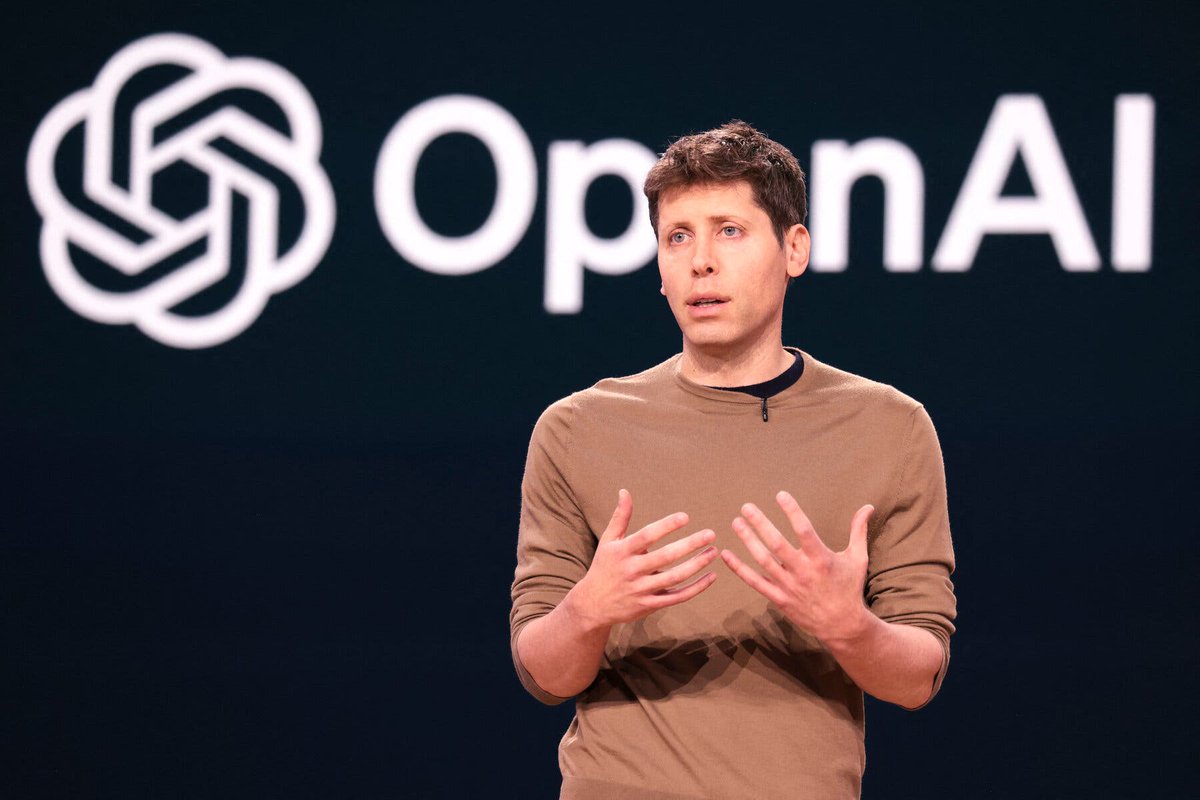


OpenAI just handed a single company the power to decide which ads inside ChatGPT live or die.
Weeks before that, the largest advertising agency on the planet quietly agreed to BUY that exact company for $2.2 billion.
Here's why this matters more than you'd expect:
The company is LiveRamp, and most people outside of ad tech have never heard of it.
It runs the identity graph that sits in the middle of the open internet, connecting more than 25,000 publisher domains and over 500 data partners so brands can match their own customers across platforms without exposing anyone's personal data.
Its entire reason for existing is that it is neutral. It does not sell ads and does not own media, so the whole industry has trusted it to be the referee rather than a player.
On June 10, OpenAI named LiveRamp as the first independent partner allowed to pipe real-world conversion data into ChatGPT's new advertising system.
So for the first time, a brand can connect what a person does inside the chatbot to what they actually buy afterward.
That measurement layer is the one thing that turns ChatGPT from an experiment into a real ad business, because serious advertisers do not commit serious money until someone can prove the ad drove the purchase.
This is the exact playbook that built Meta:
When Meta rolled out its Conversions API, advertisers who used it saw an average of 17.8% lower cost per result, and that single proof point unlocked hundreds of billions in ad spend.
OpenAI is now rebuilding that same machine for the chatbot era, and LiveRamp is wiring it together.
But here's where it gets really interesting...
On May 17, weeks before the OpenAI announcement, Publicis Groupe agreed to acquire LiveRamp for $2.2 billion in cash.
Publicis is the LARGEST agency holding company in the world, and it already owns Epsilon and its identity graph from 2019. The deal is expected to close by year-end.
So follow the chain:
The neutral referee OpenAI just appointed to verify whether ChatGPT ads work is about to be owned by a company whose entire business is creating, buying, and placing those same ads.
That independence was the only thing that made LiveRamp valuable to OpenAI, and the acquisition quietly strips it away at the EXACT moment it matters most.
This is literally the same conflict regulators spent a decade fighting Google over.
Google owned the ad inventory, the tools used to buy it, and the measurement that scored the results, and courts in the US and Europe ruled that owning all three was a problem. The ad economy now forming around ChatGPT is rebuilding that exact structure, except an agency is assembling it around OpenAI before the chatbot ad market has a single rule written for it.
Most people are watching the obvious fight, which is whether ChatGPT ads are creepy and whether anyone will tolerate them.
But that fight does not matter. The ads are coming either way because OpenAI is burning cash and needs the revenue.
The real issue is who OWNS that measurement layer.
As search collapses and people start asking a chatbot what to buy instead of Googling it, whoever controls the rails that prove an ad worked also controls the budgets that follow.
Publicis understood this earlier than anyone so they bought the "toll booth" on the only road every future advertising dollar will have to drive down.
And the smartest part is the timing:
The announcements landed weeks apart and were covered by different newsrooms. The acquisition read as boring agency M&A, and the OpenAI partnership read as a routine product update.
Apart, each looks unremarkable. Together, they are one company positioning itself to referee a market it fully intends to play in.
By the time the deal closes in December, the question will not be whether ChatGPT has ads...
It will be who already owns the referee.
7
7
16
2,362
The smartest man in AI just exposed the whole AGI narrative as a LIE.
And he used a physics problem from 1905 to prove it.
His name is Demis Hassabis. He runs Google DeepMind, and won the Nobel Prize for using AI to crack a problem in biology that had stumped scientists for 50 years.
Almost nobody in this industry has a track record like his.
He went on the NothingButTech podcast and called out the biggest lie in AI right now:
Right now the loudest voices in AI are telling you that AGI is basically here. OpenAI has literally defined AGI as a system that can outperform humans at most "economically valuable work." In other words, if it replaces enough jobs, we have arrived.
Hassabis thinks that bar is a joke.
He said real general intelligence has to do what the human brain can do, because the brain is the only proof we have that this kind of intelligence is even possible. He called that "a higher bar than just being able to do some useful economic work," which is about as close as a polite British Nobel laureate gets to calling his rivals out.
Then he gave the actual test:
Today's AI has read everything humans have ever written, including the theory of relativity. So when it explains relativity back to you, it's repeating an answer that already exists.
That's not intelligence.
So Hassabis proposed a test that makes memorization impossible. Train an AI on only what humanity knew in 1901, four years BEFORE Einstein published relativity. Then ask it to come up with relativity on its own.
It can't look up the answer, because in 1901 the answer doesn't exist yet. The only way to pass is to do what Einstein actually did: Take the same physics everyone else had and reason its way to an idea no human had ever had.
Hassabis says not a single AI today can, no matter how much it has memorized. Which means what we keep calling "almost AGI" is really just the best librarian in history.
It can find any answer that already exists but it cannot create one that doesn't.
His second version is even sharper:
AlphaGo, the system his own team built, famously invented a brand new move that no human had played in 2,000 years of the game.
Everyone called it genius but Hassabis says that still is not the bar.
The real test is not whether an AI can invent a new move inside Go, it is whether an AI could INVENT a game as deep and as beautiful as Go in the first place.
No model that exists today can do it.
The people telling you AGI has already arrived are the same people raising hundreds of billions of dollars on that exact promise.
The valuations only work if the finish line is right in front of us. So the finish line keeps getting dragged closer, and AGI keeps getting quietly redefined down to "does useful work," until the products they already sell happen to qualify.
Hassabis has nothing to prove and nothing to sell you. He already won the Nobel, and he is telling you the machines still cannot do the one thing that would make them genuinely intelligent, which is have a truly original idea.
To be fair to him, he is not a pessimist about it. He believes real AGI IS coming, and he is spending his life building it. He just refuses to pretend it is already sitting in your phone.
So the next time a founder tells you AGI is months away, remember that the one man in the room with a Nobel Prize built his test around Einstein, and admitted that nothing we have made can pass it.
What do you think?
204
475
3,178
1,260,003
Trump put his own man in charge of the Federal Reserve to force interest rates down.
But that same man might be the one who POPS the AI bubble...
Here's the trap Trump just fell for:
For most of last year, Trump waged open war on Fed chair Jerome Powell. He attacked him in public for months and leaned on the Federal Reserve constantly, and the entire goal was to force it to cut interest rates so borrowing would get cheaper across the whole economy.
Powell wouldn't budge. So Trump replaced him.
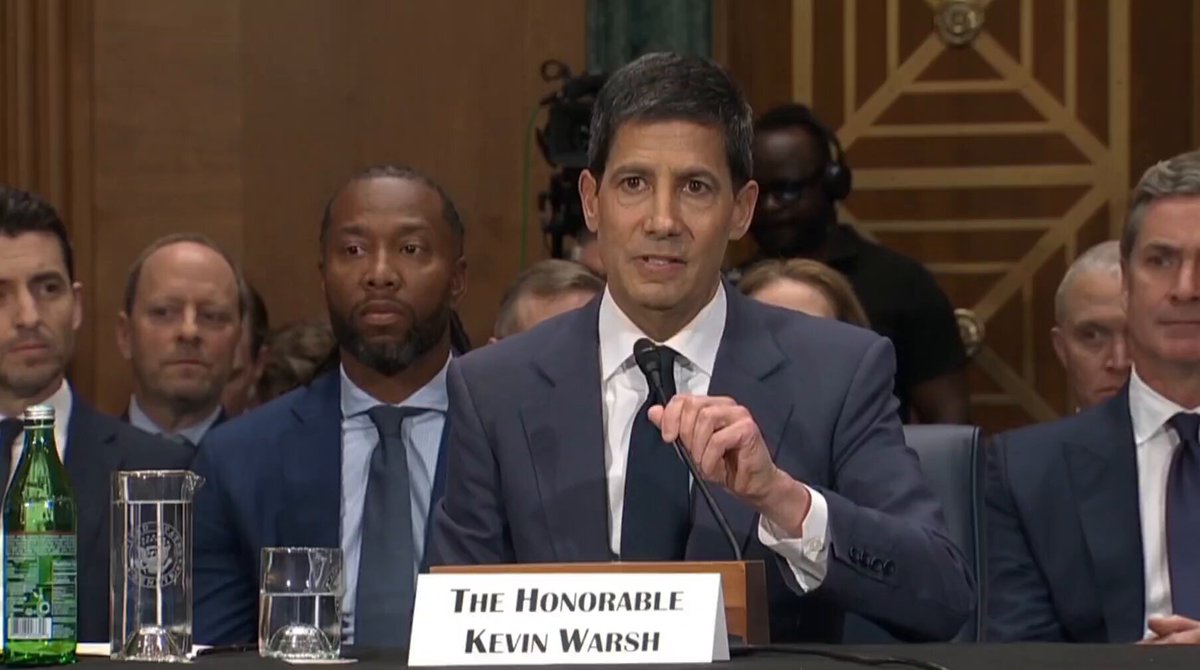
In May, the Senate confirmed Kevin Warsh as the new Fed chair in a 54-45 vote, the most divisive vote for a Fed chair in modern history.
Trump picked him for one reason: Warsh was supposed to be the guy who finally cuts, and Trump has openly said he wants rates as low as 1 percent.
There was just one problem with that plan...
Warsh is a hawk. He once called the inflation surge after the pandemic the biggest policy error in 40 or 50 years.
A hawk is someone who fights inflation by keeping rates HIGH, which is the exact opposite of what Trump wants.
Then it got worse:
On Wednesday, the government reported that inflation hit 4.2% in May. That is the highest it has been since April 2023.
Prices have now climbed four months in a row, from 2.4% in January up to 4.2% today.
The cause is energy.
The war with Iran has choked off oil shipments through the Strait of Hormuz, gasoline is up more than 40% over the past year, and energy ALONE drove more than 60% of the monthly increase.
So follow the trap they're falling for:
Trump installed a Fed chair to deliver cheap money. That chair is privately a hardliner against inflation. And inflation just spiked to a three-year high because of an oil shock tied to a war his own administration is deep inside of.
The odds of any rate cut in 2026 have collapsed to roughly zero, and the market is now putting better than even odds on a rate HIKE before the end of the year.
Warsh runs his first meeting as chair next week, and Powell is still sitting right beside him on the board, the first time in roughly 80 years an outgoing chair stayed on.
But here is why this matters far beyond Washington:
The entire AI boom was built on the assumption that money stays cheap. The roughly $5 trillion the industry plans to spend on AI through 2030, the leveraged data centers, and the private credit loans behind all of it only work if interest rates fall.
But they are NOT falling... They might even RISE.
On June 4th and 5th, chip stocks lost a combined $1 trillion in value in just two days.
The semiconductor index had its worst day since March 2020. Micron lost almost a fifth of its value and Marvell dropped more than 16%.
The trigger came from a strong jobs report that pushed bond yields higher and forced the market to accept that the Fed can no longer ride in and rescue them.
So the AI trade and the interest rate trade just became the same trade.
For three years the market has run on the belief that the Fed will always step in and make borrowing cheap the moment things get scary. Trump tried to guarantee it by handpicking the referee.
But the referee turned out to be an inflation hawk, walking into a three-year inflation high, who may now have to raise rates on the most leveraged bet in market history...
5
24
64
7,998
SpaceX, Anthropic, and OpenAI just synchronized the biggest insider share dump in financial market history.
In the last 11 days, three of the most valuable companies on Earth filed to go public:
SpaceX prices Thursday at a $1.77 trillion valuation, the largest IPO ever recorded.
Anthropic filed a confidential S-1 on June 1 at $965 billion.
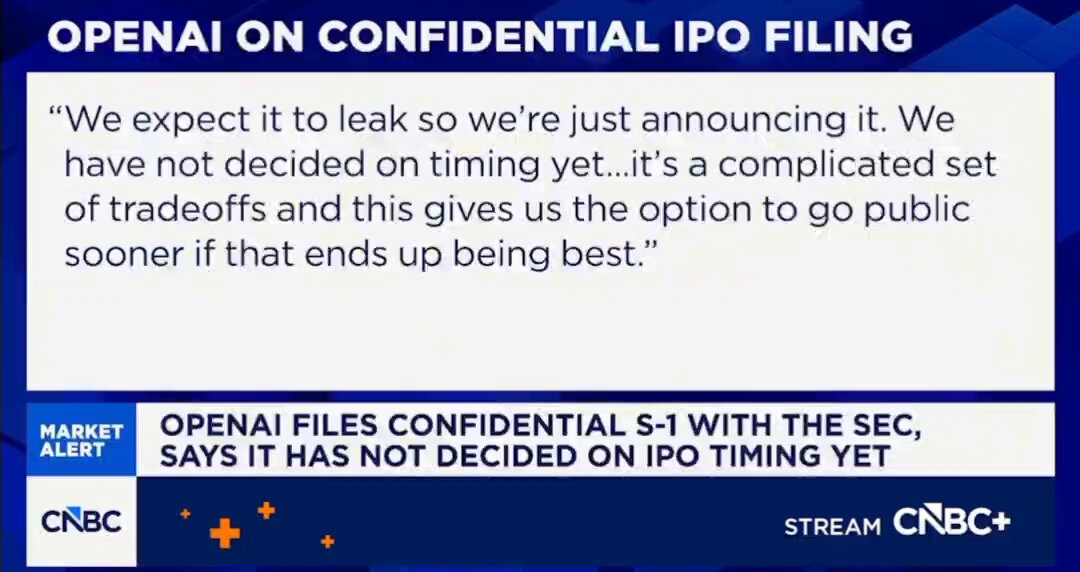
OpenAI filed a confidential S-1 on June 8 at $852 billion.
Combined market cap entering public markets in roughly six months: $3.5 trillion.
Bankers privately warned Anthropic and OpenAI that whichever filed first would get the deeper pool of institutional money. Anthropic moved first by 7 days. Sam Altman publicly framed OpenAI's filing as a "financing event," which is corporate speak for we need cash and we need it before the window closes.
But the real story is buried in every S-1 in the same place, inside the lock-up provisions:
Standard IPO lock-ups prevent insiders from selling for 180 days after listing. But SpaceX is using a phased structure that lets pre-IPO investors sell 20% of their shares right after the company's first earnings report, then unlocks more in tranches at 70, 90, 105, 120, and 135 days. Elon Musk himself is locked up for a full 366 days, but everyone else can start dumping as early as August.
Look at the timeline:
SpaceX hits full lock-up release on December 9, 2026. Anthropic listing in October 2026 would unlock April 2027. And OpenAI listing in Q4 2026 would unlock May 2027.
Within roughly a 90-day window in spring 2027, every founder, every employee, and every early investor at three companies worth a combined $3.5 trillion becomes legally free to sell their holdings at the exact same time.
And Michael Burry bought January 2027 puts on the SOXX semiconductor ETF struck at $330, implying a 27% drop in chip stocks within weeks of SpaceX's full lock-up release.
He also owns puts on Nvidia, QQQ, Palantir, and Oracle, all expiring in 2027, sized to 9.5% of his portfolio's short exposure.
The Buffett Indicator, which compares total market cap to GDP, hit 231.7% on June 9. The dot-com peak was 146%.
Morningstar analyst Andrew Owens published a fair-value estimate for SpaceX of $780 billion, less than half the $1.77 trillion IPO price. He explicitly wrote that long-term investors will get a better entry point after insiders sell.
The combined profitability of three companies entering public markets at $3.5 trillion in market cap is literally NEGATIVE.
OpenAI is projecting a $14 billion loss in 2026 and does not expect profitability until 2029. SpaceX posted a $4.94 billion net loss in 2025 and Anthropic still loses money even with a $47 billion revenue run rate.
The smart money isn't betting against AI as a technology. They are betting against three founder groups becoming legally allowed to cash out in the same 90-day window.
And notice the one detail that gives the whole game away:
Elon Musk's personal lock-up runs 366 days, conveniently extending past the synchronized unlock period for the other two companies. He is the only major insider not selling into that window.
That tells you which way the smartest seller in the room is positioning.
Every retail investor buying SPCX on Thursday, every fund piling into the Anthropic and OpenAI debuts later this year, is on the other side of a trade Burry (the guy who called 2008) put in writing.
These IPOs sound fancy but the real story is what happens 180 days later, when the founders are no longer legally required to hold.
What do you think?
13
20
41
6,315
Wall Street just got exposed for FAKING the ratings on a $3 TRILLION market.
Columbia Business School researchers found that the ratings underpinning the private credit market are systematically understating how risky the investments actually are.
The ratings say these loans are safe. But the researchers say they're lying. And US life insurance companies have $807 BILLION of their money parked in this exact market.
Private credit is a $3 trillion shadow lending market where investment funds lend money directly to companies instead of banks. It exploded after 2008 because new regulations stopped banks from making risky loans, so Wall Street just moved the same risky loans to a different address where regulators couldn't see them.
The market grew from $10 billion twenty years ago to over $3 trillion today, and the people rating these loans have been telling everyone they're safe the entire time.
But they're NOT safe.
Fitch Ratings reported in May that the US private credit default rate hit a RECORD 6.0% in April 2026. Companies with less than $25 million in earnings are defaulting at 15.8%.
More than one in ten loans in private credit funds have been marked down by at least 50%, meaning they've already lost HALF their value on paper.
And Moody's found that 65% of defaults in 2025 weren't even counted as real defaults because lenders restructured them through extensions and payment-in-kind deals where borrowers pay interest by taking on MORE debt instead of cash.
The defaults are being hidden and the ratings are being inflated, and the people most exposed are the insurance companies managing the policies.
But here's where it gets genuinely scary:
The top 10 US life insurers now hold $352 billion in private illiquid bonds. Apollo runs an insurance company called Athene and KKR runs one called Global Atlantic.
These private equity firms are taking insurance premiums, lending that money to risky companies through their own private credit funds, rating those loans as safe through friendly rating agencies, and collecting fees at every step of the chain. The money goes in a circle and gets counted as safe at every stop.
Blue Owl, one of the biggest private credit managers, literally froze withdrawals from one of its retail funds in February 2026. An Apollo-managed fund cut its dividend and wrote down the value of its loans around the same time. Blackstone had to raise its repurchase limit to handle nearly $2 billion in withdrawal requests in a single day.
And a London-based lender called Market Financial Solutions collapsed entirely with a collateral shortfall exceeding $1 billion after a company called First Brands was caught pledging the same assets as collateral to multiple lenders simultaneously.
Jamie Dimon even saw it coming. On JPMorgan's earnings call he said "when you see one cockroach, there are probably more."
And remember, there's a $162 billion wall of debt that has to be refinanced THIS YEAR at significantly higher interest rates. The companies that borrowed this money can't afford to pay it back, and the lenders are running out of ways to pretend they can.
This is 2008 all over again. Bad loans, fake ratings, insurance companies loaded with toxic assets, and everyone looking the other way because the fees are too good to stop.
The only difference is last time it was mortgages. This time it's corporate loans. And instead of your house being at risk, it's the life insurance and pension.
22
92
192
8,601
In 1879, JP Morgan paid a man to invent the lie that is the foundation of modern economics.
A billionaire who helped start Amazon just exposed the whole thing on Diary of a CEO, and once you hear it you will never look at paychecks the same way again:
146 years ago, a guy named Henry George wrote a book called Progress and Poverty.
It was the first mainstream book about the rich systematically stealing from the poor, and It literally became the bestselling book in the history of the United States at the time.
The working class was reading it everywhere, and the people at the top of the economy completely lost their minds.
So JP Morgan personally brought a man named John Bates Clark to Columbia University, which was essentially the intellectual headquarters of Wall Street, and told him to fix the problem.
Clark wrote a book called The Distribution of Wealth. In it, he invented something called the "theory of marginal productivity," which claims that because markets are perfectly efficient, the amount of money you earn reflects EXACTLY the value you contribute to the economy.
If you make $15,000 a year, that's because you're providing $15,000 of value. If a hedge fund manager makes $500 million a year moving money around, that's an accurate reflection of the value he creates in the world.
And Clark literally said the quiet part out loud IN HIS OWN BOOK.
He wrote that they had to prove to working people that no matter how much they make, whether it's a little or a lot, it accurately reflects their value, because if workers ever concluded that their labor was worth more than they were being paid, they would revolt and destroy the entire system.
That was the whole point. The theory was built to prevent a revolution.
And it worked so well that it got absorbed into mainstream economics and is STILL taught as a foundational principle to this day.
Every time a CEO tells you "the market decides your salary," they're repeating a framework that was literally commissioned by JP Morgan in the 1800s to convince you not to ask for more.
Nick Hanauer, the billionaire who told this story, also shared the numbers that prove why it matters right now:
The median full-time worker in America earns about $60,000 a year. If that same worker had maintained the same share of GDP they held in 1975, they wouldn't be making $60,000. They'd be making $120,000. That gap goes all the way up to the 90th percentile. If you earn $180,000 today, you'd be earning $250,000 under the old distribution.
The ONLY people who benefited from 50 years of economic growth were the top 10%, and the vast majority of that went to the top 1%. That is trillions of dollars every single year that used to be wages for ordinary working people and now sits in the accounts of the wealthiest people on the planet.
This happened because of policy. Tax cuts for the rich, deregulation for the powerful, and wage suppression for everyone else, all justified by an economic theory that was invented specifically to make you believe you deserve exactly what you're getting.
And the craziest part is that GDP growth rates in America were 4 to 4.5% for decades when workers were included in prosperity. As soon as the neoliberals took over in the mid-1970s and implemented these policies, GDP growth fell to 3% and eventually to 2%.
Including people in the economy doesn't slow growth down. It's literally the thing that CREATES growth. And the theory that convinced the world otherwise was a hit job paid for by one of the richest men in history to keep workers quiet.
What do you think?
171
1,453
3,859
327,155
Microsoft just got CAUGHT lying to every Fortune 500 company.
At Build 2026, Satya Nadella announced 7 brand new AI models built entirely in-house.
Microsoft's own technology trained on what they called "enterprise grade, clean and commercially licensed data."
That pitch was aimed directly at the biggest buyers in regulated industries: Banks, hospitals, insurance companies, and government agencies that need to know EXACTLY where their AI's training data came from because of active federal copyright lawsuits.
Procurement teams across Wall Street and Washington heard "clean and commercially licensed" and started writing checks.
There was just one problem:
Microsoft published the technical paper alongside the models, and a developer named Simon Willison actually READ it...
The MAI-Thinking-1 preprint describes a data pipeline that starts with 1.2 TRILLION pages scraped from the open web using a proprietary crawler. After filtering out piracy and adult content, that number drops to 794 billion pages.
On top of that, Microsoft fed in another 24.2 billion pages from Common Crawl, which is a massive open archive of web-scraped content that carries ZERO licensing guarantees and ZERO author consent mechanisms.
Common Crawl is the exact data source sitting at the center of multiple active federal copyright lawsuits against AI companies right now.
Microsoft told regulated industries the data was clean. But their own paper says it started with 1.2 trillion unverified web pages and a repository that's currently being sued over in federal court.
Those two things cannot both be true.
And here's where it gets worse:
This wasn't even an accident or a miscommunication.
Microsoft built this entire pitch around data provenance ON PURPOSE because they knew that was the number one concern for enterprise legal teams in 2026.
The DeepSeek scandal earlier this year made every compliance department in America paranoid about where AI training data actually comes from. Microsoft saw that fear and sold directly into it with a claim their own documentation contradicts.
As of today, Microsoft hasn't issued a single public statement addressing the contradiction between what Nadella said on stage and what the technical paper actually shows.
The reason Microsoft did all of this is what really matters though...
They are DESPERATE to break free from OpenAI.
In April 2026, the two companies renegotiated their partnership, ending Microsoft's exclusive license to OpenAI's technology and removing revenue-sharing obligations. Microsoft can now build competing models, and OpenAI can shop its compute to Google, Amazon, and Oracle.
The divorce papers are signed. Microsoft needed to prove it can survive without OpenAI, so they rushed 7 models to market, made claims about data cleanliness they couldn't back up, and got exposed by their own published research within 72 hours.
Every enterprise customer who signed a deal based on that "commercially licensed data" pitch now has a legal question on their hands. Every procurement team in finance, healthcare, and government that used data provenance as a deciding factor just learned the provenance was just marketing copy.
The EU AI Act requires providers of general-purpose AI to publish a detailed summary of training data content. So if Microsoft tries to sell MAI-Thinking-1 in Europe with the same pitch they used in San Francisco, they'll be walking straight into a regulatory mess.
What do you think?
38
174
413
52,357
Big Tech just ran out of money building AI and what they're doing to cover it up should be illegal.
Google, Amazon, Microsoft, and Meta are spending a combined $700 BILLION this year on AI infrastructure.
This eats up 94% of their total operating cash flow.
The richest companies in human history are almost broke. And instead of slowing down, they're covering it up with the biggest financial engineering operation since 2008:
Google just sold $80 billion in stock to fund AI infrastructure. That was their first equity raise in 20 YEARS.
The last time Google needed to sell stock, YouTube didn't even exist. Sundar Pichai admitted the thing keeping him up at night is "compute capacity."
The company that prints $100 billion a year in ad revenue just told Wall Street it isn't enough anymore.
Amazon's free cash flow is projected to go NEGATIVE this year for the first time ever. Morgan Stanley estimates a $17 billion deficit and Bank of America says $28 billion.
The most profitable logistics machine on Earth is about to burn more cash than it generates, and they quietly filed with the SEC saying they may need to raise even more debt and equity to keep building.
All four hyperscalers are now borrowing hundreds of billions in bonds to keep the AI buildout alive. These were the most cash-rich companies in human history, and they're leveraging themselves to the teeth to build infrastructure that nobody has proven will generate enough revenue to pay for itself.
And the cracks are already starting to show:
Broadcom makes the custom AI chips that power Google, Meta, OpenAI, and Anthropic. This week their AI revenue TRIPLED year over year, sales grew 48%, and profits smashed every Wall Street estimate.
The reward for all of that was $320 billion in value erased in a single trading session.
Their CEO Hock Tan went on the earnings call and exposed three things about the AI industry:
Google is already shopping for cheaper AI chip alternatives, broadcom abandoned its strategy of selling complete AI systems and is now retreating to selling bare chips at lower margins.
And despite supposedly "unprecedented demand," Tan refused to raise his full-year forecast, which tells you everything about what he's actually seeing behind the curtain.
Wall Street heard all three and hit the sell button so hard it dragged AMD, Intel, and the entire chip sector down with it.
When a company triples its AI revenue and gets punished because tripling isn't fast enough, the expectations have left the atmosphere entirely.
And here's the really scary part...
These companies ARE your retirement account. Apple, Microsoft, Amazon, Google, Meta, and Nvidia make up roughly 30% of the S&P 500. If you have a 401k or an index fund, you are already exposed to this bet whether you chose to be or not.
Every single one of these companies is telling you AI will generate trillions in revenue. But right now the math says they're spending trillions FIRST and hoping the revenue shows up later.
If the revenue catches up, this becomes the greatest infrastructure buildout in human history. Bigger than railroads and bigger than the internet.
If it doesn't, the companies that make up a third of the American stock market just leveraged their balance sheets into the largest write-down cycle since 2000.
And unlike the dot-com crash, this time the bubble companies aren't random startups with no revenue. They're the backbone of the entire global economy.
201
681
1,775
225,053
OpenAI's president just got CAUGHT running a fake AI safety movement to destroy the real one.
They were literally playing BOTH SIDES of the AI safety debate to manufacture outrage.
Taylor Lorenz and Tyler Johnston just exposed this in their investigation, and it's absolutely ugly:
In July 2025, exactly 10 days after a dark money offshoot of pro-AI super PAC Leading the Future filed its articles of incorporation in Nevada, a new X account called "Doomers Are Dumb" appeared. It looked like a generic meme page, posting jokes about waifus and dating drama.
Then in October, around the moment the PAC began publicly campaigning, the account pivoted to lewd and offensive content designed to mock AI safety advocates.
Then on the same day, a SEPARATE account called "Jonathan Doomer" appeared on X, claiming to be a panicked AI skeptic who had quit his job to spread warnings about the technology. He was the perfect strawman, loud and unstable and easy to dunk on, and the "Doomers Are Dumb" account was sparring with him from day one.
The PAC was running BOTH sides of the debate. They built the fake skeptic so they could make every real skeptic look unhinged by association.
The funders behind this network are not random:
OpenAI president Greg Brockman gave $25 million to Leading the Future, and another $25 million to Trump's MAGA Inc. Andreessen Horowitz, Joe Lonsdale of Palantir, Ron Conway, and Perplexity all wrote huge checks. Total commitments are around $140 million, with about $51 million still on the way.
The political operative running it all is Josh Vlasto, the same strategist who ran crypto's $300 million Fairshake PAC that helped flip the 2024 election. Their target is the 38 state-level AI safety laws legislatures passed in 2025.
Their first big victim is Alex Bores, the congressional candidate in New York's 12th district. Bores worked at Palantir until 2019, when he RESIGNED over the company's ICE contracts.
He then went on to write New York's first state-level AI safety law.
The PAC has committed at least $10 million to defeat him, and their ads attack him for "building the tech for ICE deportations" - the work he quit over.
But the nastiest part is what OpenAI did yesterday...
The company put out a statement distancing itself:
Their employees are "free to participate in the political process in their personal capacities."
In other words: It's not us, it's just our president and the executive organizing it.
Then Jason Kwon, OpenAI's Chief Strategy Officer, was caught FOLLOWING the sockpuppet accounts on X. These are accounts with almost no followers. You don't accidentally find them. You only follow them if you already know they exist.
Chris Lehane, OpenAI's Chief Global Affairs Officer, was part of the founding conversations of the PAC according to the Wall Street Journal. The company that just filed for an $852 BILLION IPO is publicly testifying to Congress that it "supports thoughtful AI regulation" while its own executives are simultaneously funding a $140 million operation designed to destroy every politician who actually tries to regulate AI.
This is the second scandal for the PAC this year. In May, the same operation got caught paying TikTok and Instagram creators $5,000 per post to spread anti-China AI panic content scripted by political operatives.
This is what the AI billionaire class is actually doing while their PR teams put Sam Altman on every podcast talking about wanting regulation.
The strategy is to fund fake critics so real critics look insane, pay creators to manufacture moral panics on demand, and control every angle of the conversation so no real conversation about AI safety ever happens.
What do you think?
16
118
159
8,219
Today the EU made American AI illegal in 27 countries.
The reason is ONE sentence Microsoft's own lawyer said under oath:
This morning in Brussels, EU Tech Chief Henna Virkkunen unveiled the Cloud and AI Development Act. It's the most aggressive anti-American tech move from Europe since GDPR.
The law forces EU public sector procurement in banking, healthcare, defense, and energy to apply mandatory non-price factors favoring software and hardware built inside the EU. Microsoft Azure can be cheaper, AWS can be faster, Google Cloud can have the better model, and EU governments MUST legally prefer European alternatives.
AWS, Microsoft, and Google currently control roughly 70% of the European cloud market. Brussels is now openly targeting greater independence from US providers in cloud, AI, and semiconductors.
The largest regulatory market-share transfer in tech history is being written into law right now.
But the real story is how this happened...
On June 10, 2025, a man almost no one outside Brussels had heard of walked into the French Senate. His name is Anton Carniaux, Director of Public and Legal Affairs at Microsoft France.
Senator Dany Wattebled asked him under oath whether he could guarantee that data belonging to French citizens, stored on Microsoft European servers, would never be transmitted to US authorities without explicit consent from the French government.
Carniaux answered honestly. He admitted he could not guarantee it, because Microsoft must comply with the US CLOUD Act regardless of where European data physically sits. One sentence of sworn testimony from Microsoft's own counsel killed every sovereign cloud defense Big Tech had spent five years building.
It became the legal foundation for the law unveiled today.
Then Trump accelerated the divorce.
January 2025 brought executive orders expanding US surveillance authorities. Vance went to Munich and attacked European democracies on stage.
The tariffs followed and so did the Pentagon's $200 million AI contract war that ended with OpenAI replacing Anthropic after Hegseth labeled it a supply chain risk. So did OpenAI's Stargate and yesterday's Trump AI Executive Order, whose Section 3 lets the White House pick which AI companies get 30-day early access to frontier models. American AI was officially declared a US government strategic asset.
Europe heard every word of it.
On May 12, Mistral CEO Arthur Mensch told the French National Assembly that Europe had 24 months to build sovereign AI infrastructure or become a permanent US VASSAL state.
And the response came fast:
April 24: Cohere acquired Germany's Aleph Alpha for $20 billion with both Germany's and Canada's digital ministers in the room at the Berlin announcement. May 30: SoftBank committed up to $87 BILLION for French nuclear-powered data centers, the largest AI infrastructure project in European history.
Yesterday: EU Parliament announced it's dropping Google for French search engine Qwant tomorrow. France ordered every government workstation off Windows and onto Linux.
Today the Cloud and AI Development Act made all of it law.
- Mistral is building a 1.4 gigawatt AI campus near Paris by 2028 with Nvidia, MGX, and Bpifrance
- SAP's EU AI Cloud, launched last November, runs on Cohere, Mistral, and SAP's own sovereign infrastructure
- McKinsey forecasts $600 billion in sovereign AI needs by 2030
None of that money is going to Silicon Valley.
The America First AI policy built a wall around the world's most regulated economy, and American companies are on the wrong side of it.
Microsoft's lawyer told the truth in a Senate hearing nobody watched. Trump turned that admission into a national security narrative while the EU turned that narrative into procurement law.
And one entire continent walked away from the American tech stack...
Community note
The Cloud and AI Development Act is a legislative proposal—not law—that introduces sovereignty assessments and procurement preferences favoring EU providers but does not ban American AI or cloud services. digital-strategy.ec.europa.eu/en/policies/cl… ec.europa.eu/commission/pre…
280
1,231
2,839
263,376