
Joined October 2008
- Tweets 4,512
- Following 360
- Followers 2,470
- Likes 642
370 Photos and videos





Jun 12
When you hear a company brag they've deployed 1,000 AI agents and they're all humming along, don't believe it.
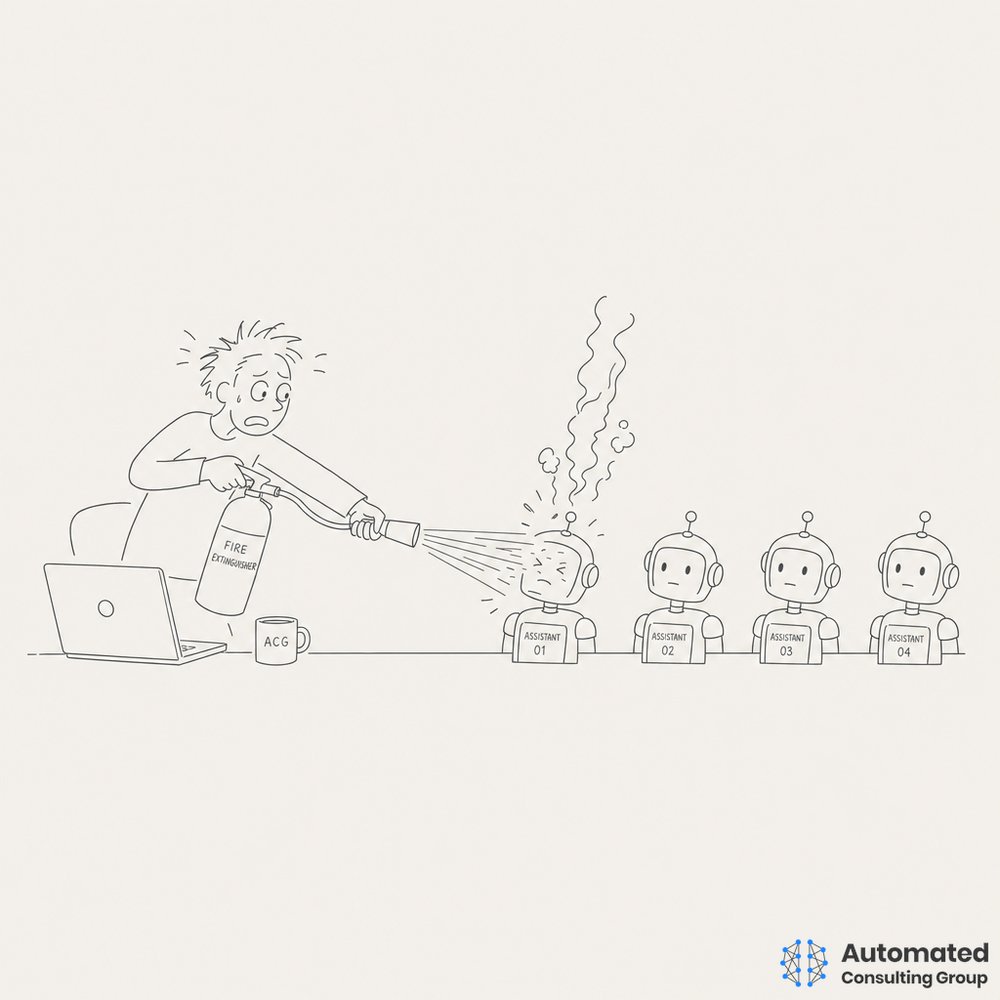
I have 25 agents running for my own work. I wrote a monitor script that checks them every day. Every single day, three or four of them have some kind of issue. Not broken forever. Transient stuff. Something timed out. A file got reclassified. An API hiccupped. But broken enough that without the monitor, I'd never know.
This is the part of agentic AI nobody is putting in the keynote. We are still very much in human-in-the-loop territory, even when the loop is just "notice it failed and poke it."
A client built a Copilot agent last week and couldn't see it in the picker. Took two days to figure out a tenant admin had to approve it inside the Microsoft 365 admin center. None of the demos mention that step.
I'm bullish on agents. I'm using them every day. But the gap between "we deployed 1,000 agents" and "1,000 agents are reliably doing work" is enormous right now.
If you're being sold the first number, ask for the second.
1
1
40
Jun 11
I'm starting to see a pattern with executives who really embrace AI.
Month one is exciting. They build a thing. It works. They build another thing. They send me Codex outputs daily. They're effectively writing their own business requirements by prototyping. It's great.
Month two is when reality hits.
They realize the things they built aren't write-once-run-forever. They need care. The data source changes and the report breaks. The prompt that worked last week gives weird answers this week. The skill they built is now five skills, and they're all slightly out of sync.
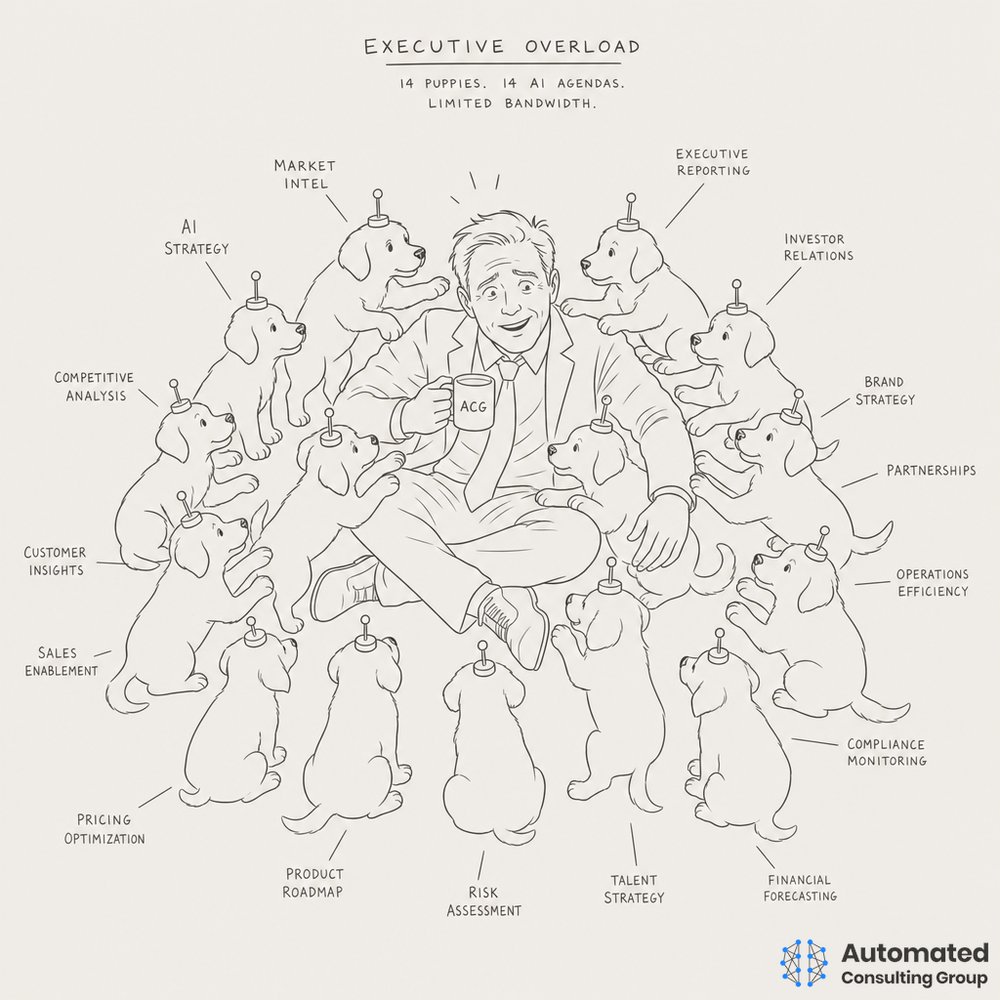
This is the part nobody warns the AI-pilled executive about. The fun part is the building. The unfun part is that you just adopted 14 new puppies.
I'm not saying don't do it. The executives who push through month two end up dramatically more capable than peers who waited. But the right expectation isn't "I built it, done." It's "I built it, now it's part of my operational footprint."
If you're an executive in your first 30 days of building with AI, just know: month two is coming. Plan for the maintenance, not just the magic.
34
Jun 10
In 2010 I started the first commercial generative AI company called Automated Insights. We didn't call it Generative AI. We called it natural language generation (NLG).
The hardest part wasn't the tech. It was explaining what the tech did.
I'd walk into a customer meeting with a report our software generated from their data. They'd read it, nod, say it was good, then ask: who wrote it?
No one wrote it. We wrote software that wrote it.
But software can't write. People write.
We'd spend half the meeting on this loop. I started calling it the chicken biscuit problem. When I moved to California in my twenties, I asked locals where to get a good chicken biscuit. They looked at me like I'd said two words that don't belong together. Chicken. Biscuit. What?
That's what "software that writes" sounded like in 2012.
Now my kids ask Claude to write their essays and don't think twice. The concept that took me three years to explain is dinner table conversation.
The lesson I keep coming back to: when you're early to a category, your real product isn't the technology. It's the vocabulary. The first 500 customer conversations aren't sales calls, they're language lessons. That's part of what makes the "first mover advantage" often a big disadvantage.
If you're building something genuinely new right now, budget for that. It's the work nobody warns you about.
1
1
91
Jun 9
A client called me last month, frustrated. Their AI tool had been giving wrong answers for weeks. Nobody noticed because there was no error message. No crash. No alert. Just quietly bad output flowing into decisions.
This is the thing about AI that most demos skip over.
Regular software fails loudly. It crashes. It throws an error. You know something is broken. AI often fails softly. It keeps running, keeps producing output, and you have no idea the wheels came off.
You don't have a 20-person data science team watching model/output drift. You have one IT person and a busy ops team. By the time someone notices the AI is off, the damage is done.
I've seen this play out in three ways:
- Outputs look plausible but are subtly wrong (the hardest to catch)
- The output degrades over time as your data changes
- Edge cases that never showed up in the demo start showing up in production
None of this means you shouldn't use AI. It means you need a simple monitoring layer before you deploy anything that touches real decisions. Even a basic human spot-check process on a weekly sample of outputs catches most problems early.
Before you roll out your next AI tool, ask the vendor one question: how will I know when it's wrong?
If they don't have a clean answer, that's your answer.
39
Jun 8
A VP at one of my clients swore she uses Claude every day. Her usage logs said otherwise.
I was trying to help her team get more out of the tool, so I pulled the data. She'd used it a handful of times in the past month.
She'd been logging into her personal Claude account on her work laptop. Most of her actual usage was with that account. Including uploading corporate docs to ask questions about vendor contracts.
Whoops.
This is more common than people think. If you're already signed into a personal Google account in the browser, you can land on the personal AI account without realizing it. The next time you open the app, it just remembers you.
For mid-market leaders, this matters. Personal accounts don't have the data protections of enterprise tiers. Customer data, contracts, financials, anything you wouldn't paste into a personal Gmail probably shouldn't be in there either.
Worth doing this week: ask your team which AI tools they use, then ask which account they're logged into. Pull a usage report from your enterprise admin. See if the story matches the data.
Nobody in this story was doing anything wrong. They were just trying to get work done.
But the data still ended up somewhere.
72
Jun 5
Most AI companies are losing money on every prompt you send them. Right now, that's good news for you.
Adam Smith asked me about this site: which tracks the financials of the major AI labs. The picture is what you'd expect. Big revenue, bigger costs, deep losses.
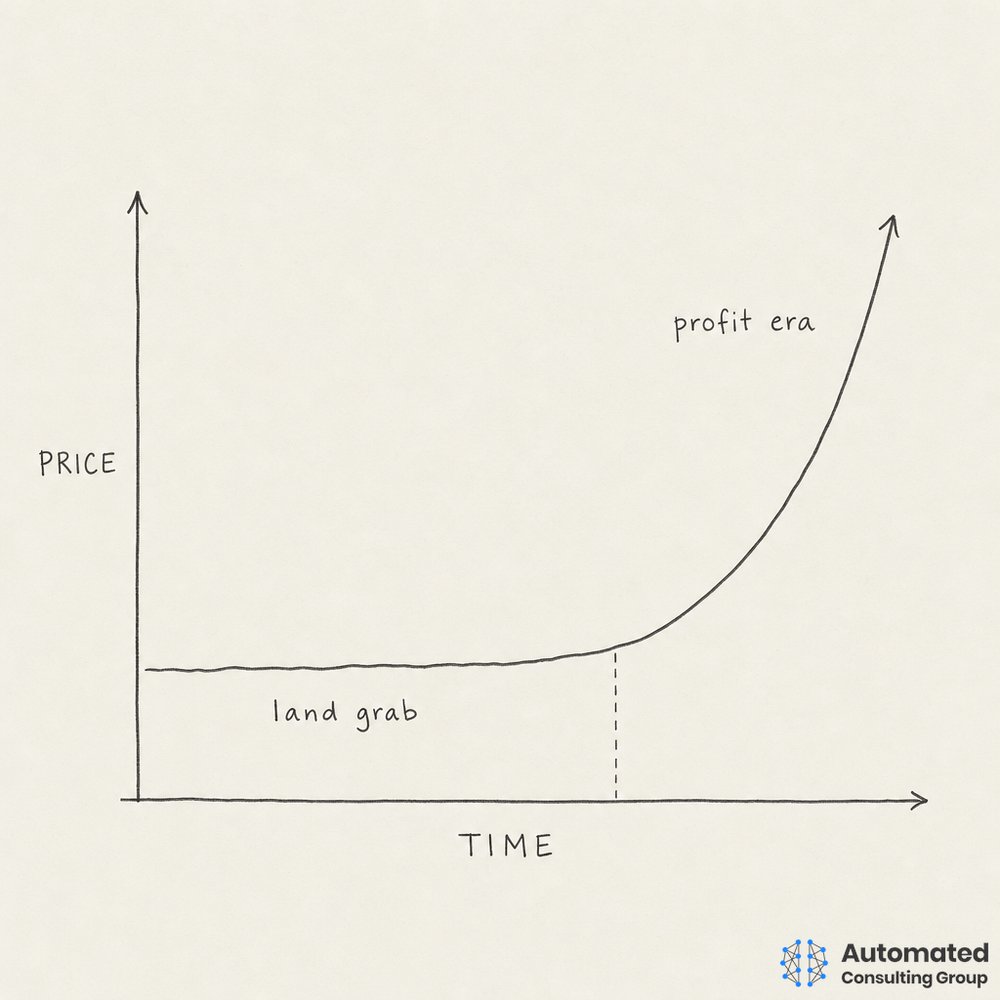
We're in the golden era of AI usage. The land grab is on. Every major lab is suppressing prices to capture market share, get developers building, get teams hooked. The travel planner you spun up over the weekend for $30 of API calls? You're getting that at a steep discount someone else is paying for.
This can't last. Capitalism doesn't take a permanent vacation. At some point the subsidy ends, prices float to where they need to be, and "build whatever, it's basically free" stops being true.
You'll hear "intelligence too cheap to meter" a lot right now. I'm skeptical. The more dependent we get, the less pricing power we have. Supply and demand works the way it always has. When everyone is hooked, the pricing changes.
A few things I'm doing because of this:
- Building the things I want to build now, while compute is cheap
- Capturing the workflows, prompts, and patterns that work so I'm not rebuilding them at 5x cost later
- Treating today's AI bill as the floor, not the average
Curious what others are doing to take advantage of the window while it's open.
59
Jun 4
Built a Claude Code skill this week that I didn't expect to need: I call it "/codex-opinion."
What it does is take whatever Claude just produced, send the full context over to Codex (OpenAI's CLI agent), and ask Codex what it thinks. Get a second model to grade the first model's work.
Why I built it: when I'm coding with Claude and it's been on a task for a while, I lose the ability to QA the output. It's confident. It's articulate. It tells me clean stories about what it did. But I can't always tell if those stories are true.
A different model, with different training and different biases, will often catch what Claude missed. And vice versa.
The interesting wrinkle is what I had to fix in my skill. When I first wrote it, Codex would mostly just agree with Claude, because the prompt I was passing in unintentionally led the witness. I was framing Claude's work as "the answer," not as "a proposal." Once I rewrote the skill to present it neutrally, Codex started catching real problems.
This is going to be a real pattern, I think. Not one agent doing the work. Multiple agents checking each other, with prompts carefully designed so they don't just rubber-stamp each other. Now I have a "/gemini-opinion" skill too.
We're going to spend the next two years rediscovering peer review, but for LLMs.
2
1
92
Jun 3
Did a software audit for a client this month. They have around 200 people. The list of paid software subscriptions came back longer than I expected, and I work in tech.
The pattern is always the same. Someone in one department bought a tool three years ago. Someone in another department bought a nearly identical tool last year. Neither knew about the other. A third tool covers 80% of both, and they're already paying for it as part of their Microsoft license.
A partner I was talking to said his litigation team has a contract redlining tool, and he discovered their general contract platform already had that exact feature built in. Nobody read the release notes.
This is the part of "AI strategy" nobody wants to talk about. Before you go buy the new shiny tool, you almost certainly already own the capability somewhere. M365 ships with Forms, Planner, Whiteboard, Loop, and most companies have never touched any of it. Likewise, Google Workspace has many of the same capabilities.
My rule with clients now: before we evaluate a single new AI tool, we do a full audit of what's already paid for. Nine times out of ten we find at least one tool that could be turned off, and at least one capability they already own that they thought they needed to buy.
The biggest AI ROI in 2026 might just be a spreadsheet of your current subscriptions.
Anyone else find duplicate tools when they actually looked?
1
1
85
Jun 2
Caught a weird AI failure mode at a client this week and I want to name it.
They asked an LLM to write a profile of someone whose personal life isn't documented online. Instead of saying "I don't have that information," the model wrote something like: "He keeps his personal life private, choosing instead to focus public attention on his professional work."
Think about that sentence. It looks like a fact. It reads like a fact. It's actually the model's way of saying "I don't know," dressed up in confident prose.
I've now seen variations of this everywhere. "While specific details are limited, this likely reflects..." "Information on this topic is not widely available, but it represents..." These are not statements. They're hallucinations wearing a suit.
The scary part is how persuasive they are. If you didn't know the model had no source, you'd assume it did.
The practical implication for anyone using AI in their work: when an LLM tells you something with no specifics, no numbers, no names, no dates, treat that as a confession, not a finding. The vagueness is the tell.
I now run every AI-generated summary through one filter: would this sentence still make sense if I deleted every adjective? If the answer is no, the model is probably bluffing.
This trick has saved me a couples times recently.
44
Jun 1
I keep telling people this and I don't think it lands until they experience it.
AI is a multiplier for your own productivity. That's table stakes. Everyone gets that.
But here's what's less obvious: if you only do one thing, AI multiplies that one thing. If you do a bunch of different things, the multiplying effect compounds across all of them.
I was talking to someone who runs an organization with a bunch of different business lines. Around $100 million in revenue, no real tech team. And my pitch to him was: you're actually the ideal AI candidate, not despite having a bunch of different businesses, but because of it.
I see this in my own work. I run a consulting firm, co-manage a venture fund, and do a bunch of other stuff. When I create something for one context, I can repurpose the thinking for another. I had Claude building a presentation in the background during one meeting. When it finished, I passed it to another AI tool that turned it into a website. The whole pipeline took minutes of my active attention.
Someone I work with described the same thing. He's giving a talk on Wednesday. He has Claude creating the presentation while he's in a meeting about something completely different. Once it's done, he feeds it into another tool that produces a website, prompts, and supporting materials. He always builds a website now for talks he gives.
For people who wear multiple hats, AI doesn't just save time on tasks. It gives you leverage across contexts.
The old advice was to focus. Do one thing well. That's still good advice for your company.
But for the individual operator? Doing lots of different things might actually be an AI superpower.
46
May 29
Sat in a meeting this week where smart people spent 30 minutes debating a company name.
I used to do this too. On my first startup, I think we burned a full week on it. We were convinced the name was going to make or break the brand.
It didn't. The product made or broke the brand. The name was just a sound the customers eventually got used to.
Look at the most successful companies you can think of. Half of them have names that are kind of weird, kind of meaningless, or both. Google. Spotify. Stripe. Beehiiv (with the two i's nobody can ever remember how to spell).
None of them won because of the name.
My current rule of thumb: pick something you can say out loud at a dinner party without explaining, that has an available domain, and that won't get you sued by Apple. Then move on.
Same thing with logos. I've seen early-stage founders spend $10K and three months on a logo they end up redoing 18 months later anyway. (Ok, maybe I was one of those founders)
The stuff founders agonize over is rarely the stuff that ends up mattering. Save the obsession for the product and the go-to-market.
1
68
May 28
My productivity outside of meetings is probably 10-20x what it was a year ago.
Inside meetings? Still 1x.
I had this epiphany last week. We've always said meetings are expensive. But in the age of AI, they're exponentially more expensive. Because every hour I spend in a meeting is an hour where I could be getting 10x more done outside of it.
So I started building something. The idea is simple: I'm already recording and transcribing every meeting. What if the AI could just act on what I say in real time?
Like, I'm talking to someone and I say, "Oh yeah, I need to send you that consulting agreement." And instead of me writing that down as a to-do item that I get to three hours later... it just happens.
Right now I've built a system where my meeting transcripts automatically get tagged by client, downloaded to the right folder on Google Drive, and at the end of the day a script pulls out all the action items and creates Google Tasks. End of week, another script goes through everything and drafts LinkedIn posts from stories I told in meetings.
But the next frontier is making meetings themselves productive. Not just capturing what happened. Actually executing during the conversation.
I've started doing something funny in meetings. I'll pause and repeat something back, not for the person I'm talking to, but for the AI that's listening. "So what you're saying is you want me to send that by Friday." I'm not clarifying. I'm issuing instructions to the transcript.
The economist Tyler Cowen said he wrote his last book for the AIs, because they'll be the only ones reading books in the future. He wanted them to remember him fondly.
I'm starting to talk in meetings the same way. Not for the person across from me. For the system that's going to do the work afterward.
Is that weird? Probably. But my to-do list has never been cleaner.
2
34
May 27
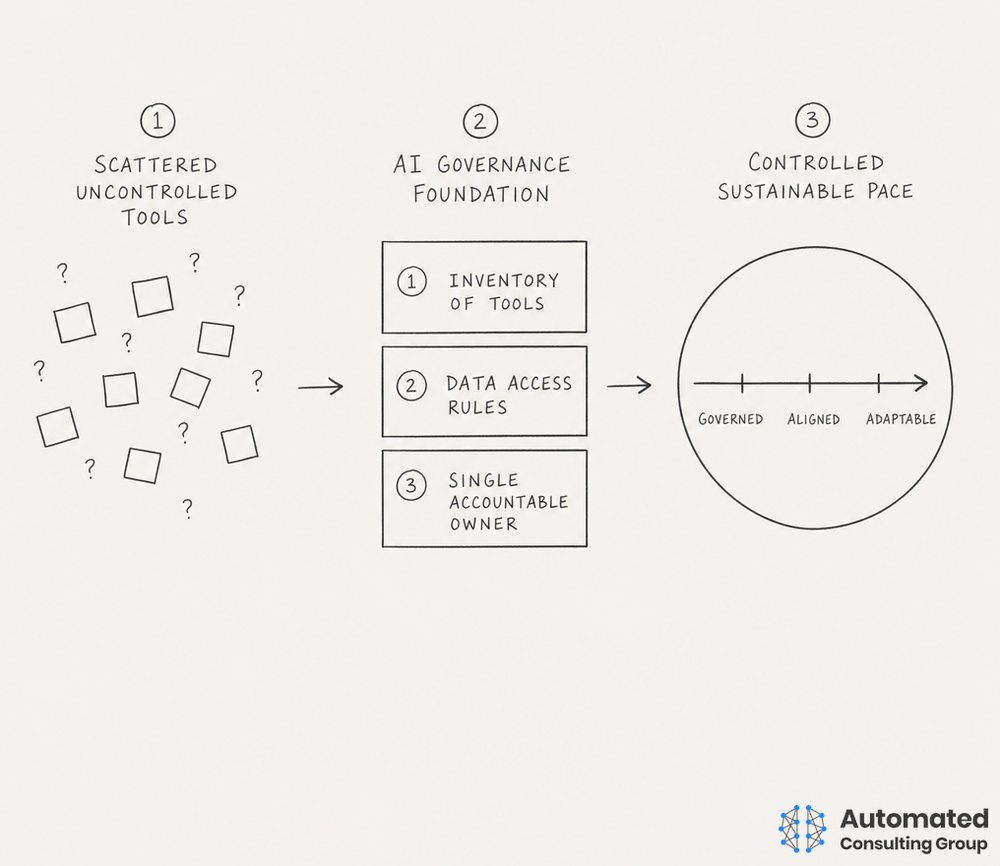
78% of business leaders aren't confident they'd pass an AI governance audit in the next 90 days.
That stat came out of an event my network was buzzing about this week. And honestly, it tracks with what I see at ACG.
Most mid-market companies have started doing something with AI. A pilot here, a tool there. Someone bought a ChatGPT Enterprise license. Maybe a vendor bundled AI into the software you already use.
But governance? Nobody touched it.
Here's why that matters: when AI is just scattered tools with no oversight, you don't actually know what data is going where, who approved what, or whether any of it is working. That's a real problem, not a theoretical one.
I'm not saying you need a 40-page policy document before you're allowed to use AI. That's how you get nothing done.
But you do need three basic things in place:
1. A list of which AI tools are actually being used across your company (most leaders I talk to are surprised by this number)
2. Clear rules on what data can go into those tools
3. One person accountable for keeping that list current
That's it to start. You can build from there.
The companies that will win with AI aren't the ones who move fastest. They're the ones who build enough structure to move fast without breaking things they care about.
If you're a CEO or COO and you genuinely don't know what AI tools your team is using right now, that's your first problem to solve. Start there.
33
May 26
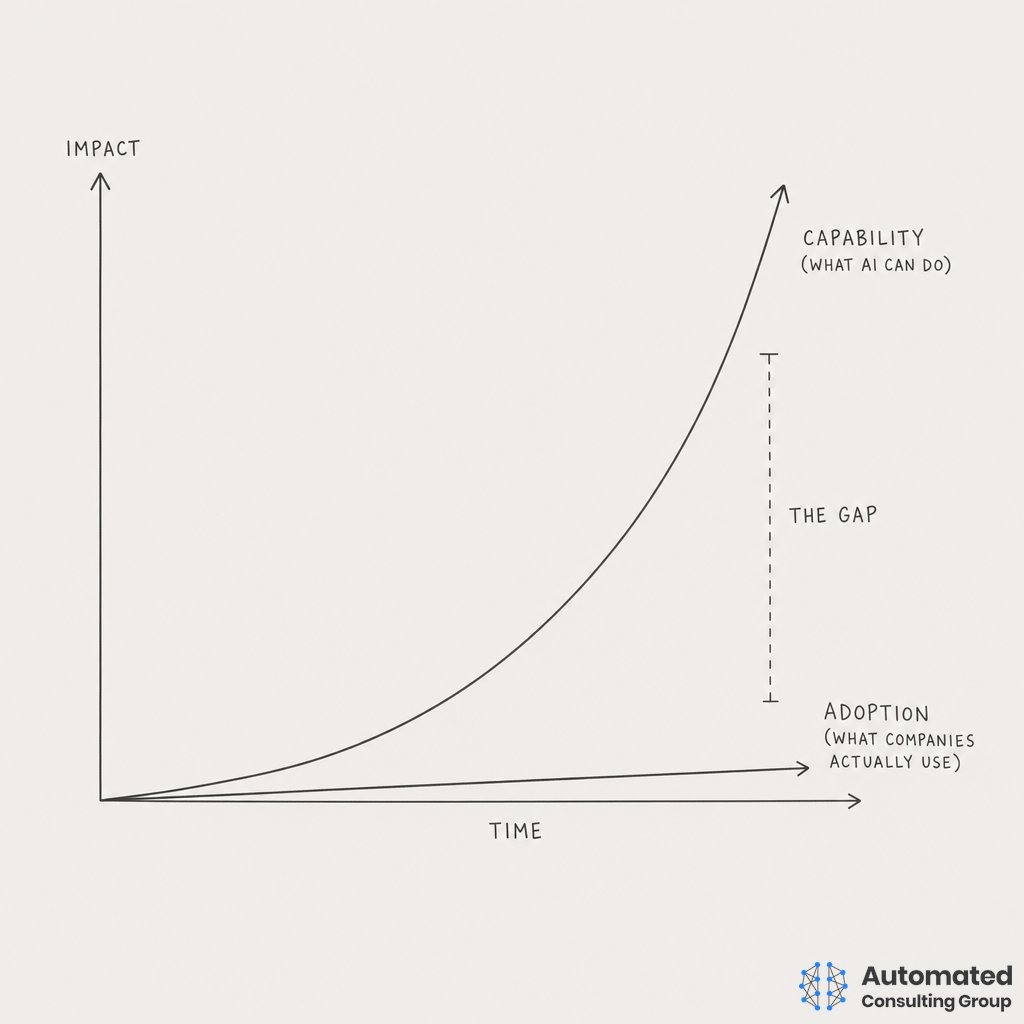
If every AI lab paused innovation tomorrow, most companies would still have 5-7 years of work just absorbing what already exists.
That's the part nobody talks about. The headlines are all about the next model. Faster. Smarter. More agentic. Meanwhile most companies are using maybe 5% of what's already shipping.
I see it every week. Teams that haven't tried Claude on their messy data. Finance leaders who've never had AI summarize a board deck. Operators still copying numbers between spreadsheets when an agent could do it in 90 seconds. Not because the tools are missing. Because nobody pointed them at the work.
The capability curve is exponential. The adoption curve is linear, and it's specific to each company. The pressure isn't that AI moved too fast. It's that almost nobody has sat down and asked which of their daily tasks could already be done by something that exists today.
The companies pulling ahead right now aren't waiting for the next model. They're auditing what they already have access to and putting it to work.
You can count on the models only getting better from here.
If you ran a 60-minute audit of your own week, what percentage of your tasks could be handled by tools you already pay for?
Curious what people are finding.
1
41
May 25
Sat in on a conversation at a client last week about whether new college hires should have access to AI tools from day one.
The usual debate. Some leaders want them to use it because that's what the job will actually look like. Others worry the new people will never develop the underlying skills if they lean on AI before they understand the fundamentals.
Then one manager floated something I hadn't heard before. What if new hires had to earn the right to use AI?
First month, no AI. You have to demonstrate you can do the work, understand the reasoning, defend your decisions, all without the tools. Prove you grasp what you're actually doing. Then after you've shown you understand the role, AI unlocks.
Like a progression system, but for tooling.
It's kind of like what the country of Malta recently announced for their citizens. Take an AI fluency course, get ChatGPT free for a year:
I don't know if it's the right answer. Honestly, I don't think anyone does yet. But I liked it because it inverts the default. Most companies are debating how much AI to allow. This frames AI as a privilege you qualify for by showing you can do the work without it.
That's a fundamentally different question than "how do we restrict AI?" It's "how do we make sure people understand their craft before they start optimizing it?"
Feels closer to right than what I've heard elsewhere.
Curious what folks in your organizations are landing on.
65
May 22
One of the best descriptions I've heard of using AI came from someone at a retail company.
She called it "arguing with it."
Here's how she described her process: "I give it my dirty version. Like, here's my idea. Here's the rough draft. Can you clean it up? No, I don't like that. You didn't understand. Here's what I actually meant."
Back and forth. Shaping an outline. Fleshing it out. Hitting a wall on a slide concept and pinging the AI until something clicks.
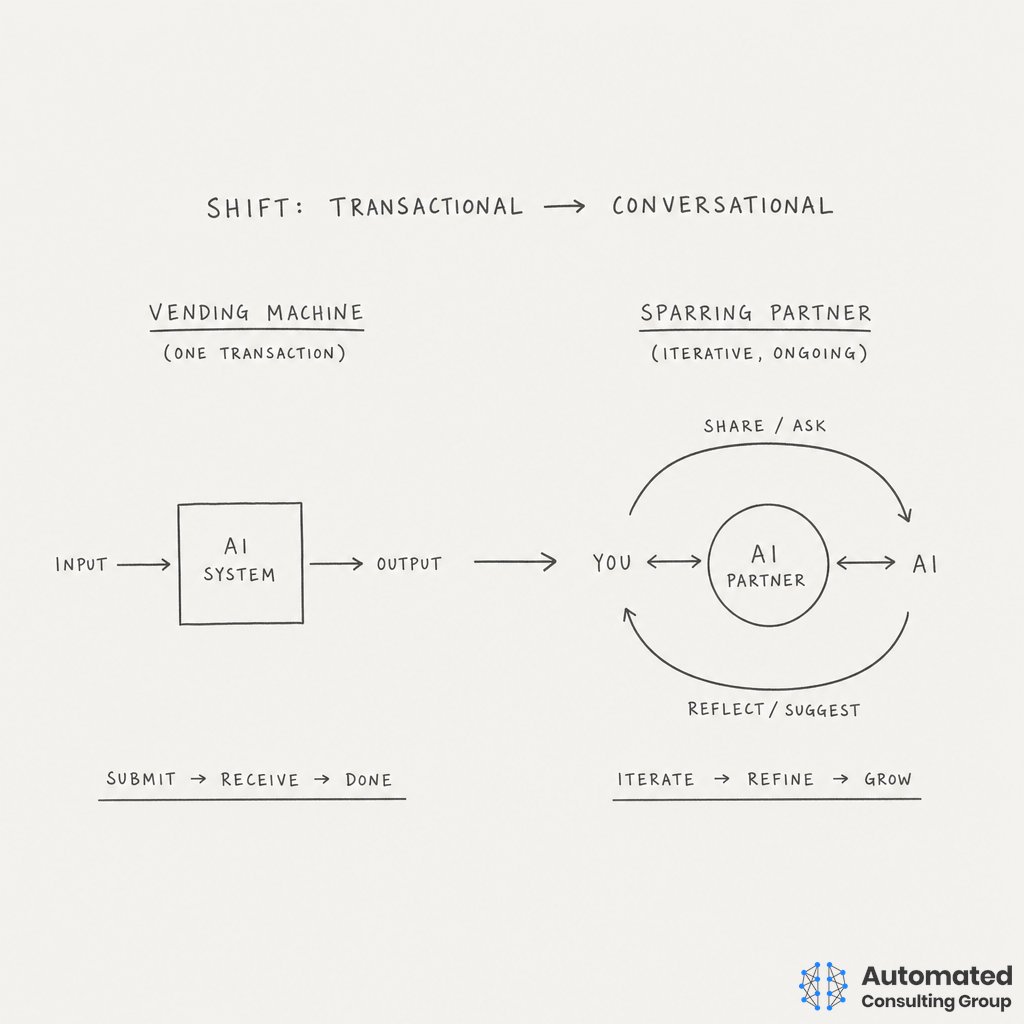
She's not copying and pasting AI output. She's having a conversation with it. And the conversation IS the work.
This is something I think a lot of people miss. They try AI once. They get output they don't love. They conclude AI isn't good enough.
But the people who get real value from it? They treat it like a sparring partner, not a vending machine. You don't put in a quarter and get a finished product. You throw ideas at it, reject what doesn't work, redirect, refine.
The same person told me she recently screened job candidates by transcribing all her interviews, feeding in resumes, and having AI help her synthesize the information. She said it "felt like cheating at first, but now feels very comfortable."
I hear that phrase a lot. "Felt like cheating."
It's not cheating. It's what the tool is for.
Nobody says using spell check is cheating. Nobody says using a calculator during tax season is cheating. We just haven't normalized this one yet.
Give it six months. The people arguing with their AI today are the ones who won't be able to imagine working without it tomorrow.
44
May 21
Met with someone last week who got picked as one of her company's AI champions and was completely confused about why.
"I'm not technical at all. I have no idea why they chose me."
She then proceeded to describe, in detail, how she uses ChatGPT every day. To draft emails she's stuck on. To turn rough thoughts into clear presentations. To work through a personal challenge where she just needed to think out loud with something that didn't know her. She called it "arguing with it" until she got what she wanted.
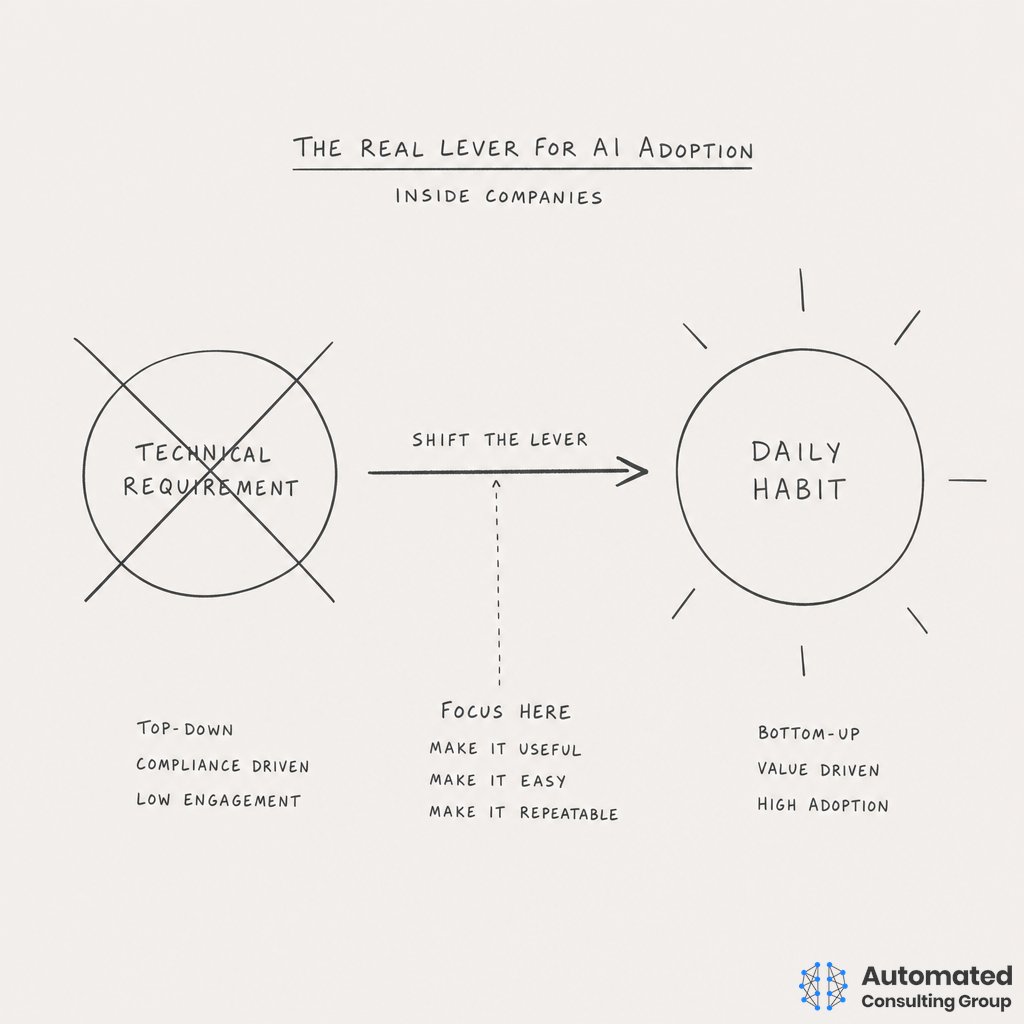
That's the champion. Not the technical wizard. The person who built the habit.
The biggest unlock in AI adoption inside companies isn't training people on prompting techniques. It's getting them to internalize that this is a tool they should reach for by default, the same way they reach for Google or Slack. Habit formation.
The technical depth comes later, and honestly, for most roles, it never really has to come at all.
The people I see making the biggest leaps inside their companies aren't the engineers. They're the operators who developed the reflex first.
69
May 20
When I started my AI consulting firm a year ago, I called up a bunch of CEO friends to get a read on the market.
First one: "Honestly, we're behind. We've barely done anything with AI."
Okay, fair. It's 2025. Maybe they are.
Second one: "We're so behind on AI it's embarrassing."
Hmm.
By conversation ten, every single CEO had said the exact same thing. "We're behind."
If everyone thinks they're behind, is anyone actually behind?
What I've come to believe is that the "we're behind" feeling is mostly a function of reading tech Twitter and Silicon Valley press, where the loudest voices are people whose job is to make it sound like the future already happened. It hasn't. Most companies haven't done much. The ones that have are mostly dabbling.
If you're just getting started in 2026, you're not behind. You're early to the practical adoption phase, which is where the real value gets created anyway.
The Silicon Valley narrative is not the same as the actual operating reality of the economy.
If you wait until 2027, you'll start to look behind.
60
May 19
Lately, I start every AI training session I give with the same concept. It's called the car wash problem that Karpathy mentioned in a recent talk.
Give this prompt to your favorite LLM: "I need to wash my car. There's a carwash 50 meters away. Should I walk or drive?"
Most AI models will respond with: "walk". They have facts about carwashes, about distance, about transportation modes. They've read everything the internet has to say about all three. But they don't have the world knowledge that you can't walk away from your parked car and have it get washed. They're missing the obvious constraint that makes the question absurd.
Current AI models have been trained on the entire internet. Every public book. Every piece of information the frontier labs could get their hands on.
But they don't actually understand the world.
That sounds counterintuitive. If you've trained on everything ever written, shouldn't you understand everything? The answer is no. There's a massive gap between knowing facts about things and understanding how those things actually work in context.
This is why the next frontier of AI is something called World Models. AI that doesn't just know what a car wash is, but understands the physical process, the sequence of events, the spatial relationships, the constraints.
Why does this matter for prompting? Because right now, you can't just type a phrase and expect AI to give you exactly what you need. You have to provide the context that AI is missing. The world knowledge that it doesn't have.
I was giving a session to attorneys at a law firm this week. These are smart people who are used to being precise with language. But even they were surprised at how much context you need to provide to get good results.
It's not that AI is dumb. It's that it's operating without a worldview. Every prompt you write is essentially filling in the gaps of understanding that AI doesn't have yet.
The people who get the best results aren't the ones writing the cleverest prompts. They're the ones who understand what AI is missing and provide it.
That's the real skill. Not prompt engineering. Context engineering.
And yes, that means the people with the deepest domain expertise have the biggest advantage. Not the techiest person in the room.
51
May 18
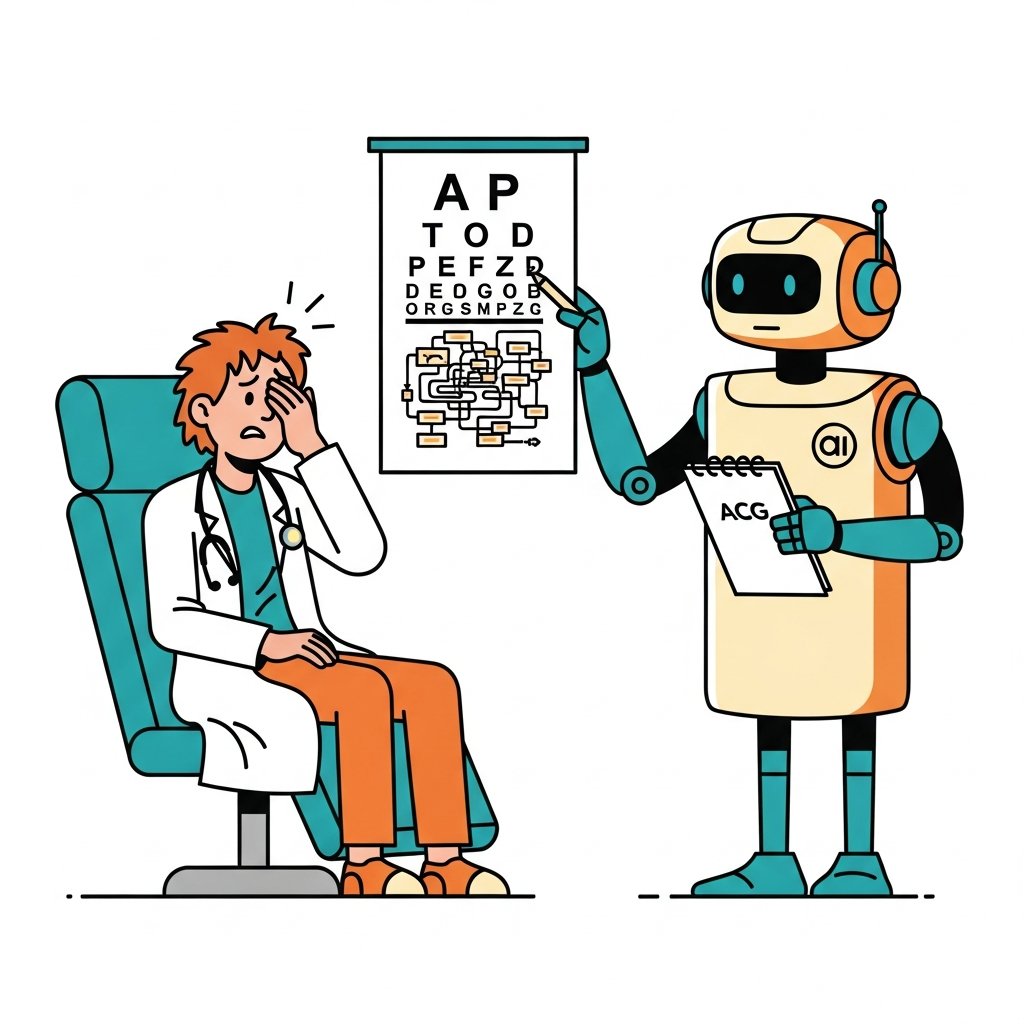
A doctor told me something last week that stuck with me: 'AI isn't going to replace us. It's going to show everyone how inefficient we've been.'
He was talking about eyecare practices. But I've seen the exact same thing play out in manufacturing, distribution, and professional services.
Here's what actually happens when a mid-market company starts using AI seriously:
Week one, they're excited about the tool. Week three, they're uncomfortable. Not because the AI is wrong. Because it's right, and that means staring at a process nobody has questioned in 10 years.
One client ran an AI tool against their sales pipeline data. The model flagged that their team was spending 60% of follow-up time on deals with less than 15% close probability. Not because anyone was lazy. Because nobody had ever built a system to tell them otherwise.
That's not a technology problem. That's a visibility problem AI just made impossible to ignore.
This is why I tell CEOs: the ROI conversation is the wrong starting point. Start with the question, 'What would embarrass us if we actually saw the data clearly?'
The answer usually points you to exactly where AI will pay off fastest.
What's the process in your company that nobody wants to look at too closely?
53