
The Ecom Google Ads Guy | Scaling online brands to$100k in 90 days with our Google Ads Framework | Follow for 8 years of E-com insights.
Joined November 2022
- Tweets 13,877
- Following 461
- Followers 7,768
- Likes 20,180
494 Photos and videos


Pinned Tweet

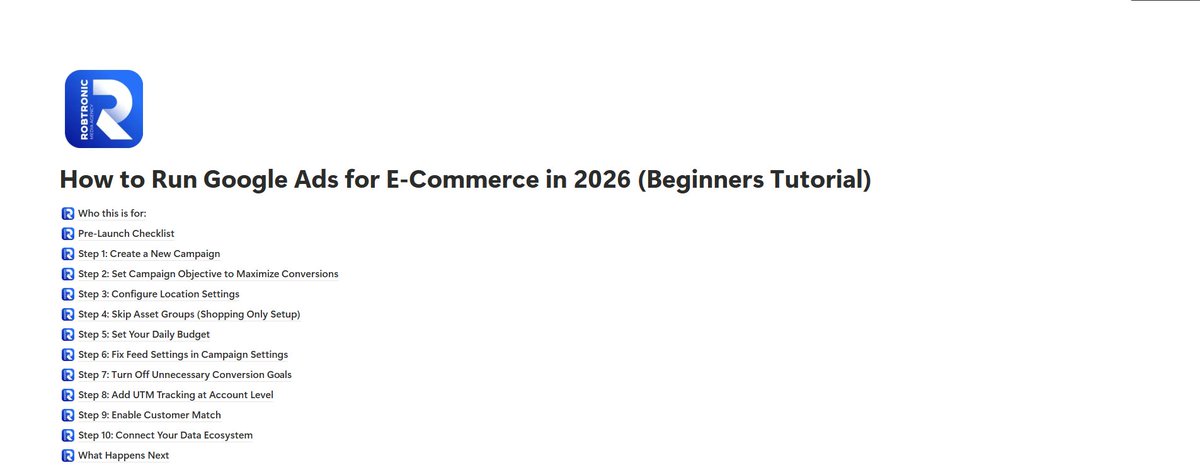
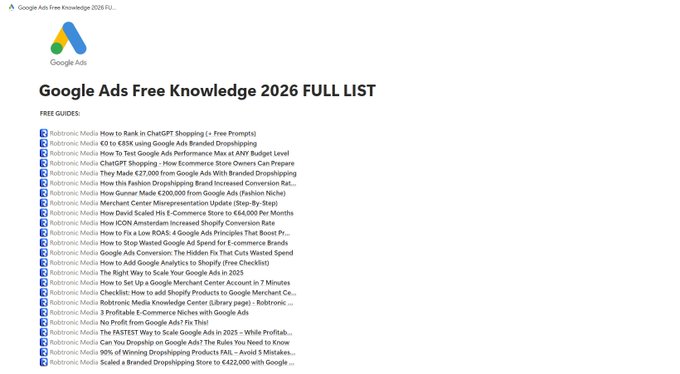
How to Run Google Ads for E-Commerce (Beginners Tutorial 2026)
If you want to grow an e-commerce or Shopify store with Google Ads, you first need to understand how Google Ads actually works and how to set it up the right way.
In this Google Ads beginners tutorial, I walk you step by step through creating your first Google Ads campaign, setting up your account, and avoiding the most common beginner mistakes.
This complete Google Ads for e-commerce guide shows you exactly how to run Google Ads in 2026, even if you’re starting from zero.
9
4
62
6,337
this is the only google ads tutorial you need

How to Run Google Ads for E-Commerce (Beginners Tutorial 2026)
If you want to grow an e-commerce or Shopify store with Google Ads, you first need to understand how Google Ads actually works and how to set it up the right way.
In this Google Ads beginners tutorial, I walk you step by step through creating your first Google Ads campaign, setting up your account, and avoiding the most common beginner mistakes.
This complete Google Ads for e-commerce guide shows you exactly how to run Google Ads in 2026, even if you’re starting from zero.
1
235
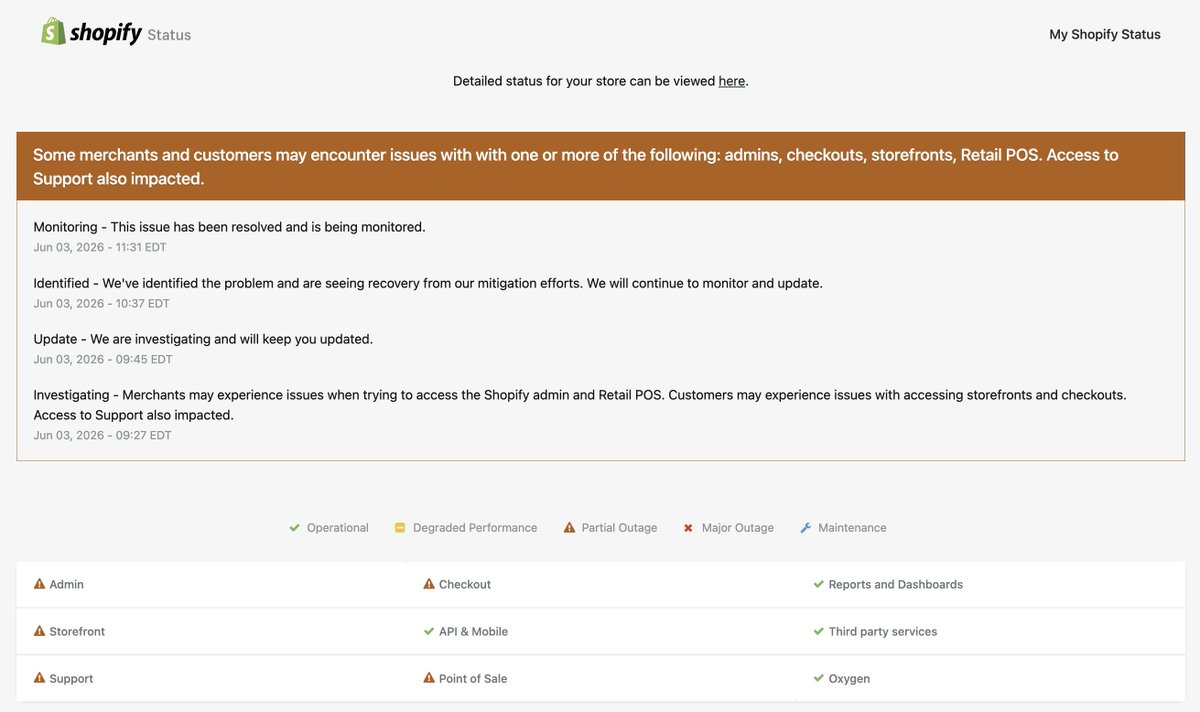
Shopify is down!
Exactly one day after their 20th year celebration.
Many stores are affected; be careful when scaling today.
1
1
471
google just changed how scheduled campaigns pace budget.
most people missed it.
previously, google paced your daily budget against active scheduled days.
a $100/day campaign running mon–fri spent roughly $2,200/month.
after march 1 (june 1 for the next wave): google now paces toward 30.4 × your daily budget - regardless of how many days your schedule runs.
that same mon–fri campaign now targets $3,040/month.
same budget. same schedule. 38%.
the math:
- weekends only, $100/day → up to $1,600/month ( 100%)
- mon–fri, $100/day → up to $3,040/month ( 38%)
- seasonal/flighted campaigns → some accounts seeing 50–100% overspend
one concrete case: a $3,550/day mon–fri campaign expected $74,550 in may.
under the new pacing, google targets $107,920.
that's $33,370 unplanned.
why it compounds:
- maximize conversions and maximize conversion value now have more headroom to spend toward
- mid-month overspend creates a dead zone in the final 7–10 days where impression share collapses
the fix: new daily budget = intended monthly spend ÷ 30.4
$2,200/month ÷ 30.4 = $72.37/day
$800/month ÷ 30.4 = $26.32/day
what to do now:
- audit every campaign with a custom ad schedule
- recalculate daily budgets using the formula above
- switch maximize conversions/value to tCPA or tROAS
- monitor budget pacing panel weekly through june
the passive protection of limited schedules is gone.
what used to manage itself now requires active recalibration.
1
6
341
Your Google Ads isn't spending your full daily budget?
Two reasons this happens:
1. You're in the learning phase
New accounts take 3–4 days to ramp up.
This is normal. Google is still figuring out your audience.
2. Your campaign settings are too restrictive
Target ROAS or max CPC limits can cap delivery even if your budget allows more.
Lower your target ROAS to open up more opportunities for Google to spend
Two things to always remember:
Target ROAS = the floor, not the ceiling. Google will always try to exceed it.
Daily budget = monthly cap. €30/day means you'll never exceed €900/month.
Master these = higher ROAS
1
2
245
you can implement sale prices across 500 SKUs in under 10 minutes, without changing a single website price.
that's what supplemental feeds are for.
a supplemental feed overlays attributes on top of the primary feed by matching on product ID.
five things you can do with a google sheet and a daily refresh:
- custom labels without touching the product database
- title overrides for your top 100–200 products
- sale price implementation for flash sales in minutes
- GTIN matching to increase impressions
- competitive title testing
the other thing worth knowing:
products priced more than 10–15% above the merchant center benchmark get algorithmically reduced impression eligibility.
it doesn't look like a pricing problem.
it looks like a campaign problem.
the diagnostic:
- high impression share, low click share → price is the issue, not visibility
- high impression share, high click share, low conversion → landing page or price-on-page problem
two different problems.
completely different fixes.
most accounts never separate them.
1
4
277
when your feed says "in stock" but the product isn't...
google's AI tries to complete the transaction, hits an error, and damages the product's reliability score.
it gets shown less.
for accounts running business agent or direct offers, the penalty compounds.
content updated regularly maintains positions 4.2 places higher than static feeds.
in 2026, freshness requirements have intensified.
AI mode and agentic commerce surfaces need:
- fashion and electronics: every 15–30 minutes
- home goods and sporting goods: every 1–2 hours
- everything else: minimum daily
the mistake that's hard to recover from:
deleting products instead of marking them out of stock.
deletion erases conversion history, impression history, and quality score.
when re-added, the product starts from zero.
mark it out of stock.
suppress with a custom label.
never delete.
feed freshness isn't housekeeping.
it's a compounding signal that determines where your products show up, and whether they show up at all.
2
3
254
stop treating PMax as a plug-and-play solution.
google made its roadmap clear at GML 2025 - PMax, Demand Gen, AI Max.
everything else is legacy infrastructure.
but the accounts failing on PMax aren't failing because the channel doesn't work.
they're failing because the inputs are broken.
three failure patterns across accounts:
1. feeding volume instead of value
- optimizing for "leads" tells google to find the cheapest leads
- cheapest leads = bots, junk, and form fills that never convert
- assign revenue values to lead types and the signal changes entirely
2. branded query cannibalization
- PMax gravitates toward branded searches by default
- high ROAS numbers, zero incremental growth
- you're not scaling, you're recycling existing demand
3. insufficient conversion volume
- PMax needs 30–60 conversions per campaign per month to learn
- below that threshold, the AI is guessing
- split campaigns incorrectly and you starve each one of signal
what's actually working in 2026:
- offline conversion tracking CRM revenue imports
- brand exclusions at campaign level
- reCAPTCHA v3 friction on lead forms
- regular placement audits — PMax defaults to mobile apps and made-for-ads environments, both high-fraud by default
the operators winning on PMax aren't using it differently.
they're feeding it better data.
signal quality is the only lever that scales.
1
3
304
most google ads accounts are not profitable.
they just look profitable.
ROAS is not return.
the formula is revenue ÷ ad spend — before cost of goods, shipping, returns, and fulfillment.
a 4x ROAS campaign can lose money.
a 2x ROAS campaign can be your most profitable.
the difference is margin.
three ways ROAS lies to you:
1: it doesn't know your margins
google gravitates toward high-volume, low-margin SKUs because those are easiest to sell at scale
ROAS looks strong
gross profit quietly collapses
2: it rewards warm audiences, not growth
the algorithm funnels budget toward returning customers because they convert cheaply
in brand-dominant accounts, 60–80% of attributed conversions may have happened without the ad at all
3: it hides diminishing returns
average ROAS is a blended number
channel a: $1k → $5k (ROAS 5x), raise to $2k → $6.5k (marginal ROAS 1.5x)
channel b: $1k → $4k (ROAS 4x), raise to $2k → $7k (marginal ROAS 3x)
channel a has the better headline
channel b generates more profit on incremental spend
the platform never shows you marginal ROAS
the metric that tells the truth: nCAC
one case using google's NCA goal: new customer share from 39% to 51%, volume up 54%, cost of new customer acquisition down 30% — while ROAS had been reporting strong the entire time
what to optimize instead — POAS: gross profit ÷ ad spend
set target ROAS at break-even (1 ÷ gross margin)
if your margin is 35%, break-even ROAS is 2.86x
anything below loses money
four things to check now:
- ROAS by branded vs non-branded
- break-even ROAS against your actual margin
- NCA reporting in PMax - if new customer share is below 30%, you're primarily serving repeat buyers
- nCAC for last 90 days from your CRM — if it's rising while ROAS holds flat, the deterioration is already underway
accounts optimized for profit often look worse on the dashboard initially.
the businesses scaling sustainably are running slower on the dashboard and faster in the bank.
2
4
248
Robin Tesselaar | Google Ads Merchant Fix retweeted
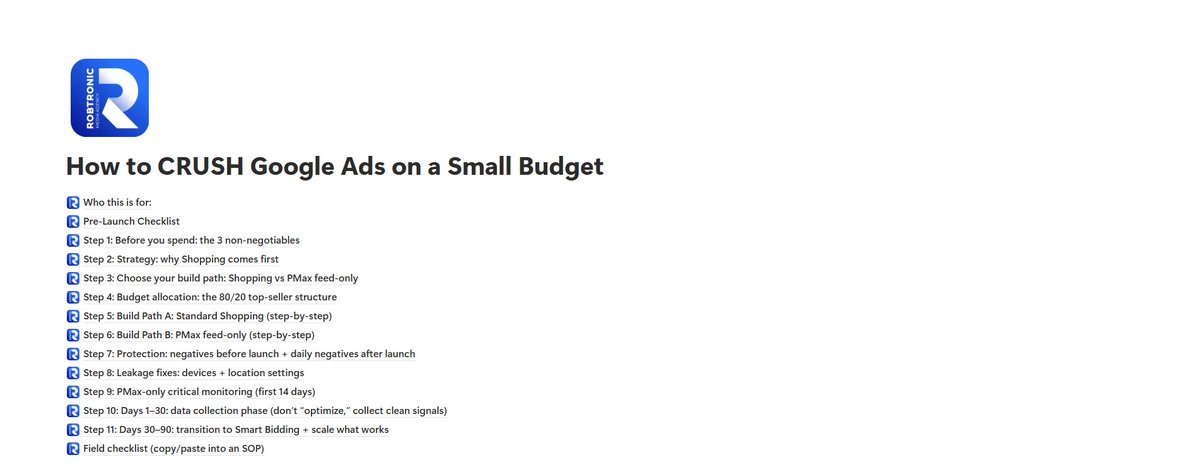
I’m giving away my best Google Ads strategy in 2026:
How to CRUSH Google Ads on a small budget.
Comment “Ads,” and I’ll send it over.
(just make sure you’re following so I can DM you)
19
2
11
831
one thing in Demand Gen most e-commerce accounts are ignoring:
creator content converted into Demand Gen ads
google added this in the march 2026 capability update
you can now discover relevant creators directly inside google ads
and convert their content into Demand Gen creatives
the performance difference is not marginal
creator-sourced Demand Gen ads drive on average 30% higher conversion lift on YouTube Shorts versus standard creative
why that number matters structurally:
Demand Gen already drives 18% higher share of conversions from new customers versus the paid media average
that makes it one of the few campaign types built for top-funnel acquisition, not just demand capture
when you combine that with creator content
the conversion lift compounds on top of an already stronger new customer signal
what this means for account structure:
if you're using Demand Gen exclusively for retargeting or warm audiences
you're using a top-funnel acquisition tool as a bottom-funnel safety net
the accounts getting the most out of it are running creator-sourced creative
against cold audiences
with the YouTube Engagements goal building organic reach alongside paid performance
the creative input is the structural variable here
not the audience, not the budget
1
3
256
AI Max is not a new campaign type
it's a feature suite layered onto existing search campaigns
three capabilities:
- keywordless intent targeting beyond landing page content
- dynamic ad copy tailored to individual search contexts
- AI-selected landing pages, not the one you specified
the full suite delivers roughly 7% more conversions versus search term matching alone
what most accounts haven't configured yet:
AI Brief - gemini-powered steering for messaging rules, audience targets, and matching restrictions
if you're running AI Max without it, you're handing the wheel to google entirely
text disclaimers in final URL expansion: regulated industries can now maintain required disclosure text even when AI selects the landing page
AI Max for shopping: dynamic shopping ads that answer conversational queries and capture long-tail searches standard shopping misses
the risks most accounts aren't managing:
landing page control: final URL expansion sends users to AI-selected pages, which can undermine conversion funnels and any A/B tests running in the background
search term opacity: the query range is broader than keyword campaigns, negative keyword hygiene becomes more critical here, not less
the auto-upgrade deadline: DSA, ACA, and campaign-level broad match get auto-upgraded to AI Max starting september 2026
advertisers who don't configure settings proactively will have them mirrored from legacy setup
the right way to test:
- 50/50 traffic split via google's experiments feature
- 30 days minimum before scaling
- monitor search term reports daily in weeks one and two
the accounts that will benefit most are the ones that configure it deliberately before september
not the ones that get upgraded on google's timeline
1
6
359
that moment you realize scaling wasn’t the problem, but your system was:
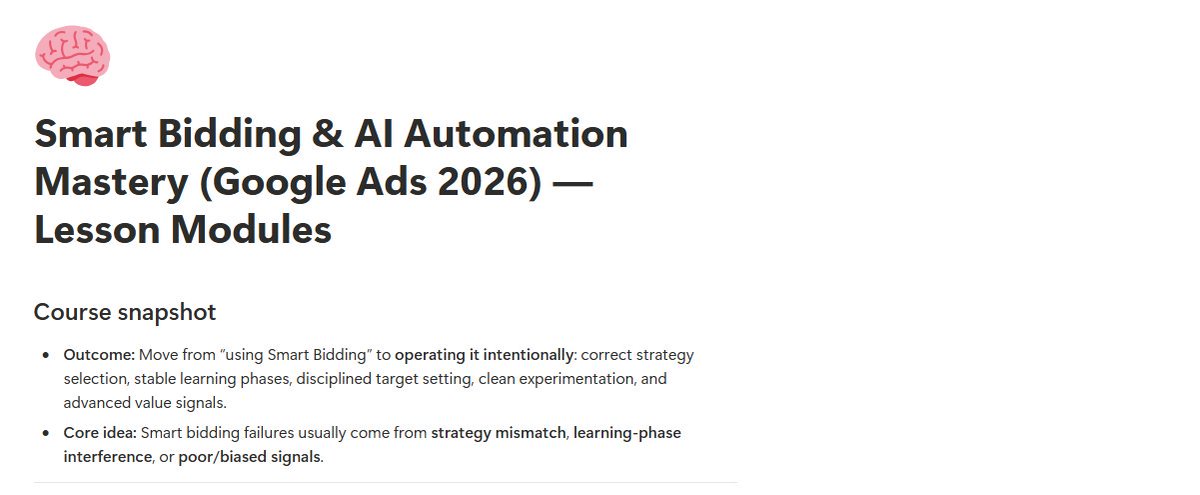
I built a complete Smart Bidding operating system for 2026.
Here's what's inside:
Step 0: Tracking and value integrity
Step 1: Strategy selection
Step 2: Matching strategy to your real business
Step 3: Learning phase rules (what not to touch)
Step 4: Setting targets that don't collapse spend
Step 5: Portfolio bidding for low-volume accounts
Step 6: How to test without breaking production
Step 7: Seasonality adjustments before promos
Step 8: Margin data, LTV signals, and value rules
Step 9: Phase-by-phase transition roadmap
Step 10: Weekly review that preserves stability
Want access?
Comment "google," and I will send it over.
(Must be following)
167
Robin Tesselaar | Google Ads Merchant Fix retweeted
I built a complete Smart Bidding operating system for 2026.
Here's what's inside:
Step 0: Tracking and value integrity
Step 1: Strategy selection
Step 2: Matching strategy to your real business
Step 3: Learning phase rules (what not to touch)
Step 4: Setting targets that don't collapse spend
Step 5: Portfolio bidding for low-volume accounts
Step 6: How to test without breaking production
Step 7: Seasonality adjustments before promos
Step 8: Margin data, LTV signals, and value rules
Step 9: Phase-by-phase transition roadmap
Step 10: Weekly review that preserves stability
Want access?
Comment "google," and I will send it over.
(Must be following)
4
1
3
641
in 2026, google AI autonomously manages:
- bidding
- audience selection
- creative asset generation including video
- URL routing
- inventory allocation across channels
and now with AI Brief, powered by gemini:
- messaging direction
- matching boundaries
- audience persona targeting
the advertiser's job has structurally changed
what AI cannot decide for you:
conversion architecture - what counts as a valuable conversion, what CRM data to import, how to structure value rules
account structure: how many campaigns, how to segment, when to consolidate vs split
brand voice - AI Brief lets you set messaging restrictions, but the strategic direction has to come from a human
incremental measurement - whether PMax or AI Max is driving net-new customers or just capturing demand you would have won anyway
the model won't tell you any of this on its own
AI Brief gives you three steering mechanisms:
- messaging guidelines: what ads should and shouldn't say
- matching guidelines: what searches to prioritize or avoid
- audience guidelines: who to reach and with what message variation
it only works if you have a clear strategic position to feed into it
1
2
222
five things to stop doing in google ads in 2026:
1. phrase match as a primary strategy
AI-powered broad match now reads intent better than phrase match did semantically
the only cases where phrase match still earns its place:
- highly regulated categories
- brand terms where exact phrase control is legally or competitively critical
everywhere else, migrate to exact or broad
2. defaulting to standard shopping without testing PMax
the 2024 ad rank update removed PMax's auction priority over standard shopping
standard shopping gives you cleaner attribution and better brand safety
PMax gives you scale and cross-channel reach
the right answer is testing both
3. GA4 as primary conversion action
GA4 attributes conversions to the date the conversion happened, not the ad click date
that misalignment starves smart bidding of the real-time signal it needs
native google ads conversion tags are the standard
GA4 is secondary
4. letting PMax capture branded queries
PMax gravitates toward branded searches by default — easiest conversions, highest reported ROAS
the problem: those conversions were largely going to happen anyway
separate branded traffic into dedicated brand search campaigns to see the true incremental contribution of PMax
5. over-pinning RSA headlines
pinning headlines feels like control
what it actually does is prevent google's system from finding which combinations perform
fewer, higher-quality assets with minimal pinning outperform stuffed, heavily-pinned ad groups
the pattern across all five:
tactics that felt like control
but were actually hiding signal from the system doing the bidding
clean inputs beat clever constraints
4
274
7 things breaking most google ads accounts right now:
1. GA4 as primary conversion action
GA4 imports don't fire in real time
smart bidding is starved of the freshness it needs to bid correctly
native google ads conversion tags are the standard
GA4 should be secondary
2. no consent mode
when users decline cookies and consent mode isn't configured those conversion paths disappear from smart bidding signals entirely
not a compliance issue
a performance issue
3. no offline conversions
lead gen accounts that only fire on form submissions are teaching google to optimize for volume
not for revenue
4. phrase match reliance
phrase match is caught between two better options:
— exact match for tight semantic control
— broad match with smart bidding for scale and intent reach
most phrase match keywords need to move to one or the other
there's no compelling reason to stay in the middle
5. call-only ads still running
google began phasing these out in january 2026
new call-only ads can't be created
existing ones stop serving entirely by february 2027
the replacement is RSAs with call assets
if you haven't migrated yet, the clock is running
6. PMax transparency tools not used
google added real controls in early 2026:
-first-party audience exclusions to shift spend toward net-new customers
-budget reporting with end-of-month projections
-full demographic reporting by age and gender
-network segmentation in placement reports
accounts ignoring these are spending budget on existing customers and calling it growth
7. AI voice-overs already running on your video assets
google quietly enabled automatic AI-generated voice-overs on PMax video assets in early 2026
opt-out deadline was march 20
if you missed it, check your PMax video assets now
there may already be AI voice-overs running out of brand tone
the common thread across all 7:
these aren't bidding problems
they're infrastructure problems
smart bidding performs to the quality of the signals it receives
fix the signals first
3
288
here's what most Google Ads accounts are missing right now:
google's AI Overviews
the results on the search page only serve ads from broad match and keywordless targeting
exact match and phrase match are architecturally excluded
AI Max, which graduated from beta in april 2026, takes this further:
- keywordless targeting based on real-time intent signals
- dynamic copy tailored to the individual query
- AI-selected landing pages, not the one you specified
- accounts using it see roughly 7% more conversions at similar CPA
starting september 2026, DSA campaigns and campaign-level broad match campaigns get auto-upgraded to AI Max
whether you're ready or not
what actually changed:
old model: keyword triggers bid
2026 model: predicted conversion probability per query triggers bid
old model: you pick the destination
2026 model: AI routes to the best page
old model: you write the copy
2026 model: AI Brief guides dynamic generation
the marketers who understand these updates
will outperform the ones who don't
5
386
I created the best keyword strategy in 2026.
Here's what's inside:
• Step 1: what match types mean in 2026
• Step 2: the match type decision matrix
• Step 3: four-layer negative keyword architecture
• Step 4: weekly negative keyword system
• Step 5: search themes for PMAX
• Step 6: what AI Max actually is
• Step 7: ad group structure
• Step 8: DSA campaign audit
• Step 9: DSA to AI Max migration
• Step 10: the 2026 keyword strategy
Want access?
Comment "keyword," and I will send it over.
(must be following)
16
1
9
547