
Gelukszoeker, wie niet?
Joined September 2021
- Tweets 1,654
- Following 195
- Followers 53
- Likes 18,230
12 Photos and videos








Ronald (0k) retweeted

9 Aug 2023
#FactCheck on pre-trial schedule issued today by Judge Torres (1/2)
- @Ripple is NOT "going on trial"
- Judge Torres' ruling that the XRP token is not a security is NOT going to trial
- The trial will NOT decide matters of law, only one narrow set of facts in dispute
34
497
1,481
117,585
Ronald (0k) retweeted

9 Aug 2023
No, they’re not. 😂
They’re appealing the programmatic sales by Ripple.
Not the security status of XRP itself.
🎇XRP’s non-security status can’t be appealed.🎆
😎
Already seeing lots of BTC maxi’s spreading this narrative. Good luck with that! 😂
92
587
2,325
167,418
Ronald (0k) retweeted

9 Aug 2023
The SEC does not have the “right” to appeal just yet which is why they are asking permission to file an “interlocutory” appeal. Ripple will file its response with the Court next week. Stay tuned.
9 Aug 2023

#XRPCommunity #SECGov v. #Ripple #XRP BREAKING: SEC Files Letter outlining its basis for filing a Motion for Leave to File an Interlocutory Appeal regarding “Programmatic” offers and sales to XRP buyers over trading platforms and Ripple’s “Other Distributions.”
dropbox.com/scl/fi/l2650lb9y…
249
1,239
3,999
425,159
Ronald (0k) retweeted

9 Aug 2023
I'm excited to be welcoming XRPL developers and speaking at Apex 2023 in Amsterdam.

97
283
1,836
103,896
Ronald (0k) retweeted
7 Aug 2023
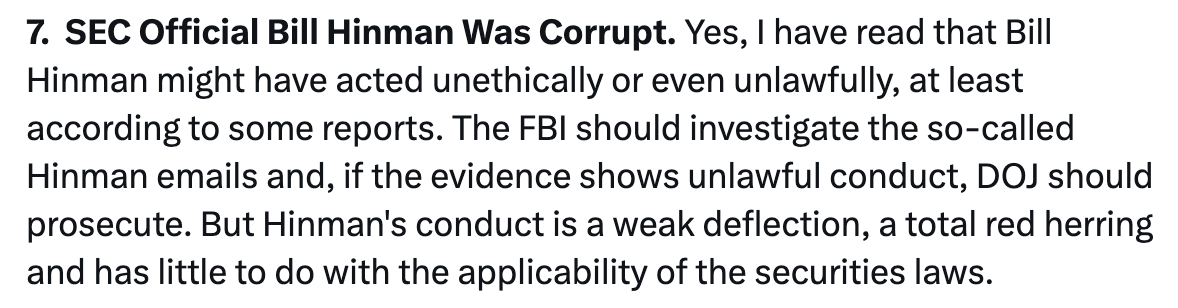
Crypto critic/x-SEC official @johnreedstark says there should be an investigation into Bill Hinman. This is broader than Ripple - there could potentially be serious conflicts of interest by a gov official. An investigation will either put it to rest or hold folks accountable.
153
919
2,614
542,172
Ronald (0k) retweeted
4 Aug 2023
As a companion informational tool to the troves of "Hinman emails" now public via @Ripple's legal defense, @EMPOWR_us lawsuits and #XRPArmy sleuths, here is our Video Library consisting entirely of publicly sourced videos of key figures involved in the 2018 Hinman speech stating #ETH was not a security.
It's all their words, not ours. 👇
crypto-law.us/video-library/
27
160
467
43,591
Ronald (0k) retweeted

4 Aug 2023
PUBLIC SERVICE ANNOUNCEMENT: We are only at 1.3°C of global heating and the Earth is breaking down like crazy. 1.5°C was NEVER a safe level. But, thanks to fossil fuel industry lies and bribes, we are on track to blow past that and get to 3°C or more which will be hell on Earth
164
1,822
5,340
305,890
Ronald (0k) retweeted

4 Aug 2023
listen up, stupids:
no, the email lady did not contest her election. she conceded after 24 hours. then she fucked off and went home.
Al Gore challenged his election in court, and after he lost, he conceded. and then he fucked off and went home.
Donald Trump refused to concede, and whined and plotted and begged and bullied and conspired with his ace team of parking garage lawyers and eventually sent a mob of armed dipshits to the Capitol to disrupt the certification so he could cling to power.
all because he's a big fucking dirty-diaper baby who couldn't face being a loser.
and now he's fucked and all the lying the world isn't going to change one thing
1,745
4,355
24,038
1,814,972
Ronald (0k) retweeted

2 Aug 2023
Ik kan wel janken. De rechtbank ziet klimaatcrisis beperken als 'onze doelen' ipv algemeen belang. Een onwetenschappelijke houding en geeft geen gehoor aan uitspraak van Hoge Raad dat mensenrechten van Nederlanders onvoldoende worden beschermd tegen klimaatcrisis.
699
88
455
272,405
Ronald (0k) retweeted
2 Aug 2023
A lot of reasons.
First, he's one of the worst boss/managers in history. One of the most critical skills a boss/manager *must* have is to push away "yes men" and get people to report honestly what's not working well to them. Donald Trump is worse at this than anyone I have ever heard of.
Second, he accepted the job of President with no intention of actually *doing* that job and to the extent he actually did thing, they were largely attempts to get the US government to facilitate his personal business.
Third, he is a dishonest man. He deliberately refuses to pay people who have done labor for him, despite knowing he has no legitimate reason to do so, to obtain leverage to get them to accept reduced payments.
Fourth, he is a pathological liar who treats every interaction as a transaction that he must win. He demands loyalty but will burn those who have supported him as soon as he thinks it's to his benefit to do so.
Fifth, he is a stubby-fingered vulgarian who has corroded the quality of public discourse.
Sixth, everything he does turns to garbage. His list of failures is nearly endless, his airline, his magazine, his steak, his vodka, he even bankrupted a casino. How do you even do that? He has no taste and everything he builds or designs looks like the way a child might imagine something expensive would look. This is something he has in common with many of the world's worst dictators.
And, honestly, I've barely scratched the surface.




238
25
247
39,598
Ronald (0k) retweeted

1 Aug 2023
What the hell is going on here? @DailyMailUK claims the emissions of solar panels are much higher based on a "report" by a "researcher".
Turns out it's just some Italian guy talking bollox to a conspiracy loving lobby-group.
I can't believe ppl in the UK call this a newspaper.
31 Jul 2023

The big eco lie: Solar panels produce five TIMES more carbon dioxide than previously thought, report claims trib.al/eb6SjsJ

52
188
957
137,005

2 Aug 2023
RT @extremetemps: South America is living one of the extreme events the world has ever seen
Unbelievable temperatures up to 38.9C in the Ch…
7,297
Ronald (0k) retweeted

30 Jul 2023
I'm officially done with the @SECGov .
I've been following their approach to Ethereum since 2017. I've watched, studied, and evaluated dozens of emails over the past six years in which SEC employees joke about their own bribery.
I'M DONE.
Their conduct is beyond questionable. It's sluggish, costly, and overextended. Their regulatory framework is completely shattered. And they aren't even consistent with their own principles. Offering Ethereum a free pass, regardless of its glaring issues like the founders calling to defraud the public on video!
Non-stop i corruption and flawed decisions (yet they still pat themselves on the back). And I'm not naive enough to overlook their suspicious endorsement of completely shady tech projects.
Possibly the most corrupted organization ever.
@SEC_News failed, and the most disgraceful part is, over the last six years no one has presented a legitimate alternative.
$CONGRESS LOL
$DOJ incapable/corrupted
$CFTC Complicit
Everything else, also corrupt and complicit. I loathe this lack of financial integrity. The most degraded 'industry' ever crafted.
29 Jul 2023

I'm officially done with $ETH.
Ive used Ethereum exclusively as my layer one since since 2017. Bought, traded, stored tens of millions of USDT/C, tokens over last six years.
IM DONE.
It doesnt work. Its slow, expensive, bloated.
Defi is broken.
And not even decentralized.
$30 defi transactions. $7 USDT transactions.
Non-stop fee/transmit errors (still pay fee tho).
And Im not even dumb enough to store/trade worthless JPG URLs.
Possibly the most useless tech ever created.
@VitalikButerin failed, and the worst part is, over the last six yeara no one has created a legit alternative.
$BNB LOL
$SOL broken/centralized
$ADA centralized
Everything else, also broken/centralized. I hate crypto. The most useless 'industry' ever created.
@badenglishtea
20
169
618
54,997
Ronald (0k) retweeted

28 Jul 2023
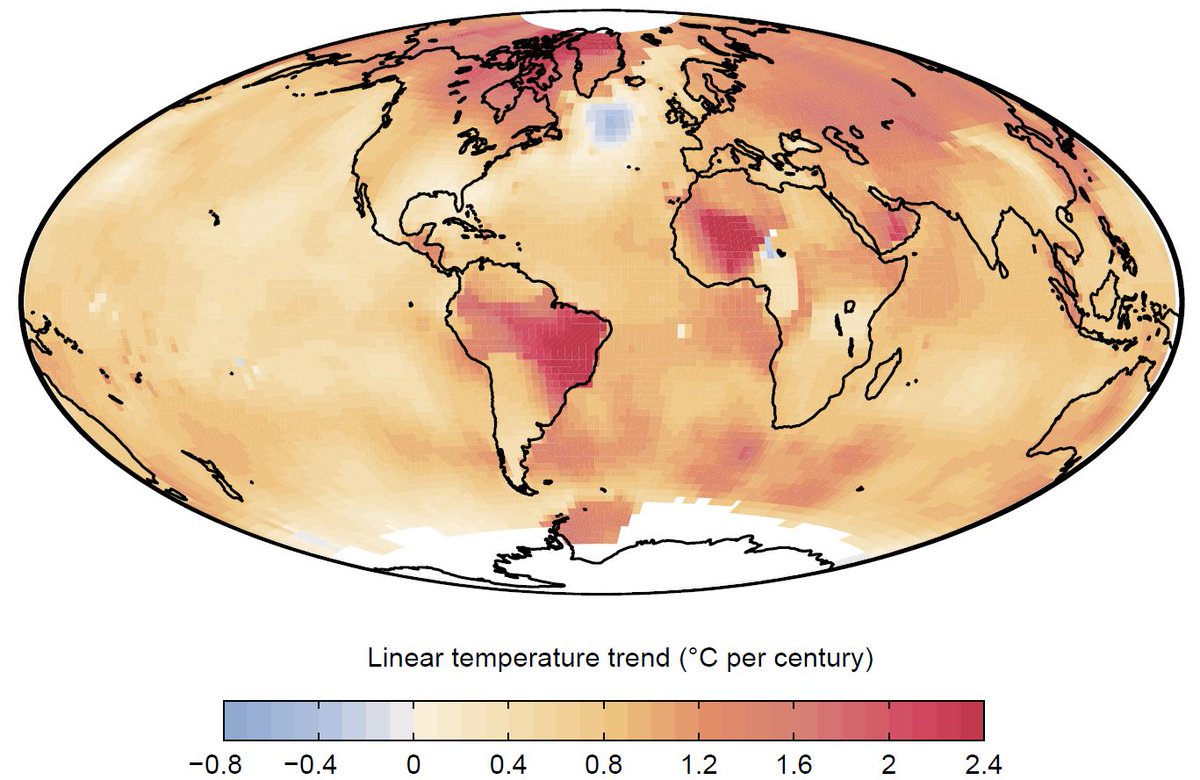
Here's a thread in pictures about the Atlantic overturning circulation #AMOC which is making headlines this week. I've studied this topic since 1991 and will show key data and models & some video.
Let's go: observed temperature trend since 1901 from nature.com/articles/nclimate… 🧵1/x
237
2,976
6,927
3,088,990
Ronald (0k) retweeted

28 Jul 2023
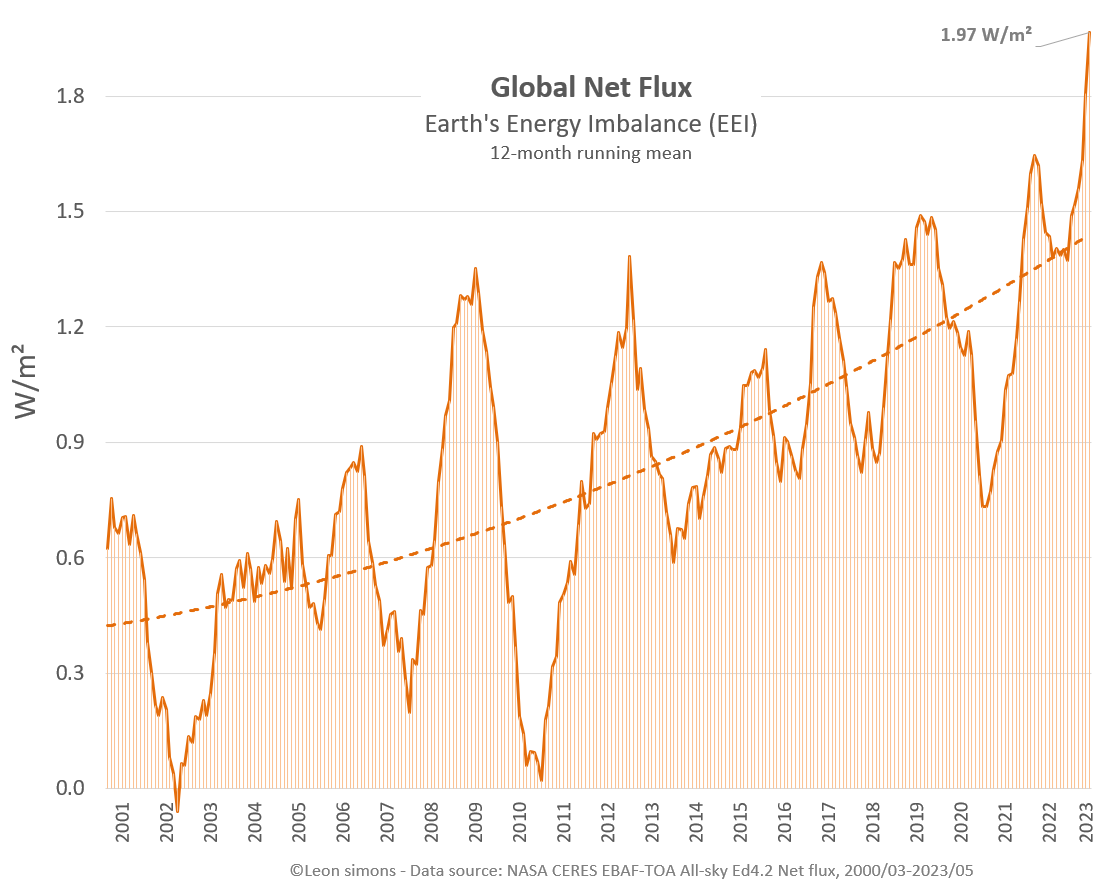
🔥🌍📈BREAKING @NASA 📈🌍🔥
The Earth's Energy Imbalance from NASA satellite data reached 1.97 W/m² (12-month mean)!!
I called this the most important graph in the world.
This helps to explain all the records currently being broken around the word!
1/
299
1,660
3,893
1,952,184
Ronald (0k) retweeted

25 Jul 2023
"De beestjes hebben geen natuurlijke vijanden.”, meldt @RTLnieuws, maar dat is maar de halve waarheid. De #appelbloesemkever heeft namelijk wél een natuurlijke vijand: de #sluipwesp. Onze biologische appelbomen hebben geen last.
@KuypersMarieke rtlnieuws.nl/nieuws/nederlan…
27
177
494
77,519
Ronald (0k) retweeted

24 Jul 2023
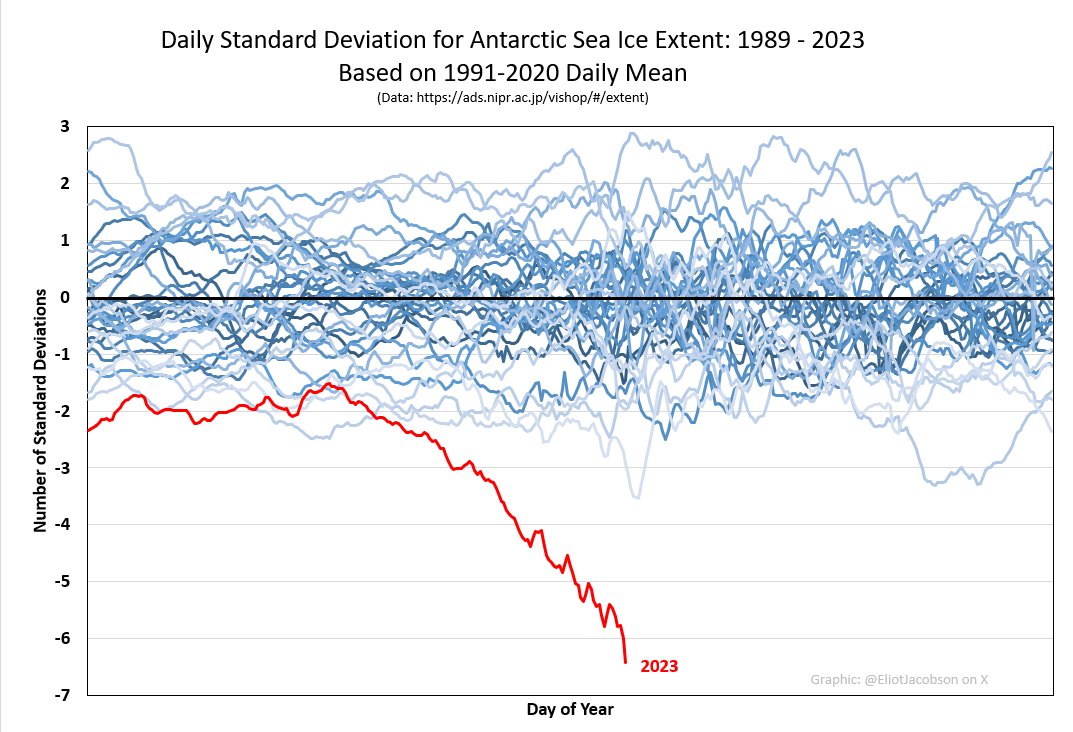
Apologies in advance for not explaining this in any way, but here are the daily standard deviations for Antarctic sea ice extent for every day, 1989-2023, based on the 1991-2020 mean. Each blue line represents the SD's for a full year. Lighter is more recent.
2023 is in red.
212
1,801
4,678
1,065,567
Ronald (0k) retweeted
25 Jul 2023
Help this xeet get a thousand rexeets.
254
1,468
3,829
504,004
Ronald (0k) retweeted

23 Jul 2023
How often will people flee from hellscapes like #Greece before the penny drops that this is a climate emergency? This is not just a minor local incident that disrupted a one-off holiday. The situation will only escalate unless significant mitigation is taken - 2021 video.
146
850
2,247
233,689
Ronald (0k) retweeted

24 Jul 2023
We understand the immense emotional sensitivity surrounding the victims of the Auschwitz, and it is crucial to approach the topic with the utmost respect and consideration.
At its core, Auschwitz was a place of unspeakable dehumanization, torture, and murder. 1,3 million people were deported to the camp by Nazi Germany and 1,1 million people - 90 percent of whom were Jews - were murdered there during 4,5 years of its operation. It is essential that we never lose sight of this universal truth.
When discussing the fates of those persecuted in Auschwitz, we employ different terminology to honor the diverse experiences and uncertain circumstances surrounding their deaths.
One term we utilize is "murdered" when we have explicit knowledge that an individual was tragically killed in a gas chamber. This term serves to acknowledge the horrifying reality of those who were chosen for extermination in this manner. We also specify when we know that a prisoner was shot, killed with a phenol injection, hanged or was murdered in different ways.
However, it is important to recognize that our understanding of the specific circumstances of death for many people deported to Auschwitz is limited. In cases where we lack precise information regarding the fate of an individual, we employ the term "did not survive." This phrase serves as a way to convey the uncertainty surrounding the person's destiny, encompassing the possibilities of being selected for extermination, registered as a prisoner within the camp, or later transferred to another camp, where their ultimate fate remains unknown.
Furthermore, when we are aware that someone died as a registered prisoner of Auschwitz, but the circumstances of their death are unknown, we employ the term "perished."
This term recognizes the tragic loss of life within the camp, acknowledging that these individuals died while under the oppressive conditions of Auschwitz. "Perished" emphasizes the human toll and the profound suffering endured by those who lost their lives in the camp, while respecting the absence of precise knowledge about the specifics of their passing.
45
165
3,816
214,397