
Joined January 2017
- Tweets 9,839
- Following 360
- Followers 3,296
- Likes 19,564
555 Photos and videos









Pinned Tweet

how much decentralization matters over time
2
2
17
607
Common Knowledge Brother retweeted

This is why **crypto agility** is super important for blockchains.
It refers to "the ability to replace and adapt cryptographic algorithms for protocols, applications, software, hardware, and infrastructures without interrupting the flow of a running system to achieve resiliency."
It's not a buzzword. It's a design imperative that @NIST keeps urging everyone to adopt.
However, we don't see anyone else in the crypto industry approaching the threat of quantum computing with this in mind.
CKB is the **only** crypto agile blockchain in existence.
And it wasn't purpose-built for this. It's simply one of the features of its low-level flexible architecture.
A bold design that is now paying dividends.
Follow us to learn more about how CKB solved quantum resistance.

Dan Boneh suggests NIST's PQ DSA standards came out too soon. his take: if NIST had waited a couple years, ML-DSA signature sizes could be 1/3 of what they are today.
It is a critical trade-off on size and timing for post-quantum crypto deployment. That's why many systems don't realize that they will have to re-architect more than they think to handle larger key sizes. But waiting is also a gamble, and if you're doing anything in government, you can't wait.
Hats off to the cryptographers/product folks having to handle this!
21
66
3,600
Common Knowledge Brother retweeted

May 31
Hey Nervos Fam, I’m building a $CKB directory app. Help decide which app image panels will be the default options, link to vote page in the replies, will be adding more applications to the list over the coming days so be sure to check back. #runckb
3
16
59
2,125
the idea that you can upgrade a blockchain without forking it will be as transformational as smart contracts were a decade ago

Are you tired of endless upgrade discussions about hard forks?
Are you interested in playing with the latest advances in post-quantum cryptography or zk proofs?
Check this out to learn more about CKB & unleashing maximum flexibility with RISC-V👇
nervos.org/knowledge-base/ck…
3
15
50
1,043
Apr 30

187 individuals from 30 teams and 11 independent institutions around the world are directly responsible for building and maintaining Ethereum's core protocol
The ecosystem has an irrefutable dependency on these core protocol contributors for Ethereum reaching its endgame
5
21
972
opportunists are the biggest risk to Bitcoin today
1
13
411
Common Knowledge Brother retweeted

Apr 3
hi there, Trezor platform is open-source and everyone is welcomed to contribute. We’re starting by building the CKB implementation ourselves and aiming to integrate it into the ecosystem from there.
5
28
1,440

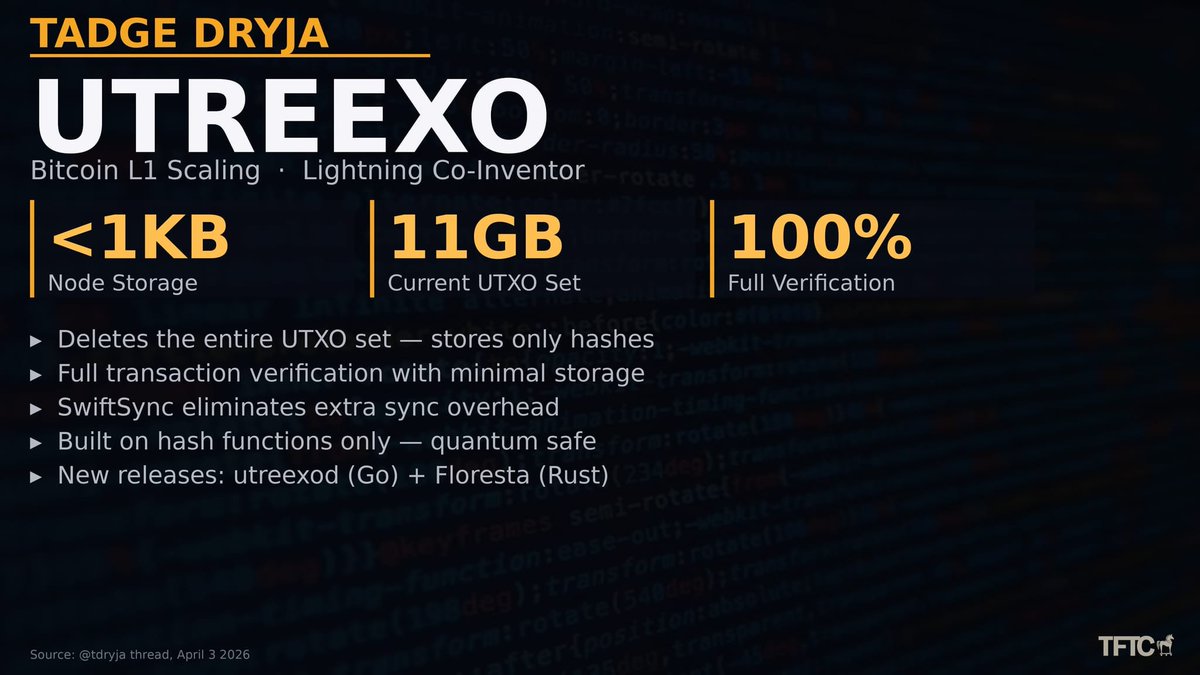
Tadge Dryja, the co-inventor of the Lightning Network, just dropped an update on Utreexo, one of the most underappreciated scaling projects in bitcoin.
The problem is straightforward. Every bitcoin node that wants to validate transactions has to store the entire UTXO set, every unspent output on the network. Right now that's 11GB and growing. As more transactions hit the chain, as inscriptions and other data-heavy outputs pile up, every node operator has to store all of it. The UTXO set doesn't get pruned like old blocks can. It just grows.
Utreexo eliminates the entire UTXO set from your node. Instead of storing 11GB of data, a Utreexo node stores less than 1KB of hashes and still fully verifies every transaction. It's not a light client. It's not trusting anyone else. It's full validation with radically less storage.
The tradeoff has always been bandwidth. Utreexo nodes need to download extra proof data to verify transactions without storing the full set. Until recently, syncing the blockchain with Utreexo took 2-3x the data download of a normal node, pushing into terabytes. That problem is now being solved, new aggregator techniques from SwiftSync have eliminated the extra download overhead. The implementation is still being finalized, but the hard part appears to be behind them.
Two things worth noting:
First, Utreexo is quantum safe. The accumulator and aggregator are built entirely on hash functions, not elliptic curve cryptography. Whatever quantum computing does to bitcoin's signature scheme, it won't touch Utreexo. At a time when the quantum conversation is heating up, that's a meaningful design advantage.
Second, Utreexo directly addresses the tension around "spam" on bitcoin. Inscriptions, BRC-20 tokens, and other data-heavy outputs bloat the UTXO set that every node has to carry. Pruning helps with old block data but doesn't touch the UTXO set. Utreexo makes the entire debate irrelevant, if your node doesn't store the UTXO set at all, the
size of it doesn't matter.
New releases are out for both utreexod (BTCD-based) and Floresta (rust-based, built with rust-bitcoin). Both are in testing mode, not ready for real funds yet, but ready for developers and node operators to try.
This is the kind of quiet, foundational work that actually scales bitcoin at L1. No token. No VC round. No press tour. Just better engineering.
25
90
432
21,464
EVM gave us smart contracts.
RISC-V gives us real compute.
#whyweckb
1
14
45
594
Common Knowledge Brother retweeted

Apr 1
Silent payments is not just a new approach to static payment codes. It's the first serious contender to improve the address derivation system since HD wallets in 2013. HD wallets were a big win over single keys, and silent payments could be a similar leap forward.
9
123
520
33,195
Common Knowledge Brother retweeted

Apr 1
Great idea! Here's a quick plot showing estimated transactions per second with different hash-based signature schemes.
This one uses size-optimized parameters, verification-optimized below 👇
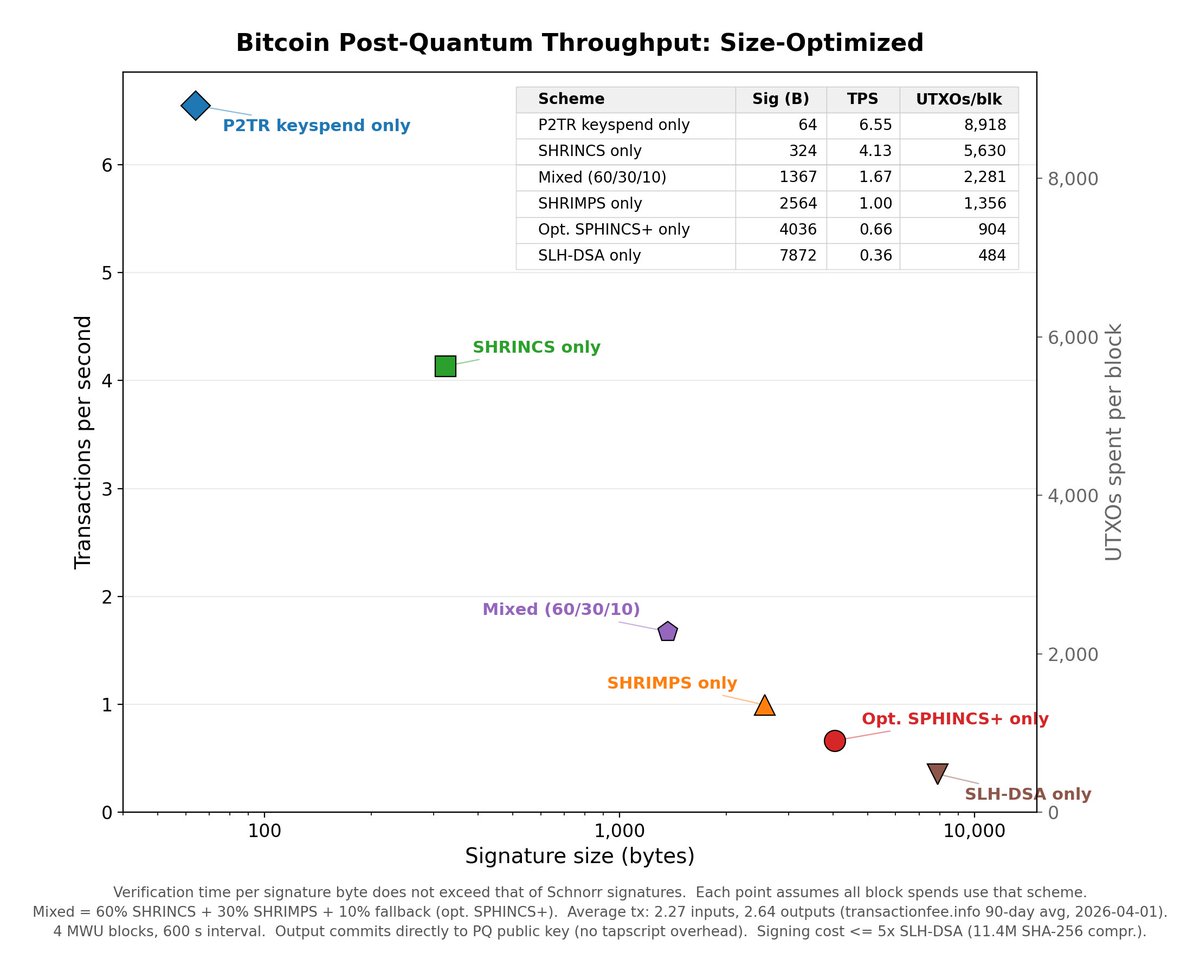

Just give the expected impact on TPS if fully implemented for all active wallets transacting (evaluate size impact comparr aggregation model to current implementation) Everything else just unnecessary tech jargon.
24
33
151
38,062
this are the vibes
Mar 31

dog we have to do pqc stuff eventually
9
351
Common Knowledge Brother retweeted

Mar 31
This gets at the core of why the bitcoin quantum FUD is overblown. There certainly seems to be some progress on the theoretical front, but how close are we to actually building quantum computers with persistent uptime that can wage these attacks?
Not saying it will never happen, but the leap from theoretical possibilities to application at scale is still unclear to me.
Mar 31

This is an obvious fallacy.
Nothing about this chart indicates how fast we are getting there. You’re highlighting progress in theoretical algorithm optimization.
None of this indicates actual rate of progress in the system needed to run these algos.
27
9
141
19,411
i give @VitalikButerin a ton of credit (for this among many other things), he is the only member of the philosopher king class who is willing to acknowledge CKB

have never felt more confident that CKB is destined for a cinderella story than seeing a header full of big brains completely miss it in a 67 page paper with 300 citations
you can use SPHINCS today with @quantumpurse
Keep calm and carry on.
1
12
54
1,352

Basically Google is saying "We've got a lot of ink on a whiteboard that says really threatening stuff...better hope we never take it seriously enough to try building the Hawaii-sized facility we'd need to pull it off!"
Mar 31

Google is basically saying:
“We’ve cut the quantum resources needed to break Bitcoin’s encryption by 20x. We can now break it. We can prove it. We’re just not going to tell you how.
We’ve slowed down research to give crypto a chance. You have until 2029 to figure out a solution. Good luck.”
1
1
159
have never felt more confident that CKB is destined for a cinderella story than seeing a header full of big brains completely miss it in a 67 page paper with 300 citations
you can use SPHINCS today with @quantumpurse
Keep calm and carry on.
5
24
73
2,865
Common Knowledge Brother retweeted

Mar 31
Going from ~1,000 noisy qubits to 500k fault-tolerant ones by 2029 isn’t just a "roadmap",… it’s a **physical miracle** or a massive bluff.
Mar 31

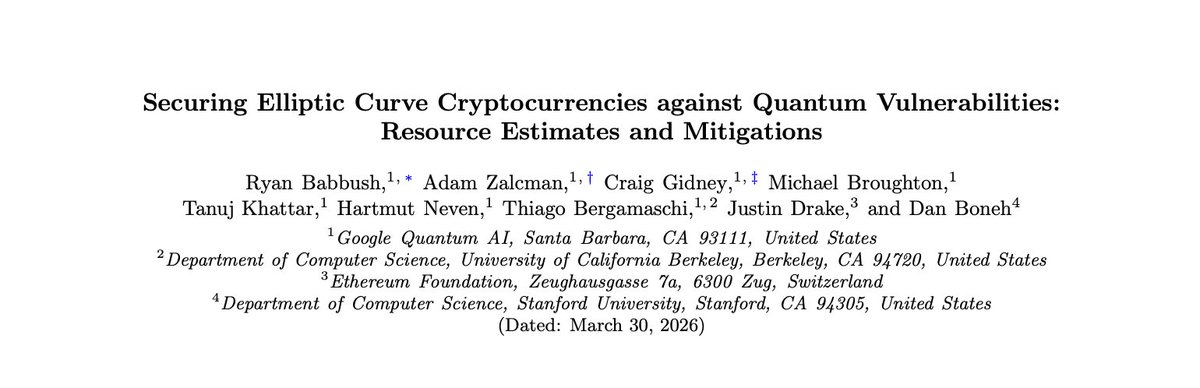
Specifically, this paper. It's a brand new resource estimate that's wildly lower than prior estimates of what it would take to break ECC-256. Featuring the Google Quantum AI team Justin Drake Dan Boneh
quantumai.google/static/site…
39
55
461
68,567
Common Knowledge Brother retweeted

Mar 31
When evaluating the claim of deep bag-biased Quantum agitpropagandists, it’s always more useful to look at what they are NOT telling you.
Recent claims suggest a Quantum computer using neutral atom arrays would require only (!) ~20,000 logical qubits to break Bitcoin.
What they tell you is that this is significant because researchers at Caltech recently demonstrated a 6000 (!) logical qubits array.
What they do NOT tell you is that those qubits weren’t not entangled, which is a requirement to run Shor’s algorithm.
So what is the state of the art in terms of actually entangled logical qubits under the neutral atoms architecture? NINETY SIX (96) qubits.
How long did they maintain coherence? 1-2 seconds.
How long did the new Oratomic paper suggest the algorithm they designed should run? DAYS!
So not only must state of the art in SIMPLE qubits entanglement increase more than 2 orders of magnitude, their ability to maintain coherence across circuit depth must be preserved ONE HUNDRED THOUSAND times longer than they currently do.
Suffice to say they have no idea how to even get there but that shouldn’t get in the way of a headline worthy paper!
37
130
720
58,391
shoutout to everyone dunking on bitcoin
going to take a lot more than a quantum computer
1
2
25
433