
Asst Professor, Georgetown • Director, CFR China Strategy Initiative • Biden NSC '21-24 • Wrote The Long Game: China's Grand Strategy to Displace American Order
Joined December 2011
- Tweets 8,815
- Following 3,951
- Followers 38,905
- Likes 12,045
269 Photos and videos




Pinned Tweet

10 Nov 2024
I've watched @amanpour on TV for decades. So I was grateful for the opportunity to sit down with her for 15 minutes.
Our interview aired on @CNN this weekend.
We talked China policy, Trump's approach, and why this decade is the decisive decade in the competition.
68
113
456
251,517
Rush Doshi retweeted

Jun 12
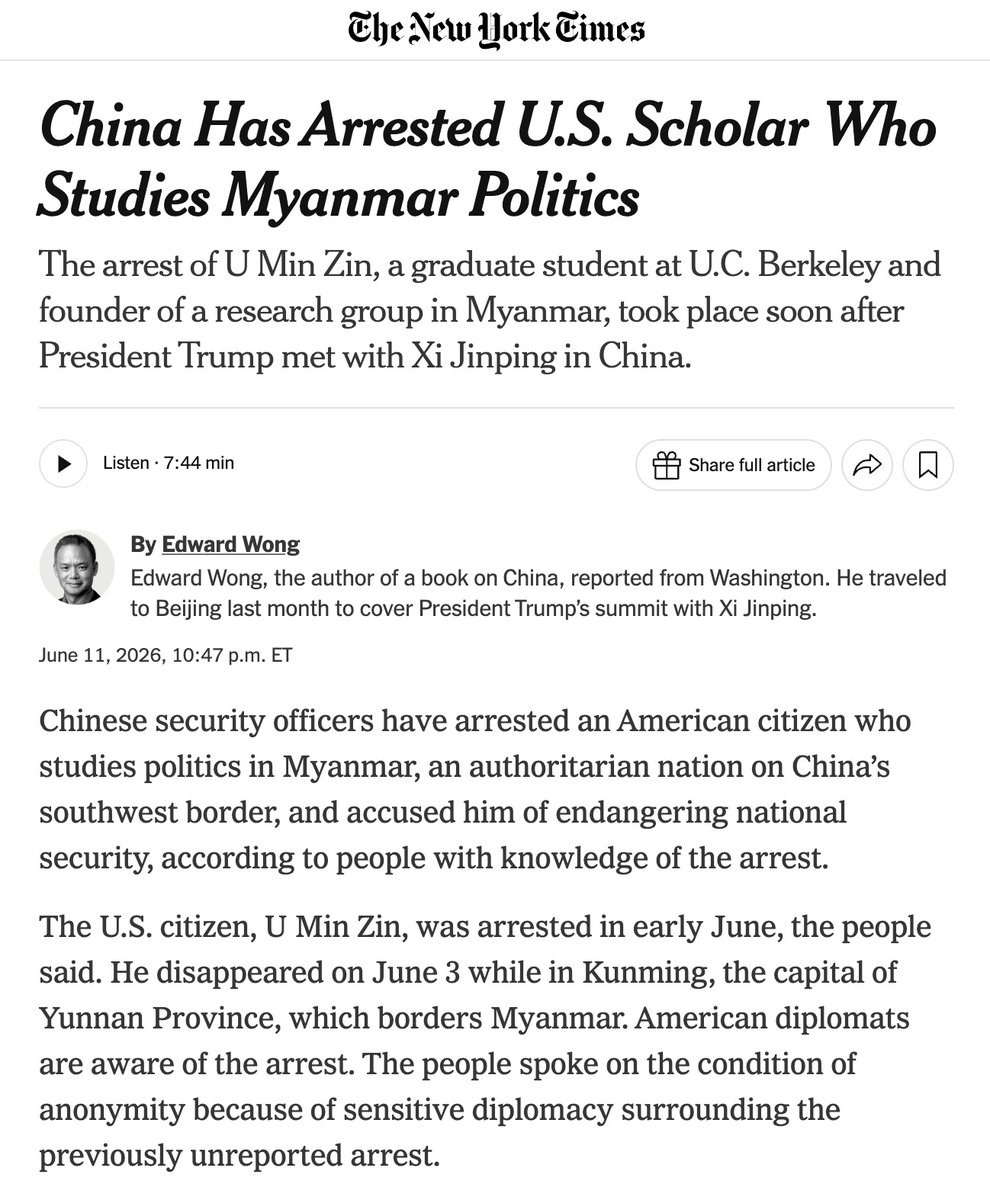
NEW: China arrested a US citizen after Trump met with Xi in Beijing and accused him of endangering national security — a rare charge against an American. The detainee, U Min Zin, is a grad student at @UCBerkeley who researches Myanmar. This adds a new strain to US-China ties.
68
288
521
291,526
Rush Doshi retweeted

Jun 11
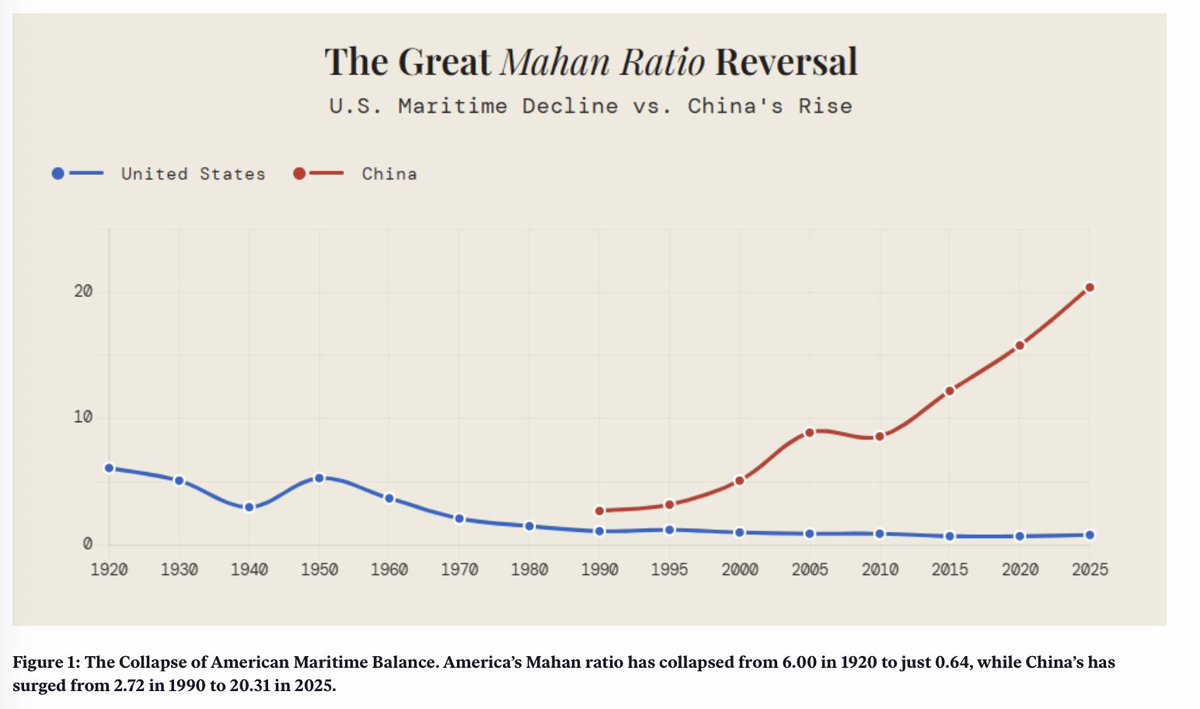
The Ratio is your merchant hulls divided by your naval hulls.
And since WWII it looks like this. Not good.
1
5
40
3,521
Jun 11
Paul seems to not realize that industrial policy in EVs may differ from industrial policy in rare earths.
Collapsing those differences is, after all, poor analysis.
And yet he does it, suggesting what happened in EVs must be what happened in rare earths!
Jun 10

Good old fashioned analysis, without ideological bias...good antidote to the "China planned to dominate all these industries like EVS and rates earths starting 30 years ago as tools of future economic coercion " school of really bad China analysis...
1
5
32
7,293
Rush Doshi retweeted

Jun 10
I just finished a book of @RushDoshi The Long Game...really enjoyed it...as very much of my interest # emergingChina
1
8
2,329
Jun 10
I’m not walking back anything. Perhaps you misread the earlier argument? It was a long post.
Here it is again for your reference. Please note the very first paragraph, which specifically indicates that the weaponization of the tool dates back to at least 2010.
I remain perplexed why any of this is controversial. The evidence is overwhelming.
x.com/rushdoshi/status/20630…
Jun 10

Glad you heed the attention to evidence&walk back from the earlier assertion that CN intentionally built& weaponized REE decades ago. It started to assemble anti sanctions toolkit in recent years (AFST 2021) in response to the US tech restrictions - markedly different than 2010.
1
5
39
6,217
Jun 9
They actually used it as a weapon in 2010. Not all concentration is deliberate. And not all of it is for coercion.
But the state did turn this sector into a more effective weapon beginning as early as the late 2000s. I’m not saying they should or shouldn’t have done that, but to argue otherwise is odd to me.
I’m not sure why this is controversial. Empirical evidence exists.
So China builds REE for decades w the intention to use it as an economic weapon? Well then most, if not all of the CN economy revolves around “war” preparations? Cos it also dominates in medical ingredients, electronics, chemical intermediates, green tech, ship building…
8
6
49
8,495
Jun 9
Some more detail here
Jun 5

This is an interesting question. My take: I do not quite accept the notion that China did not seek to "weaponize" rare earths and instead stumbled into a position of advantage. For at least 16 years, and likely more, the purpose has been an economic weapon. This is not like, say, solar or EVs, where excess capacity is sort of an accident.
Here, for example, is a semi-authoritative book cited by @JohnF_Sullivan on rare earth strategy written in 2011 for the state China Economic Publishing House the year after the Japan situation:
"What magical quality do rare earths possess that makes the usually arrogant and domineering Americans so furious? What magical quality do rare earths posses that leaves the usually wealthy and arrogant Japanese grief-stricken? China is the only country in the world capable of supplying all 17 rare earth elements, particularly holding a larger share of heavy rare earths that have prominent uses in military applications. To change China’s international position in the rare earth industry, since 2009, the Chinese government has launched a vigorous rare earth defense war, adopting a series of rectification measures including suspending approval of mining rights, controlling total mining volume, reducing export quotas, raising export tariffs and and severely cracking down on rare earth smuggling."
A key purpose of these post-2009 steps, which PRECEDE China's weaponization against Japan in 2010, was to hone a better coercive instrument.
Then there is some empirical evidence suggesting PRC action in this sector was about leverage.
First, most obviously, China used this as a coercive instrument in 2010. That shows, for at least 16 years, they have understood it as a critical leverage point.
Second, China's government has for decades manipulated the price of rare earths to prevent anyone else from achieving scale - dropping the price to kill foreign investment. Why did they do this when they already had 90% market dominance? The logic is toward control, not profit, and it is not the result of disaggregated independent Chinese market actors (which do not exist in this sector).
Third, related to that point, if this industry operated on economic logic, we would probably see more fragmentation. Indeed, for a brief time, we did see that before 2010. But then the PRC sharply consolidated the rare earths industry into state-backed companies. They shut down, arrested, harassed, and outright expropriated private actors. This was partly to ensure greater state control over external flows - the better to maintain leverage. The quote above refers to that effort.
Fourth, I do not think China's controls on rare earth minerals were modeled off U.S. controls. For example, the October controls went far beyond any U.S. controls. China's idea was any product, anywhere in the world, with .1% value coming from Chinese produced rare earths, required a license to be sold to anyone else in the world. The closest analogy -- and Chinese scholars have said this directly -- is to U.S. financial sanctions, not export controls.
Fifth, this is not a case where "there are many different actors, and they often overperform in search of particular targets." The industry has for a long time just been a few actors, tied to the state, acting at the state's direction. China's cultivation of leadership in this sector dates back to the 1960s, accelerating in the 1980s, with direct involvement of Deng's family in the 1990s and Premier Wen in the 2000s.
The empirical evidence seems to indicate a conscious desire to dominate this sector. One can debate whether or not such an intention was justifiable given U.S. control over chokepoints like finance.
But I think it is hard to advance the claim this was just the independent action of market participants that happened to accidentally create a position of extreme concentration and dominance.
5
2,424
Jun 9
The argument is not that they set out thirty years ago but perhaps 20, and certainly 16.
This is obviously true: they even admit it!
Jun 9
Agree with @jessicacweiss here...
The argument that Beijing, more than 30 years ago, set out to use rare earths as a future economic weapon, is risible, but some are intent on making it. We would have to accept that Beijing understood all the myriad ways REEs/magnets would become critical, like for semis, EVs, photonics, and that market forces would favor Chinese companies, while other governments would ignore the issue and provide no support for their own domestic players. For those in the previous administration that pushed the export controls that drew down China's REE/magnet licensing regime, this is convenient explanation for the double failure: no action on reducing dependence on China and forcing Beijing's hand on real chokepoints.
4
10
57
27,503
Rush Doshi retweeted

Jun 8
Very important points on both sides. I am more sympathetic to @RushDoshi because the reality is that the short and medium term consequences of industrial policy can be extremely damaging, as we see with issues such as rare earths, where cost of undoing intervention will be high.
Jun 8
A very thoughtful post. And perhaps true on AI.
But it is perhaps overstated in other areas. If free market dynamism were all that mattered, what would explain the catch-up of the East Asian economies? How did China go from an economic backwater in 1980 into an industrial superpower in only forty years. My view is that learning from China doesn't mean becoming China. Are there no lessons for the United States, which is now falling behind in key industrial sectors, in the success of others?
The reason a free market at home does not always produce prosperity and progress is because the economy is global. The actions of other countries, and their state-driven distortions, affect the incentives we face at home, including those of our capital allocators and businesses.
There's wisdom in the market. But there's also foolishness. The "efficient" path can be a disaster if other countries de facto shape the global terrain of efficiency and "hack" our incentives.
Indeed, this is what happened to the United States. Deindustrialization is partly the result of operating on free market assumptions and keeping an open economy in a world where other states practice industrial policy. With no state-led correction to those distortions, the result was hollowing out.
Perhaps AI will spur reindustrialization. But I doubt it will be enough. Even today, the very companies hinted at below are facing unbelievable headwinds from Chinese industrialists, who will also apply AI. There is no magic button for reindustrialization. It will take policy. I actually think the Trump Administration, in its own way, also understands this.
The simple fact is we have experienced a catastrophic loss of jobs, process knowledge, and industrial capacity -- a national tragedy -- that is as much the result of our own free-market ideology and interest group capture as it is foreign mercantilism.
2
2
4
3,139
Jun 8
Impactful work from @geoeconjennie and her team.

A war over Taiwan would cause a near-14% hit to the German economy, Bloomberg finds.
That's higher than the estimated cost to either the US and China, also even Japan.

4
34
8,636
Rush Doshi retweeted

Jun 8
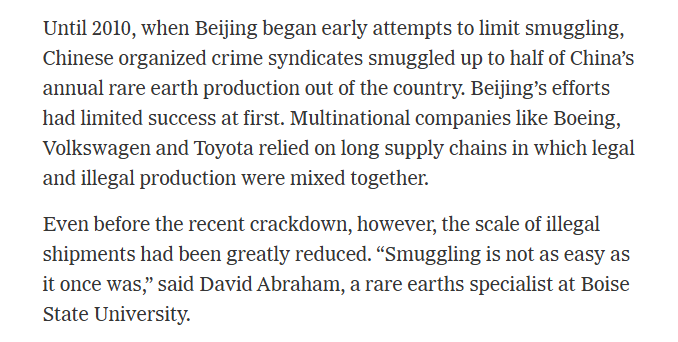
Another small bit of evidence here --
the consolidation of the industry around a few large state owned companies and crackdown on smuggling (after that weakened the controls in 2010) was clearly meant in large part to make China's export controls more effective
Jun 8
Thanks for the engagement. I believe your argument is essentially the same as mine. The question is not “whether” both explanations apply, but rather “when” they do.
My point was China built this as a geopolitical tool over the last nearly twenty years. What began as an industrial policy effort for capacity in this sector in the 1960s later became a drive to consolidate it *for geopolitical purposes* beginning at least 16 years ago if not even earlier. There are plenty of state texts indicating this, too. The decisions to drop international prices, consolidate the sector, eliminate most private sector participants, and halt smuggling were partly to ensure absurdly high market share even at a loss to China’s own economy.
The argument I responded to — that China’s current position is a product of independent market actors inadvertently creating excess capacity that later happened to be weaponized —is in my view false based on authoritative texts, market data, and the best explanation for China’s puzzling behavior. This sector has not been treated the same as green tech or other sectors. So applying explanations from those sectors to this one is erroneous and cannot properly account for the last nearly twenty years of state behavior.
The idea smuggling existed does not disprove this analysis. The real question is how the state felt about it.
And in that sense, it actually confirms the geopolitical explanation. The state waged a campaign against smuggling in the 2010s after smuggling revealed the challenge of using the tool against Japan without full state control of supply.
1
8
31
11,831
Rush Doshi retweeted

The evidence doesn’t support the idea that China’s rare earths dominance is just an accident of the market. Too many takes on China are detached from the Party’s own documentary record.
And why would it be accidental? It makes good strategic sense. It’s been a well-executed strategy and one that is completely consistent with the Party’s view that it needs counter-leverage against what it describes as encirclement by the US and its allies in Asia.
Beijing has been building capacity in rare earths for decades and started consolidating the industry under state control in earnest in the 2000s under Wen Jiabao. @KeithBradsher's excellent piece in the NYT lays all this out.
nytimes.com/2025/12/31/busin…
Beijing tested this weapon against Japan in 2010, but it was in 2019 that Xi Jinping signaled it would be China’s key weapon in the trade war. In May 2019, Xi made a highly choreographed visit to Ganzhou, the heart of China’s heavy rare earths industry, and called these elements “an important strategic resource”. Xi’s visit was just days after Trump added Huawei to the Entity List and indicated that China would use this industry to retaliate. If the message wasn’t clear enough, it was explicit at a 28 May 2019 NDRC press conference. When asked whether China would weaponise its leverage in rare earths an NDRC spokesperson replied: “You asked whether rare earths will become China’s countermeasure against the U.S.’s unprovoked suppression. What I can tell you is that if anyone wants to use the products manufactured by our export of rare earths to contain and suppress China’s development, then I think the people in the former Central Soviet Area in southern Jiangxi and the Chinese people will be unhappy.”
Just a month earlier, in April 2020, Xi gave a speech in which he said: “we must tighten the dependence of international industrial chains on our country, forming a powerful countermeasure and deterrent capability against foreign parties who artificially cut off supply.” In other words, Beijing’s official doctrine – outlined by Xi Jinping himself – was that China would build and deploy leverage in key industries to serve strategic goals. It made good sense and has paid dividends now in the second Trump administration.
After Xi’s speech and visit, the entire system mobilised to make possible the historical controls on rare earths he implemented in April and October of 2025. Beijing set up legal-regulatory infrastructure, like the Export Control Law (2020), set out regulations in 2021 that established state control over all rare earths resources, and consolidated its three largest state-owned rare earths assets into a new SOE called China Rare Earth Group. According to official state press, the objective was explicitly to grant the state greater strategic control over China’s rare earth resources: “This allowed the state to control mining at the source and provided better conditions for strategic stockpiling and planned usage.”
It's true that part of the story is American offshoring in the 1990s and 2000s, but the idea that China was not focused on exploiting the strategic value of rare earths doesn't stand up.
Jun 5
This is an interesting question. My take: I do not quite accept the notion that China did not seek to "weaponize" rare earths and instead stumbled into a position of advantage. For at least 16 years, and likely more, the purpose has been an economic weapon. This is not like, say, solar or EVs, where excess capacity is sort of an accident.
Here, for example, is a semi-authoritative book cited by @JohnF_Sullivan on rare earth strategy written in 2011 for the state China Economic Publishing House the year after the Japan situation:
"What magical quality do rare earths possess that makes the usually arrogant and domineering Americans so furious? What magical quality do rare earths posses that leaves the usually wealthy and arrogant Japanese grief-stricken? China is the only country in the world capable of supplying all 17 rare earth elements, particularly holding a larger share of heavy rare earths that have prominent uses in military applications. To change China’s international position in the rare earth industry, since 2009, the Chinese government has launched a vigorous rare earth defense war, adopting a series of rectification measures including suspending approval of mining rights, controlling total mining volume, reducing export quotas, raising export tariffs and and severely cracking down on rare earth smuggling."
A key purpose of these post-2009 steps, which PRECEDE China's weaponization against Japan in 2010, was to hone a better coercive instrument.
Then there is some empirical evidence suggesting PRC action in this sector was about leverage.
First, most obviously, China used this as a coercive instrument in 2010. That shows, for at least 16 years, they have understood it as a critical leverage point.
Second, China's government has for decades manipulated the price of rare earths to prevent anyone else from achieving scale - dropping the price to kill foreign investment. Why did they do this when they already had 90% market dominance? The logic is toward control, not profit, and it is not the result of disaggregated independent Chinese market actors (which do not exist in this sector).
Third, related to that point, if this industry operated on economic logic, we would probably see more fragmentation. Indeed, for a brief time, we did see that before 2010. But then the PRC sharply consolidated the rare earths industry into state-backed companies. They shut down, arrested, harassed, and outright expropriated private actors. This was partly to ensure greater state control over external flows - the better to maintain leverage. The quote above refers to that effort.
Fourth, I do not think China's controls on rare earth minerals were modeled off U.S. controls. For example, the October controls went far beyond any U.S. controls. China's idea was any product, anywhere in the world, with .1% value coming from Chinese produced rare earths, required a license to be sold to anyone else in the world. The closest analogy -- and Chinese scholars have said this directly -- is to U.S. financial sanctions, not export controls.
Fifth, this is not a case where "there are many different actors, and they often overperform in search of particular targets." The industry has for a long time just been a few actors, tied to the state, acting at the state's direction. China's cultivation of leadership in this sector dates back to the 1960s, accelerating in the 1980s, with direct involvement of Deng's family in the 1990s and Premier Wen in the 2000s.
The empirical evidence seems to indicate a conscious desire to dominate this sector. One can debate whether or not such an intention was justifiable given U.S. control over chokepoints like finance.
But I think it is hard to advance the claim this was just the independent action of market participants that happened to accidentally create a position of extreme concentration and dominance.
5
12
48
11,513
Jun 8
A very thoughtful post. And perhaps true on AI.
But it is perhaps overstated in other areas. If free market dynamism were all that mattered, what would explain the catch-up of the East Asian economies? How did China go from an economic backwater in 1980 into an industrial superpower in only forty years. My view is that learning from China doesn't mean becoming China. Are there no lessons for the United States, which is now falling behind in key industrial sectors, in the success of others?
The reason a free market at home does not always produce prosperity and progress is because the economy is global. The actions of other countries, and their state-driven distortions, affect the incentives we face at home, including those of our capital allocators and businesses.
There's wisdom in the market. But there's also foolishness. The "efficient" path can be a disaster if other countries de facto shape the global terrain of efficiency and "hack" our incentives.
Indeed, this is what happened to the United States. Deindustrialization is partly the result of operating on free market assumptions and keeping an open economy in a world where other states practice industrial policy. With no state-led correction to those distortions, the result was hollowing out.
Perhaps AI will spur reindustrialization. But I doubt it will be enough. Even today, the very companies hinted at below are facing unbelievable headwinds from Chinese industrialists, who will also apply AI. There is no magic button for reindustrialization. It will take policy. I actually think the Trump Administration, in its own way, also understands this.
The simple fact is we have experienced a catastrophic loss of jobs, process knowledge, and industrial capacity -- a national tragedy -- that is as much the result of our own free-market ideology and interest group capture as it is foreign mercantilism.
Jun 7

I think part of it, at least vis a vis US/China competition, is that US and western chattering classes find it hard to believe that the market-driven outcome of frontier AI could possibly be right. They basically believe, in their hearts, that the Chinese system, with its “industrial strategy,” has eclipsed capitalism. So they harbor the same inferiority complex toward the Chinese system that many Americans once harbored toward the EU’s system. Their heuristic is that the industrial strategists of China have grasped the whole picture of the technological competition in a way that US industrialists, with their “profit maximizing incentives,” could not possibly have matched. And so any outcome in the economy that is not the result of “strategy” is therefore prima facie worse than what the “strategists” have concocted. They also believe the Chinese strategists possess awesome powers of foresight and the ability to evade all tendencies of financial and economic gravity, due of course to “strategy,” really it’s almost a kind of orientalism.
Meanwhile the U.S. industrialists are making new advances in math and science, and the fastest-growing businesses in history, by spending hundreds of billions of dollars on high-margin chips whose legacy is in rendering video games, cramming them underneath tents if need be, and investing generational capital into new energy generation technologies as they do it, and perhaps even colonizing space as an instrumentally convergent result. But none of that is “strategy,” you see.
9
11
69
16,052
Jun 8
Thanks for the engagement. I believe your argument is essentially the same as mine. The question is not “whether” both explanations apply, but rather “when” they do.
My point was China built this as a geopolitical tool over the last nearly twenty years. What began as an industrial policy effort for capacity in this sector in the 1960s later became a drive to consolidate it *for geopolitical purposes* beginning at least 16 years ago if not even earlier. There are plenty of state texts indicating this, too. The decisions to drop international prices, consolidate the sector, eliminate most private sector participants, and halt smuggling were partly to ensure absurdly high market share even at a loss to China’s own economy.
The argument I responded to — that China’s current position is a product of independent market actors inadvertently creating excess capacity that later happened to be weaponized —is in my view false based on authoritative texts, market data, and the best explanation for China’s puzzling behavior. This sector has not been treated the same as green tech or other sectors. So applying explanations from those sectors to this one is erroneous and cannot properly account for the last nearly twenty years of state behavior.
The idea smuggling existed does not disprove this analysis. The real question is how the state felt about it.
And in that sense, it actually confirms the geopolitical explanation. The state waged a campaign against smuggling in the 2010s after smuggling revealed the challenge of using the tool against Japan without full state control of supply.
Jun 8

Respectfully, both can be true. China weaponized its RE dominance but it was in a position to do so because of the industry's growth through the 80s/90s/00s, not all of which was the product of a grand plan to build a trade war weapon. 🧵
4
7
41
24,327
Rush Doshi retweeted

Europe can't afford to adhere to free-trade dogma when it comes to the flood of Chinese imports.
noahpinion.blog/p/why-europe…
71
33
216
109,511
Jun 5
This is an interesting question. My take: I do not quite accept the notion that China did not seek to "weaponize" rare earths and instead stumbled into a position of advantage. For at least 16 years, and likely more, the purpose has been an economic weapon. This is not like, say, solar or EVs, where excess capacity is sort of an accident.
Here, for example, is a semi-authoritative book cited by @JohnF_Sullivan on rare earth strategy written in 2011 for the state China Economic Publishing House the year after the Japan situation:
"What magical quality do rare earths possess that makes the usually arrogant and domineering Americans so furious? What magical quality do rare earths posses that leaves the usually wealthy and arrogant Japanese grief-stricken? China is the only country in the world capable of supplying all 17 rare earth elements, particularly holding a larger share of heavy rare earths that have prominent uses in military applications. To change China’s international position in the rare earth industry, since 2009, the Chinese government has launched a vigorous rare earth defense war, adopting a series of rectification measures including suspending approval of mining rights, controlling total mining volume, reducing export quotas, raising export tariffs and and severely cracking down on rare earth smuggling."
A key purpose of these post-2009 steps, which PRECEDE China's weaponization against Japan in 2010, was to hone a better coercive instrument.
Then there is some empirical evidence suggesting PRC action in this sector was about leverage.
First, most obviously, China used this as a coercive instrument in 2010. That shows, for at least 16 years, they have understood it as a critical leverage point.
Second, China's government has for decades manipulated the price of rare earths to prevent anyone else from achieving scale - dropping the price to kill foreign investment. Why did they do this when they already had 90% market dominance? The logic is toward control, not profit, and it is not the result of disaggregated independent Chinese market actors (which do not exist in this sector).
Third, related to that point, if this industry operated on economic logic, we would probably see more fragmentation. Indeed, for a brief time, we did see that before 2010. But then the PRC sharply consolidated the rare earths industry into state-backed companies. They shut down, arrested, harassed, and outright expropriated private actors. This was partly to ensure greater state control over external flows - the better to maintain leverage. The quote above refers to that effort.
Fourth, I do not think China's controls on rare earth minerals were modeled off U.S. controls. For example, the October controls went far beyond any U.S. controls. China's idea was any product, anywhere in the world, with .1% value coming from Chinese produced rare earths, required a license to be sold to anyone else in the world. The closest analogy -- and Chinese scholars have said this directly -- is to U.S. financial sanctions, not export controls.
Fifth, this is not a case where "there are many different actors, and they often overperform in search of particular targets." The industry has for a long time just been a few actors, tied to the state, acting at the state's direction. China's cultivation of leadership in this sector dates back to the 1960s, accelerating in the 1980s, with direct involvement of Deng's family in the 1990s and Premier Wen in the 2000s.
The empirical evidence seems to indicate a conscious desire to dominate this sector. One can debate whether or not such an intention was justifiable given U.S. control over chokepoints like finance.
But I think it is hard to advance the claim this was just the independent action of market participants that happened to accidentally create a position of extreme concentration and dominance.
Jun 5

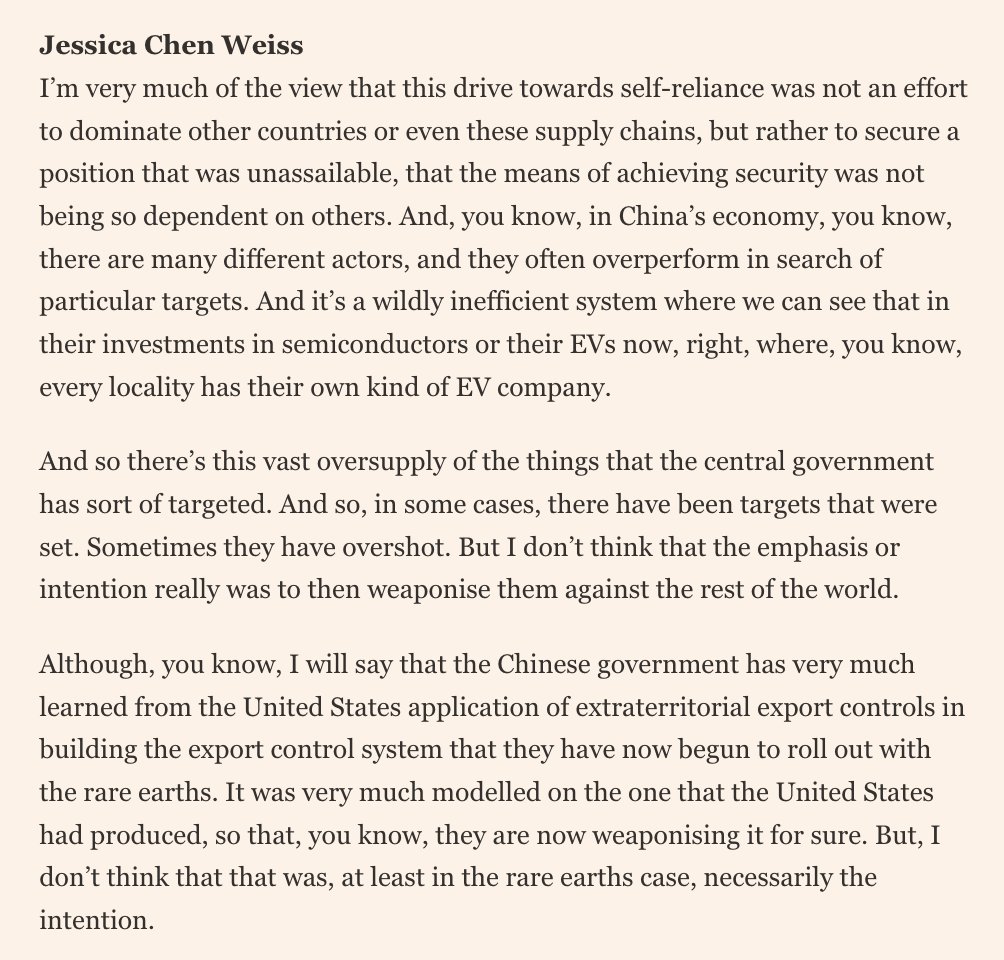
When China spent decades building dominance in rare earths supply chains, what was it really trying to do? Build an economic weapon? Or something else?
I asked @jessicacweiss on The Economics Show with Soumaya Keynes podcast this week...
ft.com/content/34a8939c-ba23…
29
79
237
80,839
Jun 6
I actually forgot to mention one important thing: the use of this tool has not always been “defensive” either.
They used this tool against Japan and the US in 2010. That was not a defensive use in response to economic coercion.
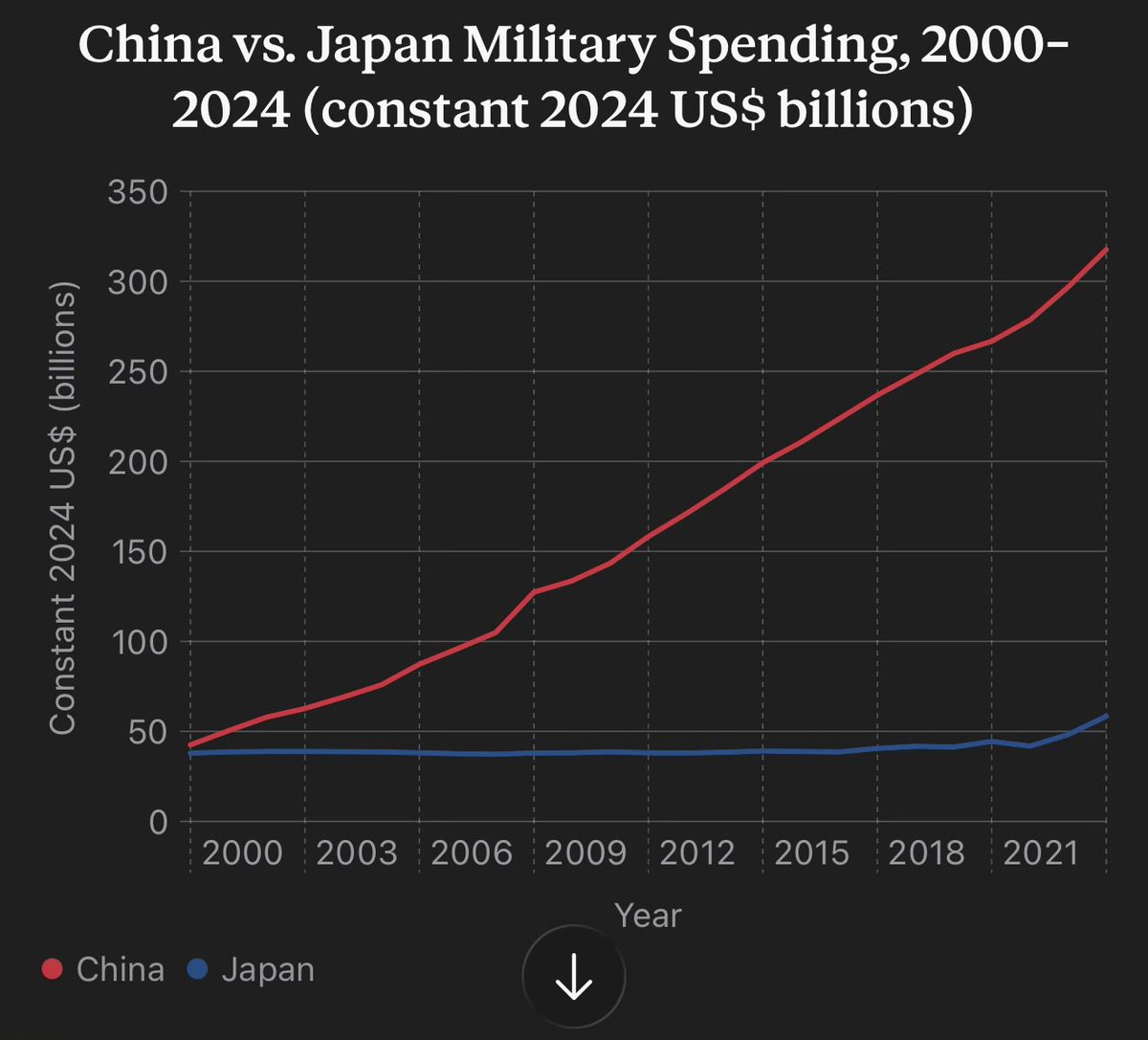
Since the trade war, they have used it offensively: threatening it in response to European industrial policy and using it in response to Japan’s modest defense increases.
I am not making a moral argument — other countries build and deploy coercive chokepoints. I don’t know why we would assume China is an exception to this logic when there is ample empirical evidence to the contrary.
China is, in fact, a great power (really a superpower) and acts like it.
1
1
19
2,113

I find it odd this is even a point of debate
Jun 5
This is an interesting question. My take: I do not quite accept the notion that China did not seek to "weaponize" rare earths and instead stumbled into a position of advantage. For at least 16 years, and likely more, the purpose has been an economic weapon. This is not like, say, solar or EVs, where excess capacity is sort of an accident.
Here, for example, is a semi-authoritative book cited by @JohnF_Sullivan on rare earth strategy written in 2011 for the state China Economic Publishing House the year after the Japan situation:
"What magical quality do rare earths possess that makes the usually arrogant and domineering Americans so furious? What magical quality do rare earths posses that leaves the usually wealthy and arrogant Japanese grief-stricken? China is the only country in the world capable of supplying all 17 rare earth elements, particularly holding a larger share of heavy rare earths that have prominent uses in military applications. To change China’s international position in the rare earth industry, since 2009, the Chinese government has launched a vigorous rare earth defense war, adopting a series of rectification measures including suspending approval of mining rights, controlling total mining volume, reducing export quotas, raising export tariffs and and severely cracking down on rare earth smuggling."
A key purpose of these post-2009 steps, which PRECEDE China's weaponization against Japan in 2010, was to hone a better coercive instrument.
Then there is some empirical evidence suggesting PRC action in this sector was about leverage.
First, most obviously, China used this as a coercive instrument in 2010. That shows, for at least 16 years, they have understood it as a critical leverage point.
Second, China's government has for decades manipulated the price of rare earths to prevent anyone else from achieving scale - dropping the price to kill foreign investment. Why did they do this when they already had 90% market dominance? The logic is toward control, not profit, and it is not the result of disaggregated independent Chinese market actors (which do not exist in this sector).
Third, related to that point, if this industry operated on economic logic, we would probably see more fragmentation. Indeed, for a brief time, we did see that before 2010. But then the PRC sharply consolidated the rare earths industry into state-backed companies. They shut down, arrested, harassed, and outright expropriated private actors. This was partly to ensure greater state control over external flows - the better to maintain leverage. The quote above refers to that effort.
Fourth, I do not think China's controls on rare earth minerals were modeled off U.S. controls. For example, the October controls went far beyond any U.S. controls. China's idea was any product, anywhere in the world, with .1% value coming from Chinese produced rare earths, required a license to be sold to anyone else in the world. The closest analogy -- and Chinese scholars have said this directly -- is to U.S. financial sanctions, not export controls.
Fifth, this is not a case where "there are many different actors, and they often overperform in search of particular targets." The industry has for a long time just been a few actors, tied to the state, acting at the state's direction. China's cultivation of leadership in this sector dates back to the 1960s, accelerating in the 1980s, with direct involvement of Deng's family in the 1990s and Premier Wen in the 2000s.
The empirical evidence seems to indicate a conscious desire to dominate this sector. One can debate whether or not such an intention was justifiable given U.S. control over chokepoints like finance.
But I think it is hard to advance the claim this was just the independent action of market participants that happened to accidentally create a position of extreme concentration and dominance.
1
1
8
1,911
Rush Doshi retweeted

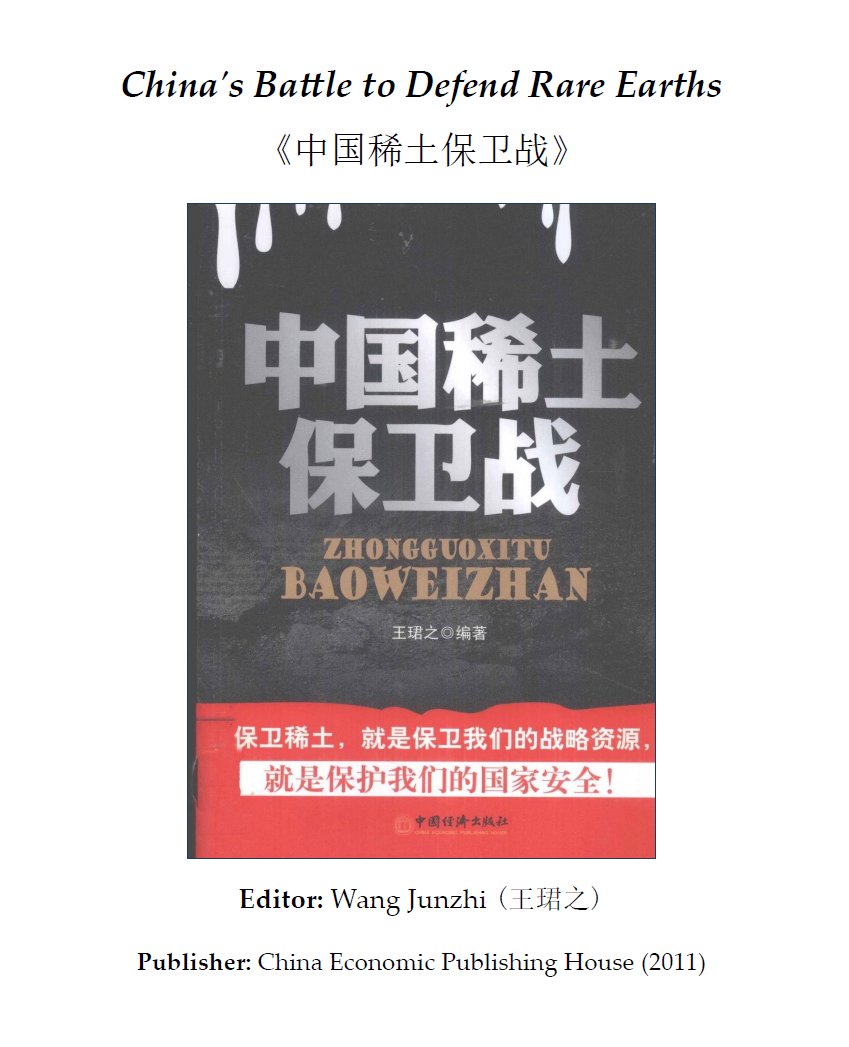
"Whoever controls strategic rare earth metals controls the resources for future technology and holds the fate of the future. China must elevate this to a strategic height and manage and control strategic metal resources in the name of the state."
Jun 5
This is an interesting question. My take: I do not quite accept the notion that China did not seek to "weaponize" rare earths and instead stumbled into a position of advantage. For at least 16 years, and likely more, the purpose has been an economic weapon. This is not like, say, solar or EVs, where excess capacity is sort of an accident.
Here, for example, is a semi-authoritative book cited by @JohnF_Sullivan on rare earth strategy written in 2011 for the state China Economic Publishing House the year after the Japan situation:
"What magical quality do rare earths possess that makes the usually arrogant and domineering Americans so furious? What magical quality do rare earths posses that leaves the usually wealthy and arrogant Japanese grief-stricken? China is the only country in the world capable of supplying all 17 rare earth elements, particularly holding a larger share of heavy rare earths that have prominent uses in military applications. To change China’s international position in the rare earth industry, since 2009, the Chinese government has launched a vigorous rare earth defense war, adopting a series of rectification measures including suspending approval of mining rights, controlling total mining volume, reducing export quotas, raising export tariffs and and severely cracking down on rare earth smuggling."
A key purpose of these post-2009 steps, which PRECEDE China's weaponization against Japan in 2010, was to hone a better coercive instrument.
Then there is some empirical evidence suggesting PRC action in this sector was about leverage.
First, most obviously, China used this as a coercive instrument in 2010. That shows, for at least 16 years, they have understood it as a critical leverage point.
Second, China's government has for decades manipulated the price of rare earths to prevent anyone else from achieving scale - dropping the price to kill foreign investment. Why did they do this when they already had 90% market dominance? The logic is toward control, not profit, and it is not the result of disaggregated independent Chinese market actors (which do not exist in this sector).
Third, related to that point, if this industry operated on economic logic, we would probably see more fragmentation. Indeed, for a brief time, we did see that before 2010. But then the PRC sharply consolidated the rare earths industry into state-backed companies. They shut down, arrested, harassed, and outright expropriated private actors. This was partly to ensure greater state control over external flows - the better to maintain leverage. The quote above refers to that effort.
Fourth, I do not think China's controls on rare earth minerals were modeled off U.S. controls. For example, the October controls went far beyond any U.S. controls. China's idea was any product, anywhere in the world, with .1% value coming from Chinese produced rare earths, required a license to be sold to anyone else in the world. The closest analogy -- and Chinese scholars have said this directly -- is to U.S. financial sanctions, not export controls.
Fifth, this is not a case where "there are many different actors, and they often overperform in search of particular targets." The industry has for a long time just been a few actors, tied to the state, acting at the state's direction. China's cultivation of leadership in this sector dates back to the 1960s, accelerating in the 1980s, with direct involvement of Deng's family in the 1990s and Premier Wen in the 2000s.
The empirical evidence seems to indicate a conscious desire to dominate this sector. One can debate whether or not such an intention was justifiable given U.S. control over chokepoints like finance.
But I think it is hard to advance the claim this was just the independent action of market participants that happened to accidentally create a position of extreme concentration and dominance.
12
39
4,369