Strategy,Analyst & Presenter at F1🏎 Speaker🗣️ AWS Motorsports Technical Advisor & Brand Ambassador 🔗 to Strategy Newsletter in Bio👇Enquiries hello@yrds.co
Joined August 2014
- Tweets 942
- Following 605
- Followers 28,646
- Likes 9,441
230 Photos and videos
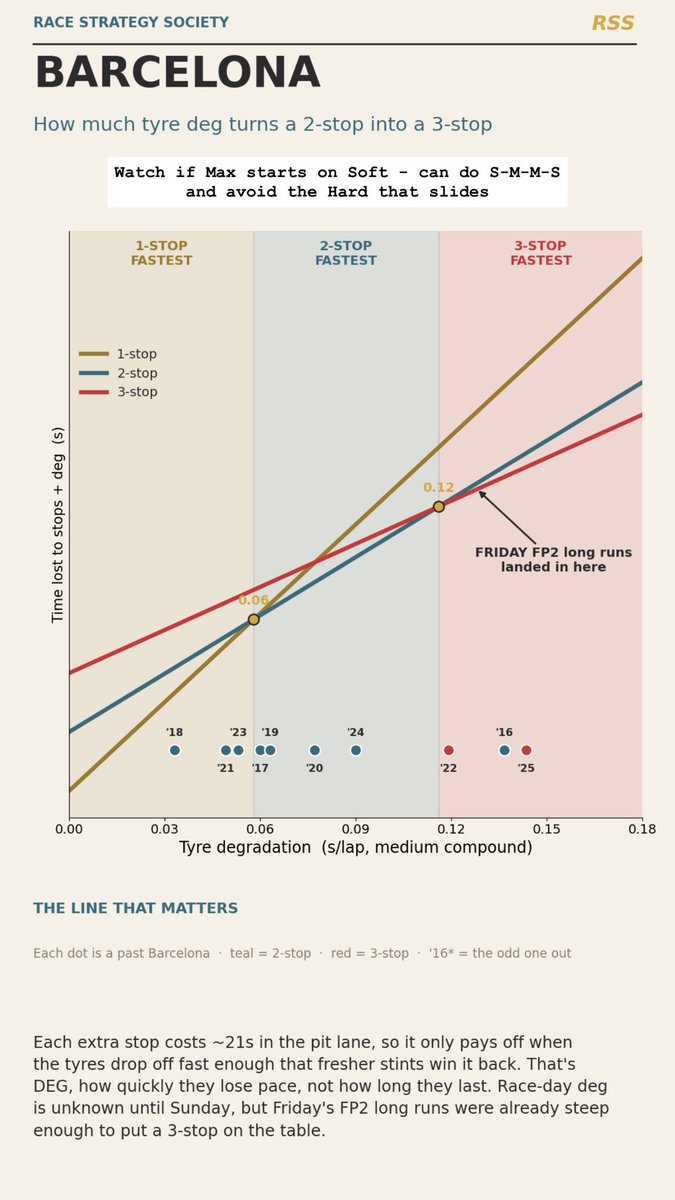

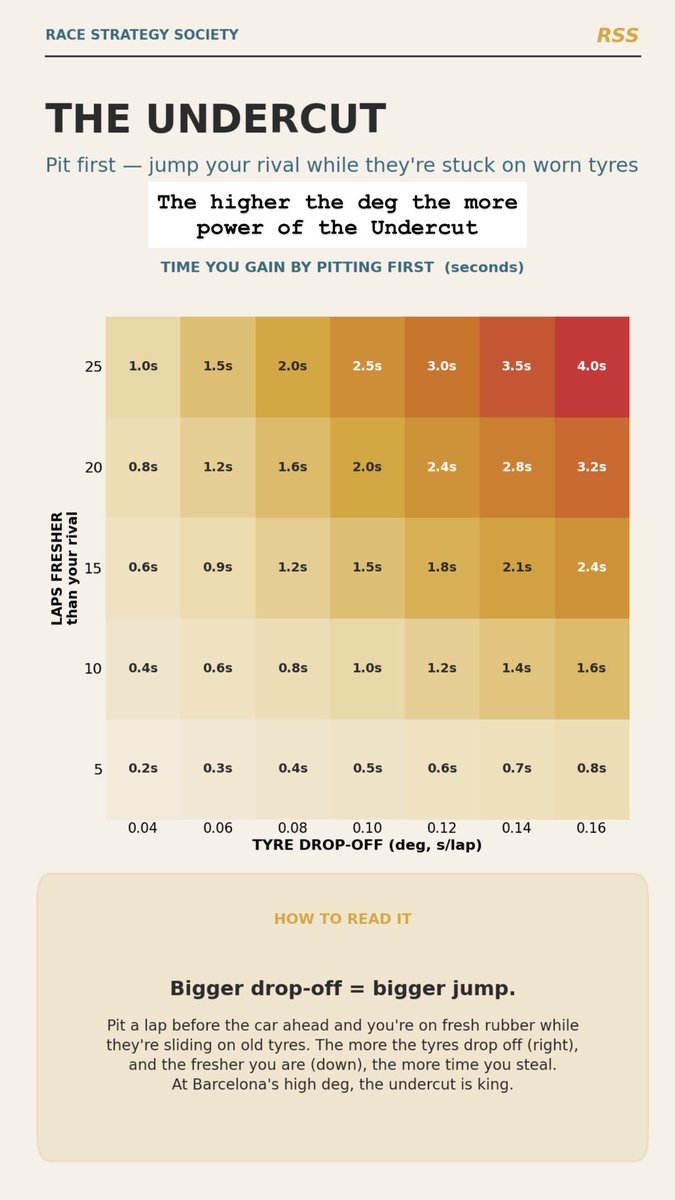
Your Barcelona GP Strategy Cheat Sheet
2 vs 3… it swings faster than you think!
2
14
1,238
I’m struggling to put into words how proud I am of my dad today.
I work in F1, my Dad @johnbuscombe raised me as an F1 fan, but both of my parents built their lives around helping other people. That fills me with more pride than any title ever could.
My Dad likes to think of himself as a lovable rogue, the person who’ll find you a window when every door appears closed.
In 2019 he nearly died. For months nobody knew why. Eventually they found an obscure illness with survival statistics that would have terrified most people. The rest of us looked at the numbers and thought, “those odds are awful.”
Dad looked at the numbers and thought, “good, now I know who the enemy is.” And I can write a paper about it after.
That’s who he’s always been.
Whether it was helping me find a path back after an accident that I thought would end my dream of working in Formula 1, helping patients fight diagnoses that looked impossible on paper, or fighting for his own life, his approach has always been the same:
Know the problem.
Attack the problem.
Never assume it’s over.
Kobayashi Maru.
Thank you for teaching me that it is never over until it’s over.
The irony is that medicine was only ever supposed to impress a girl, my mum. Somehow that turned into a lifetime of changing lives.
You never saw your own contribution the way you saw your father’s. You were so proud of him and the Queen’s honour for his service to the Navy.
But I see you the same way.
Brave. Stubborn. Brilliantly unconventional. Entirely yourself.
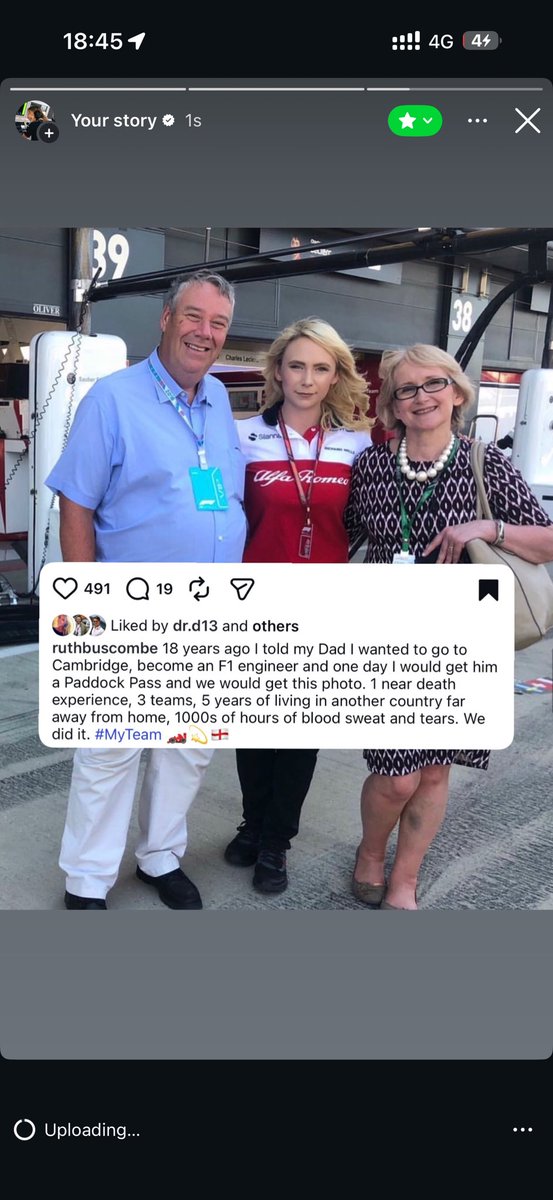
The day I finally got to take you into the Formula 1 paddock after promising you, years earlier, that one day I would, remains one of the proudest moments of my life.
You didn’t need a King’s Birthday Honour for us to tell you how proud we are of you.
But I’m incredibly grateful you’ve got one.
Congratulations Dad. ❤️
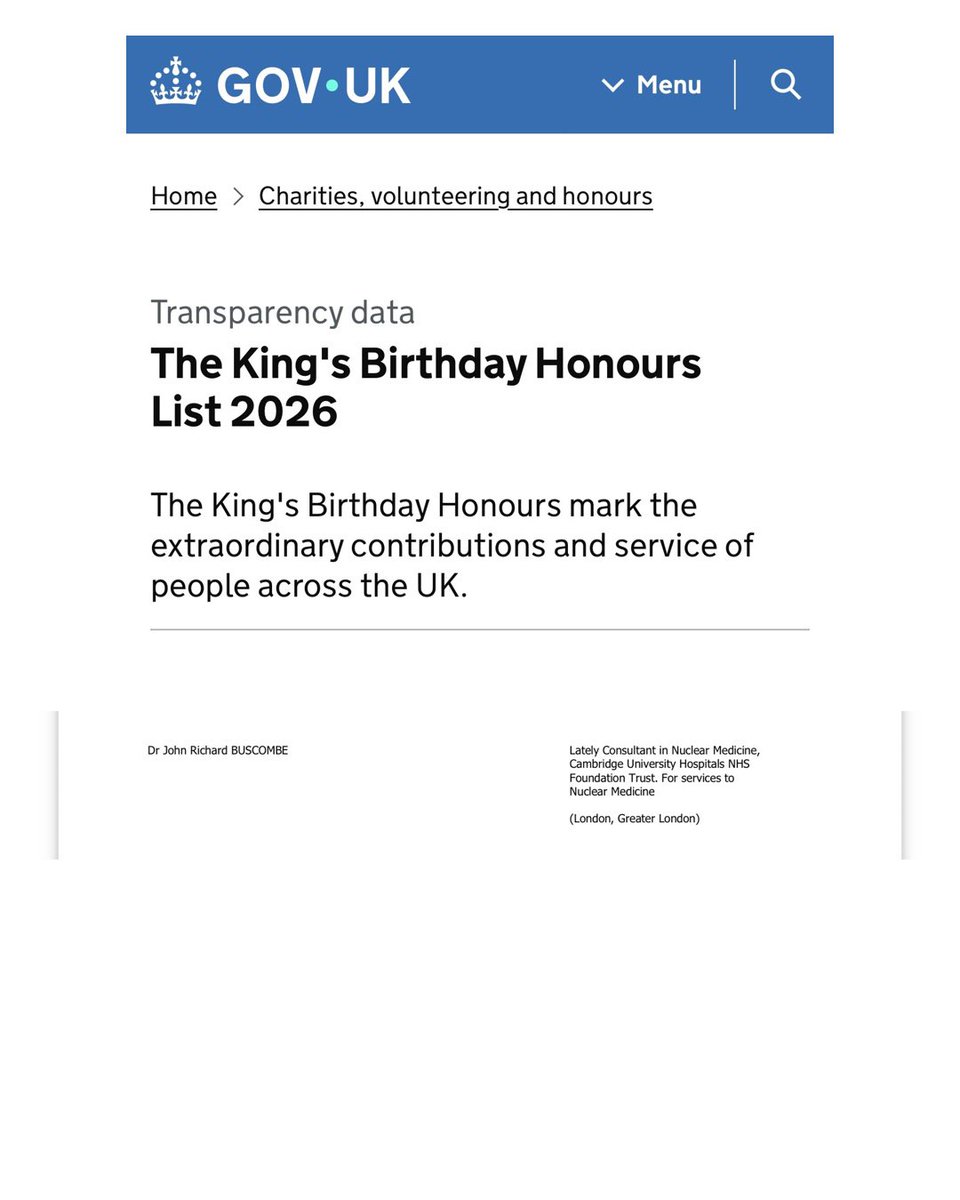
Dr John Richard Buscombe, honoured for services to Nuclear Medicine. What a legacy.
21
26
938
33,387
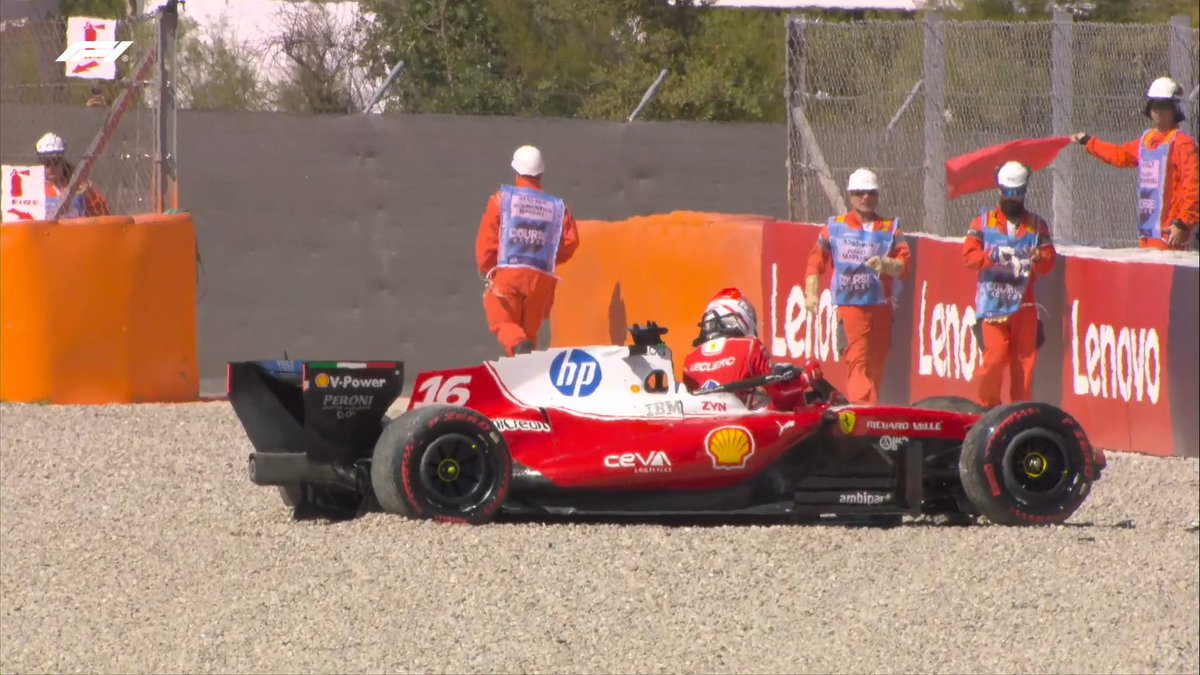
8:30 min on clock left in Q3
That’s time for 1 run options are:
Push cool cool Push
Push change tyres in Pitlane Push
Push cool Push
Single Push
If I had no time on board I quite like the Push change tires in Pit lane and Push.
You can hold the car and send it in a nice gap or do first run on used if that was your plane.
Refuelling in garage to make it 2 full runs is too risky and too tight for me.
(Next layer is if you have flexibility when you send the car in the window.
You don't want to be out of phase aka pushing when others are on our laps or cool laps so timings get built backwards like normal Qualy times. Same risk and reward applies later you go better track normally but more risk of losing your lap to another red flag or yellow. Only thing is usually avoid being first if there's dirt on the track)

1
4
79
16,028
Ruth Buscombe retweeted

Jun 13
Formula 1 cars hit top speeds of 200mph, and a race-winning move can happen in a split second. How does the F1 production team catch every moment?
10
3
34
11,964

Jun 12
Monaco GP: Pit Lane Penalties, Precedence and Podiums 👉
The technical bit, because the detail is the story:
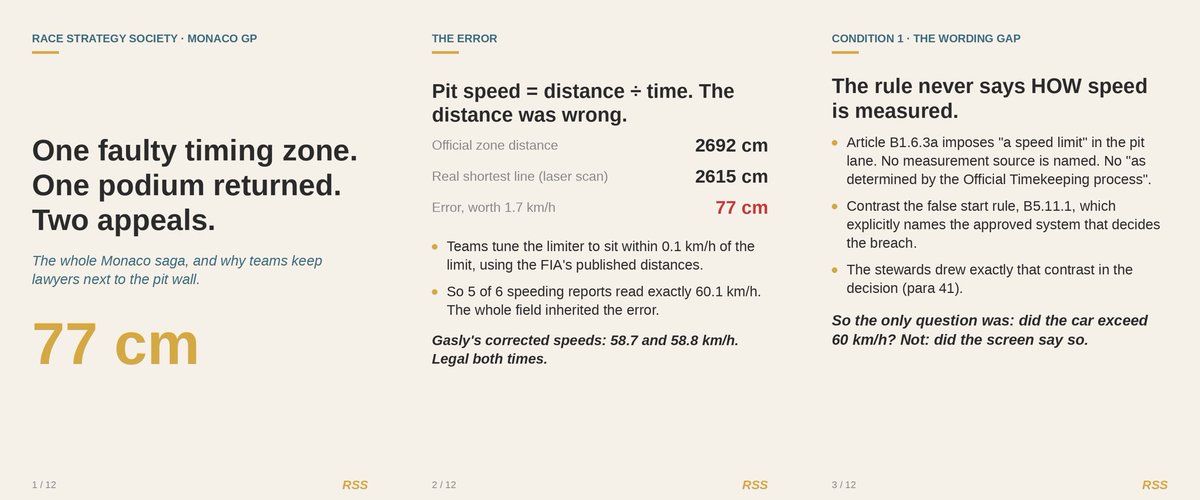
📏 Pit lane speed is never read off the car. It's the official loop-to-loop distance divided by crossing time, accurate to 1 cm and 1 ms. Monaco's first zone was set at 2692 cm; FOM's post-event LIDAR scan found the shortest driveable line was 2615 cm. Those 77 cm inflate reported speed by ~1.7 km/h.
⏱️ Teams tune the PLSL against the FIA's published distances to sit within 0.1 km/h of the limit. Wrong distance in, whole field tipped over together: 5 of 6 reports read exactly 60.1 km/h. Gasly's corrected averages: 58.7 and 58.8.
⚖️ His penalties were rescinded because all three conditions held: B1.6.3a names a limit but no measurement source, the official timekeeper disproved its own number, and his penalties were post-race time additions with a review filed inside Art 14's 96-hour window. Served penalties can't be touched — para 42, and Sainz's Zandvoort review proved it just last September.
🧑⚖️ Now McLaren and Red Bull have lodged notices of intention to appeal. Swipe for what they could argue, and the precedents that decided title fights before: Brazil 2003, Malaysia 1999, Jeddah 2023.
Not joined The Race Strategy Society yet?
📨 Newsletter in your inbox now. mailchi.mp/kentixen/the-race…
🎥 Full briefingand debriefs on YouTube: youtube.com/@theracestrategy…
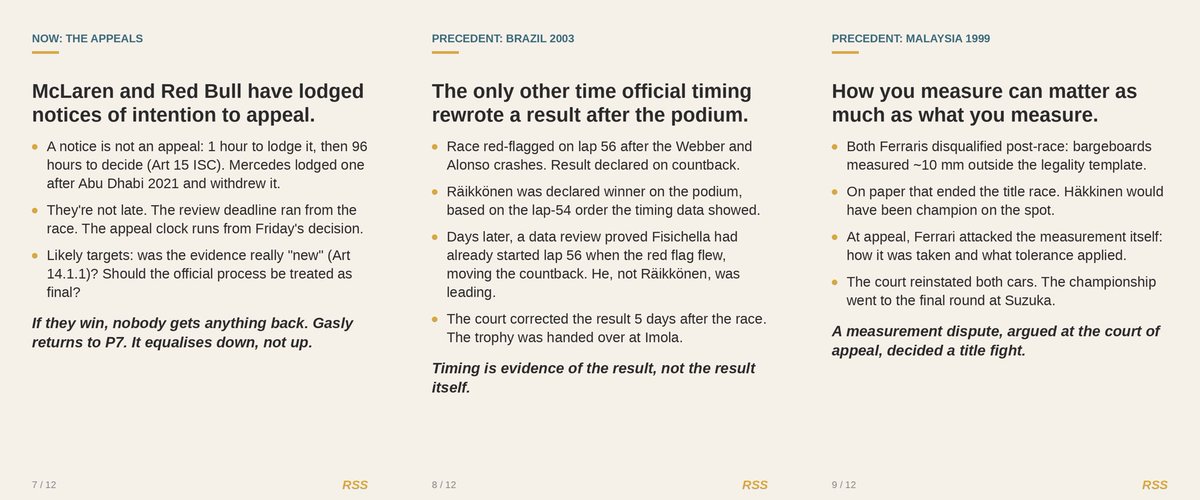
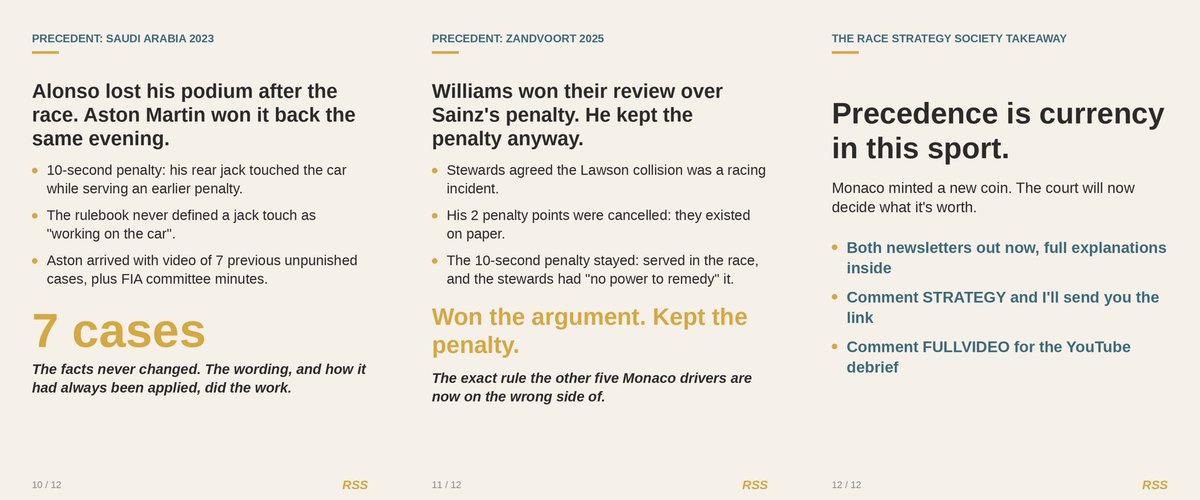
7
35
226
20,061
Jun 12
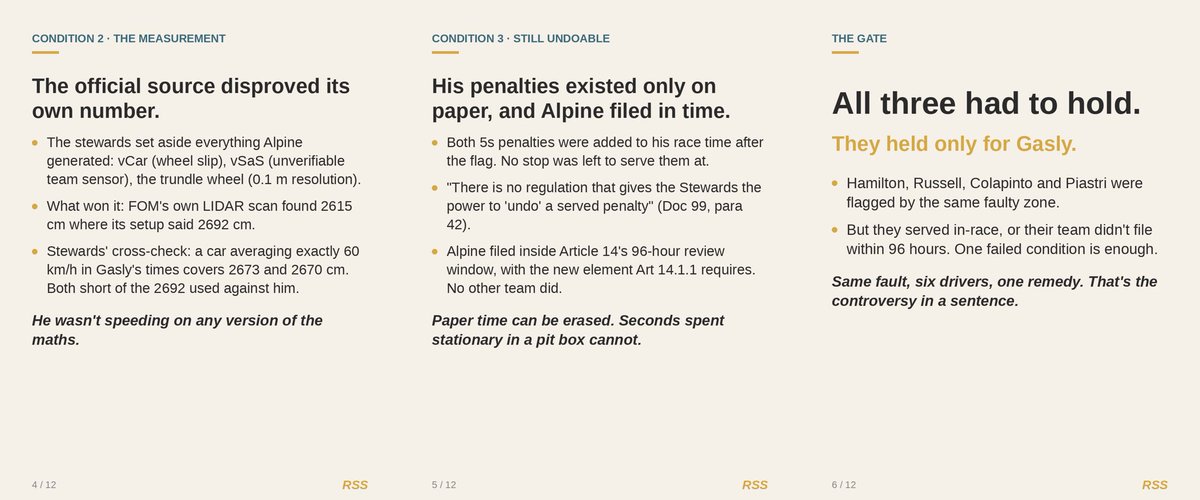
Three things had to line up for the stewards to overturn this.
1. The rule never says the timing system is the final word. The speeding rule (Article B1.6.3a) just says there's a speed limit, 60 km/h at Monaco. It doesn't say "speed as measured by the official timing system". Compare the false start rule (B5.11.1), which spells out exactly which system decides whether you jumped the start. Because the speeding rule names no source, the only question the stewards had to answer was: was the car actually going faster than 60? Not: did the screen say so.
2. The timekeeper proved its own number wrong. Pit lane speed is calculated as distance divided by time, and the official distance for that zone was 77 cm too long, because the barriers moved this year and opened a shorter line. The timekeeper found this itself with a laser scan after the race. Redo the maths with the correct distance and Gasly was doing 58.7 and 58.8 km/h. Under the limit, both times. The stewards actually rejected all of Alpine's own evidence; what convinced them was the official system contradicting itself.
3. The penalty could still be undone. Gasly never served his penalties during the race they were added to his finishing time afterwards, and that's the only kind the stewards have the power to erase. A penalty served at a pit stop is gone forever; nobody can give you back time you spent stationary. Alpine then filed for a review within the 96-hour deadline (Article 14 of the Sporting Code), with the new evidence the rules require. They were the only team that did.
That's why Gasly got his podium back and the other four drivers caught by the same faulty zone got nothing: all three conditions held for him, and only him.
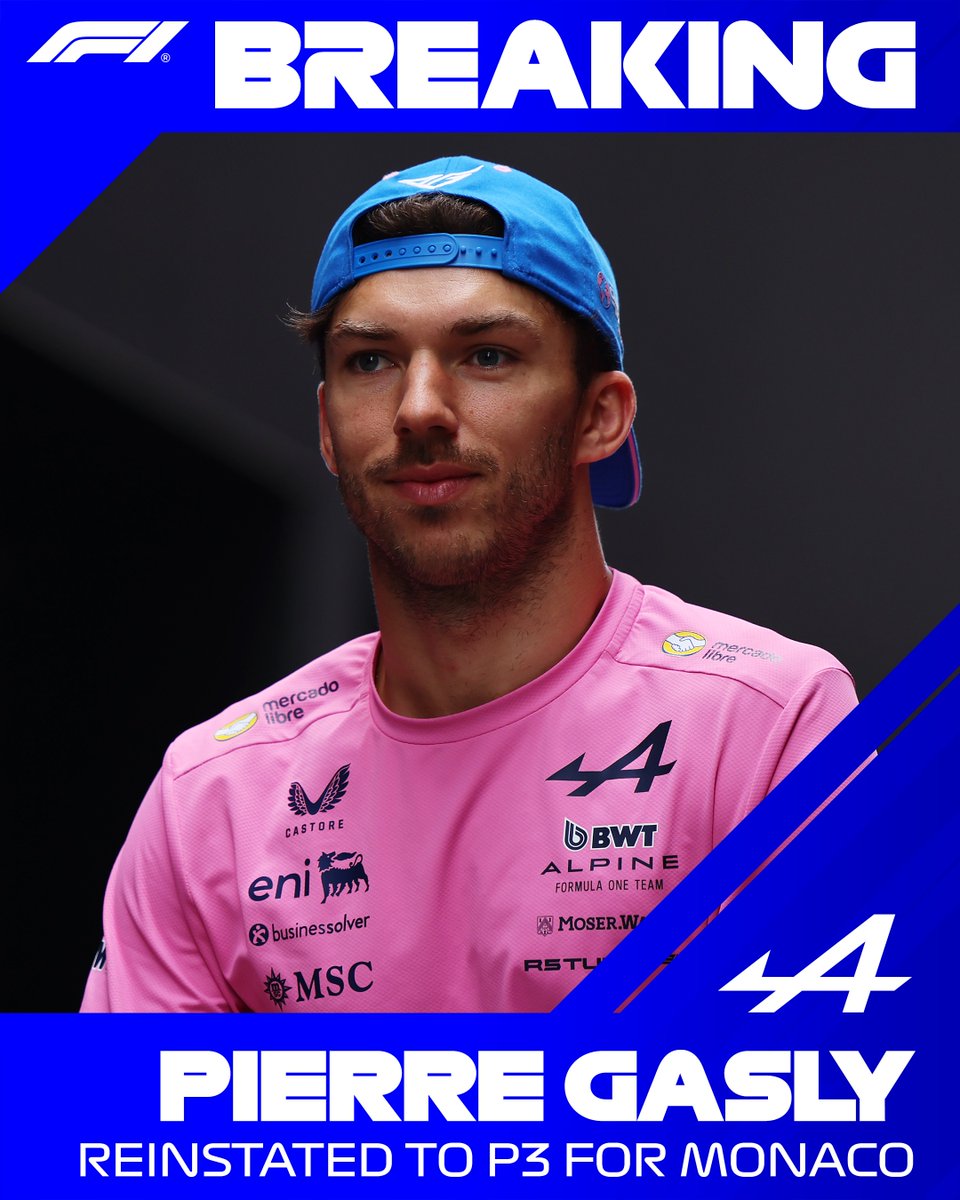
BREAKING: Pierre Gasly has been reinstated into P3 for the Monaco Grand Prix
The Stewards have rescinded the two five-second penalties imposed on Pierre Gasly during the race for speeding in the pit lane
#F1
99
653
6,485
663,584
Ruth Buscombe retweeted
Jun 6
Monaco proves it every year. 🇲🇨 The best @f1 car doesn't win on a street circuit. The best driver does. Is it speed or precision?
9
10
49
17,439
May 25
It’s drizzling.
Boss asks which tyre.
How does a strategist actually decide?
And how do I say it on live TV without the obvious things, like an F1 car and a pit wall of my own?
Well, here’s what I did.
I haven’t been on a pit wall since the end of 2023. But last night I prepped Canada like I still was. The question doesn’t change, and like my old boss, my new boss still asks. It’s my job to answer.
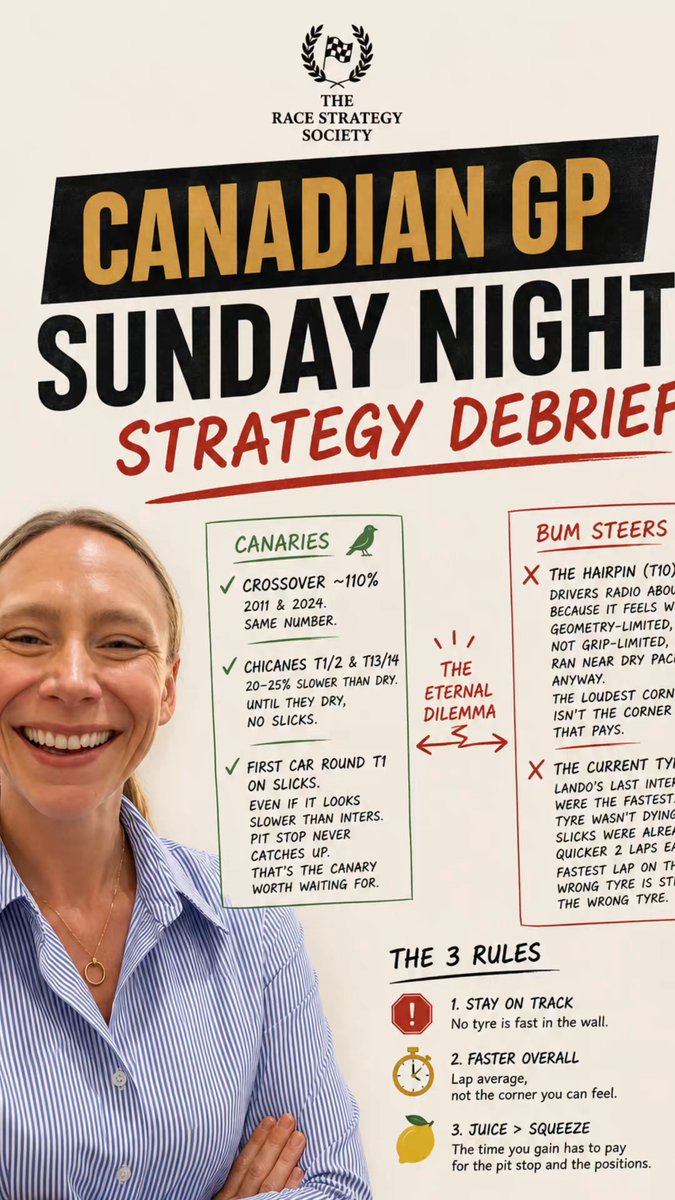
Honest answer: we build decision trees off the times we got it really wrong. Dale Carnegie called them FTDs, short for Fool Things I’ve Done. Mine are the same thing: races I’ve got wrong before and would really like to not repeat. (Singapore 2017 flashbacks intensify.) What falls out is three rules and two kinds of signals.
The rules. Every crossover comes down to these:
1️⃣ 🚨 STAY ON TRACK. No tyre is fast in the wall.
2️⃣ ⏱️ FASTER OVERALL. Lap average, not the corner you can feel.
3️⃣ 🍋 JUICE > SQUEEZE. Time gained has to pay for the pit stop and the positions.
Then the work splits in two:
🐤 Canaries, the signals that quietly tell the truth.
🎣 Bum steers, the signals that look like info but lead you wrong.
Canada, wet, last night:
🐤 Crossover number. ~110% of dry. 2011 and 2024. Different cars, different tyres, same number.
🐤 The chicanes. T1/2 and T13/14 ran 20-25% slower than dry. Until they dry, no slicks.
🐤 First car round T1 on slicks, even if it looks slower than the inters. Pit stop never catches up. That’s the canary worth waiting for.
🎣 The hairpin. Drivers radio about it because it feels wet. Geometry-limited, not grip-limited, and it ran near dry pace anyway. The loudest corner isn’t the corner that pays.
🎣 The fastest lap on the wrong tyre. Canada 2024: Lando’s last inter laps were the fastest on track. Tyre wasn’t dying. Slicks were already quicker two laps earlier. Fastest lap on the wrong tyre is still the wrong tyre.
The job: chase the canaries, ignore the bum steers, answer the three rules. 🚨⏱️🍋🎣🐤
Full breakdown coming soon.
🎥 on YouTube: youtube.com/@theracestrategy…
📨 Via Newsletter. Not joined The Race Strategy Society yet? mailchi.mp/kentixen/the-race…
🎧 Prefer your strategy by podcast? We're now wherever you get your podcasts
4
9
61
3,145
May 24
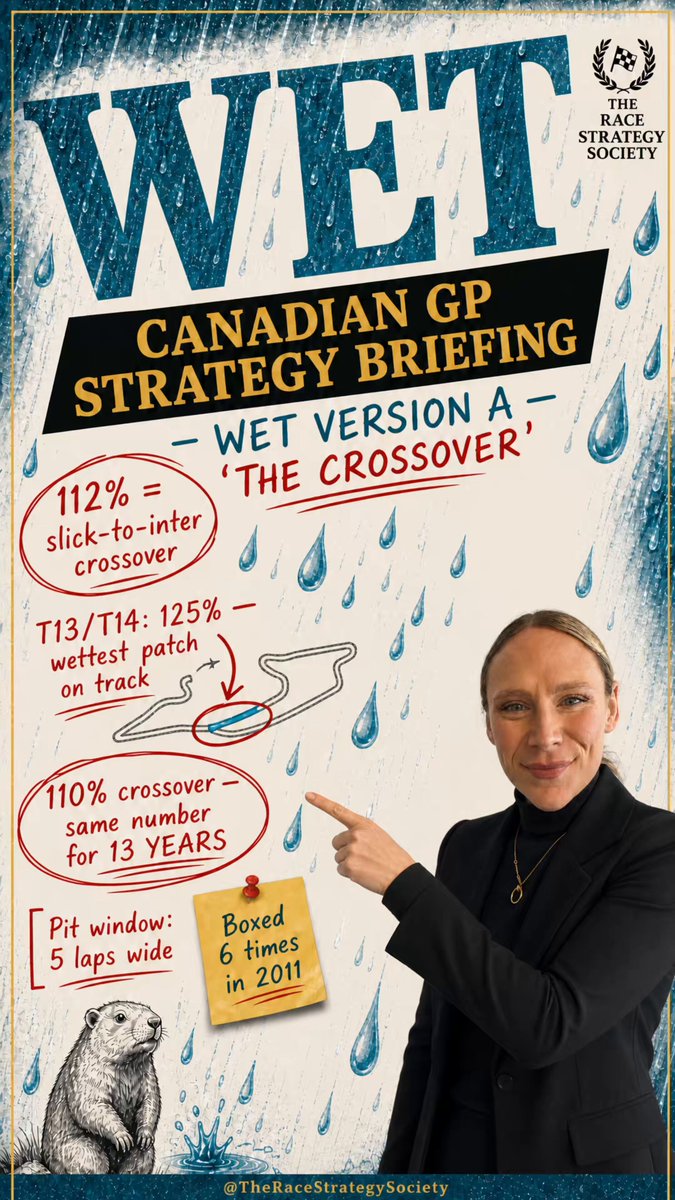
🇨🇦🌧️ Canadian Grand Prix 2026 Wet Strategy Briefing.
The crossover explained.
In Montreal, the lap never dries evenly.
The back straight can already be slick-ready while T13/T14 is still deep in the danger zone.
That is why strategists don’t pit off the lap average.
They pit off the wettest corner.
🌧️ T13/T14 peaked at 125% of dry pace in Canada 2024
🌧️ T1/T2 stayed above 120% long after the straights were ready
🌧️ Norris lost Canada 2024 by staying out two laps too long
🌧️ Button won Canada 2011 with SIX pit stops because minimum stops is not always optimal
The biggest myth in wet-race strategy?
That fewer stops automatically means the better race.
Sometimes the winning strategy is simply the team willing to keep taking the tyre advantage when conditions keep changing.
And now comes the 2026 complication:
Active aero in mixed conditions, new energy limits, recharge compromises, unknown warm-up behaviour.
The teams who pre-decide the criteria usually win.
The teams who improvise usually don’t.
In this week’s Race Strategy Society briefing:
🌧️ The real inter-to-slick crossover number at Montreal
🌧️ Why T13/T14 decides the entire race
🌧️ The 17-second pit-loss calculation teams use in passing showers
🌧️ Button 2011 vs Norris 2024, same conditions, opposite outcomes
🌧️ Why “minimum stops” is often the wrong instinct in wet races
🌧️ …and more
The Canadian GP always looks simple on paper.
It never is.
🇨🇦🌧️ Canadian Grand Prix 2026 Wet Strategy Briefing out now!
3
4
39
2,410
May 24
🦫🏎️🇨🇦Dry Strategy Briefing THE NUMBERS YOU NEED FOR THE CANADIAN GP
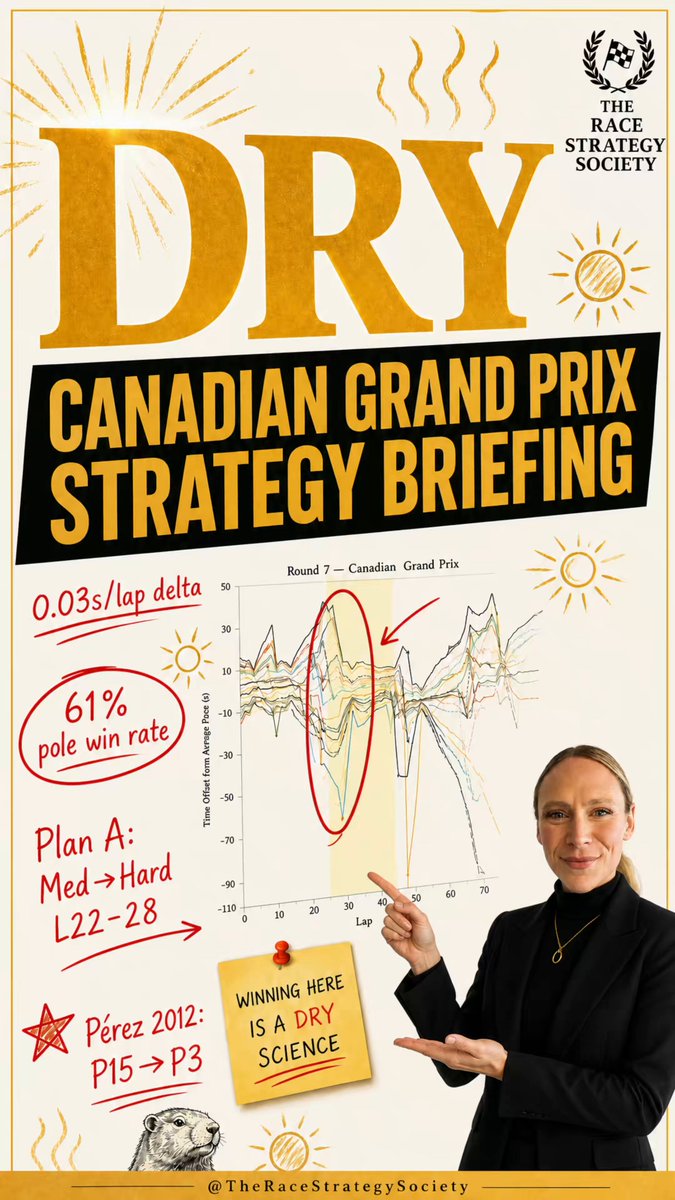
61%.
Pole position’s win rate in Montreal across the last 18 years.
Wins from P3 in the same period.
Saturday matters here more than almost anywhere.
1 in 3.
The probability of a Lap 1 Safety Car at Turns 3 and 4.
No runoff. Heavy braking. Cold tyres.
Survive the opening lap and you’ve already cleared one of the race’s biggest statistical threats.
3 of 18.
Canadian GPs altered by wildlife.
🦫 Davidson 2007
🕊️ Vettel 2016
🐿️ Hamilton 2025
Groundhog probability now genuinely higher than rain deciding the result at most circuits.
4.84 places.
Average position gain from pitting under a Safety Car in Montreal.
Largest pit timing premium on the calendar.
0.03s per lap.
The theoretical delta between the one-stop and two-stop this weekend.
Across a full race distance?
About two seconds.
That means strategy confidence matters more than pure model pace.
Plan A:
Medium → Hard, one stop.
Plan B:
Medium → Hard → Hard, aggressive two stop.
But if the field converges on one-stop thinking…
that’s when the reverse strategy becomes dangerous.
Hard tyre start.
Long first stint.
Fresh Medium or Soft at the end.
Pérez used it from P15 to P3 here.
Then comes the 2026 complication:
⚡ Overtake Mode worth ~0.45s per lap
⚡ Recharge cost worth ~0.1–0.2s
⚡ Mercedes carried roughly 0.2s pace advantage through the Sprint
The margins are tiny.
The consequences are not.
🇨🇦📊 Canadian Grand Prix 2026 Strategy Briefings out now!
🎥 Full briefing live now on YouTube: youtube.com/@theracestrategy…
📨 Newsletter in your inbox now. Not joined The Race Strategy Society yet? mailchi.mp/kentixen/the-race…
🎧 Prefer your strategy by podcast? We're now wherever you get your podcasts
24
1,863
May 22
🕵️♀️🇨🇦🐿️ WHY F1 STRATEGISTS ARE ON GROUNDHOG WATCH IN MONTREAL
Three of the last eighteen Canadian Grands Prix have been altered by wildlife.
Ignore the data at your peril.
🦫 2007, Anthony Davidson, groundhog
🕊️ 2016, Vettel, seagulls
🐿️ 2025, Hamilton, another groundhog
Sometimes the biggest strategic variable in Formula 1… isn’t in the data.
Lewis Hamilton after Montreal 2025:
“I love animals, I’m so sad about it.”
Groundhog watch is serious business if you’re a strategist around here. Ignore them at your peril.
Welcome to Montreal, where the wildlife votes, the weather forecast is a coin toss, and your brake-by-wire decides the race.
In this week’s Race Strategy Society briefing:
🐿️ Why pole wins 61% of the time here, and why P3 has won precisely zero
🐿️ The 2026 energy budget that’s 25% smaller than Miami’s, and what it changes
🐿️ The Safety Car timing worth nearly five grid positions
🐿️ Button 2011 vs Norris 2024, same wet-race conditions, opposite outcomes
🐿️ Four technical tells to watch on Sunday
🐿️ …and more
The Canadian GP always looks simple on paper.
It never is.
🇨🇦🐿️ Canadian Grand Prix 2026 Strategy Briefings out now!
🎥 Full briefing live now on YouTube: youtube.com/@theracestrategy…
📨 Newsletter in your inbox now. Not joined The Race Strategy Society yet? mailchi.mp/kentixen/the-race…
🎧 Prefer your strategy by podcast? We're now wherever you get your podcasts
5
4
20
1,989
May 22
🇨🇦 Canada GP Race Strategy Briefing | GROUNDHOG DAY 🐿️ youtu.be/zyZhxFonSZI?si=bPDD… via @YouTube
1
4
23
2,684
Ruth Buscombe retweeted

May 18
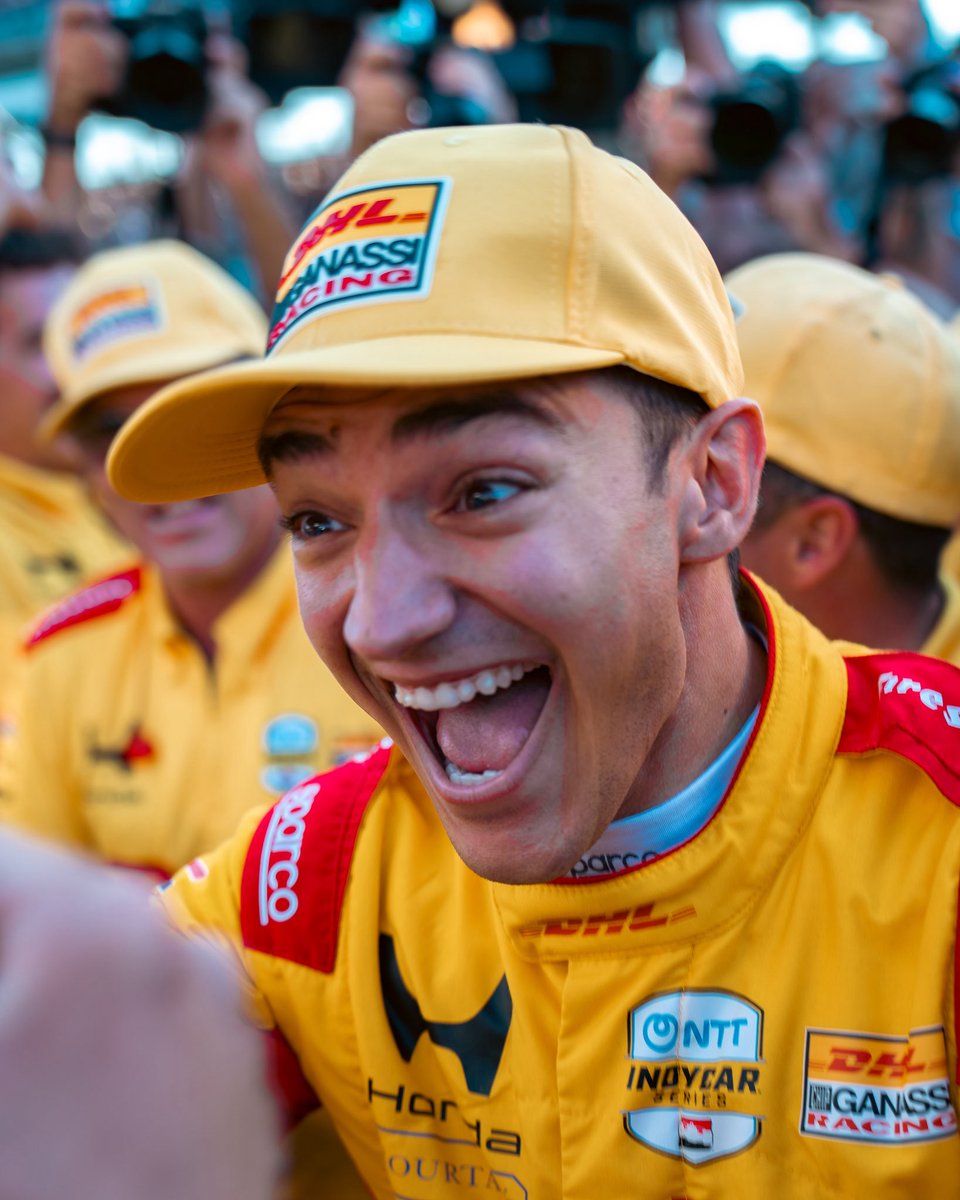
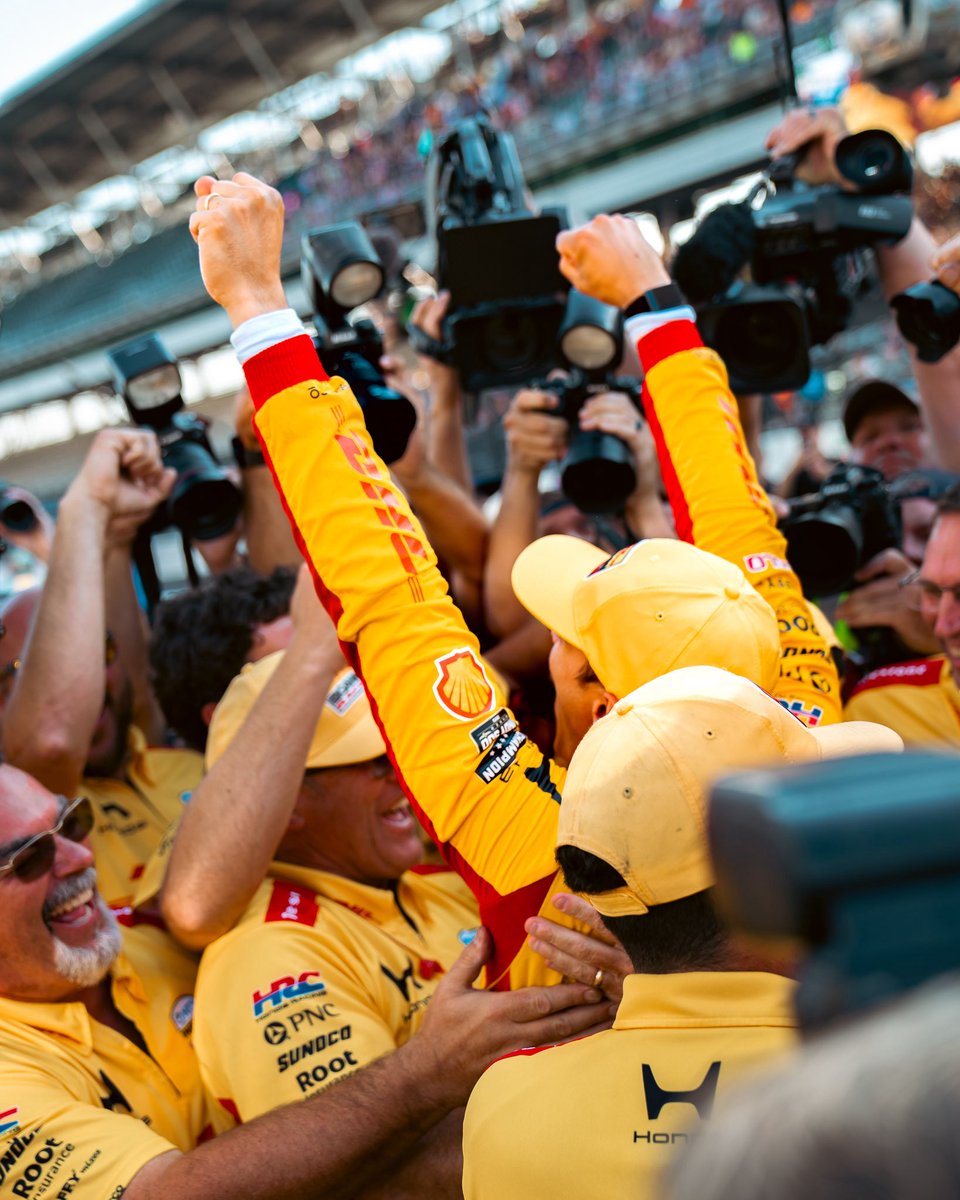
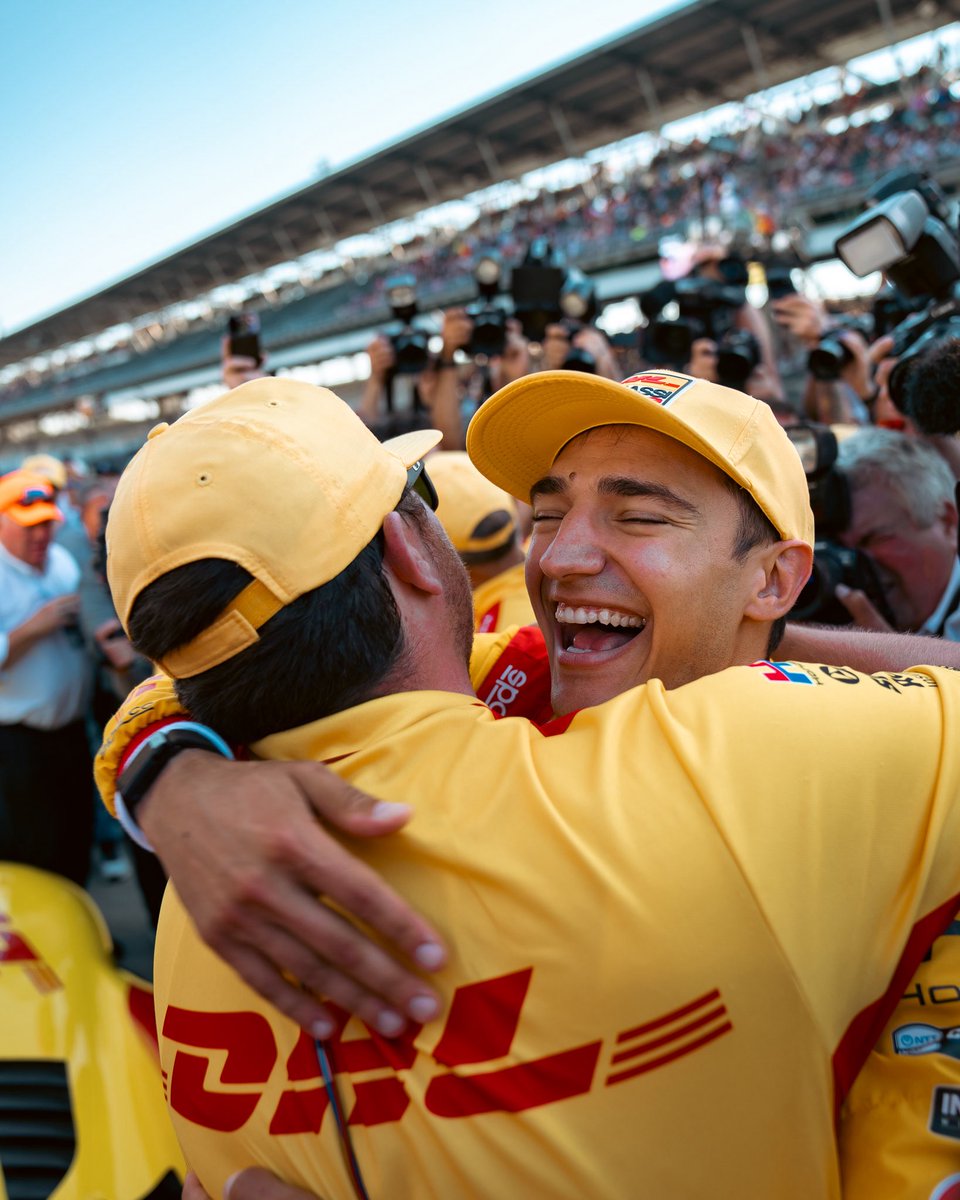
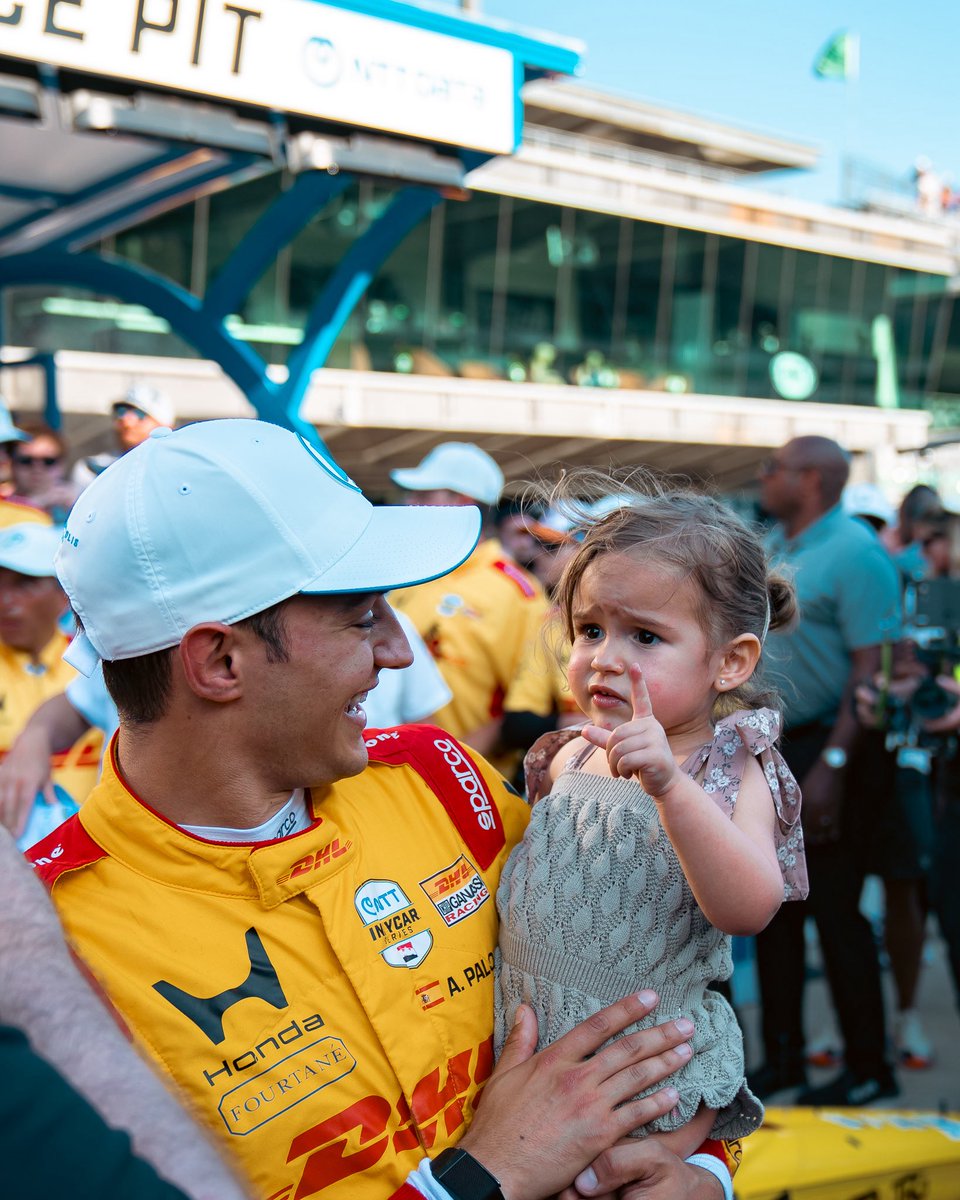
POLE FOR THE INDY 500!!!!!!!!!!
WHAAAAAAAT????
74
753
8,129
188,824
Ruth Buscombe retweeted
May 16
In Formula 1, standing still means falling behind. Is the difference between race one and race twenty the speed of the car or the innovation of team that builds it?
8
12
108
20,986
Ruth Buscombe retweeted
May 16
AWS and @f1 have partnered to push the boundaries of what technology can do in the most demanding environment in sport. Hear from AWS Motorsports Ambassador and F1 Race Strategist @RuthBuscombe on what the world can learn from F1.
3
4
18
10,821
May 2
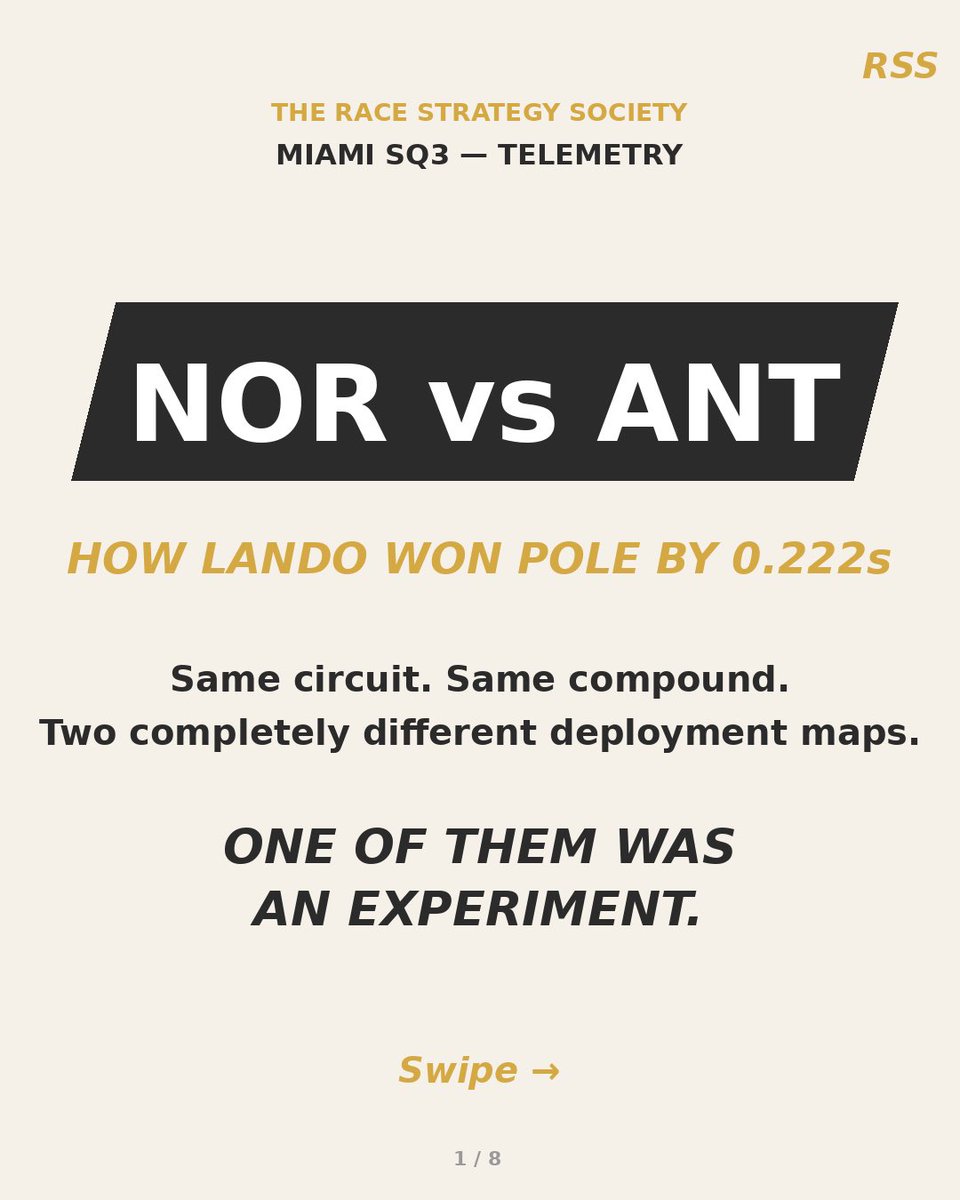
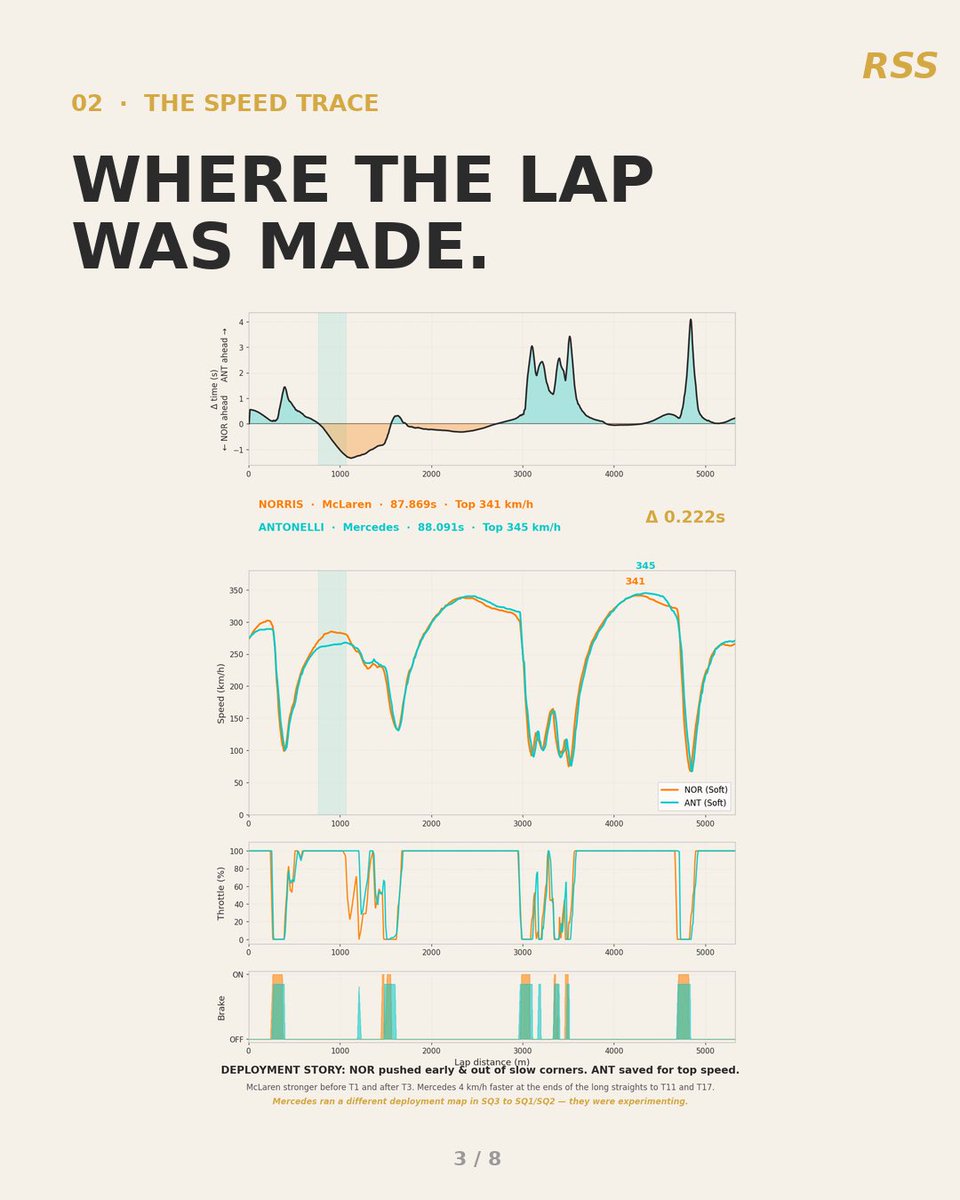
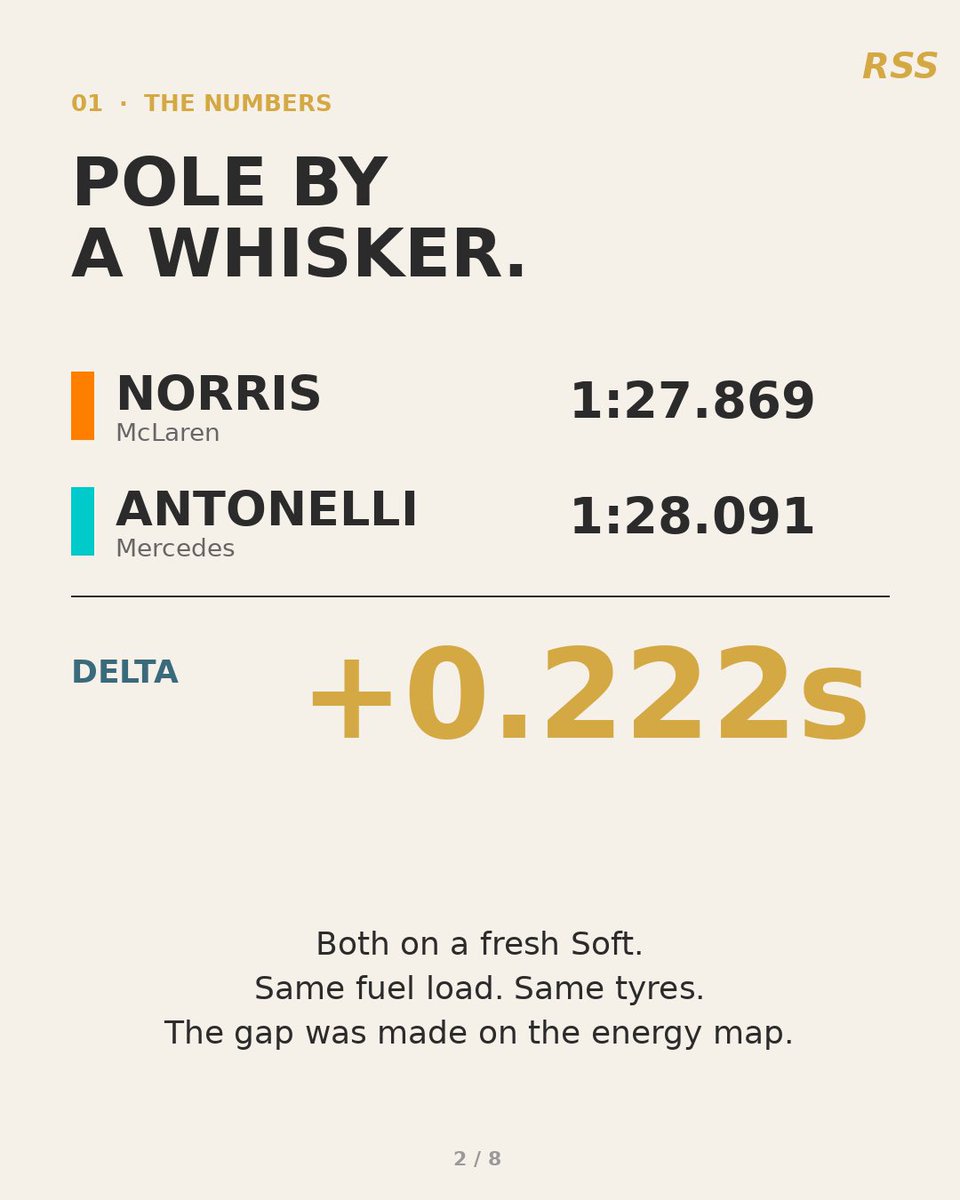
Miami Sprint Pole by 0.222 seconds. But that doesn’t tell the whole story. Swipe 👉🏻
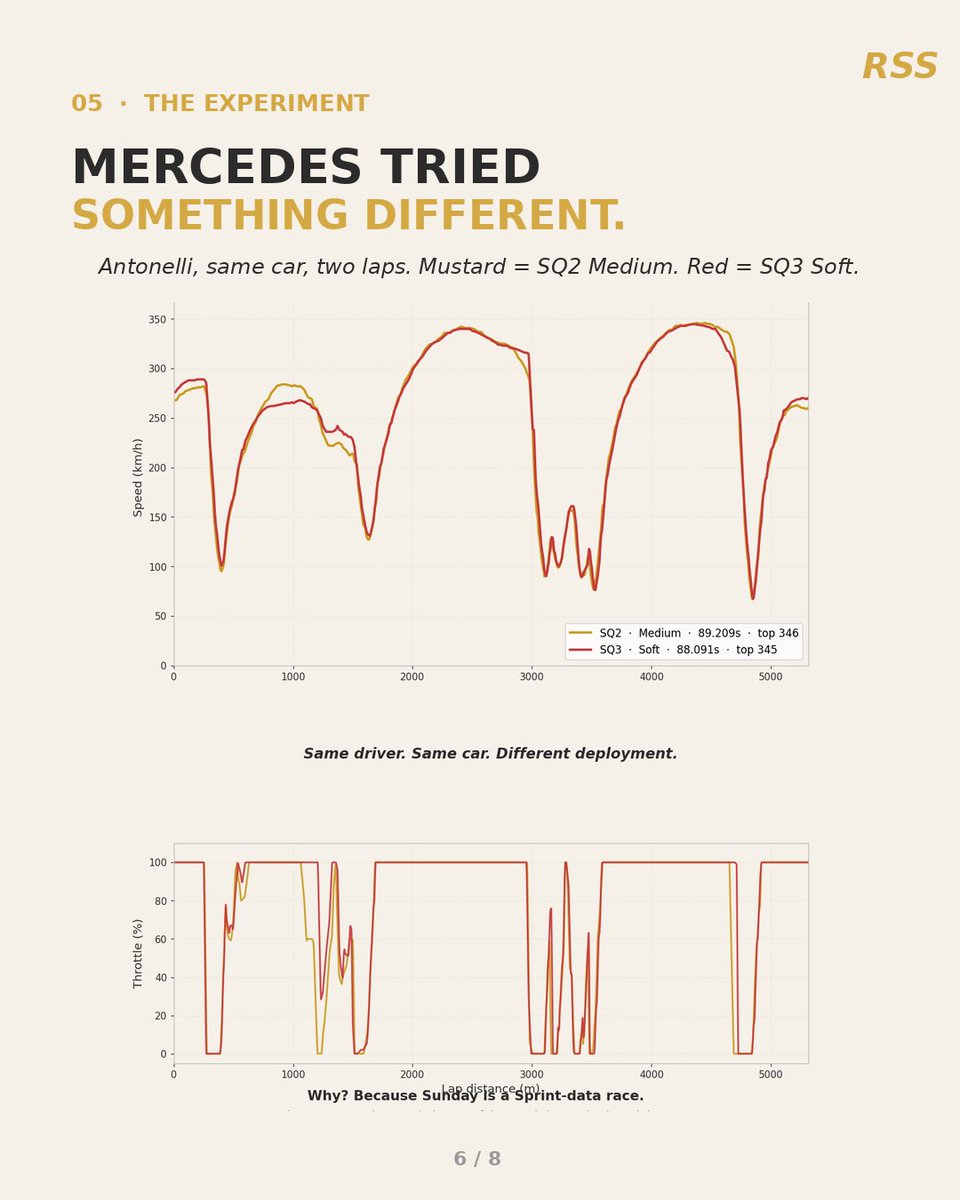
Same circuit, same compound, same fuel load. Lando Norris on pole, Kimi Antonelli alongside him, both on a fresh Soft. The gap was made on the energy map.
Watch where Lando pulled it out: the run to T1 and the exit of T3. Both early-lap, both the bits where McLaren chose to deploy harder and sooner. Antonelli clawed time back at the end of every long straight. 4 km/h faster at the top. That’s not driver, that’s stored energy waiting for the right moment.
Now look at slide 6. That’s Kimi’s own SQ2 lap (mustard, Medium) against her SQ3 lap (red, Soft). Same driver, same car, two completely different deployment shapes. Mercedes ran a map in SQ3 they hadn’t touched in SQ1 or SQ2.
The bigger story underneath: these cars are on the limit. SQ1 had Mediums overheating across the field. McLaren and Red Bull rolled into SQ2 with a double-cool brake setup on the Medium, and that cooling carried straight onto the Soft in SQ3, which has a lower working window and runs at a lower temperature anyway.
Mercedes went a different way.
It cost them Sprint pole. By 0.222 seconds.
🚨 Not joined The Race Strategy Society yet? Click for a time limited link to sign up now: mailchi.mp/kentixen/the-race…
🎥 Want more? Subscribe to the Strategy Channel for extended video briefings: : youtube.com/@TheRaceStrategy…
🎧 Prefer your strategy by podcast? We're now wherever you get your podcasts.
1
9
64
7,771
Ruth Buscombe retweeted
May 1
1
5
8,507