An active network for communication among professional historians and those in cognate disciplines working on South Africa or southern Africa. Home to @sahisjor
Joined June 2013
- Tweets 665
- Following 255
- Followers 1,175
- Likes 130
40 Photos and videos



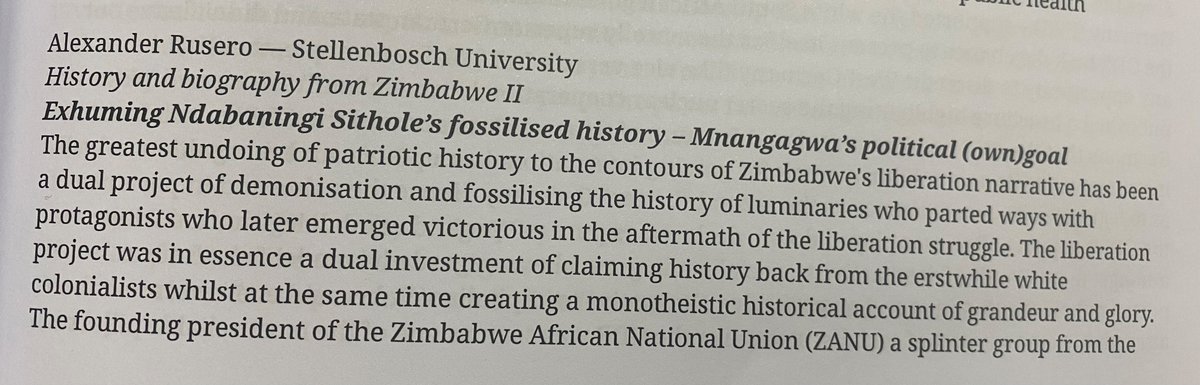
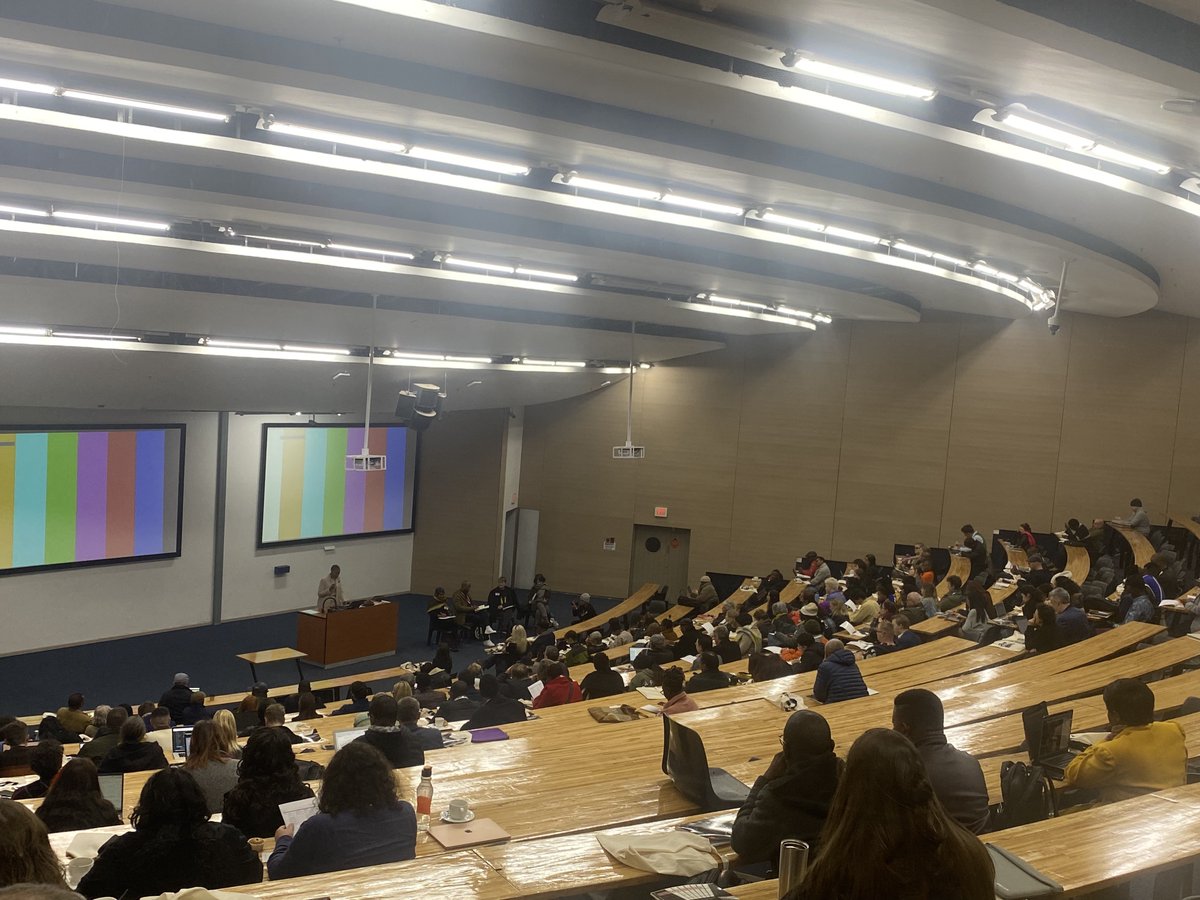
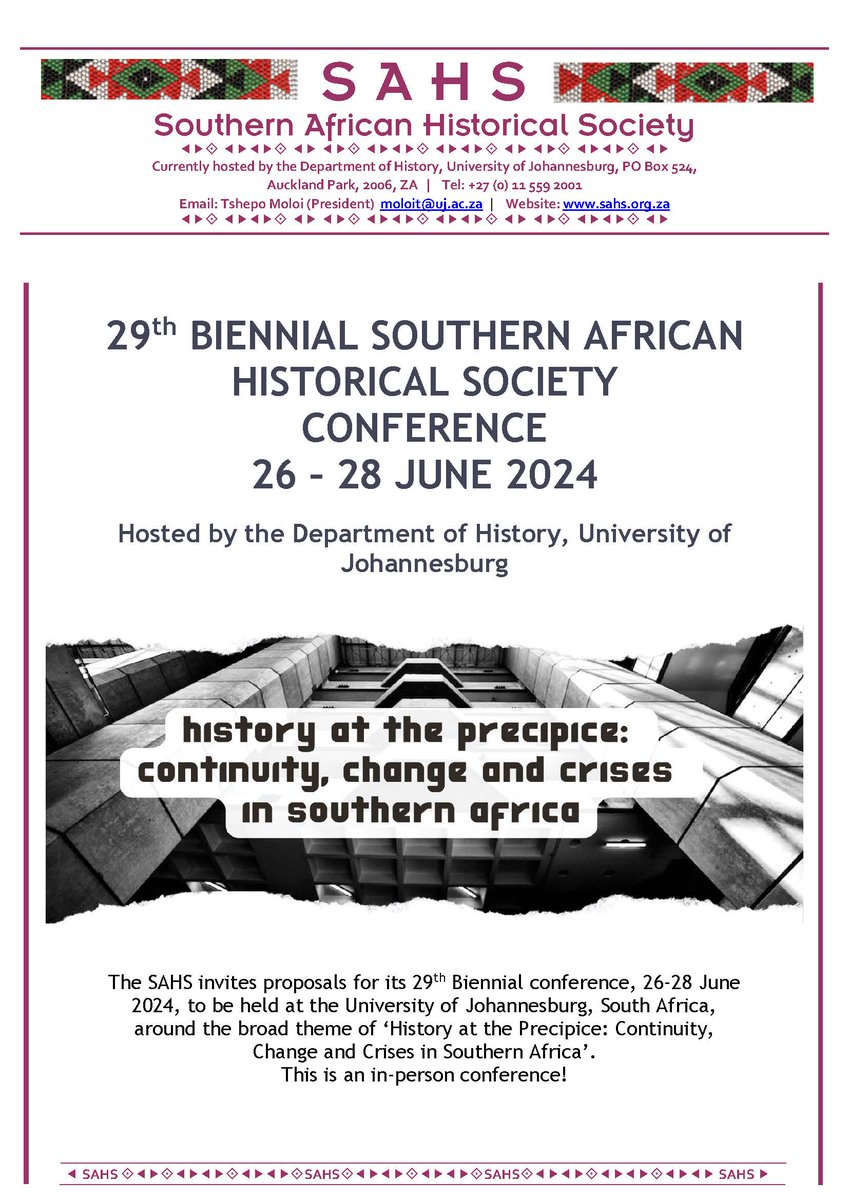
Studies on South Africa’s liberation movement have largely been dominated by narratives around male leaders, armed struggle, and formal political institutions. Our latest issue challenges this focus and foregrounds women’s resistance to apartheid.
tandfonline.com/toc/rshj20/c…
16
31
1,487
Our latest issue is up. Its illuminating articles, including three that are open access, examine the multifaceted histories of black lawyers in South Africa from colonialism and apartheid to globalisation.
zaf01.safelinks.protection.o…
14
17
1,355
Lesotho at 60: A Historical Retrospective
On 4 October 2026 Lesotho will celebrate its 60th anniversary of independence. As an enclave country many of the problems of post-independence Africa are magnified in Lesotho, as the country has long struggled to assert its sovereignty and support its own citizens, both at home and abroad for migrant labour. Still, the significant changes in the country since the return of democracy in 1993 and the end of apartheid in surrounding South Africa in 1994 deserve examination.
The post-apartheid period has seen, paradoxically, both better access to historical sources in Lesotho and fewer historical publications. Greater access to historical sources has been – in part – due to a revitalised National Archives in Maseru, the opening of new archives such as the Royal Archives in Matsieng, and a renewed focus on history in the country due to the political salience of issues like the border with South Africa.
However, South African history has long dominated Southern African history and historiography. With the coming of democracy to South Africa in 1994, this historiographical dominance has been heightened as scholars rushed to document and re-interpret the years when scholarly work on the country was difficult due to apartheid restrictions. Changes in peripheral states like Lesotho, a place many scholars gravitated to in their work when they were denied access to apartheid South Africa, were often left unnoticed except by those still working in country. This historical and historiographical erasure has meant that scholarship on Southern Africa often implicitly takes South Africa as the norm in the region.
This special issue, therefore, calls for a dramatic re-centering of regional scholarship on Southern Africa. Even continuing to call Lesotho (and other countries) ‘peripheral’ to region implies that South Africa is the centre around which everything else revolves. This is not the case. While the Republic of South Africa plays particular regional roles, this issue will serve as a corrective, using the lens of sixty years of independence for Lesotho to explore and shift toward more regional perspectives on political, economic, and social histories to better reflect the lived realities for many—where border crossing is the norm and national citizenship reflects the passport people hold, but not necessarily the allegiances they feel.
Much of the best scholarship on Lesotho—scholarship that has complicated and reframed Southern African historiography—has only been published locally, which has contributed to the lacuna in the regional historiography around such ‘peripheral’ states. Individual authors have broken through to write important works, but this special issue of the South African Historical Journal will foreground voices and authors who will bring work on Lesotho and its situated contexts to a wider audience.
The existing historiography on Lesotho is strong in migration and migrant labour, the history of development, and nineteenth century chieftaincy/land disputes. These all remain important themes, but with the ending of apartheid the migrant labour system has been radically reshaped, and the development industry has gone through multiple iterations in response to both regional changes and global upheavals in the aid/development regime.
More historical scholarship is needed, both on the changes in these processes in the years since 1993/1994, but also in the apartheid era, given the new access to archival sources in Lesotho. Further, by virtue of being an enclave country, the role of Lesotho citizens in increasingly vitriolic regional debates around borders, citizenship, belonging, and the role of passports/identity documents in the post-apartheid period deserve a more fulsome examination.
The special issue will ask authors to engage with prior literatures, but also to tell new stories, including new stories about old phenomena. The shift from Lesotho being primarily an exporter of migrant labourers to being an exporter of water is one that may foreshadow future regional changes, as low-skill manufacturing and mining jobs continue to disappear in many Southern African countries. Further the rise and decline of Lesotho’s textile industry in the 21st century may be a cautionary tale about how embracing globalisation may bring some short-term wins, but at great cost to the workers, the environment, and the political system.
Some of the themes authors may explore in this special issue include:
· What new histories of Basotho and Lesotho need to be written?
· What new insights into older Basotho history have been discovered with the new wealth of documents available from the Royal Archives in Matsieng and/or new collections of documents from the 19th and early 20th century?
· How has literature produced in Lesotho engaged with historical storytelling, oral traditions, and the reinterpretation of Lesotho’s past?
· What regional lessons are there to learn about political changes that have taken Lesotho from democracy through one-party dictatorship, military rule, back to democratic rule and then to some of the first coalition governments in Southern Africa?
· How have struggles over constitutional reform evolved over time? Especially regarding relations between the monarchy and government.
· How have Basotho responded to changing economic developments in South Africa that have altered labour migration routes, so prevalent in the 20th century?
· How have patterns of labor migrations between Lesotho and South Africa shaped musical traditions, performance practices, and the development of shared artistic expressions as tools for contesting power during the 20th and 21st centuries?
· How does the textile industry in Lesotho illuminate globalisation and its discontents in the late 20th and early 21st centuries?
· What re-examinations of older histories and historiographies will alter the ways we understand Basotho society and the role that Lesotho plays in Southern Africa and the wider world?
· How have smaller states in southern Africa managed to push forward their own diplomatic agendas and/or the concerns of their citizens in the region and internationally?
· What has been the relationship between NGOs, Basotho citizens, and the Lesotho government?
· How have large development projects like the Lesotho Highlands Water Project influenced the ways that Basotho see the world and their own government?
· How have environmental histories of Lesotho reshaped how we understand processes of social and economic change?
· How do borderland communities between Lesotho and South Africa navigate identity, belonging, and adapt in response to labour systems and state policies?
· How have artists in Lesotho engaged with questions of memory, heritage and historical narrative in their creative work since the 19th century?
· How have historical narratives and oral traditions documented migrations, the founding of settlements and the formation of communities in Lesotho since the 19th century.
· Other topics of interest to scholars and the public.
Tentative Timeline:
30 June 2026: Abstracts due to the editors (contact information below)
August/September 2026: Authors informed of acceptance
30 November 2026: Full paper submissions due for peer review
For submissions, more information, or questions, please reach out to Dr. John Aerni-Flessner, AerniFL1@msu.edu, Dr. Nthabiseng Mokoena-Mokhali, nthabisengmokoena082@gmail.com, or Kevin Qhubu, 28799747@sun.ac.za.
8
10
678
SAHS Postgraduate Bursaries
The Southern African Historical Society and 2026 Local Organising Committee are pleased to announce sponsorship opportunities for our upcoming conference in Harare, Zimbabwe, 24-26 June 2026...
1
6
7
299
In this article, anthropologist Christian Williams shows how exiled Namibian nationalist figures appropriated the Bible to imagine "a postcolonial, post-apartheid future", illustrating the relationship between religious faith and the liberation struggle.
doi.org/10.1080/02582473.202…
1
2
171
New: In tis article, Timothy Gibbs discusses how post-apartheid debates about affirmative action and the transformation of the South African justice system intersected with wider debates in the 1990s about democratic transitions and transitional justice.
doi.org/10.1080/02582473.202…
1
2
128
New: How did the MPLA in Angola assert the legitimacy of its leadership in the face of a contestation from within and outside it in the early years of independence? Stellenbosch historian @drjustinpearce provides a compelling answer in this article.
doi.org/10.1080/02582473.202…
3
6
2,221
New: In this article, @JonathanKlaaren, Professor of Law and Society at the University of the Witwatersrand, examines the barriers to the admission of foreign and black nationals as lawyers during and after Apartheid in South Africa.
doi.org/10.1080/02582473.202…
1
3
166
Call for Papers: New Histories of and on Black Consciousness
With the fiftieth anniversary of Steve Biko’s death at the hands of apartheid security police approaching, this is an opportune moment to reassess Black Consciousness (BC) histories and look forward. As a movement founded in the belly of the apartheid beast, with the older liberation movements like the ANC, PAC, and NEUM/UMSA mostly defeated and in exile, a new voice of Black activism needed to be formed. Deborah Matshoba, Bokwe Mafuna, Steve Biko, Ranwedzi Nengwekhulu, Mapetla Mohapi, Maphiri Masekala and a host of others emerged to build a movement that inspired generations of activists to reimagine what a free South Africa, or Azania to some, would look like.
Since the early 1970s, academics and activists from across southern Africa and the wider African World have researched, written, critiqued, praised, and at times downplayed this movement. Some even saw Biko’s assassination as a defeat of Black Consciousness and much literature after it even framed the late 1970s as the end of BC as an organized effective anti-apartheid movement. Newer research, however, has challenged this perspective and further extended our chronological analysis of BC. Most importantly, perhaps is that these new histories have attempted to reconstruct the history of the movement beyond individual personalities.
As co-editors of this special edition of the South African Historical Journal, we are calling for papers which offer new histories/insights of the Black Consciousness Movement (BCM). While literature has grown exponentially in the post-1994 moment, and become more insurgent since the mid-2000s, there is much left to explore about the movement in various geographic places, organizations, and groups of people. While explorations of the philosophical and theoretical interventions of Black Consciousness and Black Theology are welcome, this journal issue seeks historical analyses of the ways Black Consciousness was made real in the daily lives of the peoples of Azania and the broader global struggle against imperialism, capitalism and white supremacy.
What organizational expression, or lack thereof, did Black Consciousness have across South Africa/Azania? What was its impact across southern Africa/Azania particularly in countries that today make up the Southern African Development Community (SADC)? What happened to Black Consciousness activists in Europe, Australia/New Zealand, and North America? What has life been like for BCM activists post-1994? Questions such as these drive the research agenda of our special journal addition. We especially welcome works by newer scholars who offer fresh historical perspectives but look forward to reading all submissions.
Topics of inquiry may include:
● What did Black Consciousness mean to people living in different parts of South Africa outside of places like Durban, the Black colleges, and Johannesburg? What was the evolution of Indian and Coloured identities and conceptions of Blackness and what did BC look like in rural communities?
● How did miners, farmers, migrant workers, domestic laborers and other working people understand this new movement?
● What was the impact of the Black Peoples Convention (BPC), the Literacy Programs, and other BC formations?
● Investigations into the Southern African Students Movement (SnASM, to be distinguished from the South African Students Movement).
● What was the Soundtrack to Black Consciousness? What sorts of music did people listen to, how did it influence their politics, and why?
● Histories of Black Consciousness outside of South Africa/Azania (southern Africa and other African countries, Europe, Australia, etc.).
● Experiences, labors, and activism of Black women within Black Consciousness.
● Experiences and histories of LGBTQIAP peoples within Black Consciousness.
● Histories of Black Consciousness beyond 1977 (including community and political organizations stemming from Black Consciousness like AZAPO, the Umtapo Centre, etc.).
● What role/how has BCM praxis manifested itself in post-1994 South Africa/Azania?
Please send abstracts, of no more than 300 words, to Toivo Asheeke (Tasheeke@gsu.edu) and Leslie Hadfield (leslie_hadfield@byu.edu) no later than April 1, 2026. Full papers will be requested by August 1, 2026.
2
5
215
Southern African Historical Society retweeted

31 Oct 2025
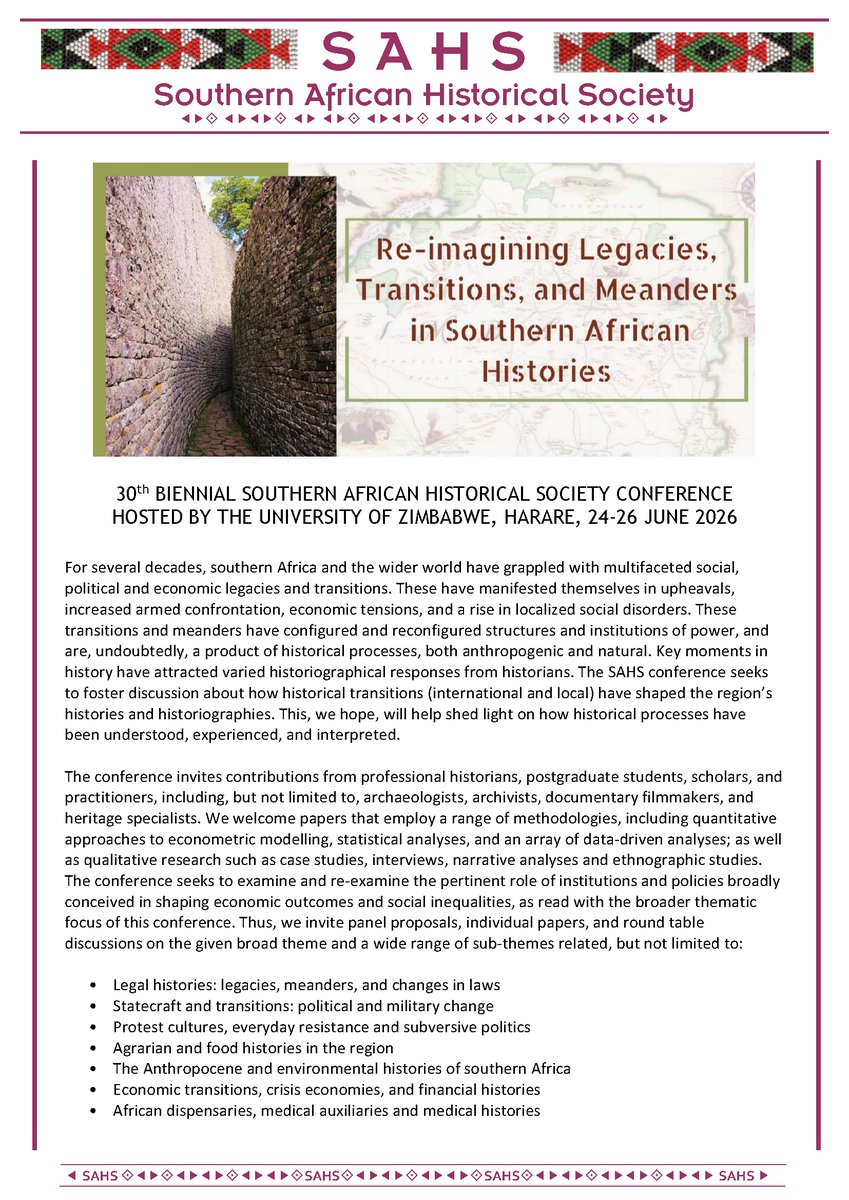
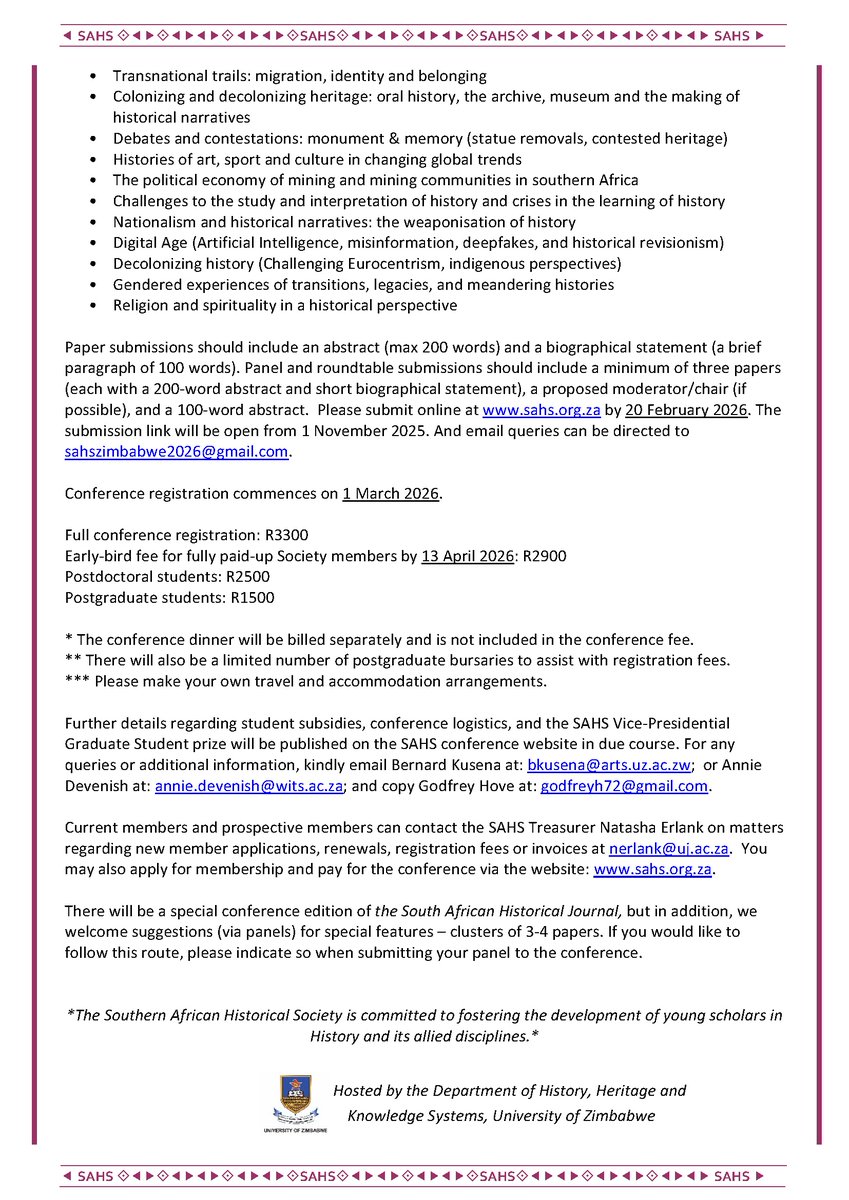
Call for Papers: 30th Southern African Historical Society Conference on Re-imagining Legacies, Transitions, and Meanders in Southern African Histories to be held at the University of Zimbabwe, 24-26 June 2026.
1
11
14
1,403
27 Oct 2025
Our latest issue is out and it is open access. Download or read the articles completely free via the following link: tandfonline.com/toc/rshj20/c…
5
10
702
11 Oct 2025
doi.org/10.1080/02582473.202…
‘‘What can history do? Why study history in South Africa today, in our third decade after the end of apartheid? Beneath this question is another, perhaps more difficult question: what career paths are available to students who study history?"
"What is the role of the historian in today’s world, as a researcher but also an educator of both university students and the broader public? How does the discipline survive amidst the defunding of the humanities, declining student enrolment, and the looming presence of artificial intelligence?"
"What significant changes in South African historiography have occurred in the last 30 years?"
With an introduction by Laura Philips, a Senior Researcher at the Wits Institute for Social and Economic Research, this article provides illuminating responses to the above and additional questions by four academics who share their reflections on developments in South African historiography and history. These include Anne-Maria Makhulu, Associate Professor of Cultural Anthropology and African and African American Studies at Duke University and Senior Research Associate in the Faculty of Humanities at the University of Johannesburg; Athambile Masola, a Senior Lecturer in Department of Historical Studies at the University of Cape Town; Goolam Vahed, Professor of History in the Department of History at the University of KwaZulu-Natal; and Mattie C. Webb, an Assistant Professor of History at the Virginia Military Institute.
The quartet offer significant insights on post-apartheid history, history in contemporary South Africa, the shifts in the field, and the emerging questions and future directions. When taken together, the ‘four pieces reflect the dynamism of the field but equally the constraints and limitations of historical work 30 years into South Africa’s democracy.’
doi.org/10.1080/02582473.202…
3
5
309
16 Sep 2025
History as Therapy: Introducing the Historiotherapy podcast series
Dear Reader,
We are excited to introduce the Historiotherapy podcast series dedicated to reconnecting you to the joy of history and the meaning that it brings. Hosted by Lindie Koorts and Thula Simpson, and produced by Ryan Simpson, it features deep dives into hard-core history - the kind of history that is usually locked away behind academic paywalls.
In the words of the hosts: "We talk to fellow historians about their research and ask legends of our field to reflect on their life's work. Can History heal?"
Please find out by watching the regularly updated podcasts here: youtube.com/@Historiotherapy
2
6
421
30 Aug 2025
"I must admit that I came to this book with low expectations", writes Italian historian Giacomo Macola from Sapienza University of Rome in his review of Zambian historian Sishuwa Sishuwa's book, Party Politics and Populism in Zambia.
Until the publication of @ssishuwa's book, Macola, who also studies Zambian political history, believed there was little that anyone could add to what he has already published on the country's politics. After all, the Associate Professor writes in this review, “I (emphasis original) had written the definitive book on Zambian nationalist and postcolonial politics.”
After reading the book, Macola had completely changed his views:
"Well, Sishuwa Sishuwa proved me wrong, and reading Party Politics and Populism in Zambia has been a bit of an exercise in humility.... [The book is] an impressive study in political leadership that will speak to the concerns of a wide scholarly constituency. By teasing out the deep roots of twenty-first-century Zambian populism and by ‘demonstrating the value of employing a contextualised biographic approach to understanding political change’ (196), Party Politics and Populism in Zambia is a testament to the maturity and sophistication reached by Zambianist historiography during the past couple of decades.”
Read the full book review here: doi.org/10.1080/02582473.202…
5
9
30
3,277
Southern African Historical Society retweeted

26 Aug 2025
Full article: Green Lands for White Men: Desert Dystopias and the Environmental Origins of Apartheid tandfonline.com/eprint/DVCHR…
@SAHistSoc
@Stell_History
1
4
136
25 Jul 2025
In this new and open access article, Ian Macqueen and Adam Kochajkiewic use the stories of Patrick Mabinda and Beverley Joan Marcus to explore the experiences of South Africans in exile in the Polish People’s Republic.
doi.org/10.1080/02582473.202…
3
4
458
2 Jul 2025
In this open access article, Handri Walters uncovers the significant connections between Afrikaner nationalism, the National Party, and the emergence of Afrikaans-medium in the faculty of medicine at Stellenbosch University during the 1940s and 1950s.
doi.org/10.1080/02582473.202…
4
10
439
16 Jun 2025
The latest issue of the South African Historical Journal is now online. This issue includes a fascinating set of articles that examine:
> the response of farmers in the Cape respond to the ravages of the phylloxera outbreak in 1886 by Lloyd Melusi Maphosa ; doi.org/10.1080/02582473.202… >
> the bonds and bondages of Enslaved, Khoisan and Settler women in the 1825 Koue Bokkeveld Revolt by Laura Mitchell doi.org/10.1080/02582473.202… >
> the experiences of South African soliers interned in Italy and Germany during the Second World War by Ian van de Waag. doi.org/10.1080/02582473.202…
> the significance of the suspension of the South African and Namibian white Churches from the Lutheran World Federation in 1984 by Philippe Denis. doi.org/10.1080/02582473.202…
> how colonial, racial, and traditional structures determined African women’s legal status in acquiring housing in urban areas under apartheid by Phemelo C. Hellemann. doi.org/10.1080/02582473.202… >
> the expansion of African private land ownership in the Eastern Cape between 1994 and 2024 by William Beinart, Mike Kenyon, Sonwabile Mnwana, and Luvuyo Wotshela. doi.org/10.1080/02582473.202…
The issue also carries Shula Simpson’s comment, For What It’s Worth: Reflections on Stepping Aside as Editor. doi.org/10.1080/02582473.202…
1
129