
Small Business Owner | CRE Owner | ETA | AI Business Ops | Wharton
Joined May 2023
- Tweets 409
- Following 523
- Followers 499
- Likes 740
15 Photos and videos


Pinned Tweet

Feb 26
Been lurking here for a while so here goes:
I’m Ryan Murray an SMB Operator.
I acquired AAA Blind & Shutter Factory in Little River, SC through an SBA-backed ETA deal.
We manufacture and install custom plantation shutters shades for residential CRE customers in coastal SC & NC.
I talk about:
- SMB marketing & sales Ops
- Manufacturing optimization
- Using AI in an SMB
- Light-industrial Real Estate
Fellow operators, ETA searchers, & CRE folks, give me a follow!
11
35
6,548
May 14
“Just buy a boring SMB and implement AI.”
How about nah, my dude.
I acquired a 19-person shutter factory two years ago and I’ve seen this take 100 times since then.
Here’s why adding AI alone is not a strategy 👇
Applying AI to an SMB is not and will not be a moat. The operating system you build underneath AI or any tool is the moat. And that’s much harder than building agents to read your email or answer missed calls.
Every competitor has (or will soon have) access to the same models. The same APIs. The same Twitter threads telling them what to build.
What AI doesn't give your competitors:
1️⃣ The install team and the standards they hold
2️⃣ The CX team and the follow-up cadence they run
3️⃣ The leading KPIs and what they signal before mole hills become mountains
4️⃣ The culture of accountability where employees are enforcing “done right” in your shop
5️⃣ The experienced Managers who knows when the AI is off
Don't get me wrong, we use AI every day and I'm building a guide for SMB operators on the workflows that move the needle. But AI isn't the advantage. The operator playbook is, the same one that's hard to implement but when executed it works: hiring well, clear training, goal setting, SOPs, accountability, customer obsession. AI multiplies that. If there's no system underneath, there's nothing to multiply.
1
4
323
May 14
My leadership style in this 19-person shutter business is brutally simple.
I don’t manage people harder.
I make the single number that matters impossible to ignore then tie real money to it and get out of the way.
Everyone has 1-2 numbers they own and an incentive tied to it.
Team owns the outcome and knows whether it’s achieved or not.
Sure we set annual and quarterly goals, but the daily KPIs and incentives tied to them are the inputs we focus on. The goals are then just the output of hammering the same 5-6 company inputs everyday, over and over.
Clarity skin in the game consistency beats motivation every single time.
How do you think about getting results out of your team?
1
7
525
May 13
This one hits.
We’re in a different manufacturing vertical (we’re mostly B2C with a home service install component) but similar story inside our facility. 19 people, coastal SC factory, 3:30pm shutdown. I get to drop off and pickup my 5 y/o at school.
The “rules are simple” part is what I didn’t expect coming from MedTech, where there are so many rules and complex processes.
In our shutter business: Make a good product. Install when you said. Recognize and pay people well. Manage your cash. You’ll be ok. Rarely is anything else signal and not just fixable noise.
And yes, shit breaks daily for us too. Saw blade goes down mid-run. Installer calls out on a fully-booked Friday. Vendor ships the wrong frame size on a $10K order. Customer calls upset about a floppy louver.
You just fix it and move to the next thing. Things breaking and your ability to handle it is a moat. It is the difference between entrepreneurs and employees.
The responsibility for other familes is the part many miss, especially on their first deal, in the throes of diligence. Different stress than a revenue-generating W2 job (with big targets and incentives), but it doesn’t go away. Mine lives at 2am running a cashflow forecast on AP and the revenue we need to bring in to cover all expenses.
Holding the team through tariffs and hearing they’ve never made more money is awesome. We’re in a similar position. Rough seas followed by rising tides should lift all boats. If the business fights through hard times and succeeds, employees should reap the rewards as much as anyone. I like the simpler rules of this SMB game much better than the big corporate one!
May 13

What do I like about manufacturing? The rules of the game are simple and easier to follow than my old W2 life.
In my old W2 life managing a portfolio of stocks, I had to react to every new piece of information whether it was company specific or macro (interest rates, geopolitical, etc) and decide if I needed to change the book. The job was fun and engaging but also incredibly stressful. It took a massive toll on my ability to be present for my wife and daughter so I decided to make a change.
Now my job is simple => work with my small 10 person team and manufacture physical product our customers are happy with. I feel a responsibility to my customers but also to my employees. 11 families (including mine) rely on my ability to bring in new business to keep the machines running so payroll is not interrupted so we can all feed our families.
The constraint is people. Nobody wants to work into the evenings. Factory closes at 4pm. Timecards are punched. Parking lot empties at 4:05pm. I shut down the factory myself and pickup my daughter from elementary school every day. She (8 years old) still likes me so that's cool. I have dinner with my family every night. This lifestyle has more boundaries for me, and my family and I are happier.
That said, bad shvt happens daily. Today 3 machines weren't working so I called my maintenance guy at 430am to come in at 5am to fix them. An employee still hasn't showed up. I have 15 emails from customers wanting to know what the status is for their orders from April.
But this is all manageable. Most things can be fixed. Make a good product. Deliver in a reasonable time frame. Pay your employees so they can feed their families. That's it. Very simple.
My industry has gotten punched in the face the last 3 years as demand as been weak (tariffs wrecked us last year,) but I haven't let anyone go and right now as demand has picked up, my employees have told me they have NEVER made more money in their life and they are grateful I didn't let any of them go when my competitors were firing people left and right last year.
I wake up with a simple purpose now. Keep the machines running. Pay my employees so they can feed their families. Be home for dinner. If I can do this on a weekly, monthly and annual basis, everything will work out (I hope.)
2
389
May 13
Question for SMB deal lawyers, brokers and ETA service providers: are you seeing buyers include the seller’s AI subscriptions or agents as assets in purchase agreements?
Asking because I think this could become a real issue in the next 12 months and most operators aren’t thinking about it.
If you’re running an SMB in 2026, odds are you have some workflows living inside a personal Claude or ChatGPT account. Lead routing, quote drafting, SOPs, the agent that triages your inbox or briefs your team in Slack. Same login probably has your HoldCo stuff, your kids’ school schedule, your last deal’s CIM.
You sell. Now what?
You don’t want to hand the buyer your account. There’s no clean export for Projects, custom instructions, or workflow history from one Claude account to another that I could find. Same with ChatGPT.
So either:
1.The subs transfer with the business as an asset in the PA. Buyer gets the login, seller gets scrubbed off and loses all personal and holdco workflows and artifacts.
2.They don’t, and at best buyer figures out how to rebuild from scratch (a huge headache as a new owner already dizzy with a new business). At worst company systems break the day the buyer takes over (as well as some over time that the buyer may not know even exist) leading to major pain in operating the business effectively.
Should buyers be writing AI subscriptions into every PA going forward? What about an Open Claw or Hermes agent? In the PA same as domains, Facebook, GBP and the phone number?
This is another reason orchestration layer matters more than the chat UI or single agent setup for businesses. Workflows living in a clean backend on a common infrastructure = handoff is a credential swap. Workflows tangled across 200 custom Projects and GPTs in a personal account = handoff is a disaster.
Curious what the lawyers and brokers are seeing! @lawyer4SMBs @Lawyer4Deals @EndresenHeather @SBA_Matthias
6
5
1,294
May 9
X buried this post below 🥸
But every ETA searcher thinking about manufacturing should read it.
Most manufacturers run a distribution model.
My regional shutter business does it differently👇
May 4

When people think SMB “manufacturer,” they think national distribution.
Build the product, ship it to dealers, scale through volume. It works. Some of the best businesses in the country run this model.
But there’s another manufacturing model that almost nobody talks about: regional with a home service component.
We manufacture plantation shutters and shades and sell them direct to homeowners and commercial property owners in the coastal Carolinas. We measure, we build, we install, we service. 19 employees. One P&L, vertically integrated into our value chain.
We don’t own every piece of the supply chain, we still source some raw materials and components from vendors. But we own more of it than almost anyone in our market.
And the part of the value chain we own, made possible by our regional format,is the part that matters most: the customer relationship. This is what makes us different from most SMB manufacturers.
Here’s what a regional manufacturing model with a local service component gives you:
1️⃣ A feedback loop measured in feet, not weeks.
When a shutter comes back with a defect, I don’t file a vendor claim and wait. I walk to the shop floor, find the root cause, and fix the process. We track go-backs weekly by defect category and tie them directly to production and install comp. This has greatly improved our quality.
2️⃣ More of the margin stack.
A typical window treatment job passes through manufacturer, distributor, dealer, installer. Each takes a cut. We collapse most of that into one operation. Same quality product, fewer hands, better margin.
3️⃣ A customer database that compounds.
National manufacturers have dealer accounts. We have 30 years of homeowner data: names, addresses, what they bought, when. That reactivation engine is producing 42% repeat business in year 2 of ownership.
The trade-off is real. A national manufacturer can ship anywhere and scale through dealer networks without adding trucks or install crews. We can’t. If we can’t drive a crew there and back in a day, it doesn’t make sense. Both models work, they just optimize for different things. National optimizes for reach. Regional optimizes for depth.
We chose depth.
Within our radius, owning the customer relationship is a moat that’s very hard to replicate, and we’re good with that trade-off.
If you’re evaluating a manufacturing business (or building one) ask the question most people skip:
Are you scaling through distribution, or through relationships and local trust?
Neither model is wrong! But they lead to very different businesses. Choose which trade-offs you’re willing to make and lean into what makes your business unique!
1
1
1
437
May 8
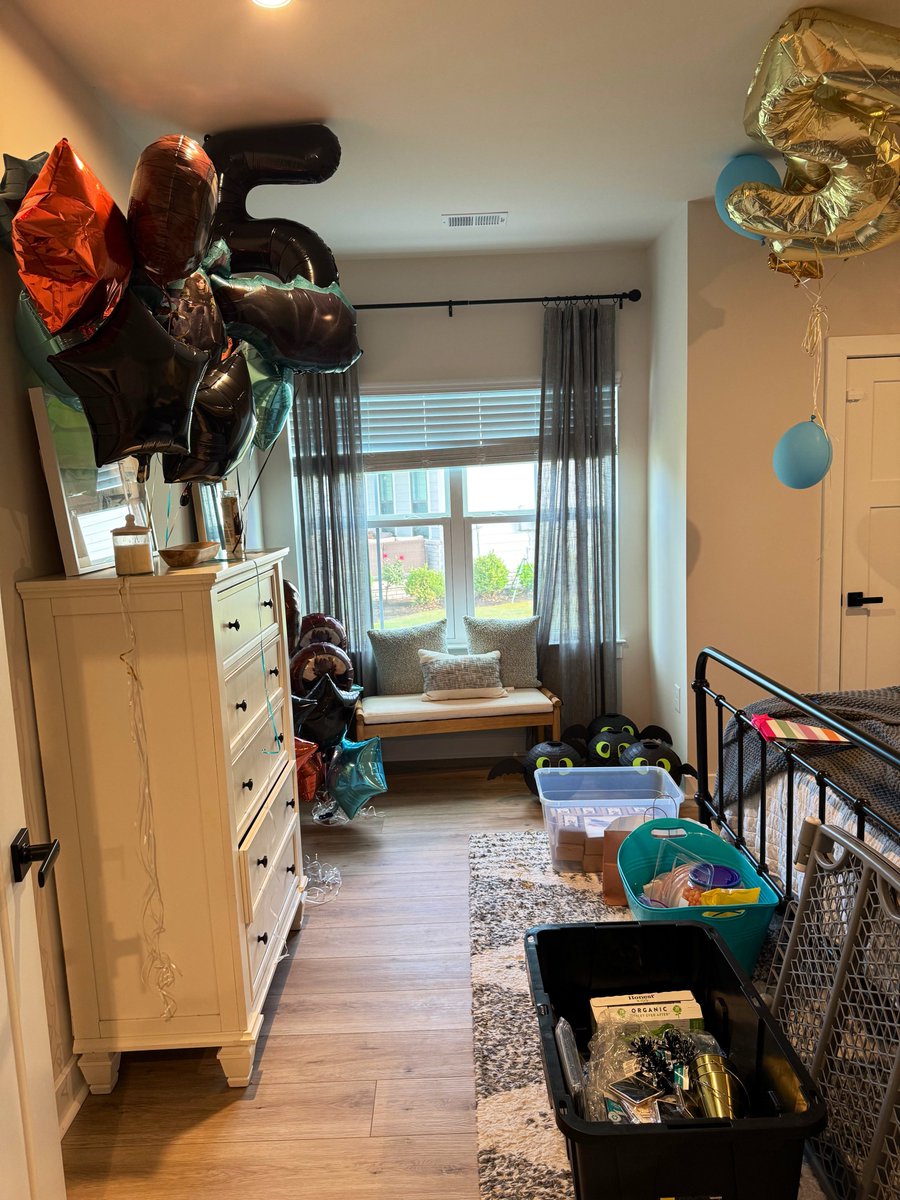
My 5 y/o’s birthday party is tomorrow.
My wife: We’re just getting pizza and cake. Not stressing about decorations.
Also my wife:
2
4
491
May 7
Two years into to owning my SMB Manufacturing business, our production capacity has increased 📈 57% without adding any new headcount.
We did this with a Whiteboard, a Monthly bonus and an AI agent. No fancy ERP.
Here's how it works:
When I bought the shutter factory two years ago, the production floor was building about 700 shutter panels per month. No daily target visible to the team. No weekly accountability. No system that connected effort to outcome.
We didn't buy an ERP. We didn't hire a production manager. We did three things, in this order:
1⃣A Whiteboard on the Production Floor
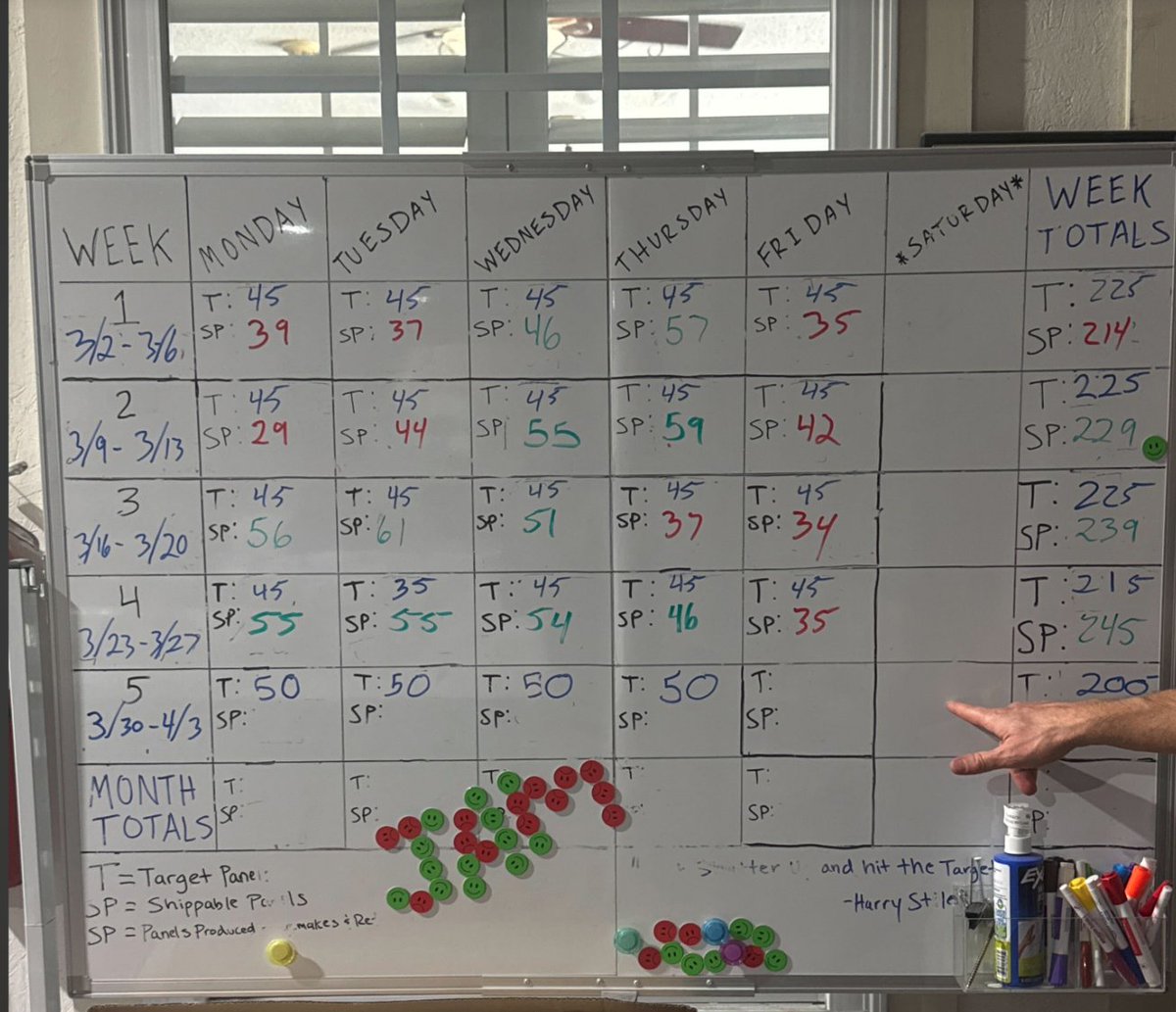
Three columns: Panel target, "Shippable Panels" (actual panels built), gap. Updated by hand during the day. Photo of the whiteboard posted to a Slack channel every Monday morning. Leadership sees the prior week in one image (we also see it on the whiteboard daily). The team sees that leadership is watching and has one number they're attacking each day.
2⃣A small monthly bonus tied to Shippable Panels
Tiered. Hit the weekly target every week of the month: $150/employee. Miss one week: $100. Miss two or more: $0. Annual upside is $1,800/employee. The metric is panels that pass QC and don't come back as a remake inside three months. Not raw panels built. The bonus pulled the behavior we actually wanted: quality output daily, not race-through-and-fix-it-later output.
Why tie the bonus to weekly goals and not daily? It allows the team to make up for a bad day when sh*t happens (machine down, large delivery received, 2 people out sick, etc.)
3⃣An AI agent that reads every photo
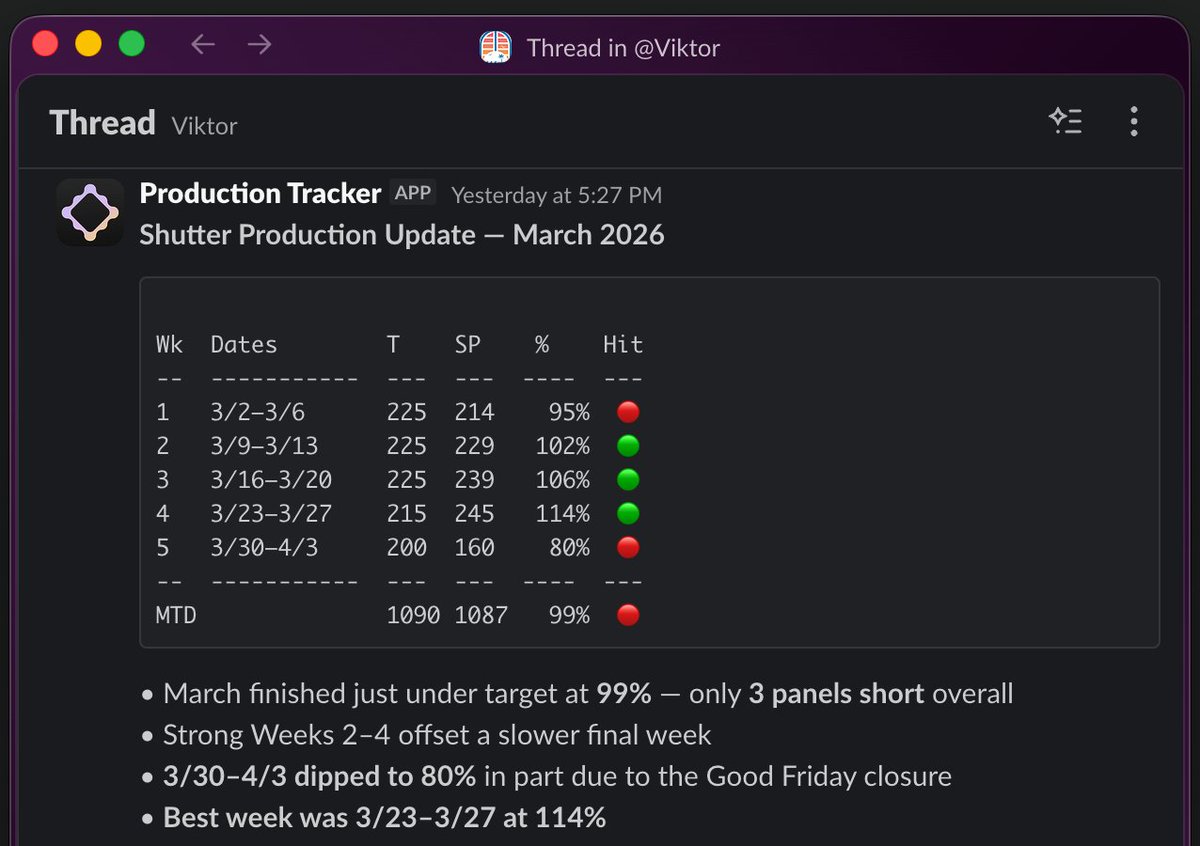
I built this on top of an AI slack agent named @get_viktor_com . Every time a whiteboard photo lands in Slack, Viktor pulls the numbers off the picture, builds the daily / weekly / MTD panel breakdown, and posts the structured tracker back to the channel with insights. No one types numbers into a spreadsheet. No one runs a report. Bad days don't hide. Good days get named.
The order matters.
-The whiteboard gave the team a goal to chase and a way to see the score.
-The bonus gave them a reason to care about hitting the goal.
-The AI made the score trackable over time without anyone running a report.
What the combo produced:
🎯March 2026: 1,087 Shippable Panels vs. target of 1,090; 99% of target (just missed!)
We just missed our target in March but still produced 57% more than in years past. Viktor summarizes why we missed and we work to fix that each week. We learn more in months we miss target than when we hit!
❌What we did NOT do...
Buy an ERP or a production-tracking SaaS with a huge subscription fee or hire an $70 k/year production manager.
Total cost of our stack:
-$1,800/year per employee in bonus (paid only when they earn it, and added to their comp in lieu of a base raise)
-$50 Whiteboard Markers
- $0 @get_viktor_com automation ($0 incremental cost for this task, we're using it for multiple tasks like this, our sub is $200/month).
If you bought a manufacturing or home-services business and you can't tell me yesterday's actuals vs. target (e.g. jobs quoted, jobs completed, widgets built) you need to first define what those targets are. Then design a system that lets your team see it (a $50 whiteboard is all you need to start!) Then attach the bonus to it. Then automate the reporting.
What target does your team track daily? How are they motivated to hit it?
5
1
19
2,015
May 4
When people think SMB “manufacturer,” they think national distribution.
Build the product, ship it to dealers, scale through volume. It works. Some of the best businesses in the country run this model.
But there’s another manufacturing model that almost nobody talks about: regional with a home service component.
We manufacture plantation shutters and shades and sell them direct to homeowners and commercial property owners in the coastal Carolinas. We measure, we build, we install, we service. 19 employees. One P&L, vertically integrated into our value chain.
We don’t own every piece of the supply chain, we still source some raw materials and components from vendors. But we own more of it than almost anyone in our market.
And the part of the value chain we own, made possible by our regional format,is the part that matters most: the customer relationship. This is what makes us different from most SMB manufacturers.
Here’s what a regional manufacturing model with a local service component gives you:
1️⃣ A feedback loop measured in feet, not weeks.
When a shutter comes back with a defect, I don’t file a vendor claim and wait. I walk to the shop floor, find the root cause, and fix the process. We track go-backs weekly by defect category and tie them directly to production and install comp. This has greatly improved our quality.
2️⃣ More of the margin stack.
A typical window treatment job passes through manufacturer, distributor, dealer, installer. Each takes a cut. We collapse most of that into one operation. Same quality product, fewer hands, better margin.
3️⃣ A customer database that compounds.
National manufacturers have dealer accounts. We have 30 years of homeowner data: names, addresses, what they bought, when. That reactivation engine is producing 42% repeat business in year 2 of ownership.
The trade-off is real. A national manufacturer can ship anywhere and scale through dealer networks without adding trucks or install crews. We can’t. If we can’t drive a crew there and back in a day, it doesn’t make sense. Both models work, they just optimize for different things. National optimizes for reach. Regional optimizes for depth.
We chose depth.
Within our radius, owning the customer relationship is a moat that’s very hard to replicate, and we’re good with that trade-off.
If you’re evaluating a manufacturing business (or building one) ask the question most people skip:
Are you scaling through distribution, or through relationships and local trust?
Neither model is wrong! But they lead to very different businesses. Choose which trade-offs you’re willing to make and lean into what makes your business unique!
2
774
May 1
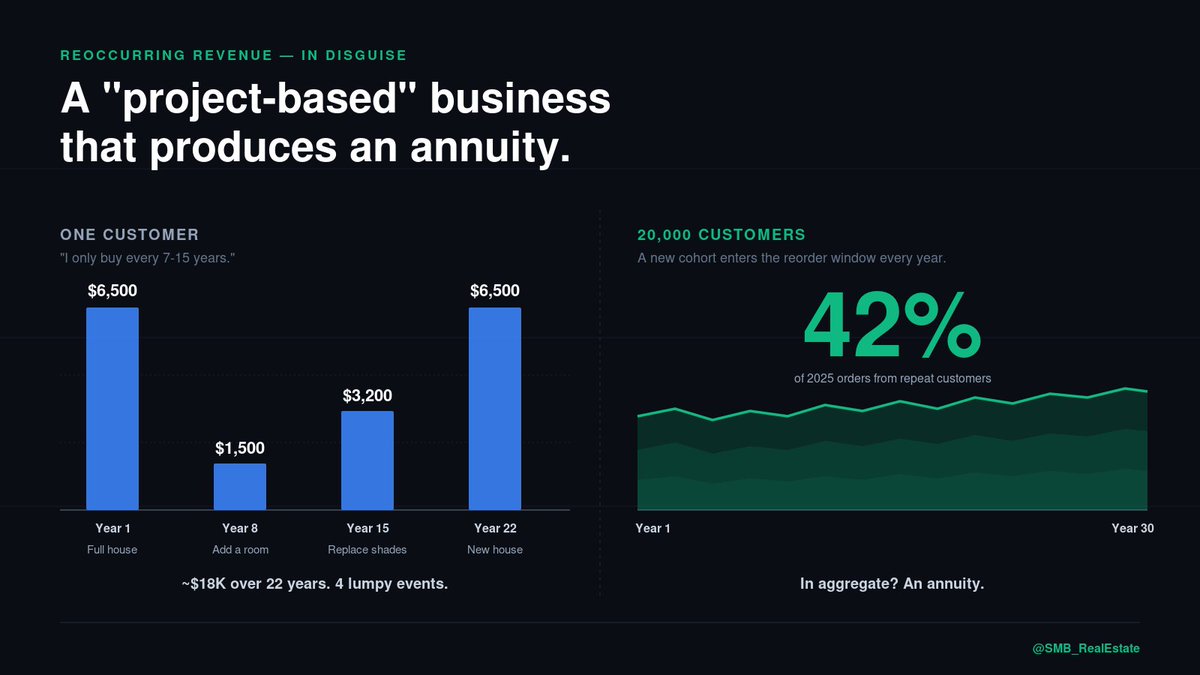
In ETA and SMB world, recurring revenue gets all the attention. Reoccurring revenue gets overlooked.
Project-based gets passed on.
But that's how some of the best deals stay on the table.
The window covering (blinds, shutters) SMB I acquired looked project-based on the surface. Single transaction, big ticket, customer goes home with shutters and you don't see them for a decade. Most acquirers price businesses like this as lumpy project work with no annuity underneath.
But what I learned is it's actually reoccurring in disguise. And that reoccurring revenue is carrying our business.
Here's the stat: 42% of our orders came from repeat buyers in 2025, in a project-based category most people buy once every 7-15 years.
That timeframe is the average between full-house projects. But every year hundreds, if not thousands, of our previous customers cross into a reorder cycle:
-Redo one room
-Add a Florida or sunroom
-Replace shades the Carolina sun killed at year 6
-Upgrade from a condo to a house
-Move into a newly-built home
Each customer doesn't come back monthly like a subscription. They come back on their own clock.
That's not recurring. It's reoccurring. And it compounds.
We acquired a 30-year-old company with ~20,000 customers in the database. The previous owner ran a phone-rings model. Strong word-of-mouth, no outbound reactivation system. And the business still sustained itself on repeat revenue for three decades without anyone systematically working the database.
That tells you the gravitational pull of an aged customer list in a project-based category is real, even when nobody's pulling on it.
But now we're pulling on it.
The reactivation cost on a customer who already knows our crew, our pricing, and our install quality is meaningfully less than a cold lead. They skip the trust-building, the competitive estimates, and most of the price negotiation.
We're at 42% repeat in year 2 and I expect it to keep climbing as we work the database with more intent and the reorder cohorts keep stacking.
If you're searching, don't dismiss project-based businesses as "no recurring revenue."
Instead, ask:
-How large is the customer database?
-What's the repeat-buyer rate?
-Is anyone systematically harvesting past customers?
A project business with a 30-year customer list and no reactivation system is one of the most under-priced setups in SMB!
4
2
38
14,243
Apr 30
Definitely feeling AI pain inside my SMB.
The models and harnesses are getting better every week, but the agent sprawl, lack of infrastructure and true understanding of our processes and conformance are holding us back. There’s a ton of half-baked AI trash now that’s outdated or just no longer works burning tokens and not being maintained.
Another thing I think few SMB owners are thinking about is the exit implications of your weak AI infrastructure.
What happens to the all AI workflows and agents that run in your business out of your Claude or ChatGPT subscription (that also house all your personal or “HoldCo” workflows) when you go to exit?
Surely you want to keep those accounts? As of now I’m not aware of a way to export certain data or workflows from one Claude account to another.
So shouldn’t those subs then go with the business as an asset in the purchase agreement?
If not, company systems will break for the new owner. I’ll certainly be requesting these subs are added to my PAs for bolt-ons going forward. This is another reason why properly built orchestration and backend layers will be key. You need a clean handoff when you sell. Transitions are already messy, and now AI slop can make it a disaster.
Auditing processes, testing workflows and building an orchestration layer where all AI workflows and agents live will be key in growing and exiting your business!

2
722
Apr 29
Most SMB sellers want to keep the Real Estate and become the operator's landlord. Mine did but I made sure I got the buildings in my deal.
Two-plus years post-close, that one negotiation is doing more for my balance sheet than any other asset.
6 reasons why you should buy SMBs with RE 👇🧵
2
6
2,077
Apr 29
7/ 💵 BONUS: The sale-leaseback option most operators don't know they have.
You sell the real estate to a CRE investor and immediately lease it back on a long-term NNN. You keep operating in the building. They collect rent and own the asset.
It can be done years post-close as a liquidity event when you need capital for a bolt-on or expansion. It can also be structured at close: you buy the business real estate, simultaneously sell the real estate to a third-party investor, and sign the lease back the same day (this is an expert level move, there are brokers than specialize in this).
If the investor's price (driven by your lease rate and the prevailing cap rate) exceeds what was allocated to the property, you capture the spread at close. That spread can reduce your equity check or fund working capital.
1
190
Apr 29
8/Most ETA searchers and SMB Operators pass on the real estate when it's available because they see it as another (very large) expense. That's the wrong perspective.
Don't frame it as an expense. View it as a financing lever, an equity builder, a tax shield, and your exit optionality. All in one asset.
The question isn't whether you can afford to buy it. It's whether you can afford not to!
173