
Psychotherapist who trades. Your trading problems aren't character flaws; they're capacity gaps. Capacity is trainable.
Joined December 2018
- Tweets 8,287
- Following 946
- Followers 4,634
- Likes 16,567
900 Photos and videos








Pinned Tweet

26 Dec 2025
"Tilt" is what traders call it.
But that word hides the actual mechanism.
What's really happening: STRAY: State-Triggered Reactions Against Yourself.
Your nervous system dysregulates. An old wound activates: failure, not being enough, and abandonment. Your brain reads "threat" and stops consulting your trading plan.
Suddenly, you're not trading as the person you've spent years becoming.
You're trading from a part of you that's desperate to prove something, fix something, or avoid feeling something.
That's why willpower doesn't work. You're not in the fight. A younger, wounded part is.
Every STRAY charges you twice: the P&L loss AND the identity damage.
Proving to yourself, again, that you can't be trusted.
2
4
61
8,806
Sean Sawyer, MS retweeted
Jun 12
The VIX spiked 34% Friday. Your body has its own VIX. It spiked, too. You just don't have a chart.
The traders who stayed inside their Execution Window this week weren't calmer people. They were doing one thing differently before the open.
1
1
10
753
Jun 13
If this week felt like a rollercoaster, your strategy wasn't the issue.
Your nervous system was operating on a threat model that perceives a 1,000-point NQ drop as a predator.
There's a way to catch it before it triggers the bad click. Most traders have never been shown how.
1
11
748
Jun 12
The more activated you are, the more convinced you'll be that your thoughts are facts. They're not. They're just thoughts on adrenaline.
8
316
Jun 12
$SPCX starts trading today. Half of you can already feel the pull.
$250 billion in demand chasing $75 billion in shares, and the most volatile instrument on the board still won't be the ticker. It'll be the trader watching it.
The challenge: Conviction and hope can feel identical, same buzz, same sense of certainty.
The difference comes down to one question: Do you know exactly where your thesis breaks?
No invalidation point, no conviction. Only hope, dressed up with a ticker.
1
4
322
Jun 12
The VIX spiked 34% Friday. Your body has its own VIX. It spiked, too. You just don't have a chart.
The traders who stayed inside their Execution Window this week weren't calmer people. They were doing one thing differently before the open.
1
1
10
753
Jun 10
Your monitoring isn't prudent. Your anxiety is compulsive. Every 30 seconds without checking feels unbearable, so you constantly refresh.
You're not staying informed, you're regulating distress. And distress always demands reassurance.
1
10
355
$TSLA believers, believing.

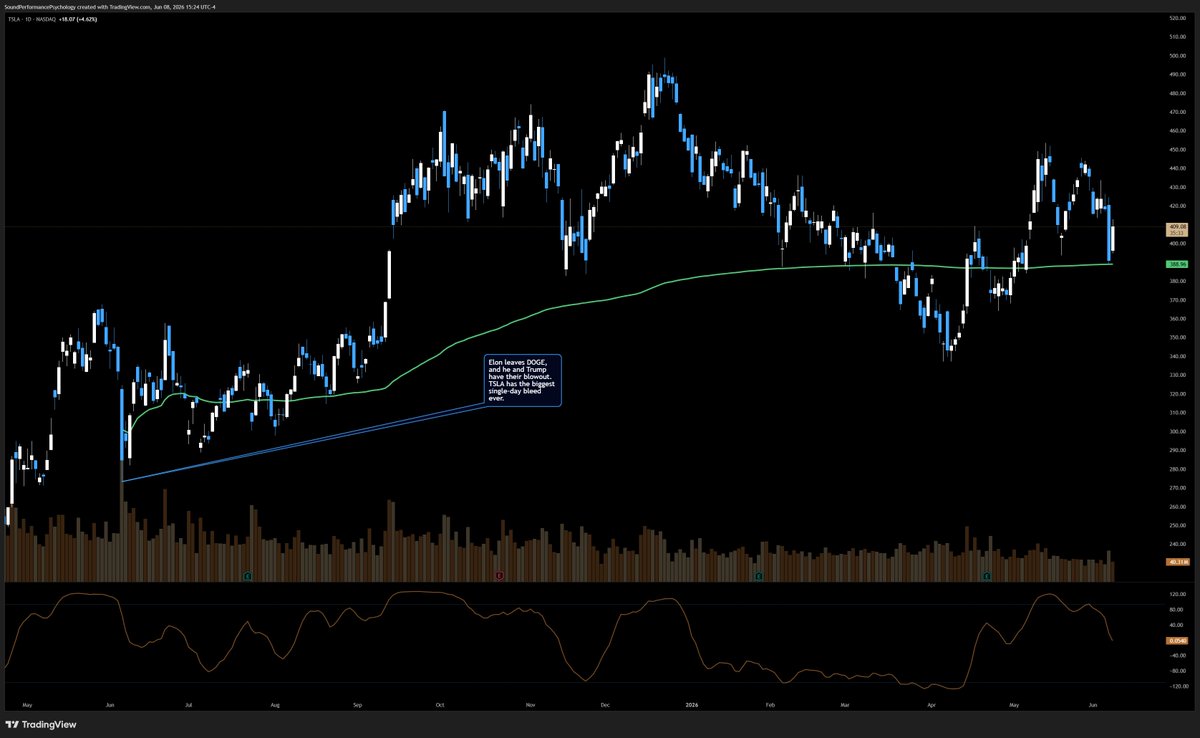
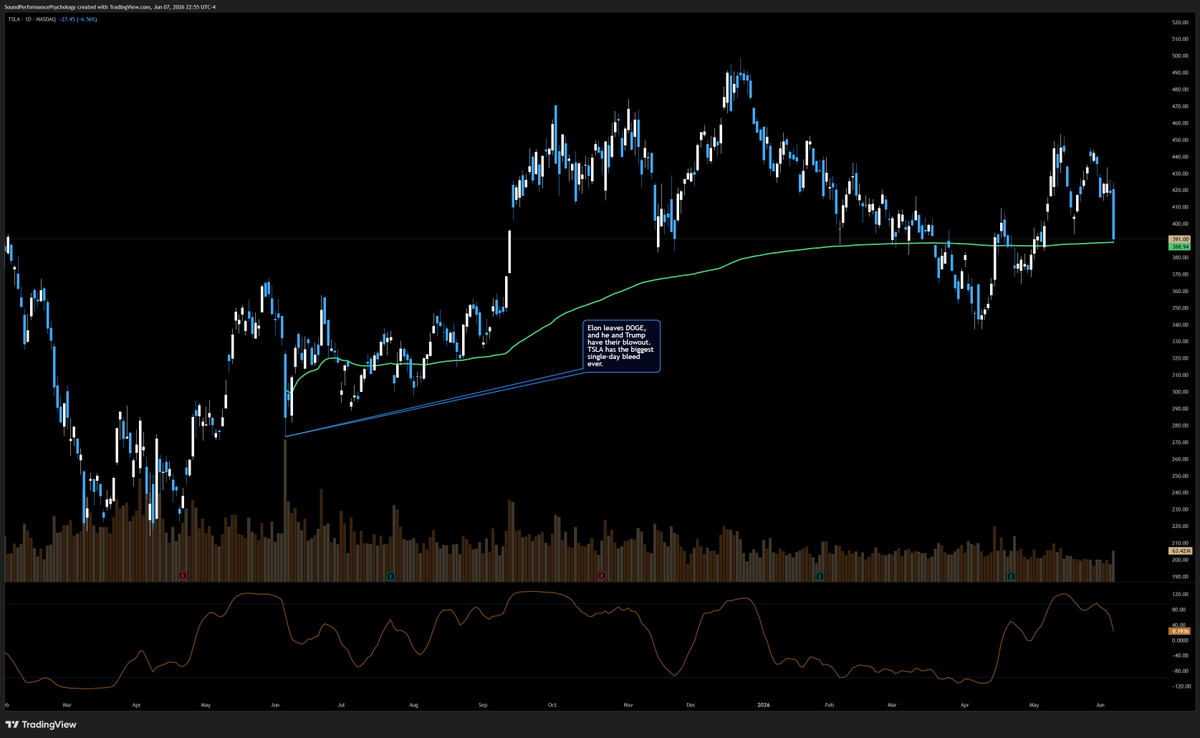
June 5, 2025: $TSLA −14%, $150B gone, the biggest one-day wipeout ever. Was the seller the crowd that owned it for the Musk–White House bromance and got spooked when he was fired?
That holder wasn't trading Tesla. He was trading a friendship, and the day it ended, the market closed the position for him.
Now, the #avwap from that day was hit on Friday, which is also a year apart. What do you all think?
One of the many things I love about avwap is its psychological nature. Shannon's first book is the first TA book I ever read, and his second is the most recent.
2
3
506
June 5, 2025: $TSLA −14%, $150B gone, the biggest one-day wipeout ever. Was the seller the crowd that owned it for the Musk–White House bromance and got spooked when he was fired?
That holder wasn't trading Tesla. He was trading a friendship, and the day it ended, the market closed the position for him.
Now, the #avwap from that day was hit on Friday, which is also a year apart. What do you all think?
One of the many things I love about avwap is its psychological nature. Shannon's first book is the first TA book I ever read, and his second is the most recent.
1
7
1,140
They get the diagnosis right: under pressure, your thinking brain goes offline.
Then they prescribe a fix that runs entirely on the thinking brain. Reframe it. Self-talk. Stay logical.
You can't reason with the part of you that already left the room.
2
1
9
380
4
196
There's a whole genre of trading advice written by guys playing doctor. They read surface symptoms like revenge, FOMO, tilt, and blown limits, naming them correctly like someone who Googled chest pain can say "palpitations." Then they prescribe. That's where it falls apart.
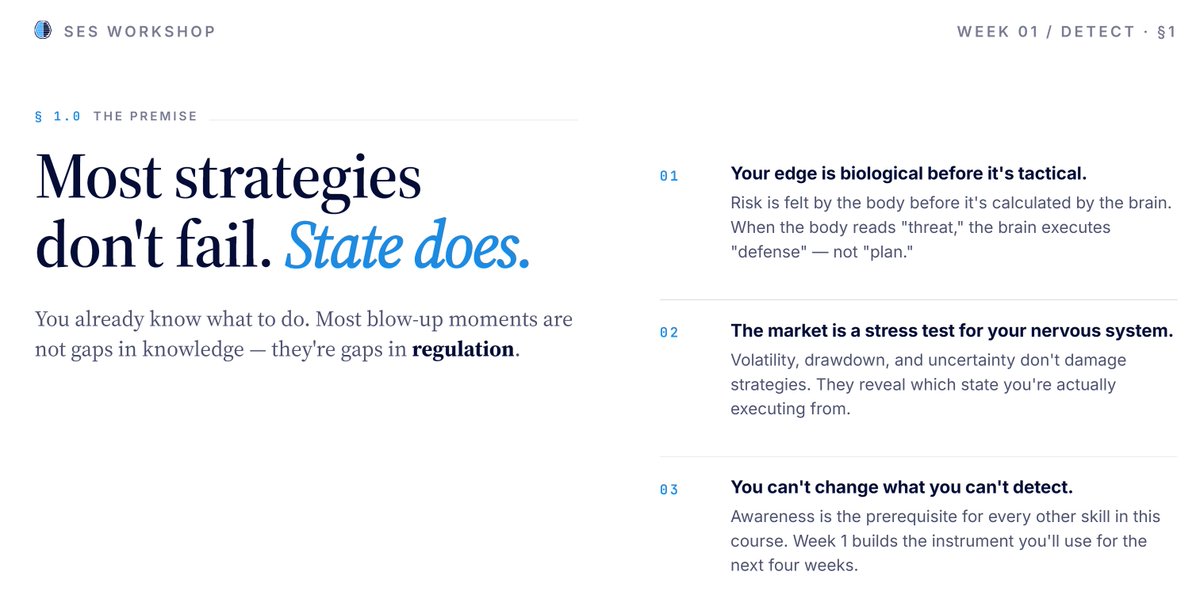
They'll tell you willpower disappears once emotions take over, so cage yourself with hard limits. Half right. Willpower doesn't disappear; your prefrontal cortex goes offline under arousal. You're not weak; you're locked out of your own controls. The limit is a backstop, not a cure.
They bury "check your sleep and stress" at the bottom of the list as one tip. It isn't one tip. It's the whole list. Revenge, FOMO, chasing, every item above it is the same dysregulation, wearing different costumes. They wrote the chart upside down.
They treat FOMO and revenge as separate diagnoses. Same activation, two costumes. Calm the arousal and clear both. Chasing each individually is what you do when you've never seen the machine underneath.
"You're clicking too many buttons." The clicks aren't the cause; they're the output. Telling an overtrader to click less is like telling Patrick Ewing to sweat less.
Here's the part that makes it worse than useless. The prescriptions sound doable, so when they fail, and they fail the first morning your system floods, you don't blame the advice. You blame yourself. I knew the rule and broke it anyway. I'm undisciplined. I'm broken. The junior doctor hands you a treatment that can't work and walks off, and you file the failure under your own character. Every round deepens the wound he never diagnosed.
Regulation first. Strategy second.
1
1
11
404
Sean Sawyer, MS retweeted

Jun 4
Read this if you have a problem with tilt or blowing accounts.
This is why advice like “Just use good risk management” falls flat.
Everyone knows that they are supposed to be disciplined when they trade. They already know good risk management is part of the game.
If you are tired of the useless platitudes on FinX by self-described trading psychology experts, follow @SeanSoundPsych. He’s my go-to source for trading psychology tips that actually work.
11 Nov 2025
I keep seeing a pattern in trading psychology advice: some successful traders, and some just loud ones, reverse-engineer their own nervous system. “I prep, I'm calm → anxiety means you didn't prep properly."
They miss the real edge: baseline neurobiology. A regulated nervous system, a wide window of tolerance, secure attachment, and resilient stress response.
These invisible substrates carry performance, not the visible routines. The successful ones take their preparation and discipline for granted, attributing success to these factors. The loud ones are pattern-matching from chaos, packaging hope as expertise.
For anxious‑attached perfectionists, hearing "just do what I do" adds another "should" to the system, often creating shame loops, anxiety, and self‑doubt. Most high performers don't even understand why they work; they see the visible prep, discipline, or routines, but miss the invisible neurobiology that carries them.
The pattern to watch for: anyone telling you their visible routines will fix your invisible wiring. If advice makes you feel more anxious or ashamed, that's data not about your discipline, but about the mismatch between their system and yours.
Your baseline neurobiology cannot be altered through willpower. The question isn't "what should I do?" but "what does my nervous system need to come back online?"
That's the work.
2
6
707
Sean Sawyer, MS retweeted
Your stop didn't fail. Your nervous system overrode it.
The exit was planned at a resting heart rate.
The override fired at a spiked one.
Same trader, two different brains; and the plan got written by the one who isn't in the seat anymore.
This isn't a discipline gap. Your execution means-reverts to your physiology, not your plan.
Regulation first. Strategy second.
Not a slogan, the actual order of operations.
So before the next entry: one slow exhale, long enough to drop the rate a single beat. That's not a calming ritual. That's you putting the right trader back in the chair.
If this named something you've lived, repost it for whoever's white-knuckling a position right now.
Bookmark it for the open.
3
5
20
1,101