
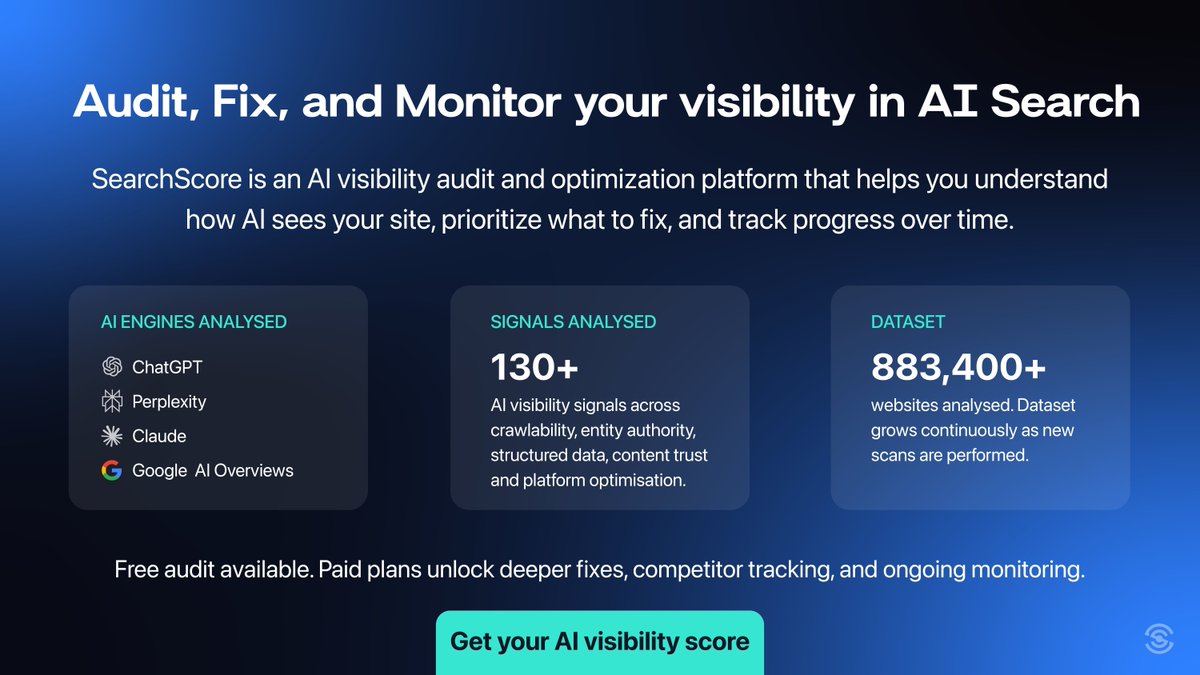
Cited by AI, ranked by Google, chosen by buyers. See where you stand across all three, free. searchscore.io
Joined March 2026
- Tweets 601
- Following 1,521
- Followers 165
- Likes 803
31 Photos and videos



Pinned Tweet

Mar 31
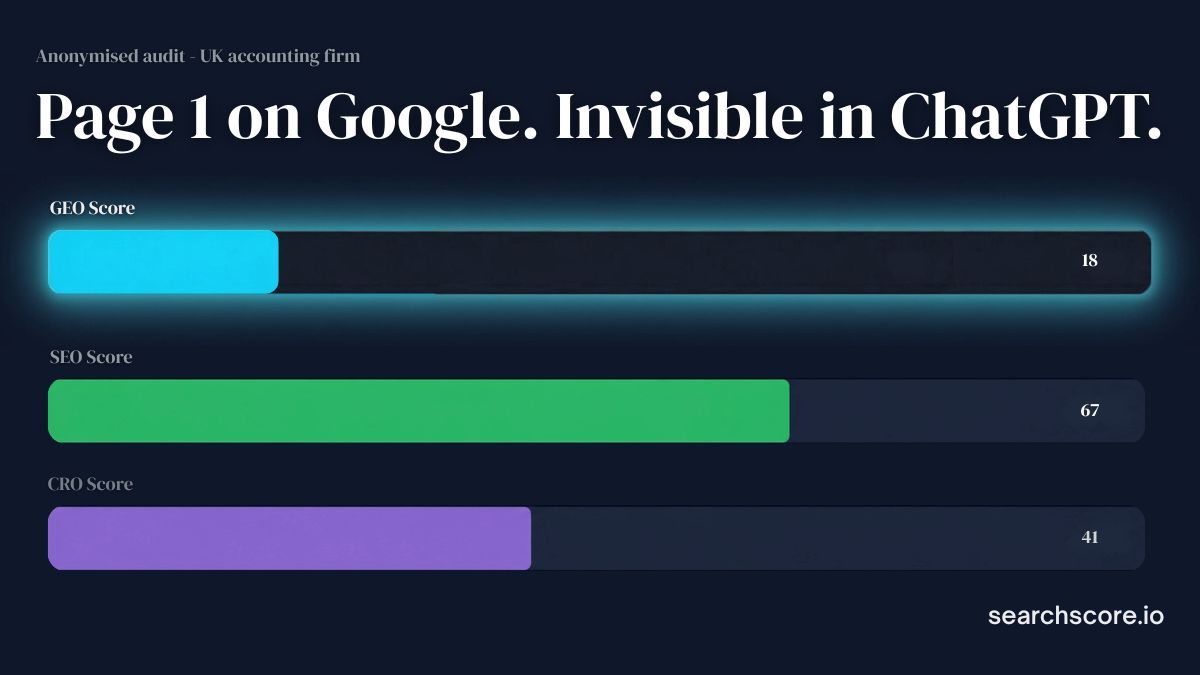
The agencies that add GEO to their stack this year will own it.
The ones that wait will buy it from someone else.
What GEO actually involves:
→ searchscore.io/blog/what-is-…
Free audit tool for agencies: searchscore.io
1
7
635
Jun 12
The internet is quietly changing shape.
And most brands are still optimising for the old one.
We’re moving from search engines to an agentic internet -
where AI systems don’t just retrieve information, they navigate, decide, and act across the web.
That means visibility is no longer about “ranking pages.”
It’s about being usable inside an AI-driven workflow.
If your brand isn’t structured as part of that infrastructure,
you don’t get discovered - you get bypassed.
• AI agents need structured, machine-readable signals
• Unclear entities can’t be safely used in decisions
• Unstructured content can’t be operationalised
• Weak authority signals get filtered out of workflows
In this environment, websites aren’t destinations anymore.
They’re infrastructure nodes in an AI system.
And infrastructure that isn’t legible doesn’t get used.
Why are most brands still building content as if humans are the only users left?
10
Jun 11
Most AI visibility audits don’t fail on execution.
They fail on what people think is being measured.
Because AI search visibility isn’t one metric.
It’s a system of signals that determines whether you can be selected as an answer.
If you’re only looking at rankings or traffic,
you’re measuring the wrong layer entirely.
An AI visibility audit actually breaks down:
• Can AI access and crawl your content?
• Can it understand your entity clearly?
• Can it extract usable answers from your pages?
• Can it trust your brand over competitors?
• Can it confidently cite you in responses?
Each layer compounds into one outcome:
whether you show up in AI-generated answers at all.
Most brands don’t realise they’re failing until they test this directly.
Because GEO isn’t opaque - it’s just unmeasured.
What do you think would happen if your entire visibility depended on signals you’ve never audited?
1
1
24
Jun 11
Most audits still focus on SEO outputs like rankings, impressions, and backlinks - but AI visibility audits measure something fundamentally different: whether your site can be understood, extracted, and trusted by AI systems generating answers.
Find out what an AI visibility audit actually measures: searchscore.io/guides/ai-vis…
See why many high-performing SEO sites still fail AI visibility checks - and what that means for future discoverability.
Get ahead before measurement reveals you’ve been invisible for months.
12
Jun 11
1/ You lost a client this week and there's no record of it anywhere.
Not in analytics. Not in search console. Nowhere.
Here's where deals go to die in 2026 🧵
1
2
18
Jun 11
5/ You can't fix a leak you can't see.
Step one is brutally simple: find out if AI engines mention you at all.
1
4
Jun 11
6/ Two minutes. Free. No email. Link below.
Bookmark this thread for the colleague who still thinks Google is the whole game.
7
Jun 11
Most brands don’t have an AI visibility problem.
They have an unknown visibility problem.
Because you can’t fix what you haven’t measured.
And in AI search, most companies have never actually checked whether they appear in answers at all.
That’s the uncomfortable reality of GEO.
You might rank.
You might get traffic.
You might even have strong content.
And still be completely absent from AI-generated recommendations.
That’s why an AI visibility audit matters.
• It reveals if AI can actually access your content
• It shows whether you’re being cited or ignored
• It exposes missing schema and entity signals
• It benchmarks you against competitors in AI answers
In GEO, assumptions are expensive.
Visibility is binary before it’s competitive.
If you haven’t audited your AI visibility,
you don’t have a strategy - you have a guess.
What would change if you knew exactly where AI is ignoring you today?
1
1
21
Jun 11
Most teams optimise content without ever checking whether they appear in AI-generated answers in the first place.
An AI visibility audit reveals where you’re being cited, where competitors are being preferred, and what structural gaps are preventing inclusion in AI responses.
Find out how to run an AI visibility audit: searchscore.io/guides/ai-vis…
See why measurement is the starting point of every effective GEO strategy.
Get ahead before you optimise in the dark.
14
Jun 10
Search is no longer a search box.
It’s becoming an agent deciding for you.
Agentic search doesn’t just find information.
It completes tasks, compares options, and chooses outcomes on your behalf.
That changes everything about visibility.
Because AI isn’t asking “what exists?” anymore.
It’s asking “what should I do for the user?”
If your brand isn’t easy for an agent to understand, trust, and act on,
you won’t be surfaced - even if you’re relevant.
• Clear positioning beats broad content libraries
• Structured data beats persuasive copy
• Decision-ready content beats informational content
• Machine-readable outcomes beat marketing pages
In agentic search, you’re not competing for attention.
You’re competing for delegation.
Why would an AI agent choose your brand over a simpler, clearer alternative?
1
20
Jun 10
Most SEO strategies still assume users will evaluate options manually.
But agentic search flips that - AI systems increasingly summarise, compare, and decide on behalf of the user, meaning only clearly structured, decision-ready brands get surfaced.
Find out how agentic search changes visibility: searchscore.io/guides/ai-vis…
See why being “relevant” is no longer enough when AI is the one making the choice.
Get ahead before agents become the default buyer layer.
2
Jun 10
Ranking in ChatGPT search is a misleading idea.
Because ChatGPT doesn’t show rankings - it shows answers.
And those answers are built from sources it trusts enough to synthesise.
That means visibility isn’t about position.
It’s about being selected as input to the answer itself.
Most brands are still trying to “rank higher”
in a system that doesn’t behave like a search engine.
• ChatGPT prioritises clarity over keyword targeting
• It extracts structured, reusable information
• It prefers entities it can confidently understand
• It avoids sources that are ambiguous or unstructured
So the real optimisation isn’t SEO anymore.
It’s answer eligibility.
If your content can’t be cleanly interpreted and reused,
you don’t get included - no matter how well you rank elsewhere.
What happens when your entire visibility depends on whether AI chooses to quote you?
1
1
19
Jun 10
Most people still approach ChatGPT like a search engine, but it behaves more like a synthesis system - selecting, compressing, and recombining trusted sources to generate answers rather than ranking pages.
That’s why visibility depends on clarity, structure, and extractability rather than traditional SEO signals.
Find out how to rank in ChatGPT search: searchscore.io/guides/how-to…
See why being “ranked” and being “used in answers” are no longer the same thing. Get ahead before answer selection replaces ranking as the primary visibility layer.
24
Jun 9
Most content isn’t failing because it’s bad.
It’s failing because AI can’t retrieve it cleanly.
AI search doesn’t “rank pages.”
It retrieves answer fragments and reconstructs responses.
If your content isn’t structured for extraction,
it gets skipped - even if it ranks, even if it’s detailed, even if it converts.
That’s the gap between SEO content and GEO content.
• Clear answer-first sections beat long introductions
• Structured headings beat narrative flow
• Direct statements beat marketing language
• Chunked information beats long-form storytelling
In AI retrieval, readability isn’t for humans - it’s for machines assembling answers.
If AI can’t quickly extract meaning from your page,
it won’t include you in the response layer.
Why are so many “high-quality” pages never used by AI systems at all?
1
26
Jun 9
Most content is still written for traditional SEO readability - long intros, narrative structure, and keyword flow.
But AI systems retrieve information in fragments, prioritising clearly structured, extractable answer blocks that can be recombined into responses.
That’s why retrieval optimisation is becoming the new baseline for visibility.
Find out how to optimise content for AI retrieval: searchscore.io/guides/ai-vis…
See why structurally clear content consistently outperforms longer, more detailed pages in AI-generated answers.
Get ahead before retrieval becomes the real ranking layer.
12
Jun 9
Most people think AI reads LinkedIn.
It actually detects authority patterns.
Because modern AI systems don’t just ingest posts -
they evaluate whether content signals expertise, consistency, and trustworthiness at scale.
That means LinkedIn isn’t just being “scraped.”
It’s being interpreted as an authority graph.
And once that graph is formed, it decides who gets cited… and who gets ignored.
• Repeated expertise = stronger detection signals
• Clear positioning = easier entity classification
• Consistent narrative = higher trust score
• Fragmented content = ignored or diluted identity
This is the shift from content consumption to AI detection of credibility.
If AI can’t confidently detect what you are,
it won’t risk representing you in answers.
How many “visible” creators are actually invisible to machine trust systems?
1
23
Jun 9
Most LinkedIn strategies are still built around human perception - impressions, engagement, and reach.
But AI systems evaluate something deeper: whether your content consistently signals a coherent, trustworthy, and classifiable expert identity.
That “detection layer” is what determines citation probability in AI-generated answers.
Find out how AI detection works on LinkedIn: searchscore.io/guides/linked…
See why some creators are structurally recognised by AI while others remain invisible despite strong engagement.
Get ahead before detection becomes the gatekeeper of visibility.
15
Jun 8
FAQs aren’t for users anymore.
They’re for AI extraction.
When paired with FAQ schema,
your answers become structured signals AI can trust and cite.
Most brands treat FAQs as filler.
Smart brands treat them as distribution assets.
The page doesn’t need more words.
It needs better answers machines can read.
• Ask real buyer questions
• Answer directly
• Mark it up properly
How many leads are going to competitors with better schema?
1
13
Jun 8
Most FAQ sections are wasted space.
Done right, they become AI-ready answer blocks that improve visibility across ChatGPT, Perplexity, and Google AI Overviews.
Find out how: searchscore.io/guides/answer…
See why many brands miss this easy win.
Get ahead while others ignore structured data.
16