Publishing innovative scholarly work that makes a significant contribution – theoretical, empirical, or both – to our understanding of international security.
- Tweets 376
- Following 168
- Followers 5,971
- Likes 70


ALT Revolutionary politics is an environment characterized by pressures for adverse selection. It elevates the most radical, conflict-prone, risk happy types, who in addition are poorly educated and inexperienced in government. They are vulgar anti-materialists who think reality can be bent to their will with sufficient effort and perseverance. Revolutionaries are possessed with grandiose ideas and salvation projects, which typically do not tolerate compromise and bargaining. Nor any cost seems too high to them for the realization of such ideas. When revolutionaries take over in a country that has a conflict with another state, these propensities are likely to affect their management of the conflict as well with potentially catastrophic consequences. The argument is illustrated with the diplomacy of Armenia’s revolutionary government, which led to the Second Karabakh War of 2020 and the Armenian side’s catastrophic defeat.
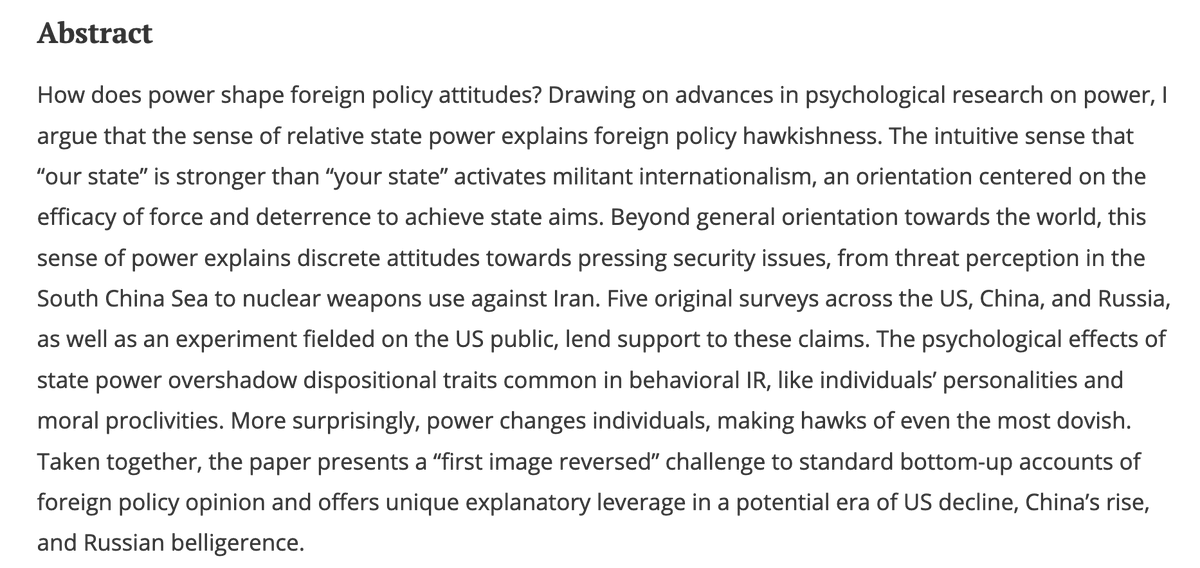
ALT How does power shape foreign policy attitudes? Drawing on advances in psychological research on power, I argue that the sense of relative state power explains foreign policy hawkishness. The intuitive sense that “our state” is stronger than “your state” activates militant internationalism, an orientation centered on the efficacy of force and deterrence to achieve state aims. Beyond general orientation towards the world, this sense of power explains discrete attitudes towards pressing security issues, from threat perception in the South China Sea to nuclear weapons use against Iran. Five original surveys across the US, China, and Russia, as well as an experiment fielded on the US public, lend support to these claims. The psychological effects of state power overshadow dispositional traits common in behavioral IR, like individuals’ personalities and moral proclivities....
ALT Lethal autonomous weapon systems present a prominent yet controversial military innovation. While previous studies have indicated that the deployment of “killer robots” would face considerable public opposition, our understanding of the elasticity of these attitudes, contingent on different factors, remains limited. In this article, we aim to explore the sensitivity of public attitudes to three specific factors: concerns about the accident-prone nature of the technology, concerns about responsibility attribution for adverse outcomes, and concerns about the inherently undignified nature of automated killing. Our survey experiment with a large sample of Americans reveals that public attitudes toward autonomous weapons are significantly contingent on beliefs about their error-proneness relative to human-operated systems. Additionally, we find limited evidence that individuals concerned about human dignity violations are more likely to oppose “killer robots"....
ALT While some social scientists see multi-method research (MMR) as a promising strategy for strong causal inference, others argue that it does little to strengthen the validity of research. This paper offers a systematic review of how MMR has been used in mainstream International Relations (IR) and specifically in security studies. Using the TRIP Journal Article Database and Web of Science citation data, I examine whether MMR has reached its full potential. MMR has grown in prominence since the 2000s. Scholars use it most often to examine domestic rather than interstate issues. They cite MMR articles less than they cite quantitative single-method articles and about as often as they cite qualitative single-method research. This suggests that MMR is not more influential, nor perceived as more persuasive. However, this gap has decreased in recent years. The study provides insights into IR at the research design and disciplinary levels, the utility of MMR...
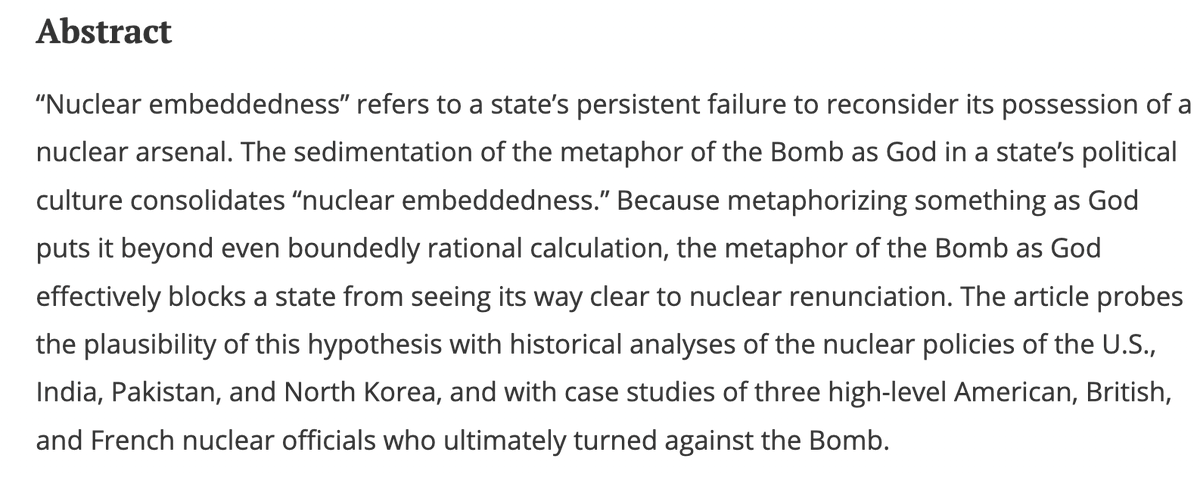
ALT “Nuclear embeddedness” refers to a state’s persistent failure to reconsider its possession of a nuclear arsenal. The sedimentation of the metaphor of the Bomb as God in a state’s political culture consolidates “nuclear embeddedness.” Because metaphorizing something as God puts it beyond even boundedly rational calculation, the metaphor of the Bomb as God effectively blocks a state from seeing its way clear to nuclear renunciation. The article probes the plausibility of this hypothesis with historical analyses of the nuclear policies of the U.S., India, Pakistan, and North Korea, and with case studies of three high-level American, British, and French nuclear officials who ultimately turned against the Bomb.
ALT This article explores how counterterrorism knowledge practices affect the groups they study. We argue that these practices typically construct terrorist groups as ontologically stable and organizationally rational, which makes them appear familiar to, and so governable by, counterterrorism organizations. We show that by excluding prevalent local knowledge, Western counterterrorism policy discourses assign the power to construct the category of “terrorist” to those without daily lived experience of the “terrorists” in question. This undermines different ways of knowing what sustains these groups, what might eradicate them and, more importantly, what might make their ability to pose a serious threat seem unlikely, or even absurd, to those whose support they purportedly need to survive as terrorists. Using evidence from Yemen, we show that groups labelled as “terrorists” do not fit into the stable categories that counterterrorism organizations require to produce actionable targets....

ALT How do actors issue credible threats during international crises? While scholarship has traditionally focused on how the context of threats influences credibility, this paper considers how the construction of the threat itself affects credibility. More specifically, this paper introduces the concept of threat justification and theorize how the choice of explanation a leader uses in communicating her threats can influence her coercive credibility. This study employs a conjoint design survey experiment to identify the influence of threat specificity and severity, public versus private threats, and threat justification on perceptions of credibility. This paper finds that more precise threats are perceived as more credible, while threats employing reputational justifications are less credible. There is a minimal amount of evidence that the public versus private delivery of a threat influences credibility...

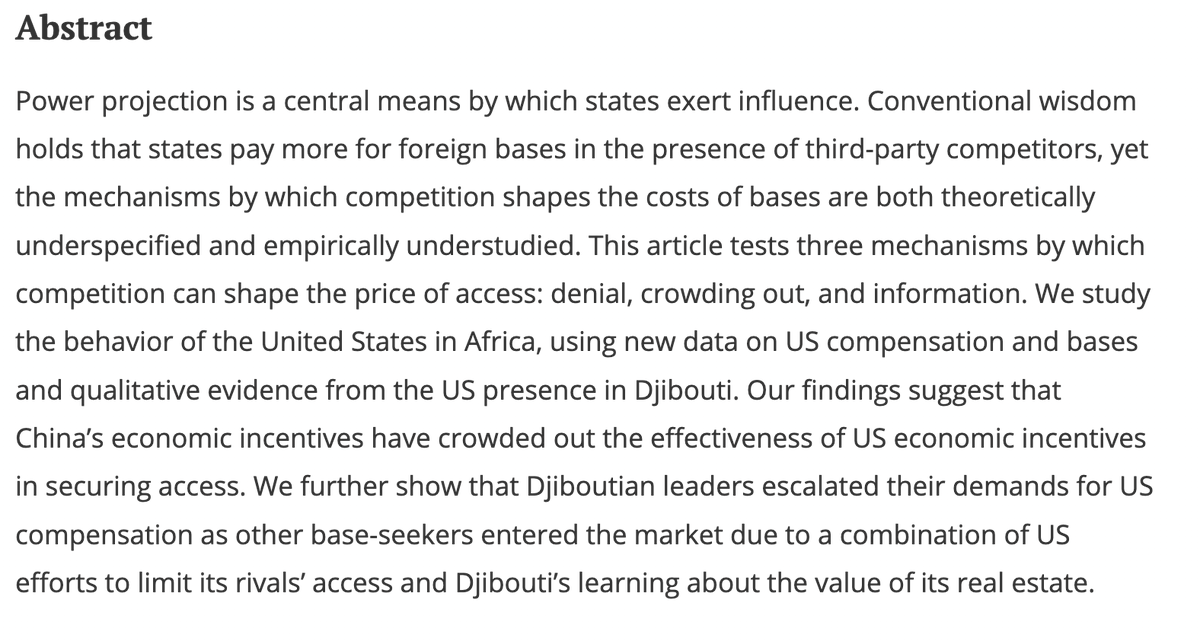
ALT Power projection is a central means by which states exert influence. Conventional wisdom holds that states pay more for foreign bases in the presence of third-party competitors, yet the mechanisms by which competition shapes the costs of bases are both theoretically underspecified and empirically understudied. This article tests three mechanisms by which competition can shape the price of access: denial, crowding out, and information. We study the behavior of the United States in Africa, using new data on US compensation and bases and qualitative evidence from the US presence in Djibouti. Our findings suggest that China’s economic incentives have crowded out the effectiveness of US economic incentives in securing access. We further show that Djiboutian leaders escalated their demands for US compensation as other base-seekers entered the market due to a combination of US efforts to limit its rivals’ access and Djibouti’s learning about the value of its real estate.
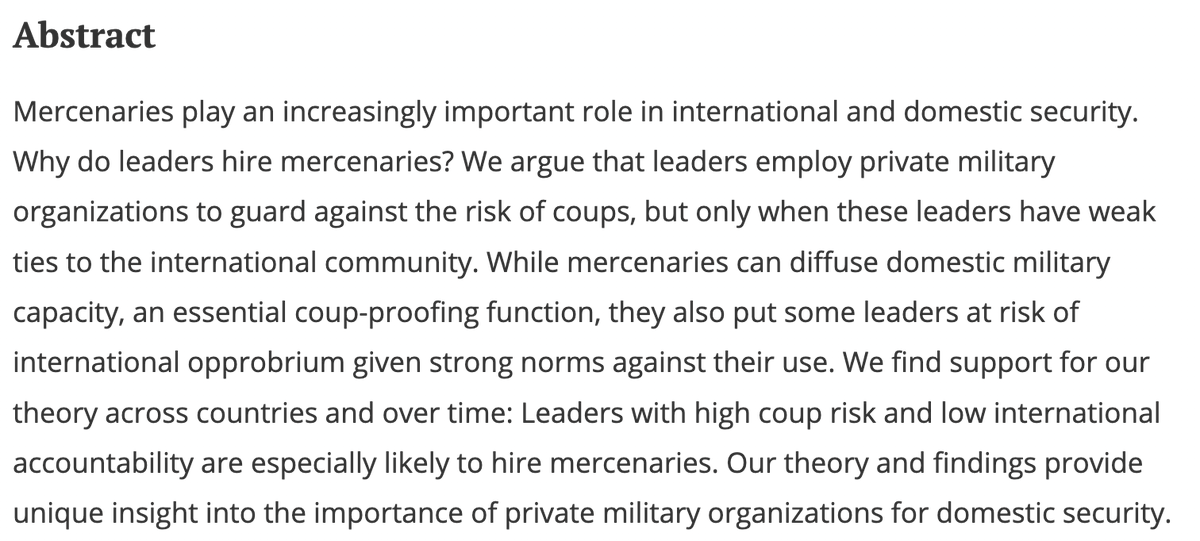
ALT Mercenaries play an increasingly important role in international and domestic security. Why do leaders hire mercenaries? We argue that leaders employ private military organizations to guard against the risk of coups, but only when these leaders have weak ties to the international community. While mercenaries can diffuse domestic military capacity, an essential coup-proofing function, they also put some leaders at risk of international opprobrium given strong norms against their use. We find support for our theory across countries and over time: Leaders with high coup risk and low international accountability are especially likely to hire mercenaries. Our theory and findings provide unique insight into the importance of private military organizations for domestic security.