
|| web3 enthusiast || reply guy ||
Joined April 2018
- Tweets 9,055
- Following 830
- Followers 1,254
- Likes 6,278
120 Photos and videos









Apr 11
Arsenal will win the league


24

Today, we closed our latest funding round with $122 billion in committed capital at an $852B post-money valuation.
The fastest way to expand AI’s benefits is to put useful intelligence in people’s hands early and let access compound globally.
This funding gives us resources to lead at scale. openai.com/index/acceleratin…
1,072
732
8,390
3,769,074
Mar 14
2026 dream body


1
1
20

Ever tried pulling on-chain data?
RPC failure, complex queries, API key management
All of this can be a nightmare
Well, not anymore!
AdEx AURA fixes this
You can now fetch your portfolio balances and DeFi positions in a single call in the fastest and cheapest way
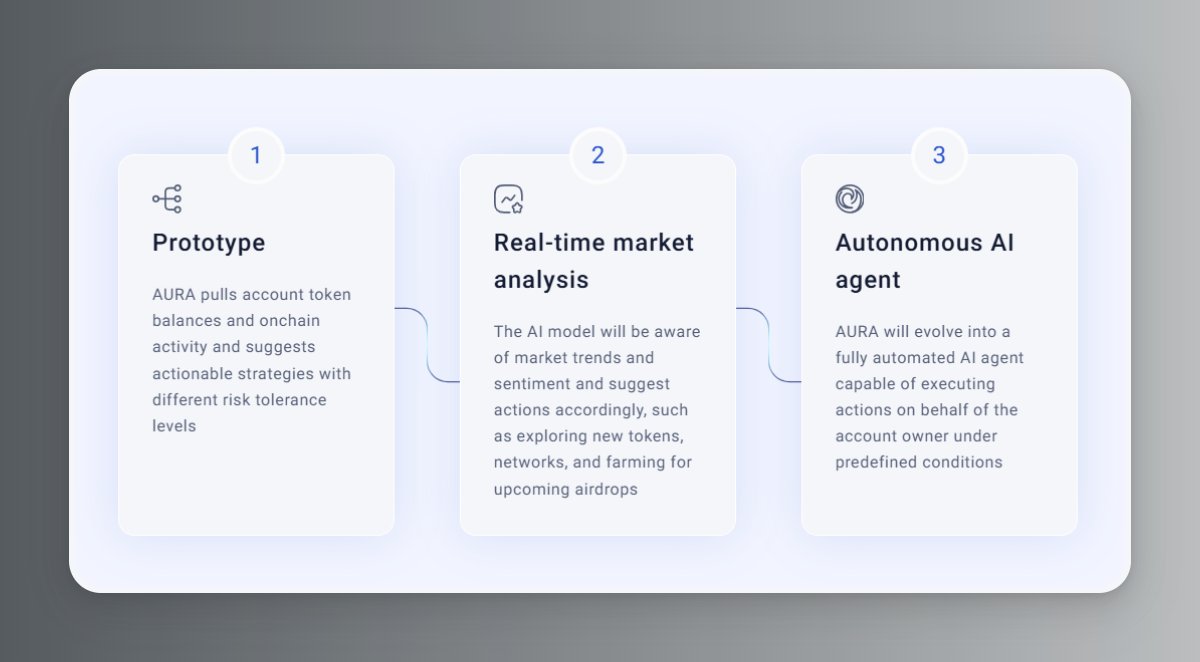

AdEx AURA is the fastest, cheapest, and most reliable API for fetching accurate on-chain data
With a single call, you can retrieve portfolio balances and DeFi positions
Best part: no need for API keys. Use it on-demand and pay per request via x402

21
1
49
2,558
Feb 9
Its a meme coin for a reason

People in crypto are literally f*cking INSANE🤬
A guy claimed he was dying in 120 hours, launched a coin, sent it to $500K, made $14K in fees, and rug pulled it live.
Shameful.

2
45
Tick Tock….⏳
Less than one hour left to the end of the @intodotspace sale
A few minutes ago $16M was committed.
Now it's over $18M
What!! I almost bet against this not reaching $20M on prediction markets
$SPACE TGE happening soon and it being 100% unlocked makes it a very attractive deal
25
5
30
1,073
Jan 16
Good morning to my two active friends on ct
What new meta are we switching to?
31
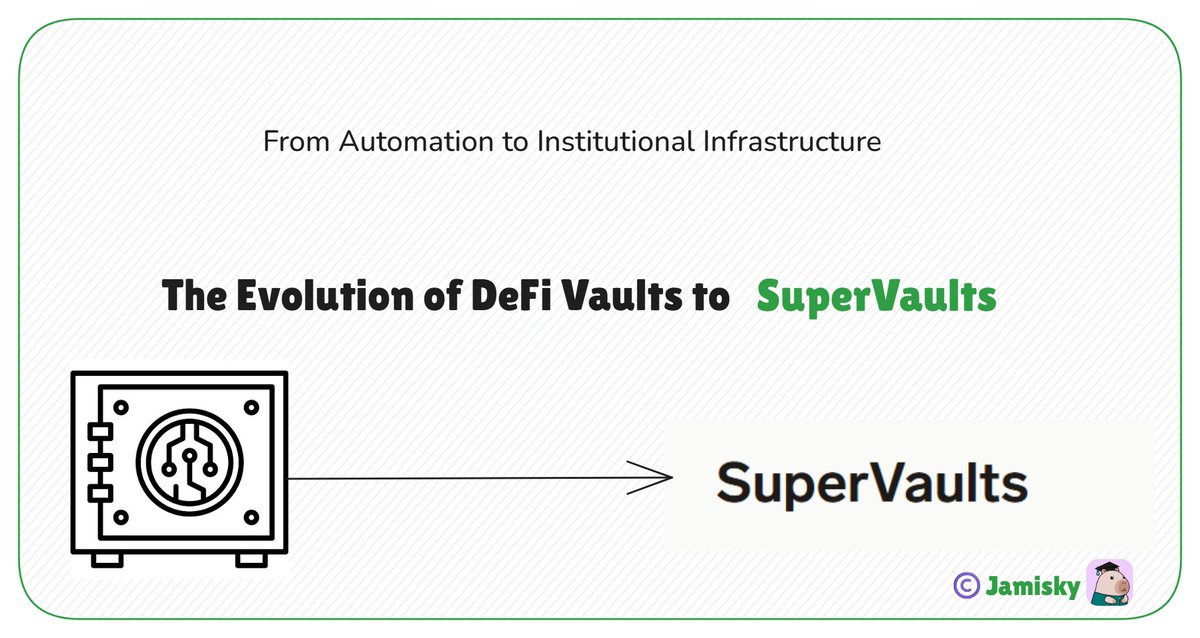
From Automation to Institutional Infrastructure. The Evolution of DeFi Vaults to SuperVaults
DeFi vaults began as a simple idea: automate yield so users didn’t have to chase rates themselves.
In 2020, early pioneers like Yearn introduced the first generation of vaults, single-strategy yield aggregators that pooled capital and deployed it into lending protocols like Compound and Aave
These vaults abstracted complexity, but strategy logic was simple, governance was minimal, and risk controls were limited.
DeFi adoption accelerated. Vault TVL grew from millions to billions, and vaults evolved into multi-strategy engines which lead to the next phase standardization
ERC-4626 introduced a common vault interface, enabling vaults to integrate seamlessly across the DeFi stack with a shift towards curated and risk-aware vaults.
However, new challenges emerged: liquidity stress during market shocks, opaque performance accounting, and governance risk from single-key managers.
This exposed the need for vaults that were not just yield-optimized, but institutional-grade.
▬ SuperVaults by Superform represent the next evolution of vaults
Built using ERC-7540, an upgrade on the ERC-4626 standard
SuperVaults enforce strategy execution through a double-merkle architecture, validator consensus, and guardian oversight
Eliminating arbitrary manager risk
All actions are auditable, time-locked, and governed by onchain risk limits
Performance is transparent, verifiable, and protected by circuit breakers and insurance mechanisms
From simple yield automation to programmable, risk-managed financial infrastructure, vaults have evolved rapidly
SuperVaults by @superformxyz stand at the frontier of this evolution
Transforming vaults from passive earn products into scalable, transparent, and institutional-ready yield infrastructure for DeFi’s next chapter
56
5
96
5,535
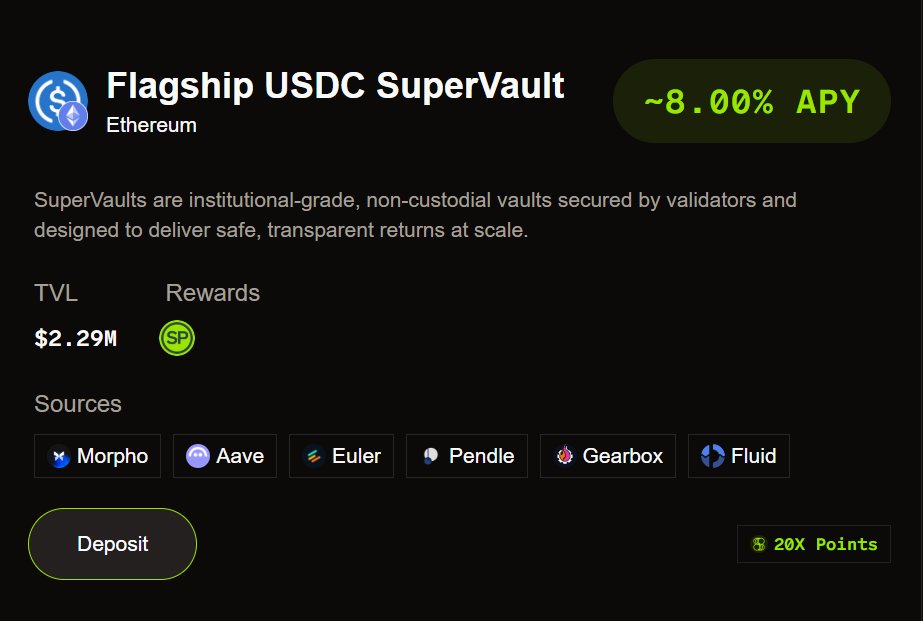
▸ 8% APY on stables
▸ 20x Superform points
▸ Boost on your capital mindshare
▸ 1000 earning opportunities
▸ Double mindshare boost
Before you log off for the holidays
Remember that you get all this by deploying capital on @superformxyz and talking about your actions today
24 Dec 2025

Cookie mindshare
If you visit @cookiedotfun during the festive season, you might notice a small daily snowfall. Post about your fav project during this period and you’ll receive a double mindshare boost.
There are currently 13 projects running campaigns. Choose the one you actually believe in and engage.
Note: As an advisor, I’m intentionally not naming any project here.
Merry Christmas 🎄🍪

63
1
80
2,457
24 Dec 2025
Good morning
no win this year
but we keep moving regardless
cheers mate
9
10
82
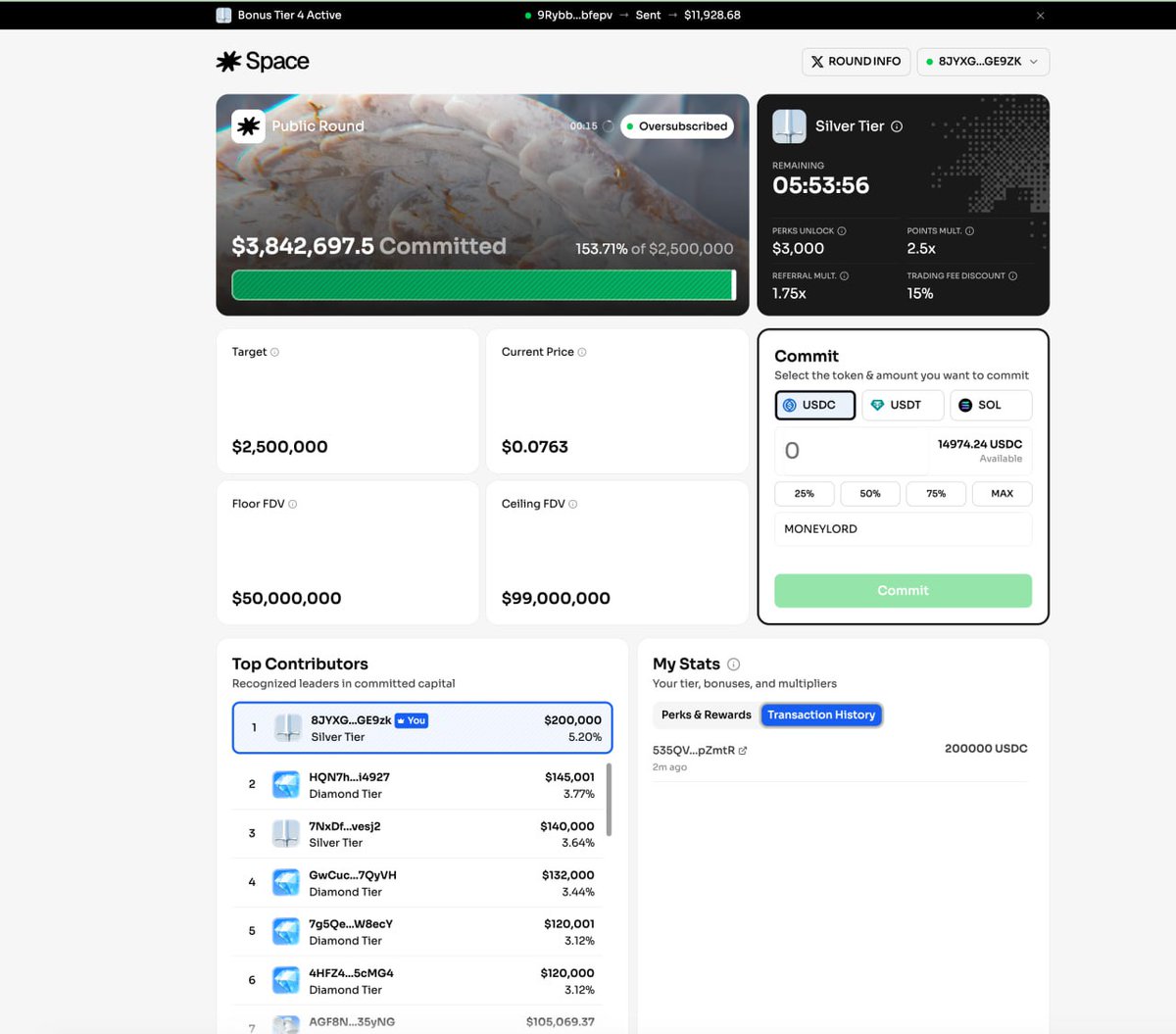
Moneylord bid $200K on @intodotspace
Does he know something, or is he just betting on the obvious?
Space raised $3M from VCs, built on the hottest narrative today, and has an oversubscribed ICO round
Sounds like a no-brainer to me. What do you think?
22 Dec 2025

Bought into @intodotspace prediction markets ICO.
I usually don't buy ICOs but this one looks like a no brainer
Prediction market are becoming huge worldwide, I think in 2026 its a good bet to be positioned in prediction market plays
They raised 3m$ from VCs, notable ones
Partnered with @Kalshi , Pyth, Moonpay, and others
You can use my ref code: MONEYLORD to get 10% top up on your buys in presale public.into.space/
I bought $200k to take #1 spot on the leaderboard as its already oversubbed and expecting 10x-20x
47
1
57
1,208
22 Dec 2025
is there any possibility of polymarket token
i want to position for the airdrop
any idea people
22 Dec 2025

⚡just in : polymarket to launch an L2
- polymarket is building its own chain for bandwidth and scalability.
- limits on existing chains can’t support massive growth.
- polygon will not be able to contain polymarket in the future .
- most users won’t notice but
- it’s an infra to handle high TPS [ Transactions Per Second ] and future expansion.
- it won't be like the useless L2s in the past years that we've seen !

3
5
102
daredreamer retweeted

15 Dec 2025
A week ago, many were bullish because it was /\ times to launch, and as we all witnessed it didn’t exactly go right.
So I implore us today, “to choose discipline over excitements” and uncertainty.
For me, this week I choose to
~ revamp my tradoors on @pip_world
~ continue to speak about the scalable abilities of @0xMiden as well the credible privacy it brings
~ check out @TheoriqAI alpha vault tvl growth
~ discuss Ethereum and Arbitrum growth randomly
~ Be a bad boy and enjoy the week

45
1
48
1,006
daredreamer retweeted
11 Dec 2025
Some weeks back, we discussed Theoriq potentials together;
~ how the alpha vault would work
~ what to expect from the vault
~ tge plans
~ theoriq as an operating system for agents and many more.
Fast forward today, I am happy to share with you that the
~ AlphaVault is live, with two seperate strategies on the Turtle Platform
~ AlphaVault has crossed over $20M in Tvl
~ there is AlphaVault incentives for @KaitoAI users, either on the lb or you joined the sale
~ Theoriq Airdrop claim is live
~ @TheoriqAI listed on coinbase markets
As the saying goes,
Theoriq is here. Many will Theoriq. Many will Turtle
gTheoriq

38
1
39
403