
Joined September 2022
- Tweets 896
- Following 141
- Followers 110,261
- Likes 522
288 Photos and videos















Pinned Tweet

18 Feb 2025
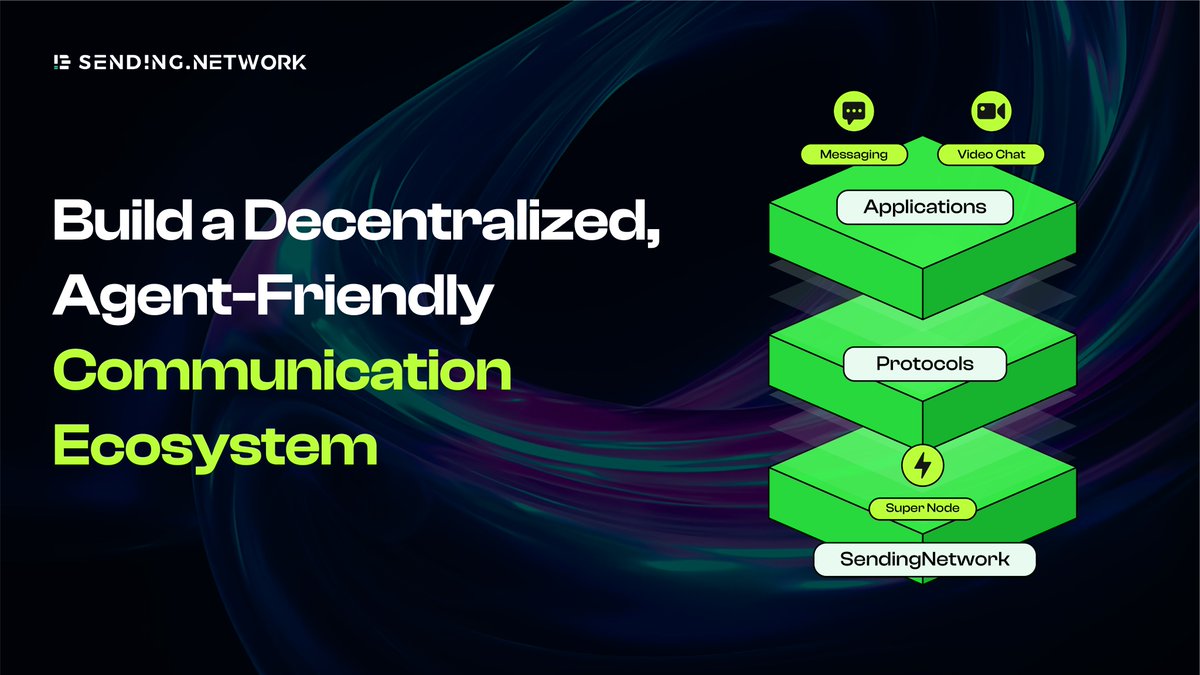
SendingNetwork 2.0: Building a Decentralized, Agent-Friendly Communication Ecosystem
Imagine a world where agents autonomously collaborate:
✅Negotiate deals without intermediaries
✅Securely share data via encrypted messages
✅Hire specialized skills from a global agent hub
17
21
70
16,002
Jun 13
Communication isn't something you add to your Web3 product.
When you build on SendingNetwork, it's something you inherit from the protocol.
Decentralized. Composable. Always on. 🟢
🌐 sending.network
1
250
Jun 12
Composability means you don't rebuild what already exists.
Communication is a primitive. Identity is a primitive. Presence is a primitive.
SendingNetwork makes all three available to any builder, on any app, without rebuilding from scratch. 🏗️
159
Jun 11
When building a Web3 app, what's the hardest part to get right?
0%
Security and encryption
0%
Messaging between users
0%
ID and wallet integration
0%
Uptime reliability
0 votes • Final results
1
215
Most Web3 apps have decentralized everything.
Except the part where users actually talk to each other.
That part usually runs on AWS. Or a centralized chat API. Or a Discord server.
SendingNetwork exists to close that gap. 🌉
137
Developers of Web3 products face the challenge of adding communication.
Instead of centralized solutions, choose SendingNetwork, a decentralized stack that integrates communication inherently.
Visit us: sending.network
1
1
243
May 25
Open source means the promise is readable.
Anyone can verify what SendingNetwork does.
Not because we say so. Because the code says so.
Transparency isn't a value here. It's a structural feature. 🗼
1
1
4
291
May 22
A company can pivot. A team can change direction.
A product can be discontinued.
The protocol runs by the rules it was built on. No meetings. No votes. No pivots.
SendingNetwork. The infrastructure that holds. 🗼
233
May 21
The most powerful privacy guarantee isn't a policy update.
It's an architecture that makes violating privacy structurally impossible.
Not because SendingNetwork promises to protect you.
Because the network is built so it can't do otherwise. 🏗️
232
May 18
Anyone can read the protocol.
Anyone can verify the guarantee. Anyone can build on the foundation.
No closed doors. No hidden terms.
SendingNetwork operates in public — because that's the point. 💻
2
377
May 13
Brands change. Leadership changes. Boards change.
The protocol doesn't.
That's not a feature.
That's the entire point of building on a protocol rather than a platform. 🛜
1
1
255
May 12
Companies make promises in press releases.
Protocols make guarantees in code.
SendingNetwork doesn't ask you to trust our word.
It's written into the architecture. 📝
sending.network
2
1
319
May 11
"We take your privacy seriously."
You've read that line before. On a terms of service page. Written by a legal team. Enforceable by no one.
Protocol-level guarantees don't need a legal team.
They need architecture. 🗼
202
Companies promise; protocols guarantee.
Boards pivot, and CEOs change minds, but protocols execute exactly as designed every time.
SendingNetwork is the communication layer beneath the promise. The protocol is the promise.
🌐sending.network
2
316
Apr 30
Who controls the communication layer controls the conversation.
SendingNetwork removes that control from any single entity.
No one owns it. Everyone can use it.
That's the point. ✅
1
2
372
Apr 30
Edge nodes. Guardian nodes. Watchdog nodes.
Each with a role. Each independent.
Together — a network that doesn't need managing.
233
Apr 28
The most resilient systems don't survive failures.
They're designed so failures don't matter.
Distributed nodes. Modular roles. No central dependency.
That's the architecture of SendingNetwork. 🗼
3
265
Apr 28
Every approval gate slows communication down.
Every gatekeeper is a single point of control.
SendingNetwork is built without them — by design.
1
184
Apr 23
Builders shouldn't need gatekeepers.
If you want to build on SendingNetwork, you build.
No approval queue. No platform fee. No terms subject to change.
Just open infrastructure.
1
1
232
Apr 22
Centralized systems have an off switch.
SendingNetwork doesn't.
Modular. Distributed. Always on.
2
2
466
Apr 17
If you could build anything on open communication infrastructure, no gatekeepers, no platform rules.
What would you build?
Serious answers and wild ideas both welcome.
2
6
667