
Joined August 2017
- Tweets 252
- Following 42
- Followers 485
- Likes 580
15 Photos and videos



Mark Simkin retweeted

Jun 10
The scary part about Anthorpic's Fable nerf is not that it refuses to answer biology or cryptography. It's that it foreshadows what's coming. A world where a couple companies decide what you can and cannot do. They're building a new ruling class and you're not in it...
463
1,305
13,884
730,803
Mark Simkin retweeted

Mar 3
Over the past year, many people I talk to have expressed worry about two topics:
* Various aspects of the way the world is going: government control and surveillance, wars, corporate power and surveillance, tech enshittification / corposlop, social media becoming a memetic warzone, AI and how it interplays with all of the above...
* The brute reality that Ethereum seems to be absent from meaningfully improving the lives of people subject to these things, even on the dimensions we deeply care about (eg. freedom, privacy, security of digital life, community self-organization)
It is easy to bond over the first, to commiserate over the fact that beauty and good in the world seems to be receding and darkness advancing, and uncaring powerful people in high places are making this happen. But ultimately, it is easy to acknowledge problems, the hard thing is actually shining a light forward, coming up with a concrete plan that makes the situation better.
The second has been weighing heavily on my mind, and on the minds of many of our brightest and most idealistic Ethereans. I personally never felt any upset or fear when political memecoins went on Solana, or various zero-sum gambling applications go on whatever 250 millisecond block chain strikes their fancy. But it *does* weigh on me that, through all of the various low-grade online memetic wars, international overreaches of corporate and government power, and other issues of the last few years, Ethereum has been playing a very limited role in making people's lives better. What *are* the liberating technologies? Starlink is the most obvious one. Locally-running open-weights LLMs are another. Signal is a third. Community Notes is a fourth, tackling the problem from a different angle.
One response is to say "stop dreaming big, we need to hunker down and accept that finance is our lane and laser-focus on that". But this is ultimately hollow. Financial freedom and security is critical. But it seems obvious that, while adding a perfectly free and open and sovereign and debasement-proof financial system would fix some things, but it would leave the bulk of our deep worries about the world unaddressed. It's okay for individuals to laser-focus on finance, but we need to be part of some greater whole that has things to say about the other problems too.
At the same time, Ethereum cannot fix the world. Ethereum is the "wrong-shaped tool" for that: beyond a certain point, "fixing the world" implies a form of power projection that is more like a centralized political entity than like a decentralized technology community.
So what can we do? I think that we in Ethereum should conceptualize ourselves as being part of an ecosystem building "sanctuary technologies": free open-source technologies that let people live, work, talk to each other, manage risk and build wealth, and collaborate on shared goals, in a way that optimizes for robustness to outside pressures.
The goal is not to remake the world in Ethereum's image, where all finance is disintermediated, all governance happens through DAOs, and everyone gets a blockchain-based UBI delivered straight to their social-recovery wallet. The goal is the opposite: it's de-totalization. It's to reduce the stakes of the war in heaven by preventing the winner from having total victory (ie. total control over other human beings), and preventing the loser from suffering total defeat. To create digital islands of stability in a chaotic era. To enable interdependence that cannot be weaponized.
Ethereum's role is to create "digital space" where different entities can cooperate and interact. Communications channels enable interaction, but communication channels are not "space": they do not let you create single unique objects that canonically represent some social arrangement that changes over time. Money is one important example. Multisigs that can change their members, showing persistence exceeding that of any one person or one public key, are another. Various market and governance structures are a third. There are more.
I think now is the time to double down, with greater clarity. Do not try to be Apple or Google, seeing crypto as a tech sector that enables efficiency or shininess. Instead, build our part of the sanctuary tech ecosystem - the "shared digital space with no owner" that enables both open finance and much more. More actively build toward a full-stack ecosystem: both upward to the wallet and application layer (incl AI as interface) and downward to the OS, hardware, even physical/bio security levels.
Ultimately, tech is worthless without users. But look for users, both individual and institutional, for whom sanctuary tech is exactly the thing they need. Optimize payments, defi, decentralized social, and other applications precisely for those users, and those goals, which centralized tech will not serve. We have many allies, including many outside of "crypto". It's time we work together with an open mind and move forward.
745
754
4,008
654,171
Mark Simkin retweeted
Feb 18
Excited to see this!
Network-layer anonymity has been a missing piece of all the privacy primitives we've been building - both the onchain stuff (eg. railgun) and the offchain stuff (eg. the ZK API tickets)
And there's a significant space of applications where the bandwidth reqs are small but latency matters a lot, so having something on the low-latency high-anonset side of the triangle matters a lot.
64
36
384
39,566
Mark Simkin retweeted

Feb 17
🌘 CRYPTO IS GOING 🅳🅐🆁🅺 🌒
writings.flashbots.net/netwo…
35
60
330
80,556
Mark Simkin retweeted
5 Nov 2025
yesterday's election was a neon signal to crypto
making the bed with fascists is a clear losing, industry killing strategy. if this is what we associate with, the backlash will be extreme, regardless of the technology
let us show the world this is a small corrupt minority only
43
19
250
22,905
Mark Simkin retweeted

1 Nov 2025
An exciting update from myself and @benediamond (eprint.iacr.org/2025/2010). We show that the 𝘶𝘱-𝘵𝘰-𝘤𝘢𝘱𝘢𝘤𝘪𝘵𝘺 proximity gaps conjecture is 𝗳𝗮𝗹𝘀𝗲. More precisely, given any pair c, d we construct codes whose error grows faster than nᶜ / (q ⋅ (ρ η)ᵈ).
19
95
488
275,551
Mark Simkin retweeted

30 Oct 2025
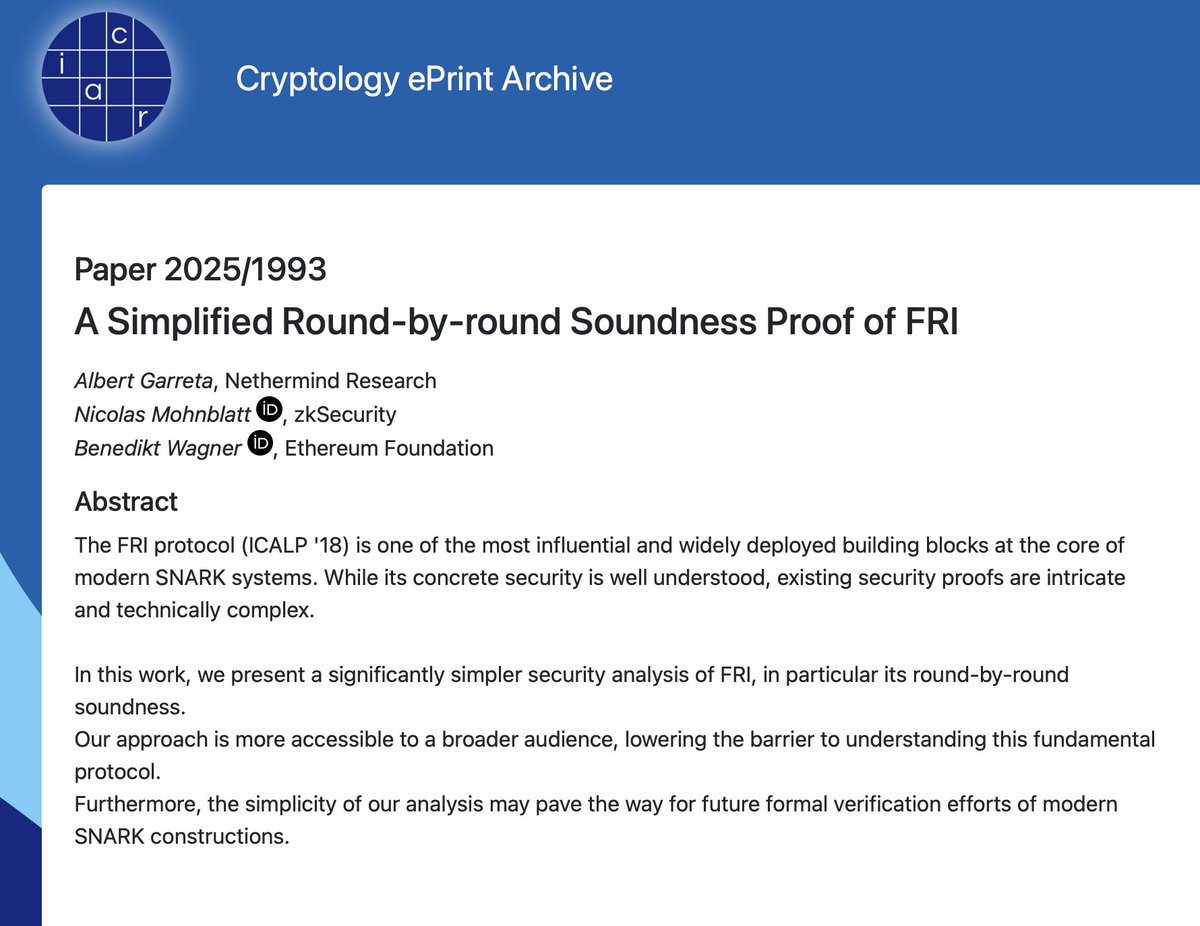
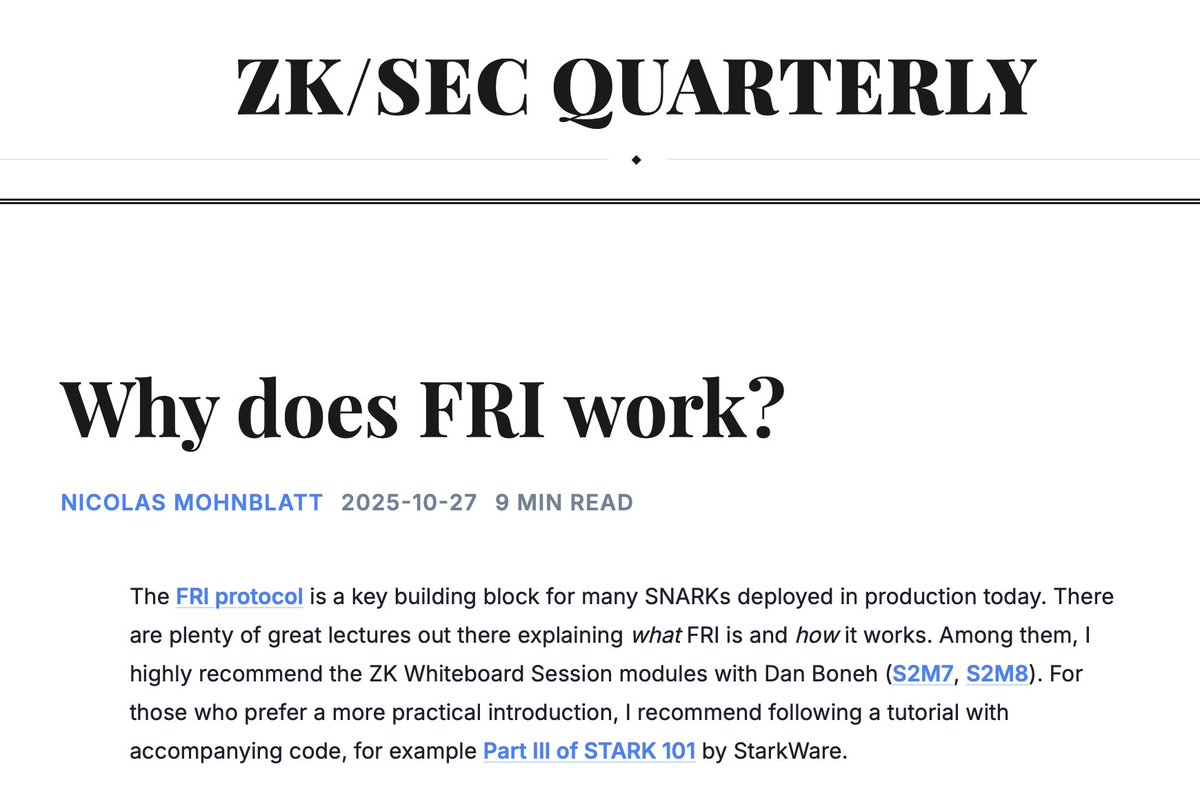
Just published a simpler proof of the RBR soundness of FRI! Work with @0xAlbertG and Benedikt Wagner
I also wrote a blog post explaining the high level ideas of the proof. All you need to know is how to colour a graph!
Links to paper and blog below
1/3
2
19
97
8,878

20 Oct 2025
RT @peter_szilagyi: Since y'all spammed my timeline full of #Ethereum existential crises, here's a letter I sent to EF leadership in a year…
114
Mark Simkin retweeted

17 Oct 2025
Privacy is also not just a value (unlike mentioned below). There are many dimensions to it.
In the blockchain space, there is sender anonymity, receiver anonymity, relationship anonymity, unlinkability across 2 or more transactions, secrecy of tx value, unobservability/deniability of tx, network-level anonymity to name the few.
ZK by itself cannot solve network-level privacy for example.
For a good privacy solution, the developers need to make up their mind about what is necessary for them across different dimensions.
A good paper if one wants to annotate the privacy properties petsymposium.org/popets/2019…
(there is no value privacy here, but it can added.)
16 Oct 2025

Privacy isn't a 'yes or no' feature, it's a 'how much?' feature.
27
8
94
4,289
Mark Simkin retweeted

3 Oct 2025
I believe this is a radically underexplored (and high potential) direction and something that I've spent the last year working on
collective.flashbots.net/t/t…
1
11
39
3,403
Mark Simkin retweeted

1 Sep 2025
In defence of FOCIL
Note: I genuinely think that more eyes on major EIPs are always a net positive. The more visibility and constructive feedback we get, the more likely we are to ship meaningful, important upgrades for Ethereum.
• FOCIL is about adding multiple proposers that participate in block construction each slot to avoid single points of failure (x.com/VitalikButerin/status/…). This is particularly useful to participate in the distributed block building process and impose constraints on sophisticated/centralized builders that build more than 90% of all blocks today via MEV-boost (mevboost.pics/). While there is work towards more decentralized block builders, the inherent economies of scale due to MEV mean builders are likely to stay centralized in the near to medium term.
• Even if you think Ethereum is doing fine today in terms of censorship resistance (CR) and credible neutrality, it’s unrealistic to assume the network will remain as it is. Most would agree that Ethereum needs to keep scaling (e.g., raising the gas limit, zkEVMs blog.ethereum.org/2025/07/10…), which likely implies a future in which solo stakers can’t locally build and prove blocks at full capacity.
This leaves the network even more vulnerable to a few centralized and sophisticated entities than today, not just from a censorship perspective but also from a liveness one. And that’s why we need FOCIL: To keep builders honest, and to stop relying on altruistic local builders to preserve CR (not just altruistic btw, they’re actually losing a lot of money doing that and it’s just not sustainable).
• It is precisely because Ethereum is permissionless and censorship resistant that nations and large institutions will be comfortable using it. Otherwise, they’re exposed to competitors or adversarial entities coercing the network into excluding their transactions.
• I personally think being an Ethereum validator means you must not only put 32 ETH at stake to earn yield, but also actively perform duties to keep Ethereum secure and help preserve its core values, some of which are (and always have been) censorship resistance and permissionlessness.
nit: Please refer to the EIP as the most recent, accurate FOCIL doc: eips.ethereum.org/EIPS/eip-7…

22 Aug 2025

I think neutrality / "dumb pipe" property of the L1 is important enough that we should have multiple lines of defense to protect it:
1. Make sure that the public mempool continues to be strong and it continues to be viable to build blocks "naively", by just grabbing txs from the public mempool.
2. Work on (extra-protocol) distributed block building technology
3. Add extra channels through which txs can be included, so that EVEN IF block building gets fully taken over by centralized professional builders AND like 2 of them control 99% of the block production, they still can't censor transactions
FOCIL is one of these "extra channels"
The easiest way to understand FOCIL is: instead of choosing one proposer per slot, we choose 17 proposers per slot, where one of those 17 has the special privilege of "moving last" and choosing transaction order. Transactions proposed by any of the 17 proposers are required to be included.
The flip side is that the 16 "non-privileged" proposers (which merely select txs that must be included *somewhere* in the block) get a much lighter-weight role: they do not need to calculate the state root, they only need to compute the validation part of any transaction, they can even be stateless, so even at much higher gas limits it's viable for any attester to also be one of these "auxiliary proposers".
And with full account abstraction (EIP-7701 or similar), the same property can be extended to smart contract wallet transactions, privacy protocol withdrawals, etc, allowing all of these things to work without centralized intermediary dependency.
The goal is to prevent a block builder oligopoly from having a veto over transaction inclusion.
151
25
303
16,541
Mark Simkin retweeted

29 Aug 2025
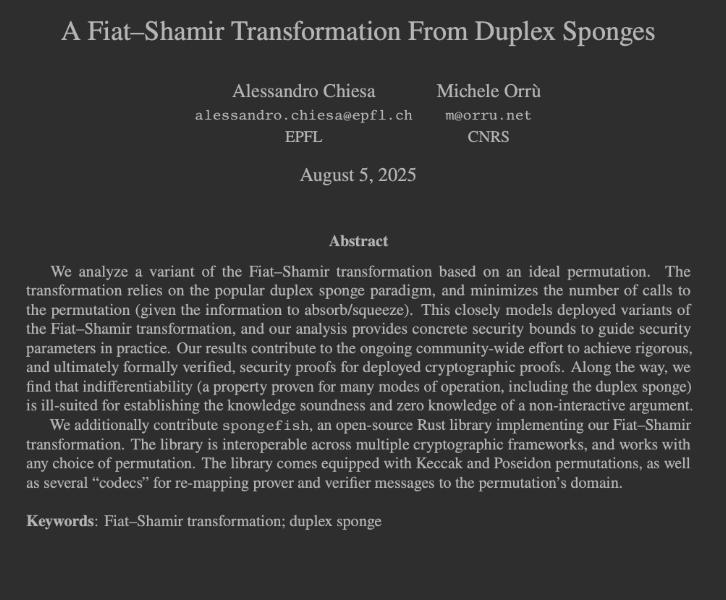
Thrilled to announce that my latest paper with Alessandro Chiesa has been accepted to TCC, the IACR conference on the theory of cryptography!
3
7
63
4,406
Mark Simkin retweeted

21 Aug 2025
Excited for the opportunity to bring Ethereum to the world via faster, cheaper, safer, and more decentralized sequencing! 🚀🚀

Optimism is partnering with Flashbots to bring fast, verifiable sequencing to the Superchain 🔴
Faster confirmations = smoother user experience.

6
7
56
8,740
Mark Simkin retweeted

19 Aug 2025
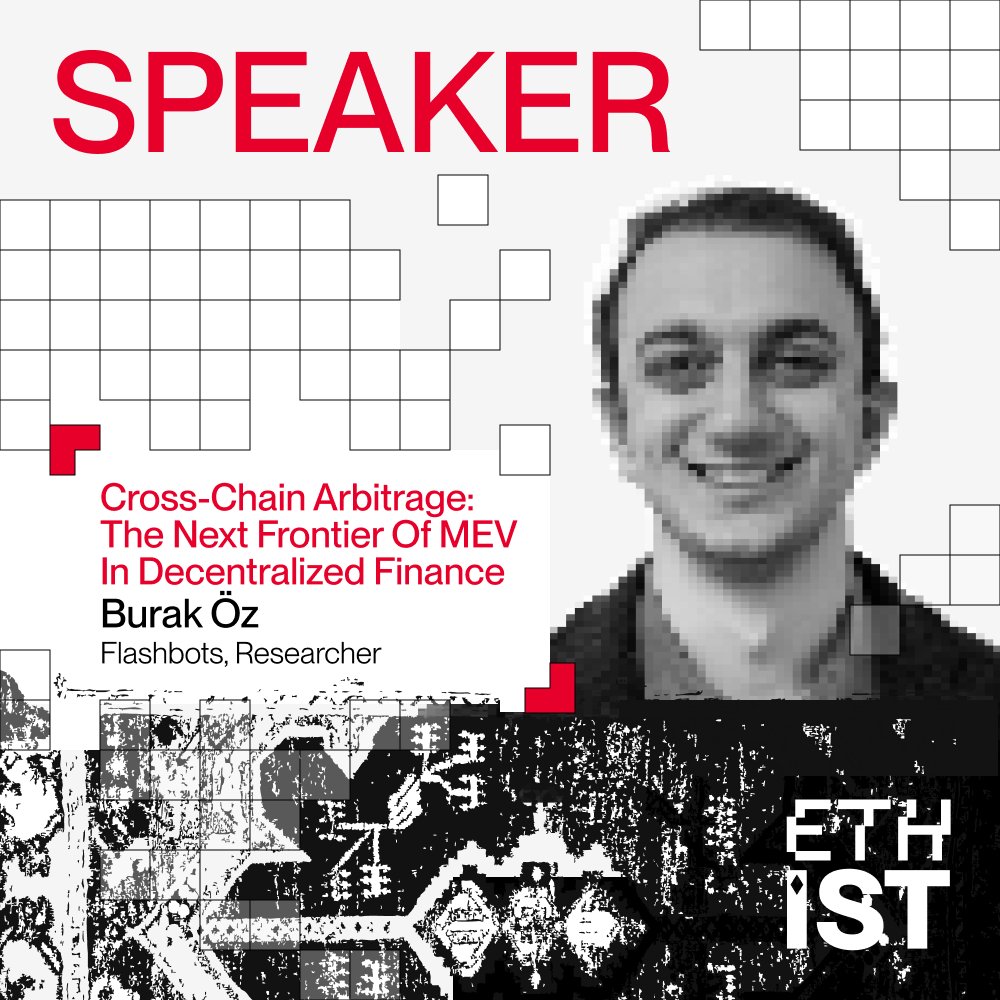
We’re excited to welcome @boez95, Researcher at Flashbots as a speaker at ETHIstanbul! 🎈
He’ll be talking about Cross-chain Arbitrage: The Next Frontier of MEV in Decentralized Finance, exploring how MEV opportunities evolve in a multi-chain world.
Meet him in Istanbul! 👋
1
6
41
1,829
Mark Simkin retweeted

13 Aug 2025
After 2 years of summarizing 1000s of publications, The MEV Letter is evolving into its next phase.
Together with Edition #100, we’re launching 𝙏𝙝𝙚 𝙈𝙀𝙑 𝙇𝙚𝙩𝙩𝙚𝙧 𝙀𝙭𝙥𝙡𝙤𝙧𝙚𝙧 – transforming the entire archive into an interactive interface.
Quick TLDR 👇
1/8
14
50
171
32,942
Mark Simkin retweeted
8 Aug 2025
Talks are up [esp for folks in other geographies :)]
Also including a link to a geographic decentralisation panel at MEV SBC which I thoroughly enjoyed
1 Aug 2025

A critical part of the crypto mission is building global systems that can stretch across trust boundaries and unlock surplus doing so
CR and credible neutrality are key
How can we build systems that don’t end up concentrated in one country or region?
lu.ma/geodecentralization?
1
10
27
10,537
Mark Simkin retweeted

7 Aug 2025
News from #aarhuskrypto! Welcome to Mark Simkin who joins the group as an assistant professor, Valerio Coletti as a PhD student, and congrats to our previous postdoc Hiraku Morita who is now an assistant professor at SDU. aarhuskrypto.dk
2
3
28
1,480
Mark Simkin retweeted
31 Jul 2025
Interested in censorship-resistance, scalability, and anonymity in blockchain p2p layers? Come hang out and discuss at NoConsensus .wtf @ SBC on the evening of Monday Aug 4th! Event link below!
8
15
45
8,023

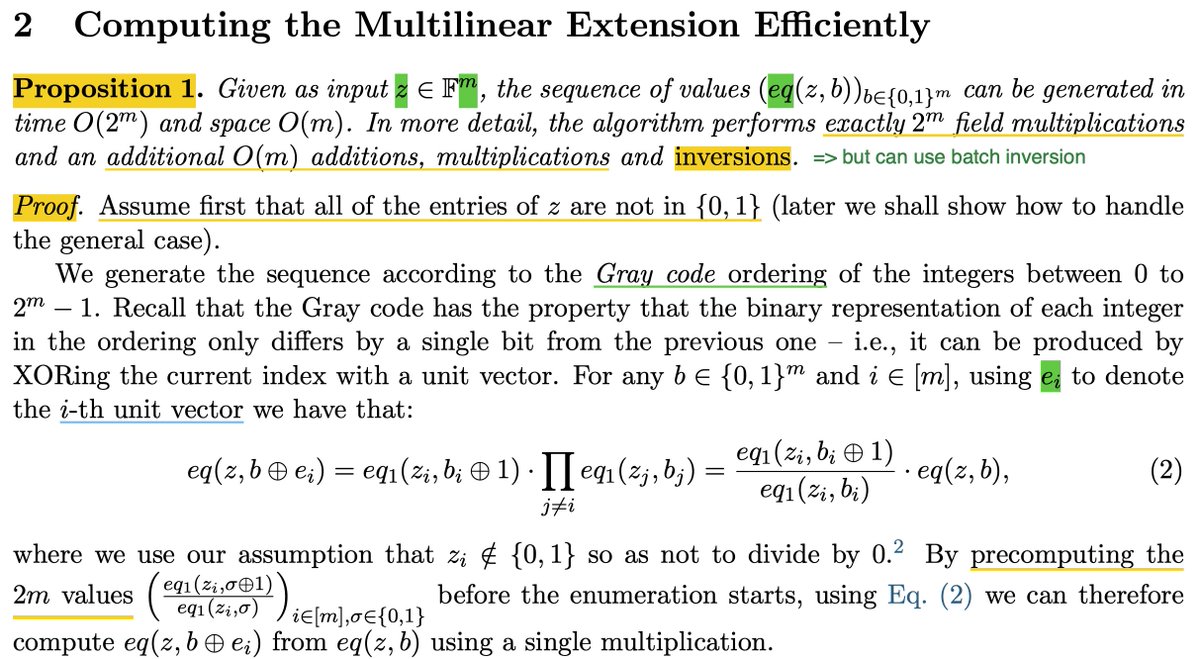
TIL from @ronrothblum that you can compute all n Lagrange eq(x, i)'s in n ~\log_2{n} field multiplications (and an inversion) as opposed to 2n👇
7
8
36
3,369
Mark Simkin retweeted

29 Jul 2025
The Agenda for MEV-SBC'25 is live!
📍Aug 7 @ Berkeley
This annual workshop highlights MEV research and talks to illuminate a new round of problems for the community to explore in cryptography, mechanism design, data, consensus, incentives, and their intersections

ALT MEV-SBC'25 Agenda
23
22
104
24,290