
Tenacious news curator and incisive commentator championing evidence-based journalism and social justice with razor-sharp analysis against disinformation.
Joined November 2008
- Tweets 185,552
- Following 58,367
- Followers 101,477
- Likes 239,649
18,914 Photos and videos


Pinned Tweet

1 Mar 2025
Listen up, people! The jaw-dropping tale of how Trump clawed his way into the White House, riding a tidal wave of Russian cash, is one that’ll blow your mind—and it’s a story EVERYONE needs to hear, loud and clear!
728
13,491
23,996
1,182,923
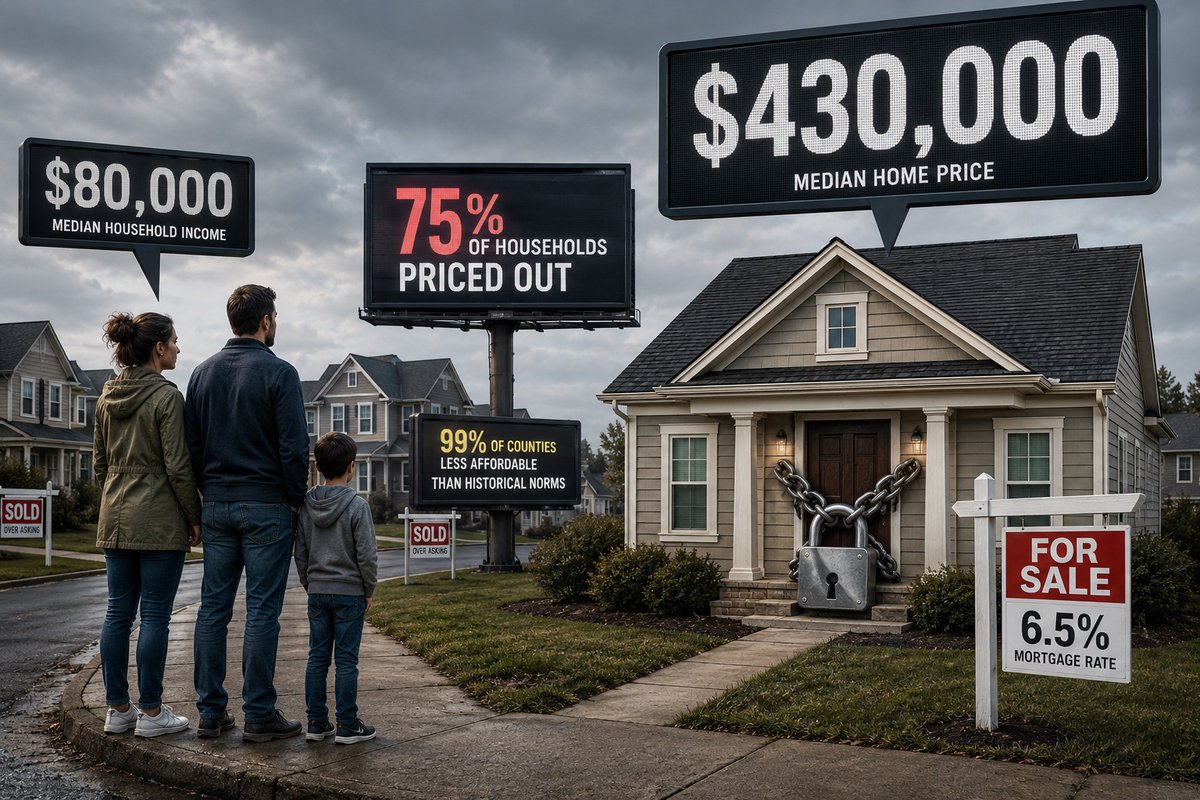
🏠 SKYLINE REPORT: America's Housing Crisis Is Near Record-Worst Levels
Housing affordability is now near the worst level ever recorded.
Harvard's Joint Center for Housing Studies says affordability is at its second-lowest point since 1952.
The National Association of Realtors' affordability index shows conditions became even worse than the 2006 housing bubble and remain near record lows today.
The consequences are brutal:
• About 75% of U.S. households cannot afford a median-priced new home at current mortgage rates.
• Existing-home sales are running near 30-year lows.
• Homes are less affordable than historical norms in 99% of U.S. counties analyzed.
• Mortgage rates have more than doubled from pandemic lows, dramatically increasing monthly payments.
Meanwhile, on January 29, President Trump told his Cabinet:
"I don't wanna drive housing prices down, I wanna drive housing prices up."
His argument was that existing homeowners should see their property values rise.
The problem is that every dollar added to home prices pushes ownership further out of reach for millions of Americans already locked out of the market.
This isn't just a housing slowdown.
It's one of the worst affordability crises of the modern housing era.
1
4
2
273
Receipts:
1. Harvard Joint Center for Housing Studies, The State of the Nation's Housing 2025
jchs.harvard.edu/sites/defau…
2. Statista / National Association of Realtors Housing Affordability Index
statista.com/statistics/2015…
3. National Association of Home Builders, Priced-Out Affordability Analysis
nahb.org/blog/2025/03/priced…
4. ATTOM Q3 2025 Home Affordability Report
attomdata.com/news/market-tr…
5. National Association of Realtors Existing Home Sales Data
nar.realtor/newsroom/nar-exi…
6. USA Today, Trump says he wants housing prices to rise
usatoday.com/story/news/poli…
189
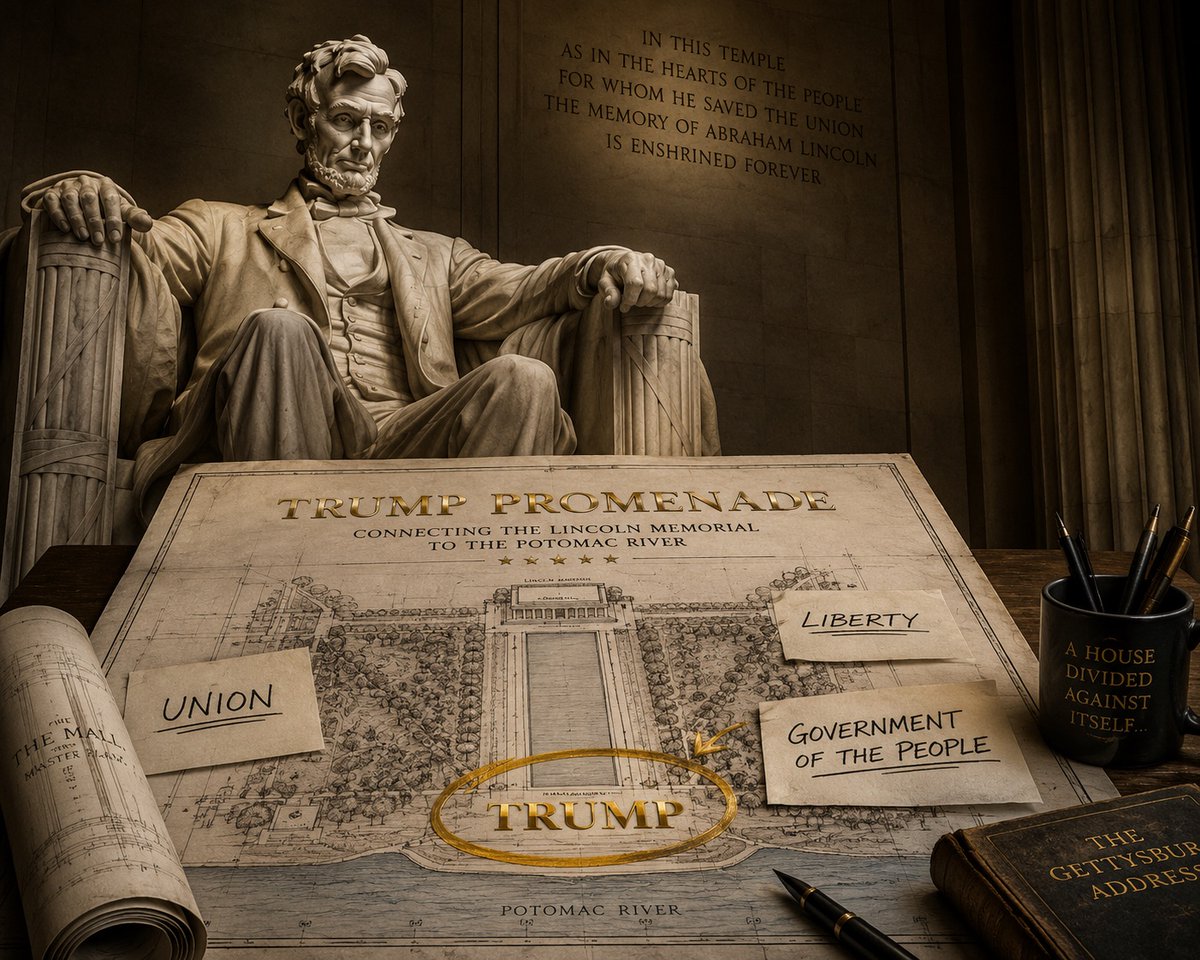
BREAKING: Trump announced plans for a new promenade connecting the Lincoln Memorial and Reflecting Pool area to the Potomac River.
During the announcement, he floated a possible name:
"They want to call it the Trump Promenade, but I don't know if I want to do that."
Notice the construction.
Not "I want to name it after myself."
Not "Congress named it after me."
Just the familiar "they want..." framing, where the idea appears in public attached to his name while he performs reluctance.
To be precise, no reporting identifies who "they" are.
But the result is the same: the project is now widely being discussed as the "Trump Promenade."
Public infrastructure. Public land. Public money.
Private branding.
Receipts in reply. 👇
14
32
61
2,191
RECEIPTS
[1] Reuters
Trump to build Lincoln Memorial promenade as part of Washington beautification plan
reuters.com/world/us/trump-s…
[2] ABC News
Trump announces plan to add 'promenade' to Lincoln Memorial
abcnews.go.com/Politics/trum…
[3] ABC7 New York
Trump announces plan to add 'promenade' to Lincoln Memorial
abc7ny.com/post/trump-announ…
[4] The Hill
Trump unveils plan for Lincoln Memorial promenade
thehill.com/homenews/adminis…
[5] New York Times
Trump Plans to Create a Promenade at the Lincoln Memorial
nytimes.com/2026/06/04/us/po…
[6] KTXS
'Trump Promenade'? President teases plan for new public walkway near Lincoln Memorial
ktxs.com/news/nation-world/t…
5
3
603
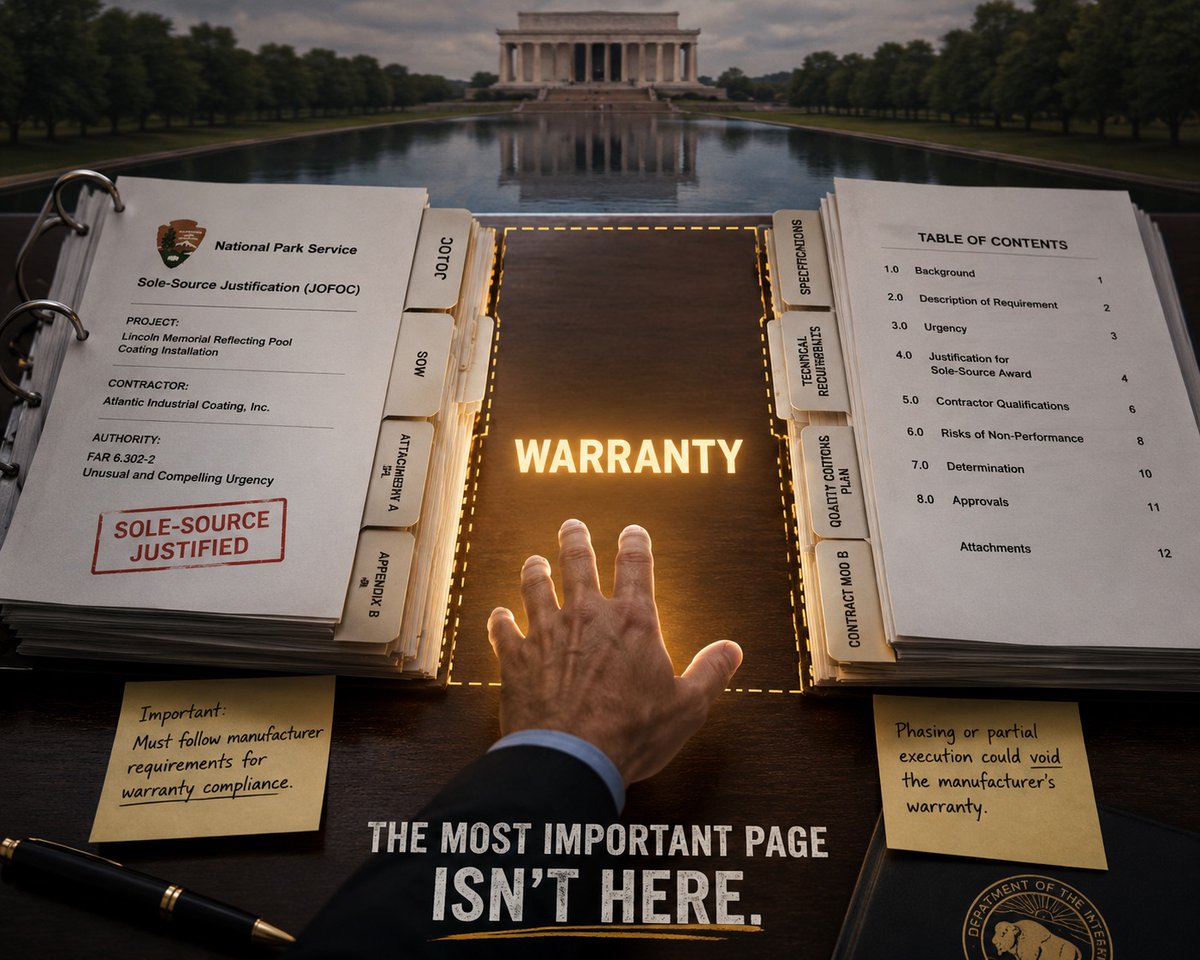
One detail buried in the Reflecting Pool no-bid paperwork deserves more attention.
NPS repeatedly argues that the Rhino coating system must be installed in a very specific way because improper sequencing or partial execution could void the manufacturer's warranty. The contractor must also perform manufacturer-required testing for "warranty compliance."
In other words, the warranty is important enough to help justify waiving competition.
But the public never sees the warranty itself.
The JOFOC tells us the warranty exists. It tells us installation decisions are being driven by warranty requirements. It tells us losing the warranty would be a significant risk.
What it does not tell us is the length of the warranty, what failures are covered, what remedies exist, or what protection taxpayers actually receive if the coating blisters, delaminates, leaks, or develops algae problems.
That's an odd imbalance.
We can read pages explaining why competition had to be waived. We can read pages explaining why only a narrow set of contractors can do the work.
But the performance promise being relied upon to manage the risk remains somewhere in the contract specifications and manufacturer documents that were not included with the public justification.
If this coating performs flawlessly, nobody will care.
If it fails, the most important document won't be the JOFOC.
It will be the warranty.
7
51
111
2,460
Receipts:
1. National Park Service sole-source justification for the Lincoln Memorial Reflecting Pool coating project. The document states that the contractor must perform manufacturer-required testing for "warranty compliance" and warns that phasing or partial execution could void the manufacturer's warranty.
sam.gov/workspace/contract/o…
2. The New York Times reported on the administration's no-bid contract to install a blue polyurea coating system in the Lincoln Memorial Reflecting Pool.
nytimes.com/2026/05/08/us/po…
3
11
564
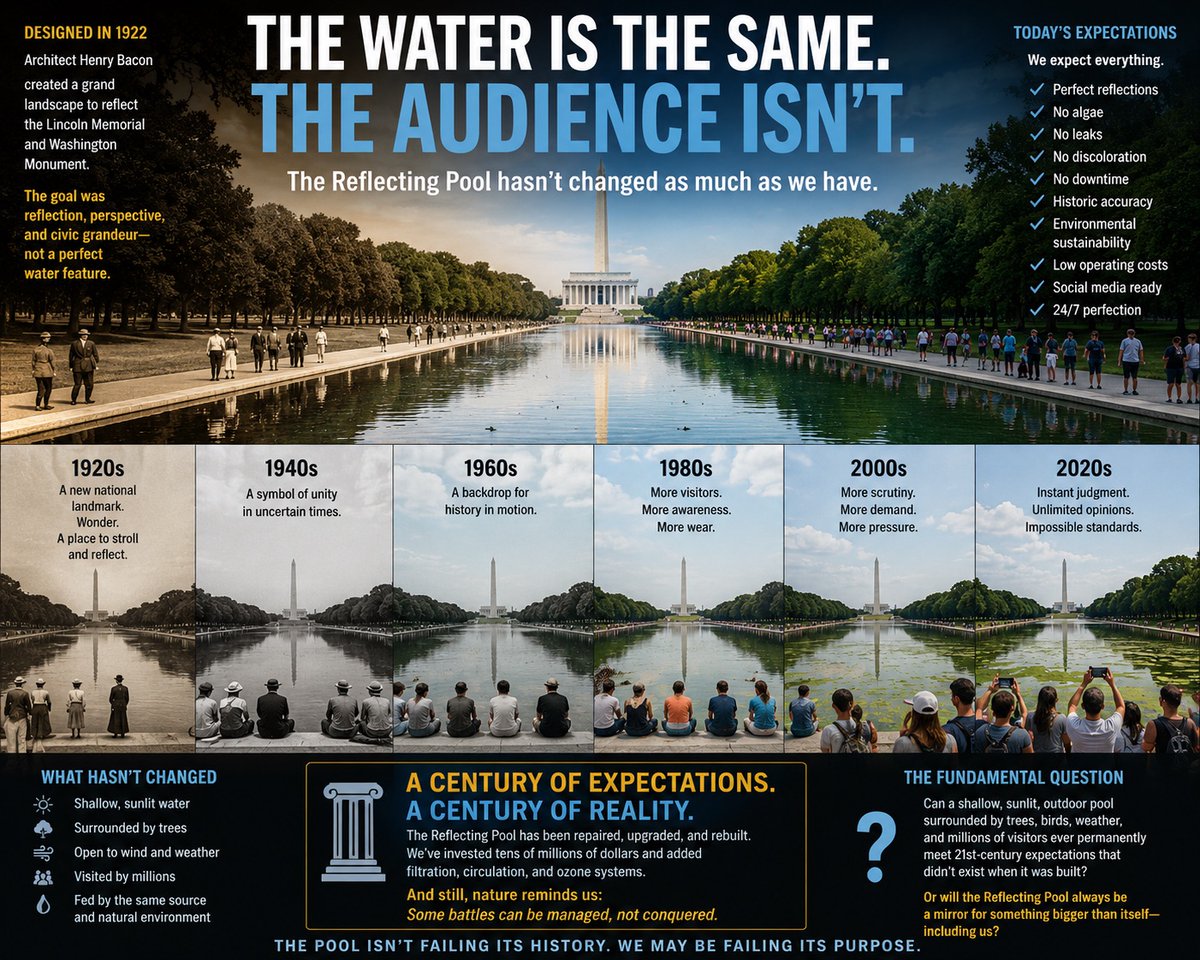
What if the Reflecting Pool isn't failing?
What if our expectations are?

FUN FACT:
The Reflecting Pool isn't changing nearly as much as we are.
When it opened in 1922, architect Henry Bacon's goal was to create a grand visual connection between the Lincoln Memorial and Washington Monument.
It was a landscape feature.
A reflection.
A civic space.
It was not designed to be a perfectly clear, algae-free, maintenance-free water feature scrutinized by millions of people online.
Over the last century, we've quietly changed the requirements.
Today we expect:
• Perfect reflections
• No algae
• No leaks
• No discoloration
• No downtime
• Historic authenticity
• Environmental sustainability
• Low operating costs
And we expect all of that simultaneously.
The pool hasn't stood still.
It has received major repairs, new circulation systems, filtration upgrades, waterproofing, ozone treatment, reconstruction, resurfacing, and millions upon millions of dollars in investment.
Yet algae still appears.
Why?
Because some of our expectations may be fighting physics, biology, and the original design itself.
The question isn't whether the Reflecting Pool can be improved.
The question is whether a shallow, sunlit, outdoor pool surrounded by trees, birds, weather, and millions of visitors can ever permanently satisfy 21st-century expectations that didn't exist when it was built.
A century later, we may be judging the pool less by what it was designed to be than by what we wish it could become.
2
2
5
694
A century later, are we asking this thing to be something it was never designed to be?
4
361
FUN FACT:
The Reflecting Pool isn't changing nearly as much as we are.
When it opened in 1922, architect Henry Bacon's goal was to create a grand visual connection between the Lincoln Memorial and Washington Monument.
It was a landscape feature.
A reflection.
A civic space.
It was not designed to be a perfectly clear, algae-free, maintenance-free water feature scrutinized by millions of people online.
Over the last century, we've quietly changed the requirements.
Today we expect:
• Perfect reflections
• No algae
• No leaks
• No discoloration
• No downtime
• Historic authenticity
• Environmental sustainability
• Low operating costs
And we expect all of that simultaneously.
The pool hasn't stood still.
It has received major repairs, new circulation systems, filtration upgrades, waterproofing, ozone treatment, reconstruction, resurfacing, and millions upon millions of dollars in investment.
Yet algae still appears.
Why?
Because some of our expectations may be fighting physics, biology, and the original design itself.
The question isn't whether the Reflecting Pool can be improved.
The question is whether a shallow, sunlit, outdoor pool surrounded by trees, birds, weather, and millions of visitors can ever permanently satisfy 21st-century expectations that didn't exist when it was built.
A century later, we may be judging the pool less by what it was designed to be than by what we wish it could become.
5
16
26
1,853
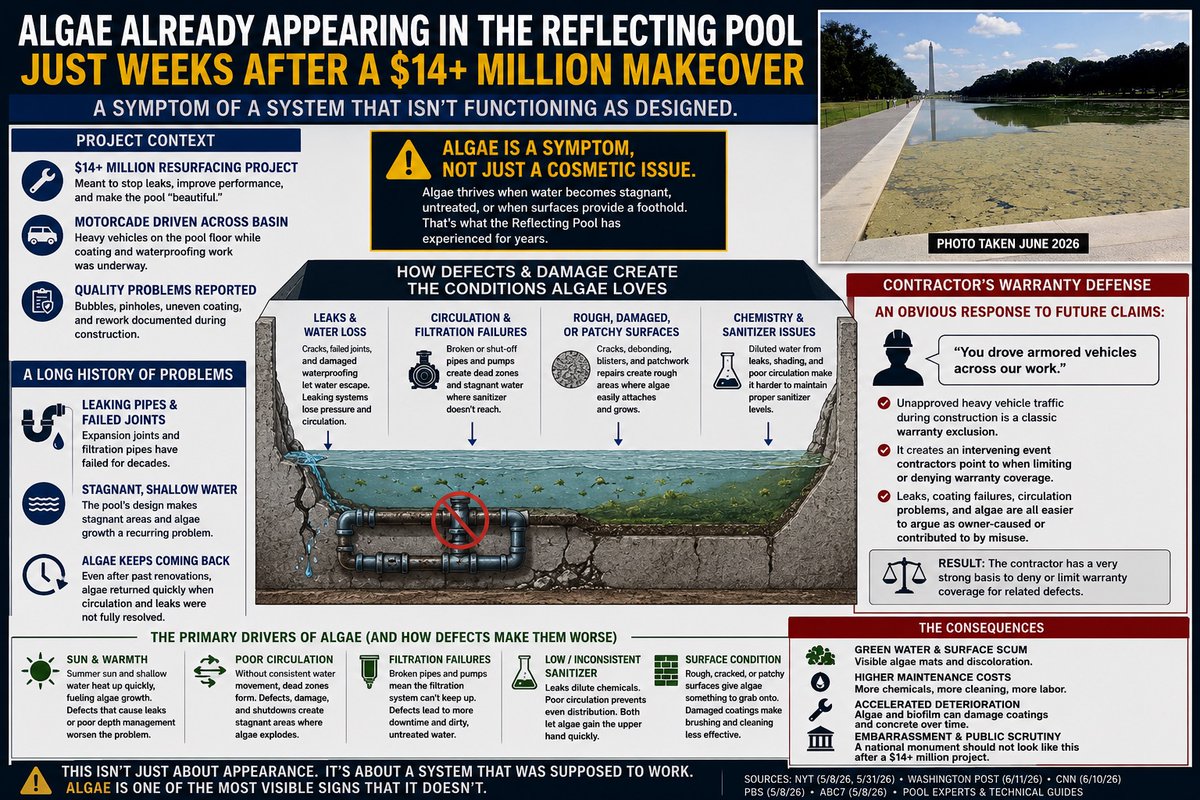
🚨 BREAKING
Just weeks after Trump's $14 million Reflecting Pool makeover, algae is already appearing in the water.
To be clear:
Algae isn't proof that the motorcade caused damage.
But algae is often a symptom of a system that isn't functioning as designed.
The Reflecting Pool has a long history of leaks, broken pipes, circulation failures, and stagnant water. Those conditions repeatedly produced algae blooms before the latest renovation.
That's what makes this development noteworthy.
The same project that was supposed to stop leaks and improve performance has already experienced documented reports of bubbles, pinholes, uneven coating, and rework during construction.
And we all watched a presidential motorcade drive across the basin while resurfacing work was underway.
Any contractor facing future questions about leaks, circulation problems, coating failures, or algae growth now has an obvious response:
"You drove armored vehicles across the work."
Whether that caused damage or not, it creates exactly the kind of intervening event contractors point to when limiting warranty responsibility.
The irony is difficult to miss.
A project sold as a fast fix for chronic water-management problems is now showing one of the most visible warning signs of poor circulation and stagnant conditions:
Algae.
4
43
77
1,581
Receipts:
• Washington Post: Algae has already appeared in portions of the newly renovated Reflecting Pool despite the recent resurfacing project.
washingtonpost.com/style/pow…
• CNN: Reported "residual algae" appearing shortly after the renovated pool reopened.
cnn.com/2026/06/10/politics/…
• New York Times: The Reflecting Pool has a long history of leaks, broken pipes, circulation failures, and algae problems associated with stagnant water and system performance issues.
nytimes.com/interactive/2026…
• New York Times: Previous reporting documented concerns about leaks, failed seals, piping issues, and water-management problems that have plagued the pool for years.
nytimes.com/2026/05/08/us/po…
• CNN, ABC7, and PBS documented Trump's motorcade driving across the drained basin while resurfacing work was underway.
cnn.com/2026/05/08/politics/…
abc7.com/post/trump-motorcad…
pbs.org/newshour/politics/tr…
2
6
15
471
Jun 12
🚨 BREAKING: Internal Interior Department and National Park Service documents reportedly show bubbles, pinholes, and uneven blue coating emerging during Trump's rushed Lincoln Memorial Reflecting Pool renovation.
The stated purpose of the project was to stop leaks.
But officials reportedly documented defects in the waterproofing layer itself:
• Bubbles and trapped air
• Pinholes and small holes
• Uneven, mottled blue coating
• Sections requiring rework
That's not just an aesthetic issue.
Pinholes and blistering are exactly the kinds of defects that can compromise a waterproofing system and shorten its lifespan.
The administration sold this as a fast, beautiful fix.
The documents reportedly show crews scrambling to correct quality problems while racing to meet a politically driven deadline.
A project intended to stop leaks was reportedly battling defects in the leak-prevention layer before it was even finished.
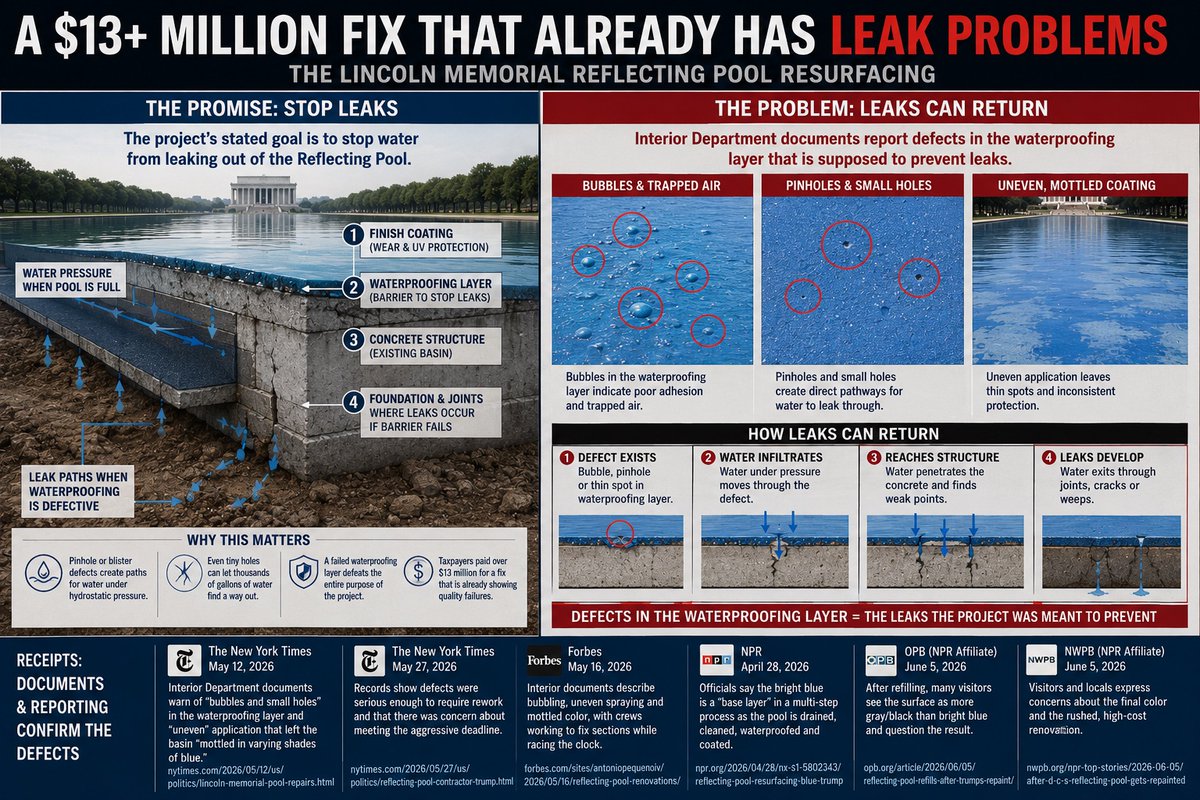
107
941
1,975
432,061
Jun 12
Receipts:
• New York Times: Internal Interior Department records reportedly documented bubbles, small holes, uneven coating application, and concerns about schedule pressure during the Reflecting Pool renovation.
nytimes.com/2026/05/12/us/po…
• New York Times: Follow-up reporting described quality-control concerns, rework requirements, and questions surrounding project execution and costs.
nytimes.com/2026/05/27/us/po…
• Forbes: Reporting summarized Interior documents describing bubbling, uneven application, mottled coloration, and contractor efforts to address defects while maintaining the project's timeline.
forbes.com/sites/antoniopequ…
• NPR: Officials described the bright blue coating as part of a multi-step process and acknowledged ongoing work as the resurfacing project progressed.
npr.org/2026/04/28/nx-s1-580…
• NPR affiliate coverage after refilling documented continued public scrutiny of the final appearance and color of the renovated pool.
opb.org/article/2026/06/05/r…
nwpb.org/npr-top-stories/202…
4
86
250
20,199
Did Trump cause the new defects, or did he just hand the contractor the perfect excuse to deny responsibility for them?
x.com/SkylineReport/status/2…
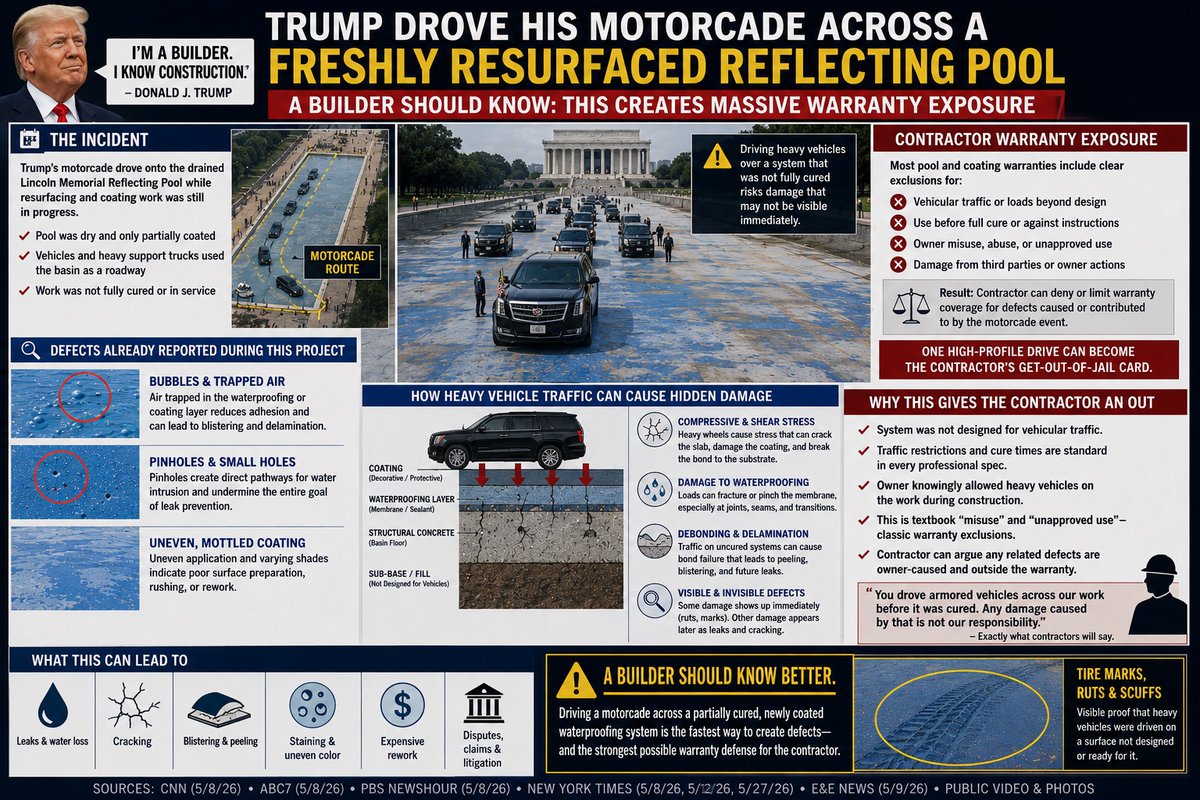
🚨 BREAKING
Trump drove his motorcade across the drained Lincoln Memorial Reflecting Pool while resurfacing work was still underway.
As someone who constantly reminds us he's a "builder," he should have known exactly what that means.
If leaks, blisters, delamination, cracking, or coating failures appear later, the contractor now has an obvious response:
"You drove armored vehicles across our work."
That's not a political argument.
That's a warranty argument.
Pool coatings and waterproofing systems typically come with cure requirements, traffic restrictions, and exclusions for owner-caused damage.
In construction, documented heavy vehicle traffic on a freshly resurfaced system is the kind of thing contractors point to when they deny warranty claims.
The irony is hard to miss.
A project intended to stop leaks now has documented coating defects.
And the owner created a highly public record of driving a motorcade across the very surface that was supposed to keep the water in.
1
6
10
509
🚨 BREAKING
Trump drove his motorcade across the drained Lincoln Memorial Reflecting Pool while resurfacing work was still underway.
As someone who constantly reminds us he's a "builder," he should have known exactly what that means.
If leaks, blisters, delamination, cracking, or coating failures appear later, the contractor now has an obvious response:
"You drove armored vehicles across our work."
That's not a political argument.
That's a warranty argument.
Pool coatings and waterproofing systems typically come with cure requirements, traffic restrictions, and exclusions for owner-caused damage.
In construction, documented heavy vehicle traffic on a freshly resurfaced system is the kind of thing contractors point to when they deny warranty claims.
The irony is hard to miss.
A project intended to stop leaks now has documented coating defects.
And the owner created a highly public record of driving a motorcade across the very surface that was supposed to keep the water in.
83
979
2,159
74,485
Receipts:
• CNN: Trump toured the drained Reflecting Pool and drove his motorcade onto the basin during the resurfacing project.
cnn.com/2026/05/08/politics/…
• ABC7: Video and reporting show multiple vehicles driving onto the Reflecting Pool during coating operations.
abc7.com/post/trump-motorcad…
• PBS NewsHour: Reporting confirms Trump drove across the drained Reflecting Pool to inspect the blue resurfacing work.
pbs.org/newshour/politics/tr…
• E&E News: Coverage of the project notes the resurfacing involved waterproofing and coating systems rather than a full reconstruction.
eenews.net/articles/lawsuit-…
• New York Times: Reporting documented project delays, coating issues, and quality-control concerns during construction.
nytimes.com/2026/05/12/us/po…
nytimes.com/2026/05/27/us/po…
2
49
111
5,297
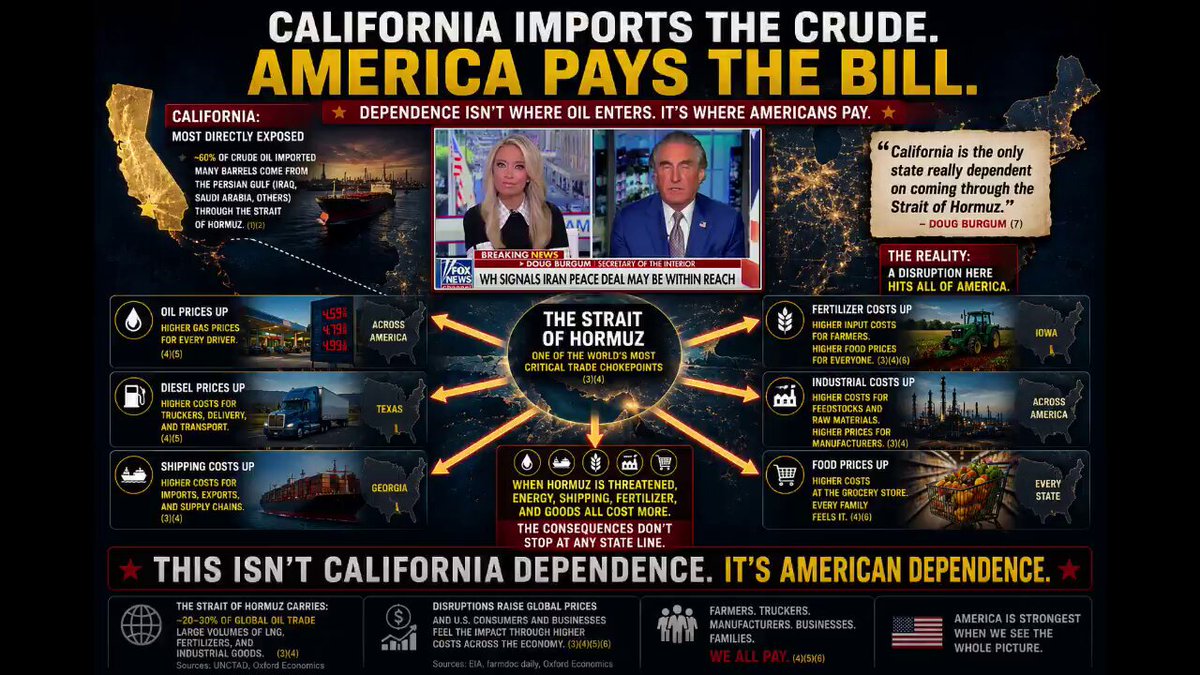
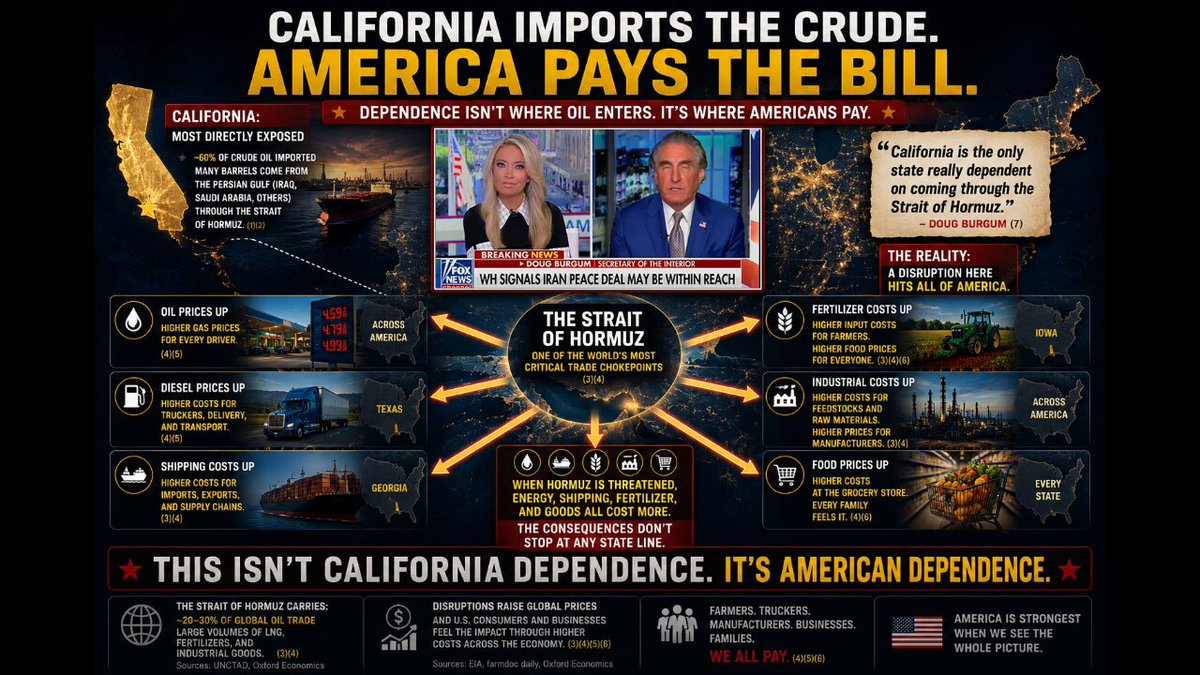
Doug Burgum says California is the only state "really dependent" on the Strait of Hormuz.
That's true only if you define dependence as the moment crude oil enters a California refinery.
But that's not where Americans feel the consequences.
California may be the most directly exposed state because of its crude import mix.
Fair enough.
But a Hormuz disruption doesn't stop at California's border.
If fertilizer prices spike, Iowa notices.
If diesel prices spike, Texas notices.
If shipping costs spike, Georgia notices.
If food prices spike, everyone notices.
The Strait of Hormuz isn't just an oil route.
It's one of the most important trade chokepoints on Earth.
When energy flows are disrupted, transportation costs rise.
When transportation costs rise, goods become more expensive.
When fertilizer costs rise, food becomes more expensive.
When shipping costs rise, businesses and consumers pay more.
That's how global markets work.
So California may be the most directly exposed.
But Americans everywhere are economically exposed.
The real question isn't whether California depends on Hormuz.
It's why Burgum measures dependence only where crude enters a refinery instead of where Americans actually feel the costs.
Receipts below. 👇
1
7
10
538
Receipts
[1] California Energy Commission. Foreign Sources of Crude Oil Imports to California.
energy.ca.gov/data-reports/e…
[2] University of California Irvine Energy Observer. Saudi and Persian Gulf Oil Among US and California Oil Imports.
sites.uci.edu/energyobserver…
[3] UNCTAD. Strait of Hormuz disruptions: Implications for global trade and development.
unctad.org/publication/strai…
[4] Oxford Economics. Iran and the Strait of Hormuz: Risks to Global Energy Prices.
oxfordeconomics.com/resource…
[5] U.S. Energy Information Administration (EIA). How much petroleum does the United States import and export?
eia.gov/tools/faqs/faq.php?i…
[6] farmdoc daily, University of Illinois. The Strait of Hormuz: Why Global Trade Dependency Turns a Localized Conflict into a Global Crisis.
farmdocdaily.illinois.edu/20…
[7] E&E News. Burgum calls California, New England a "national security risk."
eenews.net/articles/burgum-c…
Key takeaway:
California may be the most directly exposed to a disruption in Strait of Hormuz crude flows.
But when Hormuz disruptions raise energy, fertilizer, shipping, and food costs, the consequences don't stop at California's border.
Farmers, truckers, manufacturers, businesses, and families across America pay the price.
3
416
Doug Burgum says California is the only state "really dependent" on the Strait of Hormuz.
That's true only if you define dependence as the moment crude oil enters a California refinery.
But that's not where Americans feel the consequences.
California may be the most directly exposed state because of its crude import mix.
Fair enough.
But a Hormuz disruption doesn't stop at California's border.
If fertilizer prices spike, Iowa notices.
If diesel prices spike, Texas notices.
If shipping costs spike, Georgia notices.
If food prices spike, everyone notices.
The Strait of Hormuz isn't just an oil route.
It's one of the most important trade chokepoints on Earth.
When energy flows are disrupted, transportation costs rise.
When transportation costs rise, goods become more expensive.
When fertilizer costs rise, food becomes more expensive.
When shipping costs rise, businesses and consumers pay more.
That's how global markets work.
So California may be the most directly exposed.
But Americans everywhere are economically exposed.
The real question isn't whether California depends on Hormuz.
It's why Burgum measures dependence only where crude enters a refinery instead of where Americans actually feel the costs.
Receipts below. 👇
3
6
14
487
Receipts
[1] California Energy Commission. Foreign Sources of Crude Oil Imports to California.
energy.ca.gov/data-reports/e…
[2] University of California Irvine Energy Observer. Saudi and Persian Gulf Oil Among US and California Oil Imports.
sites.uci.edu/energyobserver…
[3] UNCTAD. Strait of Hormuz disruptions: Implications for global trade and development.
unctad.org/publication/strai…
[4] Oxford Economics. Iran and the Strait of Hormuz: Risks to Global Energy Prices.
oxfordeconomics.com/resource…
[5] U.S. Energy Information Administration (EIA). How much petroleum does the United States import and export?
eia.gov/tools/faqs/faq.php?i…
[6] farmdoc daily, University of Illinois. The Strait of Hormuz: Why Global Trade Dependency Turns a Localized Conflict into a Global Crisis.
farmdocdaily.illinois.edu/20…
[7] E&E News. Burgum calls California, New England a "national security risk."
eenews.net/articles/burgum-c…
Key takeaway:
California may be the most directly exposed to a disruption in Strait of Hormuz crude flows.
But when Hormuz disruptions raise energy, fertilizer, shipping, and food costs, the consequences don't stop at California's border.
Farmers, truckers, manufacturers, businesses, and families across America pay the price.
3
369
Doug Burgum says California is the only state "really dependent" on the Strait of Hormuz.
That's true only if you define dependence as the moment crude oil enters a California refinery.
But that's not where Americans feel the consequences.
California may be the most directly exposed state because of its crude import mix.
Fair enough.
But a Hormuz disruption doesn't stop at California's border.
If fertilizer prices spike, Iowa notices.
If diesel prices spike, Texas notices.
If shipping costs spike, Georgia notices.
If food prices spike, everyone notices.
The Strait of Hormuz isn't just an oil route.
It's one of the most important trade chokepoints on Earth.
When energy flows are disrupted, transportation costs rise.
When transportation costs rise, goods become more expensive.
When fertilizer costs rise, food becomes more expensive.
When shipping costs rise, businesses and consumers pay more.
That's how global markets work.
So California may be the most directly exposed.
But Americans everywhere are economically exposed.
The real question isn't whether California depends on Hormuz.
It's why Burgum measures dependence only where crude enters a refinery instead of where Americans actually feel the costs.
Receipts below. 👇
4
10
16
639
Receipts
[1] California Energy Commission. Foreign Sources of Crude Oil Imports to California.
energy.ca.gov/data-reports/e…
[2] University of California Irvine Energy Observer. Saudi and Persian Gulf Oil Among US and California Oil Imports.
sites.uci.edu/energyobserver…
[3] UNCTAD. Strait of Hormuz disruptions: Implications for global trade and development.
unctad.org/publication/strai…
[4] Oxford Economics. Iran and the Strait of Hormuz: Risks to Global Energy Prices.
oxfordeconomics.com/resource…
[5] U.S. Energy Information Administration (EIA). How much petroleum does the United States import and export?
eia.gov/tools/faqs/faq.php?i…
[6] farmdoc daily, University of Illinois. The Strait of Hormuz: Why Global Trade Dependency Turns a Localized Conflict into a Global Crisis.
farmdocdaily.illinois.edu/20…
[7] E&E News. Burgum calls California, New England a "national security risk."
eenews.net/articles/burgum-c…
Key takeaway:
California may be the most directly exposed to a disruption in Strait of Hormuz crude flows.
But when Hormuz disruptions raise energy, fertilizer, shipping, and food costs, the consequences don't stop at California's border.
Farmers, truckers, manufacturers, businesses, and families across America pay the price.
2
380